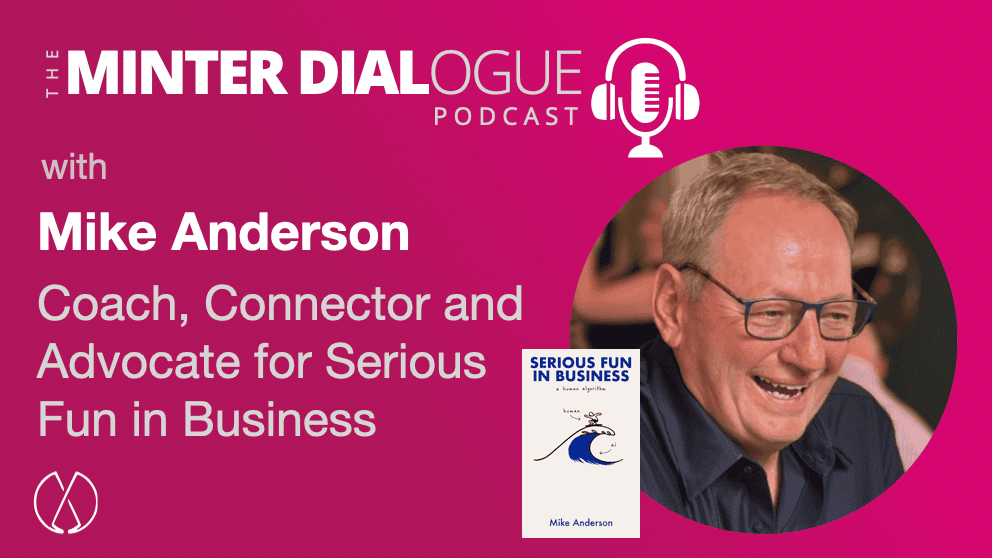
Minter Dialogue with Mike Anderson
Mike’s recent book, *Serious Fun in Business: A Human Algorithm*, distils decades of leadership experience into practical lessons, quirky stories, and actionable strategies. Our discussion traversed topics from the power of storytelling, surviving life-altering challenges, and bridging the gap between professional and personal selves, to the criticality of humour and instinct in modern leadership. Above all, the conversation reinforced the principle that enjoying the journey—and remembering to remain human—adds value for both individuals and organisations.
3 Key Points:
- The Human Algorithm Matters: The conversation focused on how balancing instinct and data is crucial in today’s business landscape. Drawing on past transitions—from print to digital, desktop to mobile, and now into AI—Mike argued that human qualities such as instinct and empathy remain vital for navigating complex decisions and building resilient teams.
- Leadership Is About Storytelling and Connection: One concept discussed was the value of stories in coaching and leadership. Mike builds “libraries” of stories from his career, using them to help leaders make sense of challenges and foster learning. The discussion explored the unique impact of approaching leadership as both a coach and connector, creating more meaningful professional relationships.
- Serious Fun and Authenticity: A key theme that emerged was the role of humour and authenticity in business. Several points were raised, including the importance of bringing personal sensibilities to work, cultivating gratitude in tough times, and not becoming buffeted by external pressures. Being “seriously fun” means engaging wholeheartedly while refusing to take oneself too seriously.
Other mentions/sites:
- London Scottish RFC here
Further resources for the Minter Dialogue podcast:

Meanwhile, you can find my other interviews on the Minter Dialogue Show in this podcast tab, on my Youtube Channel, on Megaphone or via Apple Podcasts. If you like the show, please go over to rate this podcast via RateThisPodcast! And for the francophones reading this, if you want to get more podcasts, you can also find my radio show en français over at: MinterDial.fr, on MegaphoneFR or in iTunes. And if you’ve ever come across padel, please check out my Joy of Padel podcast, too!
Music credit: The jingle at the beginning of the show is courtesy of my friend, Pierre Journel, author of the Guitar Channel. And, the new sign-off music is “A Convinced Man,” a song I co-wrote and recorded with Stephanie Singer back in the late 1980s (please excuse the quality of the sound!).
Full transcript via Castmagic.io
Transcription courtesy of Castmagic.io, an AI full-service for podcasters
Minter Dial: Mike Anderson, great to have you on the show. I saw you had published a book, and I said, oh my gosh, Serious Fun in Business: A Human Algorithm and a Reason to Get Back in Touch. Mike, in your own words, who are you?
Mike Anderson: So, I’m Mike, I’m large, I’m Scottish. I, today I present myself as somebody who does 2 things. I coach and I connect. And that narrative is backed up by 20 years of being in Fleet Street in a world, in fact, that lived purely by instinct. There was no science, there was no data in those days.
Minter Dial: There was a lot of flair and bravado.
Mike Anderson: Correct, right? And instinct. And then I moved from that into a world of entrepreneurship, a tech startup. And the world suddenly became full of data science. And I started building applications for businesses that were full of customer data and insight and understanding and customer-facing propositions. And it was just a sea of this science, which I enjoyed and saw that that was a very powerful thing. But also, I concluded, or I conclude at this point, particularly with the transition of AI, that by default I’d lived through already what I would call 2 transitions. I’d lived through a print-to-digital transition. I’d lived through a desktop-to-mobile transition. And here we were in another wave. And I thought the best thing I can do here is, if you like, give people some insight into the value of instinct and data, and not to forget your instinct in a world of science and data, because actually those things still matter and will matter more and more going forward. And also a concern about some of the people I’m coaching and their human skills, because the world is changing the way that we interact and so on and so forth. And I think there’s a lot of advantage people can gain by homing in on what I’m calling the human algorithm. So, that sort of led to Serious Fun in Business: A Human Algorithm because the underlying message is whatever you’re doing, make sure you’re enjoying it and remember to be human.
Minter Dial: When you said yourself, you’re a coach and a connector, it just struck me, Mike, that that might also be what most leaders should be, a coach and a connector.
Mike Anderson: Yeah, exactly. And the things that people remember you for as a leader, or the things that I remembered in writing this book, because it’s interesting, the lessons you learn, Minter, in reflection. And doing this is quite a good exercise because you’re looking at 40 years and I’m remembering moments and conversations. And then reflecting that, my God, there was a really good lesson in that conversation that I didn’t necessarily felt I was having in that moment. But as I reflect, it was very insightful what that person may have said, how that meeting may have gone, where our thinking was about where the world might go to in terms of the sectors I was in. And, uh, it’s just nice to have that library and that catalogue and therefore be able to use those as a way to tell stories. But then point to lessons within those storeys that may be useful. Because I found when I’m coaching leaders, I found myself using these storeys as ways to deal with some of the conversations we were having and saying, oh, I’ve seen this before. Let me tell you a storey, right? And those people that know me will say, oh yeah, I don’t— 2 things people say is You haven’t had one of those cups of tea with Mike, have you? Okay, because I also do a lot of stuff about let’s have a cup of tea, make it warm and friendly. And the second bit was I found those storeys, I would watch people’s reactions to those storeys and that I would score them mentally and think that’s a good storey, that works well as a scenario, as an explanation, as an example. And so, I kept writing down the headings of those and found myself with about 50 storeys, Minter, right? And I thought, actually, I think I’ve got a book. So, I’ve got a construct, I’ve got a book, I’ve got this material I can use in a way that hopefully in writing it will be engaging for people. And the reviews we’ve received have been, you know, say that very much about it. They say this is a great fun read. It’s quite quirky, it’s fun, and there are some useful tips. And that’s what I wanted it to be.
Minter Dial: In the way that you described it, you know, the storey or the event that happened, you didn’t pick it up at the time, but you pick it up later. I can relate that very much to how I went back and saw how I pivoted. but not necessarily explicitly.
Mike Anderson: Yes.
Minter Dial: Things changed, and then I wake up all of a sudden, I realise that that was when it began. And for me, I know that that materially happened, the biggest change in my life happened watching the 11th of September happen in front of me. But it just feels, you write about how you lost your wife and all of a sudden became a single father. These moments, while you’re in them, they’re not that much fun.
Mike Anderson: No.
Minter Dial: And you’re just dealing, you’re surviving.
Mike Anderson: Yes.
Minter Dial: And then afterwards, you look back on it and you reflect back on it. It feels for me, Mike, that so many of us who have come to this position where there’s more to work than just money, there’s more to life than just work, that you often have to have some sort of life-changing event to have an aha.
Mike Anderson: Oh, yes. Yes.
Minter Dial: How do you relate to that? And do you think that it actually is possible for someone who’s listening to this who hasn’t had a life-altering experience? And what I’m talking about life-altering is you didn’t break your pinky finger. That is not life-altering.
Mike Anderson: Okay, look, let me say something to that. First of all, It, it, it’s good to reflect on what you— where you are and what you’re doing. What you realise is that life is a series of things you know nothing about, okay? You’re born, you know nothing about it. You learn to walk, you know nothing about it. You learn to speak, you know nothing about it. You have your first love, you know nothing about it, okay? Your first job, you know nothing about it. So, don’t be— everything is going to be something you know nothing about. And what you have to do in facing the difficult ones is remember you can— you, you, you were as hapless in learning to walk as you are in facing this challenge that’s in front of you, yet you managed to do it.
Minter Dial: Right.
Mike Anderson: And it’s actually a discussion I had with my late wife about— remember us once sitting, you know, on a balcony having a few whiskies and saying, hey, guess what, life’s a series of things. Actually, the language we use was, we know fuck all about, right? You know, and somehow that just made feel like it, it, it, it, it— you don’t wish it, but you don’t fear it. And you have to, you know, there’s many good things said about if you can see your first step, take it. And so, I, I think in, in reflection, they— I could list things and go, oh, woe is me. And but it was another moment, it was another thing you had to, to deal with, as you do today, you know. And one thing I also find quite interesting is, as you get older, people look back and, and to say to you, oh, when you, when you were in your pomp, and when you were in— and I get very annoyed with that. I go Listen, I’m in my pomp today as much as I was in my pomp and when I was 20 or 30 or 10, right? And I haven’t lost my pomp, right? I just deal with what life brings at this moment. And you know what hopefully I’ve been able to do is demonstrate an ability to deal with those things and then feeling that I somehow need to share that. because I feel this is a good, a good attitude, a good feeling, and I’m just sharing it. You can take, take and use it as you, as you like. But, um, and I think as well, actually, Minter, the funny thing is when you lose somebody like young, like I— Jane— there’s a bit of you comes fearless. There’s a bit of you that in those big moments you think, well, surely nothing worse can happen. Right? And you can be dangerous and reckless too, so you have to watch that. But you also— it’s a weird thing to say you can get strength from it, but you can go, well, hell, what next? You know, then of course what happens is you go through a process of thinking nothing worse can happen, and then you think, so nothing bad is going to happen going forward. And of course something bad does happen, and then you go, hey, Listen, haven’t you filled your cup with badness on me? Get off my back, right?
Minter Dial: Okay.
Mike Anderson: But, you know, you have to kind of, you know, it’s that thing in a business principle which I love about Amazon about day one. Every day is day one. Go back to day one. You know, in a lot of the coaching, it’s remember your first day in the job, that everything that you had in terms of ambition and desire and promise and vision for where you wanted to get to, right? And of course, you go through it and bits get knocked off you and you lose it a bit and you start to become disgruntled with it or whatever. But so, you’ve got to go to that day one mentality on, okay, here’s a shit situation, right? Here’s the day one mentality. What are we going to do now, right? And we’re going to deal with it.
Minter Dial: I want to get stuck into a few pieces around the book itself, but I enjoy the personal storeys here. And on balance, I’ve regularly said that there should not be a strong gap between your professional existence and your personal existence. To what extent did you think that that gap should have existed in your past? And today, to what extent do you think that there should be at least little gap between your personal and professional persona?
Mike Anderson: Yeah. Okay. I think I’m going to try to understand that question. Okay. In the sense that I was fortunate enough to be doing things I had a desire to do.
Minter Dial: Right?
Mike Anderson: I didn’t always enjoy the dynamics of some of the places I worked or businesses that I ran or businesses that I, you know, was involved in. But I generally enjoyed the sector I was in, let’s call it. I enjoyed media. I enjoyed tech. I enjoy coaching, right? So, that’s a sort of overlying thing. I enjoy being a father. I enjoy Now my kids now grown up and marrying and everything else.
Minter Dial: Congratulations.
Mike Anderson: And, you know, and, uh, I, I never really felt that any of it was a grind. So, I think I had a similar attitude at home, you know. Now, was I around enough early on? I talk about that in the book. No. You know, but then I had a partner who wanted to play that role, you know, and, and, and, and be the mom she wanted to be. And it wasn’t— I don’t remember us being particularly, you know, like you’ll never hear conversations or anything like that. It came later, actually, probably from my children. So, Dad, you didn’t seem to be around a lot. Um, but I wasn’t consciously not wanting to be there. All right. And in fact, I would take people, I remember, you know, taking the kids to things they probably found very boring, like a printing plant, you know, and saying, hey, this is how we make newspapers. You know, I remember my father who’s obviously passed now, but as an engineer, he loved it. And I took him to the printing presses and the distribution centres and he was fascinated by the technology. I had the good fortune to— I had to go and see a business in Australia. My father happened to be there, so I got him to come and meet me in Sydney. And we went to see an operation up in Sydney. And I just— he rode as my sort of, you know, sidekick on it, you know. And people loved it. They were like, oh, your dad’s here. Yeah, yeah, I know. He’s an engineer. He’s fascinated by it. He’s done, you know. And so, I was always keen to— I’m a person who gets people in, you know.
Minter Dial: A connector.
Mike Anderson: A connector, yeah. And, uh, and, you know, uh, I’m sure the kids thought, now this is really boring, I, I don’t want to do this, I’d rather, you know, go and do something else, you know. Um, but, um, I just find, well, you know, you get fascinated. I mean, the thing, you just do example of what, you know, I found fascinating was that, and there’s an interesting dynamic in publishing. Okay. In many ways, quite risk adverse. And yet every day takes massive risks. Okay. Because you think about this, you start the day with blank sheets in the newspaper game. Right? And you’re building content in real time. Okay, you’re putting together a news product with a flow and everything else. Yes, you’ve got features and yes, you’ve got sections and, you know, but you’re then pressing a button, you’re then printing. And in the days I was around, millions of copies, you’re taking them off these machines and you’re distributing them to 55,000 sales points. all before like 5 o’clock in the morning, say from 10 o’clock at night, right? The risks in that are enormous. And the presses broke and the paper broke and the vans didn’t work and the, you know, stuff, the trains didn’t work or, you know what I’m saying? And yet I would always be amused by sometimes how risk-averse we were. And yeah, I was going, do you realise the risk factors we take every day? And the legal implications of the wrong storey, the wrong scenario, the misquotes. You know, it’s a highly risk thing. Yet sometimes, certainly then, I don’t think papers were moving fast enough to the world that was happening around them and were quite risk-averse about it.
Minter Dial: Mike, the reason why I asked the question was stimulated, and I maybe should have used that in the qualifier, is you regularly talk about the role of your sense of humour.
Mike Anderson: Yes.
Minter Dial: And for me, a sense of humour is deeply personal.
Mike Anderson: Yes.
Minter Dial: And the reason why this is an important topic is I think that too often, maybe the old-fashioned way of doing business is not to bring your personal woes, issues, sensibilities to work.
Mike Anderson: Yeah. Okay. So, the reason that I’ve, I had a boss who said to me, Michael, never lose your sense of humour. It’s an incredibly powerful tool. The way you conduct yourself in the board meetings with those pepperings of humour disarms people, relaxes people. And, you know, I wasn’t doing a stand-up comedy show, but they said that he, this particular boss said it’s so powerful. I really hope you never lose that because he wasn’t like that actually, although he did privately have a sense of humour. But in business, he was quite an earnest person, right? But he would love the fact that we would, I bounce off and be the slightly comedic partner in these conversations, right? Or find a way to lighten their— You know, the tension in certain situations. And I found it, I just found it for me quite a powerful weapon in— I didn’t want to weaponize it, but it was good at bringing teams together. It was good at people wanting to come in. They wanted to come and join your standup, right? They might get, you know, a lightness to it, right? An earnest to it. And the other thing that I— technique I learned from somebody which was good was I’d say, okay, I’m going to have 2 conversations. I’m going to have one conversation which is me, Mike, the CEO, right? And what our KPIs are, what our responsibilities are, what our factors are, etc., etc., what our performance standards are. And then I’m going to have a second conversation which is me, Mike Anderson, the real me. Yeah. Okay. So, there you could deal with the more empathetic things. There you could say, look, you know, I want you to enjoy being here. I want you to feel empowered being here. I want you to— I would love you to come to work. You know, I did a podcast series called Whistle to Work. You know, I have— not every day, okay, but I have genuinely whistled to work in the past and thought, love this, what a great fun thing to be doing. Right? And who, why wouldn’t you want other people to have that moment? Right? And so, the humour thing is the fun in business and note it says serious fun in business. Okay? So, it’s not to be flippant and not to be, you know, I don’t know, not taking things seriously, but it’s more about serious about the business, not serious about yourself.
Minter Dial: Yeah, of course, the challenge with the sense of humour is, A, is it the right tone of humour? And whose toes are we treading on? Which these days is awfully tricky.
Mike Anderson: It is. And but then I, you got to know yourself. You know, you got to know yourself and be confident in yourself. That’s a very important thing. You will know the right way to play that, right? And the right way to defend something that somebody chooses to be offended by whatever, you know, you know, I know I’m not a, you know, racist person. I know I’m not, I know myself, you know, I’m not, I’m not offended. I’m an encourager. I’m, you know, I’m not, I don’t fear that reaction.
Minter Dial: Your intentions are solid.
Mike Anderson: Yeah, intentions are totally solid, you know.
Minter Dial: So, this, I wanted to circle back then based on what you just talked about, because When we talked about our personal difficulties that we go through, and then you became fearless, you said, or somewhat fearless in the aftermath of losing your wife. You also talk about in the book about being a rugby player and the amount of sports you had, clearly more sports than maybe O-levels.
Mike Anderson: That wasn’t difficult. Yeah.
Minter Dial: But in—
Mike Anderson: Can I interrupt you there? Go for it.
Minter Dial: Go, go, go.
Mike Anderson: An amusing thing happened to me. Only yesterday, talking about sports, I play pickleball.
Minter Dial: Okay, I know it. Yeah.
Mike Anderson: And there’s a lady in my pickleball club, lovely lady, Scottish lady who very sweetly said to me, hey Mike, I read your book and I’ve got a bone to pick with you. I said, oh, okay, what’s that? She said, you claimed 4 O levels. You actually, because you were educated in Scotland, there were 4 O grades, not 4 O levels. Okay. I said, okay, I’ll look into that. Right. But she said an interesting thing. She said, listen, O grades were to prepare you for work, which I thought was interesting.
Minter Dial: Right.
Mike Anderson: That education was to prepare you for work. Which I thought was quite a fascinating thing. It only happened yesterday, but it—
Minter Dial: Well, I love it. I’m actually writing about that in my new book about what is the purpose of education and whether it is to prepare you for life or is it to prepare you for work. And the notion of playing rugby, I played 18 years of rugby.
Mike Anderson: Yes.
Minter Dial: And I believe not all sports are the same. And that what I learned on a rugby pitch was amongst the most vital of my learnings in life. I played tennis as a pro. I played a lot of other sports, but rugby stands above them all. I wonder to the extent that you believe that participated in your education.
Mike Anderson: Yeah, I think it was a lot of, you know, but it’s a good one because I think I was a decent rugby player at school. I was a laissez-faire rugby player after I left. In fact, I can tell you an amusing storey about this because I, when I came to London, I went to London Scottish to meet people, to have, you know, to connect. And I hadn’t been playing rugby for years and I’d been drinking a lot and partying a lot and doing all the sort of things you do.
Minter Dial: Becoming a better prop.
Mike Anderson: Yeah. And I, I was in good shape for a prop in those days, you know. In fact, it was before everybody wore those skin-tight jerseys and my cotton jersey was pretty skin tight. Okay.
Minter Dial: You made skin-tight popular.
Mike Anderson: I did. I was an early adopter of that rugby technique. But the funny thing was that you got there, you got there to meet people and I unfortunately had somebody who knew me from the days I could play rugby well. And they immediately selected me for a team well above my capabilities in that moment. And I remember turning up for the pre-match warm-up and feeling sick. And it was only the warm-up. And thinking, well, they’re not going to put me on, you know, they’ll probably bench me and give me 20 minutes at the end. Handed me the jersey, which was even more skin tight, right? Let’s just say he was subbed at halftime. Okay.
Minter Dial: You got through half at least.
Mike Anderson: I got through half. Yeah. But yeah, to your point about rugby, I then started to train and do and enjoy the rugby and then get quite competitive about the rugby. But the thing I loved and I skippered the, you know, the social teams, I loved the moments in games. where you would sort of get in a huddle and you say, right guys, if we’re intense in this moment, we can win this game in the next 10 minutes, right? If we manage the clock, if we do this, if we do that, if we, you know, don’t make mistakes, if we hold it in the forwards, take it out, all that sort of stuff. I loved all that in reflection, you know, the sense of you were doing that and, you know, many a glorious victory and a few defeats along the way, but a few glorious victories where you bump in the sky with a sort of— you know, we hung on 10-9, you know, um, in the mud, in the rain, right? Um, and there’s nothing glamorous about it, was there?
Minter Dial: I mean, it was baked beans and, you know, muddy baths and shooting, shooting the boot.
Mike Anderson: Yeah, yeah.
Minter Dial: Why? Yeah, I remember, I remember a few things, but one of the things that I particularly enjoy about sports today, a little differently than when I was younger, is leaning into the pressure moments.
Mike Anderson: Yes.
Minter Dial: So, if you were the penalty taker kicking for 3, or in a match point in a tennis game or pickleball, and are you— how good are you at that point? What are you feeling about that critical thing? And the thing I tell myself nowadays is, this is why I’m doing it. This is actually For that moment. For that fun piece. I’m down a match point. How am I going to get back in? I’m down 3, I’m down 2 points. How can we get to have a penalty kick? What do we need to do as a team? And that’s why the rugby piece is interesting. So, with the last, let’s say, quarter of an hour that we have left, I wanted to talk to you about your book a little bit more. So, Serious Fun.
Mike Anderson: Yes.
Minter Dial: One of the things you talk about is not losing your soul.
Mike Anderson: Yes.
Minter Dial: And I was wondering, how do you qualify the soul in a business space? Can you suggest maybe a boundary, a behaviour?
Mike Anderson: Yeah.
Minter Dial: Or even a decision?
Mike Anderson: Look, I think when it’s difficult, right? And you’re under pressure in a difficult situation, business perhaps not performing as well. You know, I talk a lot about the rhythm of business. Okay. And the way I describe that is, look, there are 2 rhythms. Businesses that do well have a clearly defined rhythm in the way they operate, right? And everybody is almost like, I describe it as you’re waltzing. It’s 1, 2, 3, 1, 2, 3, 1, 2, 3. And when your business isn’t doing well, you do this thing called breakdancing, right? And you’re moving around and you’re trying this thing and you’re moving on to this other thing. And I talk a lot about that in my leadership sessions about are we waltzing or are we breakdancing, right? And the thing is that you, in the difficult moments, you can get bossed around. By that juddering, you know, you know, you’ll have suddenly the chairman will be on the phone saying, are you sure? These numbers don’t look so good, etc., etc. Shareholders, we got this thing coming up. What’s our narrative? What we saying? How we handling that? You know, and you’ve then got, you know, unresponsive or things aren’t quite happening right. You’ve got costs going out of control. You’ve got sales that are not quite hitting the numbers. And it’s a— it’s like being buffeted around, right? And in that, you can lose yourself, right? And it’s the moments where you, you take that turbulence and then you’re able to sort of settle down and go, okay, what, what does Mike do in this situation? What is a Mike response to this situation? What is a Minter response to this situation? Because it’s probably the right response to it. And if you can keep that, this not losing yourself— I’ve many times have got buffeted around to crazy decisions, and then reflection, I think, why did I do that? I knew that wasn’t the right thing to do. I should have stood firmer. I should have found a way to express that. You know, quite often as well, There’s a thing I talk about which is about what, don’t forget the nice things you have. And often when you’re unhappy, you forget the nice things you have, right? So, quite often a good exercise is to say, what are the nice things I have?
Minter Dial: Gratitude.
Mike Anderson: Yes, right. And in business, what elements do we have? We have customers, we have a brand, we have machinery, equipment, distribution capabilities. We have technology, we have know-how, insight, data, you know, remember those things, right? And then think about how do I take those things and how do I get myself out of this situation, right? And that’s what I mean by the, you know, the, the, uh, well, the question wasn’t about the rhythm of business, but it’s about the losing your soul Right. And sometimes you can— that can happen if you don’t take that moment to sort of sit and collect your thoughts a bit.
Minter Dial: Right. So, I want to lean into this particular point. You mentioned it before, the idea that you know yourself, you know your intentions, and you’re solid. In this second example, you talk about being buffeted around by change, breakdancing, and forgetting yourself. I think that a lot of people might relate to this feeling of being buffeted around.
Mike Anderson: Yes.
Minter Dial: What concrete steps can someone take to, to be able to find or not lose their soul in this moment where emotions are running ragged, the numbers are going down, I’m feeling exhausted? Oh my God, I can’t do it anymore. You talked about gratitude and be— think good about what you do have. But with regard to knowing yourself, and be able to lean into your own personal compass? What do you suggest?
Mike Anderson: Well, I think that’s about— for me, I’m a pretty good strategic thinker, right? So, if you can sort of find a moment of silence with all the noise, right, and then strategically make your steps through that you need to do. And then getting solid with the narrative. Here’s the why. Be honest about, we’re in this situation, it isn’t good, right? These are the factors. We’ve missed the boat, we’ve missed the chime, we’ve got in a queue, we haven’t got what we needed. We’ve got, you know, we’ve got a very aggressive competitor. Be honest, right? And then if you can then lay out that picture with all the frankness and get Frank in the room, which is in the book, okay, you can then build from that as a platform. This is, this is, you know, this, this is stop knocking lumps at each other. We have, you know, I was the first, I very, I would say be asked by Rupert Murdoch or something, what the hell’s this and why have we done that? I’d say, yeah, my mistake. I got that wrong. The best way to deal with it, right? You go, okay, good, but I’m going to fix it. Great. That’s what you want to hear. That’s as a leader what you want to hear from your team, right? What you don’t want to hear is all this noise around it’s not me guff, right? So, that thing, that first thing is get that honesty on the table. Frank, honest. About the things you’ve missed or done. But then your inner self is you are a good thinker, you are a good leader. Show us the way and walk us through the steps that will get us to the other side of that.
Minter Dial: Inherent in what you’re saying, Mike, is a sense of self-confidence in that moment. Yeah. You say you’re good at strategy. I feel that a lot of people are lacking that self-confidence. And it’s very much this, lack of self-confidence, which unhinges bad behaviours. And for you who’ve seen and coached so many, what’s sort of, what’s the most common self-deception that you’ve observed amongst leaders that they might be well to relook at?
Mike Anderson: Okay, there are two that I say there are two things. The most common things I coach to are loneliness and frustration. Every leader has that in abundance, in my experience, right? It is lonely leading a business, right? And it is— you are also in a constant state of frustration because not everybody and not everything will be where it needs to be in the moment. that you want it to be there, right? So, you, you, I coach to that and say, look, I try and bring a sense of fun to those things, but we are, those ingredients are going to exist. They’re there. We ain’t getting rid of them, right? We’re going to live with them, work with them, manage them and enjoy them, right? And accept that that’s part of the responsibility of being a leader is you will feel lonely. Right, to find things to help you feel less so, right? And, you know, um, on the frustration front, you just— there are a list of them, you know. Um, yeah, I knew somebody who used to draw these little diagrams of, you know, how fucked am I on the fu**ometer, right?
Minter Dial: Okay.
Mike Anderson: And that’s how we would discuss it. That’s how they discuss it. Right. This is what I mean by a sense of fun, right? It’s a real problem. We’re not ignoring it. But that kind of thing is quite powerful in terms of, okay, it’s a problem to be solved. And there’s a way through it.
Minter Dial: And relish, relish that challenge.
Mike Anderson: Yes. And say, okay, this will be good. Let’s see how we get out of here. You know, I use this expression, how the hell are we going to get out of here, Wilson? You know, and then the fun of trying to work those things out.
Minter Dial: In the book, there’s obviously a large element around this notion of instinct.
Mike Anderson: Yes.
Minter Dial: And you think that, or you suggest that instinct is your own personal AI.
Mike Anderson: Yes.
Minter Dial: How do you distinguish between what you have, obviously this hard-won, hard well-distinguished instinct from bias that’s dressed up as confidence?
Mike Anderson: There’s the confidence and arrogance thing. It’s a fine line between those 2 things. Being confident, being arrogant is not a nice thing. Being confident is a good thing. So, I think it plays to the same thing, Minton, that you’ve got, if a good storyteller, and you can give a narrative, that’s always really helpful. And a lot of time, we spend time thinking about what is my narrative around this?
Minter Dial: What is that? When you say a narrative, that seems pejorative, because it feels like this is the, this is the, the, the comm, the comms that I want to drive, as opposed to the storey within me that I want to have emerged?
Mike Anderson: But I think it’s about getting set for that and feeling sure-footed, right? The best thing is to feel sure-footed. Okay? If you’re not feeling sure-footed, you’re in breakdancing territory, right? I think that they I mean, look, I just find in, I find, you know, one thing I’m, there’s a particular style issue. I’m not somebody who likes to sit in a room and pull his chin. I don’t do, but I’ve got quite action-based coaching. There’s real commitment on what I’m going to do as a consequence of the session to help, and what you’re going to do in the session as a consequence of the session. It’s left with real purpose and commitment, not a ponder and think and maybe you should and do this and do that. I’m very into action-based things. I find I, I never, I never enjoyed the consultants I hired over the years that you know, didn’t have that sense of next best actions and things to take place, right? So, there has to be an actionable outcome, right, in the moves you’re making and the steps you’re making towards, right? So, that sense of, you know, you might strategically, we’re going to talk to this person, I’m going to move to this person, I’m going to get this person on side. I’m going to deal with that turbulence and noise over there. I’m going to, you know, there are obviously moves you’re going to be making in a corporate environment. But, you know, to go back to the serious fun bit, you can make those things. With a client the other day who works in a huge company and we have a narrative about them that we call them the Politburo. Okay, and we name them in our private sessions. That’s how we look at— say, okay, how are we going to address the Politburo?
Minter Dial: Brezhnev and Chernenkov.
Mike Anderson: Yeah, okay, but it, but it makes it fun, right? It makes it like, okay, let’s play it like a game, you know, and how would we play out this game, right? And it just takes it down a level where you can actually think quite cleverly in it without the sort of my God, this person’s driving me crazy or being unreasonable, or, you know.
Minter Dial: So, this brings me back to this cup of tea storey, because maybe this is more serious than fun, but I intuited in your cup of teas a desire to be more present, a desire to exchange in a little bit more of an informal manner.
Mike Anderson: Yes.
Minter Dial: And I was wondering to what extent that was the ambition of A Cup of Tea as opposed to the call to action that must come out of it.
Mike Anderson: Please.
Minter Dial: One of the things that I am very keyed up on is the ability for us to have somewhat more open-ended conversations as opposed to a transactional conversation.
Mike Anderson: Yeah.
Minter Dial: I need to get a sale out of this, for example.
Mike Anderson: Yeah, yeah, yeah. No, the cup of tea is something that I just, done it for 30 years. It’s all about human running businesses. Let’s have a cup of tea. It felt a nice warm throwaway line that people liked and felt that doesn’t mean, you know, we’re having a serious meeting, right? Let’s have a cup of tea. Let’s talk about this. So, that’s, that works well in terms of people who want to talk to you today and tell you that, you know, it’s a personal thing. I think So that is just, it morphed into something that became a bit of a tagline. But the sentiment of it, you’re right, Mentor, is it’s a warm and welcoming thing, you know. Truth is I don’t really drink tea. I drink coffee more than I drink tea, but it doesn’t matter, you know.
Minter Dial: And a touch of whiskey.
Mike Anderson: Yeah, or a wee dram. But it’s just a nice warm way into a conversation. And you need to get, if you’re going to be helpful and real with people who are, say, lonely or frustrated, you need to create a warm, friendly environment for that conversation.
Minter Dial: Well, so if I could then, to what extent that means outside of your office? Because if I invited someone into my office when I was a CEO to have a cup of tea, well, that context is not as inviting as I think it is, even though I find it very comfortable.
Mike Anderson: Yes. Yeah, true. And nowadays, don’t we all do walking meetings and, you know, find different ways to go somewhere and have that. And, you know, actually, it’s a good point, Minto. The environment is quite important. You know, I, some people I work with, I say we shouldn’t meet in your office. You know, we need to be somewhere else.
Minter Dial: Right.
Mike Anderson: This environment, doesn’t feel right, you know. And in others, it’s perfectly good. I mean, but you think about all of that in the context of, you know, and you also think about actually how you show up, right? You know, what you, what you, you know, how formal you dress, how informal you dress, how you shave or don’t shave. Okay. You know, because you got to play to your audience, you know, it’s a finance organisation that’s all blue suited and turn up in a blue suit and tie, just turn up. It makes them feel comfortable. It’s all about that, you know, then other, I mean, the spectrum of clients I have today are clients like Amazon and some Googlers and things into one of the biggest influencers on YouTube, you know, and trust me, the wardrobe range is extensive for that audience. Okay. Okay. Right. Because also you, you want to be relevant, you know, and I enjoy that context switch, you know. But to go to your point about something I wanted to say that I thought was the most insightful thing that anybody ever said to me, and it’s in the book about when I got the job at The Sun and Rupert Murdoch said to me, just go like hell, son. You’ll get some right, you’ll get some wrong. Right. And in reflection, I thought going back from his office to sit in my office as the, you know, the managing director of The Sun and with that brief from Rupert Murdoch is so liberating. So, clever just to say that, just to say you’ve got the gig, do your thing. And that shows somebody who really knew how to push buttons. You know, and the funny thing about news as well was if you’re doing well, you got— you, you would get more turbulence, and if you weren’t doing well, you get loads of love. It was quite interesting. I, I remember going talking about Politburos. I used to go to New York every year to meet the Politburo and give the— and we’d had a good year, and I go there and I’m stood up to present the year, and I’m quite full of full of myself and going, hey, smashed it, we’re great. Got an absolute hammering. Mullered, right? Oh, what about this? What about this? What about the next thing? Left quite distraught and thought, shit, that didn’t go as well as I thought, right? And I knew somebody on the Politburo who— there were always these different people. There’d be some huge business people. And, uh, there was a younger guy, he was a digital bloke at the time, and I knew him quite well. And I call him up and I said, hey, that felt a bit rough. And he said, oh no, I said, you’re great. He said, listen, the one thing I’ve worked out sitting in these things is if they’re not giving you a hard time, they’re firing you or they’re selling you.
Minter Dial: It’s like if they’re not teasing you, they don’t love you.
Mike Anderson: Yes. Right. And I thought that was a very good lesson. I had a very silent session. I think, shit, we’re getting fired, guys.
Minter Dial: Well, I did want to get to the sergeant major who drilled you or always called you Anderson. But there’s lots of things I didn’t get to talk about, which is why hopefully someone who’s listened this far will be intrigued and want to know more about your books. I did want to add one other just comment like that, which is I smiled every time you mentioned L’Oréal in the book where I worked for 16 years. And so, many people who listen might have a relationship with L’Oréal. So, another reason to be intrigued by getting your book. Mike, how can someone get your book? What’s the best way?
Mike Anderson: It’s Amazon. It’s currently on Amazon. I’m doing an audio version. I’m just in the process of doing that under, um, encouragement from everybody said do an audio version with your voice. Yeah, but that’s very kind of you. That’s what other people have said as well. So, I think, right, I’ve got this voice, I might as well use it. Um, so I’m going to do that. Uh, currently it’s on Amazon and Kindle publishing, um, platform. And, uh, there are links to it in my website, obviously, and And your website is? Is www.dottt.co.uk.
Minter Dial: So, dot dot. Yes.
Mike Anderson: And yeah, it’s all there.
Minter Dial: All right, lovely. Anyone looking to hire you, get you speak at a conference or for consultancy, that’s also on your site?
Mike Anderson: It is, yes.
Minter Dial: All right, brilliant. Mike, many, many thanks for being on. Looking forward to catching up with a dram next time.
Mike Anderson: All right, thank you. Or a cup of tea.
Minter Dial: Oh, we can do that too.
Mike Anderson: Yeah, great, Minter.
Minter Dial: Thank you.

Minter Dial
It’s easy to inquire about booking Minter Dial here.