
If you play padel, this article is specifically for you! Conversely, if you don’t play but you know someone who does, please pass it along to them!
Have you ever heard yourself say after losing a padel match: “We lost because of my partner.” While it might be true, too often having such a post-match analysis speaks to a mindset that refuses to countenance the full truth. Thus starts the journey!
Before you can improve your padel, you need an honest picture of where you are now. That means looking beyond the scoreline, your favourite shot or the occasional great match, and recognising how consistently you execute technically, tactically, physically and mentally. Understanding yourself and your real level is not an exercise in self-criticism; it is the starting point for purposeful progress. Only when you can identify the gap between the player you are and the player you want to become can you decide what to practise, where to seek help and how to invest your time on court (and/or in the gym).
Levels: the hardest question in padel
“What level are you?”
It is one of the first questions padel players ask each other—and one of the hardest to answer honestly. The subject is vast. Players want a simple label that helps them find balanced matches, suitable partners and the right competitions. Yet padel level is not a single, stable thing. It changes with the format, the partner, the opponents, the conditions, the surface, the scoreline and, sometimes, the player’s mood on the day.
There are several efforts to bring order to the quandary that is your padel level.
International court booking platforms such as Playtomic and MATCHi use their own player-rating approaches within their booking system; regional booking products, e.g. PadelMates, Padelist, Scala and PlaybyPoint, that tend to serve particular markets; and national federations operate or recognise different competition and classification systems. There are a few level-specific initiatives including Pango Sports (which I cofounded and invite to explore), PadelRank and PadelLevels. Then there is the International Federation of Padel (FIP), which governs the sport internationally and manages the official international rankings of the very top players. FIP ranking points reflect results in eligible sanctioned tournaments, but are completely separate from any other system, yet provide the ceiling against which all ranking systems should relate/compare. But for now, the world is missing a universal measure of every club player’s ability.
This article intends to uncover why the problem is more difficult than it first appears. And why — and how — it’s important to get some true clarity on your level!
Why a single rating is difficult
Any effort to rate padel players fairly must solve several overlapping problems.
First comes onboarding. Many systems begin with self-assessment, but people naturally interpret labels such as “intermediate” or “advanced” differently. A player who dominates one small club’s intermediate group may struggle in another city, country or playing culture. Germane to this issue is a lack of understanding levels in general, and a solid dose of misgauging of one’s own abilities.
Second, and this is complex, as you get better at playing padel, the elements that go into an evaluation change. Where the challenge for beginners can be the serve, or the serve return for intermediates, the criteria become more subtle, even invisible, as you move to advanced and higher. For example, it will be about your overhead variety and effectiveness, your anticipation and decision-making, your mental fortitude under pressure, and your physicality (speed, strength, and mobility).
Third, there is limited if any correspondence among systems. A player might have a 3.5 rating in one platform, a 5.5 in another and a federation competition category, none of which correspond with each other. The lack of a common international reference point (for example, the top pros) makes cross-border comparison difficult.
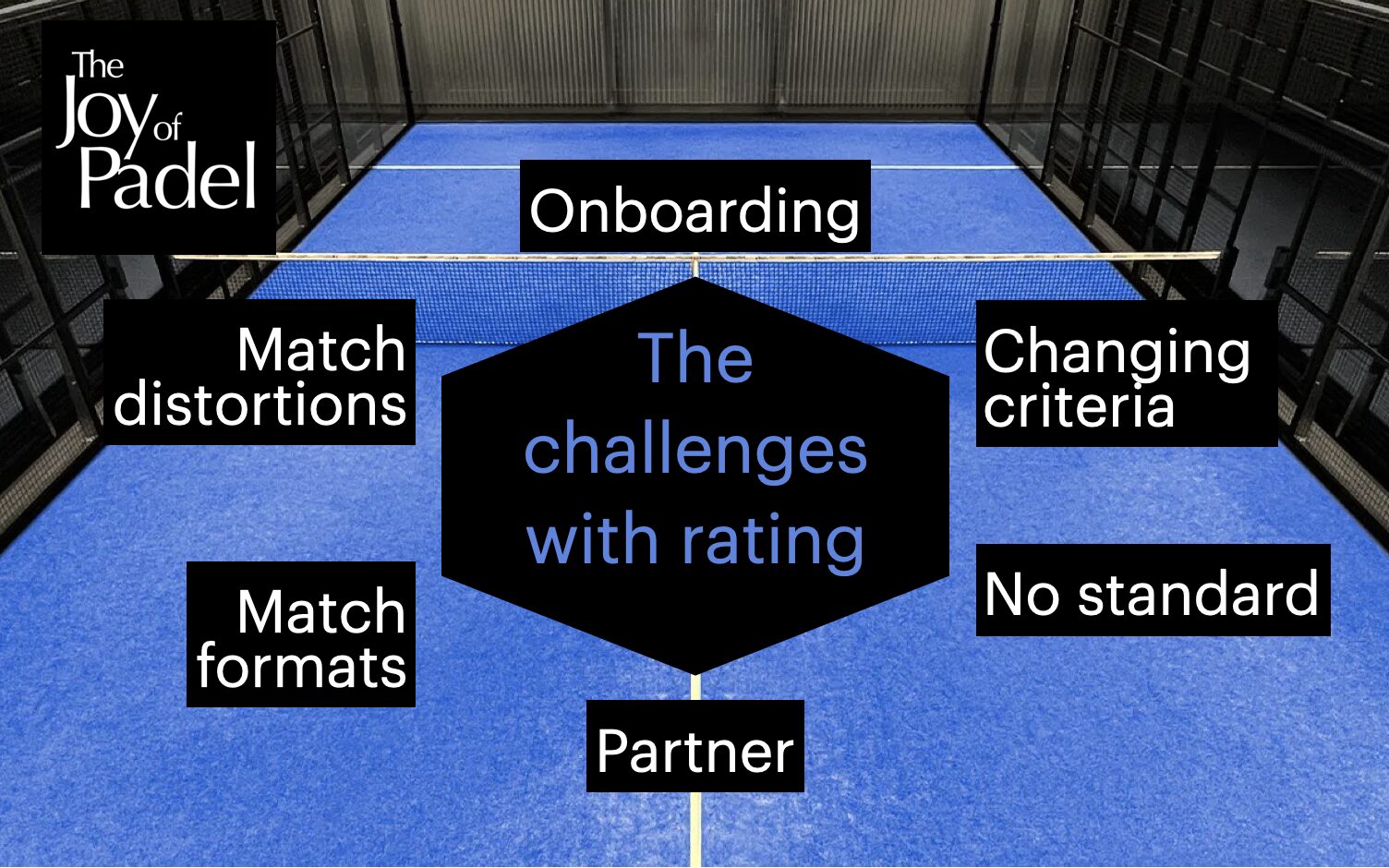
Fourth, padel is a partnership sport. A player may look formidable beside a complementary partner and much less effective beside someone whose style, positioning, personality or communication does not fit. The score belongs to a pair; a rating tries to isolate an individual.
Fifth, match formats differ and matter. One-set matches, best-of-three contests, Fast4-style formats, americanos and mixed-level social sessions do not test exactly the same things. A player who is explosive over one short set may not maintain that standard through a longer match. A player who performs well in a relaxed americano may behave differently at 5–5 in a deciding set, or in a match with decisive golden points (versus conventional advantage scoring).
Finally, results are not neutral data. They can be affected by partner strength, frequency of play, selection of opponents, event format and local player pools. Result-based systems can be powerful, especially once there is enough reliable match data, but they do not remove every source of distortion. Self-rated systems are quicker to start, but more exposed to optimism, modesty and strategic manipulation.
The challenge, then, is not simply to reward wins and penalise losses as platforms like Playtomic and PadelMates do. It is to produce a rating that is portable, understandable, resistant to gaming and fair to players with different opportunities, partners and competitive environments. That remains an unresolved global challenge.
Start with the professionals
Rather than begin by debating which system is best, I would like to suggest a more uncomfortable exercise: establish a genuine frame of reference. Nota Bene: you’re not going to get a specific grading or ranking at the end of this questionnaire, but hopefully you’ll get a better understanding of what your proper level is.
My first instruction: Watch professional padel—preferably live, where you can appreciate the pace, court coverage, communication and decision-making that television often flattens. Aside from anything, watching the pros is great entertainment AND good for learning. Here’s what I’m going to ask you to do:
- Watch some of the top female professionals (for example on Premier Padel’s YouTube channel or on RedBullTV).
- Select a long rally, say of approximately 20 shots, or ten shots per side. I suggest that you watch and analyse that point multiple times. You can take this 20-shot rally for example with Gemma Triay and Delfi Brea against Ari Sanchez and Andrea Ustero.
- Now answer the following questions as honestly as you can…
1. Shot-quality reality check (hint: this is the most incisive question)
Out of those 20 shots you watched the female pros play, how many could you execute at the same quality—not simply get back, but play with comparable control, placement, disguise, pace and tactical intent?
- 1–2 (up to 10%) = intermediate
- 3–5 (11-25%) = high intermediate
- 6–10 (26-50%) = advanced
- 11–15 (51-75%) = high advanced
- 16–20 (76-100%) = pro
How does the above classification sit with you?
It’s essential in padel to consider that each point is something of a journey, a sequence of shots, a series of ebbs & flows. The key phrase above is to be able to execute shots at the same quality. It is easy to see a professional play a bandeja, vibora, chiquita or defensive lob and think, “I can hit that shot.” But can you hit it under comparable pressure, from the same position, while recovering the court, choosing the right target and preparing the next ball, all the while sychronising and communicating with your partner? As Juanjo Gutierrez, pro coach and current head coach of the Spanish men’s national team, said in his interview with me:
“For me, the most difficult thing to measure is the development of the point from its beginning. Luckily, here we know that there is a beginning and an end with the serve and with the moment the ball is won or lost. And the complexity of measuring that entire sequence still makes it difficult for companies to audit it. But for me, the key is understanding the entire sequence of the point.”
Comparing yourself to the professional men is basically out of the question, unless you are a confirmed, highly ranked player in your country. If you, as an amateur, find yourself routinely placing yourself anywhere near half of the women’s shots, pause and interrogate the answer. The key point here is to recognise and understand what’s going into each shot, and throughout the point. More than likely, you are measuring whether you can make contact with the ball rather than whether you can reproduce — in a specific context — the full quality of the shot, its direction, speed, depth, and spin.
2. Technical repertoire
The nature of this question is to probe both your range of shots and knowledge of the game. One of the essential reasons it’s important to have a repertoire of different shots is that disguise, variety and deception are part of the advanced player’s playbook. As I explained in this article, there are a lot of different padel-specific shots. Just counting the shots above your head, there are at least ten different strokes: kick smash, flat smash, bandeja (tray), vibora (snake), gancho (straight arm), rulo (into the side), por 4, bajada (off the back wall), fake smash, and la tontona, the silly one. (Think: a googly in cricket). And, with the repertoire, comes the zoning (see below), adaptations and adjustments according to the context. Check out this article for more on overheads.
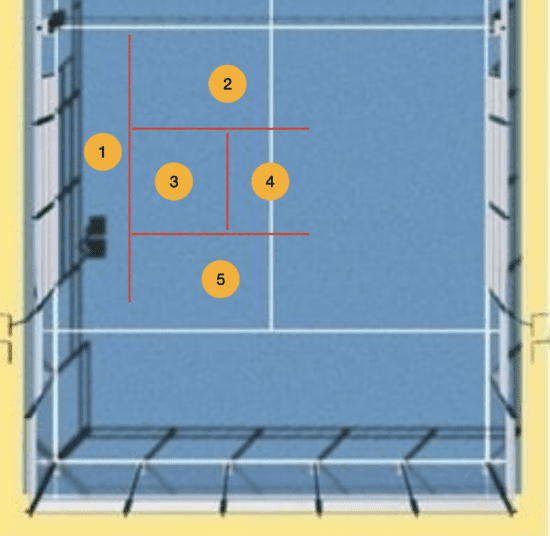
Zoning for left-side padel player overheads
So, how much of the professional repertoire of shots can you execute reliably in a match?
- None (thanks for being honest!)
- A handful of shots = intermediate
- Many shots = advanced
- Most shots = high advanced
- Virtually all shots = pro
Again, reliability is decisive. A kick smash made once during a coaching session is not yet a competition-ready kick smash. Nor is a vibora genuinely part of your repertoire if it breaks down when you are tired or facing a high-quality lob.
3. Partnership and communication
How well do you communicate with your partner compared with professionals? How compatible are you on and off the court? The legend, Juan Martín Díaz, put the point well in his conversation with me on The Joy of Padel: “I think it is fundamental… to have respect [and] to know what each one is thinking.” He added that knowing when a partner is tired, hurting or having a difficult day—and communicating through it—is vital to your success.
Score yourself from 0 to 10, where:
- 0 means you offer little useful communication, become negative or leave uncertainty about positioning and decisions.
- 5 means you communicate constructively but inconsistently, especially under pressure.
- 10 means you communicate with the clarity, calm and mutual adjustment of an elite pair.
Listen to what the best pairs do during and between points. They exchange concise information, reset quickly, protect one another emotionally and make decisions together. Their communication is not theatre; it is part of their competitive system. If you’re not communicating well, you’re missing a big portion of the game. Another guest on my show, top-ranked GB player Nik Mohindra said: “Communication is at least as important as, if not more important than the technical aspects of the game.” See this article for a deeper dive on communication.
4. Performance under pressure (mentality)
As points become more consequential—game points, deciding points, set points and match points—how closely do you retain your normal level?
Score yourself from 0 to 10:
- 0 means your technique, decision-making and emotional control deteriorate sharply.
- 5 means you remain competitive but become more predictable, rushed or risk-averse.
- 10 means you execute with the composure, clarity and courage of the professionals.
This is not solely a question of temperament. It is also about having sufficiently robust technique and repeatable patterns to rely on when the score tightens. Juan Martín Díaz has described the mental component as something that can decide whether one wins or loses a match, while also emphasising the importance of psychological work in arriving at competition relaxed. In her interview with me, GB #1 Aimee Gibson, said:
“I think mental is a a big thing because you have to have perseverance, patience… You have to be competitive when you’re down. You have to have the confidence to fight back. I think a lot of this, a lot of sport, comes from the mental side. I think you have to be very mentally strong.”
5. Physical readiness
How prepared are you physically to reproduce your best padel over the full duration of a demanding match? This was one of former world #1, Carolina Navarro’s defining qualities: to give 100% up until the very end.
Score yourself from 0 to 10:
- 0 means your movement, recovery and shot quality rapidly deteriorate.
- 5 means you are fit enough for ordinary matches but not for sustained high-intensity play.
- 10 means you possess elite-level capacity for acceleration, repeated explosive movement, coordination, recovery and durability.
This does not mean every amateur must train like a professional. But it does mean recognising that physical capability shapes tactical possibility. Fernando Belasteguín has said that a professional needs to be “fast and agile, but also coordinated, explosive, and long-lasting.” His own training integrated over the years padel, physical work, stretching and recovery—an illuminating reminder of what we often fail to see when we admire a pro’s effortless-looking shot.
The value of self-awareness
The answer to the first question (the number of shots in a rally you can reproduce) tends to colour every answer that follows. If we misunderstand the gap between our own game and professional execution, we are likely to overestimate our repertoire, tactical maturity, communication and ability to perform under pressure.
That need not be discouraging. On the contrary, accurate self-awareness is the beginning of improvement. It changes the question from “Why am I not winning more?” to “What precisely breaks down first in my game?” and on to: what do I really need to work on?
For example:
- If you can sustain rallies but lose the net repeatedly, the priority may be transition and lob quality—not a more powerful smash.
- If your technical level is sound in practice but collapses at 5–5, the focus may be decision-making under pressure and better routines between points.
- If you play brilliantly with one partner but inconsistently with another, the issue may be positioning, role clarity or communication—not your headline rating.
- If you believe you are a strong player because you win quick social matches, test that assumption in longer formats, against unfamiliar opponents and alongside different partners.
Fernando Belasteguín’s attitude captures the productive alternative to ego: “Mentally I think you prepare yourself day by day by going to train every day as if it were the last day of your professional career.” And Alejandro Galán has framed elite development in similarly comprehensive terms: “I constantly try to understand how I can improve mentally, physically and on a technical level. There is always something to do when it comes to professional sport.” The more advanced you are as a player, the more the game is about decision-making, communication, mentality and physicality.
Play, practise, improve
Sandy and Tom Farquharson of The Padel School recently identified four reasons why a player’s padel may have stopped improving:
- You are playing, not practising.
- Your practice has no purpose.
- You do not know what to work on.
- Technique is not always the fastest fix.
I would personally put the third point before the second. If you do not know what to work on, it is difficult to give practice genuine purpose. Yet, there is an even more fundamental question: why are you playing padel, and how important is improvement to you? There is no wrong answer. You may play principally for friendship, exercise, competition, stress relief or the pursuit of mastery. But the answer should determine the investment you are willing to make.
If your ambition is to become the strongest player in your club, age group, county or country, ask a further question: why does that matter to you? The answer will help determine whether you are prepared to practise deliberately, take coaching, strengthen your body, accept short-term failure and find a partner whose game complements yours.
Padel is great fun, and it is gloriously accessible at the start. But genuine improvement requires effort, time, repetition, feedback and a willingness to fail constructively. It also requires humility: the capacity to see yourself as you are today. Add a measure of ambition, and you have the two foundations of progress.
You will still need practical support: time on court, purposeful practice, a good coach when possible, physical preparation and, in a sport played by two, a compatible and complementary partner.
But before choosing a label, an app or a rating system, start with the harder work: watch the best, measure the gap honestly, and decide what you want to do about it.