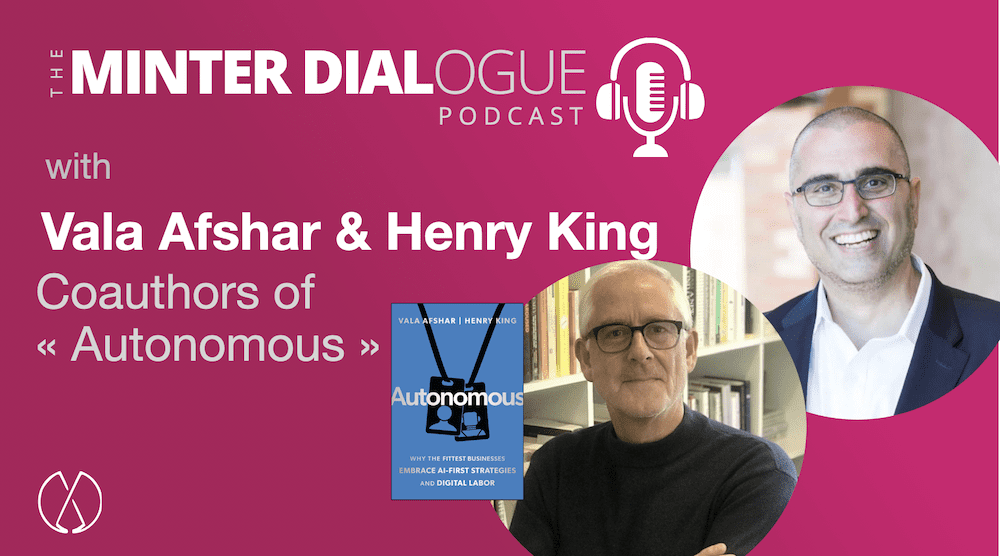
Minter Dialogue with Vala Afshar and Henry King
Henry King and Vala Afshar, co-authors of Autonomous, join me to explore how AI-first strategies are reshaping business fitness. Henry brings his unique journey from CIO to design thinking expert, whilst Vala shares insights from his decade as Salesforce’s Chief Digital Evangelist. We examine Salesforce’s V2MOM framework—a radical transparency tool that aligns 80,000 employees—and discuss why the best implementations often mean resisting customisation. The conversation tackles uncomfortable truths about autonomous vehicles, digital labour, and the erosion of human agency, whilst exploring how companies can eliminate waste through agentic AI. Henry and Vala challenge the notion that relationships will diminish in an AI-driven world, arguing instead that they’ll become more critical. We discuss enterprise fitness, the importance of identifying organisational blockages, and why trust—defined as competence plus character—remains the foundation for transformation in an age where we’re the last generation managing only people.
To connect with Vala Afshar and/or Henry King:
- Find/buy Vala Afshar and Henry King’s book, “Autonomous: Why the Fittest Businesses Embrace AI-First Strategies and Digital Labor,” here on Amazon
- Find/follow Vala Afshar on LinkedIn and Henry King here
Other mentions/sites:
- Here’s the first book Vala and Henry wrote, Boundless here
Further resources for the Minter Dialogue podcast:

Meanwhile, you can find my other interviews on the Minter Dialogue Show in this podcast tab, on my Youtube Channel, on Megaphone or via Apple Podcasts. If you like the show, please go over to rate this podcast via RateThisPodcast! And for the francophones reading this, if you want to get more podcasts, you can also find my radio show en français over at: MinterDial.fr, on MegaphoneFR or in iTunes. And if you’ve ever come across padel, please check out my Joy of Padel podcast, too!
Music credit: The jingle at the beginning of the show is courtesy of my friend, Pierre Journel, author of the Guitar Channel. And, the new sign-off music is “A Convinced Man,” a song I co-wrote and recorded with Stephanie Singer back in the late 1980s (please excuse the quality of the sound!).
Full transcript via Flowsend.ai
Transcription courtesy of Flowsend.ai, an AI full-service for podcasters
Minter Dial: Well, welcome both of you to my podcast. It’s not very often that I have a multi guest episode. I’m going to ask you guys, Henry and Vala to be on my to to introduce yourselves. The only thing I’d like to say is that I I’ve had a chance to follow what Salesforce is up to, met Marc Benioff a few times, and even spoke at a few of your conferences. So, full transparency, I’m a fan. But let’s start with you, Henry, you co-author with Vala on this last book. Who are you?
Henry King: Well, thank you Minter. Thanks for inviting us on. And I’m sorry for a bit of a surprise to have both of us, but hopefully that will be double the value or something like that. Double the trouble. Well, yes, maybe that’s what it’ll be. Exactly. So, yes. Henry King. I’ve spent most of my career in technology. I was with Accenture and Deloitte Consulting for four years and then I was a CIO for a number of years. And then after about 20 years in IT, I jumped ship into the world of design thinking because I really kind of wanted to understand design thinking, human-centered design much more. And then after about 15 years doing that, 10 years, 15 years doing that, I really wanted to then kind of bring that all together and then join a company which seemed to be really kind of at that intersection of technology and innovation. And so, I joined Salesforce and that’s where I met Vala.
Minter Dial: And what do you do at Salesforce?
Henry King: So I was in the innovation and transformation group. So, that’s really about professional services. It’s consulting, it’s helping customers with their implementations and beyond implementations, more about kind of governing the platform, putting in the right kind of structures in order to be able to manage and govern the system and get the most value out of it. Get the most business value out of it.
Minter Dial: I can see you should have a tremendous pathway. How do you avenue of work in that regard? And Vala, what about you? Let’s start. Let’s get to who is Vala Afshar?
Vala Afshar: Mitra, thank you so much for having us on your podcast. My name is Vala Afshar. I’m the chief evangelist at Salesforce. I joined the company 10 years ago. For 12 years prior to that, I was a Salesforce customer. I was the chief marketing and chief customer officer for a technology company building data center solutions, wireless software, security, building infrastructure. And Salesforce helped quadruple the size of my business. My first book was about the importance of CRM and how you should build your anticipatory muscles using data and software to gain a competitive advantage. Think I was subconsciously interviewing for a job. Who writes a book about a vendor they do business with? I did, and it worked. And you know, today I conduct research. I have an opportunity to work with my dear colleague Henry. And we’ve written two books in the last two years working on the next. And it’s an opportunity for me to stay teachable. You know, it’s an opportunity for me to work with biggest, fastest growing, brightest companies in the world and learn from them and then bring that learning into Salesforce to help shape our products and our roadmaps. So, former customer, current employee, and all along, trying to learn as much as I can.
Minter Dial: It does seem like a tremendous way to get a job. Hey, just write a book about the company you want to work for.
Vala Afshar: It works. I’m one for one.
Minter Dial: Yeah. In the stories that I tell sometimes, when I was leaving l’, Oreal, I thought about one company I wanted to work for, only one. I wrote the CEO a letter, actually the chairman a letter, and told him why I wanted to. I was the person for the job. He. He took my interview. I met him twice. He’s a very famous man, busy man, therefore. And he ended up telling me, well, I’m about to sell my company, otherwise I would have hired you. The. The idea of being specific about what you like and targeting who you’re going after is for me, the lesson learned.
Vala Afshar: There’s important, important lesson. And you know, we only had about 2% of market my company competing against a player that had 70% market share. So, if we fail to deliver on our promise, the buyer would have buyer remorse. The board would ask why didn’t we go with. In. In our case, why didn’t we go with Cisco network infrastructure? Cisco was a dominant player. So, it was important for us to make sure the marriage experience was better than the courtship experience in terms of our products, our services, how we engage, and how we earn trusted advisor status. The game began after the sale was complete. And so, we really need to leverage data to graduate from using data to describe the past. Descriptive use of analytics to diagnose why things happen, to ultimately make predictions and use algorithms. Predictive use of analytics. And then ultimately what can we guide our employees in real time, what next best action so that we can delight our customers and achieve our stretch goals. And so, prescriptive use of analytics. So, using CRM and Salesforce over a period of a decade, we were able to leverage data to really anticipate our stakeholder needs. And at the center of all of it was this enterprise software platform called Salesforce. And so, I was compelled to write about it because we were winning, frankly, we were growing and we were named one of the best companies in Boston by our, by Boston Globe, our major newspaper. So, you know, when I reflected on culture, people, processes and technology, I realized that it was an important element and all those four, in that order, Culture, people, process, technology helped us win.
Minter Dial: Yeah, well, that’s sort of where I want to go with this question, Henry. When you do your advising or consultancy with people who are taking on board Salesforce, as I was a CEO of an organization I value heavily and I think is dominant this notion of culture. And to what extent do you have to sort of custom make, custom, bring in, integrate, break down tissues, old habits in order for it to work? I mean, as I see it, most transformations fail and most people fail because they don’t really understand and gauge the nature of culture.
Henry King: Yeah, that’s a really good question. And funny enough, I think that there’s almost a sort of paradoxical answer to that because part of the advice.
Vala Afshar: You.
Henry King: Know, to customers using Salesforce is like, so Salesforce is a platform and it is built with and using and on best practices and, you know, best business processes, you know, within sales, within marketing, within customer success, and so on. And so, in some ways, the very best way of implementing Salesforce is not to do the customization. It is to use whatever you can from the platform as is, in order to make sure that you don’t build in technical debt, that you don’t build in process debt, that you use what is already there, that you’re already paying for. And you’re paying for not only the platform as it is, but, but all of the work that keeps going on in order to improve that product, to improve the platform three times a year. And it’s always been that way. And so, a lot of the innovation is being done for you. And the best thing that you can do as a business is to try to use the platform in as much of a vanilla way as you possibly can if you want to get the most value out of it, that keeps you agile and that keeps you free from technical debt going forward. So, that’s on the kind of the technology side, on the more cultural side, Salesforce has always been a company that is about its core values and customer success and trust, being at the heart of those values. And the idea of the ecosystem and the idea of the trailblazers, the Idea of, you know, those ideas have always been very, very important. And so, there’s a continual work done within Salesforce towards trying to make sure that we engage, that the company engages with its trailblazers, with the people who are using the software, you know, with the culture of the business, of the, of the customer’s business in order to make sure that we do have a really, really strong relationship with that customer. Right.
Vala Afshar: So I have a simple definition of culture I just want to share. Very simple. To me, culture is what happens when the managers are not in the room. Do the individuals feel that they’re trained, empowered and able to make decisions at the right time for the right reason for the right people in the absence of authority. And when we talk about these new emerging technologies that are reshaping our companies, like artificial intelligence, where it’s exciting and scary, where we’re worried about agency, we’re worried about being able to control our own destiny in a world that’s potentially now not human led machine assist, but machine led human assist. Culture to me is when individuals feel they have safe space to make decisions. People are not afraid of failure, they’re afraid of blame. And one thing that has helped Salesforce grow in the 22 years I’ve known the company is it has a culture where you invite experimentation. It’s okay to fall, by the way, if you know the outcome. It’s not an experiment. So, an experimentation, really trailblazing in the unknown, knowing that doers will make mistake, mistake, don’t make the same exact mistake because that’s a decision. But when you do make a mistake, it’s okay. It’s part of the learning process. So, I feel that we have an incredible safe space for people to disrupt themselves and then potentially create technology where you can help differentiate yourself and disrupt the market and win.
Minter Dial: So I am going to be in a position of disruption in this conversation because what I’m hearing is safe space. It’s okay to fail. Just use what we have, the best practices, trust what we do. And for having worked in a rather laboriously luddite world where there was a inherited success plan that had been there for 100 plus years with a set way, very strong culture, probably strong distrust within and without. It seems hard for many organizations to adopt this or have an appetite for totally giving up all the standard operating procedures, giving up all the processes and policy, you know, and just going with the flow or the, the risk. So, how do you architect that? I mean, not all of your customers surely are ready for that type of a An environment. How do you bring them in without having them fall on their flat on their face?
Vala Afshar: Sure. It’s a great question and hope. I don’t want to imply that there’s not an incredible amount of discipline and precision in terms of tactics, driving strategy or being flexible. We have a process that we’ve had since the inception of the company, and it’s called V2MOM and it’s. I’m sure you’re familiar with it, or maybe I am.
Minter Dial: I’ve heard it. I’m sure I’ve heard it.
Vala Afshar: Yeah, absolutely. So, 80,000 employees at Salesforce, all of us have our V2MOM. Vision is the first V. Values is the second M, the first M is measurements, O is obstacle, and then the final M is methods. So, vision, values, methods, obstacles and measurements. And. And it’s a one or two pager. It’s not a long document. But the company every year. But our founders will have an all-hands invitation, four-day summit to develop V2MOM. And again, all individuals have V2MOM’s. If you join Salesforce as a new employee, you’ve got 90 days to develop yours. So, what’s important is not just the fact that you can cascade V2MOM for our founders all the way to a new employee that joined our company, but I can go on my mobile device, and I can view anyone’s V2MOM in a company, from Marc Benioff all the way to my colleagues to myself. What that means is we have incredible radical transparency in terms of what we consider methods and obstacles and measurements that we have to focus our time and energy for the next 12 months. It’s a forward-looking document. But when my colleagues ask me to participate on a project or an assignment, typically the conversation starts with Vala. We haven’t met, but I looked V2MOM and as an evangelist, one of your methods is to have keynotes at conferences and customer and partner events. My customer, my partner has an event coming up. Would you be open to presenting? None of the asks are orthogonal to my view of how I can help my company grow. So, 80,000 people have radical transparency in terms of what their roadmap will look like for the next 12 months. And that alignment has created incredible velocity. We have very precise method of identifying direction and speed in terms of what we want to accomplish. It’s really a startup mindset and mentality and we can execute at scale, at scale, at scale. And so, I would advise if you want to implement change, building consensus and alignment is key to Success. And you have to be radically transparent. And I would challenge your audience. Do you know what metrics your boss or her boss? How many levels of visibility do you have with your peers horizontally and above and below? And can you use that insight to ensure that you’re not drifting away from the promise you’re making to the business in terms of how you can help it achieve success? So, the smartest person in the room often is the room. And if you can somehow find a way to connect the folks in the room in a meaningful, accurate way, magic can happen. Magic.
Minter Dial: So the room is the collective intelligence. Henry.
Henry King: I don’t think that I’ve got anything to add to that. I think that there was, that was exactly right.
Minter Dial: Well, it’s, it is, I feel the right type of approach for having run a company. The issue is many people are who are listening will not be the CEO who can implement a V2MOM for their country, their company. So, the challenge is going in at the right level. If you don’t go in at the CEO level, at the head culture level, how do you institute such a program that then flows through with radical transparency and everybody knows everybody. And it doesn’t say that everybody likes everybody, but you have a strong understanding of where we’re all coming from and why we’re all here.
Henry King: Yeah, it’s a good question. Firstly, I mean to respond to the word flow that you used, you know, flows are very, very important concept in both of our books in boundless and in autonomous. But one thing we try to make sure we’re clear about is that something that flows still has to have direction, right? Because a flow without direction is a spill and that’s of no value whatsoever. So, flow still needs to be directed. In direct answer to your question, I think one of the things about the V2MOM, since we were, since Vala was right to bring that up, is the Vitamum is not really top down. I mean you can start that at anywhere in an organization. Even though it is true that the v2 mum starts with the organizational v2 mum and then the process that is used in order for everyone to get that is kind of a trickle down to make sure that there is alignment, as Valo was saying all the way through the organization, nevertheless, in principle. Well, actually in practice all individuals are responsible for their own V2 mum and they communicate up and down with their own V2MOM. So, it doesn’t actually need to start up at the top. It can start anywhere in the organization and anyone can create a V2MOM individually and they can do it not just for their entire year, but they can do it for any given engagement. And so, that’s one of the things that is also done. And we’ve done this with our clients, too, in order to get alignment in engagements with we’ll sit down at the beginning of the engagement with the customer and we’ll say, let’s work on the V2MOM specifically for this engagement. Not for your business, not for Salesforce, but for our engagement, such that we know what the values are that we care about in this engagement between everyone that’s working. We know what the vision is, we know what we’re trying to achieve. And here’s the methods that are most important to us, again, as an initiative, not as a customer, not as a vendor, but as an initiative. And we’ve used that very successfully to get that alignment across an entire team, regardless of what the CEO or the CIO or any of the bigwigs are doing.
Vala Afshar: Am I to a single contributor who may be listening? If you’re a single contributor, you know this. This tool that we’re referencing just helps you establish trust. So, let’s just define trust. Have a common definition. If trust Competence plus character. With competence, you, no matter where you are in the organizational chart, must demonstrate capability and reliability consistently. You want to show that you’re reliable and you’re capable. Competence, character is integrity plus benevolence. I love the word benevolence. Your intentionality. If you want to build alignment, if you want to build consensus, if you want to drive change management, be clear with your intentions. Communicate as much as you can the why, the what, and the how. And if people understand there’s a fine line between manipulating and inspiring, and that line is your intention. So, if you can define, you can be clear with your intentionality, you can demonstrate highest integrity and you’re a reliable and capable person regardless of where you sit in the organization, you’ll have an easier time. It’s not guaranteed. I’ve worked in many large organizations or even small organizations where a good idea loses to a good title. And that’s not an environment you want to build and cultivate. The best ideas have to win, not the best titles. And the one thing I can say again in my experience with my company is the best ideas do elevate and eventually can be the, you know, the compass for us. It’s. It’s not the. It’s not the best titles in the room. And that’s the culture you want to cultivate.
Minter Dial: So the takeaway I’m getting here is whether or not you’re the CEO, the leader of a small unit is find a way to implement something that allows for the building of trust within you. The V2MOM is an example, not the only one to build it. And the funny thing Val, what you said about there is. And all of a sudden I’m having an aha moment at my university back a few years I created with a few friends a secret society and all the secret society had two names, something and something. And so, the one that we created, secret society, I don’t know, I don’t think it has an existence anymore, but is called benevolence and knowledge, which in fact is sort of competence and character wrapped in one. So, I’ll have to go back to that.
Vala Afshar: How do I become a member of this secret society?
Minter Dial: Well, we, we had a handshake, we had a whole lot of fun. Enough about that, let’s. Now I want to get into the bulk of the reason why. So, this is your second book, Autonomous why the Fittest Businesses Embrace AI first strategies and Digital Labor. So, you wrote a first book, Boundless. You come together again despite the fact that you haven’t been together physically to write this new book. What was the egg meets sperm moment of this book?
Vala Afshar: Well, in Boundless, Henry and I focused on writing a book that spoke to the negative impact of silos. Silo mentality, silo structures and of course in the age of AI data silos can really prevent you from reaching your full potential in studying hyper growth companies for five years. In in preparation for writing Boundless, we identified seven design principles that we, that we talk about and one of the principles was autonomy and of course the book. We submitted our final draft to Wiley in, in late 2022, about a month after the ChatGPT moment. And as you know, with major publications, it takes up to six months before the book is available. And so, by the time Boundless was on, you know, your Barnes and Noble shelf or available on Amazon, you know, we were experiencing the agentic revolution and how software could announce in addition to natural language processing reasoning capabilities, software can be injected in complex workflows and take action on your behalf. It was no longer a tool for humans to use. It could literally be considered an assistant. It’s as a, as a, as an, as a nerd. And I say that affectionately. When I remember Iron man and Tony Stark having a conversation with Jarvis and they’re building the Iron man suit, that was, you know, the amazing moment that we felt whether you’re in sales Service, marketing, any line of business. You can now have an assistant that can help you co create value at scale and at speed and intelligence unlike anything we’ve experienced before. So, I don’t think Henry and I thought about Autonomy in the seven Principles as the topic of our next book. But it was clear to us that when we thought about what does it mean to be a healthy company, what does it mean to compete and win, we realized companies that can remove waste effectively identify bottlenecks and blockages and scale their resources, those are the companies that are going to be best positioned to win. Almost like digital Darwinism and adaptability and able to survive. And it wasn’t the strongest. It was, you have thick winter, thick fur, you can survive the winter. How can you adapt and win? And so, that was the genesis behind achieving a whole level of Boundless capabilities. Recognizing that we’re the last generation of business leaders that are managing only people, we’ll be managing a hybrid workforce of people and agentic smart software to deliver value unlike any other time in our careers. Henry, anything else you want to add as to why we wrote Autonomous?
Henry King: Well, the timing was right. Initially we enjoyed the experience of working together on Boundless. It was really a great experience. So, we knew that we wanted to continue to do it. The first thing that we thought that we were going to write was actually coming back to one of the other principles, which was really about shared success and about the importance of relationships in business. And it was only because, again, November 2022, with the public release of ChatGPT, that we realized that really this moment was so important that we needed to focus on the agentic AI part and on autonomy first. That says now that we’ve done it, now we’re looking back to relationships again because we’re realizing that they also are absolutely critical, an essential part of the future. Relationships have always been the most important part of business. And even with agentic AI and generative AI and predictive AI and physical AI, that’s not going to change. And in some ways, relationships can become even more important. They’re going to become even more complex because we’re going to start having relationships like we’ve never had before. You know, when our children are now having relationships with agents, that may be their colleagues, but they may be their bosses, they may be their advisors and their mentors. And so, there’s going to be a whole set of relationships that exist between humans and AI and between AI and AI, as well as new forms of relationships between people. So, yeah, so initially it was going to be relationships. Then we recognized really the timeliness of the agentic AI story. And now we’ve realized that throughout that time relationships maintained, maintain their importance and if anything, more, more elevated still.
Minter Dial: So I, I did an interview with a doctor called Chris Kerr, who’s a hospice doctor who interviewed 1500 people but just before they died and recorded the interview. And the two things they said were most important in their lives were experience and relationships. So, I would argue therefore that relationships are not just important in business, they are wholly important in our lives. And, and the thing that was always gnawing at me in this idea of the autonomous AI and society, which is the topic of my new book, how AI Machines Devices are Altering our Relationships. And I have to argue not for the better in that people think that they have more trust and a better ear in the AI than people, which gives no incentive for people actually to change. We’ll just, you know, go off and chat with the LLM du jour, you’re a therapist and break up with a text message rather than have the courage to be face to face in a non-machine-oriented way. So, how do you square that peg? If you, you think about the autonomy and the notion and the importance of relationships?
Vala Afshar: You know, I think we’ll struggle with this question for decades. I don’t disagree with you. I have three digital natives, my three children at home, and I see how they consume information and how, you know, how they learn, how they connect and it’s not like their parents. I’m also reminded my favorite line in Clay Christiansen’s book Innovators Dilemma. You may hate gravity, but gravity doesn’t care. You know, and this is, this is, you know, this is just the way.
Minter Dial: It’S going to be.
Vala Afshar: It’s electricity for the 21st century. Again, I think you’re going to be poorer, you’re going to be sicker, you’re going to not be able to compete if you don’t have access to affordable smart AI. I think it may eventually become a human right. It may be. I never said that about cloud. I’ve never said that about mobile or social. I tell you though, two weeks ago I was at my company’s annual headquarters. It’s San Francisco and I don’t know, somebody said future is already here, but unevenly distributed. When you’re in San Francisco, you live the future and, and you can stand on the street and count to 20 and you will surely see a car drive by you without a driver. There’s about 900 Waymos in San Francisco Amazon has launched Zoox. Cybercap from Tesla is coming and Uber and Volkswagen with a car called Moya will be in the streets in the near future. So, when I see these cars go by me. And by the way, Waymos just surpassed Lyft in terms of number of rides. 45,000 Lyft drivers, 800 Waymos. So, 60 to 1 ratio because the waymos never stop. This year I had the most difficult conversation I’ve had maybe in my lifetime with my dad. He’s 85 years old and for about a year or two we realized he doesn’t have the motor skills. We were nervous when we would see him dropped and so it took two years and he.
Minter Dial: I know, I know, I know the feeling.
Vala Afshar: You know the feeling. So, you know how difficult. I mean, two years of angry emotional conversations.
Minter Dial: Loss of independence.
Vala Afshar: Loss of independence. And he’s a type A personality. I took his keys away. I shouldn’t say he gave his keys to me, but begrudgingly perhaps. Absolutely, absolutely. Probably didn’t talk for a week or so but. But you know, you know, it just, it just had to be done. I think about vision loss. 5 million adults in the US lose vision. I have a friend who has difficulty with seizures, so he can no longer drive. So, when I think of age disabilities, vision loss, knowing that, you know, my son, 15, by the time he leaves college, 10 years from now, I’m an immigrant dad, so I assume he’s going to go to grad school. So, it’s 10 years from now. The relation the car with AI first design mindset. And of course if you get into a cybercam from Tesla, you see that there’s no steering wheel, there’s no gas or brake, there’s no mirror, there’s no window in the back. All human UI has been. User interfaces have been removed. But the fact that that will give my son, you know, non-linear optionality in terms of what he will do in a vehicle. When you and I get in a car, we have one job, drive the car. He will nap, he will binge, watch Netflix. Hopefully he’ll work on his Salesforce dashboard because I’m going to try to recruit him. So, when I think about you’re designing vehicles for riders, not drivers anymore and that it’s safer. Waymo has been on the road since 2017. Zero fatalities and it’s cheaper. Cybercap is about $35,000 to produce. And by the way, cities are going to get redesigned. We don’t need parking spots as much as we have today. More schools, more parks, More museums, because again, you know, 95% of the time, the car is static. There’ll be external positivity, positive externalities that will come from this technology. So, I agree with you, I agree with you. We have to be more concerned about this technology because it doesn’t follow the same rules as prior, previous technologies in our lifetime. So, loss of agency is really important. And I actually get nervous in these cars. I’m excited, and I’m nervous because there’s 5 million men and women in the US that make a living doing ride sharing, and I’m not even including the population that drive trucks. So, what happens to these folks in the next five, 10 years, I really don’t know. But, you know, I am still optimistic because in my experience, the pessimist sounds smarter. But the future is built by optimists, and all three of us are optimists, but we’re pragmatic optimists, and we understand that this is, this is something that we’re going to have to struggle with. So, I agree with you, but I don’t have an answer. I really don’t.
Minter Dial: The talking point for me is this mental health story. There’s nothing like actually achieving something, getting your hands dirty and, and planting the, the, the rose bed or whatever, and maybe getting a prick in your finger and getting a little bit of blood, but I made it happen. I, I dug it in and I did that. And, and this notion of, of humanity sweating together, hugging, it feels like it’s a, a tangible need in our society. And, and yet I agree with you that we absolutely don’t want to be riding ponies when cars come around or driving cars when you can, you know, do other things than have to drive. Henry.
Henry King: Yeah, so I, I agree with Val. I don’t think that there are any kind of real answers. I do think that there is a sense in which Agentic AI is on a kind of steady trajectory with other technology, which is that this idea of isolation has been here for a very, very long time. You know, I, I remember well, actually, I mean, throughout my lifetime, people have always talked about village life and community, and we should be getting back to that, and we should be doing all of these wonderful things. And the funny thing is, there’s never been anything stopping us. But we have chosen individually and collectively not to do that. And there has been. Yes, but even before that, way before, way before mobile technologies, I mean, airplanes. Even before airplanes. Right. For the last 200 years at least, the story in the west and increasingly in the rest of the world, has been moving out of these villages that we say that we care about and moving into these large cities where, yes, we’re all much closer together physically, but people tend to be living in much smaller households. You know, the average size of the household has gone from like 2.3 to 1.3, you know, in the last decade or two, you know, so the average size household is continuing to kind of shrink in size. And so, there’s something. And I don’t think it’s just technology, I have to say, but there has been a very long, gradual move away from a human move away from the very things that we say that we want. And I don’t. I think that’s a conundrum and I don’t understand it, but I know that it exists. And I am hopeful that maybe we will find ways with technology to. To. To get beyond that and actually kind of reduce that in some ways. I don’t know whether for. So, one of the things that I think will happen, and there are very few signs of it happening, to be honest, but I think that there’s likely to be a rural resurgence, especially in the U.S. the U.S. and the UK, of course, are very, very different kinds of places in that regard. You know, the US is so much bigger, with so much more space between villages. My sisters still live in Sussex and they live in little villages that are only three or four miles apart from one another, and yet it still takes 22, 30 minutes to get between them because the roads are so small. You know, that’s just not the way that it’s set up in the U.S. so the U.S. is very, very different. But I think that there are all of these options now and increasing options, partially because of the technology to make it really possible to create communities in rural areas that just hasn’t been possible for a long time. So. And then I think the only other thing that I would say about this is that I feel like I myself at my age, am not really qualified to have an answer. I look to my children now to see how I find them to be living with technology. And what I find is that at least my children and their friends, they value their friendships at least as much as I ever valued mine. And I think perhaps more so. And yes, a lot of those friendships are technology mediated. Yes, a lot of time they are communicating with one another by texting and Snapchatting and everything else like that. But I think they spend more time trying to be with each other as well. And so, my sense is really that I get that we’re more isolated. But when I look at my children at least and I hope they’re representative and not outliers, I get the sense that human relationships really do matter to them.
Minter Dial: Right. So, I want to zip in for the last portion of our chat on the book. And the notions which are really germane to the book, this idea of fitness and autonomous AI at least or autonomy of the machines give us a picture of what in 10 years’ time it’ll look like our life as an employee in a company. To what extent will I be doing human-centered things to use your words from the beginning Henry and to what extent is it just sort of responding to almost what AI is doing and occasionally checking up on what AI is doing? What are we going to be doing? What are those typical employee doing in some kind of company in 10 years’ time?
Vala Afshar: One thing I can say is we will be doing less wasteful activity activities. As a, as a company that has implemented north of 200 agents over the last year and a half. The nature of onboarding intelligent software to execute on your behalf is very composable in nature, very precise. You have to identify the job that you want to transcribe a cognitive transfer to software. So, and those job is consistent of multiple tasks. And then you need to assign actions that you sanction guardrails where action things you don’t ever want the agent to be able to do on its own unsupervised. And then the channels you want the agents to operate so highly composable, highly precise. And when you go through that journey it forces you to actually study your existing processes and the handoffs between the people that are responsible for the jobs to be done.
Minter Dial: And I would argue by the way vale your culture you have to understand how you guys operate and what the behaviors are amongst the people.
Vala Afshar: Absolutely. Because you’re grounding the language models with tonality and sentiment and core values. When we moved our help.salesforce.com website, which is our most high, the highest traffic we have interactions we have with our customers is our help site. 60 million interactions a year. We had to rag that process with 700 rags. Sorry. We had to. We had to. We had to upload 700,000 documents and expand the language models and ground the language model to our way of doing things. 700,000. It took about eight months just training the language model before we could go live. But what we identified was so much wasteful activity in our company. And by the way we’re a digital native company so you would assume Lean Processes and Six Sigma and All this good stuff, stuff, ton of waste. Now what is waste? When you assign the wrong resource, when you over utilize a resource, you underutilize a resource. All of those things are wasteful and all waste is costly. If you’re in a room, you say raise your hand if you think this is good waste. There’s no such thing when you define it as wasteful. There’s a cost associated with it and it’s bad. And for business leaders for the last two, three years, driven by better margin, better EBITDA revenue per employee, there’s massive amount of pressure and cost cutting it. And if you were an executive like me for most of my career and I worked for private equity led companies for 20 years, there was a lot of exercise in terms of cost cutting. And what would I do? I look at my highest line item and scrutinize the highest cost and try to determine where I can get my 5%, 10%, whatever the guidance was at that moment, over time only to realize that cutting that cost introduced value atrophy. Because I was purely looking at cost, not waste. All waste is costly, but not all cost is wasteful. So, I’m hopeful to answer your question, 5, 10 years. By the way, all experts of yesterday, they’re not necessarily the experts of tomorrow. I have no idea where we are in 10 years, but I’m hopeful that, and this is why we say the fittest companies, as you automate more, as you hyper automate, you start to resemble living organism. You and I are a great example of autonomous system. And all living organisms are flow based. And so, if we want to increase our health and ability to grow, we need to ensure that we have minimal blockages and minimum waste. In fact, if you look at the top 10 reasons we cease to exist, six of the 10 are due to blockages. Cardiovascular disease is the number one cause of death globally. Aneurysms, strokes, six of the 10, you know, building cavities in your arteries and blockage. It’s very hard to identify blockages in a company. Imagine my company, 80,000 operating in 20 some odd countries, the faucet is running, the water is coming. You just don’t realize that it’s not at full pressure. And when you and I go up a set of stairs and we’re out of breath, there may be a sign there’s a blockage. We could take aspirin, blood thinners, we may have to implement the stent. Finding blockages in business and in our book we’ve identified hundreds, hundreds of blockages and then root Causing the blockage and then resolving the blockage. That’s why perhaps nearly 70% of Fortune 500 companies do not exist since year 2000. My personal belief is that companies that lose relevance and ultimately market share, they’re unable to create value at the speed of need because they have blockages and they don’t know about it. Sorry, that was a long answer too.
Minter Dial: No, no, no, no, it’s perfect. But it does. I mean, it brings up a, a critical reason why reading the book and getting into this fit idea, which is if that’s the future, then how do we get there and how do we get fit? And, and you talk about enterprise, general intelligence, and I, I laughed, I smirked anyway, because use the tennis analogy.
Vala Afshar: Oh, the champion, the prodigy. Yes.
Minter Dial: And it was interesting that you use tennis because for me, generally speaking, tennis is a very individualistic spirit sport.
Henry King: Sure.
Minter Dial: Although at the highest level, of course, it’s a team with a psychologist, a massage person, a, the, the fitness coach, whatever, and all the different people that go into the team at the highest level. But I was wondering whose choice was it to, to choose tennis? And did you have a debate as to maybe it should be hockey or football or anything else, or was it so obvious that tennis was the right one?
Vala Afshar: I let Henry answer. But we often when we talk about both books and we use living organism as the evolution of a company, and you look at Amazon 2012, they invest in the robotics first. Today there’s more than a million robots that help create Amazon’s reach and scale. And so, they’re resembling a living organism just like you and I. And they have filters to remove waste and they have pumps and we can talk about that. But, but we’ve always used sports because again, how do you achieve excellence? Like a Serena Williams, like Carlos, the 21 number one tennis player. Alcatraz. Yes, Alcaraz. So, we’ve always used athletes to really describe the rigor, the discipline, the practice, the mindset, the grit that’s required to succeed in this world. But Henry, let’s talk about. And it was the chief data scientist, Silvio at Salesforce, that first introduced us to, you know, the tennis analogy. But you know, again, Henry, you can talk about the, you know, the importance of why we lean into athletes to share our story.
Henry King: Well, yes, so, so unfortunately, the, the tennis specifically was not our idea. That was, as Vala said, who’s to know? But we would have chosen it if we had known. Right, of course. But again, yes, I think it is. We do think. I mean, there are all sorts of Reasons firstly, I think exactly what you said about, you know, tennis at the higher level, it’s not just about the individual, it’s about all of these other people that are coming together. So, yes, there is one person that all of the attention, if you like, is paid to, but it takes a lot of other people in order to really operate at that highest level. And I think that that’s, that in itself is an important learning for businesses, which is, it’s not all about one skill set by itself, but all of these other skill sets that can come together in order to create this championship level, you know, organization as a whole. We there, there are all sorts of reasons. I mean, one of the things is that there’s a very common idea in business that we’re a family. Right. And that’s not really a very helpful analogy because businesses and families really are not the same kind of thing apart from obviously family companies.
Minter Dial: Well, much less, you know, ask Lev Tolstoy what he said about families, which is that no one happy family is the same. So, what family are you talking about?
Henry King: Yeah, exactly. But whereas with a team, you know, a team is a much better analogy. And I think you speak to, you know, HR leaders that they’ll probably kind of agree, which is with a high performing team, there’s a recognition that people are going to join you and people are going to leave you. There is a maturity that people get to. There is a, there is a level that people get to and people want to leave and other people want to join. And there’s a freedom and an expectation in a professional team, professional sports team or athletics team, that that’s going to happen. That’s a natural part of ensuring that the team as a whole is what continues to perform at a very high level rather than the individual. And then getting back to something that you talked about Chris Kerr in the hospice and the two most important things that he found from all of these people that he interviewed, experiences and relationships. We also believe that it’s the relationships between people that are more important than the individuals themselves. In a healthy organization, we believe that the relationship between even departments is more important than departments themselves. In addition to that research from Chris kerr, there’s an 80 year old, longest longitudinal study coming out of Harvard. I think it is something like 80 years old now. And the question was really about what improves the likelihood of longevity or rather happiness and health in, in, you know, towards, you know, older age. And the number one reason always was the quality of the relationships that people were in. It wasn’t how much money they had made. It wasn’t how hard they had worked. It wasn’t about how elevated they had become, you know, in their workplace or in their professional life. It was always, always, always about the quality of their relationships. And there’s another interesting study as well, which was a study into successful relationships themselves. And the number one predictor of success in the relationship was the appearance of commitment to the relationship itself. Not good looks, again, not money, not individual characteristics, but the commitment to the relationship itself. And so, we’re seeing something that’s really, really important, I think, there about the quality of relationships that exist in the very, very best teams. And I think that that’s kind of relevant to businesses. Now I’m going for forward.
Minter Dial: All right, well, so just a quick anecdote. The Crown, the Duke of Edinburgh, says at one point that the. The thing that matters is that we commit to the. The single entity of the Royal family and the Queen at the time in the. At this episode. And he says, and as a result, that we always grow apart. Which was interesting as a. Like a signal as to what is commitment and happy marriage and such. I want to end with this last point, which, Vala, you had brought up with this idea of the 700,000 word document, whatever. It’s been my conviction that having proprietary AI is actually going to be the Valhalla of where this all goes. As in, what is my tone? What is my brand, my voice? What are the relationships that I’ve had with customers and feeding that into your AI to make your AI the best AI possible. The point that I want to just bring back to was this notion of brand, which is something that I pay a particular amount of importance to and purpose within a company. So, this notion of committed to the.
Henry King: Brand.
Minter Dial: The overarching V2MOM, if you will, how important is that in the creation of a fit organization?
Vala Afshar: You know, as a former cmo, again, I. I have a simple definition of brand. It’s what people say about you when you’re not in the room. I’m hopeful that when I’m not in the room, people would say, you know, he lived a recommendable life. He was. He was reliable, he was trustworthy, he was honest. And when you’re in an algorithmic led economy where your thoughts and beliefs are turned into algorithms, and now you’ve given software autonomy and agency to execute on your behalf, it could be you could drift away from your core values and your brand promise very easily. So, this is why we invest so much as a company in ensuring that we’re training the language models and we have guardrails and we have a trust layer both on the input prompt and the output prompt. And I don’t want to get too geeky about my answer, but I mean, there’s an incredible amount of energy and time spent. But it goes back to benevolence. We were the first company in Silicon Valley 10 years ago to hire an ethical and humane use of software executive that reported directly to our founder. Because there were times in our labs we would see certain outcomes and we weren’t sure if what we were building is good for society. So, we needed to really deeply reflect on should we include this in our release? And it’s even before first line of code is written. We have our research team and it’s a large group and a lot of liberal arts, not technology experts efforts really scrutinizing what is it that we’re trying to accomplish, what’s the job to be done and how we’re going to get there and can we safeguard our stakeholders, employees, customers and partners with this new technology. And we’re not the only company. There are other incredible frontier AI companies that have explained that they’ve, you know, suspended work on a project because they don’t quite believe that it’s ready and it could potentially harm society. Yeah, you know, our founder said it’s never about the technologies, how we use it. And I tend to agree with that. And this is why trust as our number one core value, customer success as a number two, it truly guides the way we work and the way we engage. And Henry mentioned briefly that it’s not just the departments or pumps. The relationship between the pumps is as important as the pump itself. In our book we referenced the circulatory system that keeps us alive. We breathe oxygen through our pulmonary system, our heart, cardiovascular system. You got oxygenated blood going through our arteries, deoxygenated blood on our veins, and systemic. So, systemic cardiovascular pulmonary makes our circulatory system and that’s how we stay alive. We now have business circulatory system powered by AI. And whether you’re sales, service, marketing, you’re just a pump. You capture information, you analyze it, you disseminate what you think will be good for the company and its ecosystem. And so, we have to make sure that as we develop and design these pumps, we have a shared success, holistic point of view and like you said, relationships at the heart of it. And we’re moving at speed, scale and intelligence unlike anything we’ve ever experienced. So, we just have to who was it, it was John Wooden, the famous basketball coach. Most championships ucla he said often, you know, go fast but don’t hurry. We need to be very mindful and methodical in terms of how we approach business moving forward.
Minter Dial: I was just. What I listened heard you there say was that the, the. The means are somewhat more important than the end themselves as opposed to the end justifies the means. The ethics component and governance which is such a big old topic in all of this. And just to finish with a lighter note, cradle to grave, you talk about your. The respite, the whole circulatory system. You also talk about manure in your book with the the case of, you know, the manure in. In London at the end of the 19th century. Just to be funny.
Vala Afshar: Anyway, listen, horsepower, manpower, machine power.
Minter Dial: Well and somehow energy is a key thought within all of that.
Henry King: Right, right.
Vala Afshar: That’s right. That’s right. Well said. Wow, you did read. Wow. That was, that was, that was a very specific preference. Very cool.
Minter Dial: In fact that I remembered. You know that’s the issue, you know, because I read it a little while ago. You guys, thank you for being on the show. I know time is of the essence and I don’t want to overstay my welcome. How can people track you down, follow you? I know that you’re successful individuals and, and say a lot of things, publish on things. So, where would be the best place to go find what you write about or listen, track, track you down, buy your book for God’s sake for it as well.
Vala Afshar: Definitely appreciate if you have interest in both books but on Amazon is probably the best place. Wiley’s a great publisher so your local bookstores and certainly online around the globe it’s available. Both Henry and I regularly publish across multiple platforms. ZDNet, CIO Online, Forbes. You can find both of us on LinkedIn. Al Afshar, Henry King. We made it easy and we hopeful that you connect with us so we can learn from you. Thank you so much for giving us an opportunity to talk about what we’ve been working on for the last seven.
Minter Dial: Years and good luck with the new book. Do you have a title for the new book?
Henry King: We don’t, we don’t.
Minter Dial: But no scoop, no scoop on the mentor dialogue?
Vala Afshar: No, no. We welcome suggestions by the way and we’ll give you credit, you know, you know, relational intelligence in the age of AI. You know, help us figure out a. And if it can be a one word title. Yeah. We’ll treat you to dinner, your favorite restaurant.
Minter Dial: I relationship. Listen, great. Thank you for having. Great to meet you. Hopefully we get a chance to meet in real life in the future. Thank you again for spending the time with me.
Henry King: Thank you, Mitta. It’s been a pleasure.