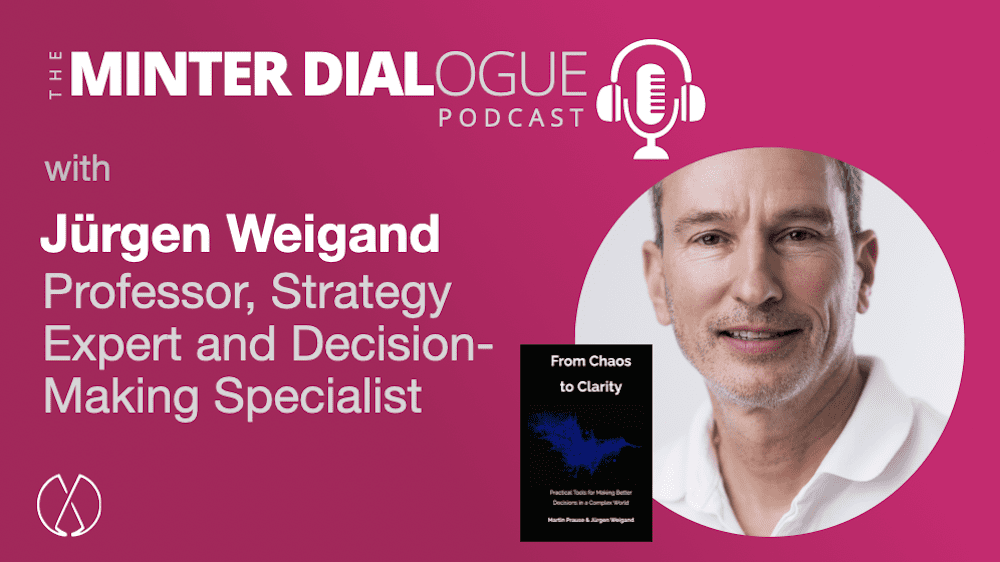
Minter Dialogue with Jürgen Weigand
Jurgen Weigand, professor of economics and co-author of two insightful books on strategy and decision-making, joined me for a far-reaching conversation about the true purpose of education, the challenge of finding meaningful work, and how leaders can best navigate uncertainty and complexity. As a senior leader at WHU—the Scientific School for Strategic Management—Jurgen brings a wealth of experience from academia, consulting, and public sector decision-making, informed by his international journey from Germany to the Netherlands and the US.
We delved into the major differences between German and American higher education, how both systems prepare students for life and work, and why meaning and purpose matter so deeply in career choices. Jurgen shared personal anecdotes about his own journey, emphasising the critical role professors play in guiding students, whether they are young graduates searching for direction or seasoned executives seeking new purpose. We explored his books, “Hope is Not a Strategy” and “From Chaos to Clarity,” discussing why hope alone isn’t enough to drive strategic success, and how humility, cognitive diversity, and systems thinking can help leaders make better decisions amidst uncertainty.
Key Points:
- Purpose and Meaning in Education: Jurgen believes education should help individuals discover and fulfill their potential, not just impart technical skills. Meaningfulness—both in work and personal development—is essential for true satisfaction and preventing later-life regrets.
- Strategy Beyond Hope: From his book and practical experience, Jurgen argues that owning the strategy process is vital for organisations, especially mid-sized ones. AI-based strategy tools empower teams to create, implement, and adjust strategy themselves, moving beyond wishful thinking.
- Leadership, Communication, and Complexity: Successful leaders balance decisiveness and humility, repeatedly communicating strategic direction and adapting to complexity rather than attempting to master it. Cognitive diversity in teams, systems thinking, and willingness to let go of sunk costs are crucial to staying relevant and navigating an uncertain future.
To connect with Jürgen Weigand:
- The book co-authored with Christian Underwood, Hope Is Not a Strategy, English edition, on Amazon
- From Chaos To Clarity, co-authored with Martin Prause on Amazon
- Strategy Frame (Strategy making as SAAS, founded by Christian Underwood and Jürgen Weigand)
- X in Blue (simulation software, founded by Martin Prause, Nicole Weigand and Jürgen Weigand)
- “Hope is something beautiful” Podcast with Padre Anselm Gruen, OSB (a German Benedictine monk who was in charge of Münsterschwarzach Abbey’s financial matters, as its cellarer. He has written around 300 books focused on spirituality, of which more than 15 million copies have been sold in 30 languages.) Check out the podcast here, to be published on Dec 25th, on Youtube with English captions.
Further resources for the Minter Dialogue podcast:

Meanwhile, you can find my other interviews on the Minter Dialogue Show in this podcast tab, on my Youtube Channel, on Megaphone or via Apple Podcasts. If you like the show, please go over to rate this podcast via RateThisPodcast! And for the francophones reading this, if you want to get more podcasts, you can also find my radio show en français over at: MinterDial.fr, on MegaphoneFR or in iTunes. And if you’ve ever come across padel, please check out my Joy of Padel podcast, too!
Music credit: The jingle at the beginning of the show is courtesy of my friend, Pierre Journel, author of the Guitar Channel. And, the new sign-off music is “A Convinced Man,” a song I co-wrote and recorded with Stephanie Singer back in the late 1980s (please excuse the quality of the sound!).
Full transcript via CastMagic
Transcription courtesy of Castmagic.io, an AI full-service for podcasters
Minter Dial: Jorgen Weigand, pleasure to have you on my show. I was introduced to you by someone I know and you’ve written now two books, co authored both of them. You’re a professor and I have to say it, practice my German at the Wiesenschlaflicher Hochschule, something like that.
Jürgen Weigand: Very good. That sounds good.
Minter Dial: Well, because I had to WH U and I thought the U would be for Universitat, but it’s not. So, anyway, in your own words now, who are you? Jorgen?
Jürgen Weigand: So as you already said, I’m Jurgen M. I’m a professor of economics at that strangely sounding school WHU which is Scientific School for Strategic Management. That would be the literal translation. Very hard to digest. There’s of course a story and the history to all of that. Maybe I can talk about that a bit later. But first of all, let me say thank you so much for having me on your show and I know that you are one of the most famous podcasters and I’m very happy that our friend somehow connected us. So, I’m happy to talk about any kind of things relating to universities and to other things. Maybe a bit about this. The school was founded in 1984 in a very strange system and at least for Anglo Saxon eyes, we had public universities and 99% of the universities were public universities. And in the university system you have pure universities which have the right to confer doctoral and postdoctoral degrees. And then you had something like technical universities, kind of applied sciences schools who did not have the right to convert doctoral into a post-doctoral degrees, which means research. They were supposed to teach but not to do research. And our school, who is right in between, we have to write for doctoral and postdoctoral degrees and we do research. We are fully research based university. But in that time period in 1980s this was quite unique. So, this is the background to it. And actually today students, if you ask them what does WHU stand for WHU they would answer, either I don’t know or we marry among ourselves because the WH in German the you would among ourselves and age would be Mary H. And we is we. Yeah, so that’s the funny story behind it.
Minter Dial: Well, of course one shouldn’t forget that it is one of the most prestigious schools out there. So, it’s. That’s a, that’s a funny version of it. And tell me, tell us about your background because it’s awfully interesting how you’ve channel changed, you know, gone around the world and worked as a civil servant.
Jürgen Weigand: Yeah, true. Actually I grew up Very much in the German public university system. I never had the intention to become a professor, but I had very helpful people who set me on the right track. So, after my master studies, I wanted to join a big Swiss band bank for their strategic unit doing data analysis and stuff like that. And along came my professor, with whom I did my master thesis. And he said, oh, this is ways that you shouldn’t do that. You have the potential to at least do your doctorate. And I thought about it another three years, which I can spend at the university doing research. So, I agreed. Once I finished that, I was hunted by consulting firms. I had contracts on my desk to sign again. My professor came along and said, well, I think you should stay in academia, do research. You. I think you can be a terrific teacher. He convinced me.
Minter Dial: And, and, but I mean that this time, I presume there’s a lot. There’s a big number on the bottom of those contracts.
Jürgen Weigand: Yes, of course. Yeah. And then I also realized if I really want to become a professor, and we were internationalizing back then already, I’m talking about the early 1990s. I said to my professor, okay, I continue, but I need to go abroad. I have to go to the US I have to do research there. I have to publish papers there because it’s a different environment. And if I really want to become a professor in Germany or somewhere in Europe, I need that background from the US And I had, of course, some good friends who hosted me in. I first went to Georgia State University and then on to Indiana University, Bloomington, nice college town. And my dear friend David Aldrich, one of the most cited professors, economics professors, he said, well, you have not only the potential, you’re right there. Continue, do it. And then I wasn’t really up to going already into the academic track. I was hired by the Dutch Ministry of Economic Affairs. It was the late 1990s, and the Netherlands, they had to introduce a. In Germany, in Europe you would say cartel authority, competition authority, in the US would say antitrust authority. And that was some thing I was interested in because my background is in industrial organization, the interface between microeconomics and strategy or strategic management. So, I was highly interested. So, then I left from the US to the Netherlands, actually in the beginning only for project for three months. But the Dutch are very convincing. They convinced me to stay on. So, in total, I spent almost four years with them doing very interesting public sector consulting for the Ministry of Economic Affairs. And after a year they said, well, if you want to continue here, and we would like you to continue, do you have to become a civil servant. So, I’m German and I swore my oath on the Dutch queen and became a Dutch civil servant, worked for them. Then I got the offer to join WHU and I got leave of absence from the Netherlands until retirement. That’s the background. And then in 2000, I joined WHU. Since then I’ve been a professor at WHU. I had a lot of leadership and management tasks. I started the MBA programs at the school, was deputy dean for almost 10 years. And yeah, now I’m still in charge of one of our most prestigious programs. We have an EMBA program. EMBA program together with kellogg in the US and I’ve been running this program for the past 15 years or so.
Minter Dial: What a great trajectory. So, as I was talking with you before, one of the things that intrigues me is the impact of education on the youngsters who are coming into the workforce. Because these are the individuals who we as managers are having to work with and will be the future patrons and bosses of the big businesses. So, for having done work in Atlanta, in Minneapolis, not in Minneapolis, Bloomington, as well as your work at WHU, what do you do? What do what? What sort of differences do you see in the student bodies at your level? Of course, you know, we’re not talking about people in high school, but people who are graduated from high school. So, typically American products and German products, but obviously some internationals as well. How do you see the difference?
Jürgen Weigand: The main difference, at least from my perspective, is the kind of professionalism I experienced in the us so Indiana University or the business school, very professional and very, very structured in their approach to have an integrated program. I wasn’t used to that. Coming from Germany, I had a very good university education, but it was more or less individual courses somehow put together and you could decide to do this or that. But I was really missing a focus structure. So, if you do, for example, the MBA in the us, you’re pretty clear what comes next. There you have a two year or one year program and then you know, the next step and your career follows. We didn’t have that because MBA programs were not known to the German market. So, the approach was really the Humboldt ideal. Research, research, research. And we translate research into something meaningful in the classroom. But that meaningful was most often very theoretical. So, the kind of application was lacking. And when I went to the us, I mean, I was a postdoc scholar at the time, but I also taught at both universities, MBA students. So, that kind of practically oriented research that was new to me, really explaining people this is what you can do with it. If you leave here tomorrow for your new job, you take along with you tools and frameworks and all of that stuff. And it was no surprise in hindsight, because public universities in Germany, in some other parts of Europe are still set up in that mindset. We educate the next generation of people, scholars most probably. You know, some professors have that ambition, the next scientific scholar, academic scholar, but it’s not. It wasn’t that much oriented towards what you really need in life, in your professional life, and things you can easily and immediately apply. So, I think that was the main difference, which I realized very much in the beginning. Of course, the whole system. System has been changing now, but still public universities are public universities underfunded, with huge numbers of students who come basically for free or almost for free. And that sets also the quality in the market, more or less. If the they are released to the market, well, they have certain education. But is it really the best kind of education? I doubt that.
Minter Dial: Maybe I could ask you this question. What is the purpose of education?
Jürgen Weigand: That’s an intriguing question, a very good question. What is the purpose? From which perspective? From my perspective as an instructor, as a professor, my purpose is to help people find their way. Now, that sounds a little bit psychological, but like my professor back at the university, with me, pointing me in a certain direction, telling me, not just watching me look at this, well, I see potential in you. You shouldn’t end up in a statistical office. You’re much too good for that. Do something else. I think this is also the kind of role I have tried to fulfill over the past 25 years. At our school, whenever students come to me, ask me, how do you see me? Should I go in this direction? Should I write the master thesis with you or someone else? I try to give honest feedback and help them find their way. I think this is for me the most important thing.
Minter Dial: And I mean, obviously you’ve got now older students, at least, you know, graduated from high school. I have, I’ve been hearing and reading a lot about the. The challenges that professors have with students. I have had on my podcast, a fellow called John Vervake, who’s a professor at the University of Toronto and he’s a psychologist, and he talks about the meaning crisis. You mentioned the word meaningful in terms of what is useful, meaningful out of what you’re learning as a student. But what of the notion of meaningfulness in the work that you do, or maybe otherwise, the need for students?
Jürgen Weigand: Actually, I’m a big fan of Oscar Wilde. He has many Great quotes. And one quote, I can’t really give it exactly in, in the words he used. But it’s something like, we are here. A purpose of our life is to fulfill our potential, to explore our potential and fulfill our potential. Now, what has that to do with meaning? If I do a job where I feel uncomfortable, where I think I don’t really contribute, I don’t know what I’m doing here. My values don’. They interfere with the values, whatever the values of the company, then this has no real meaning anymore for me. It’s just earning my income, but it won’t satisfy me. It won’t make me happy. So, in that sense, meaning is something I give to it and say, okay, now this is exactly what I want to do. Would I want, if I go back in time, would I have done it differently? Would I have been a happier person? I mean, this is hypothetical, but anyway, I’m happy with where I am. So, I have meaning in my life, and I have meaning over in my professional life. And I don’t impose anything on anyone. I mean, of course I have to teach. I have to teach my stuff. And people can believe me, they can trust me or not. It’s up to them. But when they come to me and ask for advice or for help, then I’m there. And I really want them to understand what is my next step and what is the meaning? What is the purpose of that next step?
Minter Dial: Yeah, I, I, I feel like in terms of preparing people for life, the idea of choosing some kind of vocation that is meaningful will hopefully cut off the risk of feeling like you missed your life later. You, you have so many people that have the midlife crisis, and I think it, it’s a direct result of not actually having done anything meaningful or been more tied into who they are as a person. To what extent do you see, as an economist, the value of meaningfulness?
Jürgen Weigand: Value is absolutely high. I mean, this is one of the core values that I at least cherish. I mean, for quite some time when I was in the 20s and studying and doing my doctoral dissertation, I was very focused on achievement, basically ticking off the box. Now I did my masters, now I did my doctoral studies. And then I realized, hey, this can’t be all, what is it? What do I want to do with it? And again, coming back to my professor from these times who nudged me in a certain direction, at least making me think about it, saying, is this really what I want? And I realized, no, what I want is in the direction. And I also take a risk because who knows whether I can become a professor. I mean, this is not that you apply for a job and you get it, even if you’re good. There’s a lot of other things to be involved. So, I think that drove me in the right direction. And early on I had this feeling, okay, there’s more to it than just studying, doing research and teaching. There must be more. At some point I realized, okay, my purpose is really there, to be there for others as well and help them. By the way, you said, I’m teaching basically older people. But this is also interesting. Over the weekend, I had an Ember program, and the people there are around 40, 42. And some of them are at crossroads professionally, also in their private lives. And they do a program because they need a new orientation. Right. So, it’s not just that they have had a career and they continue with their career. No, most of them have issues here. We can also help or I can help by bringing them different perspectives and saying, hey, if you’re not good anymore in your position, if you’re not happy anymore with your company, if you feel like in the wrong industry, why don’t you look around and talk to the other people in the program? They can give you other perspectives, and that can help you find your next or your new orientation.
Minter Dial: So it’s not just the young that are lost sometimes.
Jürgen Weigand: No, no, no, no. But, you know, I’ve been doing that for a long time now. It’s increasingly so that we see people in their late 30s, early 40s, really thinking about, who am I, what I’m here for, what is my identity? Who determines my identity? Am I determined actually more by the circumstances in my life than what I really would like to be? And what would like to do that happens now increasingly?
Minter Dial: Well, it makes me think I wrote an article shortly after I turned 37 saying how important that year is, because it’s the. It’s the age where typically, of course, that’s just huge generalizations and, well, you know, watch out for those. But 37, oftentimes you’re married, you have young kids, you’ve just got a great job. You now the boss comes to you say, hey, listen, now I want to make you like, you know, the new CEO or soon to be CEO, which just means you’re going to have to work another 20 hours more per week, travel a little bit more, and you’re not going to see your kids. Which road do you want to take? And anyway, that was. Speaks to this idea of late in life coming up with the need for meaningfulness.
Jürgen Weigand: So.
Minter Dial: In terms of things I’m thinking about here are the brand or the company you work for, so you’re sending them out. The value of meaningfulness is big. And to what extent do you see students and. Or needing to find a stronger alignment with the company they’re working for? To what extent is the brand truly relevant in this decision? You know, like McKinsey is, is it the dollar or is it the brand? What, what, what do you see your students looking for most?
Jürgen Weigand: Both. So, the, the younger students, when they leave the university with a bachelor’s degree, first of all, they, they want to earn their speak. And of course they look at the brands. Brands are extremely important. So, since our students, I mean, we’re a privately funded business school, so they come with a certain ambition that after their first degree they would get really a great job. And in previous times it was basically in the consulting business or in investment banking or banking as such. This has changed for sure, but still they come with that ambition. I want to work for the best known brands you can imagine. If it’s something else than investment banking consulting, it could be, it used to be car, the car industry, like BMW, one of the most favored employers in Germany, things like that. Yes, brands are extremely important. So, this is also why students come to look at our school, because we select our students different from public universities. So, we are very selective and we try to find students that not only are ambitious, but also later on contribute to the communities. So, there’s a very strong component in our programs having also social impact, not just impact as such.
Minter Dial: Well, then that becomes more fulfilling. So, before we get into your new book, which is, is really the reason why I wanted to speak to you, I did want to speak to you about your book, previously written, co authored around this title, which I. It’s, it’s a word, it’s a sentence that I’ve used I don’t know how many times. But hope is not a strategy. And the pushback I wanted to throw in for fun is that hope is also beautiful.
Jürgen Weigand: Yes.
Minter Dial: Give us the punchline of why hope is not a strategy.
Jürgen Weigand: So let me tell you a little bit about the background story to it. It was early on in the pandemic April 2020 format research and teaching assistant of mine called me up, said, jurgen, I just started a podcast series. I said, what, what is that podcast? How many have you done? Yeah, just one. And I would like to ask you if you could do the second one with me that would give me some push here in the Market. And I said, what would you like me to do? Yeah, talk about strategy. Can we do strategy in 33 minutes? And it was the first podcast. Okay. And then it went really well. It’s still one of our best podcasts. And then he said, why don’t you become a co host of the podcast? When time allows, of course. So, by now we have done, I think, more than 150 podcasts, and I think I did one third of it whenever time allows. But in the second year of the pandemic 21, he came along and said, well, listen, now we have such a good podcast and we have a lot of experience. He was also in the consulting business before. Why don’t we write a book? And I said, come on, no, I’ve done so many books, it’s tedious work. And the publishers and all of that stuff. No, I really don’t want to do that. He insisted. We made the book. First the German version, which came out in 22, and then the English one in 23. Now we had the book, the strategy process, end to end, from our own experiences, very applicable, very practically oriented. Then I said, who’s going to read this book? I mean, we can distribute it and send it out to friends and colleagues and so on. Are they going to read it? 200, I don’t know, 50 pages?
Minter Dial: Maybe your mother will.
Jürgen Weigand: Exactly. So, then we came up with a crazy idea to turn that book into a software, because we strongly believe in the process that we described there. And we said, okay, let’s have strategy as a software, as a service. Well, crazy idea. We did a quick calculation and we said, if we want to have a certain platform we have in mind, then it costs us, I don’t know, an investment of 1 million, something like that. We didn’t have the money, so we had the luck to meet people with whom we could partner and who basically provided our first engine to the software on very low money that we had to use for that. So. And from there we build it. And now, two years down the road, no, we started in 22, now it’s 25. We made quite some progress. So, we went up from in the beginning, first year, roughly ‚Ǩ300,000 of sales revenues, and now we are close to 5 million. So, in. In a short period of time. Why? Because the punchline behind it, why I hope, is not a strategy from our. From that perspective, because you should do it on your own. You should own the strategy process. You shouldn’t leave it to others to tell you. Now here you have 250 slides. Good luck. Implement and execute. For big corporations, we are not touching on the big players like McKinsey and Boston and so on. They cater to the needs of the big corporations. This is not our interest, but there’s a big, big population out there of small and mid sized companies and increasingly they ask for strategy. What can we do? But we can’t bring in the McKinsey’s, they’re way too expensive. Actually we don’t want to work with external consultants, all of that stuff. So, our platform allows you to do the whole strategy process on your own. Wherever you need help, you can get help. If you need market intelligence, you can book an additional module on market intelligence. It’s all AI based. Now at whatever point in the strategy process you would need help, you have guiding questions, you have a personal assistant. If you have a question, you ask a question and you get an answer. But the key point is we want you to own your own strategy. You get support if needed, but only the support you really want, nothing else. That’s the key. Now Hope you said is something beautiful. I will comment on that, but I just let you continue to ask.
Minter Dial: No, no, I want, you know, hell, comment away please.
Jürgen Weigand: Yeah, actually, of course we also thought about that in the beginning. We needed that punchline. Of course it attracted quite a lot of attention. And my co author Christian has been in the business press here in Germany, all over, up and down. It’s the right point in time to talk about AI based strategy making things like that. Quite recently we went to a monastery in where I come from, Bavaria and there’s a very well known priest who has.
Minter Dial: Well, I was going to, I was sure you’re going to tell me some very good known beer.
Jürgen Weigand: Yeah, yeah, that’s good for beer. And actually the monks, you remember the monks were the ones who cultivated beer brewing. But anyway, that monk or priest, he’s very well known for life help and so on and stuff. Like he has published tons of books, 300 more books. And of course since he is monk, he knows a different concept of hope. So, for this Christmas special podcast we interviewed him, we said, okay, look, you know our book, it’s Hope is not a strategy. What do you say? And of course he explained the Christian approach to hope. And of course, absolutely right. You can’t do without hope. There should always be hope. And that will be also a very great interview to listen to because he really gave that different perspective. And at the end of the day, these are compliments. Yeah, of course you have to be rational, you have to Plan out a strategy. Why? Because you don’t know how the future will look like. There’s always competition. There are limited resources. So, you have to have some kind of a strategic idea how you can achieve your goals. But since things are uncertain, there’s no guarantee whatsoever. The only thing we can trust in is God if we want to. So, that person said, okay, see, hope is something beautiful, something important. It’s a fundamental value, at least in the Christian religion, so it should be part of our understanding. And of course it is. Yes, but we wanted to provoke thinking. This is hope is not a strategy.
Minter Dial: That is for sure. And is that an alch or is that in English?
Jürgen Weigand: That podcast, the 22 Edition, is in German, and the 23 Edition, which is in the US distributed by Chicago University Press, is in English.
Minter Dial: Sorry, I was talking about the podcast with the priest. Was that in English or German?
Jürgen Weigand: Oh, the podcast, that’s in German, but it will have subtitles.
Minter Dial: I see. Well, I was going to make sure I include the link in the show notes for people who want to check that one out, so.
Jürgen Weigand: Beautiful.
Minter Dial: All right, let’s. Let’s move now to your latest book, which is From Chaos to Clarity, which you co wrote with Martin Paul.
Jürgen Weigand: Martin Prowse. Yeah. Correct. So, what is this book all about? For many years, I’ve taught a course here at the school called Economic Decision Making, or Fundamentals of Economic Decision Making, which basically introduces students to the different ways how we can think, critical thinking, rational thinking, and so on and so forth. But we all know reality looks a bit different because we are, as one scholar once said, boundedly rational. We can’t immediately digest all the information. Now we have more information than ever before. We have cognitive biases which distort our thinking or may lead us to the wrong conclusions or to flawed decisions. So. And from that background, at some point, again, Martin, my colleague said, why don’t we write a book? Oh, no. The next one who wants to write a book. I’ve done so many. I don’t want to do it anymore. But he convinced me, like, before Christian. So, we did this book, and actually, it provides you with some kind of an approach that helps you to think through uncertainty and also to complexity. And the combination of uncertainty and complexity is what makes our lives difficult. In reality, there are so many interconnectedness and so many interdependencies, it’s very hard to see through the complexity. If you take a business organization, it needs a lot of understanding to combine the different elements of the business organization in the best possible way. Economics would tell us, yeah, do it in a rational way. Right. But in reality, we deal with human beings, so hardly anything is fully rational. And this book helps you to think strategically, systematically through the whole process of decision making. And for most of all, it shows the pitfalls. When I make a decision, I have to check, am I overly confident that it’s going to work out? Why? Because in the past I made a similar decision and it was successful. But who tells us that it’s going to be successful in the future? And who tells us that it’s really comparable? Yeah, we’ve done merchants and acquisitions for the past 20 years. And how successful have you been? Can you translate what you learned there to your next acquisition? Most likely not that much. And this is what we cover in this book and try to provide frameworks and tools that help you to improve your decision making process. So, we’re not saying a person, a decision maker, is not intelligent enough to make the right decision, but it’s such a complex and uncertain environment that it’s better to check back whether you are really on the right track and also to accept help that you bring in, I don’t know, experts checking back whether what you’re thinking is really the right way to go and things like that.
Minter Dial: So this is indeed the crux of the, the matter, this issue of the uncertainty and complexity and, and, and, and what I hear in your work and in your book you talk about the, the need to balance clarity with humility. Yes, and I, I’m certainly, I. Humility is up in my book and in you lead I topic I think about a lot. Yet do we also have other issues like decisiveness and having a backbone? Because as soon as we’re in too much of, you know, let me listen to more, let me have empathy to hear everybody’s opinions, let me listen to everybody else because they’re the experts. Then it becomes difficult to say, well, I actually believe in something and I, this is the way I have to go. And we have to go quickly. How do you, how do you balance that?
Jürgen Weigand: Yeah, that’s an excellent question. Why? Because to find that balance means that you have to show also your leadership skills. Right. Decision making in business organizations is not a democratic process at the end of the day because someone has to be accountable for it. I mean, I can listen to different opinions and it’s good to have different perspective. It’s also important to put yourself in the shoes of others and try to understand their position. But at some point you have to say, now we have to make A decision. We come up with a decision. And I will be behind the decision. I will have the backbone. And this is now my decision. Whether it’s the CEO of a company or the board of managing directors, whoever, at the end of the day, for business organizations, you have to make the decision. And of course, hope comes into play. We all hope that that was the right decision, but there’s no guarantee. And leaders have to walk their talk and they have to take on the responsibility. Otherwise you can’t be top level. If you’re not willing to make these critical and decisive decisions, then you’re in the wrong place.
Minter Dial: So I love this leadership. So, you make it, you walk the talk, you’re responsible. To what extent is how you express your decision a part of the leadership.
Jürgen Weigand: Tool kit the most important one? Your leadership? Communication makes things work or it destroys things. From the very beginning, you have to. I mean, you talked about empathy. This is a big buzzword nowadays. But you have to somehow find the right, set the right tone depending on with whom you’re talking. You can’t go into a town hall meeting and dictate from above. This is now our strategy. This is what we’re going to do. Yeah, we have to win people over because you can’t do with the people in your organization. These are the people who implement and execute your strategy. And your leadership has to be according to what your people are, what the culture in the organization is. And you can’t be a dictator. I mean, if you own your own company, your owner, manager, you’ll find then you can be a dictator. But in all other companies, you first of all have to understand your people and you have to work with what you have. Of course, if you find out these are the wrong people, you have to make other decisions. But if you want to work with these people, then you have to give them the feeling that they are important to you and to your strategy. If you don’t do that, it’ll fail. I mean, there’s academic research out there showing that roughly 66 or 65% of all strategy initiatives fail because of implementation problems. Takes too long, the momentum gets lost because people are not part of the whole game. You exclude them, others are included. Then companies do their famous strategic or strategy retreats down in vodka and people are wondering what are they doing when they come back, they will fire people and stuff like that. And if you can’t balance that and really make clear the why and why not, then you will have a problem.
Minter Dial: Well, hopefully they’re in Mallorca playing Paddle tennis, my sport of predilection. So, in, in this, you know, you mentioned the 67%. It’s a number that I think you can attribute two thirds of failure to so many things like acquisitions and mergers or transformation programs. The, the. The notion of the culture piece. The, the. And I was wondering if, if I, I suspected in your book, hope is not a strategy. You can’t just hope that everyone gets it. What I see so often in my experience as a senior executive CEO was that the number of times I had to repeat myself because I thought I’d already said it, I thought I was clear. Parody. However, it turns out you have to sort of over and over again repeat the strategy. And then in, in that implementation, that’s the first piece, is make sure that the strategy is clear and then link everything you’re trying to do in the transformation model to that strategy. So, you kind of know why and hopefully you know why and how you’re contributing as part of the contribution into that strategy. And the more you get those links done. But that you can’t just wish in a prayer to that make that happen.
Jürgen Weigand: No, that you have to be the one to do it all over again, to explain to everyone in the organization whenever needed, why we do what we want to do do, and of course, what companies, what I have experienced, what they try to do, they have ambassadors in the different hierarchy levels, they have multipliers, they have influencers. It’s all good. But at the end of the day, the boss has to be visible and has to tell the people, this is what we want to do. And I explained to you that it makes sense. Please follow me. I can paint a picture of the future where we will be in a very good position if we concentrate on what’s coming up in terms of our strategy process. But you have to be the person to communicate that.
Minter Dial: Chief storyteller. So, in, in this notion of complexity, something that you wrote in the book says the future does not belong to those who master complexity because it cannot be mastered, but to those who learn to navigate it.
Jürgen Weigand: Yes.
Minter Dial: So intellectually I get that, that. But what is the navigation process? What is the compass that allows you to navigate that sort of uncertainty and complexity?
Jürgen Weigand: You have to have the willingness to change direction if needed and to know where you’re headed. You know, a compass. And that compass, of course, is loaded by your experience, by your personal experience, by the experiences of the people surrounding you, and of course by your observations of the things going on in your, let’s call it, strategic environment. So, you have to be on the watch out for things that are changing. And you should never underestimate small things which could lead to sudden disruptions. Navigating means here, like in sailing, that you look out for the stars. If your compass is going crazy, you still can navigate using the stars, the polar star, what, whatever star system. And then you can reconfigure your approach, you can recalibrate your compass, but you need some kind of a compass. Mastering a complex situation is a nice experience, but the next complex situation might be different and situation which we haven’t experienced before and which we may not have foreseen. So, there we need some kind of approach. Like we take our compass, we look at the compass, okay, it’s still working in the right direction, so we can use it. But if it’s turning around and spinning, we realize, okay, this is not what it’s like anymore. So, we have to recalibrate our whole system of understanding the environment and making sense of what we are observing. I hope that it was some kind of understanding.
Minter Dial: Yeah, I think about this a lot. Of course, I very often use this idea of North Star. It’s my observation that there are a lot of clouds in between us and the stars when your compass is gone. And a lot of people are rudderless, are shapeless in terms of what they want to do, and that ends up, and it means very quickly get blown off course by the next shiny object. If you had a, if CEOs listening to this, what. And you wanted to wake them up, what would be the, the biggest mistake that they will likely have put or have? And I’m thinking, because you said, you know, for example, you need to know how to change your decision because what you did before may not be the first. And I’m thinking, do you also need to know how to say I’m sorry? And what are the. What are the biggest, hardest things or biggest mistakes that you see top leaders making today?
Jürgen Weigand: I would say letting loose, letting go of what we have done so far. Instead of investing more and more in the same stuff to prop up the whole system, we should rather realize that the future will hold a lot of things for which our current system is not suited anymore. More and the willingness to let loose. This is hard. This is a mindset thing from an economics point of view. We would say, look, there are legacy costs, costs of the past, investments we made previously. Just forget about it. We’re talking about the future.
Minter Dial: Sunk costs.
Jürgen Weigand: Sunk cost, exactly. So, forget about it. Look ahead into the future. Think about the resources and Capabilities we need for that emerging future and forget about everything else. The past successes don’t count anything in the future. Right. So, that the willingness to say, okay, we destroy our own well function so far well functioning business model because we need to do something that can be sustainable and we want to stay relevant in the future.
Minter Dial: Including for example, cannibalizing my.
Jürgen Weigand: Of course, yeah, now would say, yeah, listen, this is. I understand that, but I still have to run the business now. People have to earn the income. So, this is the trade off or the balance between what we call exploitation of our routine business, the brick and mortar business and exploration. We have to somehow move into the future. And this is not an easy balance.
Minter Dial: To make, especially for publicly traded companies that have to turn in the performance with the time that’s got left. I got two more questions I’m hoping we’re going to get to here because you write about how cognitive diversity is essential. I’ve always thought this, but I think that the word diversity has gotten lost in another type of soup, unfortunately. Yeah, and you call that diversity without connections just noise? How, what, what have you found that actually works to bridge diverse perspectives? So, there’s cognitive diversity.
Jürgen Weigand: Yeah. So, cognitive diversity. Let me relate it to my co author Christian for the first book and I We are very different, but at the same time very complementary. The kind of skills I have, he hasn’t that much, but he has very other skills. So, also from our cognition we understand the same situation maybe differently. And if we realize, okay, we have different opinions, it always because we have different assumptions of what we see. Right. And then if we go into an exchange and say, oh, this is my assumption here, this is your assumption, this is how I interpret things, then we can come up with a better solution. So, if I basically have all the same Jurgens together five times or five time Martin, or five time Tristan, we end up in a very different situation. At least this is what I believe. And that situation won’t be as good as it could be if we are complementary. I mean, this is why scholars talk about team diversity is so important. And I think for decision making this is very important to have some kind of feedback of people who think differently with a different perspective. And all that I have experienced, I experienced it as very helpful not to talk to myself too much, but rather integrate others and ask them, well, how do you see the situation?
Minter Dial: Of course, empathy is a critical component of this. However, I just wanted to ask specifically with Christian, for example, how do you explicit that diversity in a way that doesn’t Denigrate the other or mockingly humiliate yourself. Oh, I don’t know how to do that stuff. Of course you do. Right. Because we’re all at some level intelligent cognitively or intellectually, we understand a lot of things. So, you’ve got a group of 10 people around you that aren’t 10 year gins. But how do you cross those bridges and make each other’s specific strengths complementary?
Jürgen Weigand: I think at least if it’s about my person, it’s more about listening first then saying, well, I want to basically dictate the way how we think. Right. I don’t shape up front our conversation. So, with Christians it’s pretty easy because we’ve known each other for quite some time. We did the book together and other things. Of course we have different opinions, but we’re pretty clear why we have different opinions. It’s mostly based on our interpretation of what we observe on the assumptions in and if we make them explicit. Okay. Then we come to a final conclusion and I would say okay Christian, you’re absolutely right, we should do it this way rather than the other way. Or he does the same. If you have people in a professional setting with whom you’re not friends, then I think you have to have that kind of sensitivity to feel out the other person. You don’t want to insult anyone by saying hey, this is stupid what you’re saying. Right. So, you have to develop the right kind of of language there and nevertheless somehow get from them their opinion, their perspective. Huh. Otherwise you feel like there’s a, a barrier in between you and them. Beautiful.
Minter Dial: All right, well, last question. Because I always enjoy talking about paradoxes and, and I think certainly when we talk about complexity there we can talk about the complexity of the human being and the complexity of the intellig being because you’ve read so much, you know so much, got a lot of experiences. So, the paradox that I wanted to pick up on you talk about a lot about the, the need for systems thinking.
Jürgen Weigand: Yes.
Minter Dial: And yet and then to, to free us from the narrow minded version but yet we have our own reasoning fallacies then that sabotage that process assistant thinking which got it really got me thinking when I started to give the juices flying. So, how do you, how do you avoid that trap? Because I mean we’re cognitively smart, we’re trying we. And we don’t even know the biases that are getting in the way.
Jürgen Weigand: Yeah. When you go to the Internet and type in cognitive biases you get a lot of websites listing all kinds of biases at the end when you read through all of them, you think, do I do anything on my own? Is it always someone up there deciding for me, understanding for me? No, I mean what you can do is check back with others. So, if I believe I should make a certain decision because I had similar decisions in the past and these decisions were good ones, I can check back with my wife. Is that’s really a smart idea or am I overconfident? So, you need others. Like you can’t see your own shadow. You can turn around as many times if you want to. You wouldn’t see your shadow, but others do see your shadow. Shadow. Why not ask them and say, what do you think about my potential decision? Is this a good one? Is this a bad one? I know of course we all have distortions and this is why if we look at the same data, the same observations, we could come up with different explanations and insights on that. But as soon as we not only trust ourselves, but really integrate others into our thinking, critical thinking. I think this is very useful and it should be the approach taken by many people.
Minter Dial: Well, so the last question then. You mentioned it a few times in some way, but you didn’t say the words. Do you believe in free will?
Jürgen Weigand: Oh, that’s now a very philosophical question and I think we could do another hour on that one. Yes, of course. I’m hopeful that there is some free will left despite all these cognitive issues and all other things that happen up there in our minds.
Minter Dial: Yeah, exactly. As you say, a topic for many more. Maybe with a Bavarian drink in hand it might be even better. Been a lovely pleasure Jordan, having you on. Thanks for spending some time with me. So, tell me, tell us, how can people get your book, get in touch with you? What would you like people to be doing now?
Jürgen Weigand: The books are available on Amazon, easy to get, no problem. You can also check out relating to the book. Also we have a website side Martin and I, we also have a company together doing we design simulations for educational purposes. So, that’s companies called X includes mentioned in the book. So, you can go there and also strategy frame. The other company with Christian can be found. We have a website explaining everything that we do as a company and what our products are and of course, of course I also have hope, I hope that people would be interested in these books to their best advantage. Not just that we would be selling a book. No it’s really. It comes from our hearts because it’s based on many years of experience and we do hope that we can somehow contribute to improving decision making of individuals and also in organizations.
Minter Dial: Well, I hope that that is the case because sure as hell I’m not making more than 15 cents a book that I sell. So, ain’t that that’s going to make my, my, the coffers go up. I’ll put all of the the links in the show notes. Been a pleasure. Villa Banker.
Jürgen Weigand: Yeah, I have much. It was really a pleasure. And yeah. Have a nice evening and hope to see you around anytime soon.
Minter Dial: May we stay in touch?
Jürgen Weigand: Absolutely. Thank you, Minta. Thank you.