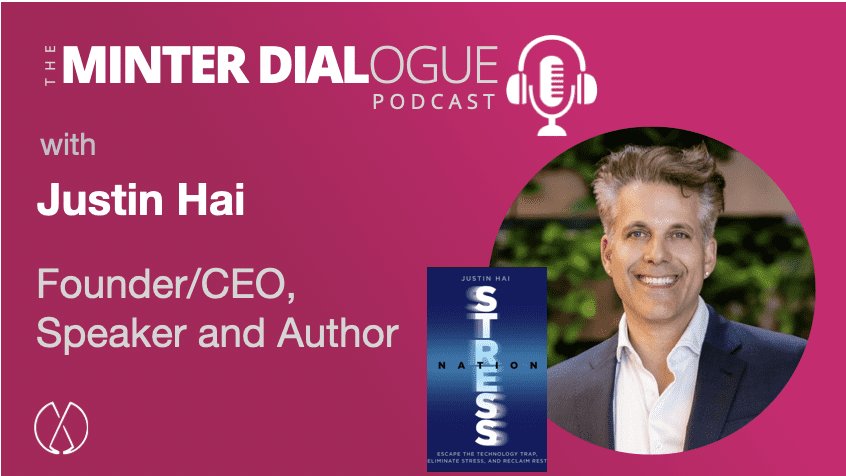
Minter Dialogue with Justin Hai
Justin Hai joined me to discuss the technology-driven roots of modern stress, as explored in his book “Stress Nation: Escape the Technology Trap, Eliminate Stress, and Reclaim Rest.” Justin’s background is as colourful as his insights: a RISD-trained designer, entrepreneur, and cosmetic innovator, he’s also a husband and father whose personal journey through his wife’s health struggles shaped his current mission at Rebalance Health. Based in Colorado, Justin’s approach blends scientific rigor, nostalgia for simpler times, and a deep empathy for our collective battle with stress.
We dove into Justin’s perspective on beauty—not just in aesthetics, but in function, intent, and process. He refuses to see beauty as skin-deep, instead defining it in the design and purpose behind everyday objects. Our conversation moved from the history of cosmetic entrepreneurship to the science of cortisol, the master hormone for stress and rest, and its impact on sleep, weight, and resilience. Justin offered practical systems and routines for leaders and individuals to break the cycle of tech-driven stress, advocating for mindful boundaries in a world that’s always buzzing. His quest is to recapture “JOMO”—the joy of missing out—and create a life where playfulness lowers stress and deepens relationships.
Key Points:
- The Truth about Cortisol: Cortisol isn’t just the “bad” stress hormone—it’s also essential for rest, regeneration, and overall well-being. In modern life, technology keeps us in perpetual fight-or-flight mode, disrupting sleep and driving chronic health issues. Coming to grips with cortisol’s dual nature is key to understanding—then solving—our epidemic of stress.
- Systems Beat Willpower: Justin argues that breaking tech habits takes more than willpower—it requires deliberate routines, schedules, and sleep hygiene. Building healthy systems in teams and at home is the antidote to always-on, notification-driven culture. Leaders should foster boundaries and create environments where employees can truly recover.
- Reclaiming Joy and Presence: The best “redesign” isn’t just in the sound of a notification; it’s in how we live. By prioritising playful, joyful relationships and embracing the “joy of missing out,” we naturally lower stress and cultivate genuine well-being. Justin’s rule? Make his wife laugh five times a day—a reminder to design life for happiness, not just productivity.
This episode is a clarion call to step back from relentless digital demands, rethink what matters, and build habits that support true resilience—not just efficiency. Listen in for actionable ideas, science-backed insights, and a generous dose of humour and humanity from Justin Hai.
Further resources for the Minter Dialogue podcast:

Meanwhile, you can find my other interviews on the Minter Dialogue Show in this podcast tab, on my Youtube Channel, on Megaphone or via Apple Podcasts. If you like the show, please go over to rate this podcast via RateThisPodcast! And for the francophones reading this, if you want to get more podcasts, you can also find my radio show en français over at: MinterDial.fr, on MegaphoneFR or in iTunes. And if you’ve ever come across padel, please check out my Joy of Padel podcast, too!
Music credit: The jingle at the beginning of the show is courtesy of my friend, Pierre Journel, author of the Guitar Channel. And, the new sign-off music is “A Convinced Man,” a song I co-wrote and recorded with Stephanie Singer back in the late 1980s (please excuse the quality of the sound!).
Full transcript via Castmagic.io
Transcription courtesy of Castmagic.io, an AI full-service for podcasters
Minter Dial: Justin Hai. How brilliant. I suppose we’re sort of birds of a feather in some ways. Yankee, British, cosmetics entrepreneur. In your own words, Justin, let’s say, as I like to always ask, who is Justin High?
Justin Hai: What can I say? Who am I? I am a husband first. I’m a father second. And I love what I do third. And what I do changes from day to day and from position to position. So, I like to call myself an adaptive entrepreneur.
Minter Dial: Well, the world of transformation and change, that’s probably a pretty good place to be. So, you’re the author–that was released in the fourth quarter–of the book Stress Nation: Escape the Technology Trap, Eliminate Stress, and Reclaim Rest. A highly engaging title, might I say. We’re going to get into that, of course. I was going to ask you, since you worked in the beauty world and I, you know, something we both shared, I wonder to what extent as a designer you believe in the importance of beauty in our lives.
Justin Hai: Hmm. It’s a very interesting question as it pertains to confidence, as it pertains to, you know, Feeling good within ourselves, I think it’s extremely important. In terms of looking good for other people, not so much. It’s about how you show up in the world, what it makes you feel. So, if you feel confident and happy and joyful and you can spread that love and joy to others, go for it. If you’re doing it for other people, that’s your own choice. I don’t really resonate with that personally.
Minter Dial: Right. So, expanding the environment of beauty, I think of the theory of broken windows. And I ponder the role of an exquisite piece of artwork versus, let’s say, a toilet in the middle of the museum. Is all–are all things beautiful? Just in the eye of the beholder, or do you believe that there’s some kind of absolute beauty?
Justin Hai: Oof, very, very good questions. As a designer, I believe there’s intrinsic beauty within everything. Um, and beauty isn’t necessarily for me aesthetic. It can be mechanical. It can be the, the thought process behind the parts, how they went together, not necessarily just the overall shape or aesthetic of the, of the, of the product. Also, what a lot of people don’t understand, because it’s only typically in the eye of the designer, they don’t always share, is the reason why. And it’s the, it’s the, you know, the, the muse behind it, right? It was the, it was the story and the thought process behind it, not necessarily the end result. It could also be the journey that the person went through that could be absolutely exquisite. And so, I think it’s very challenging to critique something from the outside in purely on one of the criterions when you look at something from an aesthetic stand, um, and design-oriented perspective.
Minter Dial: Yeah. I mean, much like the, the amazing biography of Steve Jobs, how he talked about the beauty of the design within, which is not being visible by, uh, by the consumer. It’s, It’s the beauty for the designers within and making them feel proud, even though it’s behind the painted fence.
Justin Hai: Absolutely. Absolutely. Don’t disagree with you as well.
Minter Dial: Well, so I, you know, looking at your book, Stress Nation, you’re a designer, and you studied at RISD, probably the most well-known school for design, and you did an MBA at Pepperdine. I have a few friends who went there as well. And you said, I’m a designer at heart, and I’m solving, just solving design briefs all the time. How did that designer mindset or instinct to solve problems shape the way you approach the writing of the book Stress Nation? Is the book itself in some way a design solution?
Justin Hai: No, the book is the reason why I started my company Rebalance Health.. And it was purely a medium for which I could educate individuals stepping away from modern technology, which gives you seconds to capture people’s attention. And I think if people are really interested in understanding the science and the psychology behind why we’re so stressed in today’s world compared to 30 years ago, you need to take a moment maybe pick up a book and read a chapter of my book. From a design perspective, I deliberately wrote it so you could pick any chapter. You don’t have to read them in order. They don’t piggyback off one of the other, and they deal with different topics and subjects that one may find interesting. Um, but I’d use nostalgia and I referenced, um, what some would say the good old days, the slower days in contrast to where we are today. So, from that perspective, yes, there was a design process put in place on how the book was assembled and how the information was disseminated throughout the book. The book also contains solutions at every chapter. So, there isn’t just a, you know, you have to keep reading to get to the meat and potatoes. You actually could read a chapter and feel quite satisfied with the information that you’ve ingested, and then you could go into another chapter and it didn’t have to be in sequence.
Minter Dial: Like that. Well, in today’s world where so few people read books, finding ways to create bite sizes like one chapter and alone, someone opens the book, starts from the back and reads from there, so be it, as opposed to having to chronologically slip through from one to the back, from one to the end. The book is filled with lots of anecdotes and stories and some of them very personal. So, the one about your wife, seems to be sort of elemental in, in your shift in the way you’ve looked at traumatic brain injury and the, the notion of cortisol. So, um, what I understand is that she had a brain injury at college and then got a diagnosis of Cushing’s syndrome, none of which I really knew about, but that creates excess cortisol. Cortisol in everybody’s vocabulary typically is but negative. But it’s remarkable how you’ve looked at it differently. And that was one of the most insightful elements of the book as far as I was concerned, Justin. So, describe to us, A, what is cortisol, why it’s better. How this deeply personal quest transformed you from helping, from going for what you were doing to do before to this new business you’ve got.
Justin Hai: Well, absolutely. Um, well, let’s start off with the beginning. What is cortisol? So, almost every molecule in the human body has a cortisol receptor, and no other hormone acts the same way. And so, that means when cortisol is elevated, you really feel it almost at every cell in your body. And that’s where I called it the master hormone, because if it’s elevated and out of whack, it actually can control what other hormones you make. And so, cortisol is an amazing hormone. It’s one of the most important hormones we have in our body. It’s got a bad rap as the stress hormone, the fight or flight hormone, as you allude to. But it’s also known as rest. It has another stage called rest and digest. And if we were to take cortisol at the very, very surface, it is your body’s alarm system. That’s it. It is your body’s alarm system. Its sole job is to keep you safe.. And when you are not safe, it’s elevated and you are in fight or flight. When you are safe, it’s in rest and digest. What has happened over the past 30 years is all the technologies and content that’s coming at us through technology has elevated our cortisol levels. So, we’re constantly in fight or flight. So, why and how does it affect? It’s really a linear progression and it’s very straightforward when you think about it. Cortisol was designed to keep you safe in the prehistoric days. A saber-toothed tiger, a woolly mammoth was chasing you. A bear is chasing you in the woods. Your building is on fire. You’re getting robbed. Your cortisol goes up, anxiety goes crazy, your adrenaline kicks in and you take action or you freeze. It’s one of the two things, right? What’s wrong in today’s world is a beep, a vibration, a buzz, a ding., your body thinks it’s a threat because you don’t know if it’s good news or bad news until you respond to it. Therefore, every vibration, every ding, every buzz is a potential threat, and therefore it elevates your cortisol. That is, in essence, what’s happening now. When your cortisol is elevated all the time in fight or flight, well, your body is a very smart machine, and it’s designed to keep you safe, like I said. So, if you’re in fight or flight and your body thinks you’re running from a bear, a tiger, you’re being robbed, building’s on fire. Well, it turns off libido, it turns off your metabolism. Why? Because it wants to store as much energy as it possibly can, because it doesn’t know the next time it’s going to eat. Which is why we are gaining weight as a big society. We’ve got more visceral fat than we know what to do with. It’s why GLP-1 is going crazy, because everyone’s like, why can’t I get rid of this weight? That’s real simple. You’ve got elevated cortisol. The problem with elevated cortisol is that it should only be high in the morning. It should start to peter off around lunchtime, come down in the afternoon, and be as low as possible before you go to bed. Then it hands it off to melatonin, as if they’re in a baton race. It literally hands off the baton to melatonin. Melatonin prepares you for sleep, and then ultimately you fall asleep quickly, and you stay asleep uninterrupted for 7 to 8 hours. Now, most people go, that never happens. That’s because you have high cortisol, my friend. That’s really that simple. Go back to the ’70s, the ’80s, and even the early ’90s, we didn’t really have a big sleep issue that we do today. Most people were 5 to 10 pounds lighter than they are today. And not because of age, just comparing like to like. You know, a 30-year-old in the ’80s is very different than a 30-year-old in today’s world. They’re bigger, they’re heavier, they have more health issues and so forth. All generated by cortisol. So, if you can’t fall asleep and you can’t stay asleep, guess where you make all your hormones for the following day? At night in bed whilst you’re asleep. You make all your testosterone, your progesterone, your estrogen, your HGH at night whilst you’re sleeping. So, if you’re not sleeping, you’re not making those hormones. No wonder you feel not so great the next day. You have multiple days, multiple weeks, months, your health is just unraveling. It’s all because sleep is the most important thing for your health. Yes, eating, dieting, exercising, all that fun stuff is important. But the number one thing that you cannot do without is sleep, because that’s where your body regenerates. So, if you’re not making the hormones that you need to regenerate, you’re just showing up as tired, exhausted. And most of the time, just people start seeing their health completely unravel. And that is the real reason behind this book, is to explain that process. Use analogies, compare and contrast to different times in history to today. And you’ve slightly–hopefully by the end of the book you’re like, oh, I get it, I get it. You talk about menopause, perimenopause symptoms. They’ve never been so bad as they are today. Why? Because of stress. And I know women go, well, you know, you need–you can’t sleep. So, if I can’t sleep, I can’t get the hormones. But you know, it’s, it’s a chicken and egg. Yes, but I did a clinical study with over 331 women and I saw an 80% reduction in hot flashes, a 94% reduction in symptoms across all candidates and so forth. And I have been published in 3 medical journals because of the studies. So, it is all related to cortisol and it’s all related to the sleep quality that you get. That’s the first part of your question. The second part was my wife. I did not start the company because of my wife. I started the company because out of my skincare company, we were asked to look at supplements for skincare. We turned that opportunity down because I didn’t see a direct correlation between something you put in orally compared to what consumers are used to putting on topically. And so, I was like, eh, it’s not quite right for me. I don’t see the connection directly. But I was always interested in endocrinology. And in fact, our first iteration of our skincare line had HGH inside of it.. But in the United States, the doctors didn’t like the systemic effect. So, we pivoted to peptides and we grew a large skincare company, uh, with peptides. But because I had already had–we’d experimented with HGH, I was still very interested in endocrinology. And as I did that research, I personally latched onto cortisol for the reasons I just explained. From there, um, we were about a year into it, then my wife got sick. And she was diagnosed with Cushing’s. And so, what started off as a passion project and something I was really, really interested in and delve, delve into the science quite heavily pivoted towards nothing’s working for my wife. She can’t sleep. She’s not getting better. No drugs work for her. This is horrific. What can I do? And it just pivoted to let’s do a test. Turns out on this particular test that she had been diagnosed with Cushing’s, which is when your body makes too much cortisol.. And I was like, not arrogant enough to think that I could come up with a solution, but like, I can help. I can help. And I know this space. I’ve been researching it for over a year. Let’s see what we can do. And we put the pieces together to come up with a product that helps. And out of that product spiraled a whole bunch of secondary and tertiary benefits to the product from sleep recovery. You know, just hormone production naturally and people just reporting that, oh my God, I’ve never felt so good. And luckily my wife is doing very well. And I can’t say that we cured her, but I can say that we definitely had a hand in helping her feel better, significantly better, and get into sleep.
Minter Dial: Brilliant. Well, so a few things. I ponder the extent to which cortisol is responsible for everything. Let’s say I put push back a little bit on that because overweight, for example, and, and the, some of the issues in mental health, I tend to point the finger to the food industry and the pharmaceutical industry.
Justin Hai: And well, it’s all connected. It’s all connected, isn’t it? It is not one in isolation, but the outcome of, the outcome of not getting the support that you need is elevated stress and elevated cortisol. So, it all comes back to biology within the body. And the outside stressors have that impact on the human body. And so, yeah, the food industry doesn’t help for sure, right? You’ve got so much artificial nonsense out there and the sugars, but that causes stress and anxiety and it triggers and it puts you in this horrible loop that you find very difficult to get out of. Pharmaceuticals, absolutely same issues, right? They can generate anxiety. And people want magic pills and they’re not getting it and they’re stressed and all of a sudden cortisol and stress goes up. It all comes back to how the body reacts and how the body reacts is through cortisol.
Minter Dial: Yeah, I guess what I’m looking at is more what, what is causing the problem of the cortisol rather than the cortisol itself. And I might have a narrative that looks a little bit differently at the idea of safety. So, if cortisol is there to provide you safety, I tend to feel like our tolerance for risk has decreased. You know, obviously there’s some entrepreneurs and there’s some people risking their lives, but on balance, we tend to glorify the individual, want to live forever and avoid all forms of risk, including death or aging.. And I feel like that is a, probably a cortisol driver as well.
Justin Hai: I think if that was truly the case, the majority of people would be doing more to educate themselves and do more to put themselves on the right track. I mean, 92% of people can’t keep their New Year’s resolution, right? And so, that should give you some idea that the psychology behind the pressures that people put on themselves one way or another are also a reason for the cortisol levels to elevate. But when you’re in high levels of cortisol through whatever medium got you there in the first place, your body isn’t helping you because it’s storing that visceral fat. It’s storing its reserves because it thinks it’s in danger and it doesn’t know when it’ll eat again. So, you could be eating endlessly, just constantly eating endlessly, thinking, I’m trying to use this food to keep me awake, to give me energy, to keep me going, and I’m working out, but it’s not coming off. It’s–the weight’s not coming off. And that’s because your brain is thinking that you’re in fight or flight all the time.
Minter Dial: That cycle needs to be broken. Well, I am sure that cortisol is, you know, can be good and bad. And now as I listen to you, I feel very changed in my mind as to what it is, just like there’s good stress and bad stress within our lives. But I do feel that as a society, let’s call the West, but it’s not just the West. We know that the same types of issues are existing in Asia in different ways. But what about resilience? Because it feels like there’s a lot of discussion, great book by Angela Duckworth on grit, that as a society we’re not quite as resilient. And I wonder what role cortisol has to play in resilience if there is a link.
Justin Hai: Interesting. I think it depends on the individual, right? There’s those that are able to perform at high levels of stress, like athletes, for example, extreme resilience and thrive off that. And we’ve worked with the Nike running team. We’ve worked with men’s hockey, field hockey team stress. Is something that athletes deal with all the time, and they’re always focused on cortisol. I just actually talking to the firefighters the other day, that’s all they talk about is how we can control our cortisol levels and how we can support it. And I think it’s very unique to the individual. So, how does resilience play into that? I’m not 100% sure, to be quite transparent. I think it is designed on the individual and what their particular makeup is. Some people thrive off stress and are naturally resilient to it. I apologize. That’s a phone call that came in that I’m on mute, but they get through.
Minter Dial: So, I apologize. It does happen like notifications, you know, when the, when, when the iPhone resets, a lot of they, they like the apps will just rejig the notifications to be back on sound on.
Justin Hai: No, back in there all the time. If they’re family or so forth, it will always come through, right? So, for emergency calls, So I apologize. We were saying, the firefighters I was speaking to and the athletes I speak to, they inherently thrive on stress, but their body doesn’t recover and they suffer with sleep. And so, that’s constantly their nemesis is trying to figure out how can I sleep? How can I lower my cortisol in the, in the early evening so that I can actually fall asleep and stay asleep? Because I know I need to regenerate. I need those hormones to help me function the next day and allow me to operate at my absolute best? That’s a challenge. And so, I don’t think we naturally have resilience to cortisol. Cortisol is a chemical reaction in the body that for the most part is pretty consistent amongst everyone that I’ve spoken to and in the people that have been in our studies. It’s a matter of how you can control it and enable, enable it to actually become in the normal circadian rhythm that we’re supposed to have. And I think that’s where I go to in the book. You talk about what’s responsible for the, the stress and the cortisol levels. And I point quite clearly to technology, as simple as that. Because if you go back to the ’80s, my favorite time to reference is simply that you had beginnings and endings to your day, different parts of your day. You went to work, you left work. When you left work, you were gone. They couldn’t get you. If you weren’t at home, they couldn’t get you at your home phone. So, you were out, you were gone until you showed up the next day. Modern technology has brought that office with you in your pocket no matter where you go. You could be at a sporting event, you could be at a wedding, you could be on holiday. That office is in your pocket and that generates additional stresses for you. Also, people are beginning to get better at boundaries, right? The boundaries around when you take calls, when you take texts. But historically, people have been trained that when you text someone, you expect a text back within a reasonably short amount of time. Used to be a phone call, they’ll call me back. But when you leave messages, you send texts, you’re kind of expecting more immediate communication. And that demand is also placed on yourself. So, when someone sends you a text, you feel like, do I respond now or do I ignore it? I think people are beginning to get better at ignoring it and responding when it was appropriate for them to respond, as opposed to the pressures of responding right away?
Minter Dial: Well, so I am a tad older than you, Justin. And a few things come to mind. First of all, when the telephone call used to come back in those glorious ’80s, you answered. Many, I mean, back in the ’70s, we didn’t even have answering machines.
Justin Hai: So, the telephone calls were–if you were there.
Minter Dial: But if you were there, of course, if you’re not there, then there’s no sound, you don’t hear it.
Justin Hai: There’s no interruptions, no stress considered, because that’s where my point is.
Minter Dial: Yeah, that’s where I understand. And I think today when people call me, it’s almost an invasion of my privacy. The point I want to get to is that I went to university in America like you, and I studied sleep. There were 4 courses of sleep back in the ’80s that I took. And one of the things we looked at was sleep through the ages. And while we live in these times, because this is normal, this is our life, there weren’t many times in the history of the human being that sleep has been a great, easy 8 hours, obviously for everybody. I mean, just to take some examples, of course, you can have the king. Well, even the king had to have people onlooking while they’re having sex. To make sure that the babies were properly from him or her, you know, whatever. But people had 10 kids. They all slept in the same room. Many people sleeping in the same bed. I just don’t think that their sleep was perfectly great. Think of the smell, the cold, no lights and all this and that and how it was not easy to sleep over most of our lives. And so, I think, I feel like in today’s world, this is our challenge, the technology. But there have always been challenges getting in the way, or always, I think anyway, of the human being’s ability to have a great night’s sleep and a penchant for well-being all day long.
Justin Hai: Yeah, you know, it’s interesting. I think also you got to look at quality of life through the ages, modern conveniences that have supported better quality lifestyles.. And so, yeah, you can go back, you know, 200, 300 years and the average lifespan was not very long. We seem to have reached a peak where on average humans are tending to live longer because of medicine and conveniences that are out there. But you can definitely see through the medical industry how disease is being creeping up and up and up and up.. And I think if you really did a study, and I have not done one, but I’m basically hypothesizing here that lifespan has kind of got a bell-shaped curve to it and we’re coming back down the other side of it, in my opinion, simply because of the level of disease and the stress and the pace of the world. And obviously, you know, there’s obviously war today and it’s unprecedented how many people can die so quickly in today’s world compared to many, many, many years ago. But Essentially, I think you’ll find that we’ve reached the peak over the past, say, 50 years. Somewhere in the past 50 years, we peaked out where we were getting good sleep, we were getting better quality life from our food supply, etc. And as that food supply changed, as you correctly pointed to, we went from farm to table to more processed and synthetic foods. Now we’re getting into really an abundance of information technology that’s causing a lot of people to stress unlike ever before. And that is having detrimental effects to their health. And I think what’s going to happen quite, quite quickly is we’re going to start saying enough because we are not machines. And what’s happened over the past 30 years is we’re trying to keep up with technology. We are acting like computers and we’re not. We are still the same humans that we were. In the ’50s, ’60s, ’70s, and even before. But I think the onset of medicine and technology that to support better quality lifestyles, um, basically hygiene in the home, running water, that type of thing, has enabled us to live better quality lives and get better sleep. But I feel like the time has passed. I think now we’re heading down the other side unless we personally take action for ourselves and draw boundaries around what we do with our hours that we’re awake and the hours that we’re asleep. I think that I would disagree to some that there’s never been good quality. I think we’ve seen it.
Minter Dial: It’s passing us by, but we can get it back if we’re educating ourselves. Well, who’s to know the right about that? What I do believe is that we are getting sicker. But not because necessarily we are sicker. There’s a massively interesting book written by an English doctor of neurology called Susan O’Sullivan, who wrote the book The Age of Diagnoses. And her thesis is basically that we have gotten to a point where we prefer to be ill than healthy. Her thesis is that we are making well people ill through diagnoses that are not even pathologically provable, and therefore bringing in pharmaceuticals. And, oh, look at me, I’m sick, I have this illness, and, you know, that allows me to have more time for my exam or whatever it is.
Justin Hai: Oh yeah, I, I, yeah, I see where you’re going. But, but I think in general chronic disease has increased dramatically, whether it’s heart disease, obesity, Alzheimer’s, what have you. I think disease has increased dramatically over the years. Um, what you’re talking about is almost gamesmanship, right? I can be, I, I can be diagnosed with ADD and therefore I need another 50% more time, blah, blah, blah. I’m not dismissing any of that, but yeah, I’m talking more chronic disease, not necessarily the, the gamesmanship that parents play or children play to be able to get the one-up at school. Um, I think the, I think the onset of, you know, mass-produced plastics and mass-produced foods is more damaging than we actually realize.
Minter Dial: Simple as that. Yeah. I think that the, the need for attention that the smartphone plays into in social media, which is part of your, you know, the whole gig. Is also where this links in is that look at me, I want to, you know, like me, look at how I’m…
Justin Hai: this FOMO. Yeah, that’s, it’s all the fear of missing out, which is inherently built into our DNA. And, you know, whether it was by design, I’d like to give people the benefit of the doubt, right? Whether it was by design or not, right? That’s what social media and apps play to. They play to that fear. Of missing out. I mean, my kids talk about streaks and, you know, having–right. Yeah, yeah, exactly. Duolingo streaks. And it’s like they don’t want to mess it up. They don’t want to lose out. You talk about followers and likes and having this persona online. And as a parent, that’s absolutely our worst nightmare, trying to explain to kids what’s real and what’s not. And now with the onset of AI, it’s a whole other level. But essentially it’s like people post online what they want you to see, not what’s really happening in their world.
Minter Dial: It’s not real. Oh yeah. Well, that’s the thesis of my new book, which is called The Avatar Trap, which is all about our inability to tolerate reality, including, as I was mentioning before, the ideas of risk and death. And while you have some people who are all, you know, $640 billion being invested in anti-immortality or anti-immortality, anti-aging and such to try to live longer. That’s maybe the one side of society that has too much money and thinks that they have such grandiose identities that they deserve to live forever, as opposed to the rest of us who are on the bell curve coming down. And by the way, just to add into it, Justin, the way I read the book is I’m a type 1 diabetic. And as a type 1 diabetic, I am very convinced that it was directly related to stress. About half of people who have type 1 diabetes, they get it as a juvenile, and then the other half get it as late onset, which is what I did.
Justin Hai: And I think that the stress was directly related to kicking off my autoimmune reaction.
Minter Dial: Right, right, right, right, right. Just to let you know how personal that is. You have this thing called the $10 million question. I thought it was very nice. It’s a very provocative thought experiment. What if someone offered you $10 million to give up your phone for a year? Would you take it? What does the answer to that question reveal about the depth of our biological rewiring? And what are the most surprising responses you’ve encountered in asking that question?
Justin Hai: I’ve never actually asked it to anybody. I wrote it in the book as an example because I felt like it was very intriguing. And the people that read the chapters and helped me write the book, we sat around and we spoke about that because growing up in London, I used to remember the entire bus schedule. I knew the underground map. 52. Yeah, exactly. I knew the underground map, the 18 bus, right? I knew everything, right? I knew my friends’ phone numbers. I knew their addresses. I didn’t have to think twice. It was almost–by the time I was 17 and driving, it was almost like I had done the cabbie exam. I knew my way around the West End, the back doubles. I didn’t need a map. Because, you know, it was a piece of paper, it was a pain in the butt to put it on the steering wheel and try and trace where you were going. And so, exactly, they’re the A to Z. And so, you, you just had that and you compare it to today and it was like, oh yeah, and it’s like, you know, I used to spend hours in my room with my ghetto blaster recording from one cassette to another cassette or from a DVD, uh, a CD to a cassette to make my own mixes. We are so spoiled today and so much is done for us that I think we are losing some of that creativity. And I think as a designer, that’s my biggest concern. I’m seeing designs coming out of AI. You know, the music industry has been decimated by digital music as opposed to actual, you know, skilled musicians playing. And, you know, I have a good friend that’s in the music industry. He talks about it all the time because there’s They’re just not making songs the way that they used to. They just don’t. And it’s just very interesting having these conversations at how with the technology’s got in many ways a yin and yang effect, right? There’s good and there’s bad, there’s positive and there’s negative. And when you ask about the $10 million question, it just posed, do you think that you could get, if I dropped you off in the middle of London, could you figure your way out? Would you be able to make a phone call? Would you be able to not be able to resist the urge to share the news with someone? Would you want to put it online and have your ego be boosted by all the likes and the wows and the thank yous? And would you be able to take photos? We used to have film, right? We used to have 24 photos on a roll of film that I used to process in, in the, in the photo lab. And ISO. Yeah, exactly. In the sixth form, I used to go in the darkroom and process the film. And so, you would have chemicals. Yeah, you were very selective with what you took photos of because film was expensive. And today, selfies all left, right, and center. It’s, it’s, it’s nonstop. And it’s wonderful that you can do that. But I think the art of being creative, selective, and retaining information is gone, especially in the younger generation. It’s just gone. It’s kind of like when I went to RISD and I studied industrial design. It was at the, the peak of industrial design. You know, Jony Ive had just stepped in at Apple. We’re beginning to go from the beige Apple computers to more colorful iMacs that came out, and design was really leading the charge. You go forward today, now engineers are doing industrial designers’ work, and so you understand what has been done something’s been designed by a natural designer and you understand when it’s been done by an engineer. It’s pretty obvious, right? Because industrial designers typically draw the most beautiful organic curves and sketches, hand it off to the engineer, go, you can’t make that, it’s impossible. It’s not my problem, right? So, that’s, that would be it. An engineer goes, well, it’s going to have 90-degree angles, a 45-degree angle. It’s going to be able to be easily manufactured. So, there’s, there’s different thought process that goes through it. But I think that creativity, that uniqueness is getting lost in many industries. And it is about who can generate something as fast as possible, spit a profit. And if it isn’t built with quality or didn’t have–wasn’t completely debugged, oh well. And planned obsolescence is coming in. Cycles are getting faster and faster and faster and faster. And honestly, consumers are getting confused as to what’s real, what’s not. What’s actually made with quality, what, what is just mass produced as quickly as they possibly can. Um, there’s a lot of smoke and mirrors everywhere, particularly in the supplement industry, right? 95% of supplements don’t get into the human body. Yeah, you swallow them, but they get destroyed. They actually get into your body.
Minter Dial: And yet people are swearing by this product or this product. Well, there’s the placebo effect. 100%. 100%. I think I’m doing good for myself. And that can be good. If I think I’m going to win, I can visualize myself winning.
Justin Hai: That’s a good thing.
Minter Dial: So, sometimes–The mind is very powerful. Yeah. Sometimes it works. However, one of the things that’s most striking in Stress Nation, Justin, was this notion of what you talk about willpower, saying it’s not willpower alone isn’t enough to break our technology habits. Correct. So, you got, you built a lot of systems, whether it’s Rebalance Health, Alastin Skincare and so on. What kind of systems would you suggest that leaders need to put in place for their teams in organizations rather than just telling them put the phone down?
Justin Hai: It’s routines, it’s routines, it’s schedules, it’s getting into a rhythm of thing. Do something for 30 days and you start to make it a habit. It’s building those healthy habits. Yeah, Rebalance, we developed a product, a mint lozenge that you suck on that helps bring your cortisol levels down and you take throughout the day. But if you don’t take it, it doesn’t work. Right. It’s the same thing as brushing your teeth. You don’t brush your teeth, you’re going to get cavities. Right. It’s really as simple as that. You have to actually be mindful and put in the time to build a schedule and a routine to build a habit. It’s like going to the gym. If you wake up every day early in the morning and the first thing you do is go exercise, go for a walk, go outside, go to the gym, guaranteed to start your day off much better than if you pick up your phone. The instant you pick up your phone, you start that stress cycle again. The moment you go outside and you exercise and you get sunlight, instantly your body is feeling significantly better. It wants movement. It wants sunlight, and the phone is keeping us inside. It’s keeping us tethered to our sofas, our beds, our desks. And so, it’s all about building routines and habits. And that’s–it’s as simple as that. But the most important habit for me is really the bedtime routine. It’s the sleep hygiene component of it. It is trying not to raise your cortisol when you’re deliberately trying to lower it in order to go to sleep and stay asleep.. And so, really those 2 to 3 hours before bed are key.
Minter Dial: You want to stay away from anything that’s going to give you a spike. Grand advice, Justin. Of course, I’m thinking about this with my type 1 diabetes. My glycemic reader goes directly to my phone, which is attached to my watch, to tell me when I’m having a hypoglycemic moment, and it wakes me up, which is kind of useful. Because I can go into a coma and die. However, yes, it’s very helpful. Very helpful. However, so the reality is I need to regularly look at my phone for that purpose, which is a real beast and a burden to my life. But going back to the business concept so that I understand the advice for the evening, that’s great. You were an entrepreneur and we were talking a little bit beforehand how it’s, you know, it’s all hands on deck. It’s 24/7. Life is crazy until the cash burns out and so on So you got the speed of time, the need to be efficient, effective, productive all the time, even in big business, it exists. So, going to a lunch with somebody with your family, no phones at the table, I think that seems obvious. However, when we’re in business meetings, you like the temptation to pull out the phone, send an email, wait to get the expected response right away as the leader. Wait, wait, you didn’t answer me quickly. You’re fired. You know, there’s a lot of that kind of a pressure in business. So, what kind of advice would you have with a leader in a business environment? So, in other words, before, not before bedtime, but sort of in the office to manage in a healthy way, being effective, productive, efficient, so on and so forth with this idea of get rid of the phone.
Justin Hai: Well, there’s, there’s two ways you can answer that. Number one, you know, um, if you’re good at your job, you know the answers, you should be able to manage that, right? If you don’t know the answers and you don’t know what you’re doing, then you ultimately are going to get fired, right? That, that’s just some basic realities right there. Um, the pressures of multitasking and doing multiple things at once is really where it comes down to in today’s world, because we are being asked to do so much more than maybe we should be. And so, I think it’s very important to try and keep a level head and try and, you know, manage your time effectively. And from a leader’s perspective, it’s, you know, you can have burned-out employees and you can churn and burn your employees if that’s what you want to do, but most people aren’t going to respond well to that. I think in today’s world, people are beginning to really, really cherish employers that understand that mentality, whilst once in history was once upon a time in history was a strategy that was very popular, just doesn’t work in today’s world. Social media is a dangerous tool. I know many people that, including myself, that have sat on the toilet and Accidentally, my legs have gone numb. We’ve been scrolling for too long. We’ve been playing that game. We’ve been reading that book. We’ve been watching a movie, whatever you were doing, and you shouldn’t have been there, right? You’ve just gone down the rabbit hole. And so, I really don’t like giving lots of advice to CEOs about how they should run or not run or treat their employees or not treat their employees. I think the employees are becoming very savvy and they know what kind of environments they want to work in. It’s challenging because, you know, particularly in my current company, we’ve got investors, we’ve got shareholders, I have a board, I have to make sure we have results, we have to develop things. It is extremely stressful. But I think what’s very good is because of this company, I’ve learned to turn that phone off, to shut it down, to not have it by me. In the bedroom, um, whilst I’m sleeping. I deliberately try and put that thing away. I’ve taken off all social media off my phones. I’ve encouraged my employees to do the same thing because then you don’t get stuck on this device going down the rabbit hole. If you need to go to social media for business, for work, or even for, for pleasure, you have to be at a desktop. You have to be on a screen. It’s not quite so easy to, to scroll and, and you get out of that addiction. I’m all about providing superior healthcare and support. So, I took care 100% of the medical expenses for the employees where it’s not always that popular. Some people are doing 60%, 70%, but I don’t want employees to be stressing about something as simple as basic healthcare. I don’t nickel and dime people for their salaries, right? If someone you know, needed an extra $5,000 or $10,000. It’s not a, you know, win-lose. I won the negotiation, I got you for $10,000 less. Um, you know, if the employees got peace of mind that their expenses are paid for, they can live, and they can focus at work, that’s worth its weight in gold. Um, I remember early on it was always a, you know, Can we get this person for less, less, less, less, less? And I’m not talking about overpaying for an employee, but I’m talking about a true fair market salary. So, I think that there’s ways that employees can feel more at peace and at rest in working for an employer that respects them, understands what’s going on. Also, a big thing that I try not to do, and very rarely do I do it if at all, is call after hours. And I don’t call on weekends. I respect employees’ time away from the office. If you’re that person that calls all the time on the weekends, I need this done, have you responded to this email? I think you lose respect and you lose that employee’s willingness to go above and beyond when you actually need them to go above and beyond. So, you know, if I do have to call someone of an evening or on the weekend, they know it’s real. And they respond.
Minter Dial: And that’s the kind of loyalty and respect that goes both ways. You do something that feels purposeful, that’s fulfilling and doing something good for the world, not just selling another beauty cream, so to speak. And I was going to get into that, the sort of the dilemma of selling on people’s insecurities, which is basically what the beauty industry does. But I want to get into another last question for you, Justin, because time is of the essence all the same. And we are fortunately able to do this call Colorado to London, thanks to technology.
Justin Hai: So, it’s not–Yes.
Minter Dial: No, it’s not a bad thing. No, not at all. Yeah. And I’m quite radical with my notifications. I rarely ever have a red banner that appears on my home screen even on the back screens. I, whenever I see somebody who has 4,000 messages, you know, unread, I’m thinking, oh my gosh, that is heartache going to turn into ulcer.
Justin Hai: Yes, you and I are very similar. I don’t have any notifications on my phone whatsoever, but I also believe in a zero inbox. So, when I get emails, I deal with it. And I think that was just something I learned from business school, which is Pick up, open up a letter, read it, and do something with it. Either file it or throw it in the, or throw it in the rubbish. You know, just don’t put it back in the pile on your desk. And I’ve always had that mentality. So, whenever I see something, I deal with it. Um, but I agree with you. I don’t have any notifications on my phone. Those notifications that are banners are on the home screen, not good for cortisol. So, I just simply don’t have them. But I am mindful enough that once an hour I look at my email, I look at my messages, and I deal with it all.
Minter Dial: Well, and I would just put a little bit of a buffer. First of all, the iPhone sometimes, or for example, settings of the set, there’s a red button that comes in the settings that you can’t really undo because it’s saying update the software. So, there are times when it gets through the system. And just like you had your phone call, you know, you can also allow for, yeah, if you’re intentional, about the notifications you want to have coming through.
Justin Hai: So, you’re not the victim of everyone else’s notifications. Oh, 100%. 100%. So, you’re talking about that. I want to come across as a hypocrite. My family, meaning my two children and my wife, are the only ones that get through that notification wall. And it simply just rings. It just–the phone just rings and it rings. Everyone knows if it’s my family, I pick up. I don’t care where I’m at. Simple as that. Because that’s what I, that’s who I am.
Minter Dial: I believe family first. I’ve always believed in that.
Justin Hai: That’s how you started the conversation, Justin. It’s how I believe, family first. I wanna be that dad that my kids can rely on 99% of the time.
Minter Dial: End of the story. Like 1% for me. That’s cool. Well, last question, which is, is sort of a little bit more of an ethereal question based on your design. So, we all know that notifications are, are fairly much horrible. The intention behind them is to grab our attention. But if you could redesign the default notification sound, if you will, or I suppose the sound in general, from a designer’s perspective, what sort of sound would you like to have, so to speak?
Justin Hai: You know, I’m going to answer that question with a different proposition. I don’t think it’s a problem with the tool. I think it’s a problem with how we’ve prioritized our world. And I like to end podcasts because typically the people ask me, what’s the one piece of advice you would give? And my piece of advice is really simple. I live my life with very few rules, but one of my rules is I need to make my wife laugh 5 times a day. And that means I get to flirt, I get to be a kid, I get to do stupid stuff. And have fun with my wife. And you know what? That drops cortisol like a tank. So, because I believe in living my life with a little bit more joy and lightheartedness, right? My grandfather taught me to live life seriously, but enjoy it. Be a jokester, have some fun along the way. I think that offsets what your question focuses on, which is the technology. And is it a–is there a new design that could come cross in a better way. And I think the new design is how you live your life, not the tools that are within it. They are tools. They should only be tools. And if you can design your life in a manner that makes you happy and others around you, I think the tools will fall back in their rightful place. What’s happened is those tools have been elevated to a status they should never be elevated to.
Minter Dial: And that’s how I’d redesign it. Beautiful. On these fine words. We didn’t get to talk about your JOMO, which I was thinking must have been in relationship to your wife JoJo, the joy of missing out and adding more fun, flirting with your wife.
Justin Hai: Some great advice. How can–Yeah, joy of missing out is really very simple. It’s living in the moment and being content in the moment and not thinking about what am I missing, which is what social media does for you. So, that’s part of, again, flirting with your wife, having fun, go doing stuff that you used to do when you were a teenager and we didn’t have the technologies. Go have fun, go get yourself dirty, go play in the mud. It doesn’t matter. Your cortisol will tank, your joy will go through the roof, your relationships will just multiply.
Minter Dial: And guess what? You will sleep like a baby.
Justin Hai: Grand words.
Minter Dial: Justin, how can someone track you down, learn more about your business, get your book? What are the things–these–the, the calls to action that someone has to pick up the phone, probably, I’m afraid, to do.
Justin Hai: But hey, this is for good reason. Yeah. Well, rebalancehealth.com is our website. You can find our products and the books there. Books will push you directly through to Amazon, which you can also search for stressnation.com. We are currently working towards retail, so we hope to have our products on the shelves across the country before the end of the year, hopefully by the summer in the States in particular. In the United States. Unfortunately, it’s not so easy to get things over to the UK at the moment. We have some tariffs, some issues to deal with, and I’m a big believer in making things affordable. Our products retail for about $39.99. We offer, give very steep discounts on our products. We don’t believe that we should be gouging people for something that should be very readily available for everyone and can make a meaningful difference in your life. So, we’re trying to go to retail and make this really accessible for everybody.
Minter Dial: Fabulous. Justin, many thanks. Hopefully we’ll have a chance to, uh, shake hands in real life one day.
Justin Hai: I would like that very much. Thank you for your time. Thank you for having me on your show. Been a pleasure. Bye, Wes.

Minter Dial
It’s easy to inquire about booking Minter Dial here.