Minter Dialogue with Rebecca Rowntree
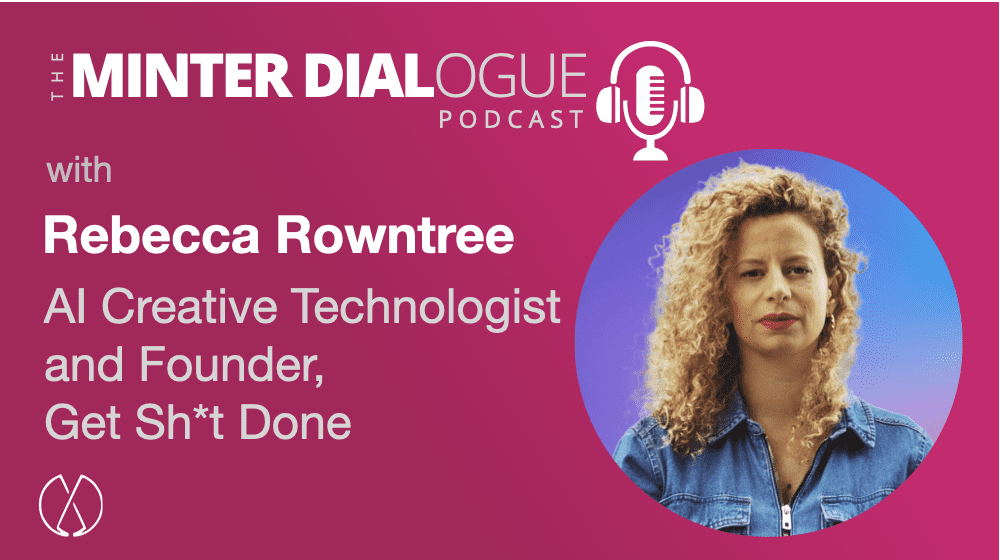
Rebecca Rowntree is an AI creative technologist and founder of Get Shit Done, a vibrant creative community that connects over 700 minds through events and WhatsApp. Based in London and equally fluent in French and English, Rebecca has led global campaigns for brands like Nike, PlayStation, Kellogg’s, Uber, and Sainsbury’s. She joined me courtesy of our shared friend Zoltán Vass, and immediately brought both empathy and practicality to our discussion—from her marketing background to her mission making AI more accessible and human.
In our conversation, Rebecca shared her journey from creative director in advertising to AI innovator, building custom AI assistants like Dave and Roxy that went viral due to their relatable personalities—each shaped with empathy and cultural awareness. She explained the overwhelming nature of today’s AI landscape, drawing a distinction from the dot-com era, and highlighted the need for AI literacy, not just strategy, so we broaden the types of voices shaping new technology.
We explored how bilingualism, empathy, and curiosity fuel her approach to both creativity and AI. Rebecca emphasized organizing creative work within “sandboxes” of restrictions, viewing limitations as opportunities to engage audiences—whether on social media or with AI prompts. Her WhatsApp community is intentionally intimate and focused on exchange, resisting performance culture and self-promotion, so members help each other tackle real creative and professional challenges. She’s also a fierce advocate for women in AI, aiming to make the field more inclusive and less bro-dominated, which she expands on in her Substack newsletter, “The Woman Who Talks to Machines.”
Key Points:
- Human-Centric AI in Practice: Rebecca’s approach centres on making AI more human, not overwhelming—by teaching the art of prompting and creating empathetic, personality-rich assistants. This grounded, accessible method empowers more creative minds to join the conversation and shape AI’s evolution.
- Community as Generosity Engine: Her Get Shit Done WhatsApp group thrives not on self-promotion but on mutual support. Rebecca curates thematic projects (like founder directories) and enforces rules so the group remains a space for real help, not distraction or performance.
- Empathy and Curiosity as Creative Superpowers: Drawing on multicultural experiences and her marketing career, Rebecca asserts empathy and curiosity are essential for resonating with audiences and staying plugged into culture—whether through campaign work, community-building, or AI innovation.
If you want to follow Rebecca’s work, discover her AI assistants, or join her community, just connect with her on LinkedIn or visit her Substack. And if you’re seeking ways to make technology more human, Rebecca’s story is proof that the best solutions start with connection and curiosity.
Further resources for the Minter Dialogue podcast:

Meanwhile, you can find my other interviews on the Minter Dialogue Show in this podcast tab, on my Youtube Channel, on Megaphone or via Apple Podcasts. If you like the show, please go over to rate this podcast via RateThisPodcast! And for the francophones reading this, if you want to get more podcasts, you can also find my radio show en français over at: MinterDial.fr, on MegaphoneFR or in iTunes. And if you’ve ever come across padel, please check out my Joy of Padel podcast, too!
Music credit: The jingle at the beginning of the show is courtesy of my friend, Pierre Journel, author of the Guitar Channel. And, the new sign-off music is “A Convinced Man,” a song I co-wrote and recorded with Stephanie Singer back in the late 1980s (please excuse the quality of the sound!).
Full transcript via Castmagic.io
Transcription courtesy of Castmagic.io, an AI full-service for podcasters
Minter Dial: Rebecca Rowntree, I’m delighted to have you on. We have crossed paths several times. We have in common a wonderful Zoltan Vass, who helped facilitate this particular conversation. But as I like to start off, Rebecca, who are you?
Rebecca Rowntree: Well, thank you for having me. Who am I? That’s a very good question. And I sometimes struggle to answer it. In fact, I have built Rebecca AI just to, to help do that. We can touch on that a bit later. But for anyone listening, I am an AI creative technologist. I used to be and still am to some extent a creative director in advertising, but I’m also the founder of Get Shit Done, which is a creative community that started with events 8 years ago. With the sole purpose of getting shit done. And now it’s also on top of the event, it’s also a WhatsApp community of 700+ creative minds. So, yeah, that’s kind of me in a nutshell.
Minter Dial: We are going to get back to that topic for sure. Zoltan informed me that you studied together at the University of Oxford at Said, and then you also part of the Brains with A and I capitalized. To represent artificial intelligence. What are the, what are the brains?
Rebecca Rowntree: Yeah, I’m so lucky to be part of that. And Sultan started it from our cohort whilst we’re doing 6 weeks on artificial intelligence at Oxford University, and it has been the source of just constant push in terms of AI. So, we have this WhatsApp group, I think we’re about 200 now, or like the entire cohort, and Every day, week, we sort of push ourselves to learn more about AI, the new sort of stuff that is happening. Obviously there’s stuff happening all the time and yeah, and teach each other and help each other out basically in that world.
Minter Dial: Beautiful. It feels, Rebecca, that in today’s world, AI is about as omnipresent as the dot-com was about 20-odd years ago. As we sort of rolled into it. If you don’t have a dot-com, you don’t exist. Would you say if you don’t have an AI strategy today, you are likely not to exist for long?
Rebecca Rowntree: Yeah, yeah, it’s an interesting point and I’ve thought about this a lot. I would argue that it is very different from dot-com in a sense that if you think about the dot-com boom, you kind of were able to understand it. You might not sort of change your business into a website, etc., but you were able to understand it a bit more. And the thing, the kind of analogy that I love with AI is there isn’t a week that I don’t get surprised by AI, and that tells you just how fast and far it’s going, and it’s almost hard to catch up. So, it’s really hard to really, um, to compare it. But yes, you’re absolutely right. I think, and also I should say that I, I do a lot of AI workshops for that very reason. I’m trying to get people to be part of the AI world because it is really important to not just have a strategy but to just be literate in AI. Otherwise we’re just going to get the tech bros just leading that, which we don’t want, oddly, from my book.
Minter Dial: We’re going to get back to that shortly. But it does feel rather overwhelming. You and I are navigating in the world of AI. You have your brain’s WhatsApp group, your creative WhatsApp group. Everybody is talking about it and it just feels like it’s everywhere. My other topics I often talk about empathy is this idea and empathy is sort of everything like humanity. How, how do you orient your learning and not be in a million rabbit holes at the same time?
Rebecca Rowntree: Yes, that’s a very good question. And by the way, I’m also a big believer in empathy. I think it’s a superpower. So, I’m really glad you said that. So, for me, in fact, I just did an AI workshop on Monday, so it’s like fresh in my mind. And my thing is, one, I’m angry about the number of social posts, LinkedIn, newsletters that keep sort of saying, open, you know, ChatGPT is dead, take this tool instead, etc., constantly. And I think that really is what creates a sense of overwhelming and like you just don’t know where to start, what it’s all about. And I just want to call them out because I think it’s really bad that they are doing that. All they want when they do things like that is for you to follow them on social follow their newsletter, etc. So, my belief is, yes, it’s overwhelming to some extent, but actually, if you reduce it down to the art of prompting, which is the way to communicate with the machines, with AI, then it’s not overwhelming. And that’s what I kind of teach and what I’m all about is trying to show a very human side of AI, but also very simplistic way which is if you know how to prompt well and know how to do it, you can just do it on ChatGPT, Claude, generative AI, you will feel a lot more confident. So, yes, it’s overwhelming, but you can have a much simpler solution. Right.
Minter Dial: Well, I’m going to just wiggle in with you in a second because I love that you do it that way. It’s very practical, this idea of a prompt. Yet have I observed that my own prompting skills are fairly nil. And so, what I’ve now done is I ask the LLMs to help me with the prompt. And I say, I want to do a prompt in OpenArt for an image that accompanies this blog with this text. Provide me one. Make sure that they don’t have words on the image and, you know, this whole thing that I want out of the image. But the prompts that the LLM create for me are so much better. And here’s the issue. Here’s the issue is what am I learning? How do I learn from that? So, move from just copy paste, slap it in, get brilliant images to really understand what’s going on within the prompt to make it good.
Rebecca Rowntree: Yes. Okay. That’s an interesting question. So, yes, you’re absolutely right. Never write your own prompts. Always make AI write it because think about it, machine to machine talking to one another, they’ll always understand things better. So, I would argue that you learn by seeing, for example, now I do markdown prompts, which are, you know, huge amounts of prompting all in one. And you learn by just seeing how it’s sort of divided. I think there’s always kind of 5 key pillars of like, what’s the role, how it should act. Context, what the format you want. That’s a key bit of your prompt. And then yeah, you just learn by seeing the prompts. And then of course, I would really recommend to– the things I do in my workshop, for example, is to build AI assistants so that you don’t just always use a prompt. You use– the best way to call it, like a mini agent within ChatGPT, like a custom GPT. So, that it just does that. It sort of has that same prompt over and over again, and you just sort of have your results that you want. I think that’s a simpler way, and then you’re using AI a lot better. Does that make sense?
Minter Dial: It does indeed. So, I, this is basically a selfish question, but I use probably 5 different LLMs at this point. And I’m just wondering to what extent, maybe you can just clarify, the LLM that I’m doing a number of researches or prompts on, does it capture me? To what extent is it now becoming an assistant to Minter in the collection of prompts? I have subscriptions for all of them. Or is it still pretty much new territory each time I create a new prompt? In other words, does the library help understand me better, or is it really going to be a new version of me every time?
Rebecca Rowntree: It depends. So, memory is key. First of all, the future of AI is going to change drastically in the next 6 to 8 months because it’s starting to have more memory built in to the LLM. So, this kind of problem that you’re talking about might be all gone in 6 to 8 months. It might be longer, but who knows? But yes, it depends how you have set up all your LLMs. So, I spend a lot of time making sure that my memory in my LLMs is up to date. And if it’s not up to date, a really great trick is to say, update this to my memory. So, you thought of something, you’re sort of typing a prompt or something, you’re sort of having a discussion and you think, oh, I need this to be part of my memory and it automatically does that for you. So, yes, if you’ve got a good updated memory, it will, it will know who you are. If you don’t, it will feel like a brand new person every time.
Minter Dial: And concretely, how do you set up the memory piece? I mean, I suppose each one has a different environment for that, but is there in the settings an area where you can say–
Rebecca Rowntree: Settings, and then you go into memory. Now, what’s great if you use Claude, for example, is you can put So I saw my– it’s called an MD file. It’s like a web doc, but it’s one that again, the machine sort of understands better. It’s all about how to talk to the machine. So, if you’re learning a new language like Chinese or Japanese, whatever language, it’s kind of that, that you need to know with AI. So, you start these kind of.md files and on there it will– it has all of my history. And so, every time I set up a new project, I can just attach that and it will know the memory that I want to give it. Does that make sense?
Minter Dial: Yes, it does.
Rebecca Rowntree: Yeah.
Minter Dial: So, Rebecca, we are going to get into what you’re actually doing as opposed to just helping Minter out with his employees. But we just mentioned new languages and the fact is that you and I are entirely bilingual. I don’t even know how many other languages you might speak, but you are one of those rare people that speaks French like a French person and English like an English woman. What extent does that, do you think that bilingualism and multilingualism helped you in the idea of onboarding and dealing with AI in a better way?
Rebecca Rowntree: Oh, that’s a great question. If you don’t mind, I’m going to change it slightly in terms of more how I deal with life in general, not just AI. And I think it goes back to your point of empathy. When I came at 14 to London, I wanted to fit in. I think I didn’t speak English for like a year until I got the accent perfectly. But it’s also like I could see that the French are a lot more direct. Let’s just face it. So, I had to be very empathetic and try and understand that I was actually, you know, they weren’t reacting the right way. So, I needed to change a little bit. And I think that’s become a superpower for me. But I’m a creative at heart, right? So, as a creative, you have to put yourself in other people’s shoes constantly to imagine the best solution to a problem. So, that’s kind of how I apply to everything I do, including AI. But I guess it could be a good start to talk about the AI assistants that I’ve built that have resonated with people a lot because they’re very much based on that. So, I, I’ve created sort of 5. I’ve got a lot more, but on social I’ve given out for free 4 different AI assistants. One of them is called Dave. He is my personal assistant and he can, he puts sort of 27 calendar invites in my diary to prep me for a big conference that I was doing in Berlin. And he was so useful that I thought I would sort of get him out onto LinkedIn, and he went viral because I think I gave Dave this personality which is kind of unflappable. He’s a man. When you think about personal assistant, you always think about a woman. I think really sort of resonated with people. And for example, another one is Roxy, which is my email assassin. She was born– you’ll love this– because I was in the south of France with my kids at an Airbnb, and the woman at the Airbnb accused my children of scratching the walls of the Airbnb after we’d spent time there. And she– and I was like, the best way to get even with this woman is to write a really strong email. So, I built Roxy, my email assassin, and I built her to be a detective. And she helped me through pictures to work out that it wasn’t my kids. Of course it wasn’t. I knew I was always with them, but it was actually the stools by the kitchen. Anyway, long story short, I sort of built her again, very empathetic but also badass woman. Got her out onto LinkedIn. She went viral. And now she’s helping people save tons of money because she’s helping sort of people have like, you know, sort of gas issues, you know, like when they’re overpaying, that kind of stuff. So, she’s great. And of course, I’ve got a lot more that I can talk about.
Minter Dial: But, but yeah, we just stop in one second. So, Dave and Roxy, can other people use Dave and Roxy? And where, where do they go get them?
Rebecca Rowntree: Yeah, so I, part of the post, I then sort of share the link and it’s a custom GPT that they can use and it sort of sits on their ChatGPT sidebar. So, it’s sort of Roxy, Dave, Dolly, etc. They all sit there for them and help.
Minter Dial: I haven’t used them yet, so badly, but I will definitely be interested to check them out. I love the idea of adding attitude. At the end of the day, this is a question of trying to make AI more human.
Rebecca Rowntree: That’s right.
Minter Dial: When you have attitude, you know, that maybe red lines, ethical lines, empathy, humanity, what are the methods that people, you know, who are running or companies are thinking about using AI that’s resembling them? What are the key elements for trying to make this attitude not too attitudinal, you know, and going across lines that are maybe dangerous for your reputation?
Rebecca Rowntree: Sorry, can you say that again? So, what’s the question?
Minter Dial: Well, so how do you make AI have this attitude in a way that’s contained? Or at least, or do you want to have it an AI that says, well, in general, I want it to be, I want you to be funny, and learn to have a sense of humor, or do you need to constrain it and make sure it doesn’t have a, you know, move into hallucinations or space you don’t want?
Rebecca Rowntree: I got you now. So, because they’re based on very intricate prompts, these AI assistants, they will always be constrained. So, unless you have ClaudeBot, which is now OpenClaw, an agent that can sit on your computer and start opening tabs, etc., for you, which is quite dangerous, then yeah, don’t do that. That’s not the right– it’ll just go loose and buy stuff for you. But in general, the ones that I have, because they live on the actual platform, they have very strict rules and they can’t sort of go beyond what they’ve been prompted to do.
Minter Dial: One of the things that I feel is necessary in the part of the future of AI is the proprietary AI. Have your own as a company, your voice, which can help you spew out better advertising links and all that. To what extent are companies managing to do that in a way that’s effective? And what advice do you have for companies, if you will, enterprises who are trying to make their AI better for them? How do you organize that?
Rebecca Rowntree: So, I think that’s a great question. And I think if companies are not starting to think about that, they are in trouble to some extent. I think it is really important to have a view on how you use kind of these type of AI tools or agents within your company because it, one, is going to make you more efficient. Two, it also means that people who are either starting out in your company or part of the company are always using the same tone and language and understanding. And yeah, I think it’s– I’ve been working with some very big brands who are really thinking about things like that. One of them until recently was like, I have a sales tool in mind, but it’s not the type of sales tool that you can imagine of like sending out an email or, or a text message or whatever. It’s more something that happens internally. I can’t go into details about it, And I thought, that’s brilliant. That’s exactly the type of thing to be thinking about.
Minter Dial: Well, so when we’re talking, I mean, you and I share a background in marketing as well.
Rebecca Rowntree: Yes.
Minter Dial: And the idea of communication. I worked at L’Or√©al. We had many, many different brands underneath that, therefore many, many different voices. So, it’s sort of a language I understand, this idea of, you know, what voice do we want to have an ad? Yet do I find it rather abstract and difficult for companies especially big ones, to really understand what is their voice and how do you define it. As much as we, you end up with like an image, well, that’s right, that’s the right image. It speaks to me in the voice, but there’s no actual voice. You know, how do you construct a voice that is at once the tone, the speed with which I speak, the images I use, the type of videos, 20 seconds rough, or polished. It feels like it’s maybe the biggest challenge is actually, do I know myself?
Rebecca Rowntree: Yeah, I think it is forcing people to really understand their brands and themselves in terms of tone of voice and how they show up in the world. It’s more marketing, like, and less than AI. I would say that having a really good understanding of how to talk in different platforms. I see brands get that wrong so, so much. For example, my specialty is being a creative director, but in social. I think you cannot have the same tone of voice that you have for your TV in social. You have to use the native way of speaking on TikTok, on Instagram, etc. So, it’s, I guess, it’s having a really understanding, a good understanding of your brand and knowing how it needs to flex for different social platforms or for TV or for print, that kind of stuff.
Minter Dial: So, you’ve led global campaigns for a number of huge brands, to name them Nike, PlayStation, Kellogg’s, Uber, Sainsbury’s. Amazing brands with wildly different relationships to culture and to our culture. What would you say is the common thread in how you approach a brief?
Rebecca Rowntree: Well, I think it’s an easy answer to that, and one I think resonates with you, is empathy, right? I was very lucky that I had some very good teachers from university to my kind of first job who were more like strategic minds, and they really taught me the importance of really getting an understanding of the audience. So, when I work on Kellogg’s, for example, I think about its main audience, which is the shopper. It might be more of a mom or a dad, but they have an idea, they have young kids often. And then I, I am very hard on myself. I go, you know, will this idea truly work for them? And I really immerse myself in all the research and data and try and come up with the best idea.
Minter Dial: Cool. Well, being hard on yourself, that seems like a very French element.
Rebecca Rowntree: I think it’s, yeah, I don’t know if it’s– I just find it more fun. I think maybe it’s, it does sound like a strict word, but it’s more about restrictions. I always say that creatives, you know, often people say, oh, creatives are messy. They just, you know, do whatever they want. I love to be extremely organized because for me it’s like a sandbox. I do a little square. And I go, okay, I can’t go beyond that, that won’t resonate for the audience. So, I can’t, you know, it needs to be on social, so therefore we can’t do a TV ad style type of thing. So, it’s, yeah, so I build a strong sandbox and then I just play in the sandbox.
Minter Dial: Well, I mean, and the social media itself provides some kind of control as well, restrictions like number of characters, the number of images, the size, the shape of the image.
Rebecca Rowntree: Yeah, I actually find it fun. I know people were like, oh my God, but like the idea of having to stop someone scrolling past, and I’m constantly doing that, that’s a great challenge to have. It’s like, how do you get someone to stop and, you know, and listen to what you’re saying? And I apply that to, you know, as I mentioned, the AI assistants went viral. And if you have a look at the social posts, it’s because I wrote them as if they were mini scripts for like character descriptions for all of them. And I think it just– people just really resonated with that. So, everything I do, I have that kind of lens onto it, which is how can I get the audience attention.
Minter Dial: So, Rebecca, your bio says you build ideas designed to travel in culture, not just in campaigns. That’s a very meaningful distinction. What does an idea that lives in culture actually require differently at the brief writing and execution stage?
Rebecca Rowntree: Yeah, that’s a great question. It’s back again to the audience. So, I mentioned kind of really understanding the data, the research, and then working really hard with a strategist to sort of find out what’s the really interesting point here that will resonate with the audience that plays in culture. So, I guess we, we could talk about Womb Stories, which is a big campaign I was part of, part of when I worked at AMBBDO, and it’s part of Libref is the brand. And Womb Stories was very much about the understanding– we did a huge amount of research, the strategists, about understanding the different stories women are having, the relationship they have with their wombs. So, anything from baby loss to pregnancy to, uh, you know, any issues that you might have, menstrual cycle, etc. And then we collected these stories and we were like, okay, how do we sort of convey that, uh, both on TV, which we sort of built a really amazing campaign for TV, but also how do we get people to take part and tell us more about their womb story. So, on social, we divided a huge amount of different ways for influencers and people to describe their, um, that what happens with their womb, their relationship with their womb. And it was so successful because for the first time ever, women had been asked What is my relationship with the Maori? Do I hate it? Do I love it? What is the great thing? And we just got so many different stories from the back of it. So, yeah, I was very lucky to be part of that. But that’s, that’s what I mean. And it resonated in culture and it’s still something that people talk about today.
Minter Dial: How does one stay plugged into culture then, Rebecca? It feels like today everybody’s plugged into their own ecosystem.
Rebecca Rowntree: Yes.
Minter Dial: You know, having empathy with the people around you, sure. But at a broader level, the womb, how do you, I mean, is there a little bit of testing? Is it a little bit of luck, intuition to get stuck in with what might be a culturally relevant piece?
Rebecca Rowntree: Yeah, I mean, in the Womb Stories case, it was very much about listening to as many women as possible, collecting the data and seeing you know, sort of immersing yourself in the data and taking a step back and trying to work out, okay, what is it saying? And that the key thing was to be heard, to be putting these stories up and for people to see them. But in terms of me as a creative, um, what’s interesting, I would say that, uh, I’m the most curious person on Earth, and I love that. Um, and from the get like from the moment I was born, uh, I used to be told off constantly, like curiosity killed the cat, you know, stop asking so many questions. And now I, I guess I found my solution because I have Get Shit Done. And what people don’t realize is they love the events, they’re sold out, but, uh, I use them as my curiosity filter. So, let me explain. Every, uh, event that I do– so the last one was about 3 weeks ago is under a theme, and the theme was founders. So, I asked 3 different founders to be on stage with me so I can ask them questions about what’s it like to be a founder of– is it kind of a really bougie non-alcoholic drink? There was a snack brand, and then there was more of a techie brand. And I just ask, like you, I guess, as many questions as possible because I’m extremely curious and also be able to resume. And I have been doing this for 8 years. So, now I have like a collection of really interesting, you know, ways of seeing the world and insight.
Minter Dial: Well, I, I certainly try to organize my questions around things that might other people might be thinking as well.
Rebecca Rowntree: Yeah.
Minter Dial: Try to make it as relevant for others. One of the questions that, um, I wanted to address, the fact that you and Sultan both did the Saeed course. A lot of people talk about going back to school. Maybe schools are no longer relevant. You completed the Oxford AI program. How did formalizing your AI education change or challenge the instincts you’ve developed as a creative practitioner?
Rebecca Rowntree: Yeah, so the reason I did it was because I was sick and tired of seeing all these people on LinkedIn going, I’m an AI expert, and I had taught AI. I taught myself AI. I was very interested in, um, in everything to do with AI, but I wanted to make sure that I wasn’t– I was also taking myself seriously. So, sort of signed up for that very reason. I did learn a lot, but there was thankfully stuff that I already knew, but it was just also being in that very kind of rigid Oxford environment that was so interesting. And also, of course, meeting Zoltan and the whole crew.
Minter Dial: Yeah. At the end of the day, these types of experiences are helping you to confront what other people know, obviously giving you some elements of direction as to what to be learning and stuff like that. And then it also is a certification that says you are taking yourself seriously. And that’s brilliant. And the fact that it’s 6 weeks probably is also useful as opposed to sort of an elongated 2 years because by the time you’re 2 years in, the things you began with are absolutely irrelevant.
Rebecca Rowntree: Exactly. Exactly.
Minter Dial: All right, so Get Shit Done. I was wondering whether we were going to use the S-H-Star-T, you know how for podcasts and explicit language and all that. But you started it as a side project.
Rebecca Rowntree: Yeah.
Minter Dial: And because of the lack of diversity in the creative world, And one of the things that a lot of people have cottoned on to, yet I’m not sure they know how to, is create and run a community. So, you run this community, over 700 people on a WhatsApp group. It’s something I would have to imagine somewhat amorphous. What sort of lessons learned in terms of leadership and guiding, creating community have you come to understand, Rebecca, since you started this program?
Rebecca Rowntree: Yeah, it’s been, um, completely eye-opening. Um, what’s been nice is actually I realized that it wasn’t too different from what I do at my events. Um, I should say, to give a bit of context, that during the events I interview these kind of panelists, like the founders I’ve just talked about. But the second half of the event is, um, anyone in the room can put their hand up and say I have an issue. It could be I have a bad boss, or it could be I’m starting a new company, I need a contact, blah, blah, blah. Whatever it is, it’s a safe space, and everyone in the room, not just the panelists, and everyone in the room has to come up with a solution. And so, it just kind of explodes, and it just goes on for a whole hour, and everyone’s basically helping each other out. So, what I did with the WhatsApp group is kind of take that element, which is anyone can ask a question and ask into the WhatsApp group, but it’s– but everyone has to help. And it’s not about self-promotion. It’s really– I mean, it’s hard to keep that on the rack because of course there’s loads of people who want to promote themselves, but it’s always about giving and helping each other out. And that’s the key thing. And now I do this generosity project. Um, every Friday I put a theme out onto the WhatsApp group. It could be like the latest one was a founder’s directory. So, if you’re a founder, we start a little carousel for LinkedIn and then we all get behind it for Monday morning. And so, it helps sort of promote, um, people who are founders in this, in this example. Um, And so, I work hard at it and I’m strict in the sense that it’s really about an exchange and help, and people seem to love it, which is great.
Minter Dial: So, I wanted to get into, I mean, in the end of the day, I have an a priori, which is that women tend to be more social, tend to be more empathic. Studies show that you women have a 10 percentage point lead on men.
Rebecca Rowntree: Oh, wow.
Minter Dial: Generalizations being what they are. And yet you’re quite on the case with regard to women in AI. So, you have your Substack, which is a platform I’ve long enjoyed. You started The Woman Who Talks to Machines.
Rebecca Rowntree: Yeah.
Minter Dial: So, maybe you can explain why you did that, why you use Substack for this particular thing. And the area that I wanted to lean into was what happens when women step into AI. Shape it in their image? How is that going to be different than when the bros do it?
Rebecca Rowntree: Yeah, great question. So, I started the Substack really because I wanted to, or I got asked a lot, like, how did you build Dolly and explain kind of my process? So, all my different AI assistants. So, that’s kind of what the Substack is about. But yeah, there are so few women in AI. It’s still very much the tech bros. So, it’s also kind of a way of showing what women can sort of bring. And as you said, it maybe it’s more the empathy, um, it’s just kind of our view of the world. To me it’s so important. But really I advocate, and as I mentioned earlier, for everyone, especially the creative community, to be part of that web world. So, genderless in some ways, because And that’s really what I, I’m passionate about, is just getting different minds to play with AI and put it out in the world, because otherwise we’re going to only have one side of AI. And also we know, right, that datasets are learning from the same way of thinking, And so, the results are not as good, of course, and biased, and that’s not what we want.
Minter Dial: I’m going to maybe again tread in sort of an area that’s a little bit sensitive. Generalizations being what they are, in my experience, men tend to have more bravado, more embracing of risk than women. So, hopefully that’s not offensive as a statement. And it seems that your Dolly is very much helping to craft a better, stronger personal branding. Is there any relationship with what I just said before and the creation of Dolly?
Rebecca Rowntree: Yeah, I, well, I think on that statement, I’m not sure that’s quite true. I think I don’t deal with kind of, you know, this is how women are and this is how men are. I think you could argue that I do a lot of brave stuff, and I know plenty of women that do brave stuff. I think it’s more that I built Dolly because of the LinkedIn cringe, which I know that both men and women feel.
Minter Dial: What does that mean? What is the–
Rebecca Rowntree: well, yeah, yeah, yeah. So, the cringe is, uh, especially if you, you’re a founder, you might want to, um, uh, pop up, and especially if you’re a founder, you need to promote yourself on LinkedIn. It’s important, but often it can just feel a bit cringe-worthy, right? It could just be like the self-promotion, that language, and then you sort of kind of doubt yourself. So, I just built Dolly because I had a really exceptional year in 2025, And I wanted to do that kind of wrap-up, like, post, and then I sort of stopped because I felt this cringe coming. And then I thought, actually, what would be great is if I ask AI now, it always pays you more compliments. I don’t know if you noticed that. It’s always on the compliment side. It’s done on purpose so you stay as long as possible on LLM. So, I didn’t want that. So, what I did is I downloaded my LinkedIn data because it’s mine to have and I’d like to play with it. And then I used all the posts that I created on 2025 and almost do a Spotify wrap of my year using Dolly as a way to just go, okay, in January you managed to do all of this, that, that, that. And then she just built this carousel for me of all of my achievements and wrote the LinkedIn post. And it was great. And I think it resonated across because of that, because everyone feels that LinkedIn fringe.
Minter Dial: So, she created the carousel of images as well with the text?
Rebecca Rowntree: No, she just gave me the text because it’s an LLM, but I’m sure it’s only a few months away that you can build the actual carousel. Claude and Canva, for example, are doing some very interesting stuff.
Minter Dial: Yeah, I’ve been playing with these ideas of carousels and trying to figure out how useful they are. Person, I’m not, I’m not really maybe as rigorous as I ought to be in terms of measuring the number of likes or comments. Or to what extent does AI help you with the analytics part?
Rebecca Rowntree: Yeah, oh gosh, there’s something that I really love. I get really geeky, uh, looking at my data from LinkedIn was fascinating. So, that’s what AI is so good, um, and I really urge everyone to play around with that, is just being able to crunch a huge amount of data. So, knowing which post is doing well or what comments people are saying. And then also what I love to do is ask AI, yeah, what else did I not think about from all this data? And it often sort of surprises me with an interesting, you know, thought.
Minter Dial: So, you’ve built a career on ideas that move people. but AI can now generate sentiment-optimized content at scale infinitely.
Rebecca Rowntree: Yeah.
Minter Dial: At what point does emotional resonance in advertising become a manipulation problem rather than a craft problem? And to what extent does AI accelerate that sort of ethical blur?
Rebecca Rowntree: Yeah, and it’s something that I think a lot about because I think it’s going to become a huge problem, especially with all that data. That people have, it will become extremely good at sort of giving you what you think is a really good advert, but actually it just knows a lot about you and knows kind of your passion points. And look, I feel like AI is kind of pendulum, and at the moment it’s kind of in its high part, like sort of, you know, quite scary. I’m hoping that the more, again, the more people get into it and work with it, that they will be sensitive to these things. I also know that we’re coming to an era where social, you know, people are downloading apps that block their social, having usual block. People are trusting social a lot less, and it’s more about in-person or like the WhatsApp community. So, I think people are smart enough to be able to differentiate what is kind of human and craft-led and really resonates with them versus something that is much more sort of machine-led. I could be proven wrong. I do know that AI is, you know, it’s getting there pretty quickly and it does understand a lot about me. Um, but I think, uh, I, I would imagine that the pendulum will go to the other side and people wanting the craft just for the, just the joy of it.
Minter Dial: Well, I, I spent a good amount of time trying to think about what are ways to encode humanity into AI. And in the research that I went into, I suggested that the AI that spits out too quickly, very quickly responds, feels obviously impossibly, it’s very, very machine-led as opposed to human, you know, sort of feel the thinking, you don’t see the typos and then the corrections, if you will. It sort of spews out perfect text in fast fashion. So, then maybe to make it more human, you need to slow it down, add a few mistakes. And yet the research shows that if you show mistakes, then you lose credibility.
Rebecca Rowntree: Yes.
Minter Dial: So, it’s a difficult balance to try to figure out.
Rebecca Rowntree: Absolutely. I mean, now it depends, you know, a good prompt should ask the prompter some questions back. So, now all of my prompts are always based with asking me questions so we get to a better answer. So, yes, it will be able to give good answers, but it needs to know more context sometimes.
Minter Dial: So, this is a little bit more of a prod in for society and people in business. In business, you need to do analytics, you study facts, get your science right and all that, whatever you’re producing. Yet, if you will, you started to get shit done because you were very frustrated. And I was wondering to what extent that sort of activism that was generated by that frustration, that act of impatience. Maybe should people be getting angrier quicker? Do you think that anger, that’s such a creative juice, is missing in business? And if you want to get stuff done, you actually do need to be angry?
Rebecca Rowntree: I don’t know if you need necessarily to be angry, but I’d love to reframe anger, right? Anger has such bad connotations. I use anger, or not all the time, but I love it. But that’s because I also make myself be doing it always with a positive lens. So, if I’m angry with something, like, rather than be angry at something, what is the positive thing that I can do to solve that problem? And that’s what sort of fuels me to do something. And the other thing, and why people I think enjoy Gets It Done, is not waiting for permission. I think in our lives we have waited for permission way too much, especially in marketing. I think I also got that frustration of like, I have a brilliant idea and for whatever reason, no budget, the change of brief, whatever, and it just doesn’t get made. And I guess another lens, which is not probably where you thought this question would go, but I lost my mother when I was 23 and I lost my father 3 years ago. And I think losing specifically my mom so young really put a lens to how I live my life, which is why, why do we have to wait for permission when it’s something good and positive for the world, you know? And let’s not wait around. So, I guess I just don’t like waste because life is short and that’s why it’s important to get shit done.
Minter Dial: Yeah, this notion of our mortality, the deadline within it. I’m remarking and writing a new book on this topic, but the paradox of people who wish for immortality, which means you don’t die, which means that you should procrastinate forever, because why get stuff done today when you can do it tomorrow? Add infinitum. Does that resonate with you?
Rebecca Rowntree: Yeah, no, exactly. I think I see people do that when actually for me it’s the opposite. I just think, oh my God, am I doing enough? Which sometimes is a bit of a problem because I also need to learn to rest. That’s important.
Minter Dial: Yes. Well, curiosity can be overwhelming.
Rebecca Rowntree: Exactly.
Minter Dial: But it’s funny how we tend We tend to sort of rush at, try to shut up that curiosity. Hey, you know, it kills cats. Focus. Don’t ask so many questions. And we kill the child in us in society so often. In today’s world where we have to learn so much, it’s really what we need to stimulate. Yet do we need to know how to also limit the number of tabs we have open at the same time, the number of books on our bedside shelves. And it’s a balancing act. I want to just talk one last piece, which is the fact that you have built your creative community on WhatsApp, which does not feel like it’s high-tech. It feels sort of deliberately lo-fi, if you will. And I’m just wondering, is the intimacy of a WhatsApp group the last defensible space against the performance culture of the rest of the internet. What is it about WhatsApp? I mean, just to give you context, I play a sport called padel tennis, which is, you know, now so popular and everything is on WhatsApp. A lot of that because WhatsApp was very famous in Spain, which is the hub of padel. But it’s become a, I mean, such a tool for us. I hesitate to think about what Meta’s doing with all the information on it.
Rebecca Rowntree: But yeah, yeah.
Minter Dial: What do– to what extent is WhatsApp the right environment for that type of a community? And is intimacy something that is much more deployable on a WhatsApp group versus other tech?
Rebecca Rowntree: It’s exactly that intimacy, but the instant sort of solution, I think, I think it’s this, the feeling that people have that I have a huge issue, I don’t know what to ‘Can anyone help?’ And then seeing, you know, 2, 3 people come in. And, and then even if you’re not coming in, you’re sort of seeing that, uh, right there and then. I think that’s the thing. And then also purposely, I have made it, you know, I have looked at other platforms, um, but sometimes in something that I’m trying and do almost as a rule is like to try not to do too much. Because actually the content itself is the most valuable. So, rather than having a Slack channel or having, you know, another platform somewhere else, I just want to have one place and do it really well. And it’s the same with social. I’ve really focused on LinkedIn because I know that’s going to make the biggest impact for my community, more than Instagram would.
Minter Dial: Although they do say that LinkedIn isn’t exactly a hotbed for creators.
Rebecca Rowntree: No, unfortunately it really isn’t. It’s not the best platform. And if I had the money and the know-how, I would definitely would love to do my own social platform. And so, yes, it’s a necessary evil.
Minter Dial: Well, I should introduce you to a friend of mine who actually did that.
Rebecca Rowntree: Oh, wow.
Minter Dial: Creative. That’s why I can’t remember his last name. Let’s just one last question about the WhatsApp group. To the extent that you don’t want self-promotion, you lay down the laws up in the description. Are there any tools that you can use to help you curate attention to too much self-promotion, or is that something that has to be done manually by administrators? Still?
Rebecca Rowntree: Yeah, it’s me doing it, um, and I don’t think I will relent that, uh, unless I get extremely busy. And I think honestly that people self-regulate as well now, and I very rarely deleted, um, posts, but if I have, people have gone, oh gosh, you know, they, they didn’t play by the rules type thing. Um, so honestly it doesn’t happen that often, so I don’t need to to do that. And every time there’s someone new, I just let them know to look at the rules.
Minter Dial: Yeah, right. And I suppose even in the rules, you could ask some LLM to craft them in the smartest way, make these more understandable for my community.
Rebecca Rowntree: All right.
Minter Dial: Well, listen, Rebecca, I wanted to thank you for joining me to talk about this, answer my wacky and sometimes esoteric questions. Been great sharing with you. Can you now tell us where people who’ve been listening all the way through here go run down and get either Dave or Roxy or, and find out more about you, what you’re up to, join your communities and what other calls to action can we give?
Rebecca Rowntree: Yeah, I guess the key thing is to just find me on LinkedIn. So, Rebecca Roundtree, eResearch. And if you follow me or connect with me, you will see all of my latest AI assistants. I also have a Substack, The Woman Who Talks to Machines. But really, go to LinkedIn, DM me if you’d like to be part of the community. That’s probably the quickest way to do it.
Minter Dial: Wunderbar. Merci beaucoup, Rebecca.
Rebecca Rowntree: Merci beaucoup.
Minter Dial: It was a pleasure.
Rebecca Rowntree: Thank you. Bye. Is that recorded?

Minter Dial
It’s easy to inquire about booking Minter Dial here.