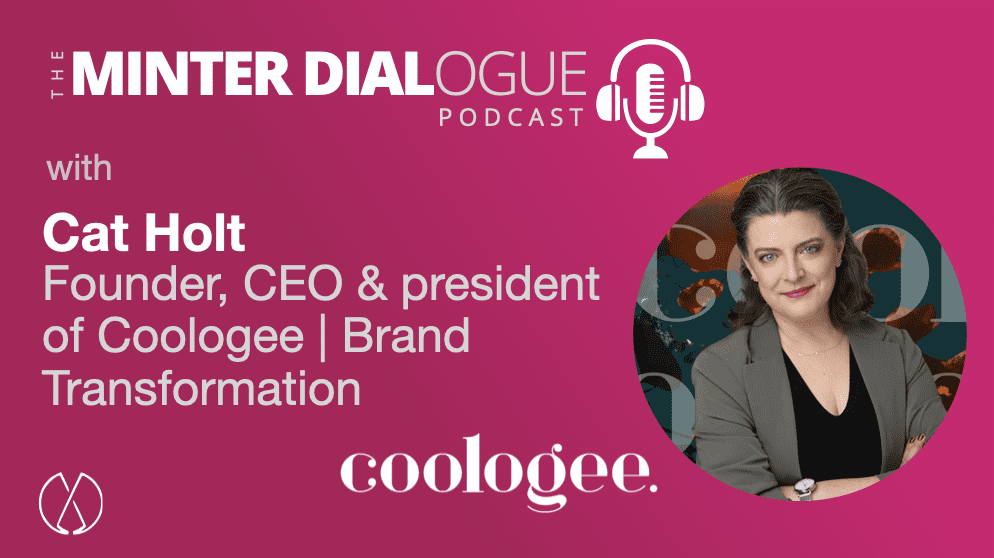
Minter Dialogue with Cat Holt
I had the pleasure of speaking with Cat Holt, founder and CEO of Coologee. We explored the critical role of branding in today’s business landscape, discussing how it’s more than just logos and slogans – it’s about creating meaningful connections and outperforming competitors. Cat shared insights from her experience at Progressive Insurance, where she introduced the successful “Dr. Rick” campaign. We delved into the challenges of integrating brand strategy into data-driven industries like insurance, and the importance of maintaining humanity in an increasingly AI-driven world. Cat emphasised the need for brands to tell compelling stories and create emotional connections with consumers. We also touched on the value of brand in employee retention and recruitment. Throughout our conversation, we highlighted the importance of understanding customer perspectives and the potential pitfalls of relying solely on data-driven decision-making. Cat’s passion for brand strategy and her innovative approaches to marketing made for an enlightening discussion on the evolving role of brand in business success.
Further resources for the Minter Dialogue podcast:

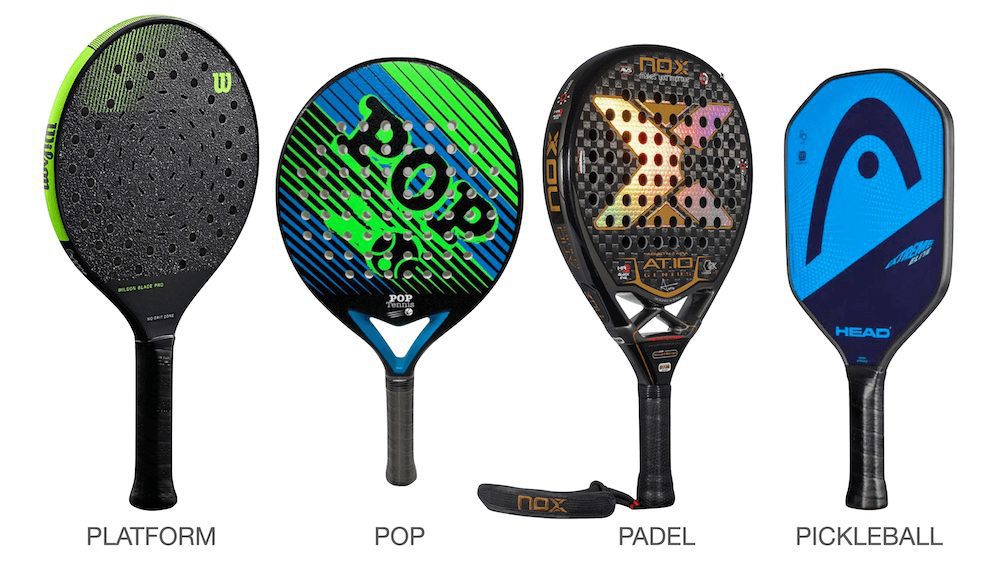
Meanwhile, you can find my other interviews on the Minter Dialogue Show in this podcast tab, on my Youtube Channel, on Megaphone or via Apple Podcasts. If you like the show, please go over to rate this podcast via RateThisPodcast! And for the francophones reading this, if you want to get more podcasts, you can also find my radio show en français over at: MinterDial.fr, on MegaphoneFR or in iTunes. And if you’ve ever come across padel, please check out my Joy of Padel podcast, too!
Music credit: The jingle at the beginning of the show is courtesy of my friend, Pierre Journel, author of the Guitar Channel. And, the new sign-off music is “A Convinced Man,” a song I co-wrote and recorded with Stephanie Singer back in the late 1980s (please excuse the quality of the sound!).
Full transcript via Flowsend.ai
Transcription courtesy of Flowsend.ai, an AI full-service for podcasters
Minter Dial: Catherine or Cat, what do you prefer?
Cat Holt: Cat.
Minter Dial: Cat. Here we go. Cat Coologee. Cat Holt, founder and CEO of Coologee. So, as I like to start off my little podcast, just, you know, for warming up. Who is Kat?
Cat Holt: Oh, who is Kat? I am. You know what I’m going to start with mom of three teenage daughters.
Minter Dial: Nice.
Cat Holt: Founder.
Minter Dial: A lot of work.
Cat Holt: It does indeed. It’s difficult. My oldest is actually at college at uni, as they would say over there.
Minter Dial: Indeed.
Cat Holt: And studying sustainable agriculture. So, that’s an accomplishment. One of three. That’s our job to raise them and protect them so they leave the house. I’m a founder of a couple of companies. One is a marketing, communications and consulting firm here on the east coast, and it’s called Coologee. That’s been around for four years. In fact, this week, just a couple of days ago.
Minter Dial: And happy birthday.
Cat Holt: Happy birthday. I know. And you got, I mean, you know, being able to get past a couple of years is important and get past five and it’s kind of sort of set in stone as long, well, nothing’s.
Minter Dial: For, nothing’s taken for granted.
Cat Holt: But no, but the likelihood goes up. Right? Yeah. I’m a musician. I’m an artist.
Minter Dial: Wow. What sort of musician?
Cat Holt: I play indie rock, indie pop and have done since 15 write and record play shows. Been a little bit less playing out recently, but getting back on it so starting something new and I’m excited about that.
Minter Dial: I love it. So, a very rounded character.
Cat Holt: Cool.
Minter Dial: OG C O O L O G E E is a brand.
Cat Holt: It’s a brand new.
Minter Dial: Yeah. So, how did Coologee come around?
Cat Holt: It came around because, well, the one I want to say now and we’re going to stick to it, but maybe afterwards I’ll tell you the other story.
Minter Dial: Are we waiting for whiskey to come in?
Cat Holt: I think that might be it. It’s the science of cool. So, the whole notion is brand has to have swagger, it has to have some kind of panache in order for people to care, to pay attention. But you have to do it with some science, with some data, with some information. So, that’s something that’s pretty important to us.
Minter Dial: So cool and scientific.
Cat Holt: That’s right.
Minter Dial: Well, all right. So, I, I, I’ve been working on branding for a good many years and I, I have a spin, but I, I wonder where, what’s, what angle you have on this? To what extent do you believe that brand plays a more important role today in society than it has in the past? Or is it just, you know, me thinking, oh, well, I’M special.
Cat Holt: No, it’s actually the most critical thing that a company can think about and manage and build forward because we are inundated with so much information, we have access to every single product or service, at least in the first world nations. In the US in particular, we can order products on Amazon and it gets delivered to our doorstep sometimes in a matter of hours. And you have to catch the lizard brain in all of us because we’re still animalistic and survivalistic. And you have to have something that’s going to hook them, catch them, build surprise, curiosity and get them to decide to spend the five or six seconds more that they spend in order to decide, am I going to actually learn more? And that’s all that a company has, about five or six seconds before they decide, click, swipe, whatever it is, or I’m interested, I’m going to learn more. So, I think it’s really, really critical to be able to understand who your brand is, who your brand is for, and how you’re going to tell your story.
Minter Dial: Right. Well, my angle is that we live in a society that is more and more meaningless. We have a surfeit of choice. Like you said, convenience, snip your fingers, get everything in immediacy. But immediacy, fantasy don’t replace meaningfulness. And it’s been my observation that why brand is more important today than it ever has been is that brand can be meaningful.
Cat Holt: Oh, I agree. It is a relationship that a company is building with the audiences or the customers that they want to have some kind of business relationship with. If you think about where we get information these days, it is in social media. In theory, we go to social media to have meaningful interactions with people. In practice, that really hasn’t worked, but that was the origination of it. And if that is the major platform that we are engaging with and brands need to find their place in it, then they do have to stand for something. And I do think it was part of good practice 20 years ago to do some work on brand positioning, to understand what the character is, what the emotional hook will be. And I think with performance marketing it became so myopically focused on leads and cost per click click that those that have now risen to the ranks of leadership within marketing don’t have this background of understanding of what meaning and purpose and brand values and valuations are because they haven’t had to. And so, I think it’s been almost like an, an art or a practice that’s lost, but it’s recent history and we can bring it back.
Minter Dial: So in, in your work, you’ve worked with a lot of insurance companies. As I see it, insurance companies, I think they’ve lost their selves in general from having had a purpose when they were as an industry ignited centuries ago to what they are today, which seems to be more about bean counting and big data and efficiencies and as much small print as possible. How do you, how do you persuade an industry captain in, and I could be a woman, of course, in the insurance industry to think that branding is actually important and it’s not about just the bottom line or it’s not just about the, the percentage risk that we are not, are covering or you know, screwing our customers, as I think some insurance companies are.
Cat Holt: Well, I want to sort of reinforce what you said, which is the origination of insurance. And by the way, I do a lot of categories. It’s just some of the more recent work was for brands like Progressive. And so, that will be more interesting conversation, I’m sure. But if you think about the origination of insurance, it was built as a category, as a product for a community of people to come together to put money into a pot so that if one person in that community has a terrible loss, it is not the financial ruin for that individual because it’s distributed among sort of the pot that others have contributed to. And so, if I think about what the origination of insurance is, it is deeply meaningful. It’s very community based.
Minter Dial: Absolutely. Enabling communities and people to take risks, do adventure, explore new lands. I mean so many things.
Cat Holt: And yet today build businesses. And frankly, you know, if we think about the weather situation that we’re in, the climate changes that we’re experiencing, losses are becoming more and catastrophic because of the intensity of the storms. But we haven’t shifted our ways as society to manage with that forward looking view that says we as individuals are ready. And so, in many, many ways insurance becomes even more critical today because of that unpredictability and the greatness of those losses. But you were right, most insurance companies, particularly the big guys, you know, I did work in house at Progressive for four years running all of their marketing strategy. And I had to learn how to put brand, to put emotion into something that could fit into an Excel spreadsheet because everything else, all of the business leaders very capably did. And it’s the reason why that organization in particular has been skyrocketing to the top. These are my children. They don’t understand the importance.
Minter Dial: Hey listen.
Cat Holt: Importance of a closed door.
Minter Dial: Hey guys, you’re in the ears. So, they can’t hear me.
Cat Holt: Yeah, they cannot hear you. Exactly. But if you think about what it is that we do as branders, as marketers, and as we think about what they do as business leaders, they are really good at doing mathematical models and predicting what some kind of loss could be and doing scenario planning. We don’t have, historically we have not had that data set as brand managers. And so, I think that it’s seen as that fluffy, nice looking stuff. And the relationship that brand health has, the relationship a brand position has with future business success, is not well understood. And that’s something that I take to heart, which is how do I show the value of a brand, figure out a way to put it into an Excel spreadsheet so that other folks that are accustomed to making decisions in that way feel better equipped to make a decision about the brand. All right, so that’s typically how I’ve done it.
Minter Dial: So what was it? Was there a moment, cat in your career or life that made you think that it shouldn’t just be an identity, but this business strategy, a business asset? Was there a specific thing that triggered this idea?
Cat Holt: Yeah, for sure. Well, there are a couple of things. One is I have always been very interested in understanding the why and wherefore of things. I have a psychology degree in undergrad. And in that sense, you know, we can be measured as people. And so, there are things like beliefs and there are things like biases, and there are things like group thinking. And what I found fascinating is that when I was in Agency World and I was getting briefed in from the clients, none of that was included in any request or planning or strategy. So, I found myself asking questions, right, so you want me to launch in this channel or with this value proposition? Okay, so who is there? What are their behaviors? How are they thinking about that? Who else is there? What’s your competition within those? And more times than not, they didn’t have the answer. And because of that, the briefs I was getting from the clients, which was really just to do an ad, were just wrong strategically. And so, I kept going upstream because I thought, well, if I can influence the business strategy, then that will trickle down and be a better ask for the creative team and then we can do work that we’re really proud of. And so, I just kept on doing that. It’s been about 15 years. I’ve been swimming upstream, got there 100% when I went to progressive and have been doing that ever since in the work I’ve been doing as a consultant and for my company. For my clients.
Minter Dial: So I, I, I want to get to this spreadsheet story that you were talking about, but I think it sounds like we ought to have from Cat’s viewpoint, what actually is a brand, you know, as people have some sort of woolly ideas of it, it’s an icon, it’s, it’s a logo, it’s an ad, what, how, how and, and really think about this. If we’re trying to persuade those skeptical sort of number cruncher, red profiled individuals who, who think of this as just emotions and you know, I’m here just for, I’m here for the bottom line. How do you, what, what is your definition and how do you persuade people to believe that actually it’s a useful thing?
Cat Holt: I borrow from some work that was done many years ago by Interbrand and then some additive work that Bain Consulting had done around the notion of the brand value pyramid. And the way I see it, and I’m actually doing work right now with a couple of research partners to create the new version of this brand is the ability for a company to outperform its peers in a marketplace. And the reason for that is because you are giving people an understanding of if I engage with you, here’s what I’m going to get and telling that story, consistently, delivering experiences that prove it, thinking about product launches or adjacent market expansions, it all starts from an understanding of is this going to help me continue to strengthen an understanding of how we are different from everyone else, or is it going to distract and make it difficult for us to protect all the fronts that we’re trying to push forward and succeed on? And I think it’s that fragmentation, that lack of focus and a lack of understanding, a vision for why somebody should care about what you do as a company, as an organization that prevents organizations and companies to outperform their competitors. So, Interbrand always had a brand health index where they proved that the folks that were outperforming the S&P 500 within their categories also had very strong brands. So, you think about brands like Coca Cola versus Pepsi. When you think about Apple versus some of the competitors, we kind of just feel like they are rightly in a leadership position. But the truth is there are so many reasons that their products are not actually better anymore. And so, it’s not that it’s not the persuasive points like tit for tat battles that puts you into prominence. It’s an understanding of who you are, how you show up and then what you can do moving forward from that. And it informs all decisions.
Minter Dial: So if I were listening to you, then I would say almost that brand and strategy are almost interchangeable at this point where you are making the choice, the selection, the reduction, if you will, to something, as opposed to trying to be everything that’s right.
Cat Holt: It’s as much about the decisions that you walk away from and the actions you don’t take as it is putting a path forward and making something, doing something, having a partnership And so, on. I think the biggest job a brand can do is to tell organizations what not to do next. Because at the end of the day, you are going to have to communicate to people that you are doing something new. And if you have to invest a lot of money to convince people that you as a brand, as a company, should be doing that, you’re going to lose your momentum. And there’s always a hundred opportunities to improve, to do something next, to expand. You don’t have to do the one where you’re going to have to do double work just to get people to even think that you could credibly be doing that product or service.
Minter Dial: You talked about the spreadsheet. I want to just get into that a second. So, because this is obviously the type of language that is pleasing to CEO spreadsheets. Bottom line, numbers. I used to run a. I was a CEO myself and I used to run a company, and I was looked at, let’s say, rather surprised by the cfo. And I said, well, I want to have elements of our brand in the.
Cat Holt: P. L. Yes, 100%.
Minter Dial: How do you architect that? Or, you know, let’s say you’re talking to a specific company and a. And a type of CEO who’s maybe a little bit open to this idea, but what is it that’s going to grab his or her attention and say, all right, fuck it, I get it.
Cat Holt: It’s funny you’re asking this because I. In fact, you know, you think about progressive because it’s a massive brand. They’ve spent billions and billions of dollars creating some kind of awareness. And so, you would think, especially because they put brand as one of the biggest business assets in a lot of their annual reports and shareholder conversations, but they weren’t looking at a single measure that could be incorporated into a P and L, for example, example, or a scorecard or like a bonus structure of some kind, because it felt so intangible. The work that I tend to do is I try to triangulate and show causation and correlation. Not just correlation, because that’s not necessarily. That can be Junk, Right. Things can be going up in the same direction, but they are not related to each other. But typically what you find is there is a triangle that happens. It kind of sits between some kind of brand health tracker, brand measure taking. And there are lots of different ways that you can do that today. Sure, there are the old fashioned quantitative surveys, I believe in those. There are in platform surveys that can be delivered for testing control within places like a metabuy. There’s also looking at trending for the frequency for branded search within within a certain time period. So, you can find a way to say here is the state of our brand, the health of our brand and the ones that are most important are unaided awareness. We don’t really have a lot of things that we want to keep in the spraying of ours. And so, if you have a need, you want to be one or two in there without any prompting because you’re going to get more at bats for whatever that sale is. You have consideration because you can be aware and don’t like it. And I think at the end of the day you also have things that we call consideration drivers. You can ask people questions around what do you think this brand is? And then take a look at those that have high consideration, what are true and do some modeling to figure out to what degree does owning that brand attribute drive consideration. Because when you have awareness and consideration trending up, then you tend to have other things that are working well for you too. So, the triangulation is understanding the relation between that and things like media and market or you know, lift in sales in a test market where you have initiatives and one that you don’t, where you’ve match marketed, being able to do small tests to prove and get the data set so it can be projected at larger scale. That’s really, really important as well. And then the last part of that triangulation is understanding sort of that POV the brand has that’s going to be central to it. Because you can’t win the war of winning over hearts and minds by taking each of the individual attributes that are driving consideration, throwing it at people and thinking they’re going to then come to a conclusion of this is the greatest thing since whatever. You have to have a story that allows for people to believe that you are going to be X, Y and Z. We were talking about that briefly before getting on this conversation. You can’t tell people that you are something. They have to come to that conclusion. And so, you have to demonstrate that with parables or metaphors or actions that get somebody to believe. Because once we believe, we look for facts that validate what we believe. It doesn’t go the other way around.
Minter Dial: Yeah, that projection is, is difficult to contain when you know I’m intelligent, I’m all powerful. All I need to do is tell, give them a 30 second spot and tell them how good we are, especially our projects. One of the things that has always intrigued me is the value of the brand as a workhouse workhorse or a power within the company for the employees. So, how important for you is it, let’s say when you are trying to hire new people, retain new people, where is the value in the P and L in of that brand and its ability to keep, retain and hire or attract quality?
Cat Holt: Oh, it’s critical. It’s critical for a couple of reasons. Number one, you know there are some product brands where this does not have to be the case but I think by and large give us an example. Why so I think so let’s just call. I don’t know, I’m probably being not fair to product group like Staples, right. Something where you have something that’s a high consumable, you have to replace it regularly. Today I can’t think of any actual like manufacturers of Staples. I’m not talking about the big paper supply store that has invested a lot in brand. Why? Because typically the way the large percentage of those staples are consumed is in procurement purchases for supplying office and workers. And it’s a very different calculation. So, I think there should be some kind of cultural branding that happens at the company that’s making those. But I’m not sure that that has to go all the way down into product marketing for this is your next staple. I mean honestly, now that I’m talking about it, that’s an opportunity for somebody out there who decides they want to add brand to it and then dominate the staples world if that’s what you kind of want to do. But for most other organizations, particularly if you have a sales team or a customer service team or people that have to make decisions that are going to either be the right decision based on what your company is trying to do or not having brand that lives inside, it’s a reflection of your culture that supports the different goals that you have. The code of contact, the values is critical. Critical because they become the brand at the front lines. And if they feel like there is some kind of disconnect, a disconnect between a promise that this company will be one way but then operationally your frontline people can’t actually do that or do not believe in it, that’s going to leak out and it’s going to undermine the falsehood of the story you’re projecting. It’s also going to make your frontline people feel like they are not being supported, that they are not connected to the future success of the company and they’re not going to stay because most people don’t like to manage this kind of disconnect between what people say outwardly and what they’re seeing inwardly. There’s also a lot of studies that show that some of the major drivers of acquisition of new and high talent, as well as retention of talent is related to this idea of I feel connected to my company’s purpose and I feel supported by others. In order to be successful within that company and driving future success, you have to give them a story that will give them a reason to believe and then back it up with the actions. So, I think it’s critical for that. You’ve seen a rise in competition with talent and the notion of branding as employment branding has just totally skyrocketed in the last 10, 15 years because we have a lot of folks retiring and there are not a lot of not enough people to come in and take their positions. It’s certainly not with the expertise that those guys have as they’re leaving those organizations. So, it’s going to be a quandary and companies are going to need to understand brand as a means of engaging people in order to continue to have, you know, hands on keyboards and butts and seats to do the work they need to do to be successful.
Minter Dial: You know, my narrative in that cat links back to my initial posture, which is that that sense of meaningfulness can fill a lot of gaps in the paycheck, if you will, for example. And just listening to you, it makes me think that a lot of companies have cottoned on to the why, the purpose, Simon Sinek and all this. A lot of companies, and old fashioned, let’s call them rearguard executives still think that the product is everything. The what for sure, but it feels like it’s the how that becomes the attractive notion. The ethics, the, the methods we employ, the style of communication. It feels like the how actually is maybe about as important as it gets in the creation of brand.
Cat Holt: I think, I think it is important. I will still give credit to the notion of why as well. And I was just reading an article, there was a recent study that looked at the importance of people living true to their purpose and what that does for their longevity. Folks that are living true to a purpose are actually living much, much longer than those that don’t feel like they have that. I think that knowing and setting a group purpose contributes to that because you’re attracting people that might have a common desire to fulfill that kind of goal in their life as well. But you’re absolutely right. You can’t just say this is what we’re doing and then forget all of the other parts that have to be supported and grown and nurtured in how we treat each other’s in order to accomplish that goal. And I think that’s particularly true. And maybe this is why you’re lighting on this right now is because when we think about the society we live in, it’s so combative and how we’re treating each other often is very unsafe. And so, when you think about how putting more thought into that now is probably very, very necessary because it’s very difficult to regulate how we act as leaders and talk to folks in today’s day. And so, I think that might be one of the reasons you’re thinking a lot about the how.
Minter Dial: In making a CEO team at a large, let’s say traditional style of insurance company, for example, but not just with the work you did at Progressive. What, what actually triggered the buy in for transformative change?
Cat Holt: Persistence and tenacity. Belief. Building it one little brick at a time. Yeah, I.
Minter Dial: So mostly would you say that that also meant resilience?
Cat Holt: Oh, always. Yeah. There is a certain tenacity that you have to have in order to forge change, particularly when it’s challenging a belief system within an organization. Now I had my work cut out for me because I was one of the only executive level folks that came from outside the organization. And then it was double whammy because most of the other folks grew up in product, in operations and claims And so, they were expert in the business of insurance. And now here I’m coming in, I’m an expert in brand and communications and that’s so adjacent to their knowledge set. And then you have this kind of black magic of something that had been working for them in the Flow campaign and the superstore, which was the set and all of the mythology that was around that, that, you know, I joined there in 2015, that campaign launched a thinking oh 7. And so, I mean it was over. It was, it was there for a very long time and it was there when they had astronomical success. And so, how do you tell the C suite and your business? Broken partners? Yeah, that. Yeah, it got you here. But it’s maybe not Going to get you to the next part. And you can’t say that, you know, baby, the baby’s ugly. And so, I spent 18 months building support for something that became big, but I made it tiny, which was a campaign going after a segment that they hadn’t successfully gone after before, which is young homeowners and explaining to them that these folks have grown up with flow. It feels like a mother figure because flow has been everywhere. It doesn’t feel like it’s for them. And because you have used flow to talk about, oh, it’s so quick and easy to have. I’m not being pejorative. I’m sorry. But to be able. Let’s make it fun to get auto insurance, the category of home, which for most young people is the biggest, scariest financial commitment they are making in their entire lives. I remember signing on my first mortgage and it was terrifying. The numbers were huge. And what that represented for me in my wealth, call it what it is, profile, was almost all of it. And so, the incongruent, the dissonance that was happening between the feeling I get when I am now doing this step that I don’t know how to do it, I don’t know how to be a homeowner, I don’t know how to maintain it, and it’s the most valuable asset I have. And then something fun and quirky, it just doesn’t work. And so, that’s when, you know, I went in and said, let’s try something different. And so, we want to own that moment. You grow up. We called it the grown up switch. And we want to show that this changes everything. And we want to show that we understand this changes everything, anything. But our brand was still based in humor, And so, you couldn’t do it with over sincerity. Also, in this day and age, that’s seen as being a newbie thing. And you’re not, you’re not, you know, you’re having the wool pull over your head if you’re too sincere.
Minter Dial: Or like Gecko the Gecko. Geico. Gecko, Yeah.
Cat Holt: I mean, well, that’s fun. That’s fun too, right? But what we ended up doing is saying, okay, well, how can we tell this story from the perspective of a new homeowner that brought this notion of the emotions that they’re feeling at the time, but do it with fun. And I give the creative team a ton of credit because we talked about the grownups, we talked about looking up to parents, we talked about all these things. They came back with this notion of what if we created a disease of you turning into your parents once you become a homeowner and they just went off on it. And so, that ended up being the Dr. Rick campaign which we launched. I mean I got to say it was 16 or 17, it’s been running ever since and it’s still a top performing campaign. Why? Because of the fact that people look at it and say that’s funny. Because it’s true. That’s how you forge a bond, that’s how you form memory. And so, that contributed tremendously. And in fact I underestimated to the degree to which it would be relevant on all generations because I thought young people would think that was funny. But it turns out young people were having conversations with their parents and vice versa. And so, it actually started a conversation that was multi generational, which in hindsight I should have seen but didn’t anticipate. And it creates a conversation that you kind of care about.
Minter Dial: A meaningful conversation.
Cat Holt: A meaningful conversation, exactly. Exactly.
Minter Dial: So the issue with insurance in particular, so I want, I got keyed up on that. My sister in law, she works in insurance, as does my daughter.
Cat Holt: Oh, interesting.
Minter Dial: So it’s a very, it’s a very numbers based, data heavy kind of industry. And now we have. Artificial intelligence has launched itself. What, what do you think of some of the pitfalls in using data and tech like AI for developing brand and to what extent or how does one keep the human side of things, the messy old human stuff.
Cat Holt: Yeah.
Minter Dial: Strong.
Cat Holt: So you have to really put that at the forefront. And I’m going to just call myself out for having my pug, who’s apparently snoring right now. It’s not an old gentleman.
Minter Dial: I can’t hear. I can’t hear. I can’t hear your pug. You have your, your daughters. It’s a whole family.
Cat Holt: You know what, here’s the thing. It’s real. Keeping it real.
Minter Dial: There you go. I do that. I don’t. I very rarely edit my, my podcast because I want this to be a real conversation. I didn’t send you questions.
Cat Holt: No.
Minter Dial: Just researched you, who you are and I wanted this to be as spontaneous and organic as it gets. So.
Cat Holt: Well, here you have it. I couldn’t be more than that.
Minter Dial: Full on in, Kat.
Cat Holt: But you were asking a little bit about, I think to me paraphrasing, how do you keep humanity in a world where robots and data are taking. Right.
Minter Dial: Obviously not just the insurance industry.
Cat Holt: No, it’s everywhere. And so, again I’m going to go back to what’s old is new. I Think the biggest pitfall of just doing data driven decision making is number one, those data points tend to be really good at predicting future performance when nothing else has changed. Because in order to have a model that works well, you have to have a very large data set to then feed into the model and with confidence, project forward. When a slice of that data set starts to shift because of other factors that are outside of your measurement program, organizations can be caught by surprise because it will grow almost like a cancer. But you don’t have the ability to identify that as a factor. Even if you decomp factors within a model, if you don’t have the measurement of that factor, it’s not going to be there, in which case you’re going to make decisions that are really rear view facing instead of forward facing. And I think that one of those biggest factors that is not captured and it’s why branding is still kind of misunderstood in advertising and still seem like wizards, art or magic of some kind is how people feel and what they think. That’s very hard to have. I mean there are ways to do it in our world, but they’re flawed in many ways. Like to measure feeling, sentiment. We’re able to do it with social listening, we’re able to do it with looking at search terms and questions that are being queried, but it’s still an approximation. And so, I think that the false sense of security around I have a data set and it is a reliable algorithm is blocking the ability to anticipate what’s coming next. And really just getting to the front lines, talking to people, hearing stories and just kind of being curious. I think, I mean old fashioned, like what do our customers think? I can’t tell you the number of companies that are divesting in that it used to be a thing that was huge from a budget perspective. Even when I was at Progressive, I managed all the market research relative to our media spend. It was tiny. It was like 0.0 something percent of the marketing budget. And that always drove me nuts. It drove me nuts because that means that, you know, you weren’t really wanting to look at the humanity of this. Then you project that into AI and AI doesn’t have humanity. And if you look at what the pitfalls are for so many of these AI products and services, it’s that the biases that are in the data just get compounded and put forward. And if you don’t have an ability to audit and hold accountable the summaries or research or generation of articles and pieces and all the different ways it’s being applied. You’re going to scale those biases, those blind spots so quickly that it’s going to almost create its own macro chamber of noise. And I think that having folks that are taking a look at that and saying, who are these people? How does something like this impact people on a human level, not just on a sales based level, is going to be really, really critical. But you look at all these technology companies and you see these ethics leaders and they’re there for a short period of time because they’re not being given the opportunity to actually act. And I think that’s going to be a huge challenge for us.
Minter Dial: Well, I’m not going to hide from the fact that a number of times I’ve been on boards and been brought in as the brand guy and it just seems like such an uphill battle all the time to talk about these things like emotions. And I’m going to paraphrase what I heard you say, which is the ability for the instinct and gut to still have a place in the board. And I, even, I, I would, I, I mean for the, my observations of AI at this point is that it can come up with a whole bunch of really crazy fun ideas. The issue is actually choosing the one and then telling the story around it that is believable within your deepest integrity of yourself. And if, if that checks out, then, you know, check, you know, as in is, is relevant, then that is powerful and then that brings along the believers with you and then you start becoming more of a bulldozer.
Cat Holt: Yeah.
Minter Dial: Not that it can’t be upended, but it does feel like our AI today is doing so many things in any of the work you, I mean, you’ve launched AI driven platforms, as I understand it, for advocacy. Where do you see the intersection of AI marketing and people or AI marketing and customer service, AI marketing and branding in general?
Cat Holt: You know, I think this is going to be a fun conversation just because we are very sort of similar thinking about this. But it’s recent. It’s been within a year that I’ve been doing this for clients and then also looking at how to use AI for my own operations. Because you, you know, in marketing communications you have to get on board or you’re going to be left behind. But typically the way I do it is test and learn curiosity. I get myself really deep into it. I bought a book on LLMs and been talking to the tech teams a lot just so I can understand how far can this go? What are the limits? And every single time that we start a Project, I think, and say to them, I say, this is not here to replace you human. Right, you leader. Because typically we’re looking to scale some kind of subject matter expert, some kind of knowledge transfer, some kind of understanding of how these people who have done all this work can be replicated in an agent or agentic way and then scaled forward. And as a human, who is that person with the expertise? It feels really bad, it feels really threatening. But the point isn’t to like delete people from the experience. The point is to scale those people’s experience so that others can benefit from it in a way that maybe one on one or one on group conversations can allow. But to do that, you have to understand who they are and you have to ask the third, fourth, fifth question to really understand, okay, this is how you think. Because for a very good agent to be created, you have to know the levels of questions to build into the queries so that it can replicate something that’s like the thinking of a human that you’re trying to replicate. And so, it starts with that and starts with listening and frankly doing old school, ask again, ask again, ask again. I grew up in focus groups and interviews and the best insights come when you ask the question three or four times. The five whys that I mean totally, or you just don’t talk and then they have to fill it in and then you listen and we can have a bots to do that and summarize, that’s not, that’s not bad. And then you make something from that. But it’s because of the human that you’re able to make that thing. It’s not because of the AI itself. And I think, I think generative AI is going to be commoditized. I mean, it’s already being brought into all the major platforms. Major tech is just going to own that. So, I think where AI has an opportunity is to really kind of bolster the human interaction in a way that can be done at scale and faster. But you have to build in accountability and audibility. Like if you can’t audit it, you’re going to run right into the biases we were talking about. And you’re also going to run into the hallucinatory thinking that happens. Right? AI makes things up, doesn’t want to not have an answer.
Minter Dial: Well, I like to say that people.
Cat Holt: Do the same thing 100%, but when it comes from a thing that’s technology driven, you project authority to it. Whereas when you’re talking to a person, you’re like, I don’t know if I’d like that person right there. The, the co pilot doesn’t have the emotional and physical tells that humans have.
Minter Dial: Right, right.
Cat Holt: Yeah, exactly.
Minter Dial: All right, so we’re going to spend the last bit, I have a couple of let’s say off the beaten track type of questions. So, let’s just imagine if suddenly every logo, slogan, color palette, image, whatever in the world vanished. How would companies and people recognize what a brand truly is?
Cat Holt: I think it would be a very exhausting world to live in.
Minter Dial: Why is that?
Cat Holt: Because brand is shortcut for an entire ecosystem of ideas, beliefs, experiences. And without it, we would have to do the hard work. It would be like every single communication would be a legal contract that you have to go and read through every bit and piece. And I think we would be exhausted and I think it would take us longer to make decisions, decisions, right or wrong. It’s how we work and how we operate as humans.
Minter Dial: If I can be contrarian, I would love that. Maybe it would be more fulfilling because rather than being smattered with swooshes and Coca Cola everywhere, advertising, you know, up the street all the time, maybe there’d be a little bit more silence and a little bit more focus on what actually matters in life.
Cat Holt: It could be. I wonder though, if there’s a distinction between branding and the consumerist marketplaces that we are participating in. Because I think the noise comes from trying to flood the consumerist spaces that our end targets are living in more than the notion of what a brand is. Now, that doesn’t mean people aren’t doing it badly. A lot of people are. So, I do still see the value in meaningful brands that have some kind of value extension, exchange and something that’s worthwhile. But I just wonder. That’s the thought that came to my mind as you were talking about that it’s just.
Minter Dial: It’s a thought or a question I’ve never asked before. So, yeah, just wanted to push.
Cat Holt: Well, that’s the challenge, right? Because, you know, we’re all under this great information fatigue and it does feel like it’s hard to find that quiet space, but frankly, we’re just having to go back. I talk about this with my kids all the time. Just turn it off, go out. We live. We live really like a mile away from the ocean. It’s still beautiful, nice. You know, I just went swimming this morning before everything started because I’m sure.
Minter Dial: It’S a little chilly, quiet.
Cat Holt: You know what if what’s interesting in New England is the, the water temperature in September is the warmest because it’s been warming up over, over the months.
Minter Dial: I see.
Cat Holt: But yeah, no, I’ll be in there in January too. Don’t worry.
Minter Dial: I, I swam in Maine in winter. I remember that. That’s.
Cat Holt: That’s a little chillier.
Minter Dial: It was chilly. But I, I do remember the phosphorescent, the bubbles that followed me. I think I got.
Cat Holt: You didn’t have your phone.
Minter Dial: I did not.
Cat Holt: You were just out there and it was peace.
Minter Dial: Yeah.
Cat Holt: But it was a choice that you had to make. And I think that we’re having to increasingly put our blinders on and put it down and work through that in order to find quiet. Because I don’t think brands or companies will make it quiet for us.
Minter Dial: No, but I. The idea that I have is that maybe there’s that a bit. There’s a joke about some parrots and you know, going, which one’s the most expensive one? And the one that doesn’t speak is actually the most expensive. And why is that? Why, why is that part the most expensive? Because when everyone, everyone else talks about him as the boss. Silly question. All right, last one. Imagine that a brand you admire is losing relevance. Like that. You’re running it or you just, you know, as a consultant, you see it. What’s the first signal you’d look for in that loss, if you will? And what move would you be suggesting to course correct.
Cat Holt: It’s almost the canary in the coal mined question. I think typically a loss of relevance comes when you’re starting to see any of the key metrics plateau. And that usually is compounded if you’re increasing things like media spend and you’re.
Minter Dial: Still seeing plateauing customer acquisition numbers are going higher.
Cat Holt: Yeah, exactly. And the costs are going higher. Or perhaps the little micro numbers, which is the click through rate or the behavior response to your brand or your narrative is going down. Sometimes it’s just wear out. But it can also mean, Houston, we’ve got a problem here. Typically what I say is, again, it’s going to be a broken record. But like you got to talk to the people, right? And there are ways to do it where it’s not just a one on one conversation. You can use things like social listing, you can use things like website behavior. Looking at the content that is or is not driving engagement. You can kind of read through the lines of like, I think there might be this. But honestly, for most organizations, they have frontline people, right? They’re the salespeople, they’re the call center people, they’re the service people. I think most problems you’re going to find if you just talk to them.
Minter Dial: And my thought as I was listening to you, because I hadn’t formulated an opinion, but I now feel it is that look for the engagement of your employees.
Cat Holt: Yes.
Minter Dial: At the front line.
Cat Holt: I agree.
Minter Dial: Are they just there trying to get the number? Do they roll? How much do they roll their eyes like this is the best product, you know, or, or whatever. And maybe they don’t even like their management style within the company because that’s also. That’s the how and that’s. That is part of the brand.
Cat Holt: Well, and that’s the management style goes back to your, like protecting, preserving humanity and everything, which I think sometimes we can overlook because it also doesn’t fit into spreadsheet.
Minter Dial: No. Yeah. Well, so much. That’s wonderful. So, Katie, now you can go back to a normal. You can go check out your pug, answer your daughter’s questions. But for people listening, where can you send people in terms of calls to action?
Cat Holt: Yeah, why don’t. Well, I’m actually building up a substack presence. So, I’m Kat Holt, C A T H O L T at the substack address. I’m also online@kologi.com c o o l ogee.com and then you can find me on LinkedIn.
Minter Dial: I shall put you all in those spaces. What made you go into substack, by the way?
Cat Holt: You know, it’s. It’s trying to test and learn and have an ability to have an engagement that’s kind of automated into the platform to re engage folks that are subscribing without having to build out a lot of other CRM systems. Another newsletter and another newsletter. I don’t have time for that. And it’s really easy to add content there. And so, I’m actually debating whether I just make that my articles and thought leadership platform. Pros and cons of SEO, especially in a. In a conversation chat world where. I’m not sure it’s working the way it used to.
Minter Dial: No.
Cat Holt: And it supports the podcast too. Right. So, that’s. That makes it, you know, we’re going to. We’re about to launch our own, by the way. It’s called Brand as Business.
Minter Dial: Brand is business podcast. All right, well, congratulations, Kat and all that.
Cat Holt: Thank you so much.
Minter Dial: Good luck with everything. Keep on pounding the brand drum. I’m a believer and I think many more people would do better, feel more successful and certainly most importantly, feel more fulfilled if they got great brands.
Cat Holt: I couldn’t agree more.
Minter Dial: Many, many thanks, Kat.
Cat Holt: Many thanks.

Minter Dial
It’s easy to inquire about booking Minter Dial here.