
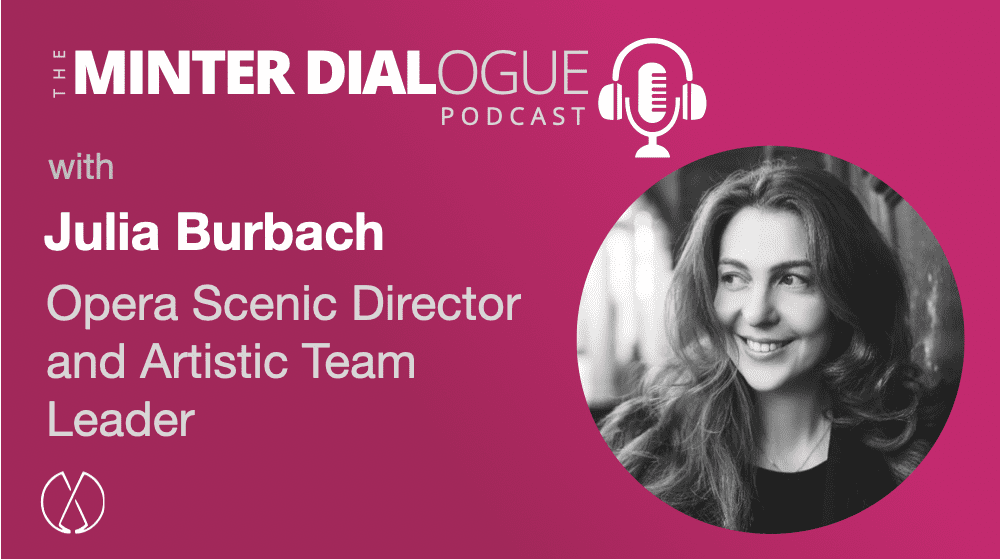
Minter Dialogue with Julia Burbach
In our conversation, Julia illuminated what it means to direct opera—crafting not just visual spectacle but psychological depth within each character. She discussed the nuanced role of confidence and her journey from being privately shy to commanding rooms full of people. We explored how her upbringing as a global citizen speaking several languages and moving between cultures left its imprint on her ability to thrive in international, multicultural opera teams.
Julia’s approach to risk is more strategic than impulsive, reminding me that creative risk isn’t always about shock value—it’s about layers of meaning and emotional honesty. She also highlighted the real-world challenges directors face, from working with singers who have been cast long before the creative team is assembled, to navigating unpredictable human factors and always ensuring the show must go on.
Key Points:
Further resources for the Minter Dialogue podcast:

Meanwhile, you can find my other interviews on the Minter Dialogue Show in this podcast tab, on my Youtube Channel, on Megaphone or via Apple Podcasts. If you like the show, please go over to rate this podcast via RateThisPodcast! And for the francophones reading this, if you want to get more podcasts, you can also find my radio show en français over at: MinterDial.fr, on MegaphoneFR or in iTunes. And if you’ve ever come across padel, please check out my Joy of Padel podcast, too!
Music credit: The jingle at the beginning of the show is courtesy of my friend, Pierre Journel, author of the Guitar Channel. And, the new sign-off music is “A Convinced Man,” a song I co-wrote and recorded with Stephanie Singer back in the late 1980s (please excuse the quality of the sound!).
Full transcript via Castmagic.io
Transcription courtesy of Castmagic.io, an AI full-service for podcasters
Minter Dial: How lovely to be able to have you on my show. I was fortunate enough for our mutual friend to meet you at a lovely dinner. Got to hear about a little bit about your story. That intrigued me so much that I said, geez, let’s get you on a podcast, talk all about this. So, for the. Because in my world, there’s a lot of business people and I’m sure that they’re not opera. Opera fans or, you know, knowledgeable about opera. But let’s start with, in your own words, who is Julia Burbach?
Julia Burbach: Well, first of all, thank you so much for having me. It’s a pleasure. Well, who am I? I’m a scenic director focusing mostly on opera these days. Yeah. So, you know, that is who I am and that is what I do. And I suppose what’s interesting about this particular job, and it’s only really something that I’ve understood to appreciate more and more that it’s a combination of the artistic process as well as a leadership role that requires you to work very collaboratively in a team and build something together. And I dare say that the combination of the two is something that I really, really enjoy and I believe suits me. And that’s very.
Minter Dial: So, I mean, we’re going to get into more of your background as well, because that intrigues me intensely. But the idea of being a scen or an opera director, what does that entail, per se, compared to, you know, like the choreographer or the conductor? What, what, what does your role entail?
Julia Burbach: Well, I suppose what, you know, what it entails is that I am the artistic leader of the entire project in terms of what the conceptual approaches, the vision, the aesthetic. I would be given a title by a producing house, and then I would, you know, then I would say, thank you so much for entrusting this to me. And then I would then ask various team members to join me on this, on this journey. And that would be a designer, a costume designer. Sometimes they’re the same person. It would be a choreographer. It could be, you know, it could be a lighting designer. It, you know, then, then you build the team around that project. The conductor joins the process much later in the day because they have a very different rhythm of how they work. But of course, we, the so-called artistic team, with essentially myself at the helm, we build the show around a title from nothing, with our imagination, essentially. And that is a process that can take on and off years and usually needs to take no less than a year and a half. And for it to be comfortable certainly too, because there are various steps. And I mean, you can imagine that from trying to understand how you would like to tell the story, to then coming up with a visual interpretation of what that is, to then building that, designing that in computer programs, costing it, adjusting it. These things take time. And that’s before you even thought about how to make the people move. Just there are incremental steps of how to build it. So, yeah, that is. That is what I do. And of course, the preparation phase is a combination between things that I do by myself and then with the team. And then, of course, the last hurdle is essentially getting to the rehearsal space, usually around six weeks. And that’s when we put it all together. And that’s when the conductor joins and the singers join.
Minter Dial: All right. So, you said it takes imagination. I’m just wondering because it’s a zone of interest for me. I remember going to see lots of opera and performances in New York City when I used to live there, and we talked about the idea of genius. And so, imagination, creativity is a part of genius in my mind. But also you must have knowledge, and you must know what the opera is about. You must know what they’re trying to achieve and all this. So, there’s a knowledge component. Component to it. And the challenge is, is allowing the imagination to have free roam at some level inside this box. How do you describe that?
Julia Burbach: Yes, it’s a very good point. Well, it’s sort of a. It’s a dance. The creative process is a dance between and within various aspects. You know, there. There’s your own personality and your own likes, dislikes, and your own experience, which no doubt colors what. What it is that you come up with. Then, of course, there’s the historical context of where that title sits. And then, of course, the social context of where we are in the world. No doubt that has an impact as well. And then, of course, you. You know, you build. You also build something for a particular country, a particular house, potentially a particular audience with a. You know, that is always a little bit on one’s mind. And within all of that, you have to allow your gut instinct to have a little bit of free rein. You know, whether. Whether that is, you know, intuition. And it’s interesting because I have a relationship with that. You know, is it a subconscious thing or a place of where imagination lies that you don’t have your intellectualism, silence, that. That you allow that to speak. And for this to be able to happen productively, you need to allow for time, for rotations, for trial and error. And then, strangely, there’s a moment where you feel that it’s right. And until that moment comes, you don’t stop searching. So, you know, that’s the sort of dialogue I have with myself. I don’t give up until I get the feeling of like, okay, we’re onto something here. And then you go, and then you proceed on that path.
Minter Dial: So, I’m wondering to what extent self confidence plays in this. I can imagine when you started off, you didn’t quite have the same repertoire, same knowledge base. And, and also, I mean, let’s. We’ll talk about that. Being a woman in it. How did you, let’s say, craft your confidence to be able to allow yourself to go and tap into that instinct, that intuition, that creative side?
Julia Burbach: You see, confidence is an interesting construct, isn’t it? Because I think it can live in different places and there’s a misunderstanding about what and who directors are. Directors to the outside world are. Are leaders and often associated with being, I suppose, bossy and strong and powerful and, you know, a lot of associations. But I actually had this conversation with a colleague the other day, and we like to think that we fall into two big categories. The people that are quite empathetic and sensitive naturally and find within that job something that celebrates or, you know, supports these natural instincts that we have that we have, you know, it allows those to come to fruition. And then they’re the ones who are egomaniacs and just, you know, are power hungry. And, you know, that’s. Those are the two broad categories that you fall into. Naturally, you need to have confidence and belief in your own vision. But that can be quite a private. You know, that if that can be quite a private thing, that doesn’t necessarily have to do with stepping into a room and telling 200 people to be quiet. You know, the stepping into a room and telling 200 people to be quiet is something that one needs to practice. And you ideally practice that from smaller projects. And then after time passing, you can get up onto a stage with a microphone or without a microphone, you scream and 200 people shut up. And you can do it in a kind way, a productive way, in a way that they understand that you have solutions and that you can guide people. So, that is something that comes with practice, increase of scale, experience, strategy, timing, and this. I’m very grateful that I learned this slowly but surely in lots of different scenarios because strictly speaking, I’m quite privately, I’m a relatively shy girl. I was never the girl that needed to be centered of attention, ever. But bizarrely now, in my Job, I’m very much the eye of the storm. But me, you know, personally, I was not the one at a party, top of the table, dancing and screaming at all.
Minter Dial: So, I’m intrigued. Julia, you talked about maybe having a private component to the direction, the creative ambition of what you’re trying to do. And it reminds me of a conversation I had, I was lucky enough to have with the author John Irving, who has written, you know, he was a masterful writer and World According to Garb and all the Hotel New Hampshire. And he, he said that he or his little private thing was always to have a bear in each of his stories. And, and I just remember sitting around over scotches late into the night as he discussed why the bear and all this. So, I was just wondering, when you talk about private, do you have something that’s a little bit of an internal motor or some kind of light motif, to use a nice general word? Well, that goes through for sure.
Julia Burbach: You know, the truth is that I of course have a very personal relationship with the piece that I’m building because it is essentially my viewpoint of how I understand that title. And let’s say if it’s like a relationship between me and the work, I know very well where the difficult corners are, the risky corners, you know, also the ones where I maybe played a little bit safe or where I couldn’t quite solve it. So, I’m finding a way to sort of wiggle around the concept, you know what I mean? So, I know where these are. So, I’m just preparing a Romeo and Juliet and the other day I sat there and I was going through Acts 3 and 4 and I dare say we’ve made our lives difficult is such a negative word. But let’s just say we always, always very conceptually challenging. So, you know, you know, we didn’t make it easy on ourselves. And there’s a couple of corners where to execute the concept. You know, there it’s, it’s difficult to achieve for it to be just so, so that it reads and. Yeah, and you know, in the school I would mark with a, with a post that, you know, these are the corners where for it to sink in, it has to happen. If we achieve it, it’s fantastic. If we don’t, it’s not legible, you know, so I, I know where they are and I would like to think that I’m quite, I’m more self-critical than I’m, you know, I’m, I’m actually quite hard on myself. That’s just the personality thing. So, I Know when I. You know, when it’s not quite right. So. But of course, within that, the private things. So, there’s a private relationship with me in the piece. And of course, within my work, there are certain things that I keep repeating. You know, I suppose it’s a style that you have the way that art do. You know, there are certain conceptual. Yeah. So, there are certain conceptual ideas or approaches that I like, and I use them in different shows from different angles, you know, and it’s almost something that I like to explore from different perspectives, and it reappears. And, of course, the people that know me very well, they can see it. For instance, I remember my father came to one of my very early pieces, and he. So, I saw. I saw you in all of the characters. And of course that’s true because I am all of the characters, because I can only create it the way that I understand it. You know, the good ones and the bad ones, the villains and the heroes. And of course, other people who know my work, they say, like, aha. This is something, you know, she did in a different way there. And you know what I mean? So, there are reoccurring things that maybe aren’t the bear, but they are like the bear. Little nods, little moments. And when you are on the inside loop, you see them, so you leave little Easter eggs and traces of your personality. And, of course, it’s a very, you know, it’s strange because while I might not be on stage performing it, of course, everything about it is me. So, it’s very exposing, if you want, or it’s very, very personal. Even though I’m not on stage doing it.
Minter Dial: I adore that. It reminds me of an experience. You know, I’m. I’m really sort of in ignoramus when it comes to opera, albeit maybe a little bit more than, you know, zero. But I remember listening to a piece, a classical piece, was like, two quartets are playing together. And I remember hearing the violin, one of the violinists, there are four violinists in total. And I said, oh, that violin has a special sound. And. And for people who play violin, that’s sort of obvious. Maybe much more obvious. You’re much more tuned to it. I said, whoa. And I went up to her afterwards, and sure enough, it was a Stradivarius. I was like, ah, I’m so very good about that moment. So, in this sort of nuanced world, I understand your grandfather was a baritone and your mom and actress, is that right?
Julia Burbach: So, my grandfather was a very good baritone and always wanted to Be an opera singer. But, you know, circumstances changed, and then he became a dentist with my grandmother, who was a dentist, so they shared a dental practice. And my mom is an actress and a singer, so I grew up with her performing, and I think only in adulthood did I understand many of the skills she had that I took totally for granted as a child, as it often does, as one does. But I think she has been very important in actually guiding, supporting, encouraging me, because, as you can imagine, it’s rather scary wanting to be an artist or a director or any of these rather obscure niche jobs, especially when you have a very academic background and you went to university and you have a place at law school and, you know, you. You should have done the things that the rest of the family did. And she would come to my rehearsals and she would watch, and had I been fantastically untalented, she would have told me, you know, because it’s, It’s. It’s too important. But she always, like, tried it longer, but she could see incremental growth. She could see growth. And she was quite, you know, quite important in those early stages to not give up. And it took my. It took my father a little longer because I. I suppose he was fearful and, you know, of course, understandably. So. It’s a rather bold thing to want to do.
Minter Dial: Yeah. The road not taken. The easier road of being.
Julia Burbach: No, it was not. Yeah, it was not an easy road. It was emotionally the obvious road because I feel very at home and connected to myself in, in the practice. But of course, that’s wonderful when the doors of the studio are closed and you’re doing the work and you feel very connected to yourself, and that all makes sense and with who you are and who you aren’t. But of course, the road of wanting to do this job is entirely not obvious, and it’s a difficult road, for sure.
Minter Dial: I want to talk to you a little bit about the notion of risk. Risk taking. When you decide to be an artist, that is an obvious fork in the road. You’re not taking the easy road. You are putting yourself out there. You’re exposing yourself. Meanwhile, as I said, I’m. I’m not an opera knower, but I do feel that the, The. The world of opera doesn’t feel quite as risqué, if you will, as opposed to being maybe a punk singer or, you know, or throwing paint on a tap. Tableau. A painting.
Julia Burbach: Yes. Yeah, yeah. On a canvas.
Minter Dial: Yeah, yeah, yeah. Thank you for. How do you gauge your level of risk taking? And when you’re putting these on we’ve talked about sort of the personal element of it, but maybe at those sticky corners that you talk about, how do you assess and live with risk in the world that you’re in?
Julia Burbach: I dare say all of us, we live in an environment of high risk, non-stop. That of course, you know, if, if you were a surfer riding a wave, that wave goes up and down. And this is something we are very, very used to. That risk can be understood on multiple levels. First of all, it’s the risk of that you’re always chasing the next job, working for the next job, finding the next job, having to defend the next job. And they’re only as good as the last thing that you did, if that. Yeah. And then of course, within making the work, there are people who take higher risks. And I dare say I would count myself as part of that group because I’m conceptually quite. I would say that I make esthetically beautiful work, but always conceptually psychologically complex and hopefully meaningful. So, I don’t like to make decorative work. I like to make psychologically layered work. And for that I find approaches that try to explore, you know, explore, expose the psychological layering of the characters. But that is, that’s emotion, you know, that’s conceptually risky, or it can be, depending on how you execute it. But you see, for me, that’s the whole point of doing the job. So, it’s risky, but it’s also the whole point of doing it so in a way that eliminates the risk. So, I’m less scared of that than of what sometimes the industry is. Because of course, the industry, like life, it’s not logical and it’s not linear and that’s very destabilizing and you can’t affect that. But me in my room with my thoughts in my work and my own little risk taking in the project, I have a certain amount of control over that because also, let’s say I have an idea. The idea might have been a good idea, but the idea doesn’t execute well. Hopefully I understand that before. And then there’s always ways of solving it, but I’m at the forefront at the helm of that decision making. So, I’d say it’s always a calculated risk. And I’m quite a good little strategist how I’ve, you know, manage to have the guts to do this in the first place. I actually don’t quite understand where that comes from because in the rest of life I’m a very, very careful person. I don’t throw around with my Feelings. I’m very careful with people. You know, I. I’m a big, in many ways, risk avoider, but I think all the risk are all the risks. Yeah. So, yeah, I’m otherwise a fantastically careful, careful girl. I don’t jump and think afterwards. I always think before.
Minter Dial: Well, I want to get into you in a moment, for sure. But it’s something else that intrigues me about your world is the role of the singers.
Julia Burbach: Yes.
Minter Dial: You talk about, let’s say, 18 months out, you know, the venue, I guess it’s been booked. When do the singers get chosen and how important are they in these risks? And the narration, the. The way you want to pull things together.
Julia Burbach: This is the big irony of this, this industry. So, the singers are traditionally chosen before the artistic teams are even chosen. So, back in the day when I was doing smaller projects, you know, back in the fringe days and so on, where it’s literally just me and the conductor on WhatsApp, casting it, I have a lot of control. I know who these singers are. I know that they can deliver what I need. This is all very easy and breezy and very relaxing. Then when you go a little bit higher in the industry, and I’ve been lucky enough to climb up a couple of little steps on the ladder, very often the singers are set and they are cast by who are called the casting directors. In these opera houses. You, nine times out of ten, have absolutely nothing to do with it. And you are presented with the. With the humans on day one. And then you deal with them. And they, of course, come in all the shapes and sizes that anybody would come in, ranging from, you know, fantastically interested in directing and stagecraft and patient and gifted and wonderful teamworkers, all the way down to, you know, not having those skills. And then you try to match adjustments, execute your vision within the parameters that you’re given every day. It’s a very interesting and challenging process because once you’re in the room building the work, you of course, confront it with the realities of life, humans, time, illness, circumstance, changes. And you adjust every day. So, you plan meticulously and then you’re endlessly flexible and it’s quite a good school. So, we are able to adjust very quickly. And of course, you adjust to the singers because singers are. They’re very complicated people to produce the sound. Something that I personally don’t have any knowledge of. I’m just a casual, private singer like most of us are. Of course, it is fantastically challenging for them to do that. And also, the voice is so emotionally Connected that when they are not, well, physically or emotionally, they cannot produce the sound quite as much. And that’s just them producing the sound, which is very connected to their internal household. And then, of course is how experienced or gifted or interested are they in stagecraft and performing. And it is baffling that of course, in opera, not everybody who’s a stage performer is a stage animal. And, and. But there are ways that we as a team can help and guide that and compensate for it as well. And we do.
Minter Dial: So, it’s, it’s. I’m thinking of blocking. And you, you, you in your head you say, well, I’d like the, the baritone to be lying down at this part of the stage and still singing.
Julia Burbach: Yes.
Minter Dial: And being prone or in some kind of position that’s not optimal for singing. You have to adjust to that kind of a thing.
Julia Burbach: Yes, of course you do. Nine times out of ten, I’ve got to say that singers certainly these days are, you know, much more interested and aware that a scenic process is a scenic process. And to. To sell the emotional journey, we need to be acting singers and singing actors. And they can do incredible things with their bodies while producing the sound. You know, this is true. But of course, one encounters a person here and there who will absolutely not do absolutely anything. You know, I mean, it’s quite hilarious. I remember I was in a rehearsal, this was back in the day when I was assisting and there was a famous Wagnerian either, I think it was a tenor and who shall remain magonymous, remain anonymous. And I think partly because he actually wanted to annoy the person in charge and said, okay, could you please kneel here? And he said, do you like this spot? Because if I kneel here, I’ll be there for the next three hours. Then he didn’t have to kneel. I actually think he did it just to make a point. And. Yeah, but, you know, so there we are. But I think on the whole, actually, singers are, and increasingly so willing, accommodating. And when they are not, we have ways to help ourselves. You know, I think of the show, of course, as a massive ensemble process. It’s not like the title character is the most important actor on stage, necessarily. You can tell a story of, let’s say, the king through five people in the court who might be the servants. So, let’s say if you have a king who is not delivering, as you would hope, you reshuffle, you change the perspective, you change the blocking, and before you know it, you can tell the story, but you place the Responsibility of the big blocking moves onto other people. You stabilize the king and you don’t expose what they are maybe not willing or able to do and you solve it in other ways. So, there are always ways that we can help ourselves and we do this, we do this all the time without anybody even noticing.
Minter Dial: It reminds me of two things. I was thinking you said the King of Aida, but then you before you talked about things happen, the show must go on. And that reminded me of.
Julia Burbach: That is so true. The show must go on and it always does, you know.
Minter Dial: Yeah, it reminded me of my experience at Kiss Me Kate where, you know, the. There’s always another show, another day. I can’t remember the exact words, but it always has to go on. So, you just have to figure out.
Julia Burbach: You figure it out.
Minter Dial: You also mentioned how some people you can not feeling well, your voice can change. It may not be the best day. And just before recording, I mentioned the story about Lise Davidson. Yes, of course, is so for those who don’t know her and I didn’t until I heard her about her. The Bailey is a well-known Norwegian soprano and according to the interviewer is the voice of a generation. Then she decided to have kids, twins in this case. And you know about that. In a world where the opera is not the, the booming industry that one might hope, you know, to use the, the terms spoken by Zachary Wolf, he said, well, it’s, you know, it’s sort of becoming a niche, it’s more of a niche industry, artistic industry, much like ballet and these other beautiful crafts. And, and he was talking about how important her voice is to the world of opera and, and brought up the tension between the, the risk of having a family, having a personal ambition while also being the voice that opera needs around the world. So, I was wondering what sort of opinion you might have on that and talk us through what the challenges are of being a soprano and wanting to have a baby and how can that impact her career and her voice.
Julia Burbach: Well, first of all, I’ve worked with Lise a few times. Lise is the most extraordinary woman and human. And I knew Lise before Lise became who she is now. And people were, you know, sort of like, oh, you know, is that a big deal? Is it not a big deal? It was very clear to all of us that it was a very big deal. And her voice is like a laser in the night that cuts through everything else. So, she really has an incredible quality in her vocal ability that is very singular. And on top of that, she’s A very, very nice human. And the combination of the two is, of course, rare. And she’s going into that big Wagnerian repertoire and has done that for a while, which, of course, again, is fantastically rare. Now, I’m familiar, loosely speaking, with what you speak about. I know that Lise just had twins. I know she just sang Isolde twice, once in Barcelona, directed by one of my dear friends. That was her debut. And then just now at the Mets in New York. And I understand that she’s had the kids and her voice is sensational, but of course, she didn’t know that. She didn’t know that before. And of course, I don’t know exactly what her experience was. Yeah. And I imagine what is true, not being a singer myself, but what is true is, of course, that the voice can change or has the ability to change, but you don’t know that prior to. To having a child as a. As a female, as a singer. And, yeah, I imagine it was. It was challenging for Lisa, at least that is what the. What the interviews are suggesting. But very. I mean, you know, we mustn’t forget that a lot of singers and sopranos have families and have children and are, you know, are having very full careers. I mean, for instance, there’s a. There’s another woman in the UK called Louise Alder. I think she just had her second one. And, you know, very often they. They, you know, they go back to singing and very successfully. So, of course, there are other cases where maybe that has changed. Yeah. And I suppose it’s something everybody has to decide personally. But I think what is. What is unusual with Lise is. And I think this is what your point is, because she. Her voice is so extraordinary. It’s almost like the industry thought, we need. We need you.
Minter Dial: But, you know, that was the nature of.
Julia Burbach: What is this. This is the nature of the discussion. No.
Minter Dial: Yeah, yeah.
Julia Burbach: You have a responsibility to the. The greater classical world.
Minter Dial: Exactly. And so, let’s just talk about that a moment. The world of opera. How do we sustain grow opera?
Julia Burbach: Is it. Is it even.
Minter Dial: I mean, to what extent is that a conversation on the inside? And if so, then how do we make it, you know, survive through all these changes and turbulence that we have today and the lack of funding and all this other stuff?
Julia Burbach: Well, of course it’s. It’s a huge topic, and I think it’s a topic that is true for all arts and culture, because in periods of, should we say, social and political pressure.
Minter Dial: Upheaval.
Julia Burbach: Upheaval. Arts and culture very often are the first, things to be less supported and ironically are potentially more needed because they speak to a certain part of humanity. You know, they bring people together, they explore what it is to be human with humans. In a way, it’s a very healthy, healthy practice. And we all know that it’s been around since the beginning of time. So, I don’t doubt that it will last, you know, as long as there are humans, you know, art, music, wanting to make, you know, wanting to create things with your hands, wanting to create things in the group of people producing sound, this is all going to remain. Is it difficult? Absolutely. Sure. Should we explore and expand our understanding of how we can make it? You know, it’s so boring to talk about this, but how does one make it accessible? How does one, you know, how does one bring other people and audiences in? The truth is that I think this is actually all fantastically uncomplicated at the core of it, because the issue is not interest. The issue is accessibility. In terms of money. If an art form is fantastically difficult and not supported enough, it increases the price, and the price eliminates you having access to it. If it costs short of 500 to see Siegfried on a decent seat, you’re likely not going to go. It’s as simple as that. But I have. I have introduced many people to opera very casually. People who had never been to opera, people who are not used to consuming content in foreign languages, people who don’t even really go to the theater much. You know, these might have been. I might have done a show and I might have given the person who does my hair or a friend of a friend or somebody a ticket. And they come and they see Wagner for the first time or Rossini, and they love it. They’re having a fantastic time. I also did a lot of shows in the off fringy scene in Berlin when the company that we were doing it with, they sort of are connected to the Berlin nightlife. So, before you know it, it was a very cool event and hundreds and hundreds of people, you know, came the drag. The drag queens, the baroque lovers, the party people, and they. So, enjoying the product or having an interest in the product I think is not the problem. I think getting people through the door that they can. And that’s a PR thing and it’s a pricing problem. And of course these things are actually much easier to solve. But community experiences of emotional human endeavor, that’s easy too sell in a way, because everybody likes that.
Minter Dial: Unplanned question, but the idea of beauty feels for me that this sort of a temporal, infinite need. The idea of beauty. And an opera delivers that in a very sort of grand way. The question I have, though, is, do you think that beauty is always relative, or do you believe that there’s some kind of absolute in. In. For. In. In beauty?
Julia Burbach: You mean, does beauty only exist because we have an understanding of harshness or brute.
Minter Dial: Well, we’ve talked about, like, you know, we’re in these difficult times.
Julia Burbach: Yeah.
Minter Dial: So, it’s, it stands out as being apart from the sort of the brutalities of war horrors. Yet. I, I mean, I, I, as much as there’s nice language around, oh, everything’s beautiful. Everybody’s beautiful. Well, not sure about that. And I wonder if there’s some more.
Julia Burbach: I think that’s not. That’s not true at all. First of all, you know, beauty is a complicated thing, because first of all, what are we talking about? Are we talking about aesthetic beauty? Are we talking about beauty? You know, some people think minimalism is beautiful. Some people think minimalism is ugly. You know, some people only appreciate historical realism and opera as beautiful. So, there’s something to do with taste. Then there’s something to do with what is emotional beauty, is that honesty, is that vulnerability? And I think different things speak to different people. You know, here’s a very basic example. So, we’re just building a show, like I mentioned, Romeo and Juliet, and we have some very elaborate chorus costumes, and they’re just being made. And my designer was telling me that she was in the fittings, and one of the chorus people was telling her, I’ve been waiting 15 years to wear something like this because very often when you wear a beautiful costume, it has a massive impact on you. And I did a show at the Eno last year where, of course, we all know what’s happened at the Eno, and we all know that they are going through very challenging times. And I very deliberately spent a lot of the budget on the chorus costumes because I wanted them to feel not like a background group. I wanted them to feel very individually important. And they blossomed and they became individual protagonists. And it was wonderful to see. So, does that have to do with beauty? I mean, we made them, we took a lot of care to make them very expressive, important, and partly very beautiful, know, aesthetically beautiful. And so, there is something when beauty is related to, to care and integrity. I think it can be very healing. Yes. And I dare say that it is highlighted. No doubt it exists on its own somewhat, but I think it is highlighted and always sharpened in, in contrast to other things. Because, of course, for instance, these choristers said these things compared to how they usually feel when they all just get, you know, jeans and a T shirt and the budget is spent on somebody else. So, that is, you know, so you relate to it in comparison.
Minter Dial: Well, I lost two questions for you, Julia, and this one’s sort of personal for me. You, like, I were brought up in all over the world, born in Japan and Hong Kong and Germany and Prague. You moved around a little.
Julia Burbach: Global citizen, this is true, and speak
Minter Dial: lots of languages as well. To what extent has that been an imprint on your professional career?
Julia Burbach: I think hugely, actually. I think one of the reasons that I’m able to ride this wave, as I described quite well, is because, of course, growing up the way that we both did, it makes you quite different to everybody else in a very individual way. So, always, I’ve always gotten along very well with people that have had a similar upbringing in terms of, you know, not the individual places, but in terms of the general lifestyle of always changing, adapting, having lots of different cultures influence you. While you might have an original nationality, and while that was very challenging growing up as a child, I have since come to the grand realization that, of course, it’s fantastically enriching, but it shapes you very much into the adult that you become. And actually, bizarrely, unintentionally, opera is the perfect haven for this, because in an opera room, they might be 10 different nationalities, and we’ll be singing. You know, we might be sitting in one country. The opera is sung in a different language. Then on my team, I have five nationalities, and the singers are another 10 nationalities, and we have. We speak in different languages if we can. The singing is in something else. Then we compensate and figure out how to understand each other when, you know, we run out of languages. There are also scenarios where two people might speak to each other in two different languages, but they are not so good in the spoken form, but better in the understanding form. And what is wonderful about this, it reminds me of my childhood and my upbringing. So, I find that very reassuring because that is what I know, the mixture of all these things. And, of course, one is reminded every day that, you know, strangers come together from lots of different places. You say hello, and six weeks later you have a show and you just build it together and you make it happen. And I think that is something, of course, very unique to opera, and I’m very thankful for it because I find it really very exciting and very reassuring in many, many ways. So, I dare say not everybody can, but My upbringing has allowed me to swim in that pond quite happily and freely.
Minter Dial: Makes me think, Julie, that I missed my career. I, I. And you know, people who study things that they love as opposed to study what they need to do to get the job, like, you know, I studied lots of languages and trilingual literature was my major. And what are you going to do with that? Oh, yeah, sure. Maybe I should have gone into opera. You talked about the, the mix of languages and new cultures and all this and that. And the other piece that was interesting in your background is that, oh, you studied history, but you also studied international public policy and diplomacy. And in one or other places I saw, I think you said diplomacy comes into directing big time. It does so deal with all these different components and all these egos and creative ownership. And I’m thinking about most people listening to this are usually in business some way or other. What’s the single most useful diplomatic skill that you deploy when you’re in the sort of in the heat of the moment in some kind of potentially explosive situation where egos are being confronted? How do you manage that?
Julia Burbach: There are two scenarios. There are storms. I think you have to be a great psychologist. You need to be able to see, understand how people tick underneath the surface. That’s essential because this allows you to anticipate the storms that have not come and it allows you to contain the ones that come out of nowhere. So, it is all about understanding people. And I think that has a lot to do with diplomacy because diplomacy is about dialogue, dialogue and understanding. And so, many things can be solved in a successful negotiation of that because you can escalate and de, escalate with what I mean, I do that constantly. I problem solve all the time. And of course there are, for instance, let’s say that somebody has an outburst. For me to know how to manage the outburst, I need to know, is the outburst out of fear, insecurity, lack of skill? Are they bullies? Is it about ego? What is the source of the outburst? Because once I know that I can handle the outburst better and can therefore contain it, calm it, solve it more successfully. If you get that wrong, it escalates. You don’t have time for things to escalate and tip, you know, tip the other way.
Minter Dial: I was talking, yeah, I was talking with a, on my French podcast, a comic, stand up comedian, actor, and he does work in businesses and he talks about the need to name or identify the emotion when it’s happening.
Julia Burbach: Precisely. It’s very important. And then what I usually do when there’s a massive situation. You don’t run away from it, you don’t hide. You go straight into the eye of the storm. You sit everybody down and you name it, you speak about it, you explore it. Very often then it turns out to be almost nothing and then it’s fine. But if you let it fester, if you run away from the problem, if you don’t go to the source of where it comes from, to the people where it’s originating from, you know, then that’s when the toxic stuff starts, the backstabbing, the talking. Somebody heard something, somebody understood something. Before you know it, it is something, it’s turned into something else. That is very much to do with everybody’s own emotional household complexities, insecurities, traumas. But if you go there and you talk about it and you don’t shy away from it. And this is how I’ve escalated. De. Escalated Huge problems. You know, I remember a scenario, for instance. Endless day. 14 hour day. Yeah. For me, I mean, I have the longest days. Nobody else has 14 hour days. But directors very. Directors and close team members often have 14 hour days. You know, there’s sort of tech, rehearsals, stage rehearsals, tech rehearsals, stage rehearsals. And of course, other people only do the stage rehearsals. We had, we were on stage with a full chorus, a lot of humans on stage, and we were repeating a segment that involved a technical aspect that was quite, you know, there were. There was a massive item driving forward on stage and two armies were essentially meeting to fight. We had tech. This, this had been, this had all been rehearsed and had been logged in the computers. Anyway, so we’re repeating this. Is this maybe almost 10 o’ clock at night. And the stage manager had decided to do a manual override and do this move manually. Which means that anyway, it didn’t stop where it should have stopped and it kept proceeding into a large group of chorus. Chorus on board, another group of chorus. Anyway, it wasn’t fast. Some, you know, people screamed, it stopped. It wasn’t necessarily very dangerous. But of course, who do you think got screamed at? I did, of course, violently, because there was nobody else there and I was the highest authority. I had neither given the command for the manual override. You know, it was essentially entirely not my fault, my responsibility or in my. In my range of duties. And of course I stood there very calmly, you know, but I understood it came from a place of heightened anxiety. They screamed at me, I said, listen, I understand you need to vent your frustration somewhere. Do you realize that I’m a guest I’m not a stage manager, I’m not the head of stage. We’ve rehearsed this. I don’t know what happened. But in that moment you need to keep it together and you need to understand. And it came out of fear, but they needed to shout at somebody.
Minter Dial: And of course, yeah, you understood the bigger picture.
Julia Burbach: Well, do that and that, that helps you, you know, and the other thing that I’ve learned for myself as, as the leader of the pack, nine times out of 10, it’s not personal, it’s circumstantial. So, you know, the, the very seldomly do I go into a little ego corner where it’s like, ah, this was against me. Or it’s a, it’s, it’s very, you know, it’s not about me. And once you understand that, that not everything is about you and your feelings, that also becomes better. You know, this wasn’t against me. They were afraid. They had nobody else to scream at. They screamed at the person who was standing in front. And then of course, the next day, you don’t take it out on them for screaming. Everybody’s an adult. You understand that. It shouldn’t have happened like that. It was late, human error. That’s what happened. The next day the stage manager said it was human error. It happened. These things happen.
Minter Dial: Well, I just want to just quickly check in one more thing, which is you say you need to know people’s motivations and what’s happening underneath for me is personal. When you’re doing all your work and you’re assembling your team, how much do you feel it’s necessary to actually know the individual underneath the competency?
Julia Burbach: In my creative team, it’s essential. I’d say that for me, the team is absolutely essential. We travel around the world, we go to a place, our job is not easy. We have a beautiful job, but it’s not an easy thing to do. We are required under a lot of time pressure within constantly changing parameters to produce something that hopefully satisfies high expectations. Yeah. And so, the team that I have around, I require them to be not only artistically refined, but also I need them to have human qualities that are non-negotiable. They need to be good team players, they need to be empathetic and caring. They need to be good communicators, you know, and that’s essential. And like that. We have a very good time, we make better work. And also I want smart people next to me. I want somebody to say, actually, Julia, I’m not sure that’s the right way to go. So, I want them also to keep me in check and vice versa. So, I want competence around me. And of course, I want human competence. It’s very important because they, of course, helped me, you know, get to get the ship into the port. And the better they are at the human, you know, the human dance, the better. It’s very important. So, for me, it’s absolutely essential. And of course, then we, you know, that group of people then, of course, on each show that we do, we gather experience and we come, you know, get closer, and then we travel with each other.
Minter Dial: What strikes me, Julia, in conclusion, is that we’re talking about a human dance. The human dance on a stage. The human dance in the preparation to make the stage happen. And then, like with Lee’s, the Human Dance of life.
Julia Burbach: Yes, of course. It’s very. I mean, you know, a lot of what I like about this job is that it’s very close to the human endeavor. It’s very immediate. You know, you’re not sitting behind a computer screen. You’re not isolated. We’re very much in a room with other humans. Bodies, feelings, emotions. Also, I do a lot of limb management. Where do you put your leg, your foot? How do you get up the staircase? Okay. It’s very raw, and it’s about emotional realism. Even though it’s fiction, we can create real emotional connection. And that’s, you know, that’s a. That’s a rare commodity these days.
Minter Dial: Beautiful, Julia. Limb management. That’s the first time that’s I’ve ever heard that term.
Julia Burbach: Listen, I. I do limb management. Constantly in hand management. Limb and hand management. Yeah.
Minter Dial: Beautiful, Julia. How can someone. Where can they go find out more about you, your work, and maybe even see your next show?
Julia Burbach: Well, of course, I have a website that is a little bit like a portfolio of what I do and what is coming next. The next thing I’m doing is a donkey shot in Innsbruck, and then afterwards, I’m doing the Romeo and Juliet in Brussels. So, those are the next two things that are coming my way. And, yeah, both French opera, so in some ways quite similar, but I dare say, yeah, fantastically different in interpretation, scale, of course, approach. Yeah. But both very beautiful operas. I mean, donkey shot isn’t done so much, of course. It’s based on the very famous book, but it’s not done so much. And Romeo and Juliet, of course, is. How can anybody compete with Shakespeare? But all the composers tried, I dare say. Yeah, yeah.
Minter Dial: Another opening, another show in Philly, Boston or Baltimore on this. Julia Burback. Thank you so much for coming on.
Julia Burbach: Thank you for having me.

Minter Dial
It’s easy to inquire about booking Minter Dial here.