
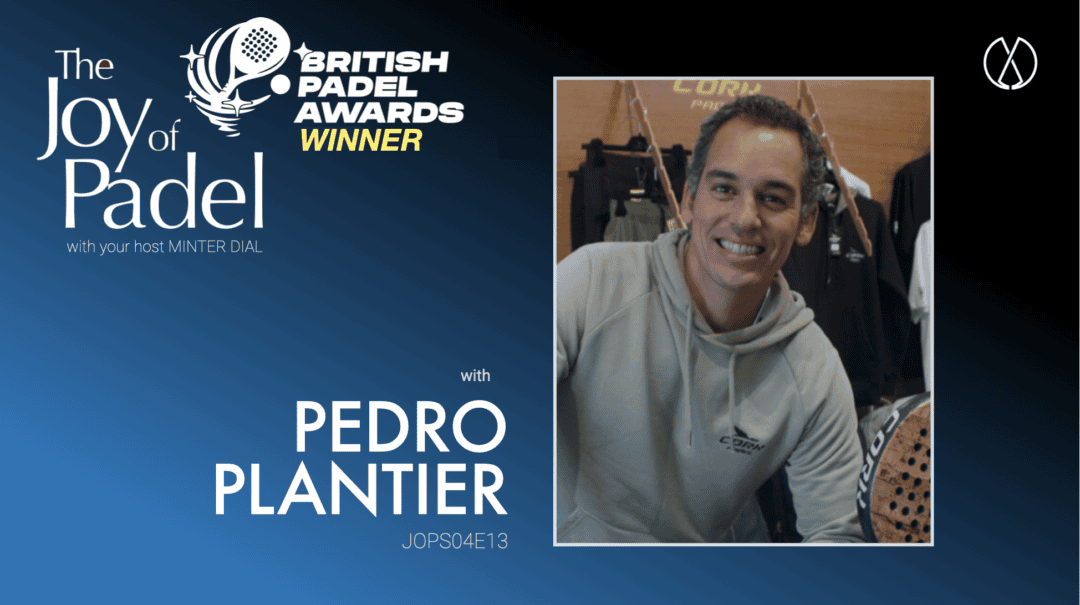
The Joy of Padel podcast with Pedro Plantier (JOPS04E13)
On this episode of the JOY OF PADEL podcast, I had the great pleasure of talking with Pedro Plantier, a true padel pioneer and the mastermind behind the innovative Cork racquets. This conversation wasn’t just about equipment—it was a journey through Pedro Plantier’s sporting life, the evolution of padel in Portugal, and the ingenuity needed to build a standout brand in the ultra-competitive padel market.
Background on Pedro Plantier
Pedro Plantier has been passionate about sport since his childhood. Having started out as a professional tennis player—with time spent studying in England—he eventually fell headlong for padel after moving to Portugal. It wasn’t an entirely smooth start: in his first session, he broke five racquets! But the magic happened after Pedro Plantier discovered the game at the World Championships in Murcia, Spain in 2006. That was his “game-changing” moment. From there, he ditched the corporate world and went all in on developing padel in Portugal—opening courts, coaching, and eventually launching the Cork brand with a small team of like-minded, innovative partners.
Main Topics Covered
The conversation focused on Pedro Plantier’s journey from tennis to padel, including the struggle tennis players face rewiring their instincts and the “click” that finally made defending off the back wall make sense for him. One concept discussed was how padel’s accessibility and fun create communities where both amateur and top-level players—no matter their age or athleticism—can compete and thrive.
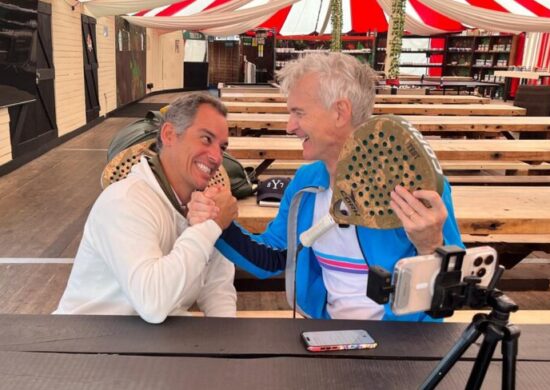
Pedro Plantier and Minter Dial signing off the recording at Padel Yard in Wandsworth
A key theme that emerged was the need for innovation in padel equipment. Pedro Plantier revealed how persistent issues with elbow injuries led to the pursuit of a softer, vibration-dampening racquet with Cork. The discussion explored the painstaking process of prototyping, sourcing unique materials like cork and Inegra, and the constant drive to make racquets that are both high-performance and eco-friendly. Several points were raised, including the changing business models in padel clubs, the importance of social experiences around the sport, and Portugal’s dreams to compete with the big hitters in Spain and Argentina.
Three Takeaways from My Conversation with Pedro Plantier
- Transitioning to padel demands true humility and patience—even seasoned tennis pros must “relearn” how to move, defend, and use the walls. But the moment it clicks, the game opens up beautifully.
- Innovation is born from real-world problems. Pedro Plantier and his partners created Cork to solve the widespread pain of elbow injuries and soon discovered that sustainability and Portuguese craftsmanship could distinguish them in a crowded market.
- The magic of padel isn’t just in the shots—it’s in the community. From clubs that double as social hubs to racquets that tell a story, padel’s joy is as much about people and connection as it is about competition.
Whether you’re searching for a racquet that soothes your elbow or dreaming about your next match, Pedro Plantier’s story is a testament to passion, perseverance, and the endless possibilities that padel brings. Ready for more insights? Listen to the full JOY OF PADEL episode and discover why so many are falling in love with the game—and with Cork’s one-of-a-kind racquets.
To find out more about Pedro Plantier & Cork:
- Check out Cork Padel and explore Pedro Plantier’s racquets at corkpadel.com
- Find/follow Cork Padel on Instagram
- Find/follow Cork Padel on X (formerly Twitter) (Dutch account!)
To listen to the show:
To listen to The Joy of Padel podcast, you can use the embedded player above, or go find it on Spotify, Apple Podcasts or any number of other podcasting services listed here.
Send in your questions or reactions: Please send me your questions — as an audio file if you’d like — to nminterdial@gmail.com. Otherwise, below, you’ll find the show notes and, of course, you are invited to comment. If you liked the podcast, please take a moment to review and/or rate it! ¡VAMOS!
Further resources for The Joy of Padel:

The Joy of Padel podcast, hosted by Minter Dial, a padel tennis player since 1974, is an exhilarating show that delves into the captivating stories of notable padel personalities worldwide.
Meanwhile, you can find Minter's other Evergreen podcasts, entitled The Minter Dialogue Show (in English and French) in this podcast tab, on Spotify, Megaphone or via Apple Podcasts.
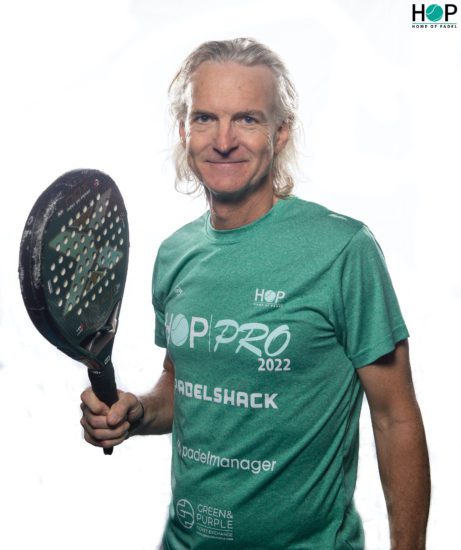
About the host: Minter Dial
Minter Dial is an international professional speaker, author & consultant on Leadership, Branding and Transformation. His involvement in sports has been a lifetime passion. Besides playing 18 years of rugby, captaining athletics teams, coaching tennis and playing squash for his university, he’s been a lifelong player of padel tennis, starting at the age of 10, from the time of its very first public courts at the Marbella Club in 1974.
Then, after a successful international career at L’Oréal, Minter Dial returned to his entrepreneurial roots and has spent the last twelve years helping senior management teams and Boards to adapt to the new exigencies of the digitally enhanced marketplace. He has worked with world-class organisations to help activate their brand strategies, and figure out how best to integrate new technologies, digital tools, devices and platforms. Above all, Minter works to catalyse a change in mindset and dial up transformation. Minter received his BA in Trilingual Literature from Yale University (1987) and gained his MBA at INSEAD, Fontainebleau (1993). He’s author of four award-winning books, including Heartificial Empathy 2nd edition (2023), You Lead (Kogan Page 2021), co-author of Futureproof (Pearson 2017); and author of The Last Ring Home (Myndset Press 2016), a book and documentary film, both of which have won awards and critical acclaim.
It’s easy to inquire about booking Minter Dial here.
Full transcript of interview via CastMagic
This transcription comes courtesy of Castmagic.io an AI service for podcasters.
Minter Dial: Pedro, great to have you on the Joy of Padel podcast. I’ve been playing with your beautiful beloved racquets, Cork. But in a few words, explain to everybody who is Pedro?
Pedro Plantier: Hi. Hello. This is Pedro here. Pedro is a guy that first is in love for sports since he was a kid. I was a tennis professional and I studied actually in England from 96 to 2000 in the University of Greenwich. And I was always looking for a sport which I could work on. And when I moved to Portugal, I quit tennis. I did some work in the music business, and then I was hired to the Portugal Telecom because I took the marketing degree. So, I travel the world because the Portugal telecom already the services for youngsters is like the British Telecom, the same. And so, I start working until I met padel in 2004.
Minter Dial: And where did you meet Padel?
Pedro Plantier: I bet in Quinta da Marinha. They started this with three concrete walls, old style. Old style. And the manager of the club was my ex-coach since I was a kid. And so, he brought his tennis team to try Padel. And the first experience was not that good. Why? Because I broke five racquets. I’m not saying, friends, that the brand that is not working now anymore already was. I smashed it and I broke it and I really felt weird. You know, how can we play a game that every racquet was getting broken? But my changing was in 2006 when I played the first world champions, that Portugal was part of it. That was game changing and the love and the joy for this game where I saw actually the best players playing. And we all came from tennis, it was a tennis team. And I will tell you the story. When he got it was in Murcia in Spain. When we get there, I went to the judge and I said, oh, we are the first Portuguese team to be part of this. Can you have a coach that see us playing a little bit and give us some ideas, some tips? And actually it passed when I called Horace Clement, one of the goddess of teaching of Padel, and I went to him with my bad Spanish on that time, and I told him, oh, can you just watch us please, a little bit and give us some tips? He said, okay. We got inside the court and I remember that for one minute and a half, we gave the most of everything. And he stopped. He said, guys, guys, guys, can you come here, please, guys? You play tennis? Incredible. Padel0. So, what I would suggest is you see those guys over there? We went to set up, sit there and watch. And I remember it was maybe 10 o’ clock in the morning, very hot. And we stayed until 1 o’ clock in the morning. We just left to eat something toilets go back. Because we couldn’t believe that they could do the shots that was allowed. It was breathtaking. And after that we returned home. And because Portugal is frontier with Spain and everything happens. Spain happens, Portugal and so forth. And I thought to myself, how can be a sport to develop with so many people? The stadium was for TVs brands. And no one know this in Portugal. It’s just a matter. So, I went home and I fired for my business. And actually was one day before I got married. I took my wife big week. I just gave up my job. She looked at me, why I’m going to work in Padel. You’re joking, aren’t you? I said, no, nobody knows what Padel is better. I said, I don’t care. I just so in love with this sport. This sport is going to get big. And so, I start. We actually hired me and another business partner at the time. We hired this Uruguayan Guy that we met in the world champions to come and teach. And he came and we started first in Estoril because the president of Estoril is a 35 court tennis court clays, you know, beautiful. And I said, oh, can I put Padel here?
Minter Dial: You.
Pedro Plantier: You came from tennis Padel. That game go there to a corner. And so, we start the first Padel court. And then actually the Uruguayan had a daughter, he had to move. And so, suddenly we had some 40, 50 clients. And this was in the beginning of 2007. And we looked to each other and my business partner at that time said, Pedro, I have my marketing company. I can go. You go to the court and say what? To teach Padel how I’m going to teach Go. So, that’s how I started. Wow.
Minter Dial: I want to circle back on moving from tennis to Padel. Took you two years to be the best in Portugal.
Pedro Plantier: Yes, that’s right.
Minter Dial: You represented Portugal many years. You must be young. The guy tells you often says you’re zero in padel. I’m always intrigued as to how a tennis player rewires. What is it that takes this to change the spirit?
Pedro Plantier: I will tell you. It was when they changed from concrete wall to glasses. And they divided the glasses with separation glass. 1, 2, 3, 4, whatever. And I took another degree. And actually Guy explained me that. And it was. I always tell this to my students that it took me four years to understand defending. Four years. And I suffer. And I really got mad. I broke rockets against the walls. It wasn’t the racquet’s fault. No, it was my fault until one day I did a click and when I did the click, my life changed.
Minter Dial: Well, what is it that gets you that click?
Pedro Plantier: It’s the click that suddenly you can have better shots from the ball coming from the back than the shots you hit in front. And we know from tennis everything is front, you cannot use the back wall when suddenly you start using the back wall and you start understanding the rebounds and the angles because the ball always do the same angles, the game changes.
Minter Dial: Well, I mean, you and I know that. The issue is how is it that, I mean intellectually people are listening, they’re playing some tennis and they know that they should be playing off the back wall but they’re not doing it. They still have that sort of instinct to hit the half volley to keep it from the back wall because God knows it’s not my friend back wall.
Pedro Plantier: I know it’s repetition and normally I will always tell to my students, now we’re going to do this exercise and you start using the back wall of the exercise and then with the same exercise and without using the back wall, always win when you start using the back wall. So, people say, well I lost without using and I win. So, this must be something. And the most important thing we had back times we had this guy called Inigo and he was champion, world champion, junior world champion from Spain and he went to do this university project, he’s called Erasmus. Oh yeah, you know, and he went to Portugal and someone called me from the Spanish, the Spanish male team, they call me Pedro. There’s this guy going there, help him because he needs people to play. I say okay, cool. So, he came to practice with her and in the first training practice we play and he told us, have you understand something? I said, no, every time you put the ball on the glass I kill you. You are right. So, we start understanding that good players use the glass to kill you or to counterattack you or to do different things.
Minter Dial: That surely should be an incentive for anyone out there who’s still a little hesitant about the back wall. Alright, so you’ve now become obviously an accomplished Padel player. Looking back at your life, what has Padel brought to you?
Pedro Plantier: Everything. Everything. First of all, the majority of people that did a sport professionally with the young, they came to a point that they give up and they get fed up, they get bored, some get fat. And I found, like everyone found in Pavel, another opportunity to compete, to get better, to be more positive. And it’s a game changing. I always say this. My wife was born with a tennis court at home, never played. She plays Padel twice a day and she has a physical preparation, food, everything. So, wow. And it’s happening with everyone. Padel is what I call it, a very lucky combination of all different racquet sports. And it’s so enthusiastic and it’s for everyone.
Minter Dial: And on top of that, what’s interesting in the realm of it’s for everyone is it’s easy to start and yet it takes a lifetime to master. There are not that many sports, I mean, like tennis. The issue is it becomes too big at our age, we get a 22-year-old who’s heavy hitting, we’re just not going to get to the ball. At least at my age, 62, That length, that size, the power, it can be differentiated. However, in Padel, even as we get on, we can still sort of compete closer to those bigger, better hitters, even though they can Por Tres and all that. Because we can anticipate better. The walls are there to help us and diminish the power and allow us to compensate.
Pedro Plantier: It’s true. To help you to exactly what you said, you go to some places in Spain or maybe in Argentina still, because the tradition is 50 years old or something. You see old people, very fat, winning young generation. And it’s just amazing how they read the point. And it’s like a bit like squash. If you get the tea, you control the points they do in the whole square of the game. It’s just amazing.
Minter Dial: So, I want to go back to the Portuguese question, right? On the frontier with Spain, the hotbed of padel in the world today used to be Argentina. We have the Deus brothers, we have
Pedro Plantier: Sofia Araujo, we have Nogueira, right?
Minter Dial: But it’s still. We’re still quite far away from competing against the Spanish and the Argentinians. I mean, especially amongst the women. But what is it that. What is it going to take Portugal to pierce?
Pedro Plantier: It has to start from the top and also from the bottom. What does it mean? You need to invest in infrastructures in all different kind of sports. Why Spain is so good in all sports? Because when they organized the Olympics long time ago, they did all the infrastructures and after that they prepare themselves. So, they are good in each sport because they prepare the kids, from the school to the universities, to everything. Everything is well structured in Portugal now. Portugal is football, football, football, everything football. It’s amazing. Amazing academies, amazing schools, Everything is amazing. The Arad sports are suffering a good changing for the all sports federations in Portugal is that now you’re using the batting, the result, to give you money. So, for example, the tennis federation was so poor and now is really rich. It’s millions each year from the betting. Basketball is doing that, handball. So, the betting is actually helping a lot for the Floresians to have money. But still you have to start from the beginning, from the sports in schools, the infrastructures. You go to Spain, you see a little bit here also in England you go to the schools, they have all different sports there so they can practice free. You go to the main of the cities free. And that makes people play the sport.
Minter Dial: One of the things that I know the FEP federation in Spain did is that they got with the government council courts. So, for five euros, maybe it was pesetas, but it was. They made it cheap, therefore accessible to everyone. That course killed a little bit the model for the premium clubs that had to sort of taper back. That’s the price of doing business.
Pedro Plantier: I think that’s what happens there is going to happen everywhere and they are far away, because I started first. And for even the exclusive clubs is not the renting of the court, that is the business. The business is the membership. And then the bar and then the restaurant and all the activities, they do that now in Portugal, we were invited for everyone, everywhere. And all the people are asking for clubs, proper clubs, that they go in the morning, they drop the kids, they play, they have lunch and they return again. They do everything. And we are starting to do that because that’s what they did. And you see that. And the cost of in Spain sometimes is €2, €3, €5 per person, an hour and a half, they fully bought. But what they spend there now the kids are on the swimming pool and some are in yoga and some are doing. They spend the whole day on the club. That’s where the money comes from, not more from the renting.
Minter Dial: Yeah. So, I mean, looking at the club model, like I think about restaurants, it’s typically the wine and the alcohol is where the real money, the real margin is in a club. You’ve got a club like we are here today, we’re recording in Padel Yard in Wandsworth. Beautiful club.
Pedro Plantier: A little bit of sun, I saw a little bit.
Minter Dial: But I wonder to what extent it’s the alcohol or the bar consumption or is it retail? Where does the margin happen? Because just renting courts by itself is.
Pedro Plantier: I know we have clubs in Portugal that they get more from the bar than actually from the sport in itself, but I think Most of all, it’s the socialization. You want people to socialize, so you have to give them whatever you need to for them to stay. And so, I always joke a little bit, because you do not go to discos more anymore. Few discos. I saw a program In England that is 45% of the discourse are gone. The habits are gone. And so, what? The clubs of Padel, it’s. It’s a mixture of sports with entertainment. And that’s where you should go for otherwise you’re not going well, because only for the sport. The sport is an excuse to drink and to have fun and to meet people.
Minter Dial: What I like to say is the sports allow me to lose the weight.
Pedro Plantier: Exactly. You can say that.
Minter Dial: Put it on afterwards, in the joy. All right. So, Pedro, you also have this marvelous Cork brand. I mean, I’ve been playing. Those are my racquets in the background. I’ve been playing with cork for at least, I would say, since the beginning with the racquet that Nelly gave to me. Where did that idea come up? I mean, the Cork racquet, I mean, it really is a standout brand. As soon as you’re on a court, people say, it’s a cute racquet. What is it? It’s different, it looks different. So, on a branding perspective, wow. But how did you come up with the idea? Because it’s easy to say it in retrospective. It’s beautiful. But what were you doing? Where were you? You were smoking some dope and all of a sudden this idea came to you, what was happening?
Pedro Plantier: No, this is the thing, because I was the first, or one of the first as a matter in Portugal, and I was national for many years. I was sponsored by many brands. I’m not going to say names. And what happened normally is rockets broke and my arm was killing me. So, I give classes with my left hand and I play with my right hand. Otherwise I could not match it. And I was always very concerned, how can this be possible? And my sponsor at that time always said the same thing is. No, no, it’s the way you play. You play too strong. Nothing to do with the problem of the racquets. Until I met this. My business partner, Nicolaou, the genius of engineering, and Nicolau, from the north of Portugal, where our factory is on Fatima. Nicolaou used to do this process for 20 years. So, he’s a very handyman. And he bought a brand, he broke it, and he bought another racquet of another brand, and he broke it. And he said, In two weeks I spray spend €600. I have no Money for this, I’m going to do my own rocket. But before that, for five years, he was the guy that fixed all the broken rockets. Why? To get the expertise to understand what was going on. And what he found out was, every time you open the racquet, the same, no matter the brand, no matter what, all the same, copying each other.
Minter Dial: Carbon.
Pedro Plantier: This fuse. Empty there, few there, doesn’t matter. And he actually was born in Paris. And one day when he was coming to the airport in Lisbon, he saw the cork shop, where all the cork materials are there, all the cork objects.
Minter Dial: Well, obviously for bottles, most everything. Shoes?
Pedro Plantier: Yes, okay, Shoes, floors, rooftop, whatever cork is. If you go to the best sound recording, it’s all cork, right? So, cork has unique properties. And he said, I would like to have a Racketeer. And one day he was playing in a club that I was the owner, and I saw him playing with what looks like a tree racquet or something. And I went to Nicolaou and I asked him, Nicolaou, what the hell are you doing? What are you going to say? Oh, it’s just an experience. What is that? Oh, it’s the beginning of a racquet. Can I try it?
Minter Dial: Prototype.
Pedro Plantier: Prototype of complete. One day you go into the factory, you will see there, say, how can you play with that? That’s the first feeling. And I hit it and I say, Nico, I always wanted to have my own brands. I do not like the way the racquets are broken, my elbow hurts, all the semi-conductors excuses. I sell a rocket to a good friend and he broke, and I don’t know what to say. Can you take weight on this rockets? Can you do this? Can you put light material? Can you, can you do things? Pedro, I can try. I said, let’s start this. And if it works, we have a brand and we do a business. And that’s how we started, you know, prototypes. After the prototype, he sent me 10 prototypes, because he did himself alone. And I would try them. I would pass to my friends or the national team. Guys, try, try this, try that, try that. And I would write them, say, go this way. This rocket is a little bit heavier this. Years, years, years. Our first prototype started in 2012, 13. Until I met Fernando, which is the lawyer, and he said, guys, if we’re going to start this business, you cannot continue doing what you do. Protect yourselves, protect yourselves. And actually went and said, hey, protect your friend. He protected all for all the world. And I said, how much you want for it? No, nothing. But you just spent 10,000 years or whatever. We need a Legal guy. You want to come aboard? I said, oh, I have not. We need you. He came aboard. And then I met Francisco, the marketing guy. Francisco, we are starting this brand, but we need logos. We need everything. Can you help us? Oh, of course. I do it for free. No worries. He did it. And after. After a while, I said, man, you’re spending a lot of money. What you need? Nothing, nothing. I need you as a business partner. So, we have four business partners, and we have a beautiful family. And it’s basically family. And actually, people have no idea what the bird is. This black bird, I was going to ask you. This is called a black stork, and there’s a protected black storks that only live in cork trees in Portugal. Oh, that’s why it’s a black stork. Wow. Okay, good story. And basically, our rockets are molds of proteases. That’s why all details count. Okay. And for us to be thankfully successful as we are now, we had to do the journey of what I call the rocks journey. It’s word of mouth. Pass by, pass by. And at the beginning, our racquets start to be very known by healing elbow. And that’s why they are very soft.
Minter Dial: Right.
Pedro Plantier: And what we found out was that we are known to be healing elbows, but not for good players. Right. Dalush brothers, Miguel Oliva and Vas Koskal. We had a game changing on that time. And so, what we had to do it. We had to put new raw materials. And our aim is handicraft in Portugal. Handmade and no vibrations. And for you to have a racquet stiff, because good players play with stiff racquets without vibration. It took us a long, long time.
Minter Dial: All right, so if we go back to this, this is my first Cork racquet, the Creste Club. For that Nally gave club. Obviously, there’s a similarity to the brand new one that looks there. But let’s just talk through a little bit about what is in this racquet. I mean, because this is close to the beginning. Surely you can tell.
Pedro Plantier: Normally, a normally opposite or competitive brand has one layer of carbon and one layer of fiberglass. In one side foam, and other side the same. This racquet, if I remember, he had three layers of fiberglass, four of carbon, different carbon, plus Inegra, which is a special, very flexible material that is using NASA on the spaceships. And plus the cork, plus on that time, we put the Portuguese and nylon. Basically, it’s an experience all inside. For what? Because as you can know, the vibrations of the rocket came from the mouth of the rocket is open heart above. So, our secret lies here, our anti vibration and of course on the side and of course what is inside. And this rocket, because it’s already old, this already is probably medium soft touch. Yeah, this is another line. It’s called the supreme line. This is a medium hard touch. Right. So, what we did in our rockets at the moment we have rockets from medium soft touch, the classic. Then we go to the premium line with the three different shapes, Power, hybrid and control. Medium touch. Right. And then we go to the supreme line, different three shapes also. Medium hard touch. And then we end up with the extreme line, Hard touch.
Minter Dial: Right. So, you have three shapes at hard touch, you do the teardrop.
Pedro Plantier: Basically we have a racquet for every single person. And because we work with grams, each racquet has this gram. Oh, I want the racquet stiffer but lighter. We do it because it’s handyman.
Minter Dial: Right. So, if I, if I look at this racquet or the new ones, I mean, I’m a marketing guy, so hopefully this is not going to destabilize. But how much of it is actually cork? Is there a percentage? Do you have? Can you reveal actually, because I mean the brand is so strongly this. It’s obvious you have a lot of cork.
Pedro Plantier: Of course, on the surface we have a thin paper of cork, very, very strong. But even though it’s a thin paper and we tried so many, didn’t work. So, we have a thin paper of cork inside on our anti vibration system. Cork full of cork on the sides. Because when you put in the oven, this is soft and it gets on the sides underneath. You’ve never seen our racquet is made, have you? One day you come to our factory, you understand? And underneath, on this layer here, before here, we put underneath also cork and on a cable inside cork. So, it’s probably, I would say 40% cork. Wow. Plus also here we changed this. We did an open mouse more so bigger open bigger. So, it’s easy to maneuver and it supports the anti-vibration and the vibrations up. And then we put this Portuguese wood here.
Minter Dial: So, this is the new. This is the new.
Pedro Plantier: Exactly, the new design here. It’s more beautiful and also supports and sustains all the rocket. So, this is innovation, basically. And we put more green raw materials inside on the classic and the premium line, the rocket is seen 65% green. Help. It’s sugarcane foam, only made for us. So, we are always innovating, always. Because otherwise we cannot compete with these huge brands. The power they have and the Martin they have. So, we go to the opposite way. Quality. Quality. Innovation. Quality. Quality. Quality.
Minter Dial: Well, and I’m going to say one other thing, Pedro, is that I have your bag here. And I’ve gone through a lot of these other competitive bags. Bags. And I have enjoyed this bag. I think there’s a level of detail in the bag.
Pedro Plantier: And specifically the thing, the think tactic or the leather bag.
Minter Dial: It’s leather bag. The thing that I really like is the fact that the zipper doesn’t break immediately. It’s as crazy as small.
Pedro Plantier: Do you know who made those leatherbacks?
Minter Dial: Teeth guy.
Pedro Plantier: No, no, no, no, no. Not away. Cork is always about stories and coincidence, which I do not believe, but any happenings? There is this old guy is retired with his wife. Retired old. And plus four ladies old. And this guy is best friend of Nicolaou’s grandfather.
Minter Dial: Oh, wow.
Pedro Plantier: And this guy was Louis Vuitton number one for crocodile and Lisa Skin for 20 years. He’s like a summit. But he’s retired. Just work for us for fun. Because he loves our brand. And that’s why it’s the quality of it. That’s why you find the details.
Minter Dial: Well, in the small story, Pedro, is that in my. Let’s say, while my first job, I worked in investment banking in New York. On the side, I started a luxury leather goods bags company.
Pedro Plantier: Wow.
Minter Dial: We’re making doctor’s bags in those days. And $5,000 and higher in the 80s. Wow. Just give you an idea. So, that was my understanding of leatherbacks. All right, so Pedro’s time is of the limit. Getting back to the padel story. What are you working on in your game? You know, because I like to understand how we evolve. I always say it takes a lifetime to master what part of your game, what’s your favorite shot today? And what is the part of the game that you’re still feeling like you need to improve?
Pedro Plantier: The thing is, the game is changing so much. I like. Exactly. I like to play the old game, the chess game. Chiquita Global glass three middle open angle. Do not put the ball there. Do not play to the two and four glasses. Because it is a counter attack.
Minter Dial: Yeah.
Pedro Plantier: So, I. I love so much to play the chess game.
Minter Dial: Yeah.
Pedro Plantier: And which shot I like the most depends if I play on the right side, on the left side. But that makes sense. By the way, don’t worry if it’s a left side, I’ll have my back involved in the fence because I do not miss it. I love it. Or the roll to the fence, it’s my best shot. But defending because it took me so much to understand how to defend. I just love to defend and be on the back and they are attacking and just returning, returning until they get mad and they change it.
Minter Dial: So, I just got a question for you because I had the same feeling. And maybe it was because I’m feeling older too. But the issue when you’re so happy defending is to remember to get up to the net. And today’s game is so changed. The transition up to the net is everywhere. You need to go into the fire. You know they’re up there at the net, Chiquita rush or a lob block. And if you’re comfortable defending, that can seem like a very risky proposition. Because you know you can just get it back off the back wall.
Pedro Plantier: Exactly.
Minter Dial: But going in there, you’ve got great reactions. You’ve got to be able to hit that chiquita correctly.
Pedro Plantier: I always say it, I always say what the best ever. Fernando Balesteguin once. Bela, Bela told me and he told me, but I knew him, he just told that still the best shot. Number one shot in Padel is the lob. So, it’s the defending that turns out to be a counterattack. If it’s a good law, naturally. And there’s one big ambassador of cork in Argentina. He was 11-time world champion. Robbie Gatiker, who I met on this podcast. Oh, did he? Yeah. Amazing. He show up in our factory. Pedro, your rockets are the best in the world. Sponsor me and he’s our my best ambassador. If you play with him, you know why? He was 11-time world champion. He does a lob that you think you can do a smash or you can viper it, but you’re always going backwards and you’re always selling to him. It’s incredible. His best shot.
Minter Dial: I’ve actually had a chance to play with Robbie. He doesn’t miss anything.
Pedro Plantier: It’s incredible.
Minter Dial: He’s not exactly a big man.
Pedro Plantier: He’s very short and he’s very short, but he’s an amazing man also.
Minter Dial: Well, that’s another beautiful thing about padels. You don’t have to be 6 foot 4. However, I do feel that the pro level is getting more and more speed, power, height, big. Exactly.
Pedro Plantier: The game is changing so much that if you see that if there’s a tournament outside hot, you will see the results. Explosion last year in the European Championships. That was in Cadiz in Spain. 35 degrees, all the games inclusive. The Spanish 7-6, 6-7, 7-5, 7-5. Because it’s. The kids are so big. They are very talented. They smash from everywhere. So, your lobby has to go like this from the back wall. If it’s like this smashing, the ball comes back.
Minter Dial: And even the problem with that is it comes back off the back wall
Pedro Plantier: and they had it, they kill it. And it’s a game changing. So, if you play indoors, you see the tournaments when it’s outside, the battle’s the best. Almost lose one set, almost losing. It’s a game changing. So, the game is changing and depending the conditions it changed so badly.
Minter Dial: So, when do you think that’ll be A In the men’s, probably faster than the women’s. Someone other than Argentina and Spain in the. You know, winning.
Pedro Plantier: I will tell you something. Last year on the veterans European Championships, Spain almost lost with Holland and almost lost with friends. And it’s changing. This year the World Championship is going to be in Buenos Aires. You will see. Because when you get to veterans a little bit, what happens with the beginning of Pardo, who is fit, good touch is not more anymore. When you competed, the fat guy, talent guy moves well. It’s because the world is playing power Pavel. So, it’s in a matter of years. It’s not that far. When I start playing Padel, especially in Argentina, you pray. And the Brazil on that time was very strong. Brazil, Lehman and all those guys and Flores and so many of them. Gervasio del Bono, Giuli. Giulianotti. Gervasi is our national coach. He changed Padel important Portugal Sofia is what it is Deozbra because of his ideas. That’s when he taught us the chess game of Padel. Because the guy is a genius.
Minter Dial: Love it.
Pedro Plantier: And I play against him many times and he bullying me inside the court.
Minter Dial: So, Pedro, time is of the essence. People who are listening. We have people who listen in all over the world playing padel. Obviously there’s concentrations, but. But how and where can people get your beloved Cork racquets? Where are they distributed?
Pedro Plantier: I mean, obviously now we are in 52 countries. In the website of corkpudel.com you can buy it or you can see where the distributors are. And we are going everywhere because padel is growing everywhere. And there is people everywhere that are suffering from elbows and looking for quality and performance with. Because we came from healing elbows to amazing performance racquets. So, it’s a.
Minter Dial: And how is it still possible to get your name engraved?
Pedro Plantier: You allow for the personalization, of course. Logos, signatures, whatever you can do here that is doesn’t. Because you can melt the cork, you cannot melt the carbons. And it’s still. You can. You just can get it everywhere.
Minter Dial: Basically, you guys, you heard it from us. Go, go. Try out cork Racky. They’re special. I am an ambassador of padel of cork, but, you know, I’m just a free ambassador. I love cork, so I’m not being paid for this sponsorship. All right, you take care, Pedro. Mucho de gracias.
Pedro Plantier: You’re the best. And congratulations. Getting the awards of the best, and you are the best.
Minter Dial: Thank you, sir.
Pedro Plantier: Well done. Thank you.







That’s a really interesting look at the history of the game. It makes sense that prioritizing craftsmanship and sustainability would lead to such a unique approach to padel equipment.