
There is a new energy that hangs in the air around Roland-Garros in Paris in September. It is an energy born of tension, of intersecting trajectories, and of the human drama that occurs when four people, armed with padel bats, step inside a cage with a glass wall and chicken wire. As someone who has spent a lifetime looking at the intersection of strategy, human behaviour, and the profound narratives of sport, I have always believed that statistics are never just numbers. They are the digital footprints of a deeply analogue human struggle.
Looking at the data coming out of the Paris Major 2026, we aren’t just looking at game counts and upsets. We are looking at a melange of contrasting attitudes, physical thresholds, and the evolving nature of modern padel. The numbers tell a story of two entirely different sports being played under the same brand banner—and it is a narrative that every player, fan, and strategist in the ecosystem needs to understand.
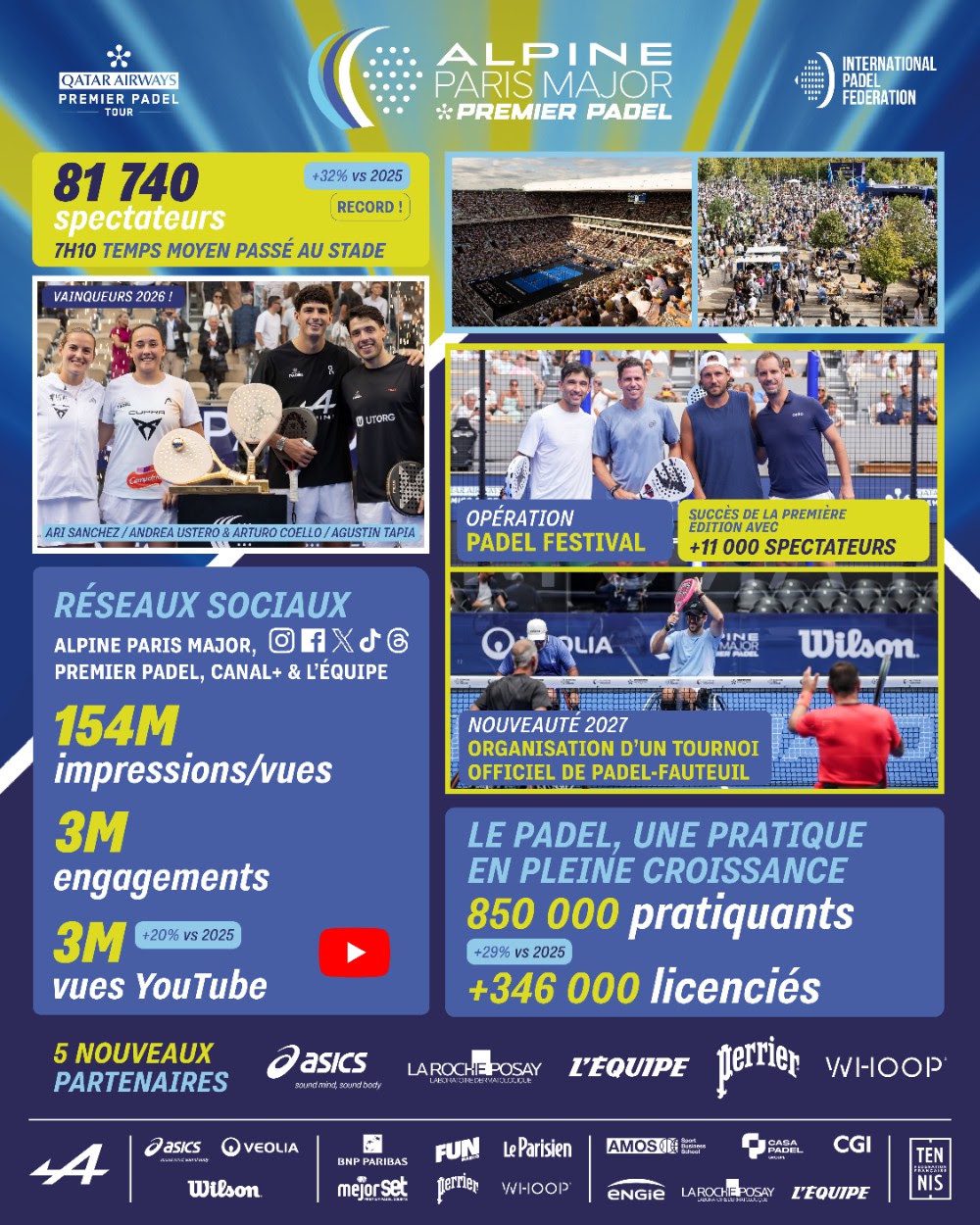
First, here are the official figures coming from the French Federation of Tennis (also in charge of padel). What are the key messages? Over 81,000 people came during the week to watch, and these individuals spent on average 7:10 hours at the stadium! That’s impressive. Media attention is growing as well. All in all, one can say that the Paris Major 2026 was a flying success, based on these numbers. Now, let’s look at the data of the professional matches.
The Gender Paradox: Speed vs. Strategy
For the recently finished Paris Major 2026, I analysed all the match results (from qualis through to the finals). The most striking revelation in the data lies in an inverse relationship between the men’s and women’s games. Across the entirety of the tournament—encompassing 59 men’s matches and 51 women’s matches—a pattern emerged.
The men, on average, played more games per match than the women (21.80 compared to the women 19.96). Yet, despite playing more games, the men typically finished their matches faster. The grand total average for a men’s match was 1 hour and 25 minutes (or 3.9 minutes per game), while the women averaged 1 hour and 29 minutes (or 4.45 minutes per game).
What does this tell us? It speaks directly to the soul of how the game is mutating. The men’s game has become an explosive, high-octane theatre of athletic efficiency. Points are decided by devastating power, kick smashes that fly, and lightning-fast net transitions. It is a game of rapid execution. And this was true even though the court speed itself was assessed as quite slow.
The women’s game, conversely, is a beautifully complex chess match. With fewer games played overall, they spend more time on the court because the points are fought with a gruelling, tactical patience. It is a world of calculated lobs, surgical chiquitas, and defensive resilience. They are not looking for the immediate kill; they are looking to break the opponent’s psychological positioning over long, exhausting rallies. For anyone who thinks power is the only metric that matters in sport, the women’s draw at Paris stands as a testament to the art of the strategic grind.
The “Quarterfinal Wall” and the Elite Separation
In this tournament in Paris, it seems that the quarterfinals were where the competition shifted from prologue to core conflict. The data shows that the women’s quarterfinals stood out as the emotional epicentre of the entire event.
During the women’s quarters, matches extended to an average of 24.75 games, with 75% of those matches pushed to a deciding third set. The average match time spiked to a punishing 2 hours and 2 minutes. This was the round that gave us the longest, most epic confrontation of the entire tournament: the 3-hour and 14-minute battle where Marta Ortega and Sofia Araújo outlasted Paula Josemaría and Bea Gonzalez (2-6, 7-6, 7-6). Araujo and Ortega saved five match points before sealing victory.
This tells us that at the elite level of the women’s game (among the top six seeds anyway), there is almost no daylight between the top pairings. When the stakes get high, the matches become marathons of mental endurance. They refuse to give up an inch of blue turf.
On the men’s side, the quarterfinals represented something entirely different: elite stabilisation, with the 1st, 2nd, 3rd and 6th seeds coming through. While the women were testing each other in three-set thrillers, the top men’s pairs operated with clinical, corporate efficiency, wrapping up matches in an average of 1 hour and 31 minutes with only one (25%) of the contests going to a third set. The men saved the true drama for the grand finale, where the top 2 seeds once again duked it out.
The Desperation of the Qualifiers
We often focus our attention on the glamorous Sunday finals, but as an analyst of human grit, I am always drawn to the qualifiers. The data from the opening days in Paris reveals what I call the “Quali Trap.”
For the men, the qualification rounds were a volatile, high-stakes ecosystem. In Q1, half of the matches went to a deciding third set, averaging 24 games per match. Think about the psychological weight of that! These players are fighting for their professional lives, playing in the relative shadows of the secondary/tertiary courts, desperate just to get a ticket into the main draw. The volatility was immense, highlighted by the Naranjo/Zapata vs. Valdes/Benitez thriller that lasted for 2 hours and 16 minutes.
Once the main draw began, the men’s game actually stabilised, with third-set deciders dropping to less than 20% in each of the Round of 64 and Round of 32. The lesson here is clear: the energy required just to enter the room at a Major is often more chaotic than the early rounds of the main event itself.
A Tale of Two Finals
If you want to understand the beautiful unpredictability of sport, look no further than how the tournament concluded on the last day. The two finals could not have been more polarised if they had been scripted by Hollywood.
The Women’s Final was a clinical shutdown. It was the shortest round of their entire tournament, lasting just 1 hour and 11 minutes and requiring a meagre 14 games for Ari Sánchez and Andrea Ustero to dismantle Claudia Fernández and Martina Calvo (6-2, 6-0). It was a masterclass in every sense of the word—a demonstration of what happens when one team executes flawlessly without a single hitch. To my viewing, Sánchez not only didn’t miss a rulo, almost each one she hit became an outright “dirty” winner. Unlike their victorious performance in London, the young pair of Fernández and Calvo who had overcome the #1 seeds in the semi-finals with relative ease (6-4 6-2), just couldn’t get their game going.
The Men’s Final, however, was a heavy-metal opera. It was the only round in the entire men’s draw where a third set seemed pre-destined to go down to the wire. And so it was another Clásico. Tapia and Coello pushed Galan and Chingotto to the absolute limit across 32 games and just under 2 hours of breathtaking padel (6-3, 4-6, 7-6). It was the perfect climax, an ultimate test of modern padel’s top two conceptual identities clashing in a war of margins. It also means that Coello/Tapia are fully in the driver’s seat to finish #1 this year.
The Real Takeaways
When we step back and look at the grand total—110 matches played and 2,304 games contested—the macro patterns emerge clearly. Padel is a sport in the middle of a massive growth spurt, adjusting its identity in real-time. The men are pushing the boundaries of human speed and verticality, making the game an efficient, elite spectacle. The women are preserving the deep, soulful identity of padel—where strategy, patience, and mental fortitude triumph over brute force.
Paris showed us that the numbers don’t lie, but more importantly, they don’t capture the sweat, the fractured focus, or the heartbeat of a player facing a match point down. They simply give us a frame to appreciate the magnificent complexity of the game.