How does one make a strong team?
It’s a question I’ve been chewing on for the best part of three decades: in the corridors of L’Oréal, on conference stages, on the padel court and, yes, on my proverbial sofa watching the Philadelphia Flyers (NHL). You can hire for talent. You can draw up the organigram, run the offsite and order the matching fleeces. But a key ingredient I’ve observed over the years can’t be bought or scheduled. And it has everything to do with mindset and attitude (rather than competencies).
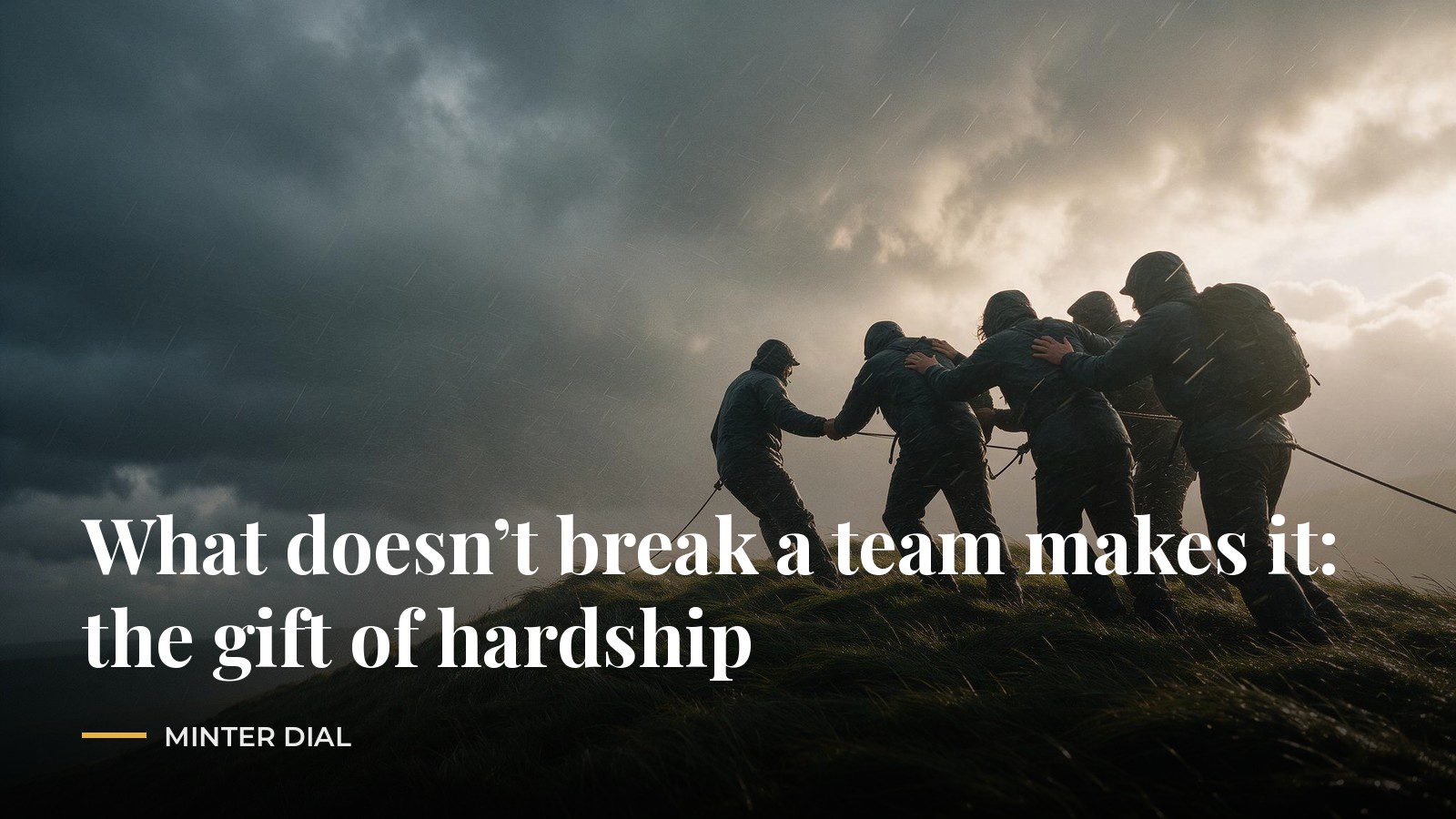
The magic happens when a team has been through a strong trial and come out the other side. The team then becomes stronger.
Hardship, in other words, can be a gift. It just rarely arrives with a bow on it.
Seven countries, one almighty row
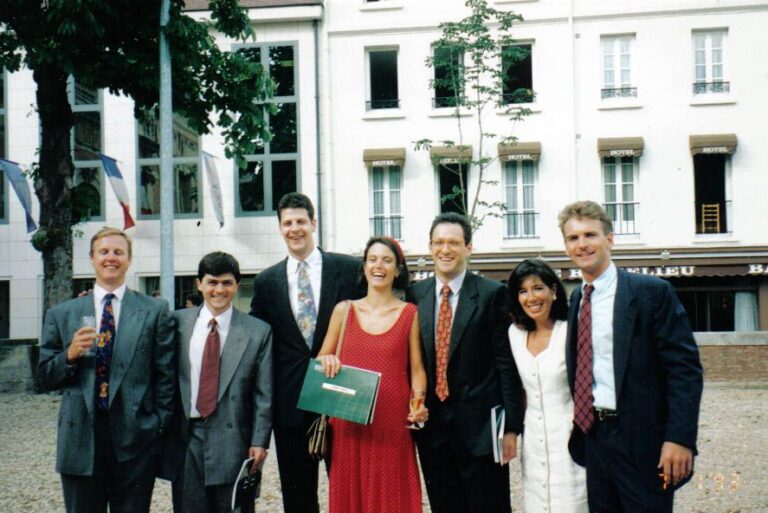
Back in 1992, when I arrived at INSEAD for my MBA, we were immediately put into study groups of seven. Everyone from a different country, deliberately, to force the “differential”. Ours was Ricardo from Brazil, Nathalie from France, Lorraine from Canada, François from Belgium, Andrew from England, Massimo (RIP, we miss you) from Italy and me, the American (at least that was my only nationality at the time). On paper, a charming mini–United Nations.
In practice, our group became famous for having an enormous argument erupt at the very beginning of our first session. Seven nationalities, seven sets of assumptions about how a group ought to work, and we certainly got off to a bad start.
It was agonising. Not least because we were being marked for our collaborative spirit as well as for the final output. Imagine being graded on teamwork in the very week your team is at war with itself.
And yet, by the end of the year, we were a very solid team (and, other than the too-early-departed Massimo, we’re all still in touch!). We produced some of the finest work, precisely because we had experienced sharp disagreement and confrontation. Through the storm, we bared ourselves and came out on the other, weathered and yet, tighter. We knew that we could survive divergent opinions.
Years later, I realised we had been textbook. In 1965, the psychologist Bruce Tuckman described the sequence that small groups tend to go through: forming, storming, norming and performing. The second stage, he wrote, “is characterized by conflict and polarization around interpersonal issues.” Then comes the good news: “Resistance is overcome in the third stage in which ingroup feeling and cohesiveness develop.” We simply did our storming rather loudly, and rather early.
The storm, by the way, is not the failure. Harvard’s Amy Edmondson, who has long studied teams at work, puts it this way: “People who feel psychologically safe are confident that candor and vulnerability are welcome in their workplace.” Once you’ve had a proper row and you all still turn up the next morning, a lot of the fear of speaking up goes out of the room.
Snow, scrums and a band of brothers
We find a similar strength in teams formed by those who engage in physical efforts. The riskier the effort, the stronger the potential bonds… assuming the team gets through. Hence the famed bonds formed on the rugby pitch: playing in the snow, playing through injuries, throwing your body into hard tackles for the person next to you. And hence the famous bonds you find in the military, the Band of Brothers in wartime.
Shakespeare, of course, got there first. With St Crispin’s Day falling this Sunday, 25 October, it seems only right to quote Henry V before Agincourt:
We few, we happy few, we band of brothers;
William Shakespeare, Henry V, Act IV, scene 3
For he to-day that sheds his blood with me
Shall be my brother
It isn’t only poetry. In 2014, the psychologists Brock Bastian, Jolanda Jetten and Laura Ferris asked small groups of strangers to do some mildly painful things together: hands in ice water, leg squats, even eating a hot chilli pepper. Compared with groups who did painless versions, sharing the pain “promoted trusting interpersonal relationships by increasing perceived bonding among strangers” and increased cooperation. Their conclusion: “shared pain may be an important trigger for group formation.”
I’m not suggesting chillies at your next offsite. (Although…) The point is that the hardship doesn’t need to be engineered. It needs to be shared.
The bad patch: stick together or implode?
Another example, in sports, is when a team goes through a bad patch or significant adversity. Does the team stick together or implode? If it’s the latter, the record will show. If it’s the former, there’s a chance that the team forms a stronger bond, a stronger core.
Which brings me to my beloved Philadelphia Flyers. Their 2026–27 season opened with a 0-6-3 record in the first nine games. Nine games, not one win. As a Flyers fan, you learn to suffer (last time we won the Stanley Cup was in 1975); it’s practically in the season-ticket small print.
So, I’m now keenly watching how they handle themselves after their abysmal start. They’ve won three straight, 3-1 against Ottawa and 3-2 against the heavily favoured Colorado, despite missing several core regulars to injury (already!). Against the Avalanche, Travis Konecny, Owen Tippett, Tyson Foerster, Cam York and Rasmus Ristolainen were all out, and four rookies stepped in. Coach Rick Tocchet’s verdict afterwards: “I just saw a lot of buy-in tonight.”
Buy-in. That’s the word. And, then, last night away in Buffalo, they made it three in a row, winning 3-1, with just one of the five missing back in the line-up. Green shoots, but green all the same.
Down 0-6, then roaring back
Padel gave us another example of what I deem a strong sense of team, at the Milan 2026 Premier Padel P1. In the semi-final, the explosive duo of Leo Augsburger and Juan Lebrón were crushed 0-6 in the first set by “Chingalan”, Federico Chingotto and Alejandro Galán. A bagel, in a semi-final. Utter embarrassment?
They figured out how to brush it off with Augsburger and Lebrón roaring back to win 6-2 6-2.
When you lose a set 6-0, the easiest thing in the world is to look at your partner and wonder. In padel, there’s nowhere to hide: it’s two of you in a glass box, and every shrug is visible. To turn that around, you have to stay a team before you can play like one. (They then lost a hard-fought final to Coello and Tapia, but that’s another story.)
The same question now applies to Chingalan. How do they bounce back from such an adverse result? Their next tournament in Kuwait will tell us a lot more than that first set did.
So, is hardship really a gift?
Only if you get through it together. Nobody sensible goes looking for a crisis, and I wouldn’t advise any leader to manufacture one. But we can stop treating the storm as a sign that the team is broken. Don’t rush to smooth over the first big row. Make it safe to keep talking afterwards. And when the bad patch comes, watch who leans in.
Because the teams I remember most fondly, from INSEAD to L’Oréal to the rugby pitch, are not the ones that had it easy. They are the ones that came through something.
What was the trial that forged your best team? And did you recognise it as a gift?
Sources
- Bruce W. Tuckman (1965), “Developmental sequence in small groups”, Psychological Bulletin 63(6), 384–399. https://web.mit.edu/curhan/www/docs/Articles/15341_Readings/Group_Dynamics/Tuckman_1965_Developmental_sequence_in_small_groups.pdf
- Harvard Business School, “Leading in Tough Times: HBS Faculty member Amy C. Edmondson on Psychological Safety” (22 Nov 2022). https://www.hbs.edu/recruiting/guides-and-stories/leading-in-tough-times
- William Shakespeare, Henry V, Act IV, scene 3 (Folger Shakespeare Library, “Saint Crispin’s Day Speech from Henry V”). https://www.folger.edu/blogs/shakespeare-and-beyond/saint-crispins-day-speech-henry-v/
- Brock Bastian, Jolanda Jetten & Laura J. Ferris (2014), “Pain as social glue: shared pain increases cooperation”, Psychological Science 25(11), 2079–2085. https://pubmed.ncbi.nlm.nih.gov/25193943/
- NHL.com, “Michkov scores twice, Flyers hold off Avalanche” (20 Oct 2026). https://www.nhl.com/news/colorado-avalanche-philadelphia-flyers-game-recap-october-19-2026
- Skull Padel, “From 6-0 Up to Out: How Galán and Chingotto Lost the Milan P1 Semi-Final to Lebrón and Augsburger” (18 Oct 2026). https://www.skullpadel.com/blogs/news/galan-chingotto-lose-milan-p1-semi-final-lebron-augsburger-2026
- StudyPadel, Milano P1 2026 results (semi-final and final scores). https://www.studypadel.com/tournaments/2026/milano-p1-2026