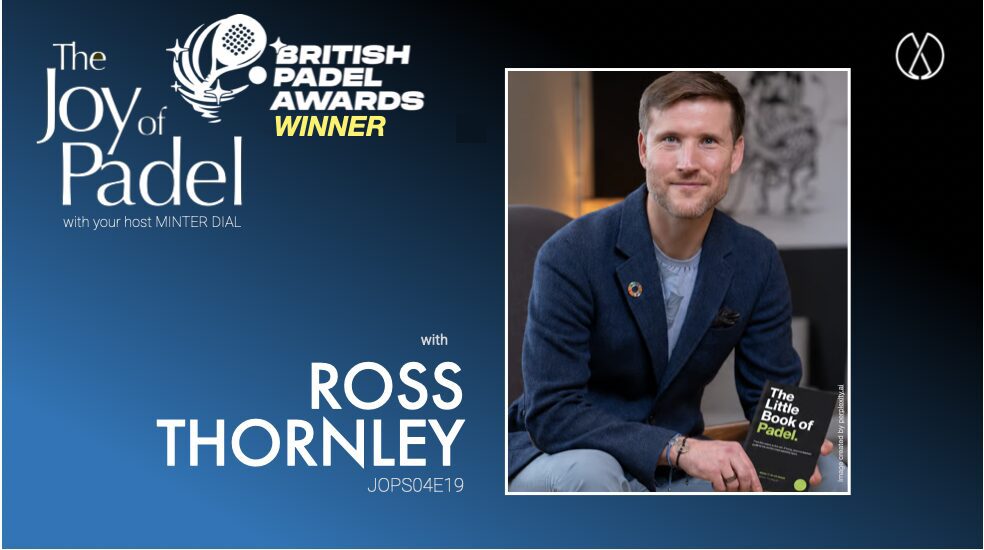
The Joy of Padel podcast with Ross Thornley (JOPS04E19)
On the latest episode of the JOY OF PADEL podcast, I had the pleasure to sit down with Ross Thornley—a British entrepreneur, thought leader, fellow podcaster and, most recently, a full-blown padel addict! While many know Ross for his innovative work with AQai and his books on adaptability and leadership, our chat focused on his whirlwind dive into the world of padel. The conversation was a delight, not just for Ross’ insights on change, but for his infectious passion for this sport and community.
Background on Ross Thornley
Ross is the founder of AQai, a company helping individuals and organizations embrace adaptability in this fast-changing world. A serial writer, he’s penned books on topics from exponential technologies to the neuroscience of change. More recently, he authored the “Little Book of Padel,” a reflection of his intense, joyful plunge into the sport—a journey only 10 weeks old, but brimming with curiosity and discovery. As Ross put it, he’s the “very, very person” who goes all in when he catches a passion, and padel hooked him fast.
Topics Covered
Our conversation swirled around the experience of being a padel beginner. Ross shared how, after years behind a desk, he joined his local club (for the padel courts, not the gym!) and was instantly captivated by the sport’s social energy and accessibility. He described showing up as a novice, fascinated by the welcoming, diverse community, the low-barrier entry, and the laughs that come with learning. We explored the nuances of padel culture—including the dynamics (and sometimes politics) of WhatsApp groups, the “snobby” echoes from golf, and how ego often plays out on court.
A key theme: the necessity of unlearning in padel, especially for those with backgrounds in tennis or squash. Ross drew parallels with his AQai work, observing how the game quickly reveals one’s adaptability, humility, and curiosity—sometimes within the first 20 minutes of play! We touched on vulnerability, letting go of ego, and how healthy community celebration can lift the experience for everyone present, win or lose.
Three Takeaways from My Conversation with Ross
- Padel is as much about adaptability as it is about skill. Success (and joy) often comes from your willingness to unlearn, ask “beginner” questions, and embrace the inevitable mistakes—double faults and hilarious whiffs included!
- The social fabric of padel is unique and precious. WhatsApp group politics aside, the game’s low entry barrier, group dynamic, and culture of generosity and celebration make it a special haven for all walks of life, from ex-pro athletes to first-timers.
- Vulnerability is a superpower on and off the court. Whether you’re learning to lose in order to win, or making space for others to shine, letting go of ego fosters not just better performance, but richer, more rewarding connections.
If you want to tap into the generous, curious, and ever-adaptive world of padel, I’d encourage you to pick up Ross’ “Little Book of Padel” or check out his latest platform, Padexa (coming soon), to get insight into your own game. To me, this episode was a celebration of what makes padel (and life) truly fulfilling: showing up, getting curious, and paddling forward—together.
Ready for the full experience? Listen now to JOY OF PADEL and join the ongoing conversation about play, progress, and passion.
To find out more about Ross Thornley:
To listen to the show:
To listen to The Joy of Padel podcast, you can use the embedded player above, or go find it on Spotify, Apple Podcasts or any number of other podcasting services listed here.
Send in your questions or reactions:
Please send me your questions — as an audio file if you’d like — to nminterdial@gmail.com. Otherwise, below, you’ll find the show notes and, of course, you are invited to comment. If you liked the podcast, please take a moment to review and/or rate it! ¡VAMOS!
To listen to the show:
To listen to The Joy of Padel podcast, you can use the embedded player above, or go find it on Spotify, Apple Podcasts or any number of other podcasting services listed here.
Send in your questions or reactions:
Please send me your questions — as an audio file if you’d like — to nminterdial@gmail.com. Otherwise, below, you’ll find the show notes and, of course, you are invited to comment. If you liked the podcast, please take a moment to review and/or rate it! ¡VAMOS!
Further resources for The Joy of Padel:

The Joy of Padel podcast, hosted by Minter Dial, a padel tennis player since 1974, is an exhilarating show that delves into the captivating stories of notable padel personalities worldwide.
Meanwhile, you can find Minter's other Evergreen podcasts, entitled The Minter Dialogue Show (in English and French) in this podcast tab, on Spotify, Megaphone or via Apple Podcasts.
About the host: Minter Dial
Minter Dial is an international professional speaker, author & consultant on Leadership, Branding and Transformation. His involvement in sports has been a lifetime passion. Besides playing 18 years of rugby, captaining athletics teams, coaching tennis and playing squash for his university, he’s been a lifelong player of padel tennis, starting at the age of 10, from the time of its very first public courts at the Marbella Club in 1974.
Then, after a successful international career at L’Oréal, Minter Dial returned to his entrepreneurial roots and has spent the last twelve years helping senior management teams and Boards to adapt to the new exigencies of the digitally enhanced marketplace. He has worked with world-class organisations to help activate their brand strategies, and figure out how best to integrate new technologies, digital tools, devices and platforms. Above all, Minter works to catalyse a change in mindset and dial up transformation. Minter received his BA in Trilingual Literature from Yale University (1987) and gained his MBA at INSEAD, Fontainebleau (1993). He’s author of four award-winning books, including Heartificial Empathy 2nd edition (2023), You Lead (Kogan Page 2021), co-author of Futureproof (Pearson 2017); and author of The Last Ring Home (Myndset Press 2016), a book and documentary film, both of which have won awards and critical acclaim.
It’s easy to inquire about booking Minter Dial here.
Full transcript of interview via CastMagic
This transcription comes courtesy of Castmagic.io an AI service for podcasters.
Minter Dial: Ross Thurnley, uh, Thornley, um, Thurnley! I don’t know where that came from. Um, great to have you on the podcast of The Joy of Padel. You might have thought that this could have been a podcast we could do about my business and leadership because you are an entrepreneur, a thought leader, and doing lots of crazy things. But in your own words, Ross, let’s just talk about who are you first.
Ross Thornley: Who am I first? Oh, that’s a great question. Um, and I guess depends who, who, who answers. I’m going to start with you.
Minter Dial: You, you, you are the one that answered this one. Yeah.
Ross Thornley: Okay. I am an endlessly curious human being who is still figuring out how he can best show up and value in the world. That’s who he is.
Minter Dial: Brilliant. All right. Well, you also run, founded a company called AQAI, which has done lots of great things, obviously working with AI. And you wrote a book, a second book or another book. Sorry, I’m not sure. I know how many books you’ve actually written, but as an author, tell us about the books you’ve written and this latest thing you just created.
Ross Thornley: Yeah, I think it’s interesting, author to author, why do we write these things? Because they’re damn hard work.
Minter Dial: Um, and to get, to get zippo in return.
Ross Thornley: Yeah, yeah, it’s all relative, right? And in fact, uh, writing a book pre-AI era, uh, when it was hard graft, hard work, um, was a different process. And my, my first books were all in and around innovation, the Sustainable Development Goals, exponential technologies that then evolved into the human part of who, why, and when do we adapt through change. And I spent a lot of my career in that kind of space. And I’ve written books basically, Minter, to learn, to try and consolidate my own thoughts into some resemblance of understanding. And hopefully beyond my mum and dad, somebody else might read it and get some value from it.
Minter Dial: So, that comment about mum and dad is so true. I mean, they’re your number one fans. They’re the ones who are going to buy 5 books if it It helps you on Amazon.
Ross Thornley: Do you know, so I’ve written quite a few books and some meaty big ones. And when I wrote this book about padel and my journey in padel, I think it’s the only one that my mum and dad have actually read.
Minter Dial: Well, it helps being short.
Ross Thornley: It helps being short. You know, you can read it in an hour. It’s kind of fun. And even though they’ve never played padel, they got some fun from reading it. So, yes, I’ve written the little book of padel. It’s about my journey. My wife and my parents and anyone who knows me kind of describe me as a very, very person. So, if I’m into something, I’m into it. And that has certainly been the case for me in padel. And I made that decision to go into it for a few reasons. One was social. I’d got a bit of you know, syndrome of sitting in my home office at the end of the garden, Zoom most days with people from around the world and been a bit sedentary for too long. So, I joined our local David Lloyd. And the reason I joined it was because they had some padel clubs, some padel courts. I’d played it for the first time a couple of years ago in Spain on a retreat.
Minter Dial: So, this is 2024.
Ross Thornley: 2024, I played it for the first time. We had a summit for our adaptability business. We had some of our partners, about 30 partners there, and it happened to be in a venue that had padel. And we organized and thought, okay, we’ll get all the courts and we’ll get everybody there to go and have a little, you know, hit for an hour. So, I did that. It was in the sun and it was— I was in the mode of I’m facilitating this, you know, multi-day uh, you know, business event. Business event. And I enjoyed it. I enjoyed seeing smiles on people and those things. And I didn’t know what I was doing, didn’t know what the rules were. I, I’ve played table tennis a fair bit in my teens. I played a lot of squash, but I hadn’t really, you know, um, been active for a long time. And then when I joined, because my wife was going to the gym all the time, she’s got her choir that she loves, and my whole network and things is virtual and, you know, distributed around the world. And I thought, I’m going to go get fit. I’m going to see this thing, Padel, join the David Lloyd. And I was in, I was in then, you know, some weeks in this last 10-week journey, uh, since I joined, I’ve been playing multiple times a day. Um, and every kind of social I can get in on. I then have done it on business trips. I was a couple of weeks ago in Singapore for a week and I said, we’ve got to go play padel. So, I went and played padel whilst I was in Singapore. I’ve just come back from an intensive 5-day week for my birthday in Barcelona where I went. Nice.
Minter Dial: Happy birthday.
Ross Thornley: Thank you. My wife said I’m a padel widow now. So, she came, we were doing the padel and then We hung out in the afternoons and evenings.
Minter Dial: Yeah. Reminds me of my— I was the CEO of a company and I would travel about 25 countries a year. And I, in those days, we’re talking late ’90s, early noughties, I would take my tennis racket. I was a tennis pro in my youth. And so, I would have racket, will travel. It’s now without doubt, have bat, will travel. Yeah, because there are now actually padel courts everywhere. But back in the day, that was unlikely. It was really, you know, really only my family. All of my family had padel courts back from the late ’70s and/or going to Argentina or to Spain. And of course, occasionally the pop-ups here and there. But anyway, have bat, will travel.
Ross Thornley: So, it’s easier to travel with a padel bat than it is a tennis racket.
Minter Dial: 100%.
Ross Thornley: Case a lot easier.
Minter Dial: Yep. The overnight, the cabin case. Exactly. I totally, totally get that. Although I still always worried about the, is it going to be considered a weapon? Oh, right. Crazy. All right. So, in the Little Book of Padel that you’ve written, you explore the history, the culture, your learning curve. What is it that makes you, you think from the position of a beginner, playing padel in the beginning anyway of your journey, as much as you’re probably good now. But as a beginner, what do you think helps you to see things differently that more advanced players, more experienced players have stopped noticing?
Ross Thornley: I think it’s very, it’s a great framing and good question. And it makes me think of 2 things. The first thing is, in my life as the adaptability guy, that has certified and trained lots of people around the world in that. When I think about I’m training people who are advanced and how I show up and what I see, what I notice versus someone who’s just brand new to this thing, what’s the language, what’s the name, can’t even pronounce some of these things.
Minter Dial: Bandeka. Yeah.
Ross Thornley: I mean, I’m not even sure Bandeka, whether I can pronounce it right or not, even at this stage. I think it’s a unique moment in time that everybody starts somewhere in a journey of something. So, in Padel, whilst I’m, you know, pretty much 10 weeks in from picking up the bat properly, I have crammed a ton into there because of my character and style. So, I’ve read—
Minter Dial: The very, very, the very, very Ross.
Ross Thornley: I’ve read the studies that the Italians or Spanish or various people that have done and published on you know, what makes a game go one way or the other, what kind of shifts, because I’m interested. I’m interested. And when I show up and I’m watching, you know, our local club from the 82-year-old to ex-tennis players to all sorts show up, what I’m fascinated by is people get joy and fun whether they know what they’re doing or not in Padel. And it doesn’t really matter at that beginning stages when you show up. I was welcomed, um, there was a real diverse range of capabilities and skills, and it, it just instantly was, uh, low pressure at that stage of entry. Then a few weeks passed and I started playing outside of the socials and a few others that have stopped going to the socials because, oh, I’m better than that, or I don’t get a good enough game. And I started to think about, well, how is this, you know, interconnected, uh, sort of cliques going on? And most of them, you know, at, uh, the David Lloyds that I’ve, I’ve been playing at, and I’ve played at a few different ones, there’s these WhatsApp groups, and it’s all organized by WhatsApp groups. I went into Spain and I, uh, went to the David Lloyd there And I said, oh, can I get on the WhatsApp group? There’s some of us over here from the UK. We want to play some games. And I got in and I sent a message on it and there’s like 600 people in the medium-level WhatsApp group. And we organised a game, played with them, and they said, how did you get on the group? On the group? I know people here at the club who haven’t even been able to get into the group because you’ve got to be assessed before you can get into that group. And there’s kind of controls around it. So, I think as a beginner, We come naive. We ask questions without sort of this knowing too much. Oh, you can’t ask that thing, or you can’t expect to get into here, or play with those people, or do that shot, or you know what might happen. And so, a beginner’s mindset, a curious mindset, but one that wants to understand, to improve, and bring others along. rather than to judge and prove a point. And that’s my makeup, shall we say, Mintern.
Minter Dial: But it seems that there are 2 things going on. The first is that sort of naivety that goes into it and how you can enjoy even if you’re not looking great, even if you’re not making all the shots. And it’s just that, that just freshness. That’s fun. The second thing, and it makes me think of golf, the golf club where you need to put a whacking big fork up you know where, sun doesn’t shine, and you need to walk a certain way and you have to putt a certain way. And there’s a language.
Ross Thornley: Fore.
Minter Dial: And, you know, there’s a courtesy and there’s a style. It makes me think, the way you describe this, that those WhatsApp groups are invaded by that sort of snobby golf mentality.
Ross Thornley: I think it’s interesting because I’m in a few different ones now, and what I’ve noticed is that there’s then splinter groups that go and set their own one up, right? Just to—
Minter Dial: They’re not really medium.
Ross Thornley: Yeah, they’re not. We’re over here, and everybody’s arguing, and it comes to, you know, You did your own, uh, self-episode talking about the levels, you know, and how do you deal with a level just based on the win or lose and, you know, from partner to partner versus, you know, my view is how can you know a level if you haven’t watched the game or me play? Um, you know, and I think, you know, they do a good job at trying to get an enjoyable match between people.
Minter Dial: Right.
Ross Thornley: But that doesn’t necessarily help you get better. And so, you know, I’ve started my journey now with the Lawn Tennis Association to become a padel instructor. In fact, I was in Bristol on Sunday for my elective, which was the how to train the double glass. And I’m there with people that have flown over from Spain that are clearly experienced, people who’ve been playing in Dubai for 20 years, the tennis coach who’s been coaching tennis for 20 years, and I’m 10 weeks in. from picking up the racket and never fed someone before. And I’m thinking, you know, I want to do this because I want to understand the system, the actual, uh, ecosystem of coaching where we don’t have enough here in the UK. You know, if you, um—
Minter Dial: Not enough good ones anyway.
Ross Thornley: Not enough good ones. Uh, you know, if you take the stats from the LTA, 420-odd, um, you know, instructors that have passed through Having spoken to the chap who’s running, um, a lot of the courses this year alone, he’s put 160 people that he’s, uh, taken through there. So, a lot go through, but they don’t necessarily qualify because there’s obviously work and a level to reach to do that. But I found it interesting that AI could do that and at least get in there. Yes, there’s a readiness test and certain things that you have to do. But how will that help me in thinking about how do we support this amazing sport that I think has got, yes, the zeitgeist of the moment, perhaps where squash was in the, you know, ’80s and ’90s, that—
Minter Dial: In certain countries.
Ross Thornley: In certain countries, that I think by its very nature, what you mentioned, you can, you can go and have fun the first time you’ve played. There’s a A rewarding sound. You might get a few shots over, and if you’re with the right people, it can be great. If you’re with the wrong people, it can be a horrible experience. So, like life, you know, choose wisely the people you spend your time with. And I found on the whole, into the variety of people I’ve found myself playing with, It’s been great fun.
Minter Dial: Well, amen to that. Um, I, I’ve, you know, obviously I, I can, I’m sort of, uh, long in the tooth of bringing people into the game. And, um, it’s funny, it makes me think right as we speak about, um, another thing that I’ve done a lot of, which is bring people into psychedelics. And I believe they’re actually quite related. There’s the bring it in, And then there’s the integration piece where you’ve actually played the game. You go back and you, and you integrate what you’ve learned from the game. And that ability to integrate in psychedelics anyway usually means you’ve let go of the ego.
Ross Thornley: Yeah.
Minter Dial: The ego, it feels, especially in the men’s side of the game, is preponderant. And as soon as you move from, oh, well, look, I can hit the ball, Oh, look, I’m good. What? They just don’t get it. I recently commented about how a man wanted to play. He asked me to organize a game and he’s not quite as good as I am. And he said, will you organize a game? And he says, well, I really want to play a competitive game so I can get my ranking up. I said, well, I mean, I didn’t say it. I just was thinking, well, that’s actually not the purpose of the play is here. It’s not to get your ranking up, it’s actually to get better. And if you’re thinking—
Ross Thornley: They’re very different things.
Minter Dial: That’s exactly right. If you’re thinking about just the win versus learning how to get better, reminds me of a chap who one day we were playing together and we talked about what we’re trying to do, tactics, and he hit a shot and I, we didn’t, no, no, that’s not what we said we’d do. Yeah, yeah, but we won the point.
Ross Thornley: That’s not the point.
Minter Dial: That’s not the point, right? It’s crazy. So, the place of ego. So, basically what I wanted to just tie in with your work at AQAI, when you have these centres on adaptability quotients, you make these things. If padel were an assessment of AQ, what does the game reveal about a player in the first 20 minutes?
Ross Thornley: Yeah, I think that’s a great question. And I think, you know, if I look at the sub-dimensions of how, why, and when people change, and we have these abilities, these skills, one of them that comes to mind is it’s called unlearning.
Minter Dial: And unwiring.
Ross Thornley: Unwiring, yeah. And psychedelics play a part to that, right? But my folks, you know, say, oh, that’s easy, you just get old, it’s called forgetting. I said, no, no, no, this is different. This is about intentionally letting go.
Minter Dial: Mom, mom, dad. Yeah.
Ross Thornley: And in fact, A good friend of mine wrote the book called Unlearning, and he talked a lot about one of the Williams sisters in tennis that had to unlearn a style of play because it was no longer working and functioning for them and had to change their entire, as it were, habits that previously had got the applause, the wins, the tournaments, the championships. But now they had to unlearn all of those frameworks, all of the neural nets, all the firing together that have happened and wired to re-engineer. Now, for many of us in work, that means unlearning our identity, our jobs, our roles, because that’s transforming. Oh, what’s the second question we ask after a name? What do you do? Oh, I’m an author. I’m an accountant. I’m something. And we label it with a role. Now, at some point, that role and that definition will be replaced by something. You know, a good example I give, we digress slightly, but I think it’s a relevant point, a computer. So, a computer was a job. That was the name of a job. Now, we just see that as a physical object. So, how many jobs that we currently do are going to be not necessarily a physical object, but it could be a digital protocol that does that. So, if we come back to the power court of what does it reveal for us, I think there is a shift in people of their level of curiosity in the first 20 minutes when you watch them. Are they curious about you as the partner? Are they curious about the game? Or are they just got, this is my goal and that’s all that matters? Whether what I’m doing is helping me or hindering me or giving me a delusion. Because actually a bad habit is winning because the opponents aren’t really that great. But as soon as they are, that bad habit shifts from being a great thing to the very thing that would hold us back. And holding us back might be being invited back to play again, you know.
Minter Dial: Hmm.
Ross Thornley: So, it’s not necessarily about winning, it’s that, that social dynamic. So, I think, um, you know, it depends at what level, you know. I’ve watched games versus playing in games and played with different levels you know, playing with these 2 coaches that, you know, one of them coaches the international Pakistani team, and he was with us for the week. And, you know, it was clearly a very different environment with myself and some others. And he was just having fun with it. He could have been, oh my God, Ross, just get it back or hit this piece or you’re not returning it. Whereas just his energy. was beautiful. Whoever I was as who is coaching, he was present in that moment. So, I think when people are playing and what I’ve witnessed, people who own their own experience tend to then have the outcome that means I’m coming back.
Minter Dial: Well, this ego piece and those 20 minutes you talked about, what am I doing? How am I doing? I played with a lovely Spanish friend called Toby, and Toby is just bona fide good. His Playtomic is only 5.4. He’s probably, I mean, I think that’s a realistic thing because he doesn’t actually play as much, but he could be a 6.5.
Ross Thornley: Okay.
Minter Dial: And we got on the court and, you know, I’m the old guy on the court and we said, well, What side should we play? I said, Toby, of course you play on the left. You know, he’s taller than I am. He’s strapping, not to mention good looking. And he’s just a lovely man. And so, I was happy to play on the right. He says, no, I love playing on the right. Why don’t you play on the left? Because I was telling him that I’m playing in the Nationals in Bristol, playing on the left. And so, he played on the right.
Ross Thornley: Ego.
Minter Dial: Dissolved. Yeah. I mean, talk about like a flash for me to be able to play on the left with Toby. What a gorgeous thing. Turns out that we played—
Ross Thornley: Oh, what a gift for both of you.
Minter Dial: Well, for me, I felt we lost the first set 7-6, and then we switched and turned out that we didn’t do as well. Not that I think that that’s because I’m better on the left than he is or anything like that. But the real point was that just that generosity.
Ross Thornley: Yeah.
Minter Dial: And the idea, it’s what do we want as opposed to what I want? And the ability to get rid of the ego piece in that. It feels like in those first 20 minutes you had that conversation, hey Ross, let’s play. All right, what side should we play? Well, I’m a lefty. I’m a left-hander. Well, if I’m left-handed, that’s fine. But if I play on the left, because I’m defined I play on the left. That’s my title.
Ross Thornley: That’s my title, my identity. I am the finisher, you know, very much so. And I think, again, coming back to adaptability, was it Toby? What a great show of adaptability to be able to understand the environment, who else is there, what’s going on, and contextually What are we here for? What are we here for? You know, am I here because, ah, this person expressed that they’re wanting to play in the tournament, uh, coming up, they’re doing this piece? And so, all of those things will have both consciously and subconsciously said, how can I show up to be a great partner, a great we? And for him, it sounded like it was just a very natural, instinctive thing that is part of, again, his identity and his character. That is he there to serve So to speak. So, to speak. And that’s how, you know, I enjoy the dance and the poetry that we’re on in terms of life.
Minter Dial: Groovy tunes. Ross, so adaptability and change. I’ve interviewed numerous people who have come from pro tennis to become pro padel. Nico Agretelli, American top-ranked tennis player. And he said, I spent a year unlearning how to play and losing in order to learn how to play.
Ross Thornley: In order to get better.
Minter Dial: And he’s now the top-ranked American padel player. When you look at, I mean, because I want to, the benefit of having you, Ross, really isn’t so much your knowledge of padel, But this combination piece, which is this change and adaptability, because a padel is really at once constant adaptation.
Ross Thornley: 100%.
Minter Dial: It’s the environment.
Ross Thornley: Psychologically, physically, emotionally, all of those things. And it’s like in sports, you know, there’s a great speech that Roger Federer talks about in terms of the difference between how many points he won and others, and it’s small margins and the ability to let go of a shitty shot or a bad shot or a bad game or a bad set that makes the difference of how you then both mentally and physically can show up. How tiring it is to constantly be in stress zone, in high cortisol, you know, and— the ability to breathe and how we’re breathing. Are we breathing both for function, for the physical performance, together with breathing to go into neutral in terms of psychologically? So, I think the unique angle that I bring is not only naivety of this discipline, but the incredible curiosity I’ve had of human nature of change, both from the neuroscience of change to then just the dynamics of teams trying to go, no, I’ve always done it that way, you know, type P. So, for people that have been good at something before, to then go and do something that they’re not so good at requires vulnerability. And that’s linked to ego, right? And I see it a lot with leaders that now leaders are having to lead without going, I’ve got the t-shirt, I’ve got the scars, I have the experience and knowledge. this is the answer to, I have to lead with vulnerability because we’re living in an uncertain world. I don’t know what’s going to happen. Now, this comes back to court awareness. You know, when you watch a lot of sports, my brother got his scholarship into Canada. And for the last 25-plus years, he trains Olympic athletes in the canoe-kayak for Canada. And so, his whole thing is, you know, tactics, technique, training, you know, these elite athletes to perform. And what I think when people are coming in, whether you’re an elite athlete wanting to transition from the best in the world at tennis to the best in the world at padel, or you’re just going from, I’m accomplished mum or dad, or I’m accomplished accountant to—
Minter Dial: I’m a Padel.
Ross Thornley: How do I hold it? What’s this glass thing? Uh, when we start is to be able to be vulnerable and, as you mentioned, to lose in order to win. So, to lose because my gain isn’t losing. I’m gaining the lessons and the training and the court sense and the reading. Okay, is it going to go to this side or this side? Do I do a turn? in a bit or do I step back? Where’s my preparation? You won’t be able to do that if all you’re thinking about is hitting the wind, you know.
Minter Dial: Or about to be screamed at by your partner, for example.
Ross Thornley: Too true.
Minter Dial: Yeah, I marvel at the psychology that goes on in padel. And I truly believe that I have, for having played about nearly 30 different racket sports, that there’s something particular about padel that as a doubles, because there are other sports that are doubles, real tennis, lawn tennis, even table tennis, there are lots of double sports. But the reality of padel is that it’s different. That’s certainly my analysis. Ross, as in your position, you’re writing this little book, How do you qualify why padel is different than other racket sports? Maybe you can bring in your brother as well. And even though it’s a different sport.
Ross Thornley: I think different is in the eye of the beholder. Because for some people, you know, one of the lads on this course, he’s only ever known padel. Right? So, it’s not different for him. For you who’ve played 30 different racket sports, the discernment and nuance that you can bring to your own experience and those that orbit around you will be very different. So, I, I don’t know that difference is important or valuable for some. It’s just that it brings me joy, brings me fulfillment, brings me something that actually my future self will thank me for, because I’ve connected to somebody, because I’ve been a bit healthier, whatever it might be, to I’ve just got a sense of fulfillment because I managed to do something today that I didn’t do yesterday in a certain shot. So, I think from my own perspective, having played rugby as a young boy, from sort of age 4 or 5 up to about 16. I played across Europe. I really enjoyed rugby. I’m a very, very person, um, to then, you know, squash, table tennis. And, you know, for me, padel has just been right time, right place, right cycle in my own life, um, for it to show up in a way where 4 weeks into it, I had a business idea. And 4 weeks from that business idea, I now have people gaining value from what I’ve brought out in the world. That to me is cool. You know, that you can do those sorts of things now with the technology that’s available and with this sport that I can bring a unique angle to, to allow people to engage in that sport that, again, be better than somebody that I found them at? How can I help them not get left behind? How can I help them connect to themselves and each other better? That’s where technology should be great in showing up.
Minter Dial: So, I played 18 years of rugby, Ross, mostly fullback or winger, sometimes outside centre. So, I have lots of ideas.
Ross Thornley: Fly half / centre.
Minter Dial: Well, fly half if I was allowed. Occasionally. But the point is that I love rugby. However, I think panel is different and different from the other sports for 2 specific reasons. And you mentioned the word vulnerability, and I think it’s linked and maybe also why it’s contemporarily useful because vulnerability, Brené Brown, blah, blah, blah, blah.
Ross Thornley: Yeah.
Minter Dial: We’re all susceptible. Of making a bloody double fault. How can you do a double fault?
Ross Thornley: It’s underarm, you’re sitting in a big box and you still do it.
Minter Dial: And you’re in total control. Even Fernando Belasteguín, the guy who was number 1 for 16 years worldwide, number 1 for 16 years in a row, double faulted on match point. He was serving. And, you know, so it does happen. So, this is the first level of humility. And the second, so you can always screw up even if you’re good at the easiest bloody shot there is. The second reason why it invites humility is the wire and the walls eventually, but the wire always, because you never bloody know.
Ross Thornley: It’s unpredictable.
Minter Dial: Yeah. And most people think the walls are unpredictable until you get started getting good. But then, but to begin, so, but the issue is this humility piece. And so, you’re always subject to screwing it up. Then you go step 3, there’s a big lob and you absolutely whiff on the ball. Now it’s not the wind, it’s just that your ego got too big. The pudding was too good. And you went for the big shot. Anyway, this is why I think padel is the sport du jour, which is so different from the other ones where lawn tennis, it takes forever to learn how to hit the ball over the net. So, if you make a mistake, that’s life. Federer made, he lost 48% of his points, something like that. And that’s okay. There are net cords. There’s little similarities.
Ross Thornley: Yeah.
Minter Dial: But padel has that Huge element.
Ross Thornley: The barrier for entry is super low to get a good person. You know, when I was in Spain, a couple of my team members lived there. Um, they came and played and they’d never played before. And in an hour, they hit some shots that made them feel good. Now that is pretty unique, um, in a, uh, team sport of 4, right? Um, and with the right people, that can be really great fun and you know, that’s, that’s great. So, I think, yes, you’re right, there is some uniqueness to it. I think once people have gone through that, and it’s what I then faced, is I want to get a bit better. And in the socials, in these games, what you’re playing and what you’re doing, how do you get better without coaches? Now you have, you know, Sandy and the Padel School, you have online learning. I’ve made a career of doing a lot of online learning. Um, watching the pros, watching the pros, watching the pros, YouTube, all of these things, Instagram. And I know a lot in here. Even in the 10 weeks, I have consumed a lot of materials.
Minter Dial: Well, you’ve written a book as well. I mean, bloody hell.
Ross Thornley: I’ve created, you know, a software application with some real good deep learning elements in there to help people deal with this, uh, based on 5 pillars of why and how do you actually get better and win games and those sorts of things. And so, there’s a corpus of knowledge that is there. Can I practically apply some of these things? No. You know, that takes, yes, repetition, process, all of these things to go through. And when you hit that overhead that didn’t work and you hit the overhead that did work, Can you feel the same about them regardless of the outcome? And for me, that is a— to your point of humility, vulnerability, ego— of why am I showing up for those things? And if I can find a smile when I trounce it, and so can my partner, and I can find a smile when it’s an incredible one, that to me is the magic. And I want to help people be able to kick themselves less, more than celebrate themselves. I think that’s the level I’m at, that I don’t want to get myself frustrated. Oh, I knew I could have got that, I could have got better, versus I’m the, you know, top 2% of getting better. And so, I think there’s a mass swash of people in that zone. that kick themselves, um, and whether that’s because the partner did it or whatever, you know, that we have an opportunity to be able to remove some of that sense of fear, some of that doubt, to just go in in flow state. Um, that we’ve all played a game, whether it was padel or had a moment where we’re in flow state, where things just go well, whether because we slept better, we didn’t have a shitty board meeting just before, whatever it might be. If we can create more moments like that, that’s my happy place.
Minter Dial: So, 2 final thoughts from my side, Ross, and we’re going to close off. But the first is something that I’ve been thinking about a lot recently is the critical points. And so, you’re returning serve, you’re down breakpoint, or you’re, sorry, you’re there. This is a breakpoint and you’re returning the serve and you’ve got to get it back to win the point. The stress, the game point, the set point, the golden point, whatever it is.
Ross Thornley: Mm-hmm.
Minter Dial: And well, how do you look at that? And do you look at like, this is an amazing learning opportunity? This is why I’m bloody playing the sport. Or do you stress out? And the second point, which is a little bit different from what you mentioned before, which is how do we celebrate? Not me, not us as a team, but we 4 celebrate.
Ross Thornley: Correct. It was a 4.
Minter Dial: Yeah.
Ross Thornley: And as a community of padelers.
Minter Dial: There’s nothing more gorgeous than an amazing point. go all over the place, and they win a shot, maybe a little luck, maybe not, maybe a beautiful shot. And also—
Ross Thornley: And everybody goes, wow.
Minter Dial: Yeah.
Ross Thornley: I think that sums up PAL for me is when you’ve got those moments that irrelevant to the outcome, the entire court goes, that was cool. And interestingly, you mentioned golf a few times. And I was having lunch with a golf coach who has had the privilege to coach some pretty high-level performers. And one of the stories that he shared, whether it was from them or borrowed from others, it was about the fact of pressure shots. And you just mentioned this in paddling, what Fired, uh, for me. And he says all he has in his repertoire, in his mind, is one shot per club. What he means by this is, okay, I’m pulling out my 5-iron. All I have in that 5-iron is my best shot I’ve ever done. It was last week, was 2 years ago, wherever it was, for the shot that happened.
Minter Dial: So, 230 yards.
Ross Thornley: That’s what I’m bringing up. I take the shot, and then all I’m doing at that point of that shot afterwards, my edit is, was it better than my best or not? If it wasn’t, it’s forgotten. If it was, it becomes my new one of my new anchor. So, I think in a way, when we’re in those pressure shots, what was my best return I had? And if I can imagine that, and all I need is a few, maybe 5 or 6 shots that are pressure shots. So, returns are a high-pressure shot, right, at a serve. So, if I go, ah, when I got one, when I attacked it well enough, it was a great one, it just went off the glass and I got in there enough and it didn’t hit me and go funny or whatever it was, and I managed to do it for that damn good server who hits it, who’s an ex-tennis player who still does topspin, he doesn’t do it in this way, and he’s still doing what he does. Or she does, and I managed to do it. If that’s what I’m remembering, whether it’s golden point, advantage, match point, whatever it might be, breakpoint, if I’m just thinking about that, the chances of me being able to control my nervous system and being able to have the kind of outcome that happened, I think that’s increased. And whether I hit it or not, can I still— smile. And that’s down to the human being, right, of who we are. Somebody I play with, nothing else matters than whether the point is won and the game is won and the match is won. Good for them. Find a partner who’s in the same zone and the same frequency as you. That isn’t my frequency. And when there’s frequency mismatch, you don’t get the 4-person celebration. That’s my frequency.
Minter Dial: 100%. Beautiful. Ross, how can somebody look about what you’re up to, follow your writings? You’re obviously a well-known individual on LinkedIn. And of course, get your book on the Little Book of Padel. Yeah.
Ross Thornley: So, the Little Book of Padel, I’m still shocked and surprised that, you know, people are reading it and buying it. Because as you know, books are not easy, they’re, you know, not easy to get out there. So, yeah, The Little Book of Padel, you can grab it on Amazon. I’m working on some stockists in and around various actual padel centres and things like that. In terms of to follow my journey and my pieces, Padexa is the company that I’ve set up around this whole passion and obsession and how we show up will evolve. We have an ability that you can for free upload a video of your game and it will give you some information that will hopefully help you, give you one fix, give you the versions of that shot that you just had. And what we’re also building out then is a coach network behind that because, for example, we don’t have a coach at our local club, can’t get one. Now there are coaches that exist, Can I get to them? What’s the availability? All of those things. So, we have potentially more demand than we can fulfill here. It’s why we went to Spain to go and do it. The opportunity with Padexa is, yes, you can get some AI feedback, and that’s great, and there’ll be some levels of accuracy, and it’s the worst it’ll ever be today. Each day, each week, each month, it’s going to get better and better, right? The next piece is, ah, for coaches, I can now review Minter’s video. I don’t have to watch the full 90 minutes. I can say, just show me these clips. I can watch those clips that we’re working on and drop you a little voice note. Hey, your preparation’s getting better, but your racket’s too high when you do this, or you’re not stepping into it in this way. This is what you want to do. So, we can, for those coaches, can coach off court while they’re on the sofa. and earn revenue. Those who can’t access coaches can get a human coach to look at their actual play and what they’re doing. So, I think there’s an opportunity to build out another layer beyond that technology of connecting humans with each other. And that’s Podexa, of what we’re trying to build out into.
Minter Dial: Fabulous. Gracias. Vamos, Ross. Thanks so much.
Ross Thornley: It’s been a pleasure.