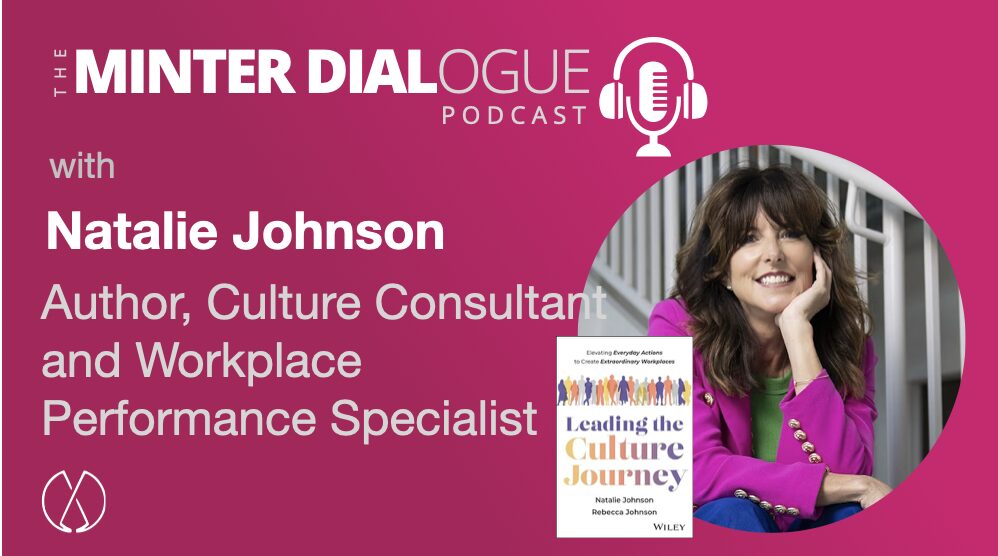
Minter Dialogue with Natalie Johnson
Our conversation focused on the reality that most workplace cultures are not actively toxic but typically accidental. Natalie challenges leaders to define, model, and reward the behaviours that genuinely matter—moving away from default habits to intentional, value-driven cultures. She delves into the nuances of integrating diversity, highlights the pitfalls of monoculture, and makes clear that meaningful connection sits at the heart of all lasting cultural change. The discussion explored the everyday actions that create trust, particularly those that leaders often overlook, such as vulnerability and asking for help. We also dove into the practicalities—how culture must be made explicit from recruitment onwards, and why courage and clarity matter so much when making room for diverse voices.
3 Key Points:
- Intentional vs Accidental Culture: A key theme that emerged was the prevalence of “accidental” workplace cultures—those that aren’t actively built but simply emerge by default. By contrast, intentional cultures embed clearly articulated values and reward desired behaviours consistently, making culture a daily, living practice.
- Diversity Within a Defined Culture: The conversation highlighted that you can foster a monoculture that remains inclusive—welcoming diverse backgrounds and ideas, but always within the frame of shared values and behaviour standards. Clarity on what those are, and how they show up day-to-day, underpins both inclusion and performance.
- Everyday Leadership Behaviours: One concept discussed was the underrated power of everyday actions like asking for help, listening with genuine curiosity, and speaking up in meetings. These foster trust, psychological safety, and help cultures avoid the traps of silence or groupthink, especially where candour isn’t the default.
To connect with Natalie Johnson:
- Check out Natalie Johnson’s company site, Vidl Work, here
- Find/buy Natalie Johnson and Rebecca Johnson’s book, “Leading the Culture Journey,” here (via Amazon)
- Find/follow Natalie Johnson on LinkedIn
Further resources for the Minter Dialogue podcast:

Meanwhile, you can find my other interviews on the Minter Dialogue Show in this podcast tab, on my Youtube Channel, on Megaphone or via Apple Podcasts. If you like the show, please go over to rate this podcast via RateThisPodcast! And for the francophones reading this, if you want to get more podcasts, you can also find my radio show en français over at: MinterDial.fr, on MegaphoneFR or in iTunes. And if you’ve ever come across padel, please check out my Joy of Padel podcast, too!
Music credit: The jingle at the beginning of the show is courtesy of my friend, Pierre Journel, author of the Guitar Channel. And, the new sign-off music is “A Convinced Man,” a song I co-wrote and recorded with Stephanie Singer back in the late 1980s (please excuse the quality of the sound!).
Full transcript via Castmagic.io
Transcription courtesy of Castmagic.io, an AI full-service for podcasters
Minter Dial: Natalie Johnson, great to have you on the show. Living in the west of Florida, as we just discovered, and you were brought up in the same town my mom lived in for many years. But, um, as I always like to start, Natalie, who is Natalie Johnson?
Natalie Johnson: Thank you, Minter. I am a mom of 2 now adult boys. I am about 1 month into the empty nest of my kids moving out and becoming adults. I’m the co-founder of a culture transformation firm called Vidl Work. I’m also pretty newly an author. I do a lot of keynote speaking, and I’m an owner of a dog named Princess Leia who’s sitting right at my feet right now. And I enjoy a lot. I have a background in performance and exercise physiology and nutrition. So, I enjoy food. I enjoy outdoors, and I enjoy lots of activities, physical activities.
Minter Dial: Well, and what sort of dog is Princess Leia?
Natalie Johnson: She’s a Shih Tzu. She’s about 8 pounds. She’s all black. And if you’re a Star Wars fan, she looks just like an Ewok.
Minter Dial: There we go. Brilliant. Oh, I love it. Lots of good energy, Natalie. So, let’s talk about your work you do at Vidl. I was sort of— I wasn’t really sure about how to pronounce Vidl, but tell us about what you do as the Chief Visionary Officer at Vidl.
Natalie Johnson: Yeah, so thank you for getting it right. It is vital. So, I am at— as a small consulting firm, we’re based here in the US. We have 13 people. My job is really working with clients on what we call our— the one-and-done experiences around workplace culture. So, in my role, I tend to be the person that’s out there providing inspirational keynote topics and practical tools and application for audiences around how they can lead their own culture journey. And that involves work and home. And, um, I also do a lot of retreats, a lot of one-day, half-day trainings. And we have a team of other coaches and facilitators that I get to work with. I have a business partner. Her name is Rebecca Johnson. We are not related. We just happen to have the same last name. And she does a lot of the more intense, deeper, more detailed work where we work with companies for longer term, sometimes a few months. sometimes a few years, where it’s a complete culture transformation and rehaul of their culture and really skilling people up and identifying what actually is culture. How do we create a culture that we actually want? And once we get there, how do we maintain that over time? And then I’m also responsible for a lot of the partnerships out there that we do, business development aspects. And I’ll stop there, Minter. I feel like I said a lot.
Minter Dial: It’s all good. The thing that struck me, you said one and done.
Natalie Johnson: Yes.
Minter Dial: Can you help me with that? Because when I, the sort of the thing I heard was you also do long-term work and helping the journey of culture to be changed.
Natalie Johnson: So, and I should say, we really prioritize the work we do when people are on a culture journey where we can help teams and organizations and even families to create conditions that everyone can show up and perform at their full potential. And in order to connect with people that need that work, we need to give them little bits and pieces of what that actually means. So, if people were to come and work with us on a culture transformation, what does that mean we’re actually doing? And so, the one-and-dones that you mentioned are when I’m invited to be an opening or closing keynote speaker, and I can introduce people to a 1-hour experience that shares with them some of the language, some of the tools that are helpful, shares with them how we actually define culture, what it is, how it gets changed. And so, people get a little taste of the work that we do, and then ultimately they end up becoming more longer-term clients. So, the one-and-dones really represent maybe the keynotes that we do, or sometimes we have teams that say we just need to work on this one thing that’s impacting our culture. Our communication isn’t great. Uh, something we often see is teams and companies that have a, a nice problem. People are being way too nice to each other. Nobody is being direct and candid. Nobody’s having hard conversations. So, another example of a one and done is I might come in and do a full day training with a team on what it means to be more courageous in the way they communicate. So, those are examples of what I mean by one and dones, and that’s where I live in the company, on the one and done side.
Minter Dial: I get it. And so, having written a few books and co-authored one book, what was it like to do this with Rebecca? I mean, the, the, it was your first book, if I understand correctly. And, and how did you separate the tasks? And what was the experience like writing with your co-founder? And, you know, obviously you spent a lot of time with Rebecca.
Natalie Johnson: Yes, I love this question. In short, it was very easy. And the reason it was very easy is because Rebecca and I are very, very different, different personalities, different skill sets. It’s the reason that we sit on 2 separate sides, different sides of the business. Rebecca is naturally a really good writer. And we also had a lot of the content, the skills, the tools, the framework. We had it all. It was in our workbooks, it was in our white paper, it was in our head. And providing us with a book provided this opportunity to get it out of our head and organized in a format that makes sense to everyone else out there. And so, pretty quickly, we knew how we were going to write the book. We would have a deadline, as you know, of when chapters needed to be done. And what we knew was Rebecca needs to start it. She’s going to start it. She’s going to have the really good solid writing. She has more experience writing. She’s a naturally good writer. I’m not naturally good at it, but I like to add the fun and the pizzazz and different kind of energy. And so, the way it worked for us was Rebecca would write first. I would come in and add my writing on top of it. We do a little bit of back and forth and then submit it. And what tends to happen for us in the book and in business is that our styles, our voices, our strengths complement each other. Really well. So, it meant that writing a book together actually wasn’t very hard.
Minter Dial: It feels actually a little bit of a reversal of roles because you’re in the one-and-done version. You have Natalie Johnson who goes in, does the spiel, and then you do the long-term work. Whereas the other way around, Rebecca does the writing and you do the sprinkling, if you will, of energy and anecdotes, perhaps.
Natalie Johnson: Yes, you’re absolutely right. And we work with an operational system that we have here in the US that’s meant for small companies. It’s called EOS, Entrepreneurial Operating System. And the number one thing, if you’ve never heard of it, the number one thing that EOS recommends in building a company is that you must have a person that is designated as your visionary. And you must have a person that is designated as your integrator. And somehow Rebecca and I just naturally fall into each one of those roles. In other words, I’m a very strong— I score very high on the visionary side, almost zero on the integrator side. And she is the opposite. She is almost all integrator, no visionary. And so, we often call it— and it comes from our EOS operational system— they call that it’s the rocket fuel for success. And I think The reason that it’s been so successful is because we talk about it a lot. People ask us a lot about how and why we’re so different and how that works. And because we put it out there on the table, if you will, and say, hey, we’re very different, you’re going to hear different things from us. And I have this role and she has this role because we don’t try and do all the same work together. We separate all the time. I think it really does make for rocket fuel. It’s very easy for us when we’re given a client or a task like writing a book to say, oh, I know what my part’s going to be. We just know. We know it in our bones. And we’ve talked about it so much, it makes processes somehow easier for us.
Minter Dial: So, in the crazy way that I tend to interpret stuff, you talked about visionary and integrator. And in my world, I connect that with psychedelics, where you have psychedelic vision. You go through some psychedelic-assisted therapy, and then you go through integration. into the real life where you have true transformation. And for me, it’s very much related, this idea of how to rewire the brain, rewire our stories, and whether that’s as an individual or as a company.
Natalie Johnson: No one has ever said that before, Minter, and it 100% makes sense. And when we think about The way that my brain naturally works and the way that I want to be working, it does feel a lot— it feels a lot like psychedelics. It’s brainstorming. It’s just throwing things out there. It’s the what-ifs, the what-ifs. Think big or go, you know, go, go hard or go home. Think big. What’s the biggest vision you could get to? And that’s where my brain loves to be in this creation moment. All the, all the actual possibilities that are out there. And at the same time, I know and recognize I need someone to pull me back. And take that psychedelic thinking, if you will, and create some structure around it and create— let’s take all this fluff and pie-in-the-sky thinking and ask some really good questions around what’s realistic, what’s not realistic. Can we put some steps in place to make that happen? So, integrating my big out-there visionary thinking into real-life practices and things that work completely makes sense with what you said, the integration back into real life.
Minter Dial: Exactly. All right. So, I have had many, many guests on my show and ran companies myself. This notion of culture, it’s such a relevant question in my opinion, for many reasons, including at a country level. What is the culture of the country in which you live? How do you define culture?
Natalie Johnson: We define culture in a really simple way. It is the way we relate with each other. It is all about relationships. And so, it feels a little bit different if you think about culture of countries, because if you, if you experience different cultures within your country, outside of your country, there are— this is just, this is the way we do and don’t do things in this country. This is what is natural here but might not be natural elsewhere. Whereas when you get into a workplace, it’s the same. And it’s also very inclusive of how we relate to each other when we have varying cultures, diverse cultures, but also how do we relate to each other when we disagree? How do we relate to each other when we’re in meetings? What’s okay? What’s not okay? And so, we define it in that simple way. It’s all about relationships, the way that we relate to each other.
Minter Dial: So, I’ve had numerous people on my podcast to talk about what matters in life and the value and importance of relationships. And I’ve also been pondering, Natalie, this idea that we have multiple ways of going about relationships. In your opinion, do you think that a multicultural company is a good idea, possible? And I say that in the context of countries where you invite many cultures to come in. Is multiculturalism that is part of the, let’s say, the angst that’s happening in the world today in many countries, is Where is the line that you need to toe when you’re running a company and you bring in people with diverse mindsets, diverse backgrounds, multiple cultures? We could say, do you want them to thrive within their culture or do you need them to be part of your culture?
Natalie Johnson: I like this question and my personal belief and what I’ve experienced in our work is that yes, the, the, the various cultures, the multitudes of different people from different places with different experiences, different backgrounds, bringing those type of people together potentially creates conditions where we can be our most creative, we can be our most innovative, we can be our most productive. But that’s not always what happens when we do that. And so, I think many companies have that idea in mind that we want diverse people, we want diverse cultures, we want to be able to learn from each other because that’s where the productivity, innovation, and performance happens. But where they don’t invest enough time and energy is on the culture side. So, when we do bring all these different cultures together and people are not relating well to each other because the way people talk feels different in a different country, or they’re not understanding each other, you can actually create the opposite where there’s a lot of toxicity. There are people not communicating well. There’s a lot of stories and assumptions. There’s gossip and there’s drama. And so, to answer your question, I think it has the potential to create an amazing workplace or an amazing team. But what we see in our work is you must first make sure you invest in the culture first. So, that people enter into the room or enter into the company in the same place of we want to prioritize connection with each other. And that’s not going to be easy because when other people who have different ideas, who have different beliefs than me, are around me and talking about it, my natural reaction to that or to many people is a disconnect. This feels uncomfortable. Disconnect. This feels like they believe in something I don’t. Disconnect. So, there’s a a protection mechanism that comes in place naturally for us. And if we don’t focus on culture and bring around, create some self-awareness around that, what ultimately ends up happening is people from different cultures disconnect and protect instead of connecting to each other. Right.
Minter Dial: So, here’s where I want to go with this. Do you need to explicit what it means to connect in our way, or do you think it’s really about accepting the way everybody connects their way?
Natalie Johnson: I don’t think it’s an us or them. I think it’s an opportunity to understand. So, I think what you’re asking, Minter, is connection can look differently. in different cultures. It can sound differently in different cultures. And so, I think we need to be intentional about that, that connection to me means that I’m going to be quiet. And I’m going to intentionally listen to what you have to say, not with the goal of responding to you, but I’m seeking to understand your point of view. And so, I’m going to be quiet, whereas another culture Being quiet might be seen as disrespectful, or they’re not listening to me. And so, it’s a matter of putting it out there on the table. This is what I’m doing. This is why. This is what I believe connection is. And what do you believe connection is? What are examples of connection in your culture, in your head as well? And I want to hear about those.
Minter Dial: Which is why I’m, I’m asking this question. It’s really exploration, Natalie. There is the, the idea that you’ve got a history and baggage and an existing culture. Someone, new person comes in, you say, no, if you want to work with us, this is how we are. This is what we think is important. Listening and being quiet, to use your expression.
Natalie Johnson: Yes.
Minter Dial: So, but I like to talk a lot. So, at that point, you have 2 choices. Yay or nay. Bring in somebody who’s different because diversity is great. We want diversity, blah, blah, blah. Or you need to buy in on our system, our culture, our way of being. Because if you come in, you ruffle feathers. Diversity ruffles by almost by definition. And, and the challenge is And, and this goes to this question of multiculturalism, which is, do we wish to have all forms of culture, or do we wish to have a monoculture?
Natalie Johnson: Mm-hmm. I like the word you use around monoculture. And what we see in our work is that monocultures can be developed that are inclusive of the other cultures that come in. So, definitely a team or an organization has a monoculture But what is in within this monoculture is that we respect and prioritize bringing in people with diverse ways of thinking, diverse ways of living, because we believe that’s how we learn and grow better as human beings. It doesn’t mean that we’re going to embrace their way and change anything, but it’s stating what the company values. So, I think in that monoculture, and this is what we work in a lot, it’s so important to not just share what your values are, but demonstrate the behaviors, the preferred behaviors, the desired behaviors that represent what those values are. And so, if your value is curiosity, we need to know within the monoculture what the desired behaviors are around curiosity. And that might be Curiosity means we listen intentionally without responding. We listen intentionally first before responding. Curiosity might mean we prioritize asking open-ended curious questions before we make assumptions. And so, I think you can create a monoculture that is inclusive of other people. And you can do that through your values and your desired behaviors.
Minter Dial: The trick, of course, Natalie, is being able to say this is and this isn’t how we are. Because much like we would, you know, diversity is sort of almost table stakes. You obviously want to have diverse opinions. I mean, if everyone has exactly mono thought, right, then not good.
Natalie Johnson: Right.
Minter Dial: However, and I mean, I ran a fairly large company, And we were quite distinct in our way of operating. And the way we went about it was, well, if you’re not interested in this way, that’s totally cool. Thank you for saying that. I’m sure you’re going to find great jobs elsewhere. You’re a fantastic person, but elsewhere. So, you make that sort of line in the sand with regard to what it is that we mean by listening, what it is that we mean by relationships. Because the risk or the challenge is intellectually, we’d love to love everybody, but we can’t love everybody.
Natalie Johnson: Right.
Minter Dial: It’s an ideal that sits in books maybe, but not in reality, not in the way that we are. My family is full of nuts and crazies, but it’s my family and I love my family and nothing against your family, but that’s the way it is. So, maybe if I could maybe circle back into the key tenet of your book, which is that most workplace cultures aren’t toxic but accidental. So, how do you avoid being accidental? How do you make it more concrete? How do you make it more specific, not accidental, such that when somebody comes in, they say, oh, I’m in, even though I bring diversity. I’m in on this culture. I’m okay to sacrifice some of my other thoughts and other ways to participate in, even though I think I can add lots of other things. But I’m okay to buy in on your process. Like when you have a new person that joins a platoon in the military, are you okay with the process, the command, the style that platoon commander is going to have, or are you going to fight it? So, is that the idea, that, that tension between diversity of ways, diversity of thought, and specific culture?
Natalie Johnson: Mm-hmm. So, accidental culture exists all the time in the workplace, and not all of it is bad or negative, or not all of it has a negative impact. But what we’re often working on is people and our clients are presenting us with the problem, the accidental culture that exists, and something that they would like to change. And so, when you have someone, say, from the military that comes in with command and control style way of working, it’s incredibly helpful to introduce intentional culture around the way we do relate to each other, not in the onboarding process, but even in the search for individuals that you’re looking for to hire. And so, we hire someone, um, we’ve hired someone because they’re a skills fit, and ideally they’re a cultural fit. They know what our values are, they know what the desired behaviors are around our values. And now when they come into onboarding, there’s a lot of intentionality around what we actually mean, uh, around those values. And so, your example, let’s say we have a military person that comes in, they’re more direct, there’s more command and control style. We need to be able to reflect back for them how operationalizing how they should be operationalizing our values in the way that they speak and the way they communicate. We believe in direct communication. We believe in being candid and clear. And we also believe in being very kind, which means that when we’re in communication with each other, we’re paying attention to our own mindset and inner operating system. And, and, you know, I’m making this up as we go, different examples with different clients, Minter, but we prioritize connection with other people, which means we don’t make assumptions. We ask questions to seek to learn first. So, I don’t know if I’m getting directly at your question, Minter, but I think, you know, we need to accommodate and we want different personality types and different styles. I think, again, that’s how we learn. That’s how we grow. But the way we get to intentional culture is in the way we hire, in the way we onboard, in the way we train, in the way we train, and then having people who are demonstrating this on a regular basis. They’re also experiencing it’s being rewarded in people on a regular basis. I appreciate you, mentor. You had that hard conversation to have. You said that very clearly, and you also said that really kindly. I appreciate that. And we discourage usually privately, behaviors that are not effective. So, I saw, I observed a conversation that you had with a person on the team, and it really felt a little disrespectful. And I just want to share with you what I observed, and let’s bring back to the table what our values are and what that looks like in person. So, it’s never a means to an end. It’s an ongoing journey that we’re always on because we face so much change through adding diverse people, diverse perspectives, or technological change, because we’re facing so much change all the time, creating an intentional culture requires constant attention, self-awareness, and some conversations around where and why we want to be intentional.
Minter Dial: And the, this notion of courage is relevant for me because we could try to be pleasing to everybody, kind to everybody. And let’s say I’m a command and control dude, and I should then be explicit in that thought when I hire people. And that makes for my, let’s say, quote unquote, going back to the mono idea, a monoculture. This is how we are. This is how we do things. And at least I’m aware of myself. I need to command and control. I have chips on my shoulder. I have other things that make me need to be eins, zwei, drei in the way I go about things. Maybe the thought I have now is with you and Rebecca being women, Mm-hmm. to what extent that informs your lecture of, or the way you read culture and the way management and relationships can be better maintained in business.
Natalie Johnson: So, is the question around Rebecca and I are the business owners, we’re both female. Does, is the question around, does it feel more natural or easier for us?
Minter Dial: Well, it’s, I, when you go to a client, And you observe that the guy’s a dick.
Natalie Johnson: Yeah.
Minter Dial: Proverbially.
Natalie Johnson: Yeah.
Minter Dial: Has a chip on his shoulder, has maybe some issues of self-confidence, which can create all sorts of toxicity. Forget masculinity, but just toxicity in the culture.
Natalie Johnson: Yeah.
Minter Dial: Who doesn’t want to listen to other people. It’s my way or the highway. And the idea of kindness, I clarify, or as I qualify that as a more feminine concept, kindness. Relationships, I qualify typically in my world. I studied women’s studies, by the way, at university.
Natalie Johnson: Yeah.
Minter Dial: As more of a feminine ability. Guys and relationships are different. If we can accept this, I know it’s almost dangerous to talk about this. But, you know, the way women interact and the way men interact is different.
Natalie Johnson: Yeah.
Minter Dial: And, and so I’m just wondering to what extent when you go in and you see relationships and the guys that come on and control Dude, to what extent you and Rebecca come at this from a, a female perspective. And, and I don’t mean any disrespect whatsoever in this regard.
Natalie Johnson: No.
Minter Dial: It’s just to understand this idea of relationships and how much important that is in culture. How, how do you manage the, you know, the existingness and things you want to change in that journey, the culture journey?
Natalie Johnson: I, I think what you’re asking, Minter, is when we, when we encounter a situation where it’s primarily male, maybe even a primarily not just male command and control person, but command and control environment, which are environments that we work in often. One of the things that we have to pay attention to in establishing and building that relationship is that there are some types of people that are a lot more appreciative of ways of relating. So, one thing that comes up for me as you’re speaking is if we are in an environment— we work in military environments all the time, law enforcement environments all the time. There’s lots of command and control. Some of it is absolutely needed, and that is the way that they lead. We know from the work that we’ve done that— and I don’t want to say— I’ll say men because we’ve started that conversation. But men really appreciate a conversation that gets straight to the point. Be very direct, be very clear, but also be kind in the way that you’re delivering it. Whereas when we work with a team of maybe females who are not command and control, there might be a little bit of fluff to the beginning of the conversation, asking about the children, asking about things outside of work. And so, there’s different ways of approaching different leaders and different people, and there’s some nuance around what people appreciate and don’t appreciate. I know, and I can only speak for myself, but when I’m working, when I’m working in an environment that it is very command and control, And a high percentage of men, it is really important for me to be quick, to the point, clear and candid, and also deliver it with some care. Um, we don’t want to cross over the line to the communication traps, what we call communication traps, which now feel aggressive. And so, there are ways of staying curious and being direct in conversation where you can get to the point quickly. And also have a productive conversation and even be disagreeing without being disrespectful. And so, I’m going to lean more. And we call those— that’s the— I call it the more direct communication or the harder communication traps, which are people that just say what they want and don’t care about what anyone else has to say, versus the softer communication traps, which again feel more female to me, which is we beat around the bush. We sugarcoat. We try to be really nice because we don’t want to hurt their feelings. And in reality, what we’re doing is we’re just protecting ourselves. We’re not protecting them, and we’re not communicating clearly. So, what this question brings me to in my head is one of the things we’re personally trying to focus on as well as teach to our clients is that we all fall into different communication traps. There’s harder, more direct communication traps, and there’s softer communication traps. And we definitely see where women tend to be on the more soft side and men tended to be more on the hard side. And so, that’s information for us around command and control environments. They wanted to be quick, efficient, get to the point. And there’s ways of doing that where you’re connecting with a person instead of disconnecting. And so, there’s some intention around how we show up as women in a group of men based on what we all experience with men and women, but also based on what we’ve learned.
Minter Dial: Very fair. And to be sure, of course, these are wild generalizations.
Natalie Johnson: Yeah.
Minter Dial: Hopefully they resonate with the people listening. I know that you’ve done lots of work with different types of organizations. And the thing that struck me was you also work with hospitals, you said. Obviously, you have companies, you might have command and control centers and hospitals. amongst others. My sister works, runs a hospital, and her husband, my brother-in-law, is a surgeon. And it strikes me that hospitals are a funny spot because the buck stops with the chief doctor.
Natalie Johnson: Mm-hmm.
Minter Dial: And so, they end up with the responsibility of everything. which at some level could be the buck stops with me, command and control is almost the natural tendency. So, I was wondering for you in how you approach differently the cultural question of a hospital versus a business. And the further context, of course, is that a business is there to make money.
Natalie Johnson: Mm-hmm.
Minter Dial: But if a hospital isn’t profitable or loses money, it’ll go out of business. And just like pharmaceuticals, they tend to say, well, we have a natural purpose. Businesses tend to think of the purpose as making money. So, in that mess of a question, how do you assess and adjust culture when it’s, let’s say, a hospital or a not-for-profit or an NGO versus a culture when it’s in a commercial company situation?
Natalie Johnson: Well, to answer that question around how do we assess culture, it always starts with making sure that the values that the company creates are truly the values that are a top priority for them and then creating desired behaviors around the values. So, that’s where we start with any company, whether it’s non-for-profit, for-profit, hospital, law enforcement, we start with supporting them around identifying the values that they believe are the most important for them. So, that’s where it starts. But what, what I’m also thinking about is how different it is when we go into a hospital versus going into a corporate pharmaceutical company. And what really has stood out to me in the work that we do is that when you’re in a hospital, Command and control is needed and necessary because the only place it’s needed and necessary is in life or death situations. And that is needed and necessary in ER rooms, in emergency rooms, in different places within the hospital. And what can happen really easily and what we see a lot, especially in hospitals and healthcare systems, is that the command and control style works in emergency situations when we need someone to take control and tell people what to do because there’s a life at And as you know, it doesn’t work in building connecting relationships and culture when there isn’t an emergency. And so, where we tend to focus a lot of our energy and time, especially with hospitals, is looking at where is command and control necessary and absolutely needed in our environment, and where is it being used and it is not needed or necessary and it’s actually hurting us. And that can lead us in a number of different directions. And maybe the most common situation that we see is there is a CEO of a hospital, or even more often, a chief surgeon. And the surgeon is needing things while they’re in surgery from their assistants, from their nurses. They’re going to be asking for things. That is expected. So, some command and control there. They’re controlling the situation. But then the surgeon leaves the room, and the team is no longer in surgery with the surgeon, and the surgeon continues in this command and control. There’s no energy, there’s no time, there’s no effort in prioritizing the relationships with people. And so, now you have a disconnected team of a surgeon that’s appearing to lead through command and control and ego, and nobody likes this person and nobody wants to work with this person. And you can imagine what comes up on that team of people that now have to work for this surgeon. And so, a lot of the work that we end up doing is looking at now when we’re not in a command and control situation, How do we create some more self-awareness for the surgeon or for people around where although it requires more energy and more time, the real value in improving your culture is taking the time and taking the energy to develop relationships outside of those command and control situations? And that’s, you know, in theory doesn’t seem like a hard thing to do, but is a really hard thing to do. when you’ve been working in an environment that works at a really fast pace with people just telling each other what to do, and a portion of the work requires that. So, and we also see the same thing in military and law enforcement. There’s a portion of the job, there are small parts of the job that require command and control, but that is not what’s needed or necessary to build good teams or build the culture that is supportive. Um, and so I think the bigger difference between a corporate environment versus not law enforcement, healthcare, is we don’t have to talk about that. Command and control is not needed or necessary 99.9% of the time while you’re working together in a typical corporate environment or pharmaceutical.
Minter Dial: That’s wonderfully clear, Natalie. You frame culture in the book as a set of everyday actions. Which small routine leadership behaviors has the greatest underrated effect on trust and performance? Hmm.
Natalie Johnson: I— there’s probably more than one. The one that comes up for me right now is asking for help.
Minter Dial: Mhmm.
Natalie Johnson: If you don’t feel you are qualified to complete a duty, you’re unsure, you don’t feel supported enough in terms of tools and technology that you need, our human reaction to that is we’re afraid to speak up and tell people. We might be judged. Our performance might be evaluated poorly. What will they think of me? And so, we kind of just BS our way through it and waste time and waste energy, and we don’t get help, and we might do things wrong. Whereas what we know around asking for help is that asking for help is one of the number one trust-building strategies that can help us on a team. And so, everyday behaviors like asking for help can be so instrumental in creating the culture that we want, especially when we’re demonstrating it. We bring up A lot around how can you lead a culture where you need to demonstrate the behaviors you want to see. You need to reward those behaviors in others and also discourage. So, when we’re demonstrating behaviors of, I’m the CEO and I’m going to ask for help, and when others ask for help, I’m going to reward that and acknowledge that, that I appreciate you asked for help. I now trust you more because you asked for help. And when people keep to themselves and make mistakes and waste time and energy, I’m going to discourage that. privately. So, that’s a great example. I also think other examples— there’s a lot, there’s a lot of accidental culture happening around meetings. Everything from who gets to speak in meetings, whose opinions get shared, to does it feel safe enough to speak up and disagree with someone in a meeting? And so, everyday behaviors like 8 out of the 9 people sitting around the table are moving in a direction that I disagree with. An everyday behavior of speaking up and saying, saying what’s happening. I feel really uncomfortable saying this right now because I feel like I’m the only one, but I tend to disagree with the direction that we’re going, and here is why. That is an everyday behavior. Takes courage. But now you’ve opened the door to allow other people to speak up when they disagree. Or admitting that you’ve made a mistake. I made a mistake. It might be a big mistake in a hospital, might be a small administrative mistake. But an everyday behavior of admitting immediately when you make a mistake and moving towards what can we learn and how can we move forward is really helpful in culture instead of hiding mistakes and no one learning and time and energy being wasted. So, those are some of the examples of those everyday behaviors that really Um, significantly influence a culture.
Minter Dial: Things that are resonating in my mind, Natalie. One of them is the story of, I can’t remember which Asian airline had a, the, the pilot that she, the head pilot was doing the wrong thing and the copilot didn’t feel the authority to suggest that this was a bad idea or, and then they crashed.
Natalie Johnson: Yes.
Minter Dial: And there’s this notion of kowtowing to the authority. And so, back to command and control ideas. And the second thought, and clearly I hear Brené Brown through what you are talking about with this idea of vulnerability and back to my masculine and feminine ideas, I think so many men suffer from an inability to allow themselves to expose their vulnerability. Because of the bravado, the hubris. And in my story, and, you know, and obviously this is just my interpretation, is that I feel like men have trouble accepting imperfections, which means that they don’t know how to ask for help at some level.
Natalie Johnson: Mm-hmm.
Minter Dial: They have this sort of carapace around them that sort of says, well, I’m strong, I can do everything like this. And, and on the other side, you know, having somebody, guy who’s crying for help, it doesn’t look great either. So, it’s a sort of tricky balance between one and the other.
Natalie Johnson: Mm-hmm. Mm-hmm. I, I definitely see and feel that balance. And I also— that balance between being too vulnerable, too emotional, being seen as weak versus I’m not going to be vulnerable at all, and I need to be the owner of everything and have all the answers to everything. I think we all struggle with that, and especially men. And it’s interesting that you bring up Brené Brown. Um, I get to work with Brené around her Dare to Lead curriculum. And one of the experiences that I’ve had that’s been really rewarding around this question or conversation is that When I’m teaching the Dare to Lead curriculum, which is very much focused on vulnerability, and maybe I’m delivering a keynote. So, it is a keynote about vulnerability. There’s a question that I always ask audiences. And years ago, say 10 years ago, I would ask audiences, what is the first thing that comes to mind when you think about vulnerability? And the entire audience would raise their hands and say, weak, weakness, weakness. And it would take over majority of audiences. And I don’t know if it’s because of Brené Brown’s work or something else, but what has happened over time is almost no one says weakness anymore. And I was speaking to a group of hospital CEOs. It was a statewide hospital conference here, and it was a keynote around vulnerability. And I thought for sure, this is a room full of middle-aged men. Boomers, Gen Xers, you know, what comes up for you when you hear the word vulnerability? And none of them— and it was about 200 people— none of them raised their hand and said weak. And they said, yes, maybe it used to, but I’ve come to learn that it’s not about weakness. It’s actually a very hard thing to do but creates connection. So, I share that to say that in the work that I’ve done, I’ve seen a shift where vulnerability isn’t always being seen as the weak thing to do. It’s still hard. It’s still the more difficult thing to do, but it’s no longer really collectively being viewed as the weaker thing to do. It’s the more courageous, harder thing to do. And I often find in speaking to men and doing one-on-one coaching or with big groups, it’s helpful to share another thing I learned, which was through the work with Brené Brown. Um, I originally have a background in sport performance. And human behavior and resilience. And so, what I was taught around making change in behavior is that you need to take small steps in behavior change, a very realistic small baby step that feels attainable. Take that step first, be successful, and now repeat that. So, maybe your step is, I’m going to start exercising again. We’ll just do something small, exercise for 15 minutes, but create consistency. And over You know, 3 to 4 months when you keep doing it, now it’s a habit. Now it feels easier. Now it just feels like my everyday life. And so, one of the things that I asked when I was learning about the, the curriculum around Dare to Lead with Brené Brown, and I asked her in the room, is I said, isn’t vulnerability a behavior that we can learn and it gets easier over time? She said, absolutely not. And I would, I just couldn’t wrap my head around it. And what I finally I finally came to understand was that if vulnerability was a skill set like exercise, where it’s something we’re going to do every day in the same situation with the same people at the same time in the same location, we probably could get better at it. And maybe it wouldn’t always be the harder choice. But because vulnerability is something that we need in order to create connection and thriving cultures with people, and the circumstance and the relationship are always different and unpredictable, it’s always the harder choice. So, male or female, when you’re thinking about doing the vulnerable thing versus the easy, quicker, more efficient thing, vulnerability is always going to feel like the harder choice. So, you can create a culture of vulnerability where more people are making the hard choice to be vulnerable more, but it will never become the easy thing to do. And I have found that helpful to share with men that it is, it is the pathway to connection. It is the pathway to great leadership. It’s the pathway to so many things. And it is always the hard thing. It’s not like playing a sport and getting better or learning to exercise. We can’t control the circumstances where we need to be vulnerable and relate to each other. So, it will always be the harder choice.
Minter Dial: Natalie, you clearly bring a lot of energy into what you talk about. I had this other whole burgeoning question about the role of being personal and personal in the professional space, but we don’t have time for that. I’ve really enjoyed listening to you, and I would love for you to now tell people how they can find out more about you, get your new book.
Natalie Johnson: Yes. So, our new book came out August 4th. It is called Leading the Culture Journey. It is not a leadership book. It is a book for anyone who wants to lead their culture journey. It is available across the board at Amazon, Barnes& Noble, Books-A-Million, all the bookstores, Porchlight. You can also find me on LinkedIn, Natalie Johnson. My company is Vidl Work. It is V-I-D-L and then W-O-R-K. My website is a great place to go, and I’m also on all the other social media channels as well.
Minter Dial: Beautiful. Natalie, multi-thanks. I look forward to, uh, knowing more about what you’re doing in the future and at least staying in touch.
Natalie Johnson: Thank you, Minter.

Minter Dial
It’s easy to inquire about booking Minter Dial here.