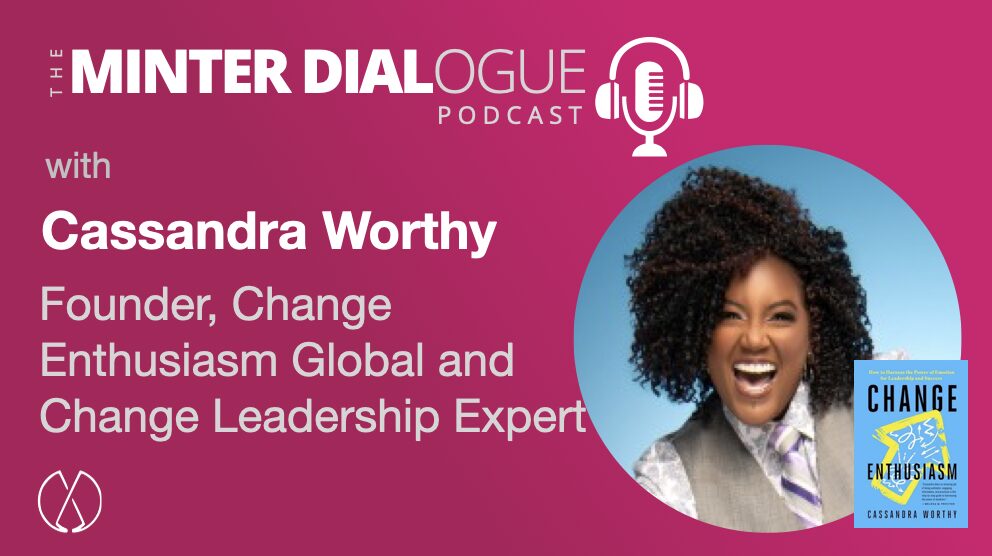
Minter Dialogue with Cassandra Worthy
Her background in chemical engineering, including years at Procter & Gamble, gave her a unique lens through which to view organisational change. Yet it was her personal story—embracing sobriety, learning to listen to her intuition, and bringing her true self to every room—that stood out powerfully in our conversation.
We delved into what it means to consistently bring energy—not as a forced performance, but as an honest expression of self. Cassandra’s candid reflections on her sobriety, navigating the complex emotions of perimenopause, and recognising the human factors at play in business transformations all shed fresh light on personal and collective growth in the workplace.
Our exchange explored building resilience not by shielding oneself from difficult emotions, but by leaning into them as signals and opportunities for learning. Cassandra’s notion of “change enthusiasm” is not just about coping with transformation, but reframing it as a personal empowerment journey.
3 Key Points:
- Authenticity Fuels Sustainable Energy: Cassandra emphasised that real energy comes from being her authentic self—embracing all emotional states rather than performing positivity. She credits journaling and stillness (like listening for intuitive whispers) for maintaining this authenticity, especially in challenging times (02:44).
- Human Factors Drive Organisational Success: In corporate acquisitions, Cassandra highlighted that recognising the emotions and experiences of people involved—rather than just focusing on business mechanics—is the key determinant between success and failure (21:49).
- Vulnerability as Leadership Strength: Modern leadership requires the confidence to be transparent about struggles and emotions (what Cassandra terms “confident vulnerability”). Doing so grants others permission to show up as their real selves, creating a culture of trust and resilience (15:43).
Further resources for the Minter Dialogue podcast:

Meanwhile, you can find my other interviews on the Minter Dialogue Show in this podcast tab, on my Youtube Channel, on Megaphone or via Apple Podcasts. If you like the show, please go over to rate this podcast via RateThisPodcast! And for the francophones reading this, if you want to get more podcasts, you can also find my radio show en français over at: MinterDial.fr, on MegaphoneFR or in iTunes. And if you’ve ever come across padel, please check out my Joy of Padel podcast, too!
Music credit: The jingle at the beginning of the show is courtesy of my friend, Pierre Journel, author of the Guitar Channel. And, the new sign-off music is “A Convinced Man,” a song I co-wrote and recorded with Stephanie Singer back in the late 1980s (please excuse the quality of the sound!).
Full transcript via Castmagic.io
Transcription courtesy of Castmagic.io, an AI full-service for podcasters
Minter Dial: Could I call you Mrs. Energy?
Cassandra Worthy: Sure.
Minter Dial: Cassandra Worthy. That’s the first time I’ve done an introduction like that. Anyway, Cassandra Worthy, in your own words, as I like to always ask my guests, who are you?
Cassandra Worthy: Oh, my goodness. Who am I? I’m an individual who enjoys life. I am an individual who, uh, feels myself as a vessel of great vibrant divine energy, uh, and I really am having fun walking in my life’s purpose, and I’m grateful to be doing so.
Minter Dial: All right, so energy is a thing, and I, I’ve been, let’s say, questing this notion of energy through multiple avenues. Yet it doesn’t just necessarily come naturally. And as much as you might have a narrative of what the things that are bringing that energy, the vessel, the divine, there are times when just saying it doesn’t work. How do you, when you wake up in the morning, jump into that suit, or are you always in it? How do you, how do you know how to move the energies? Do you bring it to certain events and other times you like chill?
Cassandra Worthy: You know what? I think that I’m always uniquely carrying it. Energy has always been something that’s been special to me because I’m a chemical engineer. And so, in doing my engineering, energy is a part of that. And a lot of the engineering work that I did But I always get complimented about my energy and how it’s very unique and vibrant and how I can light up a room. I’ve been told that ever since I was little, and now it’s something that I embrace as a gift, as a gift that I have, and I’m meant to share this energy with the world. And so, what I do to ensure that this energy that is uniquely vibing through me always comes through is always striving to be my authentic self and to show who I am to the world. And so, I’ve been striving notably in my years of sobriety to allow true me, authentic Cassandra, to come through. And if I’m doing that, whatever the energy that’s meant to flow, whether it feels like I’m in a funky mood, whether it feels like I’m in the highest mood ever, it’s authentically me. As long as the energy is authentic, I’m feeling it.
Minter Dial: Okay, so then how did you register the authenticity? What was the path that you had to take? Obviously, you just mentioned the sobriety story that gets to that authentic place. What kind of advice do you have for that?
Cassandra Worthy: Um, I think I’ve always had a strive to be uniquely me and to find that authentic light. I do believe that it been in sobriety, without having the fog and the cloud of alcohol and drugs, that true me has been able to shine through. And for me, it’s like intuition. It’s a whisper. It’s something that I can feel. Sometimes it’s something that I can actually hear, that it’s guiding me in the way that I show up. And so, my advice is to strive to listen to that. You know, find moments where you can get still and hear that thing, whether it’s in a feeling or in a voice, in a whisper, in an intuition. Get still and check in with you. The other thing that I lean very heavily on that allows me to continue to find and grow in my authenticity is my journaling. Because, you know, I challenge myself. I think about the way things have touched me, the way things have moved me, my dreams, my aspirations, my ponderings, my curiosities, my learnings. I journal all that. And sometimes when I get really still, the thing that I hear, I just let it flow out of my, out of my pen, and I write it. And so, I can transcribe those messages onto the page that I can go back and revisit.
Minter Dial: I’ve always been intrigued by journaling. I remember writing diaries when I was younger. And then there’s this philosophy of Rousseau who says, well, you know, when you’re diarizing or writing a journal, it’s inevitably a written piece, therefore, for posterity’s sake. When you’re writing, to what extent do you have a regard on the future of that versus the moment as you’re writing it?
Cassandra Worthy: You know, I actually leave blank pages in my journal for— I’ll write a note to my future self, uh, and I’ll invite her back to the page. to tell me of what she’s doing, what she’s up to.
Minter Dial: Wow.
Cassandra Worthy: And so, it’s fun for me to go back and find those blank pages that I can go and revisit because it allows me not to think about time as linear. We’re going deep, man. I like this. To not think of time as linear because often I can see Visions of what’s to come, uh, and oftentimes those visions become reality, uh, and so I feel a relationship with myself 10, 15, 20 years from now. I feel a relationship with myself 10, 15 years ago, and we communicate with each other.
Minter Dial: Well, this is beautiful. Um, 2 thoughts. One, this idea of visualizing. So, I can visualize my success. And the second thought is your name, Cassandra, which is by definition, or at least the myth of Cassandra, is someone who’s able to anticipate a negative future that nobody else sees.
Cassandra Worthy: And no one believes.
Minter Dial: And no one believes.
Cassandra Worthy: When I prophesize that. Yeah. Yeah. That’s true. That is what Cassandra has been about. And it’s been something that I have embraced as a gift. I do consider myself to have the power of envisioning a future. And I think in anchoring belief and then putting action and energy behind that belief, inevitably it manifests. And I also have great belief that when I envision something, it is that reality pulling me to it. And I feel like the universe conspires to bring that into reality for me. I envisioned my speaking career before it happened when I was, you know, still a chemical engineer, still an executive in corporate. And I just knew this was something that I was supposed to do. I could feel it. I could feel the energy of my life pulling me that way, even though I got rejection after rejection, even though, you know, I was standing on stages for free, just Hoping somebody would let me be on that stage, knowing this is where I’m supposed to go. I know I’m supposed to be on these stages. And whether I never get paid a dime and I’m still working in corporate and doing this on the side, I will do it because my life’s purpose is pulling me into it. But it manifested in the way that I saw it, actually in a bigger way than I saw it, which has been wonderful.
Minter Dial: Well, what Was the trigger or the pivot, the moment that it became bigger?
Cassandra Worthy: I don’t know if there was necessarily a moment that it became bigger than what I dreamed. But I think the moment that I— as I was pursuing this dream, as I was pursuing this pull that I was having in my life, I was just putting one foot over the other. I’m feeling pulled in this direction and I’m doing it. I’m going to create a website. I’m going to do this. I’m going to get photos made so this website pops. I’m going to think about what is the message I’m meant to bring. I’m going to get mentorship, one foot after the other. And then, in March of 2019, the next step was me leaving corporate as I had known it and pursuing this thing full-time. And it wasn’t like this big, huge leap. Oh my God, you’re leaving your 6-figure corporate executive salary to do what? It was something that I had been stepping one foot over the other for a year and a half. And the next step was me leaving corporate. Right.
Minter Dial: Well, by the way, I had the same journey, right? I left a big corporate role. So, I understand that. The words that come to my mind as I listen to you, Cassandra, are reality distortion field somehow, which Steve Jobs is known for. He’s this idea of having this strong vision, and then bringing everything to orient towards that vision. Yep. The fact that you left, that does feel like a marker moment because you had to sort of jump into the void of this. No, there’s no money, but I have this vision. What about pulling people, other people along with your energy? Because if you’re a force of nature like you have and obviously have, How do you bring others into that energy without sort of overwhelming them? Because you have an outsized energy, an outsized presence, beautiful smile that, you know, is totally disarming. And how does everyone sort of vibe into it? How do you bring people in?
Cassandra Worthy: Well, first off, thank you. And I will say that it’s natural. And I’ll go back to what I said before, I will show up my authentic self. That is what I am dedicated to doing. And the people that are meant to vibe with it and the people that are meant to receive the message and have it resonate within them, it’ll happen. And so, there’s a natural way that happens when I get on a stage or when I meet folks or oftentimes when I do walk into a room. And so, I don’t try to force anything. I just show up naturally. who I am. And as long as I vibe in that authenticity, who is meant to follow will follow. And I trust that.
Minter Dial: So, I want to be a little bit maybe circumspect on the, the, the constant source of energy.
Cassandra Worthy: Hmm.
Minter Dial: I certainly am an energetic individual despite my age. There are times when I have said, oh, God, it’s not happening. I wake up on the wrong side of the bed. Maybe I didn’t sleep at all during the night. Maybe I had a fight with my wife. Maybe, you know, things aren’t going the right way. Have you had moments like that? And how do you get through those moments?
Cassandra Worthy: Oh my God, yes. This past year and a half has been probably one of the most challenging periods of my life. I’m 45. And I have entered perimenopause. And with that has come the experience of complex migraines for me.
Minter Dial: Sorry.
Cassandra Worthy: They’re migraines with aura. And I knew nothing about a migraine. I knew nothing about migraines with aura until I hit perimenopause and started to experience them. But my mind will go blank, completely blank. I can’t— sometimes I can’t speak. What I do speak is nonsense. And they’re terrible. I can’t stand them. You know, but fortunately—
Minter Dial: Because with your intelligence, you see that it’s not what you want to be saying?
Cassandra Worthy: Yes. And I know that I’m not making sense. And I know that I’m trying to speak and I can’t. And so, there’s frustration that happens. This is what we call signal emotions in the work that I do. So, I get— I’ve got all kinds of signal emotions of frustration, of anger, of fear, you know, when I’m going to speak in front of folks. And so, for me, I have had to become the greatest student of what I teach. And recognizing when I feel that energy, because I think of emotion as energy in motion, when I feel that energy that is difficult to hold, the frustration, the fear, the anger, the aggravation, I recognize it as signals, as data, as information. I am living in a time of great opportunity. Opportunity to voice my experience, opportunity to be an example of what happens as your body continues to evolve in perimenopause, and opportunity to show how I’m using this as a moment to grow and evolve and expand. And so, yeah, it’s a recognition, and also it’s allowing myself the grace to rest, allowing myself the grace To take a step back at times when I feel myself drained, when I feel myself not being able to shine as brightly, and knowing that it’s okay. That’s okay if you need to take a day, you need to take a beat, you need to take a nap. That’s fine. We are human. And to embrace that. And so, I think, you know, it’s important for me, and my wife helps me with this, not to continue to push and to drive and to, you know, as a founder, as a CEO, as a global speaker, I travel all the time. Time. I’m always on a plane. I’m scaling my company. And it’s a lot of work. It’s a lot of effort. And I have to remember, I have to give back to myself. I ask my audiences often, who in here wants to work for a worn-out, ragged manager who has their shirt on backwards and bags under their eyes and they know, you know, they need a nap? Who wants to work for that person? No hand ever goes up. I have to know to give back to myself. And that’s something else that I teach leaders as well.
Minter Dial: Yeah. So, walking the talk, it reminds me of Tony Robbins, who, who has a specific method to getting that energy before he walks on stage. And, and the issue is, as leaders, is that we’re expected to be the model and to bring that energy. And I wanted to get into that a little bit later. But the idea of empathy, for example, is something I write a lot about. The leader is expected to give empathy to everyone else. But what about empathy to the self that you were just talking about? And what about your employees having empathy for you? Why isn’t that an expectation or a possible route?
Cassandra Worthy: I’ll tell you, I think it’s because of the way older generations have grown up. The way that we think about professionalism, the way that we think about what a leader needs to do, the expectations and the box that we put a leader in. But that has got to change in the age of AI. That has got to change in 2026 and beyond because the pace of change is unlike anything I think humanity has ever seen. And I think it’s only going to continue to accelerate. And in 2026 and beyond, Vulnerability is not a weakness, it is a strength. And I think that it is a necessity. And there’s a danger when we believe as a leader, I have to role model positivity and optimism. I have to be the motivator. I have to be the rah-rah. I have to support them. I have to hold space because I am leading them. They need me. But the danger is that you are role modeling perhaps the only feeling or emotion that you want to see in the space. That’s the message that you’re conveying. And your employees and your team members are thinking, man, I can only be high vibes when I’m talking to them. They only being positive. That’s how I got to show up. If you can show vulnerability, and I call it confident vulnerability, so it’s still rooted in the mission and the vision and what you’re doing and the work and the belief in it, but you’re showing that, you know what, I’m stressed too. I’m also frustrated. And now you have, you know, in our framework, you have a language. I have signal emotions. I’m in step 1. I am feeling my signals. I need y’all’s grace. right now. And then you role model the full spectrum of emotion and you grant permission to your people to feel their true emotions and express them as well. And there’s power in that. There’s great power in that. So, we need to get away as leaders and thinking about what leadership means of only bringing positivity and high energy and being that motivator. You need to show your vulnerability as well to grant permission for them to be their true authentic selves.
Minter Dial: So, a couple of points in the various things you said. The first is, you know, no one wants to work for a dreary, sad-looking, baggy under the eyes kind of guy. And then second of all, there’s the idea of having the energy, but also showing your signals and knowing your negative side.
Cassandra Worthy: Mm-hmm.
Minter Dial: But at what point, what’s the balance? Because I mean, if I, 6 days out of 7, I come up as the dreary, dump because I’m in touch with my emotions. I’m, oh, I got— I’m sad, but I’ve slept sorely and poorly for 6 days. I’m telling you my reality. I’m being vulnerable and I’m showing you my bad side, but I can only be good 1 day out of 7. I’m obviously being a little bit provocative. How does one know when too much vulnerability is over the top? Because at some level, you know, I’m being authentic. But if you’re authentic 100% of the time, and 85% of the time, that’s not good.
Cassandra Worthy: Hmm. I get what you’re saying. And of course, I’ll challenge you claiming or saying good and bad, and how positive, high energy is good. Low-energy vulnerability is bad. It’s all authenticity.
Minter Dial: Mm-hmm.
Cassandra Worthy: And I think the full gamut and you showing it, all of that is good. And I think as a leader or as an individual, no matter the type of work that you do, you have to strive to find the right balance for you and the nature of your work and who you’re working with and who you’re supporting and who you’re working for. And I think it’s a matter of being in tune with how your energy and how you are conveying yourself is impacting the team.
Minter Dial: Mm-hmm.
Cassandra Worthy: And, you know, there are some individuals that you, that you know that you can continually be incredibly vulnerable with. And then there are other times when you might want to teeter out the amount of vulnerability that you’re sharing. But the reality is, and this is what I invite the listener to embrace, is that you’re working with human beings. And we are emotional beings first and foremost. And as long as you are working every day to nurture trust in the folks that you work with and who you support and who you work with, I think you’re going to be able to lean on that trust when you need it in the tough times, in the difficult times.
Minter Dial: Well, the point that I picked out of what you say there, Cassandra, is this notion of intentionality.
Cassandra Worthy: Yeah.
Minter Dial: There’s a second thing that also I think is tied in with what you said, which is the ability to share in some combined vision. Because I intend to be, I want this, this is who I am. I’m authentic. And we as a group need to get here. So, I may not be showing up 100% or at least in the best light, but I’m authentically me.
Cassandra Worthy: Yeah.
Minter Dial: I want with you the same intention. So, that galvanizes that sort of communal spirit so someone else can pick up the energy that you might not have.
Cassandra Worthy: Yep. Yeah, that’s very well said. And I think when a team, when an organization, when a business is anchored in a unified mission and vision and everyone’s on board with where they’re going, I think there will be ebbs and flows. And as you said it beautifully, others around you can pick up when your energy might be lacking and they’re going to be able to hit for you in those moments. And it’s a beautiful thing when it happens. When you have a team that has that kind of vibe and cohesion. Yeah.
Minter Dial: Yeah. I like to say you are your network. You are the people around you.
Cassandra Worthy: Yeah, man.
Minter Dial: All right. So, a lot of your work in the corporate times was around acquisitions, and I worked in large corporates and boy, did I see screw-up after screw-up when it came to acquisitions. So, many people look at it as the growth avenue, the way we’re going to grow is let’s acquire because we can, we have the money, we have the financing, and we go in there. In your experience, what was the single fact that screwed up most of the acquisitions and where did you see acquisitions actually succeed? What was the magic dust that makes an acquisition succeed?
Cassandra Worthy: Yeah, recognizing the human factors, recognizing that This acquisition, yes, it’s businesses. Yes, it’s products. Yes, it’s services that are combining. Yes, there’s great growth opportunity that exists within it. But also within it are human beings. And the world’s being turned upside down by going through this acquisition. And so, I think putting people first, putting human factors first, is what has always proven successful. And I think there’s been an error, there’s been a wrong for decades about change management practices, change management solutions, HR solutions, putting people first, putting humans first, but yet still leaving emotion at the door. We’re emotional beings first. If you employ human beings, you employ emotional beings. And whether you tell people to leave emotion at the door or not, whether they’re telling you they’re leaving it at the door, they’re in the door, they’re in the room, whether they’re being suppressed and pushed down or allowed to be felt and expressed freely. So, I think that has been great power in the acquisition work that we now are able to support with our enterprise clients. And that’s where we specialize, is in the combining of, you know, so many different walks of life, different cultures, different priorities, and how you come together as one unit, recognizing the friction that’s going to happen in that combining and leveraging that friction as opportunity to really explode the growth, not only the growth of the business, but the growth of the individuals that are leading and charting the business forward. Yeah.
Minter Dial: All right, great. I want to get— I want to dive into this in a moment, but start with you, Cassandra. You’ve— it feels like you wrote about how you would get fed up at times when an acquisition wasn’t going right. And so, you’re in it, you’re doing the acquisition. What do you feel you misunderstood about your own reactions? And, and what or how did you change your mind when you’re in the motion, in the moment?
Cassandra Worthy: Yeah, it was probably the biggest lesson learned in my first, um, acquisition experience. I was still a, a young engineer. I’d only been with Procter& Gamble for about 3 and a half, 4 years, and I went through my first acquisition experience. We had just acquired, um, an entity for multi-billions of dollars.
Minter Dial: And by the way, you know, I worked at L’Oréal, so I’m going to be familiar with—
Cassandra Worthy: Oh, nice.
Minter Dial: Gillette and a few other things, you know.
Cassandra Worthy: Yes. Yes. So, yeah, you know, you know the world. So, it was an incredible, you know, growth, explosion of growth for P&G. And I was one of the leaders that went to help integrate parent company tools and processes to help continue exploding innovation. And so, I went to the headquarters of this newly acquired entity. And it was like I had left P&G and I was working for a completely different company. And it was us versus them. And it was so much tension up and down the hallway. And I felt lost. I felt frustrated. I felt angry. There were so many days where I felt like punching a wall. I felt like my ideas weren’t being respected. There was even a time when one of my peers shared my ideas and my data and my recommendations to executive leadership without me being in the room, without acknowledging that it was my work. It was a very challenging time for me. And I went to a Minter and I expressed all of this short of, you know, you are director, can you just fire my manager? Can you just promote me so we can make all of this right? And I was putting my work experience in her hands. She’s the one at the leadership level. She’s the one that has the power to do this. And she told me, Cassandra, you can either get bitter or you can get better. It’s your choice. You’re the one who’s sitting in the seat of choice. And at first that pissed me off and I got even more angry and I was like, how dare you? It’s clearly not my choice. I have no influence. You’re the one in the leadership chair, not me. But then I recognized what she was saying. I do have a choice in how I experience this. I have a choice on how I choose to show up every day. I have a choice in how I choose to engage with my peers, how I choose to engage in the work. I do have a choice. And so, I leaned heavily on that. And honestly, that was the seed of what my life’s work has become now in Change Enthusiasm and Change Enthusiasm Global. But in recognizing that I always have agency on how I show up, how I experience what was happening around me, completely shifted the lens in which I was experiencing the acquisition. And I ended up learning and growing tremendously throughout that acquisition. And I landed an opportunity that I wouldn’t have had had I not transitioned into that acquisition. And so, I, you know, it’s a recognition that this really deep, difficult emotions that you experience when going through big change, whether it’s unexpected or expected, that creates so much friction, it’s often your greatest opportunities to grow, to learn about yourself, and to contribute in massive ways into the world. So, yeah, that was probably my biggest, the big shift that happened.
Minter Dial: So, a couple things, uh, the way I describe that is moving away from being the victim to the actor. Mm. And with regard to mentorship, because I, I want— there’s still some other topics that I have in my back pocket here, but with regard to mentorship, uh, Cassandra, I can say that in my life I never really went out and got a mentor. I ended up with mentoree, you know, style people that I feel— I want to say almost posthumously because I’m no longer really in the business world, but who I say, oh, they were actually mentors for me. What extent did you go out and seek this mentor you’re talking about? And what advice would you have for individuals who are listening who may be like me or just don’t have mentors? How do you go out or go about in getting a solid mentor that can help you shift from victim to actor?
Cassandra Worthy: Yeah, I love this. Mintership has always been huge for me, and I’m so grateful it was taught, the importance of it, during my time at P&G. And in order for you to have an incredible mentorship relationship and find someone that can support you is for you to first embrace the fact that you can’t do it alone, that oftentimes we need support. We need help. We need to call for help. We need to be able to confess when we’re struggling. And I think for many of us high achievers, there’s a— that’s daunting, or that’s something that we don’t want to do. No, I can do this myself. I can do it myself. And I have been one to do that. I still do it. And I have to remind myself—
Minter Dial: Right.
Cassandra Worthy: The importance of being able to ask for help. But it’s hugely important. And I have mentors to this day. I have mentors of various ones that are much, much younger than me, ones that are much, much older and in the same— all kinds of age ranges, all kinds of life experiences that I see in unique ways that can support me in my journey. And of course, for me, it is always a mutual relationship. How can they support me? And then how can I support them? Oftentimes, you know, when I’m looking for mentorship, it’s getting very, very clear on what is the ask? What is it that I’m after? What is the need? What is the gap? What is it that I need to learn? And then understanding across my network who could help fill that gap or who would know someone that can help me fill that gap. So, it’s quite strategic when I’m looking for various mentors. I have things pretty well, I think, suited now, and it’s because I decided to join a community of like-minded individuals, of high-growth founders that have been my true support network. And I’ve found so many mentors within that group. Yeah.
Minter Dial: Well, it’s for sure having people who are in the same bailiwick, who are the same issues, that’s really useful because I’ll take an example of work I’ve done on returning veterans from the war and they come back from war injured or mentally scarred and they come back and we’re worried about I don’t know, the scratch on my car or, or other stuff. And their ability to relate into it is so far. And so, finding people who can understand what you’re going through so you don’t have to sort of, you know, layer out and sort of protect you from what I’m about to tell you, trigger you or otherwise. It’s like you get it.
Cassandra Worthy: Yeah.
Minter Dial: We’re in the same space. Yeah.
Cassandra Worthy: Yeah. And that’s huge when you can have people in your circle, in your corner, to convey that incredibly healing message of you’re not alone. And that goes back to what you were mentioning before. And I’m so grateful for your work around empathy and having people around that are able and willing and happy to hold space for you when you need it most. It goes so far.
Minter Dial: Go so far. Cassandra, it’s part of my a priori thinking about things. I studied women’s studies at university, and at the time I was the singular male at the time studying this. And so, it gave me, I feel, an aperture into somehow the woman’s world. And And you’ve mentioned 2 things, one of which is distinctly feminine, which is perimenopause, and the other, which is this call for help, the needing, the need for help. I feel men on balance don’t know how to get over the ego problem that says, I need help. And the second thing is we’re not in touch with our bodies sufficiently to know when our energies are truly down. How does that land for you?
Cassandra Worthy: Yeah, I think, um, I think that can go for any individual, whether they identify as, as female, as non-binary, as male. I think, you know, a wealth of individuals can, can fall into that trap of not being able to overcome, uh, their ego. Um, and I think it’s the allowance of putting it aside and as much as you can practice doing it and the value that comes when you’re able to do it. And thinking about mentors, find someone who you see, you know, they can get over their ego and put it aside and maybe learn from them. What have they learned? How have they grown by being able to do that? But there’s such value when you can. when you allow yourself to do so. There’s value in it.
Minter Dial: All right. So, I am anything but a chemical engineer.
Cassandra Worthy: It’s possibly— Anything but a chemical engineer.
Minter Dial: I mean, it’s possibly the furthest thing that I could have studied. It was the part of the campus that I never did, you know, literature, women’s studies, languages. So, chemical engineering, what did it teach you or bring to your repertoire about organizational change or diagnosing organizational change? And maybe where does the engineering analogy actually break down?
Cassandra Worthy: Yeah. So, it’s funny, my journey into chemical engineering. I went to Georgia Tech in Atlanta. And when I initially joined the institution, I was in pursuit of pediatric neurosurgery. That was something that I was—
Minter Dial: Sorry, sorry, pediatric neurosurgery?
Cassandra Worthy: Yes, yes, that is correct. You heard that correctly. And I wanted to be that ever since I was in the 4th grade because I saw Dr. Ben Carson accept an award for being the first to successfully separate Siamese twins from the cranium. He was a Black man. He is a Black man, very well Dressed, spoken very well. And I’m like, yo. And then I looked up how much they earn and I was like, okay, that’s what I’m going to do. That’s what I’m going to do. And so, I pursued that ever since 4th grade up to sophomore year at Georgia Tech. I was pre-med biology. And then I started looking at the journey of becoming a fully practicing pediatric neurosurgery, the medical school, the residency, all of the years in the schooling. And by the sophomore year at Georgia Tech, I was tired of school. So, I’m like, you know what, let me just switch. It looks like chemical engineering, a lot of what I’ve already done transferred into that degree. And I also saw chemical engineering—
Minter Dial: Credits, credits, right?
Cassandra Worthy: Hey, the credits. Looks like they do cool stuff. You know, you can do a lot with an engineering degree, chemical engineering degree. So, I’m going to switch to that. But I ended up loving it. And I discovered what Georgia Tech taught me and all my coursework and becoming an engineer was really how to solve a problem. And it really nurtures your curiosities and wanting to explore and ask questions and discover and experiment. And that really just feeds me. I really, really enjoy that. And so, I’ve been able to employ a lot of that framing, a lot of that mindset, my curiosity, solving problems into organizational change and transformation. and the people aspect of it. But I really enjoyed my studies at Tech, and I also enjoyed doing shampoo design and scale-up because it’s solving problems, right? And to be able to— and, you know, to be able to see a product, you know, on the shelf that I had took part in designing and scaling up, and that was incredibly rewarding. But with engineering, it taught me how to solve problems.
Minter Dial: I’m not asking you to, Beryl, but I can remember times when I would launch a product and I would just say the scientific reports that proved the efficacy of X percent of new hair growth or whatever it was, you know, younger, younger skin. It didn’t all seem like rocket science, uh, to, to be nice. And sometimes I felt that it was a bunch of hot air. And so, as opposed to solving real problems, like, you know, I would say some sort of real malady or trying to get a rocket into space, not that that’s a problem that needs to be solved per se, but it seemed like a bigger type of problem. And so, chemical engineering, very far away, but We’ve been talking about the idea of solving problems. Where do you feel that chemical engineering breaks down? Because I mean, you are a bundle of energy and maybe that’s more physics than chemistry, I don’t know, or biology, I don’t even know. Emotions. Where does chemical engineering not work? Where does the analogy of a chemical engineer not work in today’s world?
Cassandra Worthy: Good gracious. I can find it works in so many places because I talk about, I talk about energy, I talk about emotion being energy, I talk about us as, as closed systems, I talk about energy and the, and the first law of thermodynamics. So, I put it in so much of what I do. I even, you know, give a shout out to the periodic chart in one of my keynote messages. and we talk about period— we talk about chemical elements. So, I don’t know, I, I don’t have a good answer for this one because I feel like I can put—
Minter Dial: It’s all good. If I, if I said to you, NamGalSipsKlar, does that mean anything to you?
Cassandra Worthy: Say it one more time.
Minter Dial: Nam Gal Sips Klar.
Cassandra Worthy: Nope.
Minter Dial: That’s how I remember the periodic table. Ah, sodium, uh, mag— um, nam That’s sodium. Mg.
Cassandra Worthy: Yep.
Minter Dial: Is magnesium. Namgal, Al, aluminum. Namgal, Si, silicon. P, potassium. I know that’s my— that’s, that’s my— that’s it, that’s it. That’s coming back to my O-level, my O-level chemistry bearing all. Okay.
Cassandra Worthy: Yeah.
Minter Dial: Um, so emotional fluency. Uh, you know, you mentioned this before, and this is the topic I want to get back to before, which is you walk in the door and you have emotions. You walk in the door and you are you.
Cassandra Worthy: Yeah.
Minter Dial: Yet we have so many people that say, well, you know, leave what’s at home home. When you come in, be the business person. Put on the tie. By the way, you’re wearing a tie. You put on a tie and be the business person. I have long thought that that is complete nonsense, but do you, would you subscribe to this idea that we should be allowed to bring our full person, including our, the shit that happened at home in the morning, the bad night’s sleep? Where do you draw the line in terms of bringing the full personal thing into the professional thing?
Cassandra Worthy: Yeah, it’s a great question. And I think that, like I said, this idea of professionalism, that’s changing as these younger generations are coming into the workforce. And I don’t know if you’ve seen how the internet has exploded about whether or not you can bring an iced latte to an interview.
Minter Dial: I did hear about that. It’s become a thing.
Cassandra Worthy: Yes, I see that as generational differences coming into play and what people classify as being okay in a professional setting and not. And I welcome the change. Because I think about celebrating and inviting full authenticity, but I also strongly recommend, and this is what I do myself, I also want to have the biggest impact that’s possible, right? And so, how do I bring my full self into a space knowing who’s in that space and the culture that’s in that space? How do I ensure that I’m not losing myself, but I’m tailoring how I show up for greatest impact, for the greatest impact. And so, I love wearing a tie and a vest. That’s, that’s kind of my flavor. That’s my brand. And I wear a silhouette of me in a tie and a vest on a t-shirt as my uniform on every single stage that I’m on. That’s me being me. That’s my authenticity. But it’s underneath the tux. I have, you know, a tuxedo jacket and pant. But that t-shirt is there. So, that’s me tailoring my personal style, not compromising who I am, but tailoring it to ensure I still have maximum impact. So, that’s what I would offer. How can you show up in a way that’s going to have the impact that you desire, knowing your audience, knowing the culture, knowing the team that you’re a part of, without compromising who you are? And if you realize, you know what, I think I’m in a culture, I’m in a company where I have to too much compromise who I am, maybe that’s when it’s time to look elsewhere, to look somewhere else. But I think there’s a balance. How do I tailor my style without losing who I am for maximum impact?
Minter Dial: I have a feeling, Cassandra, that the reality is that is always going to be a moving post. Because, I mean, really, you want to be 100% authentic, go naked. I mean, that is about as authentic as one can go. Yet we know that a book has to have a cover.
Cassandra Worthy: Yeah. So, we can judge it.
Minter Dial: For example, right? And so, we’re always having to balance a little bit like sales and marketing, these tensions that exist in many functions in a business. We have the presentation and the reality. If you want to be fully transparent, good luck.
Cassandra Worthy: Hmm.
Minter Dial: Because if I tell you that a shampoo is 93% water, um, okay, so the marketing, you know, the anti-aging, the this and that, that the, well, I, you know, you don’t really want to say the full story because that might just dilute the power. of the 7% that I’ve got left. By the way, 0.3% of that is fragrance, and that’s just a big deal. So, transparency with regard to authenticity, there’s some kind of a tension in between those 2 areas.
Cassandra Worthy: It could be, um, but I think the tension is created by the situation, the circumstance, the surroundings. Right? If you’re in a situation or a circumstance or a culture where there is great safety and comfort and welcoming of full transparency in who you are, then there’s going to be less tension in that happening. But if you transplant yourself into a culture where there’s not much of that freedom, where people have to show up a certain way, then there’s going to be incredible tension when you’re trying to transparently be your authentic self. And you getting looks and you’re not getting put up for the promotions and the advancements. And, you know, that tension will get presented. And so, it’s, you know, for me, it’s a matter of— and I’m fortunate to have chosen the route that I have— I’m just going to create my own company.
Minter Dial: Yeah.
Cassandra Worthy: And create my own culture to thrive in. But, you know, for those of us who are working for others or in other entities that we didn’t found, that we didn’t create. It’s finding those environments and those cultures where the friction, the tension between transparency and, you know, that authenticity, that piece is a point where we are good with it.
Minter Dial: Exactly. And I think that’s such the right way to land because what I move away from is the dogmatism of transparency. When we’re in this call for radical transparency, Mm-hmm. And my feeling so often in those calls, Cassandra, is that it’s more a viewing or a light on the individual asking for it and some kind of issue that they have than the one that you have. So, often we’re blaming others for, you know, when you point at somebody, I point at you, I’ve got 3 fingers pointing back at me, these ones here. I don’t know if you can see because I mean, I’ve got the mode. But so, we’re— this is that tension I want. So, just to get back to this point of empathy, something we mentioned a little bit before, and the idea of an emotionally fluent leader and the difference between an emotionally fluent leader and an empathic leader. How do you distinguish them? Or what would an emotionally Fluently to do differently than just somebody who’s empathic?
Cassandra Worthy: Yeah, I think about fluency being the way that you’re able to converse or communicate with yourself in the experience of emotion. And within our company and what we teach across enterprises is this concept of signal literacy. We think about these difficult emotions as being signals, as being data, and how literate are And understanding when that signal exists and naming what that signal is and recognizing when it’s there, the physiological cues, that literacy. What is that that you have with yourself? And that fluency exists whether you’re talking about, you know, the emotions that you’re experiencing and to be able to communicate what you’re feeling in a succinct way, as well as being able to be in tune with the emotions of others around you. So, being able to speak that language of emotion, to sense it, to feel it, to be able to welcome it and create the type of space where emotions can flow. And so, that’s how I think about that. I think a highly emotionally fluent leader will have the ability and the capability to hold space and share that empathy, because that’s what it is, to be able to hold the space and the grace for emotions to flow and for emotions to exist. without you going into problem solving, without you trying to usher them away, without you trying to suppress them back into that individual or immediately divert them into something that’s more positive so that you feel more comfortable, which is typically what happens. And so, what I’ve, what I’ve so enjoyed and been so grateful to see with the work that we do with enterprises is our frameworks and our language have empowered leaders to step into conversations that historically they’ve shied away from because it introduces discomfort. Talking about our feelings, especially at work, is uncomfortable. But now with this framework, with this language, you don’t have to talk about how you’re pissed off and want to punch a wall. You can talk about, you know what, I’m in step 1. I am feeling my signal emotions. I’m feeling frustrated. I’m feeling angry. I need a bit of grace. I need a bit of— I need a day. Let me take a day, and then we can come back tomorrow and we can get in step 2. We can be in the opportunity and think about how can I learn from this. But right now, I got too many signals blaring. And so, that’s creating these conversations and making this connection happen. And because of it, the changes are getting adapted faster, employees are engaging quicker, and they’re moving faster because those conversations are happening.
Minter Dial: E-motion.
Cassandra Worthy: Energy emotion.
Minter Dial: The idea of naming emotions, I’ve spoken to many psychologists over the years, and it’s remarkable how vague our understanding of the nuances of the different emotions that we might be experiencing. And the thing that keeps on cropping up is that we have usually multiple emotions happening at the same time.
Cassandra Worthy: Totally.
Minter Dial: And our definition of any single emotion is often fraught maybe by the Poor language that we might have around it. Poor understanding of what is that emotion, much less its provenance. And this emotional illiteracy seems to be at the heart, not just of business problems, but of family problems, societal problems.
Cassandra Worthy: Yes.
Minter Dial: How do we fix that?
Cassandra Worthy: Go to changeenthusiasmglobal.com.
Minter Dial: Beautiful.
Cassandra Worthy: That’s what we’re striving to do. I mean, I’ll be straight up with you. Our work is at the intersection of change and emotion, right? And that’s all. Now, we focus on business and corporations, but we have a public-facing certification program, and all walks of life join that program. I think it’s a matter of being very intentional about striving to understand the emotions that you experience, and being able to name them and being comfortable sitting in them and knowing what they are. And even though you can hold frustration and gratitude in the same breath and joy and anxiety in the same breath, right? And being able to recognize those dynamics within you and giving language to it. We have a tool that we use in the certification, our emotions wheel, and it’s a magnet. And I have had leaders that come up to me and say, Cassandra, we use this thing at home all the time. I will get in front of my son. On the fridge. And I will say, what are you feeling? Tell me. And it grants language. You’re able to put language to it, and there’s such power to it. But no, that’s the intersection that we’re working at, changing emotion and being able to increase our ability to feel, to acknowledge it, to not suppress it. And notably, as we think about work, as we think about, you know, presenting in a work, in a business context.
Minter Dial: Well, I’ve always thought that, you know, what we do at work also rubs off on how we are at home in society.
Cassandra Worthy: Of course.
Minter Dial: The last question I have, it’s just a burning need, is in this world of AI where everything’s being borrowed, prompted, even empathy is being encoded.
Cassandra Worthy: Yeah.
Minter Dial: If you’re running a business today and you’re looking at your team, your teams, which emotions do you think that they should be saying or looking at and paying the most, the closest attention to that says that this is the, the uber power, the, the one that AI will never be able to overcome? Or where do you think that there’s sort of leverage points in emotions that AI, the AI-dominated world, won’t be able to overcome?
Cassandra Worthy: Yeah, it’s a good question. It’s one that I think about a lot. Will artificial intelligence ever have the ability to experience feeling? the way that they’re being coded and the way that they’re learning.
Minter Dial: Consciousness.
Cassandra Worthy: Yeah, consciousness. The way that they’re learning, they can speak to you in a very empathetic way. They know how to convey emotion, but they never can experience it. Our world is being turned upside down because of AI. And I think that in the age of AI, the pace of change will continue to accelerate in a way that humanity has never seen. But through it all, there’s, there’s an essence that is unchanging. And that is the core of what makes us human. Our power to feel, our intuition, those curiosities, the connection that you can feel. This gift that I have when I walk into a room and people talk about, oh my goodness, your energy, your energy. That’s something that is unique to being human. And I think I invite the world to lean on this incredible technology, this incredible innovation, and the pace it is accelerating to amplify that humanity, to amplify what makes us uniquely human. And I wouldn’t prescribe it to one specific emotion. I think I would invite all of them, the full gamut, and invite your listener to really become in tune with that emotional energy, that power, what makes you innately human, and how can you lean on AI to help you make that sing. Uh, even louder. Yeah.
Minter Dial: Uh, an unexpected and lovely answer, Cassandra. Thank you. Um, speaking of expected, I did expect to have a glorious experience with you. I thank you for sharing your energy, your words, your advice. Very astutely put. How can someone follow you, hire you, get you to come speak, buy your book?
Cassandra Worthy: Sure. Bother me. Well, don’t bother me, but you won’t if you reach out. Find me on LinkedIn. That’s the platform I’m most active on. So, send me a message, connect request. Tell me that you heard me on this pod so that I know the origin, or visit me at cassandraworthy.com. You can learn more about the work. There’s also links to Change Enthusiasm Global if you’re interested in hiring us to do some enterprise work. There’s lots of change happening.
Minter Dial: There’s a lot of need for change.
Cassandra Worthy: Yes.
Minter Dial: Cassandra, many, many thanks. And hopefully one day we’ll have a chance to share over an energetic matcha tea or whatever it might be.
Cassandra Worthy: Ice latte.
Minter Dial: Yes. Ice latte.
Cassandra Worthy: Thank you so much. It’s been an honor. Thank you.
Minter Dial: Thank you.

Minter Dial
It’s easy to inquire about booking Minter Dial here.