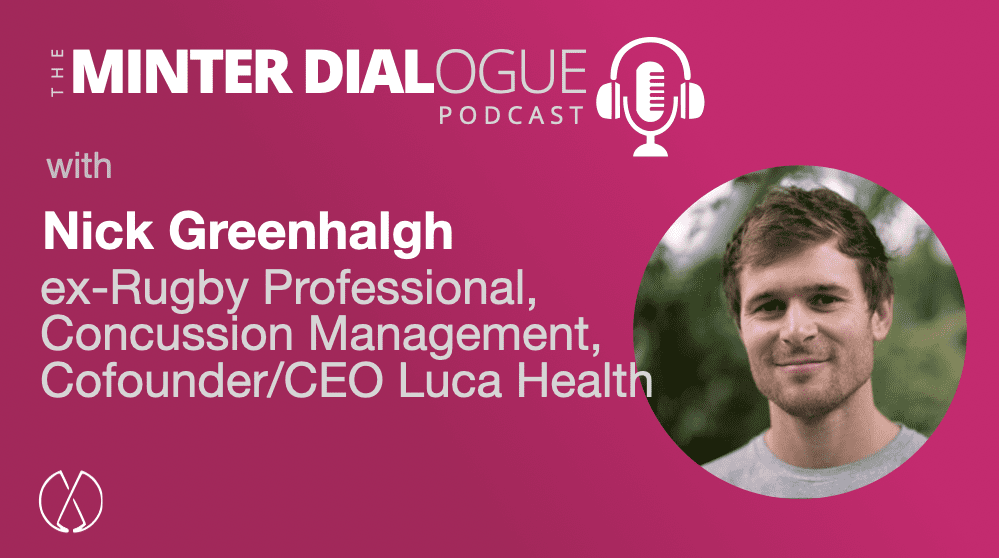
Minter Dialogue with Nick Greenhalgh
This podcast features Nick Greenhalgh, co-founder of LUCA Health, discussing his journey from professional rugby player to entrepreneur. Nick shares insights into LUCA Health’s innovative approach to concussion management in sports, particularly focusing on schools and grassroots clubs. The conversation covers the challenges of diagnosing concussions, the use of technology in assessment, and the importance of objective data in brain health monitoring. Nick also reflects on the difficulties and rewards of running a mission-driven startup.
Key points:
1. LUCA Health uses smartphone technology to provide objective data for concussion diagnosis and management.
2. The company aims to make concussion diagnosis more accurate and accessible, particularly in school and grassroots sports settings.
To connect with Nick Greenhalgh:
- Check out the Luca Health main site here
- Find/follow Nick Greenhalgh on LinkedIn
- Luca on Instagram
- Luca Safe Concussion Framework – advice to schools / clubs
Other mentions/sites:
Further resources for the Minter Dialogue podcast:

Meanwhile, you can find my other interviews on the Minter Dialogue Show in this podcast tab, on my Youtube Channel, on Megaphone or via Apple Podcasts. If you like the show, please go over to rate this podcast via RateThisPodcast! And for the francophones reading this, if you want to get more podcasts, you can also find my radio show en français over at: MinterDial.fr, on MegaphoneFR or in iTunes. And if you’ve ever come across padel, please check out my Joy of Padel podcast, too!
Music credit: The jingle at the beginning of the show is courtesy of my friend, Pierre Journel, author of the Guitar Channel. And, the new sign-off music is “A Convinced Man,” a song I co-wrote and recorded with Stephanie Singer back in the late 1980s (please excuse the quality of the sound!).
Full transcript via Flowsend.ai
Transcription courtesy of Flowsend.ai, an AI full-service for podcasters
Minter Dial: Cool. Well Nick, great to have you on the show. We got introduced to one another through the delightful Serena and Méline and was really intrigued by your project. We have some shared thoughts and activities. You’re a founder of Luca Health co-founder of Luca Health. But in your own words. Hey Nick. Who are you?
Nick Greenhalgh: Who am I? Who are we as a business or who am I as a person?
Minter Dial: Who are you as a person?
Nick Greenhalgh: I’m a 35-year-old Brit that made the foolish decision to found a company co found a company three years ago. Now I, I say that in jest. It’s been an amazing journey today. Who I am? Who am I? I sports mad for as long as I can remember all I ever wanted to do was to have a ball in my hands, kick it or do something with it. So, I was a nuisance growing up to be honest to my parents and got shipped off to boarding school where rugby started to become more and more serious and yeah, was fortunate to get picked up by a professional side here in the UK. Northampton Saints, who won the premiership the year before last, fairly successful team, was awarded a contract at the end of my, my school days and went full time and sort of at the age of 35 now I guess was going into that as an 18 year old hoping to be rounding out my playing days now and thinking about what I was going to do for the rest of my life but that, that wasn’t to be. The body well and truly fell apart in the just the two years that I played professionally and then that really kind of threw a spanner in the works because I hadn’t really planned to be doing anything else other than playing sport because nothing else. You know I did well at school and stuff because studious. But yeah, I didn’t have any sort of, I hadn’t, hadn’t done any forward thinking and planning if rugby didn’t really work. So, I was deferring a place at university and went off and took that up but, but you know, got through the three years without really knowing what to do and then I think my 20s are really a time sort of like working out who I was actually and finding out what would make me tick and spending six years at a startup scale up was a nice landing into London. But I, I soon realised that money alone wasn’t going to fulfil me because the company has done well, it’s a multi-billion-dollar business now and you know I could have had a pretty comfortable life there and probably jumped off to a couple of other jobs off the back of that. But yeah, I think I realised in my twenties that I needed a bit more than that and that took me off to go and do an MBA because everybody who’s got an MBA is successful, right? My heuristic for that was the two co founders of the business that I worked for, Shout out to Alphasites, they were Stanford MBAs and the senior guys and girls in that business also had MBA, so I thought one could only be successful with an MBA, so went off to Oxford and yeah, the, the coronavirus hit halfway through my one year programme there, which was a blessing in disguise because it meant that it gave me an opportunity to defer the second six months by a year, turned it into two years. And so, working out who I am as a person probably really sort of accelerated during that time frame and I worked out what I really wanted from life for the first time and that, that ultimately led me to founding Luca after leaving Oxford. Because I have to be doing something in sport. It’s what captivates me like nothing else. And I have to be doing something that’s impactful. And we are a concussion management business. We exist to keep pupils and players safe and people playing great sports like rugby. But not just rugby. Concussion can come from any number of sports. You know, hockey, football, horse riding, water polo has the most concussions per minutes played of any sport. Believe it or not, I’m from a family of medics. That’s probably informed my need to do something good in the world through like that service mindset. And mum and dad were GPS together, rural practise in Northamptonshire and then my brother and sister are also doctors, so I didn’t get the sciency gene. I was the, you know, doing the humanities subjects at A level.
Minter Dial: But you’re being the patient gene.
Nick Greenhalgh: Possibly, possibly. But I suspect that subconsciously my upbringing has probably led me to, to where I currently find myself, which is grinding pretty hard on a startup. But like loving the challenge, like really, really loving the challenge of it and very fortunate that I have a very capable co-founder who can do things that I absolutely can’t from a technical standpoint. He’s a software engineer and, and I’m probably, yeah, he, he’s, he’s tech and product and engineering and I’m kind of everything else, so commercial marketing, fundraising, basically people ops as it were.
Minter Dial: But if I’m not wrong, he’s a Greek geek.
Nick Greenhalgh: He’s a Greek geek. Greek geek, long hair, into his heavy metal music. We could not be more polar opposite as people or indeed skills. But hey, there’s no point in having a clone of yourself as a business partner. But the one thing that we do have in common is complete trust in. In one another. And yeah, it is working out pretty well.
Minter Dial: That’s brilliant. Well, I’ve written about the fact that 37 is the witching year, the year that you have to really lean in on finding out who you are. So, you still have a couple more years left. But just circling back, rugby. How was it to be a professional rugby player? 2 years, 18 to 20 years old. What did you take away from being a pro professional sportsman and especially in rugby?
Nick Greenhalgh: Honestly, I think my experience was very context specific. So, I was there July 2008 to July 2010. I don’t think it was a great environment for youngsters to be in and I wouldn’t be the first person from the club that I played for to say this. It was extremely hierarchical, intimidatory. And yeah, if you. Yeah, if. I don’t know if your face didn’t fit, it really didn’t fit. And I think it was probably quite good for me. You know, it was the first time in my life where I realised that not everybody in an environment that I’ve been in wanted the best for me or always had my best interest at heart. And so, I think it was very much a realisation that there is a big bad world out there. Like I was very. And like, this might sound negative and I don’t really mean it to sound negative. I’m not like having a pop at the Saints. I’ve done business with them since. I’m hoping they’re going to be a client one day. And I think just organisations go through different phases. There are very different people at the club now versus when I was there. But I think the time that I was there, I think the, the culture was pretty poor and that was a pretty tough place to operate, particularly as a youngster who was having some injury issues and having your like, mindset and attitude questioned because they thought, you know, you were making up injuries, which is. It just doesn’t make any sense. Right. When you’re a kid. I like love that club. My dad played for that club. All I wanted to do was represent them. Like I wouldn’t be. I wouldn’t be making stuff up. So, there was kind of like these weird games, mental games being played. I think reflecting on it now, it probably did have an impact on me for quite a long time. I think it really crushed my confidence and I probably didn’t realise quite to what extent. Yeah. And it probably like took me working out who I was and what I really care about, that that really started to come back. I’d probably like post business school when I realised I could be my own man and do whatever I want to do in this world and, and all that kind of stuff. But to give you a slightly more interesting answer that people might want to actually hear from in terms of, like, insights in the professional environment, like, it was amazing, like being exposed to that level of talent and it was super exciting, it was super energising until I realised that it wasn’t, you know, a great environment for me and my body was falling apart and all the rest of it. I was reflecting on this today, actually, because I’m back in Northamptonshire, like staying at my parents. I had an appointment in town this morning and I drove past the club and I was sort of like. It took me back to that summer of 2008 where I was getting up, you know, 5am to get in for preseason and you got a gym session at 6 and you’re getting flogged at fitness at 7 and then you’re coming in and you’re having steak for breakfast, you know, eggs and all the rest of it with a load of international rugby players. And at that moment it was, it was incredible. And I think the great thing about sport is that anything’s possible. Meteoric rises. You always think that you’re going to be the next, the next big thing, or at least it’s possible if you have a couple of good games, suddenly you start the first team, you have a couple of more good games, you’re being talked about in terms of like, potential international recognition. And I think that that is tremendous about sport and that’s very, very different from the corporate world that you all know and that I then subsequently got to know where obviously the Shackles are on to a certain extent. You have to fit into a structure and you have to wait so long before you get evaluated and then you have to wait a little bit longer until there’s an opening to sort of be, be open for promotion. And I think that’s really sort of demotivating in many ways. And I think a lot of ex professional athletes go into entrepreneurship because it’s basically the closest thing you can find professional sport. It’s like all on you. Anything is possible. The highs are incredible and the lows are devastating. And it’s not like this, this even keel of the corporate grind where you’re getting your nice monthly salary and you’re getting your, you know, your Pension being paid into and all the rest of it. It’s a little bit like, it’s a little bit more real. So, yeah, mixed emotions from my time at the Saints. Like, it was exciting, it was great. It wasn’t perfect. It’s a cool thing to have done. Do I wish it had gone differently? Absolutely. Did I find it difficult to talk about for a very long time? Most definitely. Because I felt like I had unfinished business and I was probably spending my twenties trying to get my body right again because I wanted to. To get back to playing at that level or, or even better. That wasn’t meant to be, but it’s. It’s definitely informed what we’re doing now in that players need more support from a welfare standpoint.
Minter Dial: Am I to assume that it wasn’t a concussion that you sent out, that sent you out?
Nick Greenhalgh: No, it was, it was soft tissue stuff. So, I had a few different things. I had a shoulder off at the. I basically damaged one of the ligaments in my shoulder at my first game for the Saints, like a preseason game in 2008. But then like I could play the whole season with that, it was fine. But then it just had to get fixed like my first summer. Then patella tendonitis problems like knee issues and. And then ultimately stress fractures in both feet at the same time, which wasn’t great in my second season. So, biomechanical issues that I think were really came about because I’m a small guy, like you met me, I don’t look like a rugby player. Right. And I bulked up extremely quickly in my last year at school. The Saints made it very clear that they were going to offer me a contract. I had a separate injury which meant that I couldn’t play in my last, my last school year. So, I basically, it was a bit stupid in hindsight. Like I just took that a little bit too seriously and hit the gym literally every day and they shipped up weights so that I had a gym in the boarding house and you know, I should have spent that time developing my passing and my kicking and putting weight on gradually. But you want everything just like that, don’t you, when you were a 17, 18-year-old kid?
Minter Dial: Well, the reason why I asked the question was more about whether there might be any psychosomatic elements. If the environment’s not good, can that also contribute to the health injuries?
Nick Greenhalgh: Good question. I think it. Look, I don’t have a control, right? Like I wasn’t in a different environment. I can’t say for sure. However, injuries like they have A very large effect on your mental state because when you can’t trust your body and you don’t know how you’re going to feel tomorrow when, when you really need to be doing the on field training, otherwise the coaches are going to start calling you glass knees or whatever it might be, you know, that, that, that builds anxiety, which obviously is creating inflammation, which is not good cortisol or recovery processes. Yeah. So, you’re just at a heightened state of sort of like alertness or anxiety or whatever it might be. So, I think that’s a good question. Like they just expect a lot of you. They don’t really allow you to just rest and allow yourself, your body to recover as it naturally would. They’re constantly pushing you to recover quick, faster than you should be. But you know, ironically, I now run marathons and I’m fine, which is just bizarre. Right. Whereas in a rugby environment, you know, I couldn’t string a few games together because, yeah, there probably just wasn’t enough rest involved. So, I think that’s a good point.
Minter Dial: I did want to have one small comment, hopefully a nice flashpoint. Your father, a doctor and a professional regular player, made me think of a certain Welsh number 15, I think.
Nick Greenhalgh: Yeah, yeah. He actually taught my parents in medical school. Yeah.
Minter Dial: Oh, bloody hell.
Nick Greenhalgh: St. Mary’s yeah, he, he was a.
Minter Dial: Rock star in my youth as far as I was concerned. I played number 15 back fullback as well as wing and outside centre and stuff. Like 18 years of rugby. And the thing about rugby is that generally speaking I have a very positive image of the sport as tough as it is. I think that toughness is part of the attraction for me. And I wonder how you would react to the idea that playing rugby is maybe a proxy for coming of age, especially when you transfer into the bigger, more adult version. And in the coming of age it’s a little bit proving yourself to yourself, moving to others, other things. How do you, how do you see rugby itself rather than necessarily your experience with the saints?
Nick Greenhalgh: Yeah, I mean, rugby as a sport I think is, is phenomenal. And I think particularly in those formative years, those adolescent years, for the reasons that you’ve suggested, I think not just proving it to yourself, but also it just forges such strong bonds that nothing else can, can really come close to from a sporting context. I don’t, I don’t believe anyway. And you know, there’s things like leadership and resilience and, you know, people ultimately relying on you to do your job. And I just think in a world where people are Questioning whether the youngsters are going soft. I think the last thing we want to be doing is wrapping people up in cotton wool. I think those, those, those days of playing sports like rugby from your school days, like, they’re still etched in my, in my mind, my closest friends are still the guys that I play the most sport with at school. And, And I just think that we need to be very, very careful before we consign sports like rugby to, to the garbage bin. Like, I think, you know, there’s a worry at the moment, particularly around head injuries, and I hope that people don’t think that companies like, like Luca are like, adding fuel to the fire and making parents even more worried than they already are. But there’s obviously a worry that rugby as we know it is going to die out, because we’re already seeing this with the participation numbers and this is obviously being fueled because parents are watching the professional game and, you know, what’s on the TV sets and stuff, and the amount of, just the, the sheer number of collisions and the ferocity of them and the number of players going off with suspected concussions is obviously making them think twice about letting their kids play. And that’s at the effect that schools are no longer making it compulsory. When I was at school, presumably when you were at school, you just played rugby in, in the, like, Michaelmas term, right? That is no longer the case.
Minter Dial: Well, there are some other people who played football, God forbid.
Nick Greenhalgh: Okay, well, yeah, God forbid. I know it’s shocking, Shocking, but. But rug. The compulsion element of rugby has been eliminated. Or if, if there is still some compulsion. There’s no compulsion around contact rugby. They’re now offering, you know, kids from first year of senior school to play, you know, touch or, or a different, different theme of the game. And, and I just think that particularly at the school, people worry about concussion. And, and it’s obviously it’s, It’s. It’s genuinely a thing, you know, that’s why it’s been speaking, spoken about so at such length in the media. And that’s why we’ve got this lawsuit being brought by a load of former rugby players against the governing bodies like it is a real thing. But the risk profile is so much higher, for obvious reasons, in the professional game than it is in the school game. In the school game, it’s still, you know, it’s not insignificant at under 18 level, because that’s when the boys are bulking up and you’ve got the mismatches between those who are in a professional academy and those who are just not. But they like turning out for their team in which case it is somewhat unsafe. But you know, under 18s downwards is. It’s a fairly, fairly ins. Not insignificant. But you know, there will be one. One concussion every 10 games in like an under 14s level, you know, which is. That’s not a massively high-risk profile yet. I imagine if you ask the parent of a 14-year-old in the street, they would be petrified about letting their child play rugby because they’re not informed with the actual risks. They just see what rugby’s like on TV and just assume that that must be the case on the school pictures as well. And I think like rugby has got. And the schools have a very big job on their hands of articulating the benefits that you were describing because at the moment it’s. There’s an imbalance between the perception of the risk and what the risk actually is and, and what the game can. Can deliver to those boys and girls. And I think we can’t lose sight of that.
Minter Dial: Before we get into the specifics of Luca, I do want to just mention how I have had seven concussions and so I feel this is. I’m very, let’s say engaged in the process of what you’re talking about. Five of them happened at a rugby pitch. One was an accident where I got hit by a wing mirror of a lorry while I was standing.
Nick Greenhalgh: Wow.
Minter Dial: Pedestrian. And I was standing on the pavement. And then the. The other one was actually on a padel court. So, the. The interesting thing for me is that I. While I. The last time I had to spend two weeks in a. In a black room and I was charged not to think anything to try to help resolve my. My issue.
Nick Greenhalgh: Easy.
Minter Dial: New. But yeah, so I just say I’ve. I’ve.
Nick Greenhalgh: You understand it? Yeah.
Minter Dial: I’ve got some blood on the. On the. You know, on the pavement. I. I feel like my solution has been a. To take it as a. Be responsible for it. As in as I played the game, you know, I’m knocking heads. This is what happens in this sport. And. And so, I feel like I need. I always felt like I needed to take responsibility for it as opposed to blaming someone else for knocking me over or the lorry driver.
Nick Greenhalgh: However, I mean, I think you can assign some blame there.
Minter Dial: There you go. But the other thing that I’ve. I found, or at least my. The narrative in Minter’s head is that psychedelics has been my saving grace without any formal therapeutic approach to it. But the ability for my head to still be on my shoulders and the, the brain still working. I had this feeling that the psilocybin or LSD that I’ve had over the years has naturally helped me to rewire or compensate for issues I’ve had in my head. I don’t know if there’s any research that talks about the concussion element side of things.
Nick Greenhalgh: Not that I’m aware of. There might well be. I mean, there’s a causal link between brain injury and onset of mental health problems. And, you know, for not an insignificant number of people, psychedelics seem to help from a mental health standpoint. I’m not okay with the research around psychedelics being. Yeah, like an enhancer for those that have suffered mild traumatic brain injury. I’m not sure. Did you take the psychedelics to, to alleviate some of the problems that you’re suffering that were directly linked to. To the brain injuries or.
Minter Dial: No, I mostly took them when I went to see Grateful Dead concerts and the like. So, highly entertaining portions. Versions why I’m going to Burning Man. But that was just to know if there had been any discussion or move over because you might know about that better than I would.
Nick Greenhalgh: Yeah, I’m not sure, to be honest. It’s also quite difficult given the demographic that we’re targeting, which is. Which. Which is school boys and girls. Not sure they’re going to want us prescribing psychedelics, but I mean, yeah, watch.
Minter Dial: The space with regard to mental health, but let’s now let’s focus on. On Luca health.
Nick Greenhalgh: But psychedelics is something that I’m actually interested in learning a little bit more about. It’s not something that I’ve dabbled in, but I’ve been getting into my meditation for the last few years. And yeah, every morning that the Waking up app is the first thing that I sort of listen to or you.
Minter Dial: Know, well, in which case I will turn you on to a. An episode I did with a. A professional hockey player.
Nick Greenhalgh: Okay.
Minter Dial: Who, who was the. He was an enforcer.
Nick Greenhalgh: Okay.
Minter Dial: And that’s the guy who goes. Yeah, ice hockey. Yeah. And he played for the Philadelphia Flyers. He won two Stanley Cups. And I’m just going to pull up his name because I can’t remember it. Daniel. Danny Carcillo. And Danny Carcillo, he played 500 games and 118 fights or something like that. Ended up with huge amount of TBI. Traumatic brain injury.
Nick Greenhalgh: Yeah.
Minter Dial: Went into. Had depressive periods in maybe five years where he just didn’t want to come in, come out and. And then one day someone Said to me, hey, listen, Dan, why do you have 18 bucks? And essentially, the story goes, he took the 18 bucks, bought him a little bag of mushrooms and overnight everything disappeared. All the pain that was related to the traumatic brain injury and the mental health just evaporated and became good.
Nick Greenhalgh: So a rewiring. Yeah, yeah. Fascinating. Yeah, because that is really interesting. I’ll have a look, because, you know, these guys that have played 500 games, particularly if they’re, like, in the physical, where they have a physical, like, role, like, like the enforcer, then they’ve probably got, like, some level of chronic traumatic encephalopathy, which is like the brain disease that, you know, these NFL guys and ice hockey players and rugby players will be suffering from. But it’s very, very difficult to diagnose that premortem. So, it tends to be. Unfortunately, once they deceased, that brain gets cut open and all this, you know, all the tests are done and then, I mean, it doesn’t really do anything right, because it’s too late. But. But it at least provides a shed of comfort to the loved ones that, you know, their loved one didn’t become a monster, because oftentimes these people become like, like, you know, really, really damaged and really, really go off the rails because they’ve just got so much sort of, you know, pain inside them or whatever. But. And so, I think it helps them rationalise maybe some of those actions, but it’s incredibly sad. And I think, you know, that’s very, very interesting. Obviously, that’s an n of 1. And I think at the Brain Health. Remember from the Brain Health dinner, you know, there was a little bit of pushback on psychedelics, wasn’t there? There was a. There was a Canadian there who was saying, you know, she’d seen the. The adverse effects of psychedelics and what they’ve done in. In her communities back home. But I don’t have enough experience, but I’ll certainly be seeking out.
Minter Dial: I invite anyone listening who’s interested. Let’s go check out Dan, the podcast I did with Dan. I put in the show notes. Anyway, let’s now focus on Luca. I want to start with the name I have. I didn’t ask you and I didn’t find it immediately when I searched for it. What inspired you with that name? What does it encapsulate for you? Luca Health.
Nick Greenhalgh: Yeah, so I actually, I know why we named it Luca Health. And then one of our advisors, who. A guy called Sam Peters, amazing guy, former sports journalist. He really pushed the concussion story in the mainstream papers, like in the Times and, and, and, and the Sunday Mail and stuff like that. Like, he was basically, he was following rugby and he was seeing this trend of players going off with head injuries or not going off, but like suffering head injuries and thinking like, there must be a problem here, these people are going to problems in, in later life, etc. Etc. He ultimately created quite a lot of heat for himself because he was seen to be trying to kill the game when, of course, he wasn’t. He loves sport, absolutely adores rugby. Just want, you know, remain viable, basically, which was his motivation. He, he ultimately wrote a book called Concussed, which is what all sorts of awards which came out a couple of years ago. And he’s now become like, pretty prominent in this space as like a bit of an authority around athlete welfare, particularly brain injury. And he’s one of our advisors and he actually wrote a piece on our founding story recently that he’s put on his website and it’s on our website and is going to feature in a few publications shortly. And he didn’t actually ask me about the or origin story of our name, but decided to just write his own version of why he thinks we called it Luca Journalistic Licence. He obviously Googled Luca and it came up with some Latin origins of like, meaning the bringer of light, which is actually quite apt, you know, given that, you know, we’re a brain health company and trying to keep people safe and, and their brains working as it should and maybe, you know, providing some hope for, for a game and a sport that, that’s under a bit of pressure. But I’m afraid that is not why we called Luca Luca. We named Luca for no other reason than I like the, the Tuscan town that goes by the name Luca, which is L U double C A. But we dropped a C because I think from a branding standpoint, probably not that helpful having, you know, an Italian town name on the website.
Minter Dial: Indeed.
Nick Greenhalgh: Well, I, I, so yeah, so there’s a rubbish, there’s a rubbish real story. There’s a better apocryphal story as to why it’s why our business is called Luca.
Minter Dial: Well, the one I I attached to was the last universal common ancestor, which is what I look at as the acronym for Luca. Anywho, anyway, that I thought that that resonated with me, but all right, so.
Nick Greenhalgh: I might seal that next time I get asked.
Minter Dial: Go for it. It’s a goodie. What about. So, Luca Health.
Nick Greenhalgh: Yeah.
Minter Dial: So what exactly is the proposition and what have been the challenges in putting it together?
Nick Greenhalgh: Yeah, so we’re a concussion management business that partners with schools and grassroots clubs. So, we’re a B2B business and effectively we are diagnosing and managing concussion cases and making sure that everybody who has a duty of care for that player or person knows that they can cast effectively. So, there’s three core components to what we do. We provide a telehealth medical service because actually access to people who know what they’re talking about is incredibly limited in this country. My parents are GPS. I’m allowed to say that GPS know nothing about concussion and also it’s quite difficult to get a GP appointment. The alternative to a GP is to try and get seen in A E. Good luck. And if you do, they’re really filtering for like real red flag situations whereby someone is acutely unwell, they’ve got a bleed on the brain or something like that. Concussion, which is mild traumatic brain injury, is like good news to them, they can send them home, but. But you need to take concussions seriously because not everybody recovers as they should. There can be post concussive symptoms that gone for a long time. And so, just sort of like ignoring the fact that you’ve had a mild TBI is not best practise either. Right. So, we provide pupils and players, if they have a clash of heads or there’s a head knock, whatever setting, let’s say on a Saturday, it gets logged by their school coach or school physio or nurse, or be it the club coach, that Jimmy Smith. Head knock, clash of heads gets logged on the Luca system either on our smartphone app or on our, on a dashboard that we provide to our clients and that creates a clinical workflow whereby that effective player could book in, be seen by one of our clinicians 24 to 48 hours later. We then run a thorough 25-minute head injury assessment where we go through all, you know, ask them all the questions and understand the mechanism of injury and orientation and all that kind of thing and we make a clinical determination as to whether they are concussed or not. And then we alert the parents, we alert the school, we alert all the relevant academic members of staff so that they can make allowances within the lessons in the following weeks, etc. Etc. And we let, and we, we hold the hand of the pupil of the player through their recovery. So, the various governing bodies in this country have concussion protocols on how a player should return to that sport, you know, after X number of days, what they can and can’t do, depending on where their symptoms are. So, We’ve got a clinical service, we’ve got a software that provides visibility on where they are on their return. And parents can log in and see the status of their children, so can the school members of staff. And then the third piece to it is our bid to really drag concussion diagnosis into the 21st century, and that is by making it objective or making it significantly more objective than is currently the case. So, the way that concussion is diagnosed now is almost entirely subjective. Okay. There’s no sort of magic test that you can do or scan that you can do that gives you 100% certainty that somebody’s concussed or not. It’s literally a conversation between a physio or doctor and the patient, the player, the pupil, whatever you want to call this person. And really they’re just using their clinical judgement to assess, you know, how sort of cogent they are effectively. But of course, you know, people can hide symptoms and that kind of thing. So, it’s really imperfect. And actually, given the status of technology now we do actually have methods of collecting objective brain health data that can help make more accurate diagnosis decisions, but also more intelligent management decisions. So, what that looks like, BeLuca is a smartphone app where we built a suite of neurocognitive tests. So, every pupil player does a baseline screen at the start of the season. So, we’re coming into that. September is when the kids go back to school and when seasons kick off. So, start of every new season, every single player that’s on the Lucas system will redo their baseline. So, we’re screening their memory, their reaction time, concentration, ability, spatial reasoning, and then we also have two ocular assessments. So, we have an eye tracking test. There’s obviously AI in there to track the movement of the eyes on the phone, as well as a pupil constriction test. So, again, that’s using the power of smartphones, using the high-quality nature of the cameras, but also using the fact that they’ve got a torch. So, we basically shine the torch into their eyes and we are analysing how, how quickly your pupil is constricting. Okay, so then we have that normative data on every single player so that if they do have a suspected concussion during the season, they’re going to be seen by one of our clinicians the day after they’ve had the head knock. But between the head knock on the Saturday and seeing our clinician on the Monday, let’s say they’re going to retest so that when the clinician jumps on the video call with the patient and the clinician already has an idea of what’s going on. They can see that like ocular wise the eyes can’t track. Like the tracking of the eyes is like, it is so jagged versus the smooth pursuit when they did a baseline. And that’s not only really telling that something’s happened in the brain, there’s been trauma, but obviously then it helps the clinician advise on what rehab is going to look like while they are progressing through the 21 day protocol, if they’re returning to rugby or whatever sport it might be. So, so that’s really what we are. We provide access to clinicians because who know what they’re talking about because that is in massively short supply. We provide a digital platform to document everything. There’s an electronic medical record through Luca we have a full history of all of your head injuries. If, if you’re like a, a pupil at a school which then travels with you when you go to university or you go on to play professionally, like it’s incredibly helpful, you know that the clinician that sees you when you’re playing for Northampton Saints in your first year as a pro knows when you have a head knock, when you’re playing in that professional environment that you’ve had in your case, seven previous concussions, because that would then dictate how they should manage you. Because hate to say this but you know, your, your brain will still be probably even with the help that the psychedelics have had, there will still be something to resolve in that probably because the brain doesn’t always fully heal and actually your, you become more and more susceptible to low level trauma having an effect on you the more concussion you have. Which I think makes intuitive sense. Right. If you damage something, it renders it more vulnerable.
Minter Dial: Yeah, totally, yeah.
Nick Greenhalgh: So that’s what we do. But the objectivity piece is big because no one’s doing this and it makes complete sense to do it and maybe we get to a point in time with the business where it becomes a diagnostic. That would be really cool. We’re going to have to collect a lot more data and have many more people on the Luca system in order for us to then go and run a clinical trial and say, hey, like, you know, we’re super confident in these tests because actually when, when we see in the data that there’s a concussion that’s being validated by a clinical opinion from one of our, you know, one of our specialists.
Minter Dial: Yeah, I dare say that in my seven concussions, maybe there are some misdiagnoses in there. I, I Do recall one, one game where in the seven aside tournament, I got knocked out. I ended up in the sanatorium and was, you know, commissioned to go off games, but I snuck out because I had to pay in the semifinals. I didn’t last two minutes. It’s just seven-minute halves. I didn’t even get through to the first end of the first half. I was just wobbly legs.
Nick Greenhalgh: Anyway, you’re, you’re lucky. You’re lucky because there’s, you know, there’s something called second impact syndrome, if you have two head knocks, you know, in really close succession. But that can be fatal and that has been fatal on school pitches.
Minter Dial: Well, I lived a life of risk and you’re right about that. Yeah. So, I had a quick question, which is, are there countries or medical centres that are reputed in concussion management? You know how maybe you have Kettering? Sloan Kettering is really good for cancer? I don’t know. I have no idea. Are there any centres that have any specialisation?
Nick Greenhalgh: Yeah, probably not from like a management standpoint, but from a research standpoint. Absolutely. Boston. Boston University. There’s a brain bank run there by a lady called Anne McKee. So, she’s the preeminent neuropathologist globally. So, she, she has the brain bank where all the NFL players who, yeah, if, if they decide that they want to donate their brain before they die, they die. She’s the one basically having a look to see whether she believes that person died with CTE. Yeah, exactly. And so, that’s where all the research is coming out of. I believe there’s also fairly prominent research institution in New Zealand. I forget, I forget which city it’s in, though. But then Oxford, Oxford has a brain bank. They’re doing a lot of work. There’s a nonprofit business called Podium analytics who are funding a lot of that research in Oxford. Professor Constantine something or other is the main guy there. He’s actually holding a tour later in September around concussion and sport and that kind of thing. So, I would say Boston. Boston, Oxford. I think it might be Otago in New Zealand. I’m not sure. But that’s, that’s very much sort of like the analysis of brains, rather than being able to do a tremendous amount with people who are living and struggling right now. I mean, there’s, there are a few associations and of course, like lots of non profits and charities who are trying to support these people because, you know, living with probable CTE and living with early onset dementia when you’re in your 40s is, you know, like devastating. So, there’s the Concussion Legacy foundation, which would be an organisation that I’d give a shout out to, that was founded by Chris Nowinski in the us he played American football at Harvard, then became a wrestler in the WWE. He is very, very prominent and outspoken and he holds the powers that be, particularly an NFL to account. They have a UK offshoot, as it were, that we do some work with, but that’s really around awareness building, you know, lobbying the rule makers, but then also providing what support they can. But it’s fairly nascent, to be honest. So. Yeah, any treat, any treatments? We’re starting to get a bit further along with scanning. So, identifying like probable CT is now being diagnosed through high resolution MRI scans with these like Tesla scanners. Yeah.
Minter Dial: All right. So, this idea of diagnosis, the one thing I just wanted to clarify you, you get your knock on your Saturday, you have a call on the Monday, but someone have to then use the torch and, and scan that. At what point does that need to happen, that torch scan to see the dilation or the retraction of your pupil?
Nick Greenhalgh: Yeah. So, just between the head knock and, and seeing the clinician. Okay, so like your concussion symptoms are going to hang around for a little bit. They, they usually come on within like 10 minutes of a head knock. You’re usually going to be symptomatic. They can take up to 72 hours, which is why we don’t see them like the same day or the next day. Like it would typically be beyond the Monday after a Saturday game, but it would be like on the Sunday they would retest, they would get a notification from us asking to like redo the testing. But I want, and these are self-administered, so they’re on the app. They can do it in their own environment whenever they want. Takes five or six minutes. And that’s how it works. But again, to reiterate, like this is informative data to the clinician, this is not, this is not delivering them like an absolute hard and fast. You’re concussed. You’re not concussed. Like it’s not, it’s not a sideline head injury assessment tool by any means, but it is well on the way to making data informed diagnosis. Well, it does provide data informed diagnosis.
Minter Dial: That’s, that’s great. My last one, which happened in the middle of the COVID I, I got a knock, I fell over playing padel. I was diving for a ball and still early and, and then I felt very woozy. I went home, I was like, oh, I got this. And then that night was Vomiting all night. So, it seemed like that was the most clinical diagnosis that I could come up with. That’s the most.
Nick Greenhalgh: Yeah, it’s fairly concrete, I’d say.
Minter Dial: Yeah, right there. So, but what about the relationship with the NHS? How do you. I mean, you talk about tracking and, and therefore it’s sort of the patient’s responsibility. It’s my, My app, my Luca, my. My data, and then I go and show that to my university rugby health team or my professional rugby team. What about the NHS and how it. What sort of progress are you doing with the GPS of the world?
Nick Greenhalgh: Yeah, so, I mean, it’s not, it’s not a consumer offering as of right now. So, you would have a Luca app because you, you’re at a school or you play for a club that, that we partner with. Right. Just. Just make that clear. In the future, it will be consumer. So, you, you can just do it off your own accord and take it and show whoever you need to show. If you’re happy to do that. Like, obviously, there’s considerations around sharing personal health data, which is all fun and games now with the NHS, yes, we, we need to link up with their systems. That is incredibly onerous. So, as of right now, we are not. Because there’s. Well, what. Okay, so if you go and see somebody in A E, they’re making sure you haven’t got a bleed on the brain or something really serious or brain swelling, and then they’re sending you on your way with a one pager on, you know, like how you might want to think about managing this in the following days, but, but, but that’s it. So, whereas what, what we have is we have a full electronic medical record and. Yes, absolutely. Wouldn’t it be great if that synced with what the GP knew about you and all the rest of it and we will get there at some point, but to be honest, you know, my thinking is that we need to build up enough traction to be taken seriously by the NHS Trust, right. So, that there, they can then say, actually, this would be really great, you know, if we did have this information or that, you know, when somebody then comes in, you know that they can see the Luca records, because there are going to be times when it’s a really serious knock on the pitch. And we’ve had this several times in the, in the last year where somebody’s been taken straight to A and E. And wouldn’t it be really helpful if whoever’s seeing them in A and E could see the previous concussion incidents or the baseline Information. But yes, as of right now, they don’t. Which is. It is. What is what it is.
Minter Dial: Well, hey, listen, any people in the NHS who are listening and we. I know a few. Jeanette, call her out, you know.
Nick Greenhalgh: Yeah, Jeanette is the reason why we met and she’s obviously a consultant at Chelsea and Westminster. And, you know, NHS is imperfect. We’ll get there. It’s exciting when there’s systems that aren’t great. Right. There’s a hell of a lot of room for improvement.
Minter Dial: Well, that’s why we do startups, is to solve problems in the minutes that are left with. I’d like to focus on the tech side of it. You have your. Your Greek geek. Yeah, co founder, whose name escaped me, I can’t remember.
Nick Greenhalgh: Vasilios Nicolau.
Minter Dial: There we go.
Nick Greenhalgh: From. From Patra. Yeah. North, northwest Greece, which has just suffered some really bad wildfires actually. So, yeah, they’ve had a tricky week, but I think, yeah, everyone’s safe and stuff.
Minter Dial: But, yeah, so are the.
Nick Greenhalgh: The.
Minter Dial: The question I have is with regard to the AI, because it seems like there’s a fair amount of AI in it, and I was wondering to what extent you are using it, what. What type of artificial intelligence you’re using, how much is data the issue? What. What are the. What’s the scope for AI?
Nick Greenhalgh: Yeah, the scope’s interesting. So, the AI in the product at the moment is around. Is in the. The ocular assessments. So, when we do basically how well your eyes functioning is a telltale sign for how well your brain’s doing, probably more so than the Neurocog stuff, which can be impacted by stress and things like that, but particularly the pupil constriction test, because that is like a subconscious reactor stimulus. So, the AI in the product there, so the eye tracking, you hold your phone up and you have to, like, place your head in the oval that we give you and then the instruction is to move your. Your eyes left and right as fast and as smoothly as you can for 30 seconds, which is actually like really difficult to do. Now, the AI in there is quite simple. Like. Like we are just mapping where your eyes are on your face and mapping the movement of them and analysing like, how far left and how far right and at what speed and how much up and down, how much pitch there is. So, like, relatively simple. And the same with the pupil constriction again, like, we are literally just analysing how quickly that’s happening. So, there’s just a machine learning model that’s baked into the product in that respect. I think what’s going to become interesting with AI is around. So, we have a symptom tracker on the app. So, when you’re seen by one of our clinicians for your diagnosis assessment, they will ask you whether you’ve got any of the like 24 classic symptoms that people tend to suffer from and to what extent you have them. And then in the following days after you’ve seen the, the clinician for the first assessment and let’s say you’re on the rugby protocol called the graduated return to activity in sports, a 21-day protocol, you’re going to be hit with a symptom tracker notification. Hey, Jimmy Day. To please fill out your symptoms, you know, and, and rank them on the severity scale. What I think is going to be interesting with AI is like, how do we start to think about maybe your progression accelerating or decelerating through that protocol based off how your symptoms are doing, but also then starting to give you more personalised rehab programmes based off what that looks like. It’s unrealistic to think that you’re going to have touch points with clinicians, like the whole time through your recovery. You can’t speak to a clinician every day like that. That’s just, you know, a supply problem. It would just be too expensive to deliver that. But I think through data and having a better understanding, right, our clinician felt you definitely concussed. They felt that you had a vestibular ocular dysfunction. Your symptoms are ticking up here, alleviating their. Like, these are the types of things that we want you to be doing for the next three days. You know, I think it’s going to be, it’s going to be that kind of thing. The other thing around AI, which is going to be really interesting for us is potentially lots of these games at school, in clubs, obviously a professional sport, are being filmed and they’re being streamed because not all parents can get to every game, right? They’re busy working in the city. But you know, what they can do is log into YouTube and watch their kids play through the various platforms that do this. That gives us the opportunity to correct, to collect clips, you know, so that we can maybe supply our clinician with a 10 second clip of the actual mechanism of injury. So, what was it that caused the head injury? Like, hey, we can isolate the clip that shows the tackle, that shows the clash of heads, shows where the head the impact was, shows the seconds immediately afterwards when the boy or girl was on the floor, you know, and that kind of thing. And with AI, you, you can very easily identify that within, you know, within a full 80, 90-minute stream. So, yeah, there’ll be a couple of other things that I don’t want to talk about, but those are probably like the more obvious thing, obvious ways of applying AI into our product right now. But I don’t want to give it all away.
Minter Dial: Well, I don’t blame you. And it reminds me that one of my concussions was on a flying accident as, as in two heads flying into one another. And I’m very glad it was not filmed because I kept it all secret from my parents.
Nick Greenhalgh: Okay. Wow. Yeah.
Minter Dial: Sort of memory down. Listen, last, last question, which is a little bit maybe philosophical, but to the extent that you, as you very said at the very beginning, you sort of inculcated with the idea of impact and you’re in a, in a very, you know, interesting pioneering role in what you’re doing. What advice would you give to other founders who are trying to tackle something more mission driven, where the stakes are literally, in your case, life and death. What sort of advice do you have when you are mission driven?
Nick Greenhalgh: Good question. Mission driven. I have general advice for founders. I think that one of the great things about being mission driven is that, like, being a startup’s hard, right? Being a startup founder is hard. You’re going to get pushback and no’s and there’s going to be challenges the whole way. Right. But if you are mission driven, you have a reason to keep going. And so, I just think it makes you scrappier and more resilient. I think the downside to it is you’re probably going to face even more of those challenges, particularly from a fundraising standpoint, because mission driven tends to mean it’s not going to be a massive business potentially. Sometimes. Sometimes, you know, you can really hit the sweet spot where it’s like, it’s win, win, win, win, win. However, I think a lot of the time we get pats in the back like, oh, this is great, it’s awesome that you’re doing this. This needs to exist. This isn’t going to be a billion-dollar business. Maybe it is, maybe it’s not, but the VCs can be somewhat patronising sometimes. It’s really great what you’re doing, but it’s just not going to be big enough or quick enough return for us. So, I think, what’s my advice to a mission driven founder? I think everything takes longer than you think it’s going to in any startup it’s going to take that much longer. In a mission driven Startup. I would say, however, given that it’s mission driven, identify the people who can help actually really move you along. Who. There will be people who really identify with the mission. And you being mission driven and you knowing it needs to exist is not enough. You need to create a community around you who are going to help introduce you to those other people. And I think, yeah, probably it’s even more of a people game, a mission driven thing than it is just to build a machine that works and optimise the machine. Would be. Would, would be. My, like initial thoughts are ever having thought about that question. But it just springs to mind because the longer we do this, the more we have people who find us or we find who are massively aligned from a mission standpoint. And they’re then the disciples and they’re then they’re willing to go to war for you because they know that you’re not just in it for the cash if it all goes well. Yeah, those would be my 2 cents. And I think, like, look, the future’s uncertain and you have no idea what an outcome might be for a business, but you’re not going to have any regrets if you are trying to do some good. So, that’d probably be like my, my closing thoughts.
Minter Dial: Well, those are lovely final thoughts, Nick. I enjoy very much listening to you. It was great to chat and I’m glad to have provoked you with some thoughts you hadn’t had to cover cross before. It’s sort of part of my objective as an interviewer. So, how can people who are interested in learning more about Luca, maybe people who are in schools, you want to send. People want to send some information to their head of. Head of school, head of the rugby programme, head of the water polar programme. What, what links calls to actions. Might I tell?
Nick Greenhalgh: Yeah, the website is Luca Health www.Luca.health. On there you’ll be able to see, yeah, like our product. But you’d also be able to find, if you are, you know, the head of a school or coach at a club, a document which might help you navigate the head injury issue more generally and help you think about whether your provision at the moment is enough or if you want to do a bit more and you don’t quite know what more looks like, you can look at our product page. But this is like a bit of like, thought leadership, hopefully to, to help these people navigate what is quite a complex and tricky, tricky environment at times. I, I encourage you to look at Lucas Health, Lucas Safe Concussion Framework LSCF on our website. We then have an Instagram Luca Health underscore. That’s pretty cool. And we have our own podcast, the Luca Health Podcast as well, which you’ll be able to find on Spotify, Apple podcasts, we video them all as well so you can find the video streams on YouTube. We’ve had some, some cool people on there. Finn Smith, the English England and Lions rugby player on there, a few other. Chantel Cameron, former heavyweight boxing world champion. And yeah, we basically have interesting conversations with athletes and with coaches and with coach developers. And it’s not all about concussion. In fact, very few of the podcasts are about concussion. The. The. The podcast is really about humanising sport and humanising people and getting to understand what makes people tick. And I think like, ultimately that’s the most interesting thing like there is basically is understanding, understanding one another. Right. Sometimes we’re quite complex creatures.
Minter Dial: It’s a crazy old world. Nick, many thanks for coming on. Great to chat with you and look forward to catching up with you again.
Nick Greenhalgh: Enjoyed that. Thanks, Minter.

Minter Dial
It’s easy to inquire about booking Minter Dial here.