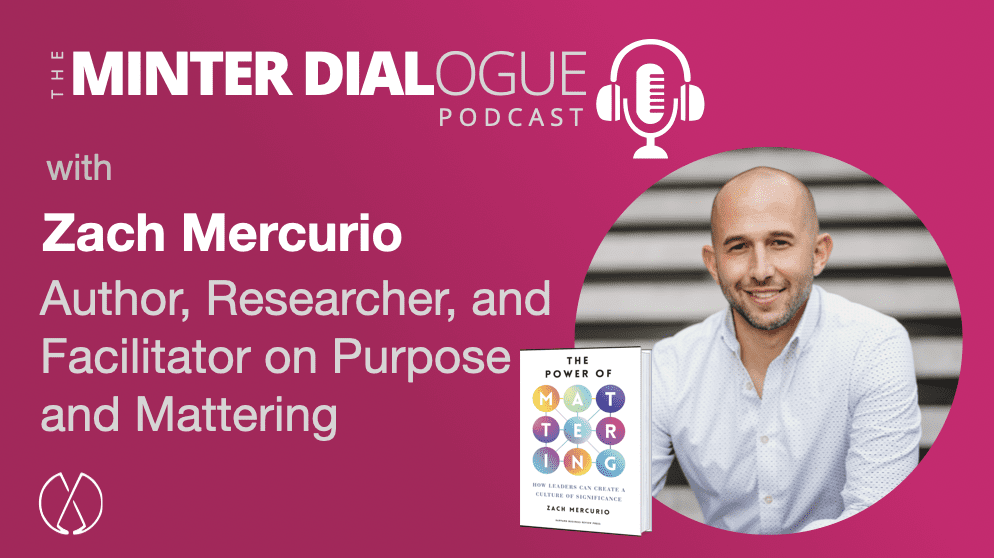
Minter Dialogue with Zach Mercurio
Zach Mercurio is an author, researcher, and facilitator, perhaps most recognisably known for his focus on the core human need to matter. Dad first (as he puts it), Zach’s work spans coaching leaders, working with organisations, and parenting—always centering on the idea that everyone has a unique significance waiting to be revealed. In this episode, we dig deep into both the philosophy and the practicalities of nurturing mattering, whether with our own children, in the workplace, or as individuals navigating today’s hyperconnected-yet-lonely world.
Our conversation explores the importance of being understood versus being controlled, the nuanced dangers of “false mattering” (think participation trophies), and why creating a secure base—a sort of relational or “psychological insurance”—is foundational for resilience and thriving. Zach shares how our need to feel valuable and capable cannot be satisfied by empty praise or top-down leadership directives: instead, it’s built and rebuilt in the quality of our everyday interactions.
We also discuss the crisis of meaning in our times, fuelled by both a lack of mattering in relationships and digital shortcuts that erode the everyday social skills needed for real connection. Through stories of parenting, research with essential workers, and the hard learnings of leadership, Zach makes a compelling case for re-centering human significance in our thinking about engagement, confidence, and sustainable organisational success.
Key Points:
- From Compliance to Commitment: Genuine agency and significance come not from demanding obedience, but from ensuring others (our kids, colleagues, teams) feel seen, heard, and understood. This builds lasting commitment rather than fleeting compliance and protects against burnout, disengagement, and narcissism.
- False Mattering vs. Real Mattering: The difference between inflating self-worth via unearned praise (like participation trophies) and fostering true agency is profound. True mattering involves giving people responsibility, voice, and the support to take meaningful action—rather than just soothing or sheltering them from failure.
- Mattering as the “Meta Need”: Before people can contribute, find purpose, or chase lofty whys, they need to feel that they themselves matter. This underpins everything from self-efficacy to organisational engagement, and it’s something leaders must intentionally cultivate through regular, high-quality human interaction—not just perks or pay increases.
To connect with Zach Mercurio:
- Check out Zach’s eponymous site here
- Find/buy Zach Mercurio’s book, “The Power of Mattering,” here
- Find/follow Zach Mercurio on LinkedIn
- Download Zach’s 25 Essential Leadership Skills for Mattering (it’s free)
Further resources for the Minter Dialogue podcast:

Meanwhile, you can find my other interviews on the Minter Dialogue Show in this podcast tab, on my Youtube Channel, on Megaphone or via Apple Podcasts. If you like the show, please go over to rate this podcast via RateThisPodcast! And for the francophones reading this, if you want to get more podcasts, you can also find my radio show en français over at: MinterDial.fr, on MegaphoneFR or in iTunes. And if you’ve ever come across padel, please check out my Joy of Padel podcast, too!
Music credit: The jingle at the beginning of the show is courtesy of my friend, Pierre Journel, author of the Guitar Channel. And, the new sign-off music is “A Convinced Man,” a song I co-wrote and recorded with Stephanie Singer back in the late 1980s (please excuse the quality of the sound!).
Full transcript via Castmagic.io
Transcription courtesy of Castmagic.io, an AI full-service for podcasters
Minter Dial: Zach Mercurio. First of all, it’s a freaking great name. I mean, surely Google loves you with that name. But as I like to start off Zach, and we start off always with a little, a little easy question, who is Zach?
Zach Mercurio: Zach is dad number one. I have an 11-year-old and an 8-year-old. So, I’m trying to create a pathway for several unique humans to live their lives. I think that that’s very important. And I really see myself as a revealer to others. I think I help reveal and illuminate in others what they may not see in themselves. One of my roles I see is to help people realize their own significance. That’s feel. I feel like that’s what I’ve been called to do. And I do that through a lot of different roles, like researcher, parenting, facilitator, coach for leaders, if you want to call it a coach, writer. But I really see my role, my purpose is facilitating people in revealing their own significance back to themselves.
Minter Dial: All right, well, let’s start off with this piece because I’m a dad as well and a husband and such and leader of the wise. How difficult or different is it doing with your own kids in situ as opposed to telling others how to do it with others?
Zach Mercurio: Incredibly difficult. But I would say that actually I’m able to learn more about these concepts with kids, which I’m so lucky to have that experience that I then apply elsewhere. I mean, I think parenting is leadership and leadership is parenting in many ways. And I think the consequences for a developing mind are even more stark. So, you can see, you know, what happens when a child feels that they don’t have any real responsibility. When an 11-year-old feels that they, they don’t have really anything to offer yet, when they’ve been told by society, you need to put in your time or, you know, not yet, you’re just an 11-year-old. You see what happens with people with, with a child in that way. So, I think it complements. But I will say I teach what I need to hear the most. So, I, I think that we gravitate towards ideas and, and research and concepts that we most need. I mean this is what I’ve learned about people who are doing really deep work. Um, and so I’m constantly learning through them.
Minter Dial: So, we, I mean we live in this crazy world with Internet everywhere, mobile phones everywhere, much less children per family. And in, in general there’s a. Now if I take a, a story which would be family sits down and the one child or the two children come and, and one says, oh, well, I don’t want to eat the what you served me at dinner. So, there’s multiple possibilities. One of them is, what do you eat? Well, I cooked you because, you know, that’s what it is. Oh, well, you don’t love me. I don’t matter enough for you to make what I want to have. And I think in this story you can sort of pick up the, the nuance of spoiled versus, you know, just deal with it. Stiff upper lip versus, you know, I need to matter more than anybody else and I’m more significant than anybody else, which then has repercussions in the way I go out into the world. Do I want them to be I matter more than anybody else, or should I be of service to, to the group? How do you, how do you untangle that little one?
Zach Mercurio: Yeah, I’ll give an example. I think there’s a, I think there’s a between as an example in between, you know, and I, I talk about this often. My kid likes watching his tablet, right? You know, screen, and I don’t want him to watch his screen. But the conversation typically goes like this, where he’s like, time’s up and I say, get off your tablet. I don’t want him, blah, blah, blah, blah, blah, get off. You know, shut it off, you know, because I told you to. I’m in power, right? And, oh, whining, complaining, whatever. I’ve learned through my research about the importance of feeling understood and not controlled. Someone who is controlled will almost always act out in desperation for control at some point in their lives. So, this idea, just eat your meal and I don’t care what you say or I don’t care about. Your experience will manifest itself somewhere down the line in an act of desperation, possibly bullying behavior of exerting control over another, because you never have control. But what I’ve learned is to seek understanding and make sure people feel understood, including my kids. So, one of the things I did as reading some work on helping people feel seen is I was in the kitchen and the tablets know tablet time’s up. And instead of saying, get off the tablet, I went and sat next to him. I said, hey, what are you watching it? It was like shocked started telling me. I said, oh, what do, what do you like about it? What do you like about the characters? Started talking about it. I started telling him shows that I used to watch. Guess, guess what happened to his tablet started shutting off, right? What I wasn’t doing is I wasn’t trying to get compliance. I was Trying to get commitment. Compliance is when someone does something because you want them to do it. Commitment is when someone does something because they want to do it, because they see the intrinsic reward in doing it. And I think that the way children are raised from just eat what I put in front of you, that usually those perpetual experiences of unmet mattering, that’s unmet mattering, that my opinion doesn’t matter, my voice doesn’t matter, it doesn’t matter. Those things are predictive of narcissism. The narcissism, for example, is the result of the perpetual unmet need to matter mostly in childhood. So, hey, look, society, I matter more than you think because I couldn’t even have a say in what I had to eat as a child. So, I think there’s a middle ground and it’s understanding. It’s seeking understanding before you seek to control, allowing someone to have a voice. Well, tell me what you don’t like about this. If you were to make this meal, I mean, we’re going to eat this meal together, but if you were to make this meal with mom or dad, how would you, how would you make it? How would you prepare it? Giving someone agency. That’s the main ground.
Minter Dial: Fair. I like the way you do that. You of course talk about that in your book and I remember your talking. Is it you who narrated the book? I can’t remember.
Zach Mercurio: I didn’t. No, you did not.
Minter Dial: Yeah, but I mean, you spoke in your voice at least, you know, I. So, I was remembering that particular story. But the idea, of course, at the end of the day, I mean, you talk about the narcissism and I’ve written a lot about empathy and probably a work that I need to do in Deeply in me to your point. But what I heard, or I’m not a psycho neuroscientist or any sort like this, but what I’ve heard is, is narcissism are people who lacked mattering before, if we choose your term, therefore need to be mattered more as it goes on. And then the empath, so that’s a pathology of everything, is someone who. What I heard from some researchers is that it can be a manifestation of someone who doesn’t know how to feel feelings and therefore goes and watches other person’s feelings and leans into those feelings and then adopts those feelings as opposed to having their own feelings. So, you know the different pathologies created out of a younger experience.
Zach Mercurio: Yeah, I mean, in response, like, I felt so misunderstood that I deeply need to understand and feel everything I mean that’s another, I think, double edged sword as well. Compensating, right, compensating. But I do think that, you know, you know, you and I talked about entitlement a little bit before we jumped on today, right? Entitlement is a reaction, it’s a response behavior of I matter more than you think. And it’s usually the result of perpetual experiences of anti mattering again. So, one of the things, Robert Emmons, he’s a psychologist, he studies gratitude. There’s people that tell him and he tells the story all the time. There’s like a boss in an organization, I’ll tell him, well, I’m not going to show gratitude for my people because they will start to believe they’re entitled. Like I don’t want to show too much gratitude because then they’ll, they’ll get an ego and they’ll think that oh, I should always just get thanked for everything. And so, he did a bunch of research studies on this and looked at the result of getting regular meaningful gratitude from somebody, you know, being seen, being heard, being, having your gifts named and your impact validated. And he was looking at its effect on things like behaviors of entitlement or envy or jealousy or some of these other things. And what he found is that actually the more the people who got more consistent meaningful gratitude exhibited less entitlement behavior over time. People won’t need a participation trophy to give them worth if they already felt worthy in their family’s communities and workplaces.
Minter Dial: There’s a, in what you say a sort of a systemic issue because if we feel that we need to say well done for coming 17th out of 17, then the issue is already before that.
Zach Mercurio: I think you and I are actually, we’re talking about, there’s something else we’re talking about and almost it’s like false mattering. And the false mattering is that is the participation trophy for coming in 17th out of 17th. The real mattering is, hey, like you have agency over making a change in this if you want, and I’m here to support you, right? The false mattering is saying, oh, like I’m going to go talk to your teacher because you got a bad grade and I’m going to fix it for you. You matter that much to me. The real mattering is, hey, what, what can we do? What can we do? Why don’t we talk to some other students in your class who are getting better grades? Why don’t you see what they do? See if you can learn something. You have agency, you matter. So, I’m talking about that mattering.
Minter Dial: Yeah, sure, of course. And I mean the idea here is moving from being the victim to the agent, the person who is going to take control of things.
Zach Mercurio: Absolutely. Well said. Yeah. The passive recipient of the world around them versus the active constructor of the world around them. But there’s two beliefs we need to be active constructors like self-esteem, the belief that I’m worthy, and self-efficacy, the belief that I’m capable. Unfortunately, or fortunately, you don’t just sit in your room by yourself and build self-esteem or build self-efficacy. You can’t go tell a kid, just go be confident. The confidence doesn’t come from us trying to be confident, pull ourselves up by our bootstraps. Confidence comes when we know someone has our back, when we know we matter enough to another person that what we do or don’t do, whether we fail or succeed, that sense of mattering, that instinct to matter is not threatened. And so, like when we look at the predictors of self-esteem and self-efficacy, two predictors, that of the most significant predictions are verbal reinforcement from others that reflected appraisal that shows us the evidence that we’re worthy and that we’re capable. And I feel that that is what those relationships that give us that real evidence, not inflated evidence. I mean, real evidence that, that you’re, you’re significant, you’re worthy, you’re capable through quality interactions. That’s what’s, that’s what’s missing. And so, we have a lot of people who don’t have the confidence or the support system. They need to consistently add value or engage in the ways that we want them to or take action.
Minter Dial: I want to get back to that in, in another moment. And you brought up this idea of confidence. It also strikes me from my experience, Zach, that confidence also doesn’t come from necessarily someone else recognizing it, but from knowing that I can get up from misery and failure. So, going back to the idea of entitlement, there’s some study, I don’t have the details of it, but that said that the likelihood of success, who someone who graduates from an IVD school is generally less an indicator or a big MBA less an indicator of success than someone who dropped out. Failed was put down, comes from a lower category of society. And that resilience is also a strong indicator of success. I don’t know if confidence is a fair term to drop into that. But in any event, the idea I feel is if I’d gone through shit, and especially if I’ve gone through shit with a team for example, a rugby team where we lost two people injured, taken off the pitch in miserable conditions, but then we pick ourselves up and we win the next match. That type of transition for me and you could take the same with, you know, brothers and arms, you know, on a wharf, you know, field. That type of confidence is a very deep confidence, but I don’t know if it’s a, it’s a healthy one.
Zach Mercurio: So, what I love about you says I’ve gone through shit with other people that social support. I mean if you look at all the meta analytics studies on what predicts resilience, one of the most common variables is social support. So, you have that secure base. I mean when we look, when we look at thriving like an individual thrives. I mean you could probably summarize the research on thriving or flourishing in one line and that’s able to explore from a secure base like are able to explore the world experiment, create relationships from a secure base. One of the things, one of the studies that, that I really liked was from the Special Forces Special Forces selection course here in the United States. It’s, it’s a historically rigorous, almost torturous ordeal that people have to go through to become Special forces officers. And it’s just the assessment, you’re not even in the Special Forces yet. It’s an assessment of course and the dropout rate is ridiculous. But researchers at entity that looks at the psychology and the behavior of people in the armed forces, they did a study and they wanted to know who, who surmounted and who succumbed. So, they measured them on all these psychological attributes. Well, the only one that statistically predicted whether someone was going to persist through that course or not persist was self efficacy. The belief that I’m capable. It wasn’t actually like mental fortitude, it wasn’t physical prowess. It was the belief, a self-belief that I’m capable. And what was interesting is they actually had thrown in a measure of mattering to other people. And though so mattering to other people, I feel I have someone who shows me attention. I have someone who believes in my worth. I have someone who reminds me that I’m needed. Um, the, from the general mattering scale and interestingly enough those who had the high level of self-efficacy that persisted were also the ones that had high levels of mattering. It was very hard to have high levels of self-efficacy and persist in that study if you did not have high levels of perceived mattering to other people. So, I think it’s interesting to think about this as I love your like you’re out, you’re out on this podcast rugby pitch and you’re, you’re going through it, but you have somebody to. You have somebody that supports you, believes in you. They, they know you belong on that team. They treat you as if you belong on that team. They treat you as if you’re needed on that team. You know, it’s that old notion that, you know, it’s an American football where just do your job, you know, focus on doing your job for the good of everybody else. I mean that secure base is so important. I feel like today many people don’t have a secure base. That’s the premise of my work, is that secure base is crumbling in workplaces, in society, in family life and community life. And therefore, we’re seeing apathy, narcissism, low resilience, coddling to try to put a band aid over the lack of secure base instead of showing up for others in a different way.
Minter Dial: Well, first thought I had is a rugby pitch, 15 people on a pitch. Then you could have individual sports, but even an individual sport you’re playing, let’s say a singles tennis game, you have sometimes a coach on the side, you might have your parents in the stands, you might have some fans screaming for you. So, inevitably no one is an island in that respect. And the second thought was the idea of a secure base. When you talked about going be an adventure in the world, I, I just wonder whether the massive adventures, Magellan and, and those folks back in 15th, 16th century, 17th century, whether the fact that insurance wasn’t also part of the secure base because that’s when, that’s when insurance as a concept came to fruition, which allowed for the ability for the risk to be tolerable at some level for the adventure. Anyway, that’s sort of. That was my little poem.
Zach Mercurio: No, it’s very fascinating. I mean I, I think this concept of psychological safety in the workplace, right, We’ve heard a lot about that key for innovation, right. People try to pursue innovation, but what they should really be pursuing is creating a secure base, creating insurance, social insurance, relational insurance, against the risks of going out and trying, failing, experimenting. So, you have that love this idea of insurance. I think psychological safety is really relational insurance. I think like creating mattering is relational insurance. So, it’s brilliant that you brought that up.
Minter Dial: I don’t remember you saying that in the book, but I’m very happy to have heard that. It’s very exciting.
Zach Mercurio: That’s the first time I said that. Oh, beautiful, right now because of that you’re, you’re the Magellan point, I mean, I think that, that, that concept of insurance, relational insurance, I mean, that’s what we’re talking about when we talk about that secure base.
Minter Dial: So, have you, have you ever delved Zach into John Vervake’s work?
Zach Mercurio: I have not, no.
Minter Dial: Right. Well, I, I. So, he, he’s written a book called the Crisis of Meaning. He’s a psychologist. I’m a teacher at, in the University of Toronto. I highly recommend all the. I had an interview with him. The. His books are fascinating. His whole spiel is fascinating. So, he focuses on, and I’ve been really, on this mantra as well about this crisis of meaning. At some level, there’s a, there’s a definite link with Simon Sinek’s work on, on why? Because he talks about the crisis of meaning. Why. Which is what? You know, what does it mean? Why does. What is this all happening? And, and he think he relates that to the, the crisis, the mental health crises we have. And I was wondering, in your mind, Sack, if you just without really knowing, obviously Verve’s work, does crisis of meaning for you? Are we in a crisis of mattering, therefore? And is that the same thing in your mind?
Zach Mercurio: Well, I mean, it depends on what he means by meaning. I mean, meaning is just the sense we make of something. So, like, I think it’s important to acknowledge terms. So, if I’m walking on a, on a seashore, meaning is being able to pick up a shell and sense it like, this is a shell. I can, I can have coherence in this because I’ve felt it, I’ve heard about it before. That’s, that’s meaningful. Meaningfulness is knowing that that shell is significant in some way. It reminds me of a vacation I took with my kids. And so, now that experience, that shell is meaningful, meaningless is when the sense that you make of something doesn’t even matter. It’s like there’s no, there’s no resonance with you. So, I think people are making sense of things. I don’t think we have a crisis of meaning. I think we have a crisis of meaningfulness. The sense that they’re making of things in themselves isn’t significant anymore, which ties back to this experience of mattering or not mattering. And so, I believe that you can’t have meaningfulness without mattering. I think mattering is the meta need. It’s the, it’s the meta instinct that we need to have met before we can even make meaning of something as meaningful. I. Look, my work is in work. And so, like can something that you do be significant if you don’t believe that you, the instrument of doing it is significant?
Minter Dial: Well, just back to your football, American football and do your job. So, you are a big goon on a line and you have to mark this chap and, and you, you can get that, that there’s a sort of. That’s your assignment. But your assignment will have more importance on certain run plays and certain pass plays. If you know, let’s say you, you’re a right God or something like that. I don’t know what the positions are, but you, you, you were on the right side and the play is going to go to the left. There’s we, you, your role matters, but just a little bit less because you know you’re going on the other side. And sometimes you know, the, the need to explain why your role matters or find meaning in what I’m blocking at this point as a guard, I don’t even know if they’re offensive or defensive.
Zach Mercurio: But yeah, yeah, yeah, yeah.
Minter Dial: I get very confused in a magnifiable. But this idea of your role having meaning meaningfulness is just a sort of the owning of that meaning.
Zach Mercurio: You know, seeing the significance of what you’re making sense of. I feel that people, I feel what we’re seeing today is that people are not feeling significant as much anymore. And I think the crisis of meaning, the crisis of meaning, the crisis of experienced meaningfulness is what I would call it though that wouldn’t be a good title for a book. But the crisis of experience meaningfulness I think is directly tied to the crisis of mattering which is a crisis of depleted interpersonal interact important to other people. And, and a couple of reasons why, I mean one, we don’t really realize what’s happened but over the. Since 1993, I think December of 1993, humans sent their first text message. I think it was like a Merry Christmas text some engineers sent to another engineer. And yeah, since then, right, we have been over reliant on short digital transactions to communicate with one another. And you know the social psychologist Jonathan Haidt, others would say, well the solution was we have to put down our phones to reconnect. But I would say the solution is not to put out down our phones. The solution is in what people know how to do when they put down their phones. And what’s happened is one of the ways we learn the skills to see, hear, value and show others that they’re needed by us is we learn it through social repetitions. And every time we’ve gotten out of a social repetition, for example, to understand another person. So, so you give me some bad news, I send you a sad faced emoji now and say sorry to hear that and I don’t have to sit with you. Seek understanding, show compassion, develop empathy. Every time I get out of that social repetition, the skill to do it decays. It’s called skill decay in psychology. So, think about the amount of social repetitions that would have ordinarily, historically helped us develop these skills to see here, value, need other people, how depleted they are now at a large scale. And no, nobody’s really talking about this, this major skills shortage that we’re seeing, which is actually this, these human skills. And what’s happened is that’s, that’s resulted in. You know, I was at the airport a couple weeks ago and I just, I observed people around me and I was at this coffee shop. There were two people, I think it looked like they were in a romantic relationship. It looked like they were on a date or going somewhere together.
Minter Dial: You’re making fast. Generally.
Zach Mercurio: I am, I am. But there was a lot of leaning forward, watch out, gazing in eyes. Right. But they were on their phones most of the time. Okay. But I think they collectively realized it and they put down their phones, but then they didn’t say anything. I mean they were doing it forgotten. And I, I don’t think it’s, I think it’s because we forgot how. So, I think we’re going to tie this together.
Minter Dial: Let’s.
Zach Mercurio: Generation Z growing up more connected than ever, but lonelier than ever. We are, you know, at work, we’re on more platforms than ever. The average US adult sends 40 text-based messages to colleagues, peers, leaders, each other a day. I mean, that is a ridiculous frequency of connection. We’re more connected than ever. But 8 out of 10 people say they feel isolated at least once every week. We’re more lonely than ever, more disengaged than ever. So, we’ve eroded these quality of interactions and relationships in our lives, which has eroded this sense of, of feeling significant to others around us. And that’s resulted in a whole bunch of fragmentation, a whole bunch of division, a whole bunch of let me find my people who will make me feel significant. And I feel that’s what’s eroding this, this sense of meaning is that sense of mattering to the people around you.
Minter Dial: Just to be sure to credit John Verveki, he talks a lot about mattering as well. There’s, there’s no doubt that that’s part of his, of his Spiel and this idea that we lose the muscle, I call it a muscle where the empathy in particular, if you don’t practice it, you can, it can shrivel and decay like you, to use your word. And so, I, I feel like people talk about it, at least in my universe, people talk about empathy. People, yeah, yeah, that’s a great idea, it’s really important. But they don’t then allocate the matter that it is the, the I, you know, in French I, I have, I talk in French and I do speeches in French and, and I talk about I don’t have time and in French I don’t have time. Je n’ai pas de temps. I do not have time. But actually what I like to pull out of that is le pas de temps is the pace of time, which is a play on words. Pas there usually means not, I don’t have time, but also there can be also the same pas can mean pace of time. And in today’s world, for a lot of this, the idea of sitting with your 11-year-old son and asking him what was on happening on his iPad or talking to the right guard about why this role even though he’s not the place going to the left, why it’s important we have to allocate time strategically to do the listening for empathy, to lean in to create the significance of mattering. And so, while a lot of people talk about it, I think not only have we forgotten how, we don’t know why even we’re lost. And that is what John is talking about. We’re lost and we don’t know. We don’t have a compass. We’re just do, do, do. My time is, I have a shorter day than anybody else really. And you know, like historically this is the shortest day ever really. You know, I think humans have been around for a while and 24 hours has basically been the day’s length, quite a while, but we’ve created this narrative that’s lost our ability to allocate the time to do the mattering, to lean into people and be present with them as opposed to it’s all about me.
Zach Mercurio: And you know, I think this relates well to the meaning piece because meaning, meaningfulness is crafted. It’s made. It’s made and it, who, who is it made with? It’s made through interactions. I’m more of a constructionist, so I believe we become who we are with others. You know, it’s, it’s hard to have a sense of self right with, without others. But I think that, that, that’s, that relation to that crisis of meaning. Because meaning is crafted and we’re, we’re not in these relationships in which we’re crafting meaning. Like, for example, there’s a Scottish theologian who has a line that says a river source knows nothing of where it leads. Right. So, like we talk about a crisis of meaning or purpose. I, as the source of the river, I don’t know where my behaviors, actions, inputs go unless someone reveals it back to me, unless the receiver reveals it back to me. And that when we’re not revealing each other’s impact back to each other, when we’re not affirming one another, when we’re not taking the time to see and notice someone’s unique value in our lives, in our world, and reflect that back to them, then you’re the source of the river without knowing where it leads. And that’s where we become, we, we’re left adrift and we’re left with that, that gap.
Minter Dial: So, many leaders, of course, are at the top of a mountain. They, they’re visible, they’re seen by men. You know, many people see them, the CEO at the top. But it’s very difficult for them to get to, to know what’s happening downstream. I want to, I mean, because this typically is a business podcast and, and I think everything is totally relevant. Oh yeah, completely in, in anime. Of course it is. And when, when you look at the issue where we’re trying to rewire people, so let’s say you’re talking to a 60-year-old, looks like me because I’m only 61, you know, have had certain success, career and I’ve just done this this way and it’s been successful the whole time. And if you, if you imagine that, well, there’s some people that, that have higher value than others in a, in a, in a, in an enterprise. That’s reality. You know, like a guy knows how to code faster, better, quicker has higher value than the, the intern that’s just come in. You know, that’s not politically correct, but that’s also the reality. But how do you.
Zach Mercurio: Depends how you’re defining value.
Minter Dial: That’s true. But I mean, let’s start with the salary, you know, and sure, I would say that’s compensation.
Zach Mercurio: Compensate means just to make up for. So, you’re making up for lost time for somebody when you pay them.
Minter Dial: Right, well, that’s fair. All right, so they’re reframing stuff, Zach. Appreciate that. But anyway. Well, the point here is how do you get hard nose executives to lean into this topic of mattering what it was like the, the unlocking argument that gets into.
Zach Mercurio: Well, I mean, think about, I would ask, I would ask you to think about not you, but if you’re that executive, to think about a one financial metric that is not mediated through how a person feels.
Minter Dial: So, satisfaction, that would be a feeling?
Zach Mercurio: Yeah, well, like, well, well, feeling a motivated, committed, feeling engaged. I mean, so what financial indicator is not made it through how at some point along the line person feels and it’s very hard to name one. I’ve, I’ve talked to many people who are skeptical of this.
Minter Dial: Profit is one.
Zach Mercurio: Well, profit is a lagging indicator of human energy. You know, like there’s no, that’s a.
Minter Dial: Reframing of, of, of profit. I mean, because at the end of the day, if you’re not profitable, you serve no purpose. So.
Zach Mercurio: Well, but what, what, what indicator that results in profit is not mediated through a person in a human organization?
Minter Dial: Well, I, I, I, I, I leave myself to AI and the mechanization of everything. Sure, but I mean, so impersonalized. I understand where you’re going, Zach.
Zach Mercurio: Yeah.
Minter Dial: So, I’m not going to be argumentative for the sake of being, arguing.
Zach Mercurio: No, you can, you can. I like this because, because profit, productivity, these are all lagging indicators of human energy. I mean, there’s no, none of those lagging indicators that exist without human energy if you’re a human organization. And even with AI, I mean, AI can take response every AI can do tasks. It can’ possibility for them. No, AI can’t care for people. It can’t trust, build trusting relationships. So, AI can’t love a person. It can, it can, it can imitate.
Minter Dial: Well, someone can feel loved by an.
Zach Mercurio: Right, but it can’t, it can’t care for you and it can’t take moral responsibility for you. We know that. So, so there’s limitations there. But that’s another conversation. But, so, so then, then you ask. Then I ask the executive, okay, what’s the ideal state of a human being? Who is producing those profit producing the performing, producing these indicators? I mean, I can ask you like what’s, or I won’t ask you, but I won’t do the rhetorical thing. But what’s the ideal state of a person? And what, what will they say? Well, they say they’re motivated. Will they care? They are engaged. They get where we’re trying to go. Oh, okay, so now, now we’re speaking the same language. So, you’re talking about feeling that they’re adding value, knowing their bigger purpose. They Feel motivated. And then I would ask them, tell me the last time you were motivated or energized to do something when you felt that you were, it didn’t matter. It’s almost impossible. So, then I, then I say, okay, with what rigor are you approaching the leading indicators of regenerating the human energy needed to accomplish the things you say you want to accomplish? With what rigor are you approaching those things versus just trying to approach getting profit, getting innovation, getting all these lagging indicators. And often there’s a mismatch, like we leave the human energy thing up to chance, or we’ll just hire good people, or we’ll do the right thing, or expect people to just care without feeling cared for. But that’s where there’s a gap. I think that we’ve depleted the human energy needed to continuously produce. And I think we’ve expected people to care for so long without doing the rigorous work to make sure they feel cared for. I mean, that’s why disengagement hasn’t moved in the last people are more disengaged than ever. Despite perks, pay increases, on average of 42% across industries. That’s pretty good. Well-being programs, benefits, you know, nothing’s really moved the needle on engagement. And then you look deeper into that Data and just 39% of people say that someone cares for them as a person at work. Just 30% say their unique potential is validated by people at work. So, human energy is the leading indicator of every lagging indicator you want. And we tend to approach regenerating that human energy with less rigor than we do pursuing the lagging indicators of profit, innovation, product, all those things. That’s my view.
Minter Dial: I like that. And of course, I mean, we are all energy after all. I think Mr. Einstein said accurately with Simon Sinek, he, he’s the guy who says, you know, it’s all about what, why you do stuff. So, we don’t buy the what you do, we buy why you do this stuff. It seems that for you, mattering is meta and maybe even above the why. Do you think that that’s just an evolution of Simon’s thinking, or would you consider it a gentle challenge to his thinking?
Zach Mercurio: I think it comes before Simon’s thinking. One of the questions that I, because I work with Simon, I got to teach a class with him on mattering and one of the questions I repeatedly asked was if, if why is your contribution, can you believe in your contribution or find your contribution, Find your why. If you don’t first believe you’re worthy of contributing. But can you use your strengths that make an impact if you don’t believe you have them?
Minter Dial: Well, sometimes if you contribute without knowing that you have the ability, then you have the experience of mattering through the effort that you put in without previously knowing that you mattered. You do need to, I mean, like the idea of someone, I have to matter to somebody else and then it’s going to all happen. I feel at times you also just need to do shit. And, and, and I mean, maybe this is the crass idea, but there are many people who just are motivated or, or, and I think unhappily so by just doing stuff. They nine to five, stamp in, stamp out. And, and you talk to them about why and mattering. It’s like talking to the wall. They’re just, it’s just not their language. And especially as you go down in Maslow’s world, he’s, you know, people who are suffering in, in far more unprivileged environments. I mean, when I was doing some work in India and, and talking to people who are, you know, earning a buck 50 a day and that was a good pay, you know, talking to them about mattering and why, whoa, you know, I need some rice on my plate, dude.
Zach Mercurio: It’s interesting because I, I, I don’t even subscribe to Maslow because there’s no like, empirical validation of it. And Maslow, Maslow never, never wanted it to be a pyramid because someone can be what they basically need and inherently desire at the same time. One of the things that I noticed in my study with like, janitors, we embedded ourselves with a group of cleaners for a year and a half.
Minter Dial: None of that famous NASA guy that says, you know, well, yeah, in the toilet to make people go to the.
Zach Mercurio: None of, none of those cleaners said that they wanted to be a janitor. Like, when they did that, that was their goal in life. In fact, many of them wish they could have been done something more with their life. But there’s two types of people. There was people who were thriving in that role that we, we interviewed and we worked with. And there’s people that were just succumbing to the, this is just a job. Clock in and clock out. They both were facing the objective socioeconomic pressures as each other. It was very difficult job. But those who were thriving tended to have two things in common. One, they were able to develop a purposeful approach to the work. So, you know, they developed, you know, what we’ve come to call a. So, that mentality, like I crafted, they’re crafting. Ye crafted. They were able to do that, but they also had regular interactions in with particularly particular supervisor which never let them forget that that’s why they were there. And this is very important. I think that there’s the meaning of work, which is to earn a. Could be to earn a paycheck for someone, but then there’s the meaning in work, what they experience when they’re there. And people that tend to, to thrive in their work. From what I’ve seen, even people who are surviving tend to have people around them that reveal to them the meaning in their work regularly and invest in them regularly. The meaning in works, what they’re experiencing when they’re there. Someone can just work for a paycheck, just work to survive, just be putting food on the table and at the same time want to experience all of the things every human being is born wanting to experience. Purpose, meaning, quality, relationships while they’re there. And I think this is one of the things we’ve gotten wrong as we say, oh, this person’s just here for a paycheck. They’re not just here for a paycheck, they’re here. They’re spending one third of their one waking life here. And you’re responsible for how they make meaning here. So, I do think, and there’s this great conceptualization of flipping Maslow on its head. For example, the path up to self-actualization is completely reliant on others. This is the ironic thing about Maslow. You don’t cultivate your own belonging, you don’t cultivate your own love, you don’t cultivate your own safety, you don’t cultivate your own shelter. Someone else probably had to build it for you, build the infrastructure for you. So, we’ve gotten this whole thing as a society wrong that you actualize yourself that we’re all self-starters, we’re not. We actualize one another completely and utterly dependent on others. So, even though people say, oh, I just do this myself or I pull myself up or I just take action or I just do it or get it together and just do it, likely they have a lot of forces that a lot of infrastructure that has been developed and paved by others, they’re just not acknowledging it that enable them to do that. And you have to matter enough to others to have that infrastructure. That’s my just.
Minter Dial: I love it. Zach, to finish before we tell people to run and get your book or find more of your work. Someone who’s listening, has listened all the way through and runs a Team what, what’s the first advice or the first thing they should do tomorrow morning or the, the next day? I could start them on a path of more mattering and being a better leader.
Zach Mercurio: I think you can ask your people, when you feel that you matter to me, what am I doing? When you feel that you matter here, what is happening? Because I can tell you all day long what our research says, right? So, yes, most everybody, I think, wants to feel noticed, seen and heard, wants to feel affirmed, wants to feel like they have some unique talent or unique gift that is.
Minter Dial: And if they don’t, that’s another pathology, right?
Zach Mercurio: Perhaps we should. That’s a great thought experiment. We should talk about that next. And then they. Most people want to feel needed that, that’s that their presence and absence means something to somebody. But how they feel, those things may be different in different cultures, different contexts, different industries, different environments. So, ask your people when you feel that you matter to hear what are we doing? And you’re going to learn a lot of different things and write those things down because that’s really important. Because when people feel valued in the ways that they want to feel valued, they add value, right? And when they add value, just as you said, they see the evidence of their adding value, which helps them believe that they are valued. And that cycle, that upward spiral continues. I also say you can ask yourself an evaluative question every day. You know, what are we doing? Three questions, three reflection questions every month. Say one, who, who am I under noticing? Who don’t I check in on? Who don’t I take the time, as you said, to really see or hear. The second question is who needs to be shown how they add value?
Minter Dial: Who.
Zach Mercurio: Who may be 3, 4, 5 steps removed from that end outcome that I care so deeply about and that the organization cares about. But they may not see it. But I see it because like you said, I’m on the mountaintop as a leader. I can see the topography. I can see where the river goes and reveal that back to the source. And then finally, who do I rely on? And when’s the last time I’ve explicitly told them. And oftentimes you’ll see a gap there. And who can I remind? Hey, so.
Minter Dial: Thank you.
Zach Mercurio: Yeah. Hey, if it wasn’t for you, you know, this company, this team, my life would not be what it is. And I just want you to know that.
Minter Dial: Well, that third one gets to the idea that certain people have more value than others in reality, because I, I don’t think. Yes, sure, playing field in this regard, but I don’t think so.
Zach Mercurio: But contextually, I think in, at, in, within, in. Viktor Frankl talks about this in his book yes to Life. Contextually, within your circle, you have irreplaceable value. It just depends on how big your circle gets.
Minter Dial: Sure.
Zach Mercurio: So, some people may have a bigger circle. Their, their circle may expand outward and touch more people. But I don’t think that means they matter more or they matter less. I just think they matter to a different, different scale of people, more stakeholders, shareholders, whatever. But I think everybody is equally irreplaceable, equally unique within their circle.
Minter Dial: Well, this lovely optimistic ending, Zach. Beautiful. How can someone get your books, read more about what you research, hire you to come and speak to them and inspire them for better leadership?
Zach Mercurio: Well, you can go to ZachMercurio.com/mattering and there’s a, there’s a PDF there. I don’t need your email or anything. Just click it, Download it. It’s 2025 skills that we’ve uncovered that help people feel that true. Not the faults mattering, that true sense of significance being seen, heard, valued and needed. And then there’s also a self-assessment there that again you can just download, take use and there’s a whole bunch of other resources. So, explore that and if you’re into that stuff, then use your rare precious time to read the book if you’d like.
Minter Dial: Yeah, well, it was a pleasure for me. I, I did it through audiobook I’m afraid. As I told you before, I read about a book a week and the only way I can do that is by having multiple books going on in different formats according to my time and how I like. That’s how I do it. Anyway, Zach, many thanks for your time. Time is precious. Your words are gorgeous and seems like you’re onto a massively important work in our society and I, I would highly, hopefully get you and, and John Vervecki to connect one day. He, he hangs out with Jordan Peterson.
Zach Mercurio: Yes. Yes. I really want to check out his work. So, thanks for introducing me to that.
Minter Dial: Hey Zach, been a pleasure. Thank you. I will let you know how this goes out. Thanks.