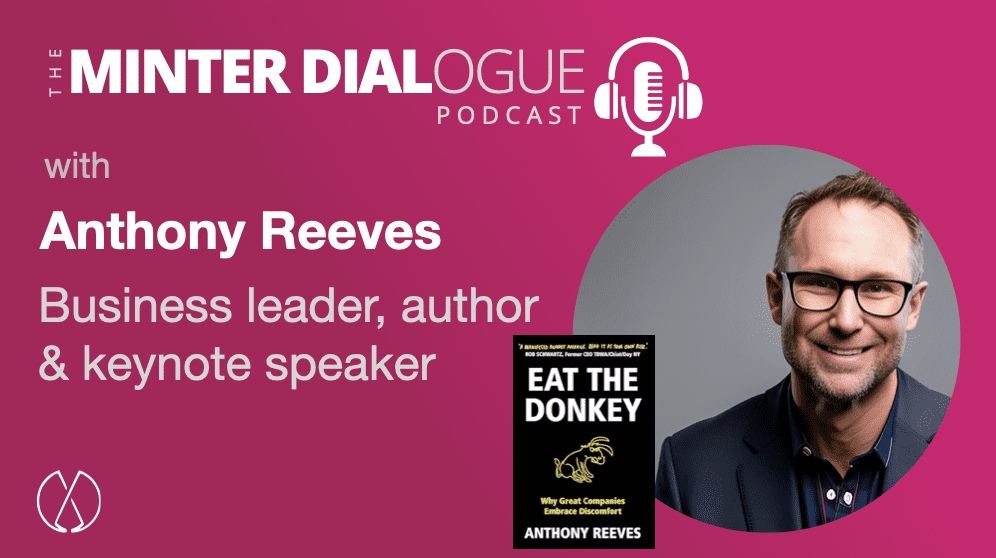
Minter Dialogue with Anthony Reeves
Anthony Reeves is a seasoned creative leader whose journey spans from the rugged Australian Outback to some of the world’s most competitive boardrooms. Currently at Kohler, Anthony has also made his mark at global giants such as Amazon and WPP, shaping legendary brands and teams along the way. In our conversation, I delved into his new book, Eat the Donkey, which draws on the hard-earned lessons of perseverance, resilience, and embracing imperfection—both in business and in life.
Our dialogue touches on a remarkable palette of topics: the value of hardship in building true resilience, the pervasive cult of busyness that plagues modern work-life, and the paradox of productivity versus real impact. Anthony’s candid stories—from his youth surviving the Outback (where eating donkey was a matter of survival) to pivotal moments navigating the intense, customer-obsessed culture of Amazon—shed light on how personal experience translates into professional practice.
We also dig into the challenges of maintaining coherence between internal values and external brand promises, questioning whether relentless customer convenience is truly meaningful for workers and leaders. Anthony courageously shares his own “breaking point,” underscoring the importance of congruence between external success and inner fulfilment. Ultimately, our exchange turns toward the personal: what matters, accepting imperfection, and the need for purpose in business beyond profit or scale.
Key Points:
- Resilience Is Built Through Challenge: Growing up in the Outback taught Anthony about the direct relationship between hardship and resilience. This mindset, he notes, applies equally in business: moving forward through adversity, learning to value silence, and embracing downtime fuels long-term thinking and innovation.
- Fight the Busyness Trap: The modern push for constant productivity leads to reactive work and short-term wins, not enduring value. Anthony advocates for blocking time to think, inviting serendipity and genuine strategy, and warns against mistaking busyness for progress or creativity.
- Meaningful Work Demands Congruence: Anthony’s personal reckoning at the height of external success highlights the gulf between corporate achievements and personal meaning. The most enduring impact, he argues, comes from aligning what matters within with what is built on the outside—whether for a leader, a brand, or a company answering the question: “Would the world be worse off if I didn’t exist?”
These lessons from Anthony’s journey aren’t just for the C-suite—they are relevant for anyone striving to lead a more genuine, impactful life.
Further resources for the Minter Dialogue podcast:

Meanwhile, you can find my other interviews on the Minter Dialogue Show in this podcast tab, on my Youtube Channel, on Megaphone or via Apple Podcasts. If you like the show, please go over to rate this podcast via RateThisPodcast! And for the francophones reading this, if you want to get more podcasts, you can also find my radio show en français over at: MinterDial.fr, on MegaphoneFR or in iTunes. And if you’ve ever come across padel, please check out my Joy of Padel podcast, too!
Music credit: The jingle at the beginning of the show is courtesy of my friend, Pierre Journel, author of the Guitar Channel. And, the new sign-off music is “A Convinced Man,” a song I co-wrote and recorded with Stephanie Singer back in the late 1980s (please excuse the quality of the sound!).
Full transcript via Castmagic.io
Transcription courtesy of Castmagic.io, an AI full-service for podcasters
Minter Dial: Great. Is it Anthony Reeves? Great to have you on the show. I read your book, Eat the Donkey. We had a little chat beforehand, talked about rugby, Second World War, and a few other meaningful things, which I think should give us a good texture for what we’re about to get into. Let’s start off with this. I like to start with Who is Anthony Reeves?
Anthony Reeves: I, you know, well, thank you for having me on here to start off with. Who is Anthony Reeves? That’s a mighty question. I grew up in one of the probably most lonely and hostile places in the world of the Australian Outback and migrated to some of the most lonely and hostile boardrooms in the world. Anyone who thinks that business is a beautiful place in a boardroom, they’re absolutely kidding themselves. It is a dog-eat-dog world out there. A donkey, a donkey, that’s very true. And I would say at the heart, what I’ve enjoyed most in my career is understanding that the lessons learned in the outback are very similar to the lessons in the boardroom, and they carry straight over. And it’s all about perseverance and stubbornness and doing the hard thing and being willing to do the hard thing in the short term so you can enjoy long-term success. Including, by the way, eating donkey as a kid, because that was short-term. That was the only way to survive, was, was eat some meat is a really big word, but eat meat of, of a donkey.
Minter Dial: Well, uh, a little bit of hardship, I think, is, um, is, is a fine component of life and breeds resilience. Do you think that your experience in the outback, um, really is also about understanding how to be resilient.
Anthony Reeves: Yeah, so resilience is something that I actually, I do pride myself on a lot. And the Outback, there’s two lessons I would say that really jumped out at the Outback. One is resilience, and there’s a sense of progress that you just have to move. You just have to keep moving forward no matter what’s been thrown in front of you. And that’s very the same in a corporate situation. The second lesson that I really do believe in now, and people call it boredom, and people, you know, enjoy letting the mind wander. But I, I really love being in silence, and I enjoy not having anything coming from the outside and really pushing into the outside. And that allows me to think. That really came from, from the Outback, of like hours and hours and hours of staring out the window. But the lesson of that is like, you can’t physically be busy all the time because you have no time to compute all that information. And, you know, I know Warren Buffett has like one meeting day, and it just blows my mind. But for me, that downtime, whether I’m driving 20 minutes in a car or walking the dog or something like that, is really, really important to be switched off.
Minter Dial: Well, I love that you are talking about this. My wife and I went down to South Africa and in the bush, as it’s called down there, no internet connection. So, and of course there’s always the need to take photographs as opposed to being present and just experiencing nature and letting that be the memory, the impact. So, we take photographs, it’s just this natural thing. We’re in a minute, we’re in a line, a queue. We bring out the phone and make sure we’re staying up with the Joneses or whatever it is. But it, You know, there’s two things that I think going on. One is this rush with time, this notion of time, the speed with which it goes along, the ability to connect 24/7 wherever you go, with whom, whatever around the world. And the second is we’re kind of programmed to be more productive, more efficient, more effective. This is what business schools are all about. And my goodness, you know, Oh, you know, Anthony’s really productive. He knows how to do a lot of shit. And so, you’re in this mode of always having to keep up with and be faster, better, quicker at everything. How do you compute that nothingness, the far niente, as the Italians will say, or the ability to be in the quiet when your boss looks at you and you’re sitting in your room and you’re meditating? How many bosses are actually going to not interrupt you or say, oh, he’s fucking weird?
Anthony Reeves: Yeah, so there’s two types of busy. There’s the busy for being the sake of busy, which is replying to emails and Teams messages and texts on the spot, or there’s busy actually producing work. And what I tend to do is two things is I’m lucky I have a big space to work in and I walk around a lot, whether it’s through a photo studio or outside. It’s like that busyness keeps me in contact with people and teams and everything like that. The other side of it is I will purposely block out calendars that allow me to do my work time and actually physically do work. And it could be late in the afternoon or it could be at a different time of day. We have got into the world where looking busy is more important than doing a great job. And that’s a big difference in life where if you look busy, if you reply to messages straight away, you believe you’re doing a great job. That is a very, very short-term position to be in because you, you’re satisfying a short-term situation. You know, Jeff at Amazon had a lot his, his approach was grow slow. So, his approach was very, very long-term. He believed that we should sacrifice short-term revenue for long-term success. And if you work in the let’s do keep busy work, this is a very short-term mentality, and we should be looking at the long term. I read a really great study, uh, out by WPP, um, one of the second largest advertising agencies where I worked. But I read this yesterday that people I did work there for quite a while. Yes, I did work at WPP for a while, and I’m a huge fan of what they’ve done and, and kind of in a sense where they’re going at the moment. The study said that 84% of your subjective buying decisions are made almost a year and a half ago, and that’s a really big impact when a brand is looking for short-term revenue. And what we want that sale, we need to hit those sales now. But we’re all predisposed a year and a half ago, and we’re not really as a company thinking about how we think that far ahead for, for a customer. And we’re all in this hurry of, of being busy and proving that we’re busy and putting work out that we’re busy. But in the long run, it’s going to affect us greatly in the long run of that, that success of being instant on the phone versus thinking longer term.
Minter Dial: Well, I, I very much I appreciated what you say, Anthony, because I very much had the same kind of concept. I talk about your pace of time in French, le pas du temps, and how much time do you give yourself. And so, I write about this. I used to make sure that I had 50% of my day free of meetings so that I could do the business that I needed to do. I could anticipate the unexpected. I would allow for serendipity. I would be very specific about making sure I had blocked out time for writing strategic notes. And a lot of other people say, oh, he’s doing nothing in the office, you know. So, there’s that notion. The other thing I was going to suggest with regard to the Amazon story, by the way, my daughter worked at WPP as well. And I have a few friends who work there, Mark Reed amongst others, was the notion that with Bezos being owner was similar to being privately held in that he owned a sufficiently large stake to put off the beast of Wall Street. And Kohler, where you work currently, is a privately held company. And I’ve often looked at this pressure that the stock market imposes on publicly traded companies and the inability to think long-term because exactly the short-term pressure. So, at Kohler, and one of the things I appreciate Anthony about even having you on my show is that you’re actually in the business. You work at a company. So, many people feel tongue-tied and unable to talk about it. And worried about, uh-oh, what if I say the wrong thing? And this guy, what’s he going to ask me? He didn’t even ask me what questions I was going to ask. And I hat tip to you, Anthony, for just allowing me and having the confidence, if you will, to just roll up and deal with whatever I’m going to throw at you. But in essence, how often is that freedom to think be long-term, not also associated with being privately held or in an environment where the shareholders aren’t breathing down your neck.
Anthony Reeves: So, you know, sticking with Bezos because he’s, you know, built this thing over the last, or built this thing over the last 25 years and he really reinvested back in the companies, small things, a small business, tiny business. Was it 1.5 billion employees now? 1.5 million, not Million, sorry, million employees. The interesting thing about Jeff is he was notorious about keeping reinvesting in the company and keeping inventing and listening to the leaders around him. And the short-termism of the stock market is absolutely critical. So, if I was a CEO of a privately held company and my audience truly is shareholders and my balloon payment, my $14 billion or $14 million cash payout is going to be reliant on the share and the share growth and the what we do. So, I’m not really thinking about the company. I am thinking, I am thinking longer term about how, how am I going to survive here. And, and it’s kind of a brutal thing to say, it’s more about like, if you think about yourself, you’re going to be okay, but you’re not your employees aren’t going to be great and your, your, your team is not going to be great. One of the great stories about Jeff and his mentality early on is fascinating. So, a really good friend of mine, Tom, who I’ve known, you know, Tom for a long time, treated him as a mentor for a while, was employee number 5 at Amazon. And Tom is a pretty direct but a really gruff type character, but I’ve really learned to appreciate him as a human as well as what he did. At Amazon.com back in the day when Jeff’s desk was a door that was actually just taken off of the hinges. And when Amazon was a bookseller way back then, Tom tells a story that, you know, someone ordered a book off Amazon.com. It was one of those beautiful coffee table books that you want to put out on your coffee table so when friends come over, you feel like you’re smarter or you’re more intelligent or you know about design. And when the book arrived, at the Amazon headquarters in Seattle, which I believe was above the Nordstrom flagship store at the time. It had this, like, scratch on the front cover. And the scratch didn’t do anything for the, for the readability of the book. It didn’t do anything for how the book opened up on pages and everything like that. It didn’t change anything, but it did make a difference if you’re putting it on your coffee table. And so, you know, Jeff asked Tom to write a letter to the owners and, you know, dear Miss, Mrs. Smith, please find and close your book. We notice a scratch on the front cover. We are going to allow you to keep this book, but we’ll order you another one. It’ll be on your doorstep in 2 days’ time. And that mentality of customer service is thinking, I’m going to lose money in the short term, but the long term is going to pay off even better. And you can see that now with Amazon. If you get an order that doesn’t turn up right, they will, they will fix it for you. So, even way back then, he, he had a very, very long-term point of view on life. He really believed that, you know, the foundations of the brand was starting with the customer and work backwards. And it was very much about taking care of that foundational type aspect of who they were. And for me, you know, there’s not many CEOs like that who can really take that long-term approach. I mean, I’m talking super, super long-term. And What you said is right, that the share market really drives a lot of these decisions that are made because they’ve got to deliver those results quarter upon quarter. And for big companies, 1,000, 2,000, 3,000 people, it’s really hard to do that, to take the long-term approach. I do wonder with the speed of AI and the convergence that’s truly happening with AI, whether they’re whether bigger brands are investing enough into the learning and the development and the retooling of teams, because they have to retool their teams to think, is, is allowing them to reinvest enough, because that comes off the bottom line, and that’s a bottom line profit of investing in technology. And I’m wondering whether big companies actually will allow that to happen. And you’re right, Jeff did treat Amazon as a private company and it is actually built into the leadership principles that we’re all founders, well, I was back then. And it is something that’s not talked about, it’s actually embedded into everything you do, is making decisions as it was your money. And it’s not just a value, it was something you live and breathe every day.
Minter Dial: Well, of course, I’ve read The Everything Store and a few other stories, obviously fascinating. And I think of how he essentially protected the company to be that more privately held notion because he wouldn’t forsake customer service for the sake of profitability, which is really what drives so many other people. One of the things that really struck me, Anthony, was in your book, and it sort of struck me because it was counter to what I think of the definition, which is that you essentially, you describe your prior way before Amazon and certainly think of it or describe how many companies operate inside out. And you describe inside out in the following manner. What are your capabilities? What are our capabilities? What are our assets? What is our competitive advantage? How can we monetize what we have? What does the stock market want? And so, that’s how you classify inside out. And then you talk about how with Amazon it was outside in. Oddly enough, I write a lot about how we need to be more inside out. However, I think of inside out in a very different way, and maybe there might be bridges back into what you think. So, for me, inside out is essentially who are we? How are we internally? In other words, how do we operate? Much like your framework. How are we ethically? How, and how does that impact how we are externally? How engaged are we internally? How much does our mission resonate with our employees internally? Because otherwise, it’s eye-rolling and basically BS from the internal perspective. So, this is what I would call creating congruency or coherence inside out, which is very much how I operated when I was at Redkid. So, I talk a lot about being, you must be more inside out. As opposed to outside in. So, your thoughts.
Anthony Reeves: Yeah, that’s interesting. So, back to the original statement, when I joined Amazon, you know, I just wanna say outright, and this is going to go across everything I say, is I have been very, very lucky in my career, and maybe luck or putting myself in the right position, but I had a lot of patient people that have really kept me on the straight and narrow and have really guided me. So, that’s everything I talk about. When I joined Amazon, you’re joining from inside another network of the Publicis group and, you know, working on brands like LVMH. I believed I was very good at my job and Amazon was hiring me for my hard skills. And what I didn’t realize until I joined, they were actually hiring me for my soft skills because hard skills are teachable. And it was a really, really big lesson for me as, as the fact that how much growing that I had to do, even that ripe old age, I had still had a lot of growing that I had to do as a, as a leader, but also as a, as a practitioner of, of branding and brands and companies and creative. So, Amazon does have a very strong internal brand and, and they’re guided by the leadership principles. And my least favourite leadership principle is frugality. I am not a frugal person by any means, but there, there was 14, um, leadership principles across the board when I was there. There were 14. I think they’ve added one or two more now. And frugality was all about making the best use of money in that moment so that those savings can be passed on to the customer, which, which really makes sense. So, there were, there were times when I was incredibly frustrated where I was flying to London every Sunday night or something like that. And I was like, oh my God, I’m in premium economy. Like, I’m not even in business class. And the frugality method really, really rings out. And I didn’t probably understand it till after a year or two at Amazon where then it began to make sense. You know, from an internal branding point of view, those principles really kept Amazon true to its core of who they are. And Apple and Airbnb call them filters, but they’re the same kind of thing. You know, internal branding, Amazon talked about work hard, have fun, and make history. And that was kind of really driven to the employees. And I know for a fact it is a very hard culture to work in, very different and very hard. But the alignment across the board was phenomenal. I’ve never seen a company aligned like Amazon in the past or even in the future. I’ve never seen anyone sort of understand the principles of the company and how they’re going to move forward. And their outside-in branding was really based on their foundations of the company, which has been about obsessed about the customer as being the number one goal for Amazon. And that was who the brand that’s who the brand is. The reason they’re into pharmacy is all about doing something better for the customer. They clicked it, they invented one-click shopping, they invented, you know, pre-filling your credit card on, on the, on the, on the page. That was all part of Amazon’s invention to, to keep people obviously keep people shopping, but do the right thing by them. And turning away from big money was, was a huge part of what Jeff really believed in because it was a short-term solve for a longer-term situation. The branding alignment was never talked about in the sense of values though, because if you and I sat down and started talking about values, we would have the same values like do the right thing or have positive intent or, you know, we probably think of 3 or 4 really quickly. They didn’t exist at Amazon. There’s no values like that.. And I, I’ve learned the hard way that my job is to treat people like adults. And if they need half a day off to because they’ve worked really hard or they need to do something, they’re an adult. And I shouldn’t have to have a value about assume positive intent because I should be assuming that they’re an adult in the room already. So, with values, Amazon didn’t really believe in them. That was aligned through all their principles for, for internal for internal work and everything, every document was written, is written through the eye of those principles.
Minter Dial: So, where I would lean into this idea of making history and pleasing customers, it’s almost like the other type of target being number one. Pleasing customers, making one click, And this will refer back to the Outback story. Is that what life’s all about? Is making everything so super convenient that you can consume everything immediately, everything stored, is that what, is that a meaningful objective that will motivate intrinsically 1.5 million people?
Anthony Reeves: I would, I would say that that’s a really good question. I’ve never actually considered it from that point of view before, so, so thank you for pushing me. One of Amazon would really spend a lot of time working at how to keep, to keep to their core or their foundation and really keep to that customer obsession point of view. And it did, it did keep the, the people clicking and making it easier to shop. Now, easier to shop also meant they spent a lot of money on the website at the same time. So, it served both parties. And their, their obsession about one-click or pre-filling cards, or the, the obsession to, to invent, was yes, it was based on the customer, it was also based on the longevity of, of the company as a whole. Because if they didn’t invent it, someone else would have invented it, and they might have gone out of business even faster. Might have gone out of business, not even faster, might have gone out of business. Now, their, their, one of their, their leadership principles is, um, invent and simplify all the way through. It’s a big leadership principle where they talk about invention and simplifying. And yes, maybe it is to keep people shopping. And, and, you know, the homepage at amazon.com is called the gateway page and people going through the gateway page pretty, pretty quickly. The other side of the situation is the customer is always moving forward. The customer will always progress. Like, you know, the pandemic, TikTok came along, and there’s going to be another social platform coming out very quickly. And, you know, we’re all worried about, you know, doing, eating healthier foods now. We’re all worried about spending less time on, on devices. And these trends are always going to come through. So, Amazon’s approach is, if I follow the customer, I’m looking after them and where they’re going and what they’re doing. Now, if I’m looking internally or looking at competitors, I’m going to be standing still. If I spend all my time trying to copy people and the customers move forward, I’m kind of almost going backward to a certain extent. So, their principle of invent and simplify kept them moving forward at a very rapid pace. Rapid pace. And there were times when this was pre-me, but the, the, you know, the, the stories are legendary. Like even the Fire Phone, that was invented and maybe it was before, before its time, and, and maybe it was wrong and it failed. Amazon Restaurants is another, another massive failure. And it is a history book full of big lessons where Amazon consistently failed and consistently kept going forward and forward every time?
Minter Dial: Well, a few things. First of all, I’m not an idealist. I think if you make no profit, you serve no purpose because, you know, you don’t exist. So, you do need to make money. As to making history, what everyone can say, maybe in 50, 100 years’ time, you know, is Amazon part of the history books? Amazon clearly revolutionized the world, revolutionized customer service for LVMH, much less everybody else. You know, I’ve, like you, I’ve had friends in LVMH. And the luxury goods companies were caught with their pants down in terms of their ideas of customer service in many ways. So, a lot of things going on, but I maybe just come back to this idea of inside out because one of the things you talk about with great poignancy is that moment where you are about to board an airplane to go, I think it was to London. And there you didn’t feel so hot. And you write, breaking points often come disguised as success. I was succeeding at Amazon by every external measure, but inside I was breaking. And it feels like there’s within that story, that incongruency piece where the employee’s sense of self, sense of fulfillment wasn’t up to snuff and needs to cover for the hard-ass work, the hard culture, that scrupulousness with being frugal.
Anthony Reeves: Yeah. So, yeah, as you were talking about that story, there was a lot of emotion came flooding through and I really wasn’t expecting that question. So, you clearly dive deep in the book. So, thank you. So, it was a Sunday night and we had gone skiing all day. We were living in Seattle. It was, I think it’s 55 or 57 minutes door to door from our house in Magnolia to the ski slopes up at Snoqualmie. And Eleanor, our daughter, had skied all day and she had a great time and probably fell asleep in the car on the way home. And as it was most Sunday nights, I jumped on a plane, whether it’s to New York or to London. And it was, it was really strange because I remember it was before a birthday and, and before my birthday, not my wife’s, because I wouldn’t dare leaving before her birthday. And so, it’s probably, um, like a late January and early February. And I remember, I remember very clearly like carrying the bag down the stairs and hitting the moment where I wasn’t living up to my own, my own beliefs, my own foundation for who I should be. We had this like phenomenal, at the time, 5-year-old, and now we have a phenomenal 12-year-old. And, and, you And I really wasn’t there, and I felt like I was letting, letting my family down and not, not living up to the beliefs that I was living up to. And it, it was a really, really rude awakening call for me as an individual, um, as a leader, especially as a leader, and a rude awakening call for me as a father to our daughter, and that I wasn’t living up to the expectations of myself And it really woke me up. With Amazon, Amazon does have a very strong reputation of working very, very hard. And the pace inside there is phenomenal. And everyone has different expectations of themselves, though. So, I can’t put my expectations on you. I can’t put it on anyone else. And I felt I was putting my expectations as a leader on everyone else, but also through my family as well. And it is kind of a, it’s a hard awakening. And I know that not many leaders or not many people will actually talk about having a, having a breakdown, I guess, or having a hard time of it. It, it did really make me take stock of who I want to be as an individual and who I wanted to be and what I want to be known for in the years to come. And that, that driving force I believe was a huge blessing disguised because it taught me that a leader doesn’t have to be the one working 90 to 100 hours a week. They don’t have to be the one flying a red-eye all the time. They don’t have to be the one sort of trying to, as my mum said, be burning both ends of the candle. And you’re coming from a background of the Outback or coming from a background of endurance sports, like, you always think you’re tougher but there’s a mental toughness and a physical toughness. And mentally, I, I collapsed at that period of time. I just wasn’t being the person I wanted to be. And maybe some was caused by Amazon, maybe some was being caused by myself. Um, the, the feeling that I had in that moment, and, and it took me a long time to shake it off, was like, I have to make a change to who I am as a person.
Minter Dial: Well, thank you for sharing. And I’m sorry if it was a little bit from left side.
Anthony Reeves: But it doesn’t I wouldn’t have put it in the book if I didn’t want to talk about it.
Minter Dial: Fair. But it does underscore this thing we were talking about before, this busyness, the do, do, do, and the idea of perfection, or at least these standards that we try to hold ourselves up to. You read about the book of this godlike person, did everything, success, blah, blah, blah. You’re in this job, you’ve been given this opportunity, you got the title of creative this or that, director, VP, whatever. Oh my God, look at me, I’ve got to stick up because my boss gave me this opportunity, pressure, expectations. And yet the ability to accept our imperfections first of all, I think is extremely important for our mental health. And as opposed to being Instagrammably perfect, and in this regard, what I’m writing about now is this also the fear that comes with this idea of imperfection, the fear of falling, hurting myself, the fear of a mistake, risk, and ultimately the fear of death. And what was interesting is how I read your book, Anthony, you had this passage where you said the world needs companies with the courage to be terrible at some things so they can be extraordinary at what matters. And in that, there are two things which are essential, the ability to be terrible, the acceptance of imperfection. And the second thing, and for me, probably more important, what matters? This idea of mattering, which I’ve had many people on my podcast about the idea of meaningfulness and mattering. And I think this is where most companies actually fail, not the short-termness, but the idea of, are we doing anything important? And the way I often describe it is, can your company answer this question? Would the world be worse off if I didn’t exist?
Anthony Reeves: What matters? Your thoughts. So, I, as, as you’re growing up in a career as a creative person, I believe there are times when, you know, back then that the work was perfect and you’d win an award, whereas you Many, many decades later, I don’t believe the word perfect exists. I think, and this thing about pursuit of happiness is the pursuit itself should be the happiness. There’s no end goal. And if there is an end goal, it’s like, I don’t know if I want to be there as a person. And And, you know, so, so for me, the, the pursuit of happiness is, is just a fallacy that we’ve made up, um, over, over the times. So, your question about companies, though, is interesting. And, and I talk a bit about Southwest Airlines, and, and I don’t fly Southwest, um, because their, their routes generally just don’t, don’t suit me. They are a deliberately terrible airline, and I have no qualms in saying that. They’ve been profitable for, you know, 47 years pre-pandemic and went straight to profitability after the pandemic period. But they’re terrible. Like, you know, up until recently, you couldn’t work out where you wanted to sit on the plane. You had to find the nearest seat, and they charge for bags. But they’re phenomenal at the A to B. They are absolutely phenomenal at moving people to their destination if they’re going to get some sun in Florida or Arizona, etc. And I don’t, I don’t believe every company should be 100% perfect. And there’s, there’s a couple of things with that. If you, if you are perfect, what’s there to explore anymore? And if you’ve, if you’re resting and sitting on your laurels, someone’s going to, going to take over from you. And it’s, it’s, it’s gone to the point where people have seen this perfect world, as you said, on Instagram. They’re looking at this beautiful image of Instagram. And, you know, as a father of a daughter, it worries me that she thinks that is what the beauty standards of the world are, or that is what it’s all about. And that is so untrue, it’s not funny. And I admire the brands like Dove who stand up there and say, like, real women should, you know, have wrinkles or freckles or be big or short or skinny or tall. That doesn’t really matter. Like, I just kind of I feel that we’ve built this world where we’ve allowed insecurity to come through and we’ve preyed upon that insecurity. And, you know, beauty, beauty brands did it, have done it for decades, and they’ve done it for a long time. Whether it’s design or interior design or fashion design or what car do you drive or how big is your house, the insecurity levels have taken away the humanity of who we are as a species. And I believe that we are put on this earth by whatever God you believe in to do something better. And everyone’s going to have a good time and everyone’s going to have a bad time. But at the end of the day, when you’re on your deathbed, it’s like, can you honestly answer yourself? It’s like, have I impacted people’s lives? And that’s how I want to be judged by, not judged by how much money I earned or what I did or whatever it is. What have I done to leave this world in a slightly better place? And we all have that little bit of long-term thought. I believe the world would be much better than it is now.
Minter Dial: Amen to that, Anthony. I’m going to leave with a sort of more of a comment than a question, but it very much resonates with your story about your recent uptake of golf. And I’m a sportsman myself, and I think of companies that say, we want to be number one in golf. You might say, I want to get my handicap to 10, or I want to drive a perfect 350-meter drive off the tee. Great. But as you say, it’s really about loving the process. And I think just to circle back, it’s about loving the hiccups and embracing the hiccups of life. Because out of those hiccups come lessons like your experience before that flight. Out of hardship become our learnings and appreciation of the good things. And I’ve interviewed several people on my podcast who work with dying people and even a few people who are dying. And when you finally, when you hear it from them, You’re like, oh, that is what it’s all about. And relationships, being of service to others, that’s meaningful. This other thing of making money, having a BMW, holy smokes. Anthony, so as I said, that was a comment. You can comment on that, but I do want to pose and just give you an opportunity to give us some calls to action.
Anthony Reeves: Where can we find more about you? Yeah, so I do quickly want to answer that question and then I’ll, I’ll go to call, call to action. So, in, in, in the endurance sport world, so I’m not sure if it exists in, in rugby or football, there’s a great rule called the rule of thirds. And with the rule of thirds is a third of your training is going to really, really suck. Like, it’s going to be horrible when you go out for, for a run or a ride or swim. You are not going to enjoy it. The middle third is going to be, yeah, it’s all right. And the other third is going to be absolutely phenomenal. And you just hope that when you hit race day or game day is, I’m in a phenomenal state of mind. And you, you try to get there. And the rule of thirds applies to life as a whole. And you’re not going to have those really high things, and you’re not going to have those really low things if you’re stuck in the middle all the time. So, the work you’ve got to work out how to bounce between the two and being stuck in the middle is, is a really bad place to be. It is a really, really bad place to be, especially for, for a company. So, some details, um, anthonyreeds.co is, is the easiest way to get in contact with me, or as most people do, they can stalk me on LinkedIn, um, with a Substack coming, coming very soon. What about the book? Yep. So, the launching a book called Eat the Donkey launches in all good booksellers very soon, launches March 24th. I’m excited. It’s my first novel and one day I hope, mentor, to have a lot more books out like yourself.
Minter Dial: Beautiful. Well, AnthonyReads.co, find you on LinkedIn, Substack and a bookstore called, I think it starts with an A something, Amma something.
Anthony Reeves: So, Amazon, Barnes Noble, all the usual places, it’ll be there.
Minter Dial: I’ve enjoyed my conversation with you immensely, Anthony. Thank you for sharing your stories and I think inspiring us with a dose of humanity that can still and create success, which we do need because, you know, You serve no purpose if you have, if you don’t exist. So, you need to, you need to know how to be profitable.
Anthony Reeves: Thanks again, Anthony. This has been wonderful. I really appreciate it. Thank you very much.

Minter Dial
It’s easy to inquire about booking Minter Dial here.