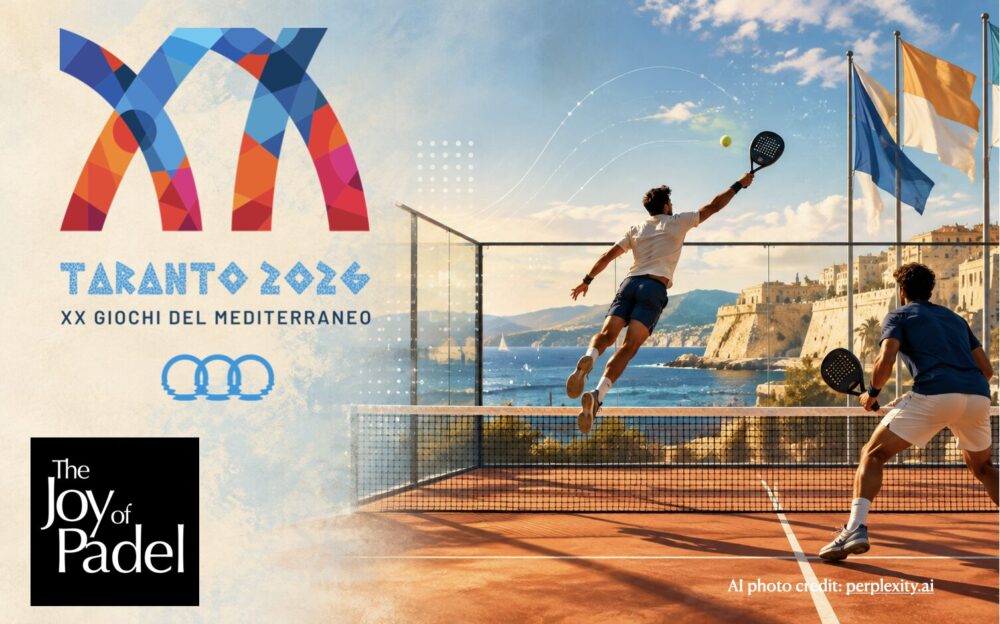
 Hurray for the 2026 XX Mediterranean Games in Taranto. Did you catch any of them? It’s a sporting event that probably isn’t on everyone’s radar in that it happens every four years, except not consistently. In any event, for the XXthe edition, I was delighted by the debut of padel. 18 countries sent padel delegates with 136 individuals participating, having a limit of two men’s and women’s pairs, and one mixed per country.
The following 18 nations participated in the padel portion of the games: Albania, Croatia, Cyprus, Egypt, France, Greece, Italy, Kosovo, Monaco, Montenegro, Morocco, Portugal, Serbia, Slovenia, Spain, Tunisia, Turkey and, wait for it, Atletica Vaticana even submitted a team. There were a bunch of allowed countries that didn’t send delegates (from Africa and the Middle East): Algeria, Libya, Lebanon, and Syria. And from Europe, there were a series of minnows that didn’t field teams: Andorra, Bosnia and Herzegovina, Malta, North Macedonia, and San Marino. My first comment concerns the eligible countries, and how many invited countries don’t actually have a border on the Mediterranean, including Portugal! I also note that, since the inaugural Games held in 1951, Israel has never been invited. If you’re wondering about why there have only been 20 iterations, it’s because they’ve had to adapt/skip three times over the years.
The inclusion of mixed doubles was great (something else that amateurs can learn from). And the golden point format is bound to keep you on the edge of your seat.
Only four countries are legitimate contenders in all the draws: Spain, Italy, France and Portugal, although we outsiders continue to imagine that one day the hegemony of Spain will start to wane (for the good of the sport).
Before going into it, I was expecting to see the Spanish pairs dominate the men’s finals (i.e. Spain versus Spain) given that both pairs were seeded 1 and 2. However, there was a HUGE upset in the men’s Round of 16 when the Egyptian pair of Georges Wakim (world number 242) and Youssef Hossam (#330) pulled off one of the biggest upsets of the year, I’d go so far as to say. They beat the number one seeds of Guillermo Collado (#36) and Pol Hernandez (#35) in a thrilling 3-set match: 6-4 4-6 7-5. The latter pair regularly feature in the early rounds of the Premier Padel P1 tournaments. Of course, it’s worth stating that, while number 1 seeds, Collado/Hernandez were far from the best Spanish talent (there are twenty Spaniards ahead of them in the world rankings!).
By the semi-finals, order had been more or less returned to the men’s draw as the seeds 2,3,4 and 6 battled it out. The two Italian pairs were pitted against one another in one semi-final, meaning that an Italian pair was destined for the Final. True to seeding, though, the #2 seeded Spanish pair of David Gala (#34) and José Diestro (#45), pulled through over the #3 seeded Italians 7-6 6-4. Gala and Diestro won Gold without dropping a set, although they had two tie-breakers and 2x 7-5.
On the women’s side, with nineteen teams entered, there was barely a contest up until the semi-final, with a solitary match out of the eleven played that went to three sets. The remainder saw the majority sets won in 6-1 or 6-0. The top four seeds (Portugal #1, two Spanish teams, #2 and #3, and the Italians as #4) made it to the semi-final. And, somewhat unceremoniously, it was the two Spanish pairs that made it to the final, that was won by Patty Llaguno* and Lucia Sainz (#2), a pair that have done a lot of battle together, and who didn’t drop a set either, on their way to Gold.
For the mixed doubles, it was the duo of Sofia Araújo and her brother, Pedro, who pulled out the win in three sets over the Italian duo of Marco Cassetta and Giulia Dal Pozzo*. It’s funny how the Portuguese two top tier pairs in the men’s (the Deus brothers) and mixed are siblings. I note that there was no Spanish entry in the mixed competition.
As enlivening as it might be to see different pairings and national pride on the line, there is one major area where padel globally continues to sin: no data. I was appalled how little and wrong was the data provided for padel at the Mediterranean Games. Below I include the “breakdown” of the famed upset noted above.
What stands out for you?
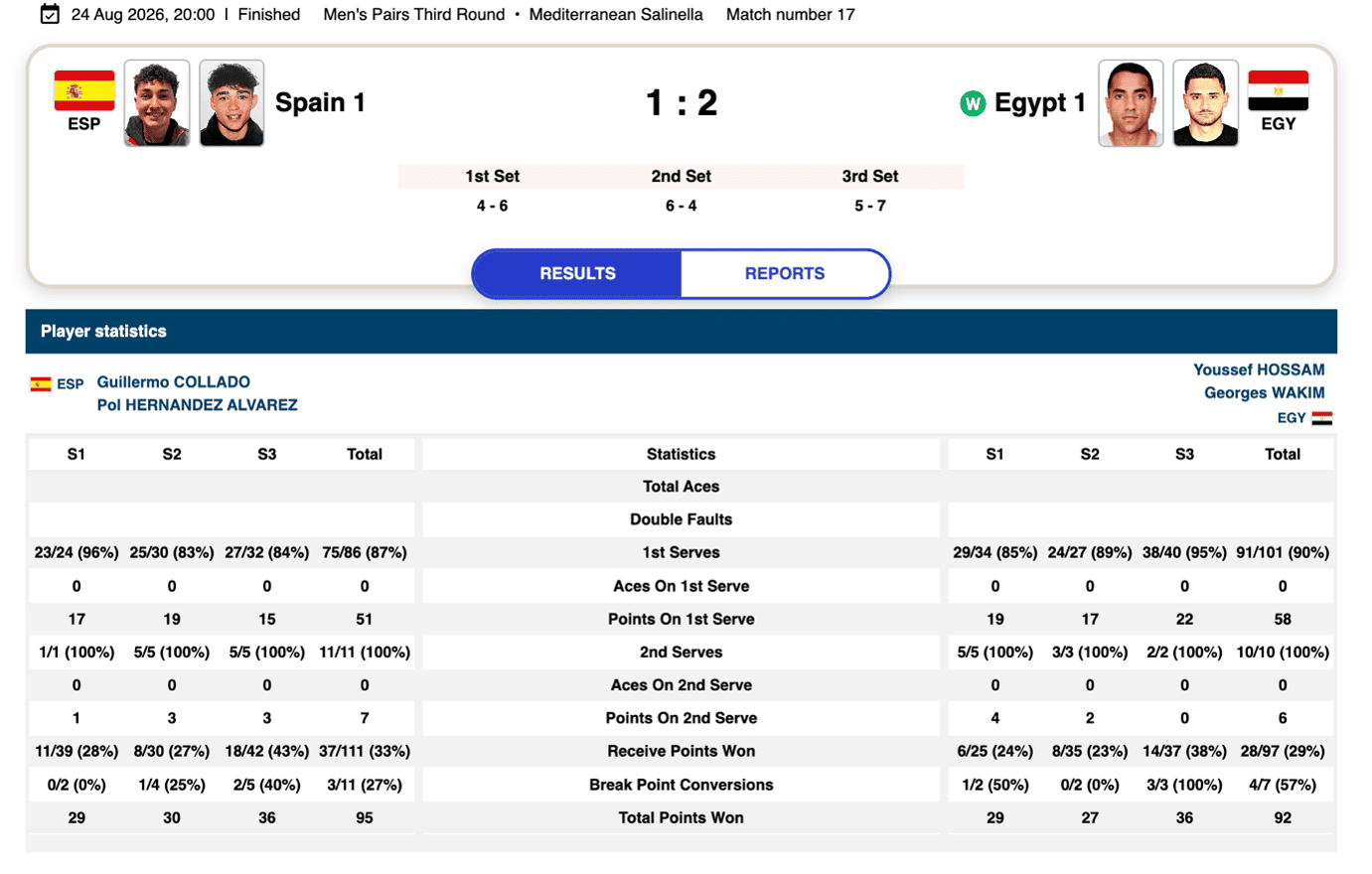
Without bothering with the fact that they waste the first two lines, the idea of counting aces in padel is rather farcical on the first serve, much less on the second serve. Double faults? They happen once in a bloody blue moon. And that’s speaking for the tournament. Points won on 1st serve? One is left to assume that these are points won on one’s own service and we’re left to do the maths of to convert how many first services produced a point or not. For example, they could have added another line that showed the percentage conversion off first serves. For the Spaniards, it was, by set: 17/23 (74%), 19/25 (76%), 16/27 (59%). Whereas for the Egyptians, the corresponding percentages were 65%, 71% and 58%. In other words, the Egyptians were systematically more pressed to win their service than vice-versa. You can also see the same through the number of break points and conversions. The Egyptians were better able to take advantage of the big (break) points. I take this opportunity to signal a stat I regularly trot out: the best players get nearly 90% of their first serves in. What about you?
What other data would be key for a better reading? Here is a sampling: number of golden points won/lost, largest number of points won in a row (as a read on momentum), and the number of (truly) unforced errors. The Mediterranean Games highlighted how impoverished in data padel is.
Suffice to say, we have a long way to go. The road to a golden age of padel will be lined with the mining of real data. At that point, we can imagine the gaming companies entering in full force. We will also, parenthetically, help the commentators to provide more valuable analysis and, eventually, help us mere mortals to improve as well.
I close with a comment from the FIP in their post-tournament press release:
“Among the gifts presented to Pope Leo XIV during his audience with the Athletica Vaticana delegation — following their return from the Mediterranean Games in Taranto — was a special Padel racket. The racket was signed by the players who were protagonists of the Padel tournament at the Games, including the athletes who represented the Vatican colours, Tiziano Lucarelli and Fabrizio Peloni. A symbol of friendship, sporting fair play and cultural exchange, but also a warm greeting to the Holy Father and a testament to how sport can be a tool for bringing different cultures together.
*All guests on the Joy of Padel podcast.