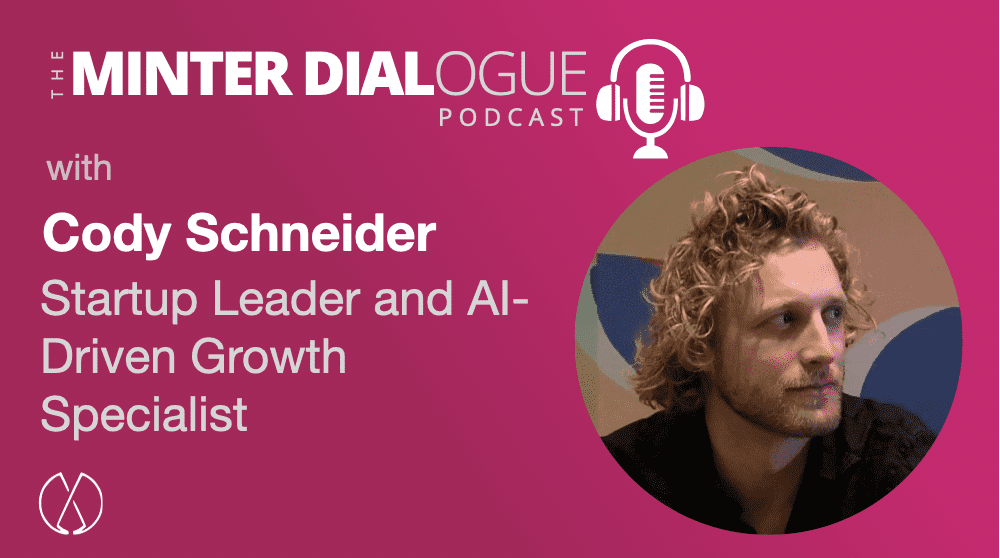
Minter Dialogue with Cody Schneider
Cody Schneider is a serial entrepreneur and AI data specialist who joined me to unpack the evolving dynamics of digital transformation, AI adoption, and what it really takes to build defensible brands in the tech space. Over the last seven years, Cody has thrived in the early-stage startup world, wearing hats across e-commerce, B2B marketing, and hyper-growth SaaS. Currently, he’s the founder of graphed.com, building AI-driven data analytics for growth teams, helping businesses unify and interrogate their data seamlessly.
From his early days executing “digital onboarding” for big corporations, to scaling Rupa Health from a $20M to a $110M valuation in just six months, Cody’s perspective is both hands-on and grounded in hard-earned experience. Our conversation zeroed in on how leaders can successfully infuse AI into their organizations—not by clunky top-down mandates, but by equipping individuals to automate the tasks they hate, sparking natural innovation on the ground floor.
Cody and I explored the critical role of brand as the only real moat in an era where product parity is inevitable. With AI lowering the barriers to building software, he argues—and I agree—that growing digital “gravity” through content and distribution is now the difference-maker. Cody shared practical frameworks for turning employee-created process “hacks” into viral knowledge within teams, building feedback loops and status incentives for sharing what works. We also discussed the ethics and practicalities of setting AI “guardrails”—emphasising context, domain expertise, and documented boundaries to harness large language models safely and effectively.
Key Points:
- Distribution Beats Product: As Cody points out, even a mediocre product can dominate with strong distribution and owned media. Companies like NetSuite thrive not because they’re loved, but thanks to formidable switching costs and expansive reach. In the digital space, investing in media brands and content ecosystems is now essential to drive discovery and defend your position.
- Brand as Compounding Moat: With product features easier to clone than ever, brand awareness—measured by direct searches and consistent content—remains the only sustainable advantage. Investing in educational content, podcasting, and community engagement not only reduces customer acquisition costs, but also creates long-term defensibility and negotiation power within your market.
- Bottom-Up AI Adoption: The most successful companies empower individuals to automate tasks and share their solutions internally—sparking organic growth and cross-team learning. Instead of one-size-fits-all “AI transformation” projects, focus on automating pain points and creating social incentives (like internal newsletters or shout-outs) to scale what works.
Spending time with Cody reinforced that thriving in the AI era is as much about internal culture and storytelling as it is about technology. As always, it’s the clarity of thought, transparency, and an obsession with continuous learning that set transformative teams apart.
To connect with Cody Schneider:
- Check out Cody’s eponymous site here
- Find/follow Cody Schneider on LinkedIn
- Find/follow Cody on X (formerly Twitter)
Further resources for the Minter Dialogue podcast:

Meanwhile, you can find my other interviews on the Minter Dialogue Show in this podcast tab, on my Youtube Channel, on Megaphone or via Apple Podcasts. If you like the show, please go over to rate this podcast via RateThisPodcast! And for the francophones reading this, if you want to get more podcasts, you can also find my radio show en français over at: MinterDial.fr, on MegaphoneFR or in iTunes. And if you’ve ever come across padel, please check out my Joy of Padel podcast, too!
Music credit: The jingle at the beginning of the show is courtesy of my friend, Pierre Journel, author of the Guitar Channel. And, the new sign-off music is “A Convinced Man,” a song I co-wrote and recorded with Stephanie Singer back in the late 1980s (please excuse the quality of the sound!).
Full transcript via Castmagic.io
Transcription courtesy of Castmagic.io, an AI full-service for podcasters
Minter Dial: Cody Schneider. Well, listen, this is a great to have you in person, albeit through the means of a, of a computer, but I think we’re going to talk a lot about that. In your own words, Cody, who is Cody Schneider?
Cody Schneider: Yeah, totally. Um, I’ve spent the last 7 years of my life in early-stage startups. Um, before that was in e-commerce, worked at a B2B marketing agency. After that where my boss had gone to Y Combinator and kind of brainwashed me to think like they do on how to build products and build brands and how to invest in brand. A lot of my work that I did for him was for large corporations Fortune, you know, 500 companies that were trying to do at this time it was digital adoption within their marketing organizations and how do you create those systems. My role was entirely that basically look at the resources available to design the processes, teach the educate and teach the teams, and then help deploy it internally. Uh, but yeah, from there ended up at a company called Rupa Health. Um, joined as employee 9 or 10 and helped take them from a $20 million valuation to $110 in about 6 months. Learned a lot there. Um, yeah, very crazy when you get to that scale that quickly. We went from like, you know, 10, 10 people on the team to, I think it was about 150 and like 18 months. So, you can imagine the growing pains that occur in those times. But yeah, now working on a company called graft.com. It’s an AI data analyst for growth teams, unifies all of your data into a single platform, and then basically gives you the ability to query that data. You know, you can build charts, live dashboards, reports, or just ask your data questions. We just actually released a what’s called an MCP, a model context protocol, that allows for you to take that into your own chat application as well. So, either cloud code or, Cloud Coworker Cloud iOS, or ChatGPT, or whatever your daily driver is, enables it there. So my expertise is early product adoption. That’s kind of what I’ve spent the majority of my time in, is how do you get your first 10, first 100, first 1,000 customers and build out those the systems and processes around that. So, yeah, that’s the high level. Uh, have basically worked on every type of company that you can imagine, whether it’s e-com or info products or B2B SaaS or consumer SaaS or our, you know, our consumer software. Um, so have a bunch of stories, a bunch of mistakes, could talk through all of those in any detail. So, anyway, yeah, that’s kind of the high level. Happy to go deeper on anything.
Minter Dial: Wow. In everything you, you recounted, Cody I the thing I retained was this notion of helping a beginning piece where you’re helping companies onboard digital. And presumably, you’ve always also thought of onboarding AI into the organization. And whether it’s bringing ecology, or diversity, or di or AI now, how, how do you see the minds of leaders today adopting, adapting to these new elements, especially to AI?
Cody Schneider: Yeah, I think a lot of them are trying to do like this large digital transformation push. And I think this is a mistake, actually. Um, I think the best way to do this is to give your individual contributors the tooling that they can, or that they need to automate as much of their own daily workflows or jobs as possible. And we see this kind of there’s like two company types where it’s like, hey, we’re going to lock down everything. And like, you basically fit you’re a cog within our system. Or there’s this other company type that’s like, we’re going to give you this tooling and give you the necessary resources to basically make you, you more effective at your roles. And I think, you know, it’s very obvious which, which is going to win in the long run. It’s the ones that give those, those team members those resources. I can give you a concrete example. So, I was talking to a friend last week., he works as a grow uh what’s called a go-to-market engineer at a company. Um go-to-market engineer, all that is, is basically somebody that does software engineering work for go-to-market systems and processes. So, think, you know, basically prospecting for your target customers you know, information, like building out the systems to actually reach out to them, like running ads to them, et cetera. Um, so he told left you know, Company A and just moved to this new company, Company B. Um, he was talking to a, a sales development representative that was at Company Company A, private previously that person had moved to another company, Company C, and that sales or that SDR was basically telling him, hey, they won’t give me like an Apollo API key, which is a data enrichment tool for prospecting. Um, at the first company that they were both at he was given all of these resources and was basically one of the highest performers on the team. At this new company, they won’t give him the tooling that he needs. And all it is is literally just like, here’s a token that allows for them to go him and him to go do research and run this personal software that he developed for himself. And so, it basically just, you know, almost neutered him, you know, as a, as an effective team member because there’s this internal policies at these companies. And so, we’re seeing this happen and there’s a lot of unknowns here, like what is, you know, data governance? Like how do I actually measure this is being used for the appropriate thing? And I don’t know, have all the answers to these challenges that all these organizations are facing. But I think the biggest thing that we’re seeing is when you have a champion on your team that is doing some activity with this new AI tooling and it is, you know, making them go from a single individual and they’re almost functioning like 20 team members. If you’re basically hindering them in any way, you’re just sitting on this asset that’s, you know, not being used to its fullest. And I think that’s going to be the, the kind of the story when you look back at 2026 from the winners and the losers. It’s the organizations that basically give their teams the tooling to be able to accomplish, you know, whatever it is in their day-to-day work that they’re already doing. They’re just trying to augment it, make it faster, make it easier. Um, you know, or a lot of the times we see they’re automating the things they hate doing about their job. Like for example, I, I’ve never talked to a single individual that likes doing lead enrichment in their CRM. Um, but if you give them a HubSpot API key and then allow them to basically go and do research using something like the Perplexity API on whoever their lead is, and then, you know, port that into their HubSpot contact information. You’re just going to have less burnout within your, you know, your team because they’re basically, you know, they’re hand-raising, I hate doing this thing, let me automate this. And then what it allows for as well is, and the best organizations that how I’m seeing them implement this is they basically are creating some type of fireside chat or forum, or maybe it’s a Slack channel where it’s just dedicated to here’s this thing I built using this tooling. If you want to use this too, here is this, you know, Notion document tutorial for you to deploy it for your own workflow. And then that creates this like self kind of incentivizing system where they get this notoriety within the organization. It’s like, oh, you know, John made this system. It provided so much value. And then it almost creates this flywheel where other people are like, well, I want that notoriety. I want that reputation within my organization. So, it creates this, this positive reinforcement. So. Long-winded answer, but I think that this is where I’m seeing kind of the, the best companies perform. Where the where companies are floundering or not having success is when they try to push like adopt AI to the whole organization or just like very these very broad. For example, I have a friend, he works at a startup. They’re like, you need to use a certain amount of tokens per week. Basically, they have like a minimum threshold and it’s a software company, huge name. He is basically what he told me, we were getting beers, is that he’s having the AI split columns and spreadsheets and then put them back together so that he hits his token limit because there’s not really, you know, a way that he can use the tool. And so, I think that, that those types of kind of broad down initiatives is not the right way to be approaching this. It’s way more like, okay, like, what is your day-to-day work look like? Here’s tooling that enables you to improve that day-to-day work. That’s where the outcomes are going to be the most effective, not this, you know, we’re doing AI transformation. The peop it’s main what pains me the most is when people like aren’t trying to automate systems or processes that they already have. I think this is like the biggest learning with all AI systems is like you basically have to look at what am I doing manually currently and then how do I basically replicate or mimic that with this tool. Tooling rather than like, you know, here’s the some pie in the sky idea and then trying to, you know, build to that. It’s like, no, like, I we need to think about this like it’s an Excel, like it’s a PowerPoint, like it’s a, you know, a, a document. It’s just a tool that I have in my tool belt to help me accomplish some output, whether that’s a report or a presentation or, you know, a dashboard on my data. Um, but the AI tooling component is a lot of it is workflow automation. A lot of it is, You know, can I take this person that’s already a high performer and make them be 10x what they are currently, or 20x what they are currently? Because now suddenly they can do their job at an even more effective rate.
Minter Dial: So, yeah, yeah. So, what I, what I was hearing was it’s really there’s one is the, the idea of identifying the champions, the individuals in the ground level, if you will, and highlighting them, making them feel valued, and and, and, and propagating their systems. The thought the initial thought about that was that, a, some people have a certain manners and ways of doing things, and the success with which they might use a tool can also be highly related to their method, their, their philosophy, their psychology, if you will. You know, let’s say, for example, to, to be a little bit provocative, you might have somebody who’s a total geek and doesn’t like social interaction, and therefore I’m going to create a method to do my sales without social interaction. And they’re successful at it, but in the, the Notion write-up, that person’s ability to contextualize why he or she has had success is going to be vital for the remainder of the others who are going to take it on. So, and that I think you can extrapolate that type of issue with any type of person or type of system? And how do you gain that learning and propagate it throughout
Cody Schneider: the company? Yeah, I think so two things that come to mind with what you just described, like that person that’s having success, they a lot of the times they’re not going to fit into a system that’s already implemented, right? Um, they are going to not be hitting the KPI metrics that are the standards. Like when you look at their raw revenue generated, you know, data, they’re like, oh, this person is a high performer, but like all the leading indicators that that person is going to be looking at for them, like messages, the number of tokens they use. Exactly. Yeah. Or conversations that they’ve had, right? All of those are going to be subpar. Um, and, and so I think that this is going to be something that’s going to be hard for managers to, to kind of like get over the hump of is and really a lot of what it comes down to is like defining the outcomes is actually really hard for people. Like, what is the outcome that we’re trying to like, what is the final end thing or result that we’re trying to, you know, create? And then that. It’s almost like I don’t care how you get there. As long as you get there, that is, is how more and more of this is going to happen. Um, so I think that that’s going to be the toughest part is like defining, and I see this, you know, again, I, when I, every early stage company I’ve worked at, it’s like, what is the metric of success? Um, a lot of the times they can’t answer that. Like, is it signups? Is it revenue generated? Is it pipeline created? Is it like actually closed deals? Like what, that, that number. And when you get down to the, the, you actually start, you know, like pulling this apart and pull it apart thread by thread. At the end of the day, everybody wants to make more revenue at a higher margin. And so, it’s like, cool, like, okay, what does that actually look like? Now let’s work our way back from there. And so, I think that that’s like a piece of this is like, how do you measure people’s how do you measure people’s effectiveness when they’re they have this personal software or this personal, you know, operating system that they built for themselves? I think that’s going to get really hard and you’re going to have to like kind of almost think about new ways to analyze productivity, productivity. I can, I can just imagine having a conversation with somebody where it’s like, your, your, you know, closed sales numbers look great, but everything before that looks terrible. Like what’s happening, right? Um, but I think the sharing of the knowledge and the information I always just try to incline people like treat it like it’s like social media almost, right? Where it’s like, I did this thing, I documented this thing, and I’m now reporting on this thing in like a public setting. And you see the best companies doing this now more and more where they are actually inclining their employees to like, I want you to write up, you know, LinkedIn posts as an example, like about the ways that you’re using the product to like help the business grow. And then that creates this like natural flywheel. But I think there has to be some type of incentive to like get people to actually do this. Um, for startups it’s very easy. It’s like if the company grows, there are, you know, options become more valuable. Um, but at larger organizations, what it ends up typically being in my experience is like you get basically some type of social status internally whether that’s like a call out from, you know, your, your boss to the whole team, or like, you know, a call up by somebody who’s in leadership, a badge of honor. Exactly, exactly. Everybody wants status, right, within wherever their, their community is. Um, you know, there’s only a few things that drive the world, and it’s, it’s money, time, and status, right? Uh, and, and I, I think that you have to either create some incentive around, around money, around time, around status. Status is typically the most val you know, the, the one that makes or is the easiest lift for organizations. So, they don’t have to have some type of monetary incentive, they don’t have to have some type of, you know, time incentive, like where it’s okay, you get more vacation times if you post a certain amount or give more the most value. What it ends up being for most people, like they want to do good work and they want to be they want to have that notoriety or be seen for that good work that they’re doing. So, you have to create a system internally for that process. Something we did at a previous company actually is we basically started an internal newsletter that was just like, here is everything that we saw this last week. And like every Tuesday we would send it out in the morning. And it would be just documenting kind of like, this is what, what we’re seeing be successful. What that we ended up finding is that gave us leverage within the organization internally, right? Because you’re starting you suddenly start to be seen as a thought leader. And so, like, this is actually a great way for team leaders if they’re trying to get, um you know, leverage within the organization so that they can get more resources, so that they can have more ability to create impact at the organization. I would think about like, how do I market internally as well as I’m, you know, marketing externally the actual organization? I think everything is just positioning. And when you can communicate, this is what my team is doing, here’s the success, here’s the failures, and do that in a very you know, concise way, it gives this, this, this leverage within an organization that is really hard to, um garner unless you have a it gives you a platform basically to put whatever you want to say on into the organization. So, yeah, just again, other tactical things I’ve seen be effective at these companies when you’re kind of stuck in these roles where you’re in the middle and you don’t have a ton of you know, sway in
Minter Dial: the decision-making process. So, well, there are a bunch of things you’ve said there, Cody, that are intriguing. First of all, I it’s refreshing to hear somehow that the motivations are, are these time, money, and status. Because for them, so many of the older people I have on this I mean, when I say old, I don’t know, no, no knock, right? But, you know, like people like me,
Cody Schneider: we this is a
Minter Dial: different vintage, you know. Sometimes for the wines it can be okay, but not all. And but this idea that there’s extrinsic versus intrinsic values And going back to this individual who is champion doing amazing things, the, the how someone does something, it can be very important. And it in my experience, it touches on brand, how you do shit, and it certainly relates to the ethics that go into it. Because if you get that KPI, whatever that special number is but you do it in some ways that might be rather questionable. A, that’s a challenge for ethics, and B, it actually I would, I use the word contaminates, but in any event, it impacts your brand because your brand is your reputation. And as you have said, your brand is your only real moat. So, how do you try to navigate
Cody Schneider: that little tricky space? Yeah, I, I think that this is the hardest thing to teach people and until you’ve been burned with, you know, a brand erosion happening, or so I started out my I don’t know if you want to call it a career, but I was doing print-on-demand, like dropshipping basically, right? So, we would like scrape websites like Etsy, like Redbubble, like Amazon, find winning products, and then we remix the designs, right? Through that process, made great money, but the I built zero brands during that whole period. And so, naturally the market shifts and it changes and I’ve got, you know, nothing to lean on. And I think communicating that internally to people within the organization is the hardest part of like the only thing that we owned, especially in this AI race that we’re in or this AI, you know, like stage that we’re in is our, our people searching for our brand name. Like are the brand volume searches increasing month over month?. And I think for growing companies, this is, for example, this is my, like, one of my biggest metrics for 2026 is, is that number going up month over month? Are our branded impressions uh uh, searches basically, like going up month over month? How we’re tracking that is with Google Search Console. So, I’m just looking at like, literally are people searching for the brand name Graphed more each month? And then I have a dashboard that’s reporting on that. But the, with, within an organization, especially a larger one, you, I think the, the challenge is the incentives. Like how do you, create the right incentives so that it’s serving not the, the quick wins, but is this a compounding like, brand is a compounding thing. And like, a mantra I live by is like patience, persistence, and compound interest. Like, those are like the basically the driving forces of people that get things done. Um, and that compound interest, like, portion I, I think that how I would how I’ve communicated it traditionally is like you know, If we look at, um for example, like paid ads market when you start out with like in a category, you see that the cost per click is at a dollar. And then as time goes on, it naturally goes to $5 because that arbitrage like evaporates. And the only way to combat that is you basically have to get more people searching out for your specific company rather than you competing in a market with other organizations. And so, this is why, you know, I always get asked like, why do you do content marketing at all? And the reason for this is because it, it, it basically is how you fight that increased, you know, advertising costs that’s going to naturally happen within a market. So, as that price goes up, I, if I’m investing in brands, which a lot of the time is education, it’s thought leadership, it’s sharing, you know, this is the, the ways that we’re approaching this, or here are these problems, here’s how we’re solving them, is typically how I see be the, the, the most effective content. And, and, and really it’s like talking to the pain points or talking to the outcomes that they want. That, that is always the best performing content in my experience. But when you create that content, it basically creates a downslope in the curve. So, the customer acquisition that hap that’s happening from organic starts to head towards zero. And so, that basically you know, combats the increasing prices that you’re paying on the advertising side. And so, internally you have to communicate, hey, like we are investing in this or, and you need to think about this and all of our actions and our activities have to, you know, respect brand in this way. Like this is the number one filter. Because over the long term, if we erode that in any capacity, we’re going to be priced out of the market from a competitive standpoint because we know that the media costs are going to increase for that distribution. And so, I, I, this is how I personally approach it and think about it. I think the hard part is how do you give people enough flexibility in the beginning to test things that may not be perfect on the brand side, but there’s a path to getting it to where it’s brands, you know appropriate. And this is the hardest part with it is like, where, where is the line drawn on the ethics side in particular? Like, you should only be doing things that serve the like, if there’s any potential that, you know, like the company gets sued or, you know, it creates surface area for that risk, absolutely should not even be in the vocabulary of the team or the organization, right? But if you’re, if you’re thinking about how do I enable people to experiment and give them that space to experiment? And this is a lot of the times just what organizations have the hardest part with is where is that boundary. I think it’s on a, you know, a company-by-company basis but over-communicating internally, like, this is the, the this is where things like this is our nos. It’s way easier to say here’s all of our nos and go figure out how to play within that system than it is to say here’s all of our yeses and then they just randomly stumble onto, you know, naturally somebody will find something that exploits that system. And so, I think it’s way easier to kind of create those, those nos and say these, these are the things that these are our principles that we can’t cross. These are our boundary, you know, our lines in the sand. Anything within that sphere you can go and experiment with. But unless, you know, unless the market or the system changes, like those are those, those lines that you can’t cross. But This is a hard one though. I don’t really have like a perfect answer. A lot of it is so situational, I feel like, from organization. I worked in a finance, you know, or a company that was in the fintech space for a decent amount of time. And like the challenges that they face are entirely different. Like we had to deal with KYC, right? Which is like you don’t have to deal with any other customer type. And so, I think that those it’s It’s, or, you know, it’s, it’s industry by industry, but the biggest, you know, the thing that I found is again, finding that cross-section where it’s like, here are our nos, but you can play as hard, you know, you can, you can find the arbitrage within this space. And then you just let the people that are the best at this. And this is, you know, our job is hire, you know, anybody that’s in leadership in a hiring position, I’m trying to find people that love that game. Like here are the boundaries. Here are the rules and like now go and figure out the arbitrage or, you know, the meta that’s within those rules that I can go and exploit to create the most impact that I can with the limited resources that I have, which is time,
Minter Dial: money, and mental energy. So, well, the this notion of, of how you describe it, I found very, very useful about lining up the nose. The, the nos become your guardrail. And yet, especially when we deal with AI, I, I it feels for me, and maybe Cody, you can illuminate me, how do you implement those nos, if you will, the guardrails in AI, especially when we’re in language models that are learning and improving and changing? And, and, you know, every other day it’s a little bit the Wild West. It feels like while we might be able to do that with human beings, how effectively do we translate that into a, an ethical framework for our AI implementation?
Cody Schneider: Yeah, I, I can give you an example of how we use it within our codebase, because I think it’s the most discreet way to explain it. Um, so when you go and talk with an AI coding agent and you’re like, build me a website, it’s just going to do whatever it thinks is like the right thing at that given moment in time. If I do that 20 different times, it’s going to be 20 entirely different outcomes if I just follow that thread with it. Um, in contrast, like how we’ve built our code base is it’s very descriptive on like what the agent is allowed to do. Like you’re only using TypeScript for the front end and the back end servers. Here’s the UI design, like implementations that you have to follow. When I say like make a card, you know, that like from a design standpoint, this is what a card is. This is what it looks like. Et cetera. Um, I actually think it’s way easier to create these systems and these guardrails but you have to have domain knowledge on that thing, like very deep technical understanding and domain knowledge on that thing to actually create the outputs that you’re expecting. Humans have all of this, um all that domain knowledge is kind of trapped within them. They can pull from these things, you know, maybe it’s like a random class that they took in college that is about typography or geometry and shapes, and that enables them to describe the thing that they’re looking for. But a lot of the times, like what I see, especially when people are trying to adopt these AI solutions internally, is they go into it and they give it a really broad, like, you know, like ask, like again, build me a website. And then they lean on the AI to like make the decisions for them. But in contrast, if they come in and when we think about what the AI is doing and how it’s created, right? Like all of these LLMs are trained off of the general knowledge in the internet. It’s just scraped everything and it’s just looking at the average, right? So, naturally what it’s going to give you from an output standpoint is the average of everything that it’s ingested. And we all know that the average makes no impact for every, you know, company. It’s only that top 10%, that top 1% is where all the value is created. So, how do you actually get it to create that value? Super easy way to do this. And like, if you’re listening to this, this is the fastest way that you can test this to kind of like see the outcomes. Is tell go to Claude or, you know, Claude.ai and say write an email trying to sell X thing, right? And then say, write in or act like you’re a top 1% direct response, right? Uh, copywriter. I want you to write this email about this product. Um, here are the main pain points and the outcomes that people like. So, you have it write it and then you say, okay, now I want you to edit this like you’re a 40 40-year veteran print, newspaper editor really be conscious of the economy of words. The output that you’re going to get from that second workflow is going to be at a standard that you’re going to just you’re going to find is so much higher than that just write me an email newsletter about this thing because you’ve given it these like guardrails and this space that it has to play within these, these requirements that it has to play with. I think this is actually the hardest part is having the vocabulary to explain the outcomes or the expectations that you have for it. This is something I’m, I’m obsessing with currently is how do I acquire the vocabulary to be able to interact with the AI more effectively? I’m somewhat technical. I’m not super technical though. Um, there’s all this vocabulary that I don’t have that this it basically hinders me from enabling the AI to do the output that I’m actually looking for. So, this is something I’m doing specifically with design right now is I’m just like, I basically built a whole podcast for myself for the acquisition of the vocabulary of design in relationship to graphic design. So, that I can reference those graph like that graphic design. So, for example, a concrete example of this, I recently was like, I want to put a texture on this background so that it doesn’t feel like it’s like this like gradient that looks very kind of aggressive. I wanted to have almost like a, like a TV fuzz, right? So, I don’t know what that is. I don’t know what that means. I end up like researching for 10 minutes on, okay, what, how would you describe that? It’s like, oh, I want an opacity of 5% and then I want you to have a compounding split of dots that are growing in size. And so, basically, when you have the vocabulary that allows for you to describe the output that you’re looking for, that’s how you’re going to create those top 10%, those top 1% outputs. So, I, I think, you know, coming back to the initial question of how do you create those nos it largely comes down to like, do you even have your own systems in place, your own internal, you know, tribal knowledge? Is that documented in any way? And a lot of companies and organizations, they don’t. This is just like the hardest thing to do. And so, this is I, I think it’s going to be really hard actually for like larger organizations to capture that tribal knowledge and that tribal information. Um, for startups it’s way easier. Like for example, we wrote our code base from day one so that it has these guardrails and it has these basically this walled garden that the, the agents can play within. And, and why we’re doing this is it enables things that were impossible before. So, for example, I wanted to add a feature that to the application that when you hover on a legend, it isolates the graph, you know, the, the line chart. So, say you had a line chart with 5 lines within it, and I want to hover on the legend, and then it isolates that line that’s related to what I’m hovering on and grays out every other line within that. Um, I was like, I just described that. I gave it to our agent. We use Cursor as in our internal like, like coding agent, and it deploy it basically wrote this code. It built the feature, it deployed it as a PR. I checked that it worked and I shipped it. And that happened all within an hour, basically from idea to creation. That whole thing could not have happened unless that, that, that infrastructure was set in the, in the beginning. And again, for a company that’s like early like us, we, we get to think from the ground up. Okay, here is how I would build this now on top of this new tooling. I think it’s going to get way harder for company. It is just, I just know this is happening because we’re having these conversations where it’s like, for example, they have a data warehouse that they built and everything’s just stuffed in that data warehouse. Uh, there’s not really good organization. You don’t actually know what’s in there. And if I go and take an agent and I try to create, you know, the semantic layer or the knowledge graph, or it’s sometimes called ontology of that data source, that tabular data it’s just very hard to teach the agent like what, what is actually in here because there’s no like, it’s just very disorganized. In contrast, when, like, how we do this is like when you connect Google Analytics 4 to us, whether you’re customer A or customer B, that Google Analytics 4 has very similar ontology or very, that a very similar semantic layer. So, if we make the agent good at, you know, interacting with Google Analytics 4, it’ll be good for customer A and customer B. But that’s only possible if you’re starting from the ground floor up and building it in, in, in kind of this, again, this like walled system. So, I, I think with companies though, like, it what it’s going to end up being is the standardized like, the standardization of what they’re doing and also using tooling that AI is more capable with. Like, we’re finding that it’s way better with TypeScript. Um, TypeScript just to like expand on this the reason that it’s used historically is it’s each like variable has a type. It, it, you it must be a number, it must be a string, it must be you know, it has this, this requirement that’s necessary for it to, to basically compile correctly. When historically people hated writing TypeScript because it’s typed, like the human hates doing it. In contrast, the AI loves it because it’s discrete, it’s typed. And so, it has to be this specific way for it to pass these evaluations. And this is what we’re seeing the best companies do is they basically are taking that same principle these evaluations and how do I apply that within the whole organization? It’s almost like these are the, the, the, the checklist of things that it has to pass for it to be okay to do. And a lot of this always comes down to like the human that’s designing the system. This is the hardest part is thinking through each of that, but the domain expert is going to become more valuable than it ever was before because of this, because they have the deep technical knowledge on whatever that is, whether it’s software engineering whether it’s, you know, brands, like whether it’s copywriting, whatever those, those, those deep technical skill sets are, you’re going to be so much more capable with this, this tooling, because you again, like to kind of bring the same idea around, it’s like you have that vocabulary that enables you to get the AI to get this, this, you know, savant, you know, thing that lives in this black box to do this at this, this, this outcome or do this process that before, you know, if I just delegated that to a VA in the Philippines, impossible for them to do. But in contrast, if I say, hey, here’s the requirements, here’s the expectations, here’s how you need to think about yourself, here’s the tooling that you can use, now go do this. They’ll, you know, be able to create to do a performance that is just impossible for the cost that we’re seeing. And this is another part of this is that’s getting really hard. Like the cost of, of intelligence or whatever you want to call it is basically going to zero. Like we see this where Claude, you know, Claude Opus 4.6 releases, it benchmarks, you know, incredibly high on, on the programming side from a usefulness. Within weeks, there’s an open source model that comes out of China that benchmarks like right below it, but it’s at 1/20th of the cost. So, if we just think about that and like, where does this go over the next 12 months, over the next 24 months, you’re going to have these leading AI labs basically release these like industry leading models. You’re then going to have open-source models train off of the derivative data of those leading labs. And so, you’re going to have this fast follow that’s continuously happening, that’s basically cost-cutting whatever the that leading model is. And so, if we just, you know, continue down that chart, where does this end up? You’re going to have these models that are incredibly intelligent that can do all of these activities, but it’s going to increase like the, the cost per intelligence, or whatever that metric is that you want to measure this, is going to basically approach zero as time goes on. So, if, if you have infinite intelligence, how do you implement that within your company? And this is something that I’m having to unlearn. Like, it’s actually really challenging of like, how do I not think from a what we can do constraint? It’s like almost from this, like we call token abundance. How do I think from a token abundance mindset where it’s like we can do anything, but what’s the right thing to do? That’s actually going to become the hardest thing for people to, to, to make decisions on. And we’re seeing this at organizations. Like I just talked to a friend, he’s a, a, a product manager at a, a large company. And he’s like, every person in my organization is now using Cloud Code to build internal, like internal products that they’re then pitching internally, like we should build this, we should get this on the product roadmap. Because these PMs historically, they were, they were limited by the amount of engineering bandwidth that they had, you know, within the organization. He’s telling me this, and then I’m like, well, is it like actually good products? Like, do people actually want to buy it? And he’s like, absolutely not. They’re just building they have, they have this, like, they can build anything. And so, now they are building anything, which is this tar pit. And so, now they, they basically like, we’re building all these things that nobody wants to buy, but they it looks like work is happening, but their skill set isn’t building, you know, understanding what the market is trying to purchase. It’s building, you know, just the thing that they think is interesting or based off the customer conversations they have. And I think that this is going to like trickle out through all of the, like, all of the organizations at companies is you basically can do anything, which makes it very hard
Minter Dial: to do the right thing. So, well, a lot to unpack in that Cody. So first fun thought that comes to mind, and I don’t remember who said it, but talking about intelligence, if you think intelligence or, or education is expensive, try ignorance or stupidity. And that was what was coming to mind as you talked about how the cost of intelligence is coming down. Um, when you talked, I a couple of the patterns I kept on picking up, one was this idea of domain expertise or domain specificity to what you’re trying to achieve. And I wanted to throw back in your comment about knowing how to explicit the commands that you might go from write this email, now make it top 1% and then the refinements that go onto that. In my mind, that is equatable to exigency. There’s a, there’s a level of refinement that goes onto it, that need to go down the next level, get one better. Is, is that sort of determination to say, well, how can I do this better? How can I use this, this machine to go better? And you a lot of people will just say, how can I make it better? That’s the sort of laziness that I see a lot of. How can I make this email better? No, how can I make this email sound like it’s coming from the lead person in the type of industry that we’re in, blah, blah, blah, blah, blah, with specific criteria that are explicit, somewhat discrete perhaps, and anyway relevant, and then you start getting a proper output. And that those are some of the thoughts that were coming to my mind. But I did want to get back to there are two other things that I’ve been looking at, Cody, in, in sort of evaluating, or let’s say checking up on your, on your approaches and things which you do. And one of them, and you this is on your Twitter profile, you say that basically product is shit It’s only just I, I jest. She you don’t say that.
Cody Schneider: You say that distribution is more important. I have said that exact term, so I that’s
Minter Dial: why I’m laughing on my side. Which, you know, for a lot of people that are sort of product-centric, a lot of companies build themselves on products. They name their company after the product. They I mean, I work for an organization that, just by the way, that one point the CEO said we need to spend 10% of our of our revenues on digital marketing. Yeah, right. And highly product-centric organization. And for sure, if your product is, is really terrible, then it’s unlikely it’s going to sell well. But I was wondering if you had any extreme example where a mediocre product with brilliant distribution crushed a superior product that had none? Totally.
Cody Schneider: Is there anything that comes to mind as you NetSuite is a great example, and the one I always use. Like, you’ve talked to anybody that’s ever used NetSuite and they despise it, like, with like a visceral hate, right? Um, it’s still winning and it’s still competing, and it’s largely because they have built out this distribution and the switching cost moat that enables them to compete within the market. And I, I think this is the thing that people don’t realize all the time. Like, if I have a product A and product B, and their feature there’s feature parity, right? But product A has better marketing and distribution than product B, product A is going to win every time, full stop. And when we as we get to this place where the, the cost of creating product is going to zero, and I’m talking about the digital, you know, space, right? Like, it’s totally different if you’re making physical products, if you’re in the e-com world, you know, or retail totally different, you know, constraints that exist. But looking at just digital products, if the cost to create digital products is going to zero or decreasing, then that means that feature parity is going to be unani like, it’s going to be unanimous about upon, you know, across the industry. So, if, if everybody has the exact same features, every there’s no differentiation that it can, it can exist from a software standpoint, then the only way that you’re going to create, you know, success is you have to have better distribution. And this is what the best companies are doing. They’re actually building out these owned media brands, a great example of this, and, you know, in my world is a16z. They’re the biggest deployer of, you know, venture capital. Um, when you look at them as a company, like, they are selling a commodity product. Anderson, is that yeah, yeah, um Andreessen Horowitz. Yeah. Um, they, they’re selling a commodity product. It’s just money. They’re selling money. Basically, they’re, they’re like, choose us to let us buy a percentage of your company so we can give you money. How do you differentiate that? And the only way that you can do that is through having media that gives you the biggest distribution leverage. And when you look at all of the I mean, they’re just acquiring like every basically podcast network, every you know, like YouTuber that they can, every all within this category of technology and VC and anything in, in that, in that relationship. Because they know that this is how this is the only way that we win when our product is a commodity, is you have to have this owned media. And I, I think that it’s a really sophisticated way to go about this. Other companies that are like more traditional that do this really effectively is a company called Arrow Electronics. I’m obsessed with them. Um, massive organization. All they do is resell electronics components. That’s all they are. They’re just an electronics components reseller. Uh, insane when you think about like that, you know, highly competitive market. How do you stand out? And they did this acquisition. Um, and this is the thing that I like initially stumbled upon them with was they basically went and they, they purchased basically every electronics blog that they could find in the early 2000s. And they owned them and solely so that they could get the email lists and that they could use those channels as a way to market directly to the electronics and/or the the engineers that were basically going to these forums to ask questions about what they should be using for their product that they’re building at, you know, XYZ company, wherever they’re working. Arrow basically sponsors those, those those media organizations, and that enables them to then go and create you know, basically this differentiation and also this flywheel of new user acquisition or new customer acquisition within their ecosystem or whoever that they’re selling to. And so, I think this is the thing that people get wrong a lot of the times as well, is you have to make media that is selling to your target customer. And if you’re like, our target customer is everyone, like you’re going to create terrible media. But if your target if you’re like, if you have a really well-defined, here’s exactly who I’m selling to, here are the pain points they’re experiencing, here’s the outcomes that they want. And then I go and I work back from that to the media that I should make. Then you’re naturally going to create content that’s, that’s beneficial to them. So, I can give you a really concrete example of this. I make, I, I have a podcast, right? All I do is interview people in my industry about what they’re seeing working like currently. For example, had a friend on recently. He deploys about 180 grand of ad spend for a startup uh, that he has a month or sorry, he deploys about 180 grand of ad spend across Google Ads and Facebook Ads. He’s the CMoto startup that he works at. Um, they recently crossed like a million users and all I’m asking him is like, what are you seeing be per you know, performant right now and your processes? And he’s like, cool, this is what I do. I go and I hire 10 different creators that are doing a video a day on TikTok, Instagram, and YouTube Shorts. The best performing videos, we then tell all the other creators this format worked. So, they all go do that. And then we also take those and we run ads against those. And so, it creates this system, but that content, what I just described there, I can package that and I can literally cold email people that be like, here’s this episode, you know, here’s this podcast episode where they talk about XYZ thing. And if that person is a media buyer or working in it, like, you know, a, a similar space, they’re going to look at that and be like, how you just gave this to me for free? Like I would have paid 10 grand to have this, like this knowledge and understanding.. And so, this, when you’re making the right media, like your audience is naturally going to be searching that out and finding that. And again, it creates this distribution flywheel of like, why does I think this is something that Silicon Valley gets like wrong. It’s like pro like product wins, product always wins, product always wins. I certainly disagree. I think that like the best product doesn’t always win. Again, it’s, it’s the, it’s the, especially now, like I, again, we can go and build every feature that a competitor has. Relatively quickly and relatively, like, cheaply, right, in comparison to traditional software engineering. And this used to be the biggest constraint in organizations was, was the engineering bandwidth that was available. So, if I have the exact same products, like, and one of those company or in company A of those two that are competing builds out this media arm of their organization, who’s going to win? Of course it’s going to be the company that builds out the media arm that is educating their target customer, that’s showing them Hey, the outcomes that you want, here’s a way that you can accomplish those, et cetera. And I think the best organizations that are doing this, they treat it like it’s almost another line, like a, another company within their company where it has its own P&L and it’s basically its own like profitability. And when you look at this, this is again how the best organizations have done this historically. Like Arrow Electronics is a prime example of this. They like treat it like it’s like, like a media company. They, they, they give it like, it’s like it has to have, you know, survival and sustainability. And when you look at like Red Bull as an example, another great organization that has done this, like they treat Red Bull Media House as it’s literally its own company. Now it’s all just marketing Red Bull, you know, the, the, the product, the, the, the can. But in reality, like they, they, they have to make it survive off of its own accord. And when you think about it in this way, like how can the media company actually like sustain itself? Then it creates this whole different paradigm. Like, so at Rupa, as an example, like we basically sold sponsorships for the podcast. Um, and so what this enabled for us to do is we, we basically took the cost of the show, like the production cost and everything that was related to it. We nullified it by selling those advertisements with our, our marketing partners. And we were um, just for context, we were a marketplace for especially lab tests. We basically aggregated them all in a single place and you could order from like multiple labs all, you know, if they through a single portal. Um, the, the thing so we were basically selling these slots to the labs, and this leverage, this did two things. One, it made it cost neutral. So, like the cost of running that marketing and distribution operation, operation operation was basically zero from a line item perspective. It also gave us leverage to negotiate with these, these companies that were way larger than us, because we’re like, hey, lab you we want to, we want to like get you onto the platform. We want these specific, you know, percentages that, that we basically take from every test that we sell on platform. That’s your test. They’re like, absolutely not, we’ll give you this percentage. And we’re like, okay, well, how about this? We’re going to give you this whole media package. Your CEO can come on the podcast. We’ll do 3 live classes with you. We’ll also do, you know 20 posts across all of our own social channels like Instagram, Facebook, you know. Well, we’ll also include email write-up you know, 4 of these that will be sent out to our entire list. And suddenly they’re like, oh, you have this distribution. And so, the deal, the leverage within the deal changes where they can, like, you, it gives you so, it allows you to punch above your weight at such a higher level than if you don’t have that owned media. And I think that this is this thing that like, especially companies that are trying to climb the ladder within an industry, if you can approach it from this perspective of like, oh, this is a I’m, I’m, I’m getting distribution through this process, but I’m also getting nego negotiation leverage for these conversations, the internal conversations that I’m having. Because if you talk to any company, like their biggest challenge is how do I get more leads, right? Like how do I get more people in the pipeline? How do I get more people to know that we exist? How do I get my product in front of more people? And if you can give them a vehicle that enables them to go and, you know, distribute their product, and that just comes as a package, a part of like being associated with us, it just, creates this unbelievable again, just leverage point that is really hard. And it’s very hard. It’s very defensible. It’s very hard for other companies to do as well. So, there’s this defensibility component that’s a part of it. Like when you have an email list of 400,000 people and a podcast that goes out every week and 30,000 people download it, like that turns into a massive, massive leverage point that enables you to almost do whatever you want within an industry. Like any product line that you want to launch, you automatically have the rails that you can put it on. And I think that this is this very like, the most advanced people that I know that are way smarter than me and doing this at a way better level than me, this is how they’re approaching it. I’m just trying to be a derivative of that. Okay, what is working for them? How do we remix that, that, you know,
Minter Dial: so that it specifically works for us? Wow. So, what I loved about that Cody, was this notion you’ve redefined for me what it means, owned media. Because for the old folks like me, own media meant that we produced our magazine, we have a website that is me.com, and and things like Facebook were not owned, they’re borrowed lands. But what the interpretation I have here is that you basically own the space through these other people that become distributor distribution outlets. But you, you I mean, you can own them, as in buy them, or you can create arrangements with them, especially with influencers.
Cody Schneider: And so, that, that’s really a very I just did this just to give an example. So, I, I just did this with Alex Lieberman, who was the co-founder of Morning Brew. Um, we’re selling to a similar audience. Like I have an own media network. He has an own media network. So, we have a marketing partnership now where it’s like, okay, every 6 weeks we’ll do a, a shared like webinar series, right? All the leads get shared. It benefits both of us. We get that duplication of results because we’re like tapping into each other’s networks. I’m going to go and I’m going to broker, you know, probably 10 to 15 more deals that look like this over the next like 12 months. And this is only possible because I have this own media. That I can lean on top of to actually get in that I’m under I’m if I have 1,000 people on an email list, right, I am very uninteresting to that person, right, if their list is 200,000. But if I come in and I have a list of 200,000, they’ve got a list of 200,000, and we’re selling to similar people, then it creates and, you know, there’s a symbiotic relationship within that, that, that, that, that media motion that we can do. It creates this very, you know, the outcomes that you can get from that are just compounding.. And so, I think that, again, this, this is something that is super hard to like, I talk about this like it’s easy. It’s a very hard thing. Like, you, you host a podcast, you know, it’s a grind. It’s an absolute like, to do this process is extremely it can be very gratifying, but it really if you’re it’s, it’s, it’s like a diet, right? Or like a it’s a lifestyle choice. I’m choosing, you know, week after week, day after day, month after month to make this this content. Um, and I think that that is very different than people that traditionally do product-type companies where the, you know, you build a product once and then you sell a million units or whatever that ends up looking like. Um, and maybe you have improvements along the way, but it’s just a different, you know, different, different process. And where in contrast with media, it’s like every week I have to have new ideas or new thoughts or new, you know, you know, new perspectives that are interesting to the people that I’m selling to. But when you do this right and you do this effectively, coming back to this brand idea, like, if you own all of the media within your category, all the media that people trust within your category, and your brand is connected to that and associated with that, like, just, just eliminate the leads entirely that come from those own media channels and just only look at, like, the brand building that can happen there. I mean, you create this defensibility for the organization, for your company, that otherwise would be impossible to garner. I mean, you know, people would go and pay, like, I mean, I’ve seen budget lines for PR that I imagine you have too that are just insane, right? Where it’s like, okay, we’re going to basically try to spin this story and get picked up by whatever the Daily Mail or every, every one of these periodicals. In contrast, if I take that same capital and I deployed it in an owned media channel and I build out that function within my organization, the leverage that I’m going to get is so much higher. And then also it’s like, cool, we have a new product line that we want to release. Here’s these 30 different channels that we can go and distribute this, this through. Say like you own the blogs or you own the email list, et cetera. And I, I think that it just creates the there’s so much, especially in this AI age where like discovery is happening in a totally different way now. Like people only discover products on social media and via like AI chats, right? And so, the only way that you can be bit like be seen by both of those things is you have to create enough surface area enough of a digital footprint to be seen, like in your category, right? I call this digital gravity. So, like you basically need to build digital mass on the internet so that you create digital gravity within your, your space. And, and, you know, to think, to put this into like concrete scientific terms, like when you’re a small mass, like within like space, you have a small amount, a smaller amount of gravity, right? So, you just have like less influence on the, on the, on, you know, the objects around you. Now, if I grow my mass, I can get larger influence on the objects around me, which gives me like just more capa like how I think about it is like I have, you know, a comet that’s flying by. If I’m a small object and that comet flies by, they’re like, you know, here, it’s less likely that I get them into orbit around my brand. Now, if I have more mass within my brand, that comet flies by, it’s a, it’s a, it’s a larger net that I can catch these people and get them in rotation around my company.. And how you do that is you build these content engines, you build this owned media so that it enables you to create a larger footprint so that it enables this discovery so that it enables you to have influence on your, your, the industry that you’re in at a larger capacity because suddenly, you know, you’re a, you’re Jupiter, you’re not the Earth or, you know and that enables you to have more like higher leverage from an interaction standpoint. And I think that this is the whole reason to invest in this. Like the first is like, okay, the cost of your CPC is going to increase. Like that’s an easy sell. We know that that’s going to happen. Like the law of worsening click-throughs is 100% going to happen with, with any category. But so, you can sell it on that. Like this is going to go up. How we’re going to combat that is by making content. But the byproduct of, of why the cost continues to decrease over time is that I’m making more and more gravity or I’m making more and more mass within my category, which gives me more gravity. And then there’s all those compounding effects that happens from it. I also think this is how people buy like products. Like people talk about the funnel and they’re like, That’s not it’s not that clean. Like people don’t go in the top and come out the bottom. In like reality, it’s super messy. There are different points at different points in time. Like they’re, they’re in different places of the funnel in different points of time. And so, if you’re a company, like you have all these people that are in rotation around you, but at a given, you know, moment they’re closer to touchdown than others. And so, your job is basically you have to like wherever they are within that, that, that funnel, you have to interact with them kind of in that space. And, And I think that when you think about, like, I build this massive content library, it gives all of these different touchpoints. It gives all of these different vectors for them to go and interact with the brand wherever location they are within that, that, that, that marketing funnel in that decision-making process. And sometimes it’s super long. Like, I, I worked for this company in the past, or we did work for this company in the past. Um, they sold uh, like shower bases to like hotels, right? Super, super unsexy massive deal size when they would close, right? Where it’s like, cool, we’re going to go put, you know here’s these 200 new Holiday Inn Expresses and we’re going to put shower bases in every single one of them, you know, as an example. Um, those deal cycles would be 3 to 5 years. How do you keep somebody interested and keep yourself top of mind during that deal cycle? And this is the challenge that a lot of companies are facing. Well, how do you do that? You make the media that they’re consuming about the industry You have it be entertainment, you have it be education, and then you talk to them about, okay, here’s the outcomes you want, here’s the, here’s the pains that you have. And you just, you just weave that into all of the owned media that you’re creating. And this is really hard though. It’s like, how do you build a team out around that? How do you how do you measure the success of it? Um, it’s very hard to like see, okay, how were they influenced as well? Like throughout the buying decision process. Um, but I, I, I incline like everybody that I talked to about this, it’s like, take a small percentage of your budget that you’re already deploying. Whether it’s to SEO or to PR or whatever it is, take a small percentage, build an owned media channel, pick one thing that you’re going to do well. We’re going to run a webinar every week or, you know, and build an email newsletter around that, or we’re going to do a podcast every week and we’re going to build an email newsletter around that and just do that for 12 months. And then look at the impact that comes from that thing and the leverage that comes from that
Minter Dial: thing, you know, over that, that time horizon. So. One of the this notion of digital gravity is the most elegant metaphor.
Cody Schneider: It’s, it’s very cool. And I need to write the book. I own digitalgravitybook.com, and it has been on my list for the last 2
Minter Dial: years, but it’s just kind of been pushed to the wayside because may I, may I further encourage you? I want to finish on one last thing. There’s so many things that came up in my mind in, in your content that you talk about, and I’m a big believer, of course, in content creation. Today, AI is creating content at ridiculous portions such that an old-fashioned, old fart person like me who types out a, a text on a blog and legitimately does that in his own time, in his own way, with including spelling mistakes that, you know, might occur, whatever else, What, what is the right approach for that? Because the easy approach would just say, hey, Perplexity, write me a blog post and write me in 10 different ways and use the tone of Cody Schneider for one, Ella Fitzgerald for another, and, and so on and so forth. And therefore, they all look different. So, you know, the AI copy, or, you know, AI, what do you call it? Uh, The ones that can tell that it’s AI detectors, you know, that they don’t, they can’t as easily detect that Perplexity wrote these blog posts. And so, we can, we can end up creating a lot of content more automatically, cheaper, to your point, intelligence. And yet I feel as an old man in this, that a large part of the, that gravitas that you’re talking about comes through the learning and actually putting pen to paper or finger to, to typeboard on the content. Because I, you know, I’ve written a few books and, and the very I don’t make money writing books, but the
Cody Schneider: process of writing books is where the gravitas comes. Yeah. How do you solidification of the ideas. Yeah. So, personally, how I’ve been doing this I, I was taught to write you know, with basically an almost martial respect for the economy of words, right? Uh, where it’s eliminate everything that you’re trying to say a specific thing, everything that doesn’t like, every word that doesn’t say that exact specific thing, like, remove it, right? As soon as you arrive at where you’re saying the exact same thing you’re trying to say, that’s where you stop.
Minter Dial: So, personally, how I do this do you, do you, for example, do you take out adverbs?
Cody Schneider: I, I won’t do you take out adverbs? Is what what’s one of your rules? Yeah, like, I see it a lot where I, I don’t this is totally just like by feel. I don’t have a good way of describing how I write. Um, it’s very stream of conscious is how I would describe it, of like, this is me thinking through a thing. Um, and then I basically take that raw material and then I reorganize it based off of like, what is the most sound logic? And then from there I just start cutting. Like, does this actually does this further the argument? Or is it, is it, you know, an anchor that’s dragging this down? And then I just, I try to get it as concise as possible. That, that’s my current process, how I’ve evolved. And I, I, I’d be curious to see how, if this would work for you, mentor, honestly, because I, I, I was firmly of the same belief of like, I can only like think through my beliefs, like when I basically translate them into something physical. I used to hit, you know, write in a journal. I used to type, like that was my process. Now what I’m doing is I’m using a transcription software called SuperWhisper.. And it’s, it’s built right into my MacBook and I hit, you know, Option Spacebar and it starts recording and I just stream of conscious my thoughts. And then I built this little like software program that basically takes that stream of consciousness and it reorganizes the logic. And then it has these rules, like it has examples of how I’ve written previously. And then that’s overlaid after that. And then it creates this final output and then I polish that output. And this is how I’m approaching this more and more is like, I have the idea, the raw materials. All the middle work is done by this tooling, and then the polish is done by me because that’s like the only way that I’ve seen it can actually like specifically replicate exactly what I’m, you know, or communicate what I’m trying to exactly say.
Minter Dial: Um, but I, I think there’s something well, plus at that point you own it. Exactly. You own it sufficiently because you’re rereading it, you’re changing a couple of things which are not me, you’re adding a comma which I prefer., and then you, when someone says, oh, Cody, I saw that article you wrote, really cool. You’re like, got it. Because if you don’t have that sort of bookend element to your content at that point, cause I, I use AI of course, and I, and I’m exploring how it can be done, but it, the, the, the ownership element, that’s back to that gravitas element. And if it’s your brand and it’s you. You sure as shit need to own that piece as well. Like, as in own it responsibly.
Cody Schneider: 100%. 100%. And I think that that feedback loop provides I mean, this is how I do social media as an example, is like I have ideas, I publish them, I look at what the audience is interested in. We can see that within the impression data. And then that influences the flywheel. With blogging, it’s very hard because it’s like, okay, I maybe I get an email or two that somebody really liked this article or they like these aspects. I just wrote an email last week that was like 4 drafts. That I had a couple friends like message me after and they’re like, this was great. You know, but that feedback loop is very it’s, it’s not it’s, it’s not very concise. Yeah. And it’s hard to scale and hard to know like if somebody actually found impact. In contrast, when you look at these social media platforms now, it’s a, it’s an unbelievable testing ground for ideas. And this is how I treat it largely is I basically am trying to I’m almost like stress testing the idea in public, and the impression data is going to like show me whether this resonates or not. And then if we see, oh, this idea gets some traction, then I can go further and deeper into that, or maybe I do a podcast that’s dedicated to that, or maybe I do, you know, a 5,000-word blog post that’s talking to like, here’s what I expect the outcomes are going to be, or, you know, I include that in these diff it basically translates to these other media types. But I the reason this ha this works now too is because all the social media platforms have changed. They’ve evolved to a For You page content. So, TikTok was the originator of this, where it’s basically it’s just going to show you the content that’s most likely to keep you on platform for the longest period of time. You don’t have to have a, not a social graph of you don’t need to follow anybody, you don’t need to connect with anybody. If you just use the product, it’s going to understand the types of, of media that’s most likely to keep you there. And then it’s just going to show you more and more like that, which is absolutely a problem when you look at like the basically the radicalization to either side of the spectrum that’s occurring. And this is the reason that it’s happening is because they go and they rabbit hole. But that, that’s besides the point here. What with that though, yeah, for you page content, what that enables for you to do as like a thought leader or a writer is it, it, it allows for you to put this information in public and then you’re going to get an immediate feedback loop from your audience whether this is valuable or not valuable to them. And you’re going to see that within the impression data and that influ that allows for you to solidify like Oh, these are the ideas that resonate most deeply with the people that I’m trying to communicate with. And it creates this immediate feedback loop. And I feel like you could probably write a book or, you know, a whole a huge piece of content entirely based on this. And I see a lot of podcasters do this where they interview a ton of people and then they look at the episodes that were the highest performing, and then that then influences, okay, I’m going to do it. But like, what, what is the common thread between the top 20 episodes of the last 2 years? Here’s the common thread. I’m now going to go and write, you know, a book based off of that. But what changes now is like, I can take the transcripts from those episodes, I put that into the context window, and then I’m like, cool, like, design a book outline based on this. Now write each of the sections. And then it basically gives me a rough draft that I can then go and beat up. And I think that the, the, the tooling has changed, like the, the, the process is exactly the same with all this AI. It’s just the tooling that the middle work is what is evolving and, and, and, and The good ideas are now the hardest thing to come by, right? Everybody, like, like, like average ideas are now a commodity that’s just infinitely scalable. Like very, like everybody has the ability to make extremely average ideas. So, if you are really good at having like new ideas and synthesizing those new ideas or using AI to help you synthesize those new ideas, that is becoming the most valuable asset for you as like an individual. And I think that also scales up to companies. Um, but anyway, just personal thoughts on how I’m approaching this and thinking about this and writing, you know, writing about this is because these are the challenges that we’re all facing is like, I don’t want to lose the, you know, the aspect of who I am within this, but I do want to use this tooling. And it’s just very hard to figure out like, where is that boundary? But again, I just come back to what’s my current process? Can I augment or automate, you know, a portion of it? And then how do I focus on the polish? How do I, how do I be a curator? Right? Always found this fascinating. Like you have like people who, you know, curate art as an example within like a home. I have a friend who works, lives in New York and he like, all he does is basically he goes to, you know, very uh, like expensive apartments or, or commercial buildings. And he just walks the space and he’s like, oh, these pieces of art that we own would be a good fit within these, these places. And, and I think that that is a lot of what our job is turning into is like, I have this, you know, I have this repository of ideas. I’m having the middle work being done. And then I’m, I’m basically just this curator that is kind of molding or, or, or refining or polishing that final output.
Minter Dial: Yeah. So, context, domain expertise, exigency, some of the themes that we got to. And I, I think for the next time we’re on, Cody, the conversation is going to be around about transparency on ownership in that process. Because the challenge we have now is, well, how much is Minter Dial, the author of this there’s, there’s a, there are a few too many emojis because that’s not Minter, that’s ChatGPT, right? So, you eliminate those. And well, I use it just to, to make sure that the spelling mistakes were eliminated. Well, do I admit that I use that, you know, like a copy editor, or and, you know, the amount of exposure of what I’m doing. Anyway, Cody, freaking lovely, great content to say the least, which I’ll be looking forward to producing. How can someone track you down, Cody? What are your favorite go-to calls to action, as you surely have a lot
Cody Schneider: of people already following you on Twitter and LinkedIn? Yeah, I’m, I’m really active on Twitter and LinkedIn. I’m just talking about what it I’m seeing work currently within this new The challenges that we’re facing. Um, if you want to reach out to me directly, it’s Cody at graft.com. Um, and then company is graft.com. We’re building the AI data analyst for growth teams connects all your data sources and basically allows your entire team to have a data analyst in their pocket to enable them to make better decisions and turn that raw data into information. So those are kind of the best places to reach out and super excited to come on again in the future, hopefully, and have another conversation like this. I would love to come back in 6 months and say, hey, here’s all the things that we had wrong.
Minter Dial: You know, here’s the better ways to do this now. So, great. Well, sounds like a really great resource for anybody who’s out there who wants to get better distribution and get some proper data analytics in their business.
Cody Schneider: Cody, many, many thanks. Have a good day and we’ll talk soon. Thank you, Minter. Thank you for your time.

Minter Dial
It’s easy to inquire about booking Minter Dial here.