
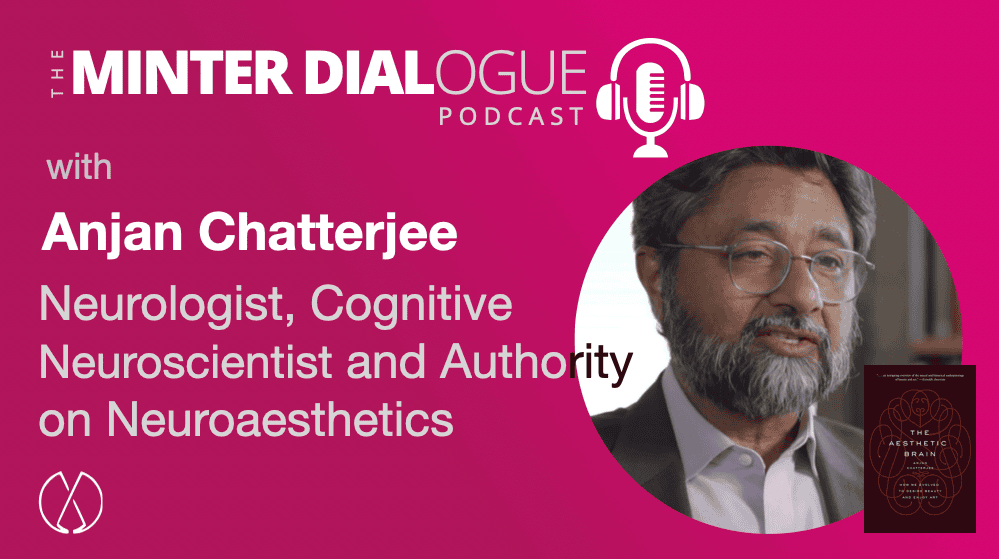
Minter Dialogue with Anjan Chatterjee
Chatterjee’s journey spans close to four decades in cognitive neuroscience, with a particular focus on understanding the human mind as it is manifested in the brain. In 2018, he founded the Penn Center for Neuroaesthetics, the very first research centre dedicated to unravelling the science behind aesthetic experiences. Our conversation spanned topics from the nature of consciousness, the ancient impulse toward beauty, and how cultural stories shape the way we perceive ourselves and others.
What struck me was the deeply human drive to seek, create, and surround ourselves with beauty—even as our definitions and values fluctuate over time and culture. Chatterjee highlighted how aesthetic appreciation is not merely about art but embedded in our evolutionary DNA, touching everything from the tools of our ancestors to the environments we build today.
Key Points:
- The Mind, the Brain, and Consciousness: Our sense of reality is filtered through neurological processes—raising questions not only about what we perceive as real but also how brain disorders can challenge fundamental assumptions about the self and awareness. Chatterjee illustrated this with compelling examples from his clinical research, such as patients with spatial neglect or disrupted senses of ownership over their own bodies.
- Beauty Beyond Culture and Species: The discussion explored whether the appreciation of beauty is uniquely human or shared with animals. Chatterjee suggested that, much like with language, beauty exists on a spectrum—rooted in evolutionary impulses but shaped by cultural and environmental contexts. His analysis of bird song and visual art revealed striking parallels.
- Culture, Storytelling, and the Conflation of Values: A key theme that emerged was how culture and storytelling profoundly inform our perceptions—of beauty, morality, and truth. Through studies of facial stereotypes and storytelling’s impact on the brain, Chatterjee showed how deeply culture imprints on our neural pathways, sometimes in ways that reinforce problematic biases.
Takeaways:
- The quest for beauty is both ancient and ever-evolving, as fundamental to humanity as language or toolmaking.
- Aesthetic experiences and moral values are often interwoven—sometimes to our detriment—by the stories we tell and the cultures we inhabit.
- Slowing down to truly “see” the world around us, especially in an age of digital distraction, is crucial for nurturing both personal well-being and our shared sense of what is beautiful.
Further resources for the Minter Dialogue podcast:

Meanwhile, you can find my other interviews on the Minter Dialogue Show in this podcast tab, on my Youtube Channel, on Megaphone or via Apple Podcasts. If you like the show, please go over to rate this podcast via RateThisPodcast! And for the francophones reading this, if you want to get more podcasts, you can also find my radio show en français over at: MinterDial.fr, on MegaphoneFR or in iTunes. And if you’ve ever come across padel, please check out my Joy of Padel podcast, too!
Music credit: The jingle at the beginning of the show is courtesy of my friend, Pierre Journel, author of the Guitar Channel. And, the new sign-off music is “A Convinced Man,” a song I co-wrote and recorded with Stephanie Singer back in the late 1980s (please excuse the quality of the sound!).
Full transcript via Castmagic.io
Transcription courtesy of Castmagic.io, an AI full-service for podcasters
Minter Dial: Professor Chatterjee, what a pleasure to meet you in person. So, rarely do I actually do in person interviews these days for people who have no idea what we’re about to talk about, because this is a very new topic, and it’s a very new topic for my podcast, but I think in the world in general and a topic that needs to be had. Dr. Chatterjee, please explain. How would you like to describe who you are?
Anjan Chatterjee: Who am I? First of all, thank you for coming, making the trip, and doing this in person. I much prefer to talk to people in person than across a digital screen, so it’s delightful that way. I am a neurologist and a cognitive neuroscientist. I work here at the University of Pennsylvania, where we are both sitting. I have been a cognitive neuroscientist for maybe close to 40 years. And along the way, just to step back, cognitive neuroscience is trying to understand the nature of the human mind as implemented in the brain and within that. For about 25 years, I’ve been interested in the nature of aesthetic experiences as something that is fundamental and core to what humans do. We tend to value aesthetic experiences of different kinds, and surprisingly, it had not been a real focus of scientific inquiry. So, that’s how I got interested in it. And in 2018, we formed the Penn Center for NeuroAesthetics, which is, to my knowledge, the first research lab dedicated to the neuroscience of aesthetic experiences.
Minter Dial: So, let’s talk a little bit more generally, the notion of mind versus brain and consciousness, because what we’re going to focus in on, of course, is the mind in this point, even though we’re talking about neuro and brain. Somehow, as I understand it, how do you qualify or define these three components?
Anjan Chatterjee: So, the three. The three components are the mind, the brain, and consciousness. I think of the mind as implemented in this organ. This is the nature of our mind. The mind or the brain interacts with the environment in a variety of ways. I think you can’t. In my own view, it’s very hard to come up with a mind without a brain. So, it’s materialist in that sense. Having said that, a term that philosophers sometimes use about one thing, superfluous on the other, meaning that it is grounded in something, but it’s not entirely explained by it. But for us, the brain is the vehicle by which to ask questions about the mind. Consciousness, I think, also depends on how you define it, right? Is it consciousness of, is it self-conscious? And those kind of definitions matter. I started my career in examining people with focal brain damage that produce various. Non intuitive observations of consciousness. So, there is a disorder called spatial neglect, which is when people have damage, particularly to the right side of their brain, particularly to the right parietal cortex, more often than not, that might act as though the entire left side of space doesn’t exist, or even the left side of their body is not theirs. And because their language circuits are relatively preserved, they can talk about it. So, you can talk to them and you can run experiments. And I’ve had people who insist the left side of their body is not their own, have held it in of front, front of them, say, well, whose body is this? They say, it’s yours. I say, well, I have brown skin. They agree to that. This is white skin. But nonetheless, they can’t be dissuaded from this idea that what I’m holding in front of them is my body, not theirs. And these are not people who are delusional in a classic sense. They haven’t had a history of mental health issues. And those kinds of observations raise questions of what is the nature of consciousness. I’ve studied people who have damage to their occipital cortex and are blind for all purposes and have no awareness that they’re blind. So, those are the kinds of phenomena as how I started my career Trying to understand the nature of consciousness in that specific context. What are we conscious of? How are we conscious of space? How are we conscious of the nature of input that is coming into us? How are we aware of ourselves, our own bodies?
Minter Dial: So, it really puts into question the concept of reality.
Anjan Chatterjee: It puts into question the concept of our representation of reality. So, physicists will talk about reality in a very different way. But for us, it is really what is our version of reality as it gets funneled through our sensory systems, through our knowledge systems, to the way our brains are organized. There are certain aspects of reality we know exist that we have no access to. So, for example, if we think about vision, our visual systems, our retinas are sensitive to a certain degree of electromagnetic radiation and things under that in the that are not part of our everyday reality, but we know it exists
Minter Dial: in today’s world. The idea of beauty. When you talked about the individual who couldn’t determine understand the left side beauty, which is central to what you’re studying with neuro aesthetics, but not only because it’s art. It’s a mirror of us as well. At some level there’s a. What does it say about us to study beauty?
Anjan Chatterjee: Yeah, well, beauty, at least culturally, seems to go in and out of fashion among academics. Right? So, there’s a period where in the world of art, people think that beauty is passe. And I’m told by artists friends of mine that, that for example, in art school for a while, one couldn’t speak about beauty. It was too naive or too simplistic or whatever. Having said that, I think that we are drawn to beauty and have always been drawn to beauty. And we also have a decorative impulse. You can go back as far as we have evidence of humans making artifacts that even things like early tools, Acheulean tools, people who are expert in that comment about the fact that these tools are made to be more than just functional, that there’s a visual form that it takes that seems to be aesthetically appealing. And so, we have this co-occurrence sometimes tension between efficiency and productivity and something else. And that something else often is beauty. And that something else is often a vehicle in which to have a certain set of experiences that we value. And we find ourselves driven to want to both create and want to experience. And really what is that? The mystery of that is what to me is endlessly fascinating. As someone who studies the human mind, the human experience, what is that? Right? Why do we care and where does it lodge?
Minter Dial: You talked about the left brain and the right brain. Of course, as we know, that’s not exactly how it goes down there. This definition that we’ve sort of galvanized, you know, brought around for everybody to believe there’s left and right. You, you talk about that. Where does one understand the beauty in the mind? And to what extent is that something that animals might or might not have? Because I mean, personally, if I’m looking at nature and seeing a beautiful sunset, while I may as an animal dream about it, I feel like even an animal must recognize something magnificent. They recognize things more like survival issues, fire, danger maybe. But is this something that is only human? Or is it, do you think that something possibly could be in an animal as well?
Anjan Chatterjee: I think every time we think there is something uniquely human, over time we get disabused of this notion.
Minter Dial: The delusion of grandeur.
Anjan Chatterjee: The delusion of grandeur that we are the center of everything. We’re the best, we’re the best, we are all of that. So, I think the null hypothesis, which is how we talk about sort of our default assumptions, is that there are continuities with the animal world. And then there might be certain things where certain things change. So, language might be a good example. Right. So, animals can communicate, they make noises. Some communicate more complex ways. But there is something about the human ability to create symbols and in this case words, and concatenate them and generate them that take something of which there are elements in other animals. But the consequences of that can be quite vast. Right. So, we build these kinds of structures and build. Build cities and build extraordinary things in a way that you might say a beaver builds a dam or a termite builds a mound. And certainly these are themselves architectural marvels, but they’re still not quite of the scale and complexity that. That we are capable of. And so, then do you say, is there a continuity or is there something qualitatively different? And then you get into the details of what that might mean.
Minter Dial: There are many things. My brain is going berserk on the number of thoughts coming in. In your book you describe, you talk a lot about, well, two animals in particular, and I have to read them. The Bengalese finch, so perhaps a hat tip to dad and the white rumped mania, which. These are the munia. Sorry, I read the audiobook, so I had to then transcribe. But in this notion of reflections with regard to animals, for you, in writing the book, to what extent was the discovery or research around the mind in the animal interesting to you, relevant to you, and impacted the way the book turned out?
Anjan Chatterjee: One of the things about writing a book, that book is that there are a set of ideas I had that I wanted to cohere, and there were things going on in the field that felt maybe needed to be pulled together. But in the act of writing, you’ll discover what you think. Right?
Minter Dial: Because the words are structuring.
Anjan Chatterjee: You have to put it down. Right. And, you know, I think I may be not getting this exactly right, but Mark Twain, I think, once said, how do I know what I’m thinking until I see what I’m saying? And so, there is a kind of almost a path of discussion, discovery as you’re writing, even though you might have a broad sense of where you want to go. And in this book, I didn’t know where I was going to end up. And this, this whole question, where the white ramp Munyan, the Bengalese finch came, was trying to understand not beauty per se, but art. And is how do we even think about art? Is art natural, kind? And you know, on the face of it, it seems as though art is a cultural construct that really came out of a certain period in Europe where these became these artifacts that were given this special property that they needed to be in their own places and museums. You know, maybe they were, you know, enriched people. People’s homes are in royalty. But there’s a kind of aura given to works of art that up until that time and still in most of the world, is just part of everyday people’s everyday lives. And so, this idea that is art a natural kind? And by natural kind, I mean as contrast to looking at people or looking at nature, and the question of whether you’re looking at an African mask or a Rembrandt portrait or a porcelain urinal, are these actually the same thing? Right. We give them the same word, and on the face of it, it seems like they’re not the same thing.
Minter Dial: I would just say, oh, I was laughing because I was thinking of porcelain from Limoge, something, you know, beautiful Chinese porcelain vase, but no, a porcelain urinal.
Anjan Chatterjee: I was like, as you know. And so, we’re in Philadelphia. The Philadelphia Museum of Art has one of these Duchamp urinals. And some people think it’s. It may have been the most significant work of art in the 20th century. So, critics will claim that. So. But the, you know, so the question was, what? How do we. Do we think of art as an expression, Expression of an impulse, an instinct? Or is it something else? And that, to me, the question which has been in the literature, perhaps was the wrong question, because it’s predicated on the idea that art is one thing, and then we can then talk about what art is. Is it this or is it that? Perhaps I thought the better question might be, under what conditions does this artifact that we call art really an expression of an instinct? And under what circumstances is this artifact that we also call art actually something else? And so, that was the strategy to try to understand that. And this is where the Bengalese finch and the white Ramanya became of interest. Because the basic idea is that there is this wild type finch that a group of Japanese collectors started to collect and then started to breed. But instead of breeding, as determined by the nature of the song, the bird’s song, which is what happens in the. The wild. Now they’re being artificially bred for their plumage, the way they physically look. And so, the song no longer has the same survival value that it does in the wild. And so, the question is, what happens to its song? On the one hand, you could think it would just degenerate and, you know, wouldn’t matter, but that’s not what happens. It turns out that the songs become more complicated, complex, they become more socially responsive, and they have a very different kind of structure. And in birds, we know fair amount about the neuroscience of their brains and how it’s structured. And it turns out that the implementation of these songs in the Bengalese finch, which are more varied, more responsive to their social environment, is also more distributed. And so, the argument is that using by analogy in the songs, that here’s one kind of song, we’re calling them bird songs, we’re not calling them different things, one that is more stereotypic, that is responsive to certain environmental pressures. And here’s another kind of thing that we’re also calling a bird song, that when those selection pressures are released, there’s a kind of freedom and opening up of it. And so, the question was, is that an analogy that works with art, which is when, again, put this in a European context, when art was really determined by the church or by royalty, there are certain ground rules and certain things it had to maintain. And once it’s released from those kinds of cultural selection pressures, it’s allowed to expand. And so, you can get a urinal, you can get, you know, you can get, you know, a black square, you can get all these things that now we call art. And it, they’re challenging because they’re responsive to local cultural features. And so, just because you might, you might have a certain experience in an educated class in an urban American or urban London or urban Paris, doesn’t necessarily mean that people in different parts of the world or without the education or background are going to have the same experience.
Minter Dial: So, just to translate for me what I was listening to, what I was hearing, was that birds would have plumage that was very non distinct, nondescript, and their song, song was the beauty that attracted their, Their sexual partner.
Anjan Chatterjee: Yeah.
Minter Dial: Because in, in your book, you talk about natural and sexual selection being these instincts that we have. And, and you, of course, you, you vie for a third path that when we’re talking here is now is the, the context within which any art is the judger somehow of, of its value. And, and that in a less constrained world, we end up with more freedom in the expression of that argument.
Anjan Chatterjee: Yes, yes, we end up with more freedom in the expression of it and along with that, the more complexity in its interpretation.
Minter Dial: So, when we break down concepts of beauty or I’m not going to say art, but beauty, you say in the book that people have a generally same idea with regard to nature and faces, human faces, but it varies more wildly. I Say widely. Anyway, when it comes to art and beauty, one of the things that I have been writing and looking at is this, trying to understand to what extent it’s maybe, and maybe this is the question, how do you feel your book is with regard to the idea that everything is beautiful? Everyone is beautiful.
Anjan Chatterjee: I mean, there’s a way in which we would like to believe that, and it sort of in some ways flattens the idea, right. If everybody’s beautiful, then.
Minter Dial: Then there’s no beauty.
Anjan Chatterjee: There’s no beauty. Right. So, I think they’re. They’re, you know, in the same way that we don’t say everybody is the same height. Right.
Minter Dial: Same skin color.
Anjan Chatterjee: Skin color, right. So, there’s. There’s variability and there’s some. Something desirable about that kind of diversity. Now, one of the areas that we are interested in is the way in which the connection between aesthetic and moral values and this I didn’t touch on a lot in the book, but this idea that we. We are very good at discriminating between objects, but we are not very good at discriminating values, different kinds of values. And so, there is this notion that attractive people, physically attractive people, are imbued with attractive moral characteristics and they are more intelligent, more competent, more trustworthy, warmer, all of this. One of the unfortunate consequences of that conflation, which since the book we’ve been investigating a fair amount, is there is also facial anomaly, is bad stereotype that seems to be built in. So, people who have scars or developmental abnormalities or burns, other people frequently think that they are less intelligent, less warm, less trustworthy, and so on. And so, that’s an instance where you have one set of values that are variable, another set of values that are variable, and they get conflated in problematic ways. And we think culture plays a huge role in this. We have a recent paper showing. So, let me step back. We know something about the neural implementation of this kind of response. We did a study in Tanzania with the hunter gatherer tribe to look at this. And we find that they, as best you can tell, because it’s not easy to do experiments in the field like that. As best we can tell, they don’t have the same stereotypes that every other population we have looked at, which got us to thinking about, well, how is culture really imposing this and writing this into our brains? Because we know it’s written into our modern Western brains or brains in this culture. So, we think that the stories we tell end up becoming very important. And we looked at the last 40 years of Hollywood movies and 20 years of Bollywood movies and did this whole analysis of heroes and villains. And we showed that it is the case that heroes are. Or villains are often showed. Shown with certain kinds of scars that are more prominent, and they’re particularly around the central part of the face where we tend to be. Where we tend to tend. Whereas heroes, if they have scars, they’re kind of off to the side, you know, the forehead. Humphrey Bogart had a scar there and things like that. And so, one thing, and this is a message we give our kids. So, the Lion King is a perfect example.
Minter Dial: Scarface.
Anjan Chatterjee: Scarf. Right. It’s like we don’t even have to. The poor guy doesn’t even get a name. Right. So, I think we’ve gotten more interested in how it is that these. These cultural tropes. You know, Star Wars, Darth Vader becomes Darth Vader at the time that he gets a scar on his face. Right. There are these kind of cultural myths that we get, you know, that we are fed and it kind of. It gets imbued in our thinking of the way in which aesthetic values and moral values are conflated in problematic ways. And we emphasize that in the. In the contemporary mythology, which is movies.
Minter Dial: You mentioned storytelling. Do we have any material evidence of what storytelling does to our brain?
Anjan Chatterjee: There are some people that have looked at that we haven’t in any systematic way. I think we. The general idea is that we are enamored of stories. Right, Right. That’s. I’m not revealing anything that your listeners don’t know. Definitely true. Definitely, definitely true. But there is a. An argument, again, an evolutionary argument made, that stories expand our experiential repertoire without us having to physically experience it. Right. So, someone tells you, don’t walk down that alley because it’s dangerous and bad things are going to happen. Right. We were willing to accept that, most of us, as opposed to actually walking down the alley to say, well, let me see if that person is correct. So, I think there is this idea that stories allow for a certain kind of transportation. It’s important for our imagination to be able to put ourselves in a situation. Situation that we physically are not in. And under some circumstances, it also is a vehicle for notions of empathy that you can empathize with certain kinds of characters. You can put yourself in their. In their position. And so, I think the. The stories become a technology to allow for imagination, allow for empathy, the. Allow for perspective. Taking in a way that expands us from our highly localized experience into something broader and into a shared experience culturally becomes a shared Experience, it can be a shared experience among friends and so on.
Minter Dial: Well, I mean, the reason why this is important in germane to your book is that we’re looking at an artwork, a urinal, and there’s a story that we tell ourselves or is being told to us. And then that story goes in through the air, presumably if it’s orally said. And then things happen in the brain as a result. And I’m wondering whether we have any evidence of it rewiring the brain synapses, going off crazy and creating some sort of hormonal reaction. I mean, this is way beyond my pay grade in terms of knowledge of the brain. But it seems important because the interpretation of that art in a context ends up being a story that we tell ourselves and that is transforming us and also changing us. I’m not going to go down that corridor anymore.
Anjan Chatterjee: In a smaller way, there are some experimental evidence that speaks to what you’re bringing up. Those kinds of experiments are very hard to do. Constraints.
Minter Dial: Well, by the way, pretty much everything you’re doing in the brain is difficult to do. I mean, we have a long way to go to understand exactly what’s going on up here.
Anjan Chatterjee: And for your readers, it’s worth knowing that making explicit that experimental science is always incremental, our results are always provisional. Right, and you’re building a story over time. Sometimes non-scientists have this notion of scientists as being very deterministic and very certain about things. It’s almost always the case that the certainty comes a couple of layers away from scientists or people talking about other people’s work. So, just to be clear, here are things we do know experimentally, that if people are given certain some contextual information about art, that their appreciation of the art improves. This is especially true in people who have had less exposure to art. We did a study looking at both Americans and people from India, looking at both American art and Indian art. And you know, from various measures we have of their judgments of what’s going on, and we were asking, is there an in group bias? Do people from one culture prefer art from their own culture versus the other? What we found was that the people who had more exposure to art had very little if any cultural in group bias. They were able to generalize beyond the culture and appreciate art. And different cultures, people who had the least amount tended to have more of an in group bias. And that was more true in America than in India. We suspect because in America people don’t really know much about Indian art. But in India, people are more likely to know about American art just because of the cultural diffusion. But in both cases where when given more contextual information, that that gap decreased. So, a little bit of information can go a long way. And the kind of. The optimistic view of this is that art contextualized can be a way to minimize these kinds of cultural divides and be another vehicle for communication across cultures if not done well. So, that’s a kind of optimistic.
Minter Dial: Yeah, because if done well, it makes me think about like history is something you could. We could share together about. And I explained to you the history of this artwork. Yeah. But the narrator, the victor, is the one describing the narrating. The narrating. And then that’s a whole other can of worms.
Anjan Chatterjee: So, yes, absolutely. Who gets to tell the story and what is the story? Right. That. That’s a whole other can of worms. But going back to your question, is there anything in the brain that we know about this? And one, there are the kinds of. The kinds of experiments that have been done are looking at people who have a certain kind of knowledge or expertise as compared to naive people when they’re encountering the exact same thing. Right. So, there’s one experiment that was done looking at architectural facades, and the participants were either people who were studying architecture, so senior graduate students versus graduate students in another domain. So, you’ve got people who are similar fades, similarly involved in some kind of study. But one group has specialized knowledge, or they’re gaining specialized knowledge. And what you find is that both groups are responding to beautiful facades and parts of the reward systems in the brain. But architecture students have additional kinds of involvement. And so, they are various parts of their medial temporal cortex, where we think memory and meaning are encoded, are also activated. And so, we take that as evidence that when people are experiencing something beautiful, if they have knowledge, and wherever that knowledge came from, it could be from stories, it could be stuff that they read that comes into play as well. And so, that’s a kind of hard evidence that we see in the brain generally. The models we use is something we refer to as the aesthetic triad, which is that our experience of beauty or any aesthetic experience is informed by three large scale systems in the brain. One has to do with the nature of our sensory and motor systems. So, going back to the example of our visual system is only sensitive to a certain range of electromagnetic magnetic radiation, might be the most unbelievably beautiful things happening in ultraviolet, but we don’t know about it. Right. So, there’s a kind of constraints and guardrails that our sensory and motor systems provide. And then what’s the emotional response to that? If it’s beauty, there’s often pleasure. But it can be more complicated than that. You can have bad mixtures of anxiety. So, when people talk about the sublime or odd, there’s always a little bit of anxiety in there. How about that cocktail of emotions is. And then semantics and meaning, which is the education, our personal backgrounds, our cultural backgrounds, what point in history we happen to be living in, how that overlays on this relationship between sensation and emotion. And so, that’s the way we try to carve it out and ask questions about what’s going on, on in the brain in the context of an aesthetic encounter.
Minter Dial: So, one of the burning questions for me has been subject of much debate in our household is the idea of absolute beauty. And the one side, one school, the house, says that there is such a thing as absolute, absolute beauty. How is it possible that anyone going by a sunset overlooking the Pacific Ocean cannot find that just jaw droppingly awesome, a peacock with their feathers out there? It seems like it’s a universal beauty. It’s different when it comes to human beings amongst one another. So, to a, is there such thing as an absolute beauty? And two, do you think it could be, if possible, something that we could define universally?
Anjan Chatterjee: So, the way a scientist thinks about this question is about variance. How much variance is there? Right. And so, a notion of absolute beauty would say there is zero variance. Everybody seems sees this is going to have the same experience. That seems extraordinarily unlikely. Right? So, you can talk about degrees. And so, as we’ve said that human artifacts, people are more consistent with. People are more consistent with natural kinds, with human faces, human bodies, with nature than with human artifacts, whether that’s art or architecture. Talking about the aesthetic triad, it’s also worth pointing out that the kind of semantics meaning piece becomes really important. So, one could look at an absolutely gorgeous sunset, to use your example, and somebody might think the reason this is so gorgeous is because of the amount of pollution there is in the air and how it’s dispersing the light. And so, that knowledge is just going to make it not as beautiful as if you were just having a purely sensorial experience.
Minter Dial: It’s a little bit more utilitarian. It’s not some sort of pure aesthetic. It’s. There’s some benefit to it, there’s some
Anjan Chatterjee: benefit to it, or there’s something that’s selling what otherwise is really beautiful. And we can’t. I mean our minds are not capable of separating these out at the moment. Right. So, you have this knowledge. We have a. We have a study that was just recently published where we asked the question of do people’s experience of a work of art, does it vary based on what they think they know about the morality of the artist? And the answer is yes.
Minter Dial: Right.
Anjan Chatterjee: And you know. So, you know, so I think these. These things get pulled in. And because we are different from each other. Right. We are similar and we are different. Right. The differences also influence those experiences, which would make me think that it is extremely unlikely that you will ever have a situation where there is zero variance in people’s response to any object, any scene. There might be high degree of agreement, but the idea of a pure universal seems unlikely.
Minter Dial: I love that answer. It’s very illuminating. I have two other areas I want to talk about. One of them is the transcendental values of beauty, goodness and truth. To what extent does do the other two impact or play a role with regard to an evaluation of beauty?
Anjan Chatterjee: So, we touched on beauty and goodness a little bit around the values. The moral values. Right. So, goodness is about moral values and that those conflate both in ways that. Both in terms of. When looking at people that we impugn certain moral characteristics. And it goes both ways. Ways. Right. So, a good person starts to look more attractive. And we’ve shown that as well. And I think that comports with most people’s experience. The first time you meet someone, you have a certain sense of what they look like, and as you get to know them, you find their personality more attractive and more appealing or less appealing. And physically they look more attractive or less attractive over time.
Minter Dial: Back to our sexual wiring. Somehow, you know, are we. Are. It’s not a sexual relationship, but it’s like a mutual affiliation.
Anjan Chatterjee: Yes, absolutely. So, there’s that happening. We have not formally looked at the relationship between beauty and truth. And so, my answer is just going to be my intuitions and not grounded and any actual work. I suspect truth is also its own value system that can get conflated with beauty in ways that sometimes make sense and sometimes don’t. So, there. Sometimes, among some scientists, there are these notions that a theory must be true because it’s beautiful, it’s elegant. Right. And I. It’s not obvious to me why that should be the case. Right. The world can be messy. Right. If we’re looking at the nature of the world, I don’t know why an elegant theory inherent. I mean, it’s. It would be fantastic. Right. Through elegant. But it’s not on first principles. It’s not given to me that something that is an elegant explanation of natural phenomena is the right one. So, you know, so I think, at least the way I think about it is these are three transcendental pillars of values. And the question becomes less about the world and more about the nature of our minds. How do we, how do those values become conflated?
Minter Dial: Well, you mentioned elegant, the elegant universe and this notion of messiness. When we look at perfection, there’s this Da Vinci ratio and there’s somehow a constant desire amongst certain companies, people to seek perfection. And yet I have to believe that imperfection which reflects on who we are as messy, imperfect beings is why fundamentally imperfect objects are more beautiful than perfect objects.
Anjan Chatterjee: Yeah, I suspect that’s true. And there is a way in which we can empathize with something with slight imperfections a little more.
Minter Dial: As opposed to the scar faces. Who. That’s, that’s totally bad.
Anjan Chatterjee: That’s right.
Minter Dial: But the little imperfection, the mole on
Anjan Chatterjee: the cheek, a little bit of face symmetry. I mean, one way, one way we see this is there is this notion of symmetry, right, in faces symmetry. More symmetric faces are generally more attractive. However, given how easy it is to do now with digital technology, you can make absolutely symmetric faces with no deviation. People find that a little weird. They don’t know why, but there’s something not right about that. So, now you’ve got absolute perfect symmetry and there’s a kind of an uncanny valley quality to it. People don’t say, oh, this is really beautiful.
Minter Dial: Well, I’m thinking also on the other side of that scale, broken windows, the idea of if there were broken windows, it doesn’t encourage people to clean up and be civil. Whereas if there’s beauty, it does have an impact on us. Is that if you look at. Just taking a step back, last question on the state of the world. To what extent do we need more beauty in our world.
Anjan Chatterjee: Right now? We live in a very ugly world. I think the people are, I’m going to make some broad brushing claims that people tend to be lonely, anxious, alienated. Right.
Minter Dial: The studies show over and over and over.
Anjan Chatterjee: Right. There’s more depression, people are more. The combination, I think, of the digital world that we have created around ourselves that disconnects us from nature, disconnects us from each other. And then the impact of the pandemic and the lockdown, which seems to really amplify some of those, those qualities, I think there’s been a real disruption that is ongoing. And the, the desire, I think, to Reconnect with nature, to reconnect with our emotions and reconnect with each other is deep. And one vehicle for that is beauty, is beauty as art, as a way of something that intrinsically draws us in. And so, I think we need beauty as much as ever, especially in the conditions we find ourselves.
Minter Dial: Now, if you go back to what you said earlier about the freedoms that one has, it strikes me then this is my interpretation of what you said is that we might be in a more constrained environment. And that actually can end up being a good thing for us to refind our roots, as opposed to believing in limitless possibilities, that sort of excessive freedom which ends up with urinals somehow. And we need to come back to some basics.
Anjan Chatterjee: Some basics and basics of means of expression. So, Philadelphia is a fantastic city for street art, right? There are murals in every. Pretty much every part of the city. Is the largest open air art gallery in the country.
Minter Dial: You can walk around even more than Austin, Texas.
Anjan Chatterjee: Even more than Texas. I mean, there are between four and five thousand murals in the city. And that’s not even talking about just the. On every lamppost and abandoned wall, like all of this artistic, just expression. And it’s. I mean, you know, we were talking about, you know, great art cities like London, Paris, Florence earlier, but you can, you can walk down a block and it can take you an hour if you stop and look at all of the stickers people have posted, all of the expressions of their political freedoms or their desire for political freedom, or their expressiveness. I mean, it’s extraordinary, this outpouring in public spaces from people who are not well known, but are doing this. And so, I think that in some ways, to me, is a reaction to this alienation, these ugly times we’re in, that people need to express what they’re feeling and what they would like, their aspirations as well.
Minter Dial: So, the message that I’m taking away from this strategy is that we also need to take the time to smell the roses, per se, observe our surroundings and, and let that be good feedback to feed ourselves.
Anjan Chatterjee: So, that also we’ve done some work on. It’s this notion of slow looking, right? We are all in such. We live manic worlds, fast world, fast worlds, right? It’s like we’re doing this, we’re doing that, we’re doing this. And how do you slow down? And that, I think, is a skill. It’s a habit, right? And that you need to learn it. So, we’ve done experiments getting people to look at one work of art for 15 minutes. And how do you do that? How do you give them some structure to do that? And we find that when people do that, if given the means to do it, their experience of the art becomes more profound, that they’re more engaged, that they, they just get more out of it. So, we. One way of thinking about this is art in this context. Is this a vehicle more generally to. What you’re saying is can we slow down? Can we be present? Right. Can we live in the now without living in our immediate past and our immediate future? I mean that has to be done, but we also be able, we need to be able to sort of switch gears when we’re thinking about the past or thinking about the future, but also be present in the now. And that’s something, something I think many of us in the world we live in have lost. And this kind of engagement, slow engagement with art, is maybe a way to recover something that’s deeply human of being present.
Minter Dial: Beautiful last words. So, I know you’re writing a new book. Tell us. Well, first of all, how can anybody get your current book? Find out more about your reading and can you give us mic drop hint about the new book?
Anjan Chatterjee: So, our, you know, so I’m at the Penn Center for Neuro Aesthetics and if you do a search on that, you’ll find what we’re doing. You’ll find links to papers we’ve published. I also write a blog in Psychology Today that is takes most of our academic academic work and presents it in a non-technical language.
Minter Dial: Good for me.
Anjan Chatterjee: Well, good for anyone who, I mean it’s a good exercise for us to try to write our science in a way that someone who is not a scientist can understand and really get what the point is. So, I think that’s all available. I think the book where we started talking about this theory, Aesthetic Brain, is available in most platforms and so on.
Minter Dial: I’ll put all the show notes. Yeah, of course.
Anjan Chatterjee: The book I’m working on right now addresses some of these issues that we’ve been talking about. And it really is centered around a notion of the mismatch. It’s called the mismatch hypothesis, which is that our brains evolved in a certain time, mostly the Pleistocene, about 1.8 million years ago. And the features of our brain were selected to adapt to certain kinds of environment. And in the last 10 or 12,000 years since we became domesticated, especially last 200 years, especially the last 50 years, especially last 10 years, we have created an environment, environment around ourselves. This is of our own making, an environment that is not what our brain was designed to flourish in. And so, it’s part diagnostic to say, here’s a problem that we have created and what are the ways of getting ourselves out of it? And underneath that, it’s a biologic argument that what we have done has really disrupted the core of our biology in a way that, like all living organisms, we have a homeostatic range that we need to exist in this to flourish. And we have pushed ourselves to the edge where we have very little reserve. And so, we are triggered constantly. And so, the broader idea is there are these big, big political and cultural assaults that. That we’re all experiencing. Part of our inability to deal with many of those is because our biology is already pushed in a direction based on what we have created, and if we can recover ourselves back. I’m not telling people it’s not prescriptive in the sense that this is what you should do because of all of the injustices in the world, but this is what you should do so that you have the reserve to deal with it and however you think is correct.
Minter Dial: Because this is brittle.
Anjan Chatterjee: Yes, exactly.
Minter Dial: We’re about to break. Beautiful. Well, mismatch. Watch this space. Professor Shatoji, thank you so much. My pleasure.
Anjan Chatterjee: Yeah. All right.
Minter Dial: And there. I almost got you.

Minter Dial
It’s easy to inquire about booking Minter Dial here.