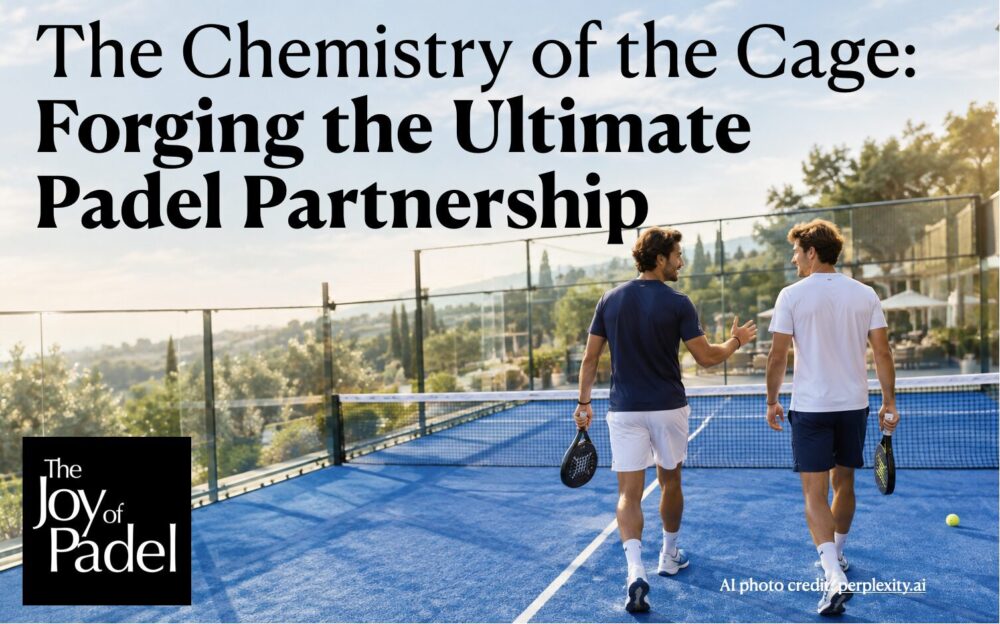
How do you choose the right partner in padel?
For the vast majority of recreational players, the answer is a revolving door of WhatsApp groups, last-minute drop-ins, and awkward court bookings with strangers. Most of us don’t have a regular partner. But if you look at the professional circuit, what can we learn about how to choose the best partner? It turns out that, outside of the top eight duos, the number of pairs that possess true staying power—the lasting, deep-seated desire to develop together through the inevitable ups and downs of a gruelling season—is, by all accounts, much reduced.
Those at top of the FIP rankings tend to stick together in the hunt for FIP points and hopes of becoming number 1. But they only remain as a team to the extent that they continue to get to the semifinals or better. For the rest of the pack, there is a remarkably short fuse. If they don’t break through immediately, the partnership often evaporates.
This got me thinking, as I so often do when analysing the intersection of human behaviour and sport: what actually makes for a good and durable pairing? In many ways, understanding a padel partnership is a little like understanding what makes for a good marriage. On one hand, you have the baseline, complementary skills. At a minimum, who plays left and who plays right, and is that the right physical and tactical combination? But in reality, it is infinitely more complicated than that. Where is the chemistry? How are mistakes handled in the heat of the moment? How do you digest a brutal defeat together? How well do you train together? How much do you enjoy each other off the court? Ultimately, what is the uniting force?
The Power of the Shared Project
It used to be that when professional players formed a new duo, they established what is usually called a “project.” For example, a pair would explicitly state their mission: to become the number 1 team in the world within a two-year timeframe. The obvious paradox here is that there can only be one number 1 at any given time. But the metric itself isn’t what matters. The profound importance of having a project is that it becomes the guiding principle for the dedication, the effort, and how you manage difficult situations.
When you find yourselves in a tactical or emotional pickle on the court, the uniting force of a shared project is the safety net that sees you through. You know exactly why you are fighting together, sweating together, and suffering together. You are aligned under a singular, mutual goal. Without that overarching narrative, you are just two individuals sharing a 20×10-meter cage, waiting for the first sign of trouble to look for an exit strategy.
A Front-Row Seat to the End of a Team
I witnessed, alongside my brother and his two kids, the precise moment this fragile thread snapped for one of the tour’s top 10 duos. I was watching from the sidelines on an external court at the Paris Major 2026 at Roland-Garros, observing what would turn out to be the end of the partnership between Javi Garrido and Lucas Bergamini, seeded 9th for this Major.
It was not a pretty sight.
In fact, the first set against the lower ranked Javier Martínez (55th in the world) and Luis Hernández Quesada (49th) was essentially a tactical bloodbath. Garrido, the heavy-hitting Spaniard currently ranked #20 in the world, was making unforced errors one after the other. He was visibly tense, his body language entirely deflated, looking almost resigned to his poor play. The court at Roland-Garros can be a lonely place when your rhythm deserts you, and the psychological weight on Garrido’s shoulders was palpable.
They lost that round-of-32 match with a scoreline of 6-1, 7-6(6).
To appreciate the gravity of this exit, you have to look at their history. Garrido and the gritty Brazilian Lucas Bergamini (#16) originally joined forces back in October 2024, ironically making their debut as a pair at that year’s Paris Major. After a temporary parting of ways during the 2025 season, they chose to reunite at the start of 2026, explicitly aiming to establish a long-term project on the Premier Padel tour.
Across their stints together, they accumulated a highly respectable lifetime record of 43 wins and 26 losses in 69 total matches. They proved they could capture lightning in a bottle, most notably winning the FIP Gold Abidjan title in June 2026 in a dramatic, three-set thriller against Juan Tello and Maxi Arce (6-3, 3-6, 7-6). They had pushed the world’s absolute best to their limits, famously snapping Arturo Coello and Agustín Tapia’s historic 130-day streak of not dropping a single set during a fierce encounter at the 2024 Kuwait P1.
Yet, none of that historical equity mattered in Paris. Their worst stretch of form, preceding Paris, culminated in three consecutive first-round eliminations on the Premier Padel circuit. Sitting literally metres away, the tactical breakdown was obvious, but the emotional divorce was what caught my attention.
I saw little to no synergy. At one point during a changeover, Bergamini was looking directly at and speaking to Garrido, trying to find a solution. Garrido was staring entirely the other way, completely disengaged. Even though the second set was much closer and the number 9 seeds became competitive, the damage was done. The words of encouragement they shared felt hollow, like canned responses from a corporate script. When the exhortations sound repetitive (“¡vamos!”) and lack genuine variation (“too bad”), there is an evident lack of complicity. At that point, the official announcement of their split felt like a mere formality.
The Optimal Partner Checklist
Whether you are trying to break into the top 20 of the FIP rankings or simply trying to win your local club’s weekend ladder, the anatomy of a successful partnership remains similar. Based on my observations from the pro tour and my own time on the court, here is the definitive checklist I use to find an optimal, durable partner.
Phase 1: The Baseline Foundation
- The Equality Principle: You need to have roughly the same general skill level. If the gap is too wide, the stronger player will inevitably find themselves being “fridged” (isolated by opponents who play every ball to the weaker player), leading to frustration for both parties.
- The Puzzle Fit: If you are both right-handed, who plays on which side? While ego frequently gets in the way of this choice, what matters is the optimisation of the team. Do your physical attributes and strengths complement one another’s weaknesses? If one has a weak overhead smash, the other must possess an aggressive, commanding aerial game.
- The Off-Court Anchor: How well do you know each other when the rackets are packed away? How solid is your relationship off the court? Do you actually like, trust, and respect one another as human beings? When the pressure mounts, respect is the buffer against resentment.
- The Project Alignment: Do you share a collective ambition for your padel journey? You must define what success looks like. Is the project simply to have fun and get some exercise, or is it to systematically improve your ranking and win some tournaments?
- Logistical Harmony: Do you have compatible schedules for mid-week practices and weekend tournament commitments?
- The Geographic Sweet Spot: Do you both live close enough to your preferred clubs? Travel burnout is a silent partnership killer that breeds friction before you even step onto the turf.
Phase 2: Deepening the Connection
Once the logistics are settled and you begin playing regularly, these five deeper, cultural elements become the true markers of a sustainable pairing:
- Real-Time Communication: Have you established an active, clear communication system? Can you fluidly provide constructive, real-time calls while the ball is in motion, telling your partner concisely where the opponents are moving?
- Empathy in Mistake Management: How do you react when your partner hits an easy volley directly into the net? A durable partner lifts their teammate up after an error, rather than weaponising silence, eye-rolling, or displaying negative body language.
- Grace Under Pressure: Do your temperaments remain stable and hyper-focused during high-stakes moments? True character is revealed during a sudden-death golden point or a second-set tiebreak.
- Tactical Congruence: Are you fundamentally aligned on a baseline strategy? Can you anticipate what shots your partner is going to make? You must instinctively know when to switch sides, when to play a patient lob, and exactly when to rush the net as a unit.
- A Shared Willingness to Dig Deep: Are you both prepared to suffer together on the court? Are you willing to systematically practice repetitive tactical sequences and put in the unglamorous work required to evolve?
Padel is unique because the proximity of the four players creates an emotional pressure cooker. You cannot hide from your partner, and you certainly cannot hide from your opponents. As the demise of the Garrido-Bergamini project reminded us in Paris, technical talent will only take you so far. Without a shared project, genuine complicity, and mutual respect, the glass walls of the padel court will eventually close in on you.
Choose your partner wisely—not just for their smash, but for how they stand by you when the smash deserts you.