
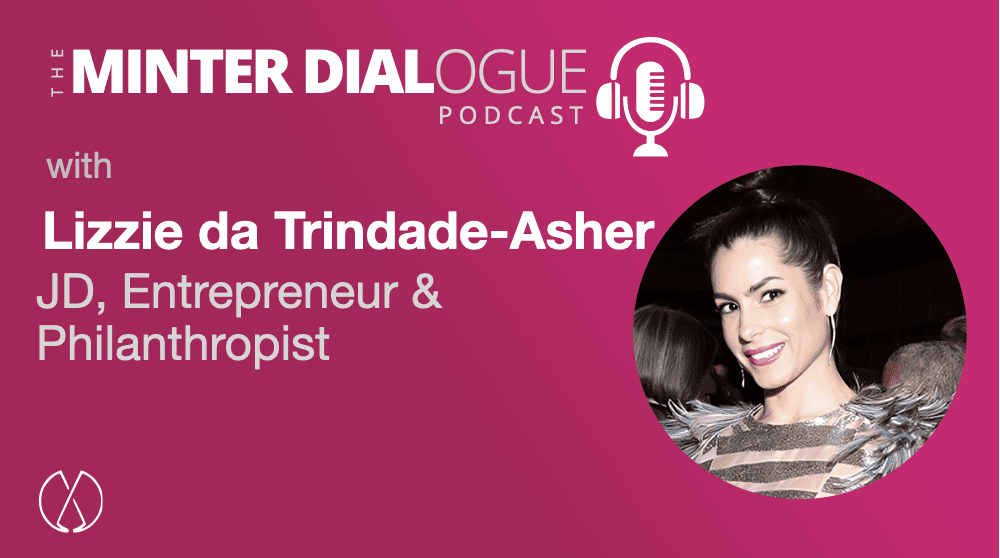
Minter Dialogue with Lizzie Asher
I had the pleasure of speaking with Lizzie Asher, a remarkable woman with an inspiring life story. Lizzie shared her journey as an immigrant from Peru, her experiences as a competitive swimmer, and her near-death experience during childbirth. She spoke passionately about the importance of perseverance, the power of the mind, and the value of sports in shaping character.
Lizzie’s commitment to making a positive impact on the world was evident throughout our conversation. She discussed her involvement with various charitable organizations, including City Squash and Save Venice, emphasizing the importance of finding causes that resonate with one’s heart.
We also touched on her family’s spirits company, Macchu Pisco, and her husband Daniel’s entrepreneurial venture, Entegra. Lizzie’s story is one of resilience, determination, and a deep-seated desire to give back to society.
Our conversation ended with a powerful call to action, encouraging listeners to find what they care about and take small steps towards making a difference in the world.
Other mentions/sites:
- The book “Bounce, The Myth of Talent and the Power of Practice” by Matthew Syed here on Amazon
- Other mentions: you can find the interview with Saul Ezra here
Further resources for the Minter Dialogue podcast:

Meanwhile, you can find my other interviews on the Minter Dialogue Show in this podcast tab, on my Youtube Channel, on Megaphone or via Apple Podcasts. If you like the show, please go over to rate this podcast via RateThisPodcast! And for the francophones reading this, if you want to get more podcasts, you can also find my radio show en français over at: MinterDial.fr, on MegaphoneFR or in iTunes. And if you’ve ever come across padel, please check out my Joy of Padel podcast, too!
Music credit: The jingle at the beginning of the show is courtesy of my friend, Pierre Journel, author of the Guitar Channel. And, the new sign-off music is “A Convinced Man,” a song I co-wrote and recorded with Stephanie Singer back in the late 1980s (please excuse the quality of the sound!).
Full transcript via Flowsend.ai
Transcription courtesy of Flowsend.ai, an AI full-service for podcasters
Minter Dial: Lizzie Asher, great to have you on the show. It’s a funny set of circumstances that we, I, I get to have you on my show because I, I have met only by virtually your husband, Daniel, and of course I hang out a lot more with his brother, Adrian, in London. And I had the great pleasure of having his or Daniel and Adrian’s father on my show talk about life. And, and your name popped up and we thought, hey, listen, there’s another great reason to have a lovely life story. Of course it’s in the middle of life, as opposed to the Saul’s version. But let’s say start off with in your own words. Who is Lizzie Asher?
Lizzie Asher: Oh, wow. I will try to be succinct, as you said, in the middle of life. And yet I have had so many iterations of who I am as I was born in Peru but grew up in the US So, I think my first label would probably be that of immigrant. My second label would probably be that of an athlete. Lizzie, as an athlete in sports, having been such a formative strain of who I am today and what has taught me and helped me through so much of the challenges that I’ve encountered. Also, I will have to brandish the Harvard name because my mother is so utterly proud of having two Harvard grad daughters. But most importantly or equally as important, I should say, is that thanks to Harvard, that’s where Daniel and I met. My husband and I met. I am an entrepreneur. With my sister we started a company, or rather she founded it. She’s the sole founder and with my JD, I came in to assist her. The entrepreneurship bug is in the family now. Daniel’s launching his company and likewise my JD is one of the pistols that he gets to shoot and fire as we bring Entegra to life. I am also a mother to a wonderful. I guess I no longer can say baby boy, but baby boy will probably be the term for my entire life as my mom always refers to us as her baby babies. Leonidas Ezra, who was born as a micro preemie. And I would have to say that I am an odd-defier as when Leonidas was born, I had a 0.1 of 0.1% of survival due to such a traumatic birth. So, it brings us where all the way fast forward where I am today and I would say I’m a mom of a child with special needs, which makes me the ultimate multitasker and huge advocate of philanthropy and activist in politics.
Minter Dial: So, wow.
Lizzie Asher: Yes, all of those things. Talk about being a multi hyphenate yeah, exactly.
Minter Dial: I mean it was always or interesting or maybe tricky is the notion of labels. Right. Do you want to be defined by those labels and whatnot? But obviously that’s just about putting together the assortment of flowers in your bouquet. And so, let’s talk about the, the rival from Peru because it’s not your average immigration story, at least not so many immigrants from Peru there. In the United States in particular, you’re talking much more about Mexico. There’s, I mean, of course there’s lots of different Latinos who come to America, but how was your arrival into the United States?
Lizzie Asher: Yeah, that’s actually a really good question. And I think it is probably something that is lost so much in the immigration debate here in the US And a distinction as to what are the motivating reasons why people come to this country personally. For my family story, it wasn’t so much related to a need for economic prosperity, which is probably what happens with the some of the Mexico and Central American travel. My birth country of Peru had a very challenging decade in the 80s when Shining Path, which was a, what is called a revolutionary movement, had captured the nation. And mind you, I am putting that revolutionary in quotes. There were many philosophies that they espouse of equality that while certainly revolutionary to some people who believe in the hierarchy that enthralls the country, needed to be shaken up. But the means by which they went about it was very disruptive to everyday life. And so, that meant my mom really wanted to have a place where her two daughters would have stability. And so, grandparents organized for us to come to the United States, to the D.C. area where my aunt was already living and had married when she had come here to study medicine at John Hopkins.
Minter Dial: Wow. So, you, what age were you when you, when you landed in DC?
Lizzie Asher: Oh, I arrived in the US when I was 12. I didn’t speak English and I probably which is hard to believe because most people with think that I am quite loquacious. But I didn’t speak for almost a year. I was terrified of speaking it probably because I didn’t want to suffer an embarrassment. And so, I had no friends. I cried most of the time. It was very challenging to have left behind friends and come to a country where you knew nobody and had to start all over again. And I think when you come at that age, you think, oh well, you’re with your family, that’s just not enough. I think when you’re a kid and.
Minter Dial: What that means, you’re just about to become a teenager, you know, You’re.
Lizzie Asher: Yeah, you’re in the main friendships. Yeah, yeah, exactly, exactly. But there come sports and I have to say sports were my lifeline because I was a swimmer. So, I got to join the swim team and found a place where to flourish.
Minter Dial: And your sister, just so I finish on that, she’s younger or older?
Lizzie Asher: Younger. We’re Irish twins. I don’t know if that’s PC to say. So, maybe I just totally stepped on that. I shouldn’t have said that. But people say that all the time and I’m not quite sure why that that is not. So, maybe I should refrain.
Minter Dial: But yes, there are so many words that are. People take offense with. But on the end of the day, let’s call a spade a spade. I don’t know. But. So, she was younger, presumably not quite as attached to home, therefore.
Lizzie Asher: But yeah, a little. A little bit easier to transition. Yes.
Minter Dial: Yeah, possibly. And so, swimming, how did you get into swimming? Did you. Did you swim when you were down.
Lizzie Asher: In Peru as well or just very much so competitively. And so, it was an easy thing to pick back up again. I did both gymnastics and swimming. I was at a certain point I was doing both so competitively that we reached a point in the road where coaches set my parents down and we had to make a decision whether I was going to pursue gymnastics or pursue swimming competitively. At that time I was a very tall 12-year-old. I get to brag about that because now I am such a short adult person in stature. Yes. I mean basically I flourished and stopped growing. My growths were just stopped at 12. So, I’ve been this height. So, I think I was a pretty tall 12-year-old, not so much an adult. But they assumed that I was going to keep on sprouting and I didn’t. So, hence why all the eggs went on the basket of swimming. And while I did not end up having the swimming career that I had, swimming is one of my first loves, I would say. But more importantly, the path leading up to where I injured both my shoulders. I had to stop swimming as a result of my injuries and just my shoulders not sustaining the four hours a day swim practice I would swim. My mom was up at 4 o’ clock in the morning to get us to the pool by five. I swim from five to seven before going to school, got out of school, swim two more hours and competitions all weekends. The dedication, the perseverance, the relentlessness of that pace and that endless pursuit. You do not realize probably when you’re a kid and you’re Just pursuing times and pbs, what it does to actually forge character. And Daniel and I have spoken about this, and you know this so much about the Ezra boys, that sports is just such a valuable love, not interest, but love to try to inculcate to everybody when they’re young. Because you just learn habits that will stick with you for the rest of your life.
Minter Dial: So, the first thought I was thinking gymnasts aren’t necessarily tall. So, I would have thought it would have led you to become a gymnast if the height was the issue.
Lizzie Asher: Well, that was exactly what they were thinking.
Minter Dial: Yeah. Yet. So, I don’t swim and let’s just go noodle into the swimming thing. You’re swimming for two hours. I mean, I can barely swim a length without being out of breath. I consider myself a very inefficient swimmer. My roommate at university, I went to the other one, down 95 in New Haven. He was a 50, 100 free swimmer for the NCA. And so, I used to talk with him about his swimming, but he was more into power swimming. And I’m just wondering when you’re doing so many hours of swimming, what, how do you architect what you’re trying to improve, to get to a higher personal best and such? What were the things that you were and you were coached to do? What were you trying to improve on every time you’re out there? I just don’t even imagine getting past my second leg.
Lizzie Asher: Well, it’s interesting that you say that because I think so. My son Leonidas is a triathlete and out of the three disciplines, his favorite discipline happens to actually be running. And I think there’s so many parallels between swimming and running and all the endless hours of dedications are very similar to on the track, to what’s happening in the pool. First and foremost is technique. The efficiency of your stroke, just the same way as the efficiency of your stride. And your form is so important. So, you’re expending as little energy in your form so that your muscles can be the most focused, propelling you forward. Technique, technique, technique invariably is key, but it also depends on, I think, the distances that you’re focused on. For example, my son happens to be a mid distance runner, right? So, we’re talking 1500, 3000. Personally I was actually a breaststroker and a 500, 500 meter freestyle swimmer. So, the, that kind of sweet spot is something that is really unique and requires specific training. I think that somebody who is a short distance sprinter, whether on the track or in the pool, you have a totally different workout. Don’t need to be working out all those grueling hours necessarily.
Minter Dial: That’s what I’m thinking.
Lizzie Asher: But you will still be doing some form of maybe dry land training or if you’re on the track, I see with the sprinters and my son’s team, they will be doing weights in the gym because you need the power. So, I think when once you’re competing at an elite level, there’s no way of avoiding the hours, which is the.
Minter Dial: Famous 10,000 hours sort of thing.
Lizzie Asher: Yeah. And I think with a caveat, that is not just 10,000 bad hours, it’s 10,000 well-honed hours. Because you can also teach your muscles in 10,000 hours some really bad habits. So, it’s not a matter of just doing the hours, it’s about doing them well.
Minter Dial: One of the things I frequently talk about because I’ve had a number of athletes, high performing athletes on my show, is to what extent the success is a product of skill, work and luck.
Lizzie Asher: Skill, work and luck. I’m really happy. I thought you were going to say a third option. I’m happy not to have heard it, but I think that skill and work can be folded into one. Work is what develops skills and luck can happen.
Minter Dial: Well, talent is the other word I usually use under skill, the ability.
Lizzie Asher: That’s what I. Okay, so. And I thought you were going to say that. So, I have to thank actually Adrian. When I was pregnant, Adrian gifted Daniel and me a book called Bounce. I don’t know if you know this book.
Minter Dial: I come across it, but I haven’t read it.
Lizzie Asher: Oh my God, it’s extraordinary. I have gifted that book to just about any and all of my friends who have been pregnant so that they can dismiss themselves of the idea of the word talent. We do not allow that word to be used in our home. We don’t allow the word intelligent to be used around our son. Nothing that lets him to believe that. What we sometimes try to. And I hear this so often, sometimes in sports commentaries and it upsets me because it perpetuates an idea that does more harm than good. And that is the idea that somehow there are some innate traits. Obviously, as an example, back to when we were talking about my swimming versus gymnastics, my sword stature would have predisposed me to have been a better gymnast. I certainly would not have had any, for example, possibility to play volleyball or basketball because of my lack in inches other than statured or physical form. For example, the idea that somehow you were just innately fast or for Daniel, innately great hand, eye Coordination like he just had that innate talent. No, we do not believe that. And Bounce does a masterful job disassembling that idea. And in the book they don’t talk just about athletes, but they even talk about Mozart. They talk about people in all sorts of walks of life where we think that was a once in a lifetime talent that was born. And little do we know what are the circumstances that that really forged those results that we see as an audience. Since that child probably came into being. For example. I mean, one of the things that I was saying about Leonidas before we started talking was that he had walked with braces until he was almost five. And we were so fortunate to meet a team of specialists in Philadelphia at the Dohmen Institute who after I attended their program for special needs kids who said to me, throw away those orthotics, throw away those crutches, throw away those leg supports, get rid of them and start Leonidas on a running program. And that was completely counterintuitive. He was walking around with those supports day and night. And I thought running program, what are you talking about?
Minter Dial: How can I walk before you can run?
Lizzie Asher: Usually, yes. And. But you know what? Everything I had attended a program that lasted a week. Everything they had said made sense. Everything that was being prescribed by MDS was not making sense. I was hearing the word idiopathic quite often, which just means it’s a very fancy word to say. Doctors do not know why they gave me a theory of the case and they said force the foot to plant, force the lungs to coordinate breath. That requires a breathing program. Eventually you will wean off your son from his feeding tube because he will have coordinated his breathing process and we will get him centered and planting the foot with proper action on a running program. Daniel and I love to remind Leonidas that his first mile that he ever ran in his life was in Central Park. We went from the east side, from the west side to the east side. It’s one mile. It took him an hour. So, he ran one mile per hour, as we like to tell him. And it was the most challenging hour where he sat and he cried and he tantrum and he fought and he pled and he was five years old. And now we fast forward seven years later and we have a child who runs a 1500 meters in 4:52. We have an elite athlete. And when you say to me how do we have a middle schooler who’s performing at that level? And people know that Daniel is so talented, such a talented athlete that I’m A talented athlete. Oh, you come from an athletic family. Weaves the story not so the story is that Leonidas, mom and dad, Daniel and me, we have all been putting the work for seven relentless years to get him running. So, that today the years of the leg braces are long past us and the years where he’s qualifying for Junior Olympics are now here in our present day reality.
Minter Dial: That’s beautiful. In the realm of, let’s say coincidences of a sort. I spent I don’t know how long actually I probably need to ask my mum if she can remember but at least a year in braces as well with my legs. So, I had a misformation and which. The irony of that is that I ended up being a. Well, a nationally ranked runner myself sprinting. So, the same kind of path, but obviously a different, I mean different one. Just that funny thing. So, what, what struck me also the talent story I was thinking about of course is mostly in swimming. I had this vision of a, a V shaped athlete, big, big, big shoulders, small hips, big hands, long arms and, and those elements usually come into the characteristic of, of talent in that respect. But surely that was an interesting response. Wasn’t expecting it and loved it. The notion that comes to mind is this idea that by disregarding the MDs that are supposed to have all the counsel and wisdom and somehow allowing the body to rewire but through, I would say challenge. It makes me a parallel between becoming immigrant, coming in without the language and a new country and as a 12-year-old, are you coming in? It feels like giving yourself a challenge. If you’re open to it, you can do amazing things with your body.
Lizzie Asher: Oh, undoubtedly I am a firm believer of that. I wouldn’t describe myself as somebody who is religious in the formal sense of organized religion, but if there is, I am in awe and wonder of the incredible intelligence that created our bodies and our brains and us as an entity. All human beings, we have such perfect machinery and our brains and our minds are one and connected. And I think that, and I say this to my son, your body will go wherever your mind decides. And I think that idea became firmly entrenched for me when I came out of my coma. So, Leonidas birth was really traumatic and I was in a coma for a month. And when I said, at the intro, when I said I was an odd, someone who beats the odds, I’m an odd beater was because I, you know, to this day I, in fact this summer I was hospitalized and one of the doctors knew my case and she was still Shaking her head. Doctors still look at me and say, you’re not supposed to be here. You just are not supposed to be here. And part of that is because they explained to me that when most people are in a coma, not most, just when people are in a coma, period, the base minimum response that remains for all of us is a self-protective mechanism. And what the doctors do is they open your eyes and they will throw a cotton ball at you and you will blink because you see something incoming. You will protect your eyes and you will blink. Doctors shared with me that they were throwing cotton balls at me and the cotton balls were landing on my face and I was not blinking and they were not detecting any electrical currents, no brain function whatsoever. Every single specialist had recommended that I be unplugged, except for one doctor who noticed that my kidneys were still producing urine. And the assumption was, well, the can be entirely brain dead if the kidneys are still functioning. But otherwise I was in full life support via a new experimental medical system called ecmo, which came to more popularity during the COVID pandemic because it was used to provide lung support for many of the very dire and, you know, patients in dire need. And I was the first patient to Colombia who was put on the ECMO system both as heart support and life support, because I had full organ shut down. But again, except for the kidneys. And when I woke up, every doctor just, they’re like, you’re like a ghost walking. And they all asked me, they all wanted to know what was going on through my brain, what was going through my mind, what was I dreaming of when I was in a coma? I hadn’t really put it together until one doctor with whom I shared, because this one particular doctor was just so very curious. She kept on digging and digging and digging. She eventually saw a thread through so many of the stories that I shared with her. And most of my stories revolved around. I always like to say that I won the family lottery, have an exceptional, loving, smothering family, have very lucky just to be surrounded by many extraordinary, challenging and loving people in my life. In all my various dreams, I was always with my family. And interestingly, I could always hear them. I was always with them. We would go on a vacation and end up in separate rooms. And I was like, why did they leave me? Oh my gosh, I can’t believe they went ahead without me. And I would always get very upset and say, that is so rude. We’re here on vacation. And they left me behind. I need to go find them. And the doctor just said, oh, my God. That was like your will to live. Your mind kept on wanting to get back to your family. All that is the continuous theme and all the different stories you’ve told me. And so, when I say your body will go where your mind decides, it’s because my mind kept on deciding, I want to be with my family. And my body just got with the program and as I said, defy the odds of 0.1 of 0.1% of survival.
Minter Dial: So, I. In my nocturne. I don’t. I know I dream. I regularly, rarely actually remember my dreams. My wife is much able to recount all her dreams every night. A month of coma. I. I’m just wondering how that process was for untangling re. Rediscovering your month away, you know, as you sort of. You were out. And, and, and how are you able to remember those dreams? I mean, I’m guessing usually when we talk about dreams which we recall, it’s the last dream we had. Although most nights we have five sets of dreams.
Lizzie Asher: So, it’s so interesting you say that because on a regular basis, I’m more like you. I don’t really remember my dreams. I can probably count my actual dreams in less than a handful. And it’s Daniel who always vividly remembers his dreams. And it’s so frustrating because I wish that I could. However, my dreams when I was in a coma, I was mostly really frustrated and annoyed at my family and putting.
Minter Dial: You in a separate room.
Lizzie Asher: Yeah. I mean, one time we were in a vacation home and we had arrived at sunset and we were going down for dinner and I was still changing upstairs, and all of a sudden I heard that they were having the best time and bottles of wines had already been open and the party was already in full roar. And I was upstairs and I’m like, oh my gosh, it’s my birthday weekend. How dare they start the party without me? So, there was this constant. I think I remember them mostly out of my annoyance of thinking, well, how dare they leave me behind.
Minter Dial: Or wait, so your coma overlapped your birthday? I mean.
Lizzie Asher: No, it was just my dream. It was just my dream. Yeah.
Minter Dial: So, Lizzie, I want to. I wanted to just. I want to talk about this near-death experience. I mean, this is essentially a near death experience. I mean, I suppose that’s how it should be characterized.
Lizzie Asher: Yes.
Minter Dial: To the extent that the odds were. Were unlikely to come there. How much does that do? Does that stick with you every day even though it’s now been, you know, some 12 years since then.
Lizzie Asher: Yeah. I would say that I. It has stuck with me in different ways. The first one is. I think that sometimes people will want to attribute purposes. My mom is. My mom was born to be a mother. And for example, she’ll say you’re here for your son and so that she will attribute a purpose for me still being here. And that sounds really beautiful and I wish I could attach to it but I remember waking up and not knowing I had given birth. So, right. I mean I had to have an emergency C section. My sister basically described Leonidas birth as. They couldn’t padel me because otherwise they could because Leah was still inside of me. There was a doctor who was straddling me giving me chest compressions while the OB GYN doctor on duty was simultaneously cutting into me while somebody else was struggling trying to keep me alive so that Leonidas could keep oxygenated and not lose him as well. And so, I don’t think that that’s it. And I know this is. I keep on thinking okay, why am I here? And I think of my dreams and I just think life is just. I. I wanted to live because life is glorious and while you’re alive on this earth you can do anything and contribute anything and have your life be meaningful or not. But you’re the author of your life in a way that we have it as such a. A gift and probably has made me more present to that in a way that I wasn’t before. Although I’ve been always generally a very positive person. That just happens to be the strain in our family. But I think that I look at my life now thinking how do I make impact? What’s the impact of Lizzie’s life here on Earth? And that weighs on me probably in a way that it didn’t before.
Minter Dial: Good. Well that’s a lovely segue, Lizzy. I. I do want to just touch on Entegra that you mentioned that your sister co-founded.
Lizzie Asher: Oh no, that’s Macchu Pisco. Entegra is Daniel’s baby.
Minter Dial: Oh, I’m sorry. So, tell us about your sister’s activity that you are working with.
Lizzie Asher: Sure. Well, Macchu Pisco is a spirits company. As I said, my sister and I were both born in Peru and Pisco is our national spirit and my sister is one — and this is not just me bragging, this is official… Other people have done the roundups, have done the studied, have canvassed the world and named her one of the 10 best women distillers on this planet. And we produce our Pisco Peru, we bottle it and then it is imported not just to the United States, also to England and really, truly all over the world. We have a worldwide market and so proud to have developed that and work with some of the top chefs and beverage programs in the world. And it is just such a pleasure to see Peru and our Pisco in particular, Macchu Pisco and Ladia Blada in some of the top shelves of Michelin restaurants.
Minter Dial: Sweet. Well, I’ll be sure to put a link to Macchu Pisco in the show notes. Let’s just focus on the last part of our chat here on this idea of impact. And it’s obviously a word that many people talk about. I feel like it’s important for everybody because it provides meaningfulness. In your case, it feels like it’s a necessity, as I hear it from you, this need to have an impact and to what extent that is linked to your total personality or this particular experience. I’m sure it’s a mixture. You can’t say it’s one or the other to start with that.
Lizzie Asher: I think that’s a. That’s fair to say because my involvement in community service predates my time being in a coma. And you know, my mom always loves to share the story of when she came down to school for parents Weekend to Duke and instead of welcoming them and it was the first parents meals with the kids and I showed up with paint all over and I had been with a program building homes in the Durham area and I was one of the campus leaders for Habitat for Humanity. It’s always just, I think, been one of the ethos in our family. And certainly my mom, I had a very engaged, politically engaged grandfather in Peru and definitely the ethos of to him much is given, much is expected was something that was often repeated, not probably much understood while I was young necessarily, I wasn’t sure entirely what that meant. As I grew up, I think it became more clear when my aunt, who used to be a nun, actually left the convent and became politically active. She became actually a teacher and became one of the heads of the union for the teachers in Peru and as a result of that eventually had to leave Peru and come to the United States when there was a crackdown against organized union labor in Peru by Fujimori. And my aunt is here thanks to political asylum because she was so vocal about the fact that there were so many people who were not taken care of in Peru, not just by the government. But she left the convent because she believed the church was not doing enough to help Those less privileged. So, that example has been very much alive in my family. And when I talk about impact, I think that we all nowadays hear that word. And with the massive amounts of wealth that has been created and all the billionaires that we have, we probably sometimes think, okay, well, what is their impact? Or really, what was the ethos with which they grew up? Money can change a lot of things. That is undeniable. But how are they choosing where they put that money? What do the causes mean to them? I don’t want to dictate what resonates to somebody, but there are so many incredible opportunities in this world. There are so many beautiful nonprofits doing work that affect all of us as a humanity and are all building blocks of what keeps our world alive and thriving and healthy and positive. That there really could be so many ways for somebody to be engaged without necessarily having to reinvent the wheel. I think that one of those examples, for example, would be how Daniel and I created the Asher-Ezra Scholarship Endowment at City Squash. City Squash is a nonprofit in the Bronx that was started by a friend of ours. He was the original executive director. And more specifically, not just a friend of ours, but a teammate of Daniel’s at Harvard who was part of the squash team and a reasonably good squash program. Yes, yes, yes, yes, yes. Yeah. Just happened to win, you know, four years in a row the national team title while Daniel was captain. So, not to mention that he was also national squash champion. Yes.
Minter Dial: Sizzle.
Lizzie Asher: Yes, yes, yes, yes. But the idea was, well, there’s already an incredible nonprofit helping provide after school programs for kids in the Bronx. It’s a matter of just putting pieces together. The Bronx happens to be a location where it’s a primarily Latino population that they’re servicing. And one of our friends shared during dinner one evening how they c Squash was evolving. Not just providing an after-school program, but they’re providing now opportunities to some of those top players to be recruited to go to boarding schools for middle and high school. And the moment you change the trajectory in a kid’s life, you just aren’t changing a kid’s life. You’re changing a family’s trajectory because that child becomes an anchor, which will be the pivot point for an entire family moving in a positive upward mobility. And he shared the case of a mother who had the great fortune and yet misfortune of having had her second child also admitted to a boarding school, but she could not afford to pay her contribution fee towards the tuition. Everything was being paid for, but she could not cover some of the attending costs, because even if you get a full ride, you still have to pay for uniforms, you have to still pay for books, you still have to pay for boarding, you still have to pay for transportation costs. And I thought, oh my God, this is horrible. The mother will have to choose which child gets to have an opportunity. And I just said that can’t be. That is a horrible situation for a mother to have to confront.
Minter Dial: Sophie’s choice.
Lizzie Asher: Yes, exactly. Sophie’s choice, exactly. You took the words out of my mouth. So, I just said, nope. We are stepping in here. If both kids merited and schools, boarding schools of this caliber are deciding that these kids are worthy student athletes of these opportunities. How, how can we not step in and help? That’s how our scholarship started. And basically when Daniel and I got married, one of our first point of impacts was, well, we were already Harvard grads, we had already moved in together. What are we going to do? Set up one more gift list of things to have in the kitchen? I mean, not necessarily we are professionals, we don’t need to be gifted basic household items, but instead we ask all our guests to contribute to the Asher ESRO scholarship fund. And from that seed it has grown into an endowment where we have, gosh, over 10 years of grads who haven’t just gone on to go to boarding schools, they are now college graduates. And in graduate school we have the most beautiful stories. We are transforming lives. And once you transform the oldest child’s life, you’re going to impact and set an example for the younger kids lives. You’re going to set examples within the community of what is feasible and that impact permeates. So, I think that when we talk about impact, it could be in any size, any shape and any form, but you better be engaged because really there’s no reason not to be. There really isn’t.
Minter Dial: Well, I want to dig in on that in a second. I read somewhere that you have this philosophy, you use the word noblesse oblige very much, which is what I understand as being essentially what your grandfather inculcated. Somehow it’s if you’re given, then you need to return.
Lizzie Asher: In fact, actually, noblesse oblige was exactly the term that was used growing up. So, yes, and. But I think that the interesting thing for me, and certainly I think for my sister, because we both grew up with a mother like this, she was tough and demanding about our grades, about our success, about our achievements, but equally so about our connections and contributions. I remember at a certain point having been here in New York for a few years and we always spend holidays together. And my mom sat us down and my sister was at Harvard Business School at the time, so it didn’t apply to her. But my mother said to me, it sounds to me like you are looking to stay in New York. And I said, yeah, I think I’m going to stay in New York. I really love it. And her question was, so to what organizations are you contributing? What are you doing there? How are you making a difference to where you live? I think it is a really tough question to ask because New York City is such a ginormous city and yet my mom was demanding that in some way as a recent grad, I somehow be affiliated with a cause. Find something that you loved, find something that was worthy of your time and start contributing in whatever way that I could.
Minter Dial: Do you feel that that has anything to do with being an immigrant?
Lizzie Asher: No, I don’t think so. I think that definitely city squash and my trajectory as an immigrant and helping that community in the Bronx definitely is informed by that and how important education was, undoubtedly because I went through the process of being in ESL classes, which is esl, English as a Second Language, and I saw so much potential talent go to waste. And in fact, I certainly would have been one of those cases had it not been for my math prowess. I basically was babysat in school until the county where I live implemented a math program testing to ensure that everybody was up to level. And I took the county wide test. I received one of the highest scores. I had done it on a computer. It was assumed that somehow I had guessed all the answers correctly. So, I was administered the test a second time on the computer. I again received one of the highest scores. They still couldn’t understand how I was getting the highest score.
Minter Dial: Just lucky, I know.
Lizzie Asher: Can you imagine? Twice in a row I got all the answers correctly. So, I was administered the test a third time. And the third time was pen and paper and I had to show my work. And it was only thanks to that that I was essentially pulled out of Easel, the babysitting program, and just put on a regular track and thrown off the deep end and just had to figure out how to just snap out of my shell where I wasn’t speaking, where I wasn’t engaging. And now to turn in homework in English, even if I wasn’t speaking in English to anybody.
Minter Dial: It does sound like a parallel of one mile, one hour being thrown into the deep end. I’ll leave that with. But there’s one last question I want to Ask which relates most people are listening or doing some kind of business. Maybe some are lucky enough to have money to give to charity or do charity work and this and that. Um, and as you said, there’s so many opportunities, so many things to do. And it’s been my observation that a lot of people do a lot of things, but maybe miss where they ought to go, as in they might do it, but then they feel a little bit empty or not engaged, to use your word before in the actual program. They can get engagement, but it’s not quite as tied into who they are. And the, the question really is, how does one settle on the right one? Because, you know, as soon as you’re wealthy, lots of people come soliciting your money and you get 15, 20, 30 letters a day. Hey, listen, give to me, give to me, give to me. Companies, brands have this idea of doing some sort of charity work or ESG kind of thing to make them look better than the chemicals they were producing and polluting the air or, you know, and such. Even I would say bankers and financiers, they need to do something that looks nice in the art world to make up for the, the way that they’re sometimes viewed by the rest of the world. And so, that’s the context within which I ask, how does one land on the right place to devote yourself to, have impact?
Lizzie Asher: Well, some of what you were talking about, of, you know, what you were talking about, people with a lot of money and contributing maybe to arts and trying to do what I consider reputational laundering, if you will. Right, yeah. That’s going to feel vapid because you’re not doing it for others, just self serving. So, it’s hollow. It will feel hollow because you’re not on service of others. So, it’s not a click. It didn’t speak to you, you weren’t moved. You’re just being self centered yet again. So, I’m involved in several different organizations that might seem quite disparate. I am on the board of Safe Venice. It’s the largest American nonprofit doing restoration art and historical restoration work in Venice. Again, the foundational work that we have done with City Squash. Likewise, two friends and I founded the CURA Collective and we are now involved in, for the third year in a row, we are involved in trying to change rape laws in New York State. And it has been an uphill fight. So, kids are rape laws. What is the commonality between those things? If you look at them in isolation, none other than they spoke to me in a basic need of Who I am, a part of your heart has to be engaged. I remember the first time that I did a board meeting with, say, Venice in Venice and walking out of a restoration and just being moved to tears. It was so unexpected. But I always say to everybody, because I think that sometimes some of my work is impactful in a different manner. And so, Saifan seems like the outlier. But I would say Venice is like one of the many cities that represents the height of our humanity, of our brilliance of heart and mind and soul. To have created such incredible beauty and it’s. To keep that city alive is to keep hope in our world of what we can continue to create going forward. Because we defied Venice, living and breathing and coming to being, defied the odds. And as long as Venice lives, I think we will be able to continue to find ways for the human race to defy the odds of living in this planet in synchronicity and with nature and communing with it and respecting it. And so, you have to listen to your heart. Your heart will draw you to it. And also, not to mention that there are just some things. For example, with the rape laws, it wasn’t my heart melting, but it was really my heart roaring. As Leonidas will tell you, he knows that mommy’s least favorite word is injustice. If you say, what word does Mommy you know cannot stand? He’ll say injustice. And so, just for your listeners to know, unfortunately, there’s a law in New York State called the Involuntary Intoxication Exclusion, which means that in New York State, if you were intoxicated so that you were incoherent and unable to stand and you were raped, you were that intoxicated and you were raped, that does not constitute a crime in New York State. Somehow your state of inebriation is deemed consent. Can you imagine?
Minter Dial: Especially if there’s been a drink that’s been, you know, rigged, or they call it, you know, whether, you know, slip, slip in another little. The drug rape, the rape drug, whether. Wow. Well, those are. Well, that. That was a little less positive note, should we say, than the. The Venice note, which was very uplifting. I want you to finish off with just some pulse action that can be. Go to visit the site, look at my work or the work being done at, say, Venice. What would you like for people to do as a call to action at the end of this chat?
Lizzie Asher: Oh, I think that, yes, obviously, it’d be wonderful to have everybody check out all the different options, how they contribute or become engaged if they’re interested in squash through city squash and they’re interested in. In art or travel through safe Venice, if they are interested in justice and criminal justice and certainly women’s rights. The CURE Collective, that’s our nonprofit through whom we’re doing all that work. But I think that overall, just ask yourself, what do I really care about? And wake up on a weekend and go do it. Just wake up and just say, just like we’re all walking around with our watches trying to say, oh, keep to your 10,000 steps. And we’re trying to be mindful of 10,000 steps. Well, just think, instead of 10,000 steps in my lifetime, how many steps of good actions can I do? And just start doing them on the weekend and you will see that if you just begin with something small on the weekend, it will lead you to something else and you don’t know where it will begin. But if you don’t begin the journey, you’ll never find what will kind of just cuddle into your heart and become a life passion that you end up contributing to.
Minter Dial: Fine words to end on. Lizzie, it’s been a total pleasure. Listen to you, chat with you. I love hearing about it. It’s good reminder what life’s all about. The challenges that you’ve gone through have made you obviously, I would say, I think a stronger person, obviously for Leo, who’s Leonidas, who’s managed to power through and good luck getting into the Olympics. That sounds very exciting. Sydney is the objective. I don’t know.
Lizzie Asher: Oh, well, believe it or not, we just did a VO2 max testing recently and he actually said it was a 20, 28 Olympics. And I’m like, my love, you’re still too young for that. So, let’s just pay 2032. He’s got big dreams. He’s a big. I always like to say he has big dreams. Like he’s always in a hurry. I said that’s why you came so early into this world. You came pre cooked. You weren’t fully done yet.
Minter Dial: It’s like my sister, she also came early in the world. All right, listen, Lizzy, great chat. Hopefully we get a chance to break some bread together or e even have some of your pisco together.
Lizzie Asher: Oh, that would be wonderful. Next time in London, some pisco sours on me.
Minter Dial: Beautiful. Thank you, Lizzie.
Lizzie Asher: Thank you. Have a great day.

Minter Dial
It’s easy to inquire about booking Minter Dial here.









I was perplexed at the beauty of a life full of displacement, rejection, near-death experience can produced such a victorious character…inmune to victimhood!!!! Can we find more Lizzies around?
Touché Donald. Glad you enjoyed the episode with Lizzie!