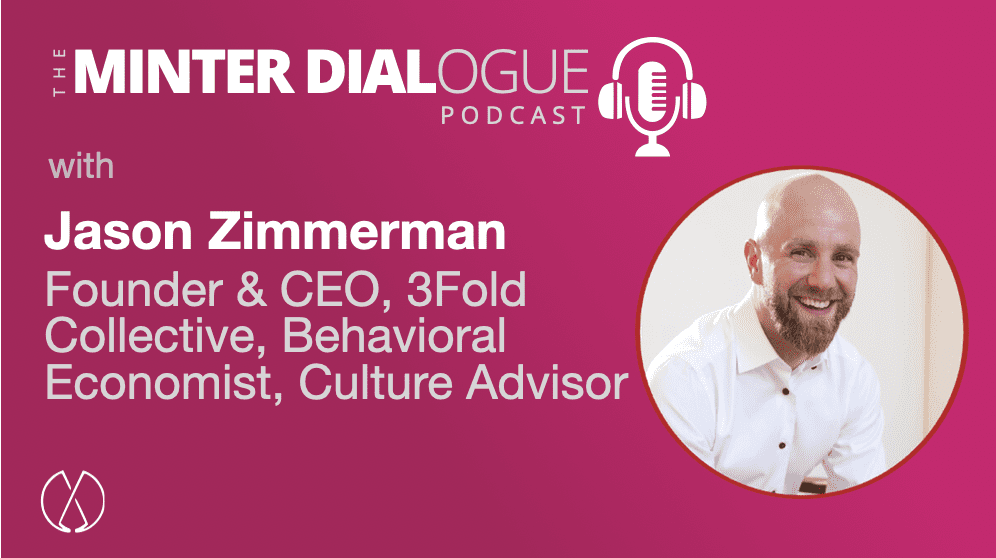
Minter Dialogue with Jason Zimmerman
I had the pleasure of interviewing Jason Zimmerman, a behavioral economist and strategy expert. We explored the fascinating world of organizational transformation and the challenges companies face in implementing change. Jason shared insights from his experience, including a case study of a 15,000-person transformation that was completed in just 2.5 years.
We discussed the importance of informal networks in organizations and how they can be leveraged to accelerate change. Jason explained the concept of organizational network analysis and how it can identify influential individuals who may not hold formal leadership positions. We also delved into the psychology of resistance to change, exploring different types of resistance and how to address them. Jason emphasized the need for clarity and control in driving successful transformations.
Throughout our conversation, we touched on the balance between maintaining a clear strategy and being adaptable, the role of trust and credibility in leadership, and the importance of creating meaningful work environments. Jason’s insights provided valuable perspectives on navigating the complex world of organizational change and strategy execution.
Further resources for the Minter Dialogue podcast:

Meanwhile, you can find my other interviews on the Minter Dialogue Show in this podcast tab, on my Youtube Channel, on Megaphone or via Apple Podcasts. If you like the show, please go over to rate this podcast via RateThisPodcast! And for the francophones reading this, if you want to get more podcasts, you can also find my radio show en français over at: MinterDial.fr, on MegaphoneFR or in iTunes. And if you’ve ever come across padel, please check out my Joy of Padel podcast, too!
Music credit: The jingle at the beginning of the show is courtesy of my friend, Pierre Journel, author of the Guitar Channel. And, the new sign-off music is “A Convinced Man,” a song I co-wrote and recorded with Stephanie Singer back in the late 1980s (please excuse the quality of the sound!).
Full transcript via Flowsend.ai
Transcription courtesy of Flowsend.ai, an AI full-service for podcasters
Minter Dial: Jason Zimmerman. Well, the only other Zimmerman that I would have loved to had is Bob Dylan. But I’m lucky enough to have you, Jason. You, I, I got very intrigued by your, your background, for your academic background and your work in dealing with strategy and execution. However, for those who don’t know Jason, let’s start with the old funny study question. Who is Jason Zimmerman?
Jason Zimmerman: Yeah. Well, one, let me just say I genuinely appreciate you having me on the podcast. As a fan, I will say I’m appreciative of the voice and the authenticity, the genuine sort of strategy to execution experience that you bring and pull out on your guests. So, it’s a real honor for me to just be here. But my background actually grew up in academia and by trade I’m more of a behavioral economist. And that was really a rise for me, looking at my mother almost as, you know, someone who’s a very creative type that couldn’t necessarily put the financial equation together. And it started just as a very young age. I couldn’t put words to it at the time, but it, it showed to me that, you know, the simple mathematics of finance and accounting and economics came really complicated when you added in the psychology of it, when you start to add in what does money stand for when you know it’s part of a society, when it’s part of our status, when it’s part of who we are. And so, I actually started out as an economist. I wanted to be a PhD and as I joke sometimes, I wanted to stand in front of the room and tell people about the books that I read. And I had an advisor tell me at one point that I should go out into the real world and live economics for a while because the messiness of the real world would translate back into the theories and the research that I wanted to explore. And 20 years later, mentor I never went back to academia. I stayed in the real world. I started out doing private economic research for the US government, really looking more into their movement away from DB defined benefit plans into DC or defined contribution plans and looking at the behavior that people played in terms of their outcomes. And that was the thread that from this sort of kitchen table conversation with my mother and trying to figure out how math and psychology married up. I’m starting to see this at a much larger scale. And I ended up taking that after a couple of years when I should have been going back into academia to study the theory of it, I kept going down the applied route and I ended up going into international mergers and acquisitions, where I started developing this Equation that I’ll talk about a lot is one plus one equals three. And at the time, it’s looking at the merger of two companies, right? When one and one combine, can we create an exponential outcome in that merger, in that acquisition? And I did that for about four or five years where I really started again, looking at not just the economics, but the cultural dynamics that come into play that make those two organizations not just successful, but what makes them exceed sort of the, the potential and the outcomes that, you know, the. The companies were trying to create at the time of the merger. After about four or five years, I ended up going even deeper into the applied world. And I worked for a Fortune 500 company here in the United States where I was running special projects for them. And so, I got to see firsthand this strategy to execution arm and exactly why brilliant strategy might collapse or fail or not succeed. And this was the equation that I kept wanting to solve. How do I create an exponential outcome when two people, you and I, or any of your listeners, get into a room together? How can they exceed just the sum of their parts? And that’s the thread that’s been driving me.
Minter Dial: Right. Well, there’s quite a lot of stuff, as my friend Mitch would say, to unpack. So, I’m thinking you never got your PhD. To what extent has that been something that you’ve dreamt of or still think about? Maybe I should do it when I retire.
Jason Zimmerman: Yeah, I’ll say this. I am in a few conversations to actually go back into academia from an adjunct professor route, which I think will scratch the itch that I have. But I think there’s something to be said about learned experience. And I mean, this is something that. A thread that you talk about quite a bit just from your experience, but a lot of the guests that you have the same thing. And it’s the messiness of the real world. For me. I started out wanting to figure out why the theory or the research never really was able to connect with the real world. And so, I came about it an opposite way, you know, but I think I have a little bit more education, having lived it for 20 years, than maybe just reading the book. So, I might end up going back into academia, but from a different perspective and hopefully still teaching some of the experience that we have.
Minter Dial: Well, I’m just projecting, but the idea of being Dr. Zimmerman, that’s what I would have imagined had somebody of a calling. I want to lean into behavioral economics. It’s a term I’ve heard. I’ve never really cottoned onto what actually does it mean? Is it messy numbers?
Jason Zimmerman: Yeah, it’s a great question. Whenever I present behavioral economics, most people, they’ve heard of these two words. We know the behavioral side and we know the economic side, but they don’t often show up together in the same place. I’ll start with the economic side. So, economics is a social science at its heart, and it’s looking more at the structures or incentives that drive decision making. And there’s a kind of a. I don’t know if it’s ever been formalized, you know, in particular, but there is this kind of underlying rule that when you start to express economics and decisions in mathematical terms, that you end up having rational decisions. And this is what I found with my mother. Just, again, I couldn’t have put words to it at the time, but we all know that the decisions that we make, whether it’s buying our first home or buying a car or even the jobs that we choose, are sometimes very far from rational. If you look at just car purchases, for instance, that is a very emotional decision. Sometimes it’s about the engine. Maybe it’s about the design, maybe it’s about the status that we have. And at times we might, especially in the United States, we might overindulge in that and go a little bit deeper than we maybe should. And that becomes a very irrational decision. If we just looked at our income and if we just looked at the debt that we might be taking on for that, we would make potentially different choices. And so, the behavioral side injects the psychology to that decision framework. And what we find, as I’ve alluded to, is that most decisions are very irrational. And when you play that out, especially over an organization looking at strategy in particular, the strategy is being developed inside potentially a much more rational sort of mindset, being able to assess mathematically, strategically where the market might be moving and how we might get to move there. But when you ask potentially hundreds of thousands of employees to move in that direction to make that pivot with you, what you find is on an individual basis, those decisions of whether to move or not move become somewhat irrational. There’s research, particularly around John Cotter, roughly back in the 1980s, so 35 plus years ago, that identified that 70% of that strategy fails, particularly at that human level, due to, you know, several factors. He had eight factors that he identified, but they kind of boil up to human resistance to change. McKenzie ended up doing that study, you know, 30 something years later, and basically we were somewhere in the neighborhood of like 75, 80% failure rates at this point?
Minter Dial: Well, I’m going to connect a few dots because that’s sort of what I like to do. So, you have 70% of strategies fail, 80% of AI implementations fail. Depending on how you look at it, most mergers and acquisitions fail according to the objectives they set out. More than 70% of digital transformation projects fail. Gosh. I mean, at the end of the day, they all seem to be human failures. Probably it’s not systems failures, like you say, with the AI. I mean, if you, if we listen to that, every. Everything we try to do is a much bigger chance of failure. I mean, nine out of ten entrepreneurial startups fail. Is it that we get the wrong ambition or do we just get the ego gets ahead of everyone else? How do you connect those dots? What’s your lecture?
Jason Zimmerman: Yeah, I think there’s a fundamental statement that I use that change is just hard. And we all know that we need to evolve and we need to adapt to a changing world, whether that’s us as individuals or whether that’s us as organizations. There’s another researcher, Larry Greiner, who did some great research on how companies evolve as well. And the underlying tenant is that making that move, even though we know it’s in our better interest, is difficult. And the question is, why is that so difficult? And there’s a lot of research here, but I sum it up, at least for my clients, in kind of two ways is one, when there’s a heavy dose of ambiguity in there, so uncertainty, you don’t necessarily know exactly what the future might hold, what that might look like, and. Or when you lose control over that. So, if we just think on a personal level, maybe we need to go on a diet for health reasons, we know what we need to do, but there might be ambiguity around, well, what types of food should I eat? And so, there’s effort that’s involved in that and there’s habits that we have to break. But then there might also be the idea of, do I have control over that? Am I doing this because I want to do this, or am I doing this because I have to do this? When you get into the organization and the larger, the firm in particular, the strategy is being created at these higher levels. And when you go all the way down to the rank and file of the organization that may be five, six, seven layers deep, that game almost of telephone that we all played as kids, it gets muddled a little bit. And so, you’re starting to lose both the understanding of why that change is happening and what it means for you and your career and then you’re also losing the control over it. You’re being told that you have to make this move. And again, all those habits that are there that we’ve ingrained, but you know, the education that we may bring to the table, maybe the skills and the, you know, even relationships that we’ve built might all now be in jeopardy. And so, at a large scale that might start to equate as resistance. And when you start to look at the power of informal networks and you start to look at the power of your peers and everyone else around you, it doesn’t take a lot of, of looking outward and seeing that resistance through others that might cause you to also begin to question whether this is the right move for yourself and whether you should adopted or not. And this is kind of the essence of the strategy that we, or the phrase that we’ve all heard is that culture eats strategy for breakfast.
Minter Dial: Mr. Trucker. Apparently. So, I, I tend to believe that it’s not that the strategy telephone tag is wrong, it’s that at the top they actually don’t have a clear strategy. And the excuse is you didn’t hear me right kind of thing. I, I mean, I have my own wobbles in this. But to have a clear strategy means we’re not going to try to do everything to please everybody and spend a lot of money on everything. You obviously have to be very selective. And in being selective in a world where we are trying to be more inclusive and accepting of everything is actually about some form of exclusivity. And so, you end up with these often very verbose, woolly, non-precise strategies, which is a recipe for misinterpretation. When you try to do everything and we’re trying to please Everybody, we want 2 billion customers.
Jason Zimmerman: Huh?
Minter Dial: Yeah, well, that’s not very exclusive. That’s, I mean, that’s, that’s. And it’s not very selective. And so, if, if strategy is choice, then we’re not being very, not very demanding in the way we exploit strategy And therefore, it becomes very difficult to express it seven layers down.
Jason Zimmerman: Yeah, yeah, yeah, there’s a lot of truth there. And I think myself, I think your experience at l’ Oreal and the other places you worked and a lot of your listeners, I’m sure can relate to this problem is strategy, I think will be more successful the more that it can adapt. And so, you know, as we’re developing this sort of in the, you know, confines of our own minds at the time, and as it starts to play out in the real world, that adaptation matters more and more. And so, I do think when you sort of roll that back a little bit, you have this hesitancy to define the strategy at the lowest levels in the most precise terms. And so, I do think there is a sort of competing force there. That is a really interesting point that you’re hitting on. I haven’t looked into the research, to be perfectly honest, about how that plays out, but I do have sort of an anecdotal story, if that’s okay to share and maybe might highlight some things. So, one of the projects that really started my firm and the reason that I wanted to explore a lot of this in the work that I do today, was around a 15,000-person transformation. And if you go back to Larry Griner’s work, what was happening inside this organization is it was growing and scaling rather quickly. And what you find is you get what Greiner would call this crisis of delegation. Basically, the organization became so large that that game of telephone started playing out and the messages would be garbled. And so, the decisions that were being made at lower levels weren’t necessarily optimal. At the same time, the organization was slow to react. And so, the transformation that they wanted to go through was to push decision making down throughout the entire organization. We masked that or looked at it from more of a systems perspective and said, okay, well we need to move much more into a digital type of transformation. And that would from an economics perspective that would drive better information and drive better decision making down at the lower levels. They would have more access to information, if you will. And what we ended up doing is creating an academy inside the organization. And this was by design. But what it was meant to do was to take the strategy that was designed at the C suite at the most executive level. And we had to rely on the formal communication hierarchy as well. But to flip the equation, instead of this top down communication arm, we would do a bottom up. And so, we invited everybody to come into this Academy and all 15,000 employees and to go through a basic kind of core curriculum, if you will, that would teach them the underlying fundamentals of what that new state would be, that new sort of product centric model, if you will. And what we ended up finding is that it ended up creating or re establishing that certainty, that clarity that they needed so directly addressing that uncertainty component of it, but at the same time giving them that control by allowing them to come into the academy and take electives on top of their core curriculum. We flipped the equation around to say, well, this is. Now you get a little bit more agency, a little bit more choice in how you absorb this message and in particular where you end up applying it. And one of the things that we ended up finding besides just accelerating the transformation, so we ended up doing it. There’s about a. We were working with a large consulting firm at the time that everybody would recognize, said it would take about 10 years to do that transformation for a firm 15,000 deep. We ended up doing that in about two and a half years, never changing our definition of success. We ended up reaching that first milestone about four times as quick as, as you would if you did a top down type of strategy just by doing it from the bottom up. And what we ended up finding is that people ended up just absorbing that. The biggest risk we actually had within that whole thing is we needed to go back to the board and ask for more adjunct professors to meet the demand that we had created by flipping that equation. Background. All right. Yeah.
Minter Dial: So success, how do you measure success of transformation?
Jason Zimmerman: It is a tricky, tricky business. The way that I have approached it is what is the outcome that you’re trying to achieve in the most simple terms, if you are, in this case, if decision making is being done at the top and we can measure the speed of decisions across the organization, and the idea is to get to a much, much quicker decision making while at the same time driving outcomes such as increased revenue, then that’s what we’re going to try to measure at the highest level. That’s going to require some deeper mathematics in terms of attribution analysis to really make sure that this isn’t being driven necessarily by purely economics. I mean, if you can move into that strategy, you’re going to reap the benefits of that. But we want to begin to isolate what are the contributing factors to that success. And that’s where it’s going to get a little bit more complicated. It’s a little bit more, you know, company specific, if you will. The way that I like to measure it, especially from a cultural lens, which is really where I kind of focus on is are you familiar or with like network analysis, social network analysis, the more variant organizational network analysis? Certain measures, such as, you know, a open network versus a closed network, we can statistically measure these things.
Minter Dial: And by the way, you did a lot of work on network analysis. I know that it’s fascinating to me, this idea of invisible networks, making visible the invisible and, and putting value on, on types of relationships that are critical, crucial in the way things go down, how do you measure those things? I mean, I mean, without. I mean, in Europe, we’re. We’re constrained with such things like GDPR and, and there’s presumably in America a million lawyers who are going to get on your arsenal if you do anything that’s modestly invasive somehow.
Jason Zimmerman: Yeah.
Minter Dial: To know what is an informal, influential relationship. Yeah. Without going into anything seedy, it’s complicated to highlight and sort of manifest.
Jason Zimmerman: Yeah, yeah. One of the punchlines, and I’ll start here, is if you just think about communication itself. Right. So, we take a new strategy, the formal hierarchy. You would have to go from, you know, the C suite down to your vice presidents, down to your directors and sort of lower and lower. But if you look at the informal network and the outcomes there is that same information can travel anywhere from four to five times quicker, and it will carry different messages within there, more sentiment, more emotional type of analysis. And what the informal network is, is it’s the friends that you might meet along the way. If you take my role as leader of special projects, special operations, within my last company, I was connected to so many different parts of the organization. That was my job. My job was to look at the intern efficiencies, operational efficiencies of it. And so, I would meet with all of the different business heads. On paper, you would just see me reporting to the chief operating officer, and that would be my formal hierarchy. And then of course, the people down below me that might support that hierarchy. But what you may not see is the trusting relationships that I’ve built potentially over time working in that organization for more than a decade, and that network that you might go to of the people that you know inside your firm that are the movers and the shakers or the people that are highly connected. And if you start breaking down, how influence. So, Dr. Robert Cini, for instance, is somebody that I reference quite a bit. You know, he has six different elements of persuasion, of influence. And if you start to measure those elements, you can start to see how trust plays into, you know, the informal connections that people might have that don’t show up on the hierarchy. And what research finds is that when you take an organization, you might find that there is a mismatch between the people that hold power from a formal structure. So, the people with the vice president titles or the C suite titles, and 10 to 15% of people that don’t have those titles but might actually have more power, more influence, more sway in what happens. And what you can do is by identifying that those 10 to 15% of people is you can tap into that network and that network is where you can begin to accelerate, you know, the, the outcomes that you’re looking for. So, as I mentioned, communication travels four to five times faster and it travels through those social influencers. We can look at this on any social media platform, for instance, right? There’s a certain subset of people that hold a lot of power, a lot of connections, a lot of trust within that social media network, and they set the trends. Those people live inside organizations as well, and they may or may not show up on the formal hierarchy. And what we’re trying to do is to measure that through network analysis, social network analysis, and it’s a statistical science that allows us to sort of identify those with some high precision.
Minter Dial: So I’m pondering experiences and people in my life, and there’s some people who are just trustworthy individuals, yet may they do things which are not always perfect, yet may they do things that might be borderline ethics. I mean, there may yet be all that, but they are just trustworthy people. And I, I remember how some of them would be tapped.
Jason Zimmerman: We’ll.
Minter Dial: We’ll send him or her to do the job because she’s trustworthy. And my observation is that that is because they have some deep personal ability and they trust themselves somehow. But organizations and many bosses don’t really like them otherwise because they’re just, they’re good and, and they certainly don’t get valued in the enterprise because they’re no cowboys. They’re. Yeah, they’re, they’re just trustworthy, good individuals. And they don’t get, they don’t get a lot of airtime. What he’s not. They don’t get the same kind of value attributed to what their true worth is. I don’t know. Have you ever seen or, or you researched anything about that?
Jason Zimmerman: Yeah, there is. I’m going to summarize some research in two words is trust in credibility. What we are finding is there is this ethical consideration to it. But when you really look at the people that hold influence and can actually drive the needle forward on a sustained basis is that these people have the trust of their peers and the credibility of whatever the topic or the subject matter may be in order to drive that forward. If you are missing that, what you might find is kind of the stereotypical, like maybe used car salesman, right? The person who’s trying to pull one over you quickly type of thing. And humans are very perceptive to that. And if that shows up, then you actually wouldn’t have influence, especially According to what Dr. Robert Cialdini has defined it as, which are as. That’s the trust and credibility. There’s four other elements that are really back there as well, but those are the key drivers to it. And what we find, and a lot of the research that I do for the companies I look into and the reports that we produce, is we will intentionally only show the people that you can positively tap into. And what’s really important here, especially with ONA and the way that it works, particularly the variant called Active ONA, which is really very easily summed up in ONA. Yeah. Oh, ONA is. Sorry. It’s the network analysis. As it moved out of sort of the computer science world, it moved into social network analysis, which is really looking at the sociology. But when you start to apply that inside an organization, we call it organizational network analysis. It’s all the same mathematics. Yeah, exactly. So, it’s all the same mathematics behind it. It’s just sort of the perspective that you’re taking on it. So, I apologize for that. SNA and ONA are kind of interchangeable. But as you start to look inside an organization, the way that active network analysis works is it’s summed up really like beauty is in the eye of the beholder, so is influence. And who I find influential may not be who you find influential. This is really easily thought about. If you think of anybody and maybe your last meeting, right. And you just kind of visualize and look around that meeting room and that meeting table, you might find that you’re interacting with all those people. So, we will show that there are connections and communication going on there, but how they might interact in that room will give you the answer to whether you find them trustworthy or not. And everyone’s going to have a different interpretation on that. And what we’re trying to do is collectively take all of those perspectives and identify who has the most trustworthy, the most credible form of influence and use those people in order to help drive a message forward throughout that informal network. And the really critical point here, and I think this is kind of what you were alluding to, is there is that ethical component to it. We can’t necessarily fake or do this in a Machiavellian way, because people will perceptively pick up on that, and that will eventually undermine the strategy that you’re going for. So, you have to find the true people that have that influence through trust and credibility, but also who believe in the strategy that you’re trying to move. They’re still going to have the ambiguity and they’re still going to have the uncertainty that comes along with it. But what we found is that if you end up bringing them into the conversation, this is throughout all levels of the organization and saying, here’s what we are thinking as an organization, right? We’re, we kind of think about it in three elements in a way that, that require change to happen is you need to have sort of a sense of urgency, if you will, right? We’re, we’re in this dire situation and if the organization doesn’t move forward, then, you know, we, we may become stale, we may become stagnant, we may not grow, we may, you know, end up losing jobs or we may end up losing market share. Then there has to be this future state as well. And we have to say we believe that this new strategy will create this future state and we’ll reap all of these rewards and the company will grow. And it’s a rising tide moment and you know, everybody will benefit from it. Then the third piece is you have to have a link between the current state and the future state. And this is where those invitations come in. If you can find those influencers throughout all levels of the organization and you can say, hey, we want you to own this part of the strategy with us and say from the future state, do you think this would work in the location that you work? How do you think we should adopt this? How should we roll this out? Where do you think the resistance might be? And by injecting that level of control for them and allowing them to own pieces of that new strategy, that’s where you start making true believers out of these influencers. And again, you can’t do it in the Machiavellian way. You have to do it in a genuine, authentic, real way. And when all of that comes together, that’s where you start to find that you can really begin to tap into the informal network to accelerate, not just accelerate change and reap the roi, but do it in a much more sustainable way.
Minter Dial: All right, well, again, there’s a lot of things and I, I wonder which, by which thread I should go. But for one, I, I, my experience about this is that this is very imperceptible. These, these, these trustworthy individuals. It’s very difficult to make emerge In a large organization, 15, 000 people sort of thing, or, or even bigger. And I wanted to push into how fear power can also be extremely powerful in, in driving a company. And, and while it just sounds horrible if the, the brand for which you’re working is glitzy, enough, let’s call it, you know, sparkling brand of watch or a, you know, high end brand of clothing or whatever. People put up with a lot of.
Jason Zimmerman: Yeah.
Minter Dial: In. Within the organization and, and the incentive for that trustworthy individual is inevitably squashed. And I wanted to counterpoint another thing which you had said earlier about what do you stand for and how you have to be adaptable. And it feels like this constant paradox or contradictory force, which is you have to stand for something, you have to have a backbone, and yet you have to be super flexible and adaptable.
Jason Zimmerman: Yeah. Yeah. Let’s start with the psychology of. And let’s put it into two kind of easy camps to think about. It is positive and negative emotions. Right. And the negative emotions would be like the fear that you might have there. Yeah, it’s. The research would point to that as human beings on the individual level now, we will be more impacted or have deeper memories two to three times heavier on the negative side of the emotions. And so, fear is certainly a motivator and it can be a motivator. And I think there are a lot of case studies out there and a lot of examples that we probably all think of in which companies will say, do this because I hold the purse strings or do this because I’m your boss. And I think a lot of us probably have come to that ourselves when we’ve maybe lost patience with, you know, certain individuals who aren’t moving forward. We just, you know, rely on the hierarchy side of it. And it is the mix of this carrot and the stick that I think have to come out into play. But for us, and what I think we’re seeing is that that sustainability piece is what’s really going to be at risk here. And when you think about, you know, all the research that goes into, you know, not just attrition rates, but the cost of replacing employees and the impact that it has to, you know, the knowledge and the culture holders of that organization and the impacts that that can have on your firm. That’s the piece where it takes more time, a little bit more patience, if you will, to get the ball rolling. But the more that you can tap into the positive side of things, the more that you can retain your employees and the more that that culture will begin to stick, the more that trust will be established and the more that, you know, all these positive motivators that actually, you know, align to that sustainability piece of it are really, really important, especially when it comes to, like, not to cut you off, but to the innovation side of things, which you Know, we can talk about that in a little bit as well. But you know, that is an interesting outcome of this type of thinking.
Minter Dial: Yeah, well, and that’s another, let’s say, sort of set of contradictory forces, which is this notion of innovation, creative destructive forces and efficiencies and effectiveness, which are operational considerations which almost don’t rhyme together. I have two more zones of questions that Jason I’d like to ask and hopefully fit this in. The first, in the same vein that we were just talking about, you talk about four different types of resistance. Comfort, control, revenge, and well-intentioned resistance. So, first of all, what is well intentioned resistance?
Jason Zimmerman: Yeah, it’s. I’ll say this, I, I don’t, this might be more of my personal philosophy, but I do think it bears out is in any, you know, merger that I’ve ever worked with, in any organization that I’ve worked with, I don’t know if anyone’s ever been nefarious in their intentions or at least it’s a small percentage of people that are. We used to say in my consulting days that people are driven by either ego or greed. And when it becomes kind of a fair playing field, people are trying to put themselves forward and trying to get either greed such as money, or ego, such as position and influence. But to get that way, what the research, and I think anecdotally a lot of us end up bearing out is that the higher you go in that organization, the more narrow that funnel, the higher the competition gets and the more that you start finding this sort of mofly, this sort of, everyone becomes kind of equally intelligent, equally influential. And it’s at those levels that you really start to find that the sort of darker side comes out. But when people understand that there is a, a positive benefit, that there could be this rising tide thing, I think there is that opportunity that people will say, well, I can see the ego or the greed inside of what I’m trying to achieve. But if you’re losing that control and if you are shrouded in ambiguity and not necessarily understanding what’s there, I think what you can find is that people will resist things not because they are afraid of what the future holds, but because they don’t understand what the future holds. And this is where I’ve seen that if you can really begin to inject those equations, as I did with that case study earlier, that 15,000 person transformation that we did by giving people that control and that clarity back to where they hold on to it, that bottom up type of transformation, you find that that Resistance gets tampered down and that’s where the firm that I run, I would really like to get into more of the research behind it. It’s not of the academic quality but it’s, you know, enough anecdotally that we’re seeing the patterns that that’s where the resistance comes down and that’s where you start to see that, you know, it’s, it really is, you know, on that sort of positive side that people aren’t necessarily nefarious behind it.
Minter Dial: Well, when I read this idea of comfort, control, revenge and well-intentioned resistance, well intentioned sounded positive. Comfort is a, it sounds nice but obviously it’s, you know, leans towards being lazy or not able to get out of your comfort zone stuff. Control, you just mentioned it in a positive way and it’s a negative way when you control freak but you feel like you have control. Agency revenge is another one. And I, I seem. Well, I mean obviously there’s sort of personal vendettas but it’s rare for a company to have a feeling that is deep. I did an interview recently with the head of a national sports team trainer or coach and they lost the World Championships in 2024 and he talked about how deeply motivating revenge is going to be for them in 2026. That sense of revenge in a corporate environment seems as for like a business, you know. Well, we were, we were number one, we’ve got to come back to. Now we’re number two, we’ve got to come back number one doesn’t seem like it’s really going to have much positive spin on to it. So, this leaves a lot, this question is which is, which of these four do you think is the most noxious and which or, and which is the one that leaders most often mishandle?
Jason Zimmerman: Oh, that is a really, really good question. As the researcher in me, I wish I had like the, the data behind me to lean into it. But can I say it depends as any good sort of academic course, no.
Minter Dial: As any, any consultant would say.
Jason Zimmerman: And truth be told it really is situational specific where that organization is in their life cycle. But I would say like first pass and this is off the cuff here. Revenge I think would not be as highly motivated simply because I think they take on different forms. So, I’m going to put that sort of lower in terms of the impact and I would love even your opinion on this too. But it’s, I think revenge can be that, that sort of motivational thing, right. Of getting back into the, you know, it’s the driver, right. Anybody who’s, who’s ever done like sports competitions, right. Like I, for instance, I’m a, you know, endurance triathlete and you know, I’ve shown up at various different races where they just haven’t, you know, the things didn’t come together the way they should and my times didn’t match what I know I’m capable of. And that motivates me. It can also be bad in the sense of certain cognitive biases. So, the first cognitive bias I’m thinking about is sort of what we call as action bias, right? Is that when you feel that pressure, you’re being driven by something kind of external to you. You have this desire to act quickly and that can be an emotional response that could potentially lead to bad decision making. So, it could go either way. So, it’s a good candidate. But I think it’s lower down. I might lean more toward. I’m going to go resistance. And I think that’s probably just because I do work in the cultural space. And I do think that is one that is not as well understood as it should be. And for that reason I think we underestimate what it can do. Again, we’ve all heard that culture eat strategy for breakfast. But to understand why that happens and just the collective power of humans and the quiet resistance that can be there, I think it’s a really underappreciated one and one that maybe isn’t necessarily looked at And therefore, it might have sort of an outsized effect in the whole thing. But really good question.
Minter Dial: My particular response is that I think I don’t know why I’m doing what I’m doing, which is none of those in my opinion. I don’t know why this is important. I don’t know how or why my contribution actually matters. And who gives a rat’s ass that we sell more widgets or shampoos? Is it really that important in the grand scheme of things? And I think that is my, my profound feeling is that we have a lack of meaningfulness in the work that we do. We have a crisis of meaning in society in general and earning more money when the future seems desperately dark and dooms worthy. Well, why should I bother doing anything like get out of bed and actually do work. I’ll do the strict minimum anyway, that, that’s maybe a dour note, but the work you do, Jason, is, is awfully interesting. You’ve got this 3fold Consultancy where you, you have a, a network of consultants. I, I, I assume that you sort of bring in who you need according to the, the mission at hand, which is a far more agile approach, can tell us people, tell people how they can get in touch with you, find out more about what you do and eventually get a hold of you to bring, bring you in, bring you and your team.
Jason Zimmerman: No, I appreciate it. Yeah. So, the firm is called 3fold Collective and as I mentioned it kind of alludes to that one plus one equals three, that exponential outcomes. And yeah, it’s more of a network of contracted consultants and data scientists. And our goal, and this is a little bit of my bias, is I created the firm because it was the firm I wanted to work for. It was the firm that could do the research but connect that to the real-world messiness that’s going on. And so, there’s this dual component that we have to the work that we do. But at its heart what we do is we try to create fit for purpose organizations. And that’s to say that the structure and the culture that your organization has, is it fit for the strategy that you’re trying to achieve. And so, we will look at both the formal organizational hierarchy, the organizational design, but we’ll also look at the effectiveness of your culture and do what we can nudge it so that there is the trust in the open communication that allows for certain things to evolve the way they should, for your strategy to evolve the way they should in the most efficient way possible. And the best way to find us is, I mean just Google Threefold Collective. It’s the number 3fold Collective. It’s also threefoldcollective.com and that’ll get you there and you can reach out to us. I also write quite a bit on Substack. It’s called threefoldoutcomes.substack.com and that’s where we really start to explore not just the science behind this, but really try to connect it into sort of the companies that a lot of us might think about. So, we just wrote a piece on Apple and what we’re finding is since Jony Ive’s departure and Evans Hinckley departure from there is that you know, the innovation arm of innovation, the innovation of Apple is sort of waning and as Tim Cook just said, he’s bringing design back into his fold, not underneath operations. So, we start to dissect what that might mean and sort of introduce the science behind behavioral economics in a much more hopefully friendly, light hearted type of way And so, people can follow us there as well.
Minter Dial: Super. Well, I love Substack. I did my own Substack. Congratulations, Jason. Apple certainly a an amazingly interesting, rich case study from all sorts of angles to. To see how it goes. Listen, many thanks, Jason. Keep up the good work and stay in touch.
Jason Zimmerman: Yeah. Thank you so much. Really appreciate it.