
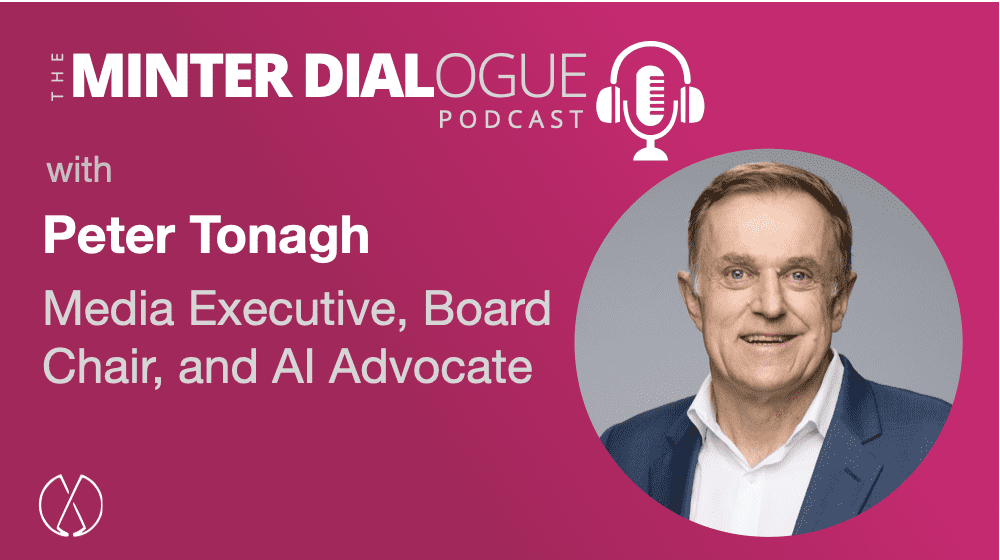
Minter Dialogue with Peter Tonagh
Peter Tonagh is a seasoned Australian business leader whose career spans consulting, executive management, and today, influential governance roles. Hailing from a small country town, Peter’s journey began with humble aspirations before evolving into a portfolio career at the highest levels of Australian business. From a formative stint at Boston Consulting Group to leading media giants like Foxtel and News Corporation, and now chairing boards such as Quantium and Nine Entertainment, his path has always been underscored by curiosity, grounded values, and an appetite for making a positive difference.
In this episode, Peter shares wisdom gained from shifting between consulting and operations, and later, into boardrooms — revealing just how consequential leadership, culture, and purpose are in building enduring organizations. Our discussion delves into navigating disruptive change, defining brand not just as a marketing tool but as the sum of every customer interaction, and the urgent need for authentic leadership in an AI-driven era. Peter pulls back the curtain on executive decision-making, the hidden complexities of people management, and why, for him, aligning personal and corporate purpose is non-negotiable.
We close with his powerful perspective on AI: both a caution and a call to arms for leaders—embrace the technology mindfully, or risk being left behind. Throughout, Peter’s calm clarity and actionable principles shine—making this a must-listen for anyone serious about game-changing leadership.
Key Points:
- Brand is Built on Every Interaction: Peter learned that brand is far more than messaging or logo; it’s the totality of experiences customers have — including with subcontractors and outsourced teams. Building strong, long-term partnerships with people representing the brand, even if not directly employed, is essential for consistency and trust.
- Culture and Purpose are Non-Negotiable at the Top: Whether as CEO or board chair, Peter makes culture and purposeful alignment central to his leadership. Compliance and governance matter, but thriving organizations need boards that champion innovation and cultural cohesion, not just risk mitigation.
- Embracing — and Guardrailing — AI is a Leadership Imperative: Peter is passionate about integrating AI across organizations, but warns that failing to set clear guardrails and take ownership of AI outputs is a bigger risk than adopting the technology itself. Leaders must treat AI tools like team members: provide context, maintain oversight, and always keep a human in the loop.
To connect with Peter Tonagh:
- Find/follow Peter Tonagh on LinkedIn
To connect with Minter Dial:
- Find/buy Minter Dial’s book, “You Lead,” here
- Find/follow Minter Dial on LinkedIn
- Find/follow Minter Dial on X (formerly Twitter)
Further resources for the Minter Dialogue podcast:

Meanwhile, you can find my other interviews on the Minter Dialogue Show in this podcast tab, on my Youtube Channel, on Megaphone or via Apple Podcasts. If you like the show, please go over to rate this podcast via RateThisPodcast! And for the francophones reading this, if you want to get more podcasts, you can also find my radio show en français over at: MinterDial.fr, on MegaphoneFR or in iTunes. And if you’ve ever come across padel, please check out my Joy of Padel podcast, too!
Music credit: The jingle at the beginning of the show is courtesy of my friend, Pierre Journel, author of the Guitar Channel. And, the new sign-off music is “A Convinced Man,” a song I co-wrote and recorded with Stephanie Singer back in the late 1980s (please excuse the quality of the sound!).
Full transcript via Castmagic.io
Transcription courtesy of Castmagic.io, an AI full-service for podcasters
Minter Dial: Peter Tonagh, it’s lovely to have you from down under on the Minter Dialogue. It’s been a long time. I’ve been wishing, I’ve been following your career, wishing to have you on to talk about all things leadership. But let’s start with, because, you know, everyone’s got to know, who is Peter Tonagh?
Peter Tonagh: Well, thanks, Minter, and a great pleasure to join you. And I know it’s taken a long time, so apologies for taking so long. But I’ve been listening to some of your recent podcasts and inspired to come and join you today. So, who’s Peter Tonner? Well, first of all, I’m Australian. I think that’s an important defining characteristic. Frankly, I grew up in a very small country town in Australia of about 1,200 people and, you know, had no great aspiration to do anything but frankly at the time to be a motor mechanic. And I ended up with the opportunity to do a range of different things. I’ve been very privileged in my career, but I’ve had a career that’s taken me through 15 years of consulting as a partner at Boston Consulting Group, 15 years directly in leading media companies with News Corporation and companies that they’re associated with, and then more recently, a long period of a portfolio career of all the best things, the things that have really engaged me in the past, and I’ve spent a lot of time focusing on getting that portfolio right so that I can do the things that I really love doing. I can give back in the way in which I was supported through my career, through supporting others in their careers, and can spend a good amount of time with my family and doing the things that I love with them.
Minter Dial: Lovely. Um, how do How would you describe your arrival as a CEO? What was it that made you CEO material? Was it the consulting role, the breadth of your experience, your own mindset, friends you knew, colleagues? What is it that led you to become this leader?
Peter Tonagh: Yeah, I think it’s a really interesting question because I didn’t set out to become a CEO. It was never a goal of mine to become a CEO. But as I say, I’ve been very fortunate in my career. I had been working for Boston Consulting Group for 15 years with a break in the middle to study with you at INSEAD, and that was a long time ago. And during that 15 years, I got the advantage of working in an organization like BCG where I got to work in many different organizations in many different countries across many different topics. And I think so the starting point would be the first thing that I developed was great breadth and that breadth I think is really important, particularly for a CEO where you need to have the ability to understand a business from front to back, not just one particular part of that business. And so, that was incredibly valuable to me. I also had, I think I had it when I started at BCG, but I developed throughout my time at BCG a real curiosity, a curiosity as to how business worked and a curiosity as to how to improve business. I always had a fundamental understanding of, you know, a P&L and a marketplace and the core elements that made it up. But I was very curious about it, which I think is really And frankly, if I have to be totally honest, I’d say in my time at BCG, I also had an incredible work ethic and I, I worked harder than most people, something that I don’t regret, but something I’ve learned that is not the way I want to shape my future by being known as the person who works harder than everyone else, but rather the person who has more to contribute than other people. So, 15 years there, and my last client when I was working at Boston Consulting Group was a pay-TV company, uh, Australia’s leading subscription TV company, which was called Foxtel. Uh, it was owned 50% by Telstra, the large telco, 25% by the Murdochs through News Corporation, and 25% by the Packers, uh, through, um, PBL, which was their organization at that time. And they were a client I’d been working with the CEO and he called me one day and he said, hey, my CFO is going to leave me. Can you talk him out of leaving? And so, I tried to, I knew him and so I thought I’d be able to convince him, couldn’t convince him. And so, I called the CEO back and he said, well, you’re going to have to come and join me. And it was a very unusual experience for me because I was loving what I was doing at BCG. I was very successful at the time. I’d won a few big clients. I was being paid very well. And this guy said to me, hey, come and join our company. We’ve been operating for 12 years, we’ve never made a profit, uh, we will make a profit in the future, you can be part of that. Um, but the thing— and, and by the way, you have to take a 50% pay cut. And it seemed the, the most natural thing in the world for me to say, yeah, of course I’ll do that, which I did. And I did it for a few reasons, to be honest. A lot of people were challenging me and saying, why would you leave? And a very elite prestigious organization like BCG where you’ve fought to become a partner and you’ve only been a partner for 5 years, there’s best years ahead of you. And the real reason I left is because it was an organization where I could see I could make a big difference. It was a CEO who was willing to offer someone who’d been a consultant all their life and never had what you might think of as a proper job and was willing to make me CFO to be responsible for all the strategy for the organization, but also, and very importantly to me, was going to give me responsibility for all the operations, like running a call center of almost 1,000 people, running installation contractors. So, we had people who were going installing satellite dishes on people’s homes, and this CEO was willing to give all of that to me and say, hey, this is something that you can do. And I knew it was a unique opportunity. And if I ever did want to work at a senior level within an organization, that this was the opportunity. And so, I did it. I took the risk. I took a 50% pay cut. I backed myself. I believed that we could take this organization and take it from an organization that had lost money for the whole 12 years of its life, and I could help to make it profitable, and I could be part of the ride to turn it into a very valuable company that was delivering a great service.
Minter Dial: So, you were actually COO and CFO, it seems.
Peter Tonagh: Yeah, I was CFO and yes, COO in the typical description of what a COO would be responsible for. I didn’t have responsibility for the content part of the business, which is a very core part of the business or the sales part of the business. But I had responsibility for all of the service, all of the installation activity.
Minter Dial: This is at the time when you and I chatted, I had my film and you’re gracious enough to get me contact at the History Channel.
Peter Tonagh: Yeah.
Minter Dial: So, my film has been shown down under thanks to your introduction. That was awesome. So, you moved from consultancy to operations.
Peter Tonagh: Yes.
Minter Dial: What were the biggest differences and where did you find yourself a little bit fish out of water and other places where you felt like I got this?
Peter Tonagh: Yeah, you know, the thing that was most difficult for me, oddly enough, is I’ve been working incredibly hard, incredibly long hours at BCG and traveling extensively. And when you work for BCG in Australia, you could be working anywhere. I’d spent a lot of time working in Asia, and so I, I was quite tired, you know. It was a, it was a pretty full day every day and a lot of travel. And I thought, this is great, I’m going to go into a corporate role and I’m going to work in an organization where I’d literally— originally they became my client because I chose them as a client because they’re about halfway between my office and my home. So, very convenient. A few more things to that, but that was a, a key driver. The biggest change for me was that every night when I went home, I was completely exhausted. And I was exhausted not because I was working longer hours— I was still working long hours, and I will always work long hours— it wasn’t exhausted because of the travel, but I was exhausted because of the cognitive load. And the fact that I’d gone from this consulting role where really I was facilitating a big decision every couple of months and working on one topic, you know, maybe for a couple of clients or maybe a few topics, but working towards a big answer. And now I’m in an operational environment where I’m making hundreds of decisions every day, like so many decisions every day, and I wasn’t used to that. And to me, that is one of the most important differences between working in a consulting environment and working in a highly operational fast-moving environment and the need to have a frame of reference so that you’re able to very quickly make decisions and make decisions all of the time. To the extent that I’d get home and I couldn’t make a decision about what I wanted for dinner or what I wanted to drink because I, I was just exhausted from the, the cognitive load. And it, it took me some time to adapt to that, to force myself to have this frame of reference, to not over-analyze, which is something that consultants are trained to be very analytical, to be much more, uh, better at triaging decisions. Those that I can— it’s no regrets move, I can just make this decision, move on, it doesn’t matter. It’s kind of that, that concept of the two-way door decision. Work out which ones were those and I could just make them quickly versus what were the one-way door decisions where I had to spend the time, I had to really dig in, I had to ensure that the team was recommending the right things. And that was quite a transition for me.
Minter Dial: This word, this notion of cognitive load is interesting. One imagines BCG consultants, you know, top of the game, smart as all heck, you know, working long hours, how that would’ve been a cognitive load. I’m wondering to what extent in the operational role, elements of culture and people management was a heavy part of that cognitive load or not.
Peter Tonagh: Yeah, a huge part. And, and one, again, one of the interesting changes for me was BCG is an incredible organization from a people management perspective with 360 feedback, degree feedback on every project and performance evaluations and a very clear performance trajectory and a career trajectory and an up or out style policy at the time. And, and then I went into a normal organization where most of those things didn’t exist, where culture was important. And to be honest, the culture I walked into wasn’t a terrific culture. Um, it was also multiple cultures. There were different parts of the business that had different cultures. Um, there were not only managing the people but also managing contractors. We were reliant on a very large number of contractors who were entering people’s homes, installing satellite dishes on their roofs, drilling holes in their walls. And so, even though we didn’t directly employ those people, they were employed through contractors, they were my responsibility to manage. And so, there are a lot of people issues, a lot of quite complex people issues, including things, you know, well, probably one of my favorite learnings was there was one guy who was responsible for a part of our business who on the surface you would think everybody loved. He’d been there for 15 years. He was part of the furniture and he was seen as the person everybody looked up to. And I worked out that he actually wasn’t great for the culture and I had to remove him. And the thing, and this is a terrific learning for me, but the moment that I removed him, people would come up to me and say, I don’t know why it took so long. ‘You know, this guy was terrible for the culture. We didn’t like him. He made bad decisions.’ But yet nobody was putting their hand up and saying, ‘Hey, we’ve got a problem here.’ And that’s an important learning for me because I’ve experienced the same thing many, many times in my career since, that there’s often people who are blockages in the culture of an organization, but the people around them don’t say anything about it, either too scared or too embedded in the way things are done. To raise the issue. And so, I think it is the sign of a good leader is to actually identify those people who are causing problems without necessarily having the feedback from the people around them.
Minter Dial: Yeah, I can imagine that he was, everyone identified him, he was carrying the culture at some level. And then that was a challenging decision to make all the same because you’re faced with lots of backlash. Now, how can you dare touch him? So, I, I have a question for you, Peter, the, the notion of brand. So, you were talking about this man drilling a hole who’s a sort of subcontracted individual doing work for you and, and therefore representing your company. I’m wondering to what extent your idea of brand has evolved since our days at INSEAD and in your work going from consulting into operationals now in governance, how would you describe your voyage or what you think brand is all about?
Peter Tonagh: Yeah. So, if I think about, I was very naive about brand, to be honest, when I was studying at INSEAD and to me brand was a high-level concept. The one thing that I learned in a pay TV business is that brand is the sum of every little interaction that occurs with that customer from, yes, it might be the advertising that they see, it might be the logo and the way in which you describe the business, But the most important thing for us was the person who’s entering your home, you know, the place that you live with your family, and installing our, our service. And those people weren’t even employed by us, they were employed by somebody else. And in often cases, certainly when I first began at Foxtel, they were employed by a contractor who was a subcontractor to another contractor who was a subcontractor to the head contractor. And so, one of the things, or two things actually, that I’m very proud about during that time, which were about brand. The first one was I used to call a customer who had sent a complaint every night on my way home from work. I’d ring the customer and I’d say, hey, I’m the CFO at Foxtel. I’m calling you because you’ve written a complaint to us. I want to talk to you about that complaint. And I learned so much and I learned so much about the way our brand was seen and the perceptions that people had about the brand, the way in which we were being represented by both people who were employed by us but also people who weren’t employed by us. And it’s one of the most valuable things that I’ve ever done in my career and something I still try to do regularly is get in front of customers and have a proper discussion. The second thing I recognized was we had these contractors that were employed for, I guess you would call it theoretically, the best commercial outcome. And so, we had 7 contractors at the time. They were on 3-month rolling contracts that we would compare their metrics at the end of 3 months, and we decide, uh, you know, which was performing better. We get rid of the low-performing ones and we keep the high-performing ones going. And that just grated with me. It really grated a lot because I thought, how can we improve our experience with customers if that’s the relationship that we have? And so, I moved from having 7 contractors with 3-monthly contracts with very harsh reviews to having 2 contractors who had 5-year contracts and long-term continuity and long-term certainty. And what do you know, the first thing that happened was the contractors would go and they’d invest in new uniforms for their teams, they’d invest in logos on the side of their vans. They’d invest in better equipment, they’d invest in technology to help them to serve the customer better. And we got a much, much better outcome. And that’s really led to one of my very deep leadership beliefs, which is that you have to build deep and strong partnerships with suppliers rather than treat them transactionally. And that’s not to say you can do that with everybody, but in most instances, I think you’re always better to build deep partnerships particularly when it’s with somebody who’s representing your brand, because every one of those interactions, you want somebody who cares as much about your brand as what you do. And, and to give you a good example of that, I, I worked at Foxtel for many years, then I went to another part of News Corporation and came back. When I came back, I decided we had to reset the purpose, the plan, and the playbook for the organization. And so, we spent a lot of time on creating a 2-day experience for our team and to really set that purpose and to dig down on what it meant. What was— how do you translate the purpose then into what I called the playbook, which was the way in which we were going to act and the plan, what are the things we’re going to do? And I very intentionally didn’t do it the way people had typically done it where you start with the executive team and then go down layers and, and cascade is, I think, is the term, cascade through the organization. I took a vertical slice of the organization and I included our outsourced call center in the Philippines and our out-call source call center from India, and I included the installation contractors who were going to people’s homes. And I invited people to fly from India, to fly from Philippines, to come from the installation contractors, plus our call center staff, plus our accounting staff, plus the engineers and brought them all together in a very cross-functional way. And the reason I did that is because if I’m going to set the purpose for the organization, I want to have direct input from the people who are going to be in front of the customer, not just relying on the executive team who would obviously be a little more distant from the customer. And that is, I think, it’s maybe a bit of a tangent to your direct question, but to me, that’s a large part of the way you need to think about brand.
Minter Dial: I absolutely adore that. It reminds me of a conversation I had with Ronan Dunne, who was CEO at Verizon, how he would use Twitter as his way of talking to customers who were complaining. And so, often at the top level, it’s, you almost get a curated version of talking to customers. When I was at L’Oréal, you know, we would polish the visits of the hairdressing salons. And yeah, and very— it resonates very much with me. Um, and the question I’m going to have follows on my experience, which was where we were working. I was CEO of Redken. We were working with distributors who were independently owned and had multiple brands. And, and so the issue of consistency, or love if you will, of my brand was vying with lots of other brands. Yeah, in their hearts and in their wallets as well. And so, the question is, when you have a subcontractor or a call center that might be doing many calls with many brands. For example, you might have a News Corp call center that are dealing with all the News Corp brands, or it might be an outsourced call center that has 3 clients, including Foxtel. I, I don’t know to what extent the challenge there is to then mold some kind of relationship between the behaviors and the values of your organization and these others who have multiple choices.
Peter Tonagh: Yeah, yeah. And we did have outsourced contact centers and there was later in the period that I was at Foxtel, we had one that was in Manila in the Philippines and we had one that was in Durban in Umschlanga in South Africa. And I went there 4 times a year Every time I did a road show to update our local team on how the performance of the business was going, on the new program initiatives that we had, the sporting events that were coming up, I would go around Australia to visit our teams in Australia, but I’d also go to Umschlanga and I’d also go to Manila and I’d do the same presentation to those groups. And that was important because it was making those groups feel like they were part of our organization. They might be outsourced, we may not directly employ them, but they were representing our brand with our customers. And so, I wanted them to feel like they were part of the organization. We also organized opportunities for them to second into our business in Sydney so they could come across and get the experience of working more closely. And I spent a lot of time listening to their calls, both in the contact center with them but equally remotely to understand differences in behaviors, differences in patterns, and to be able to ensure that we had the calls being allocated to the right place. And I’ll give you a really simple example of that. In pay television, the content is everything. And so, therefore, what we needed is people who could really connect with the content. And so, having a contact center in South Africa was very good for us because we had people who were naturally inclined to be understanding of the importance of sport. South Africans and Australians both love sport, both love rugby. And so, we had that much better connection between the people who were employed in the call center in Umschlangen with the customer because they could sell in. Now, if you called and said, I want to disconnect my Foxtel service, then they would be just as likely to say, yeah, but you know, the Rugby World Cup is coming up and, you know, we’ve got the Rugby World Cup. Don’t you think that you better keep it for that? And could do it very credibly because it was truly authentic that they truly believed it. And so, but it was about embedding them within our organization, making them feel as though they were as much a part of the organization as any other person who was an employee.
Minter Dial: Well, this notion of customer services is one that’s dear to me as well because when I was running Canada, we We, I made sure that the call center person representing the call center, the customer service, the only job in the company which has the word customer actually directly in it, at least at that time, come to our board meetings. And once every 3 months we had the, our committee board meeting at the call center location. So, we would talk to them and the whole idea was what is customer centricity? In your role now, very much in governance role, but also maybe thinking back to your life as a CEO, to what extent is culture a part of the conversation in the executive committee or in the board? And do you feel like it’s under or overstated, the importance of culture at that level?
Peter Tonagh: Yeah, I would have to say something I care deeply about, and so therefore it is a feature in the organizations that I chair. I’ve certainly worked with boards in the past, and I have a maybe too strong view, but I’ll share it anyway. I think one of the challenges for many organizations, particularly listed organizations, is that the governance task has been one of holding the management team to account and of protecting, ensuring compliance, minimizing risk, doing kind of what’s typically thought of as, I guess, governance. Whereas my perspective as the chair of a board is that my role is to support the management team to build a long-term sustainable business and to deliver returns to the shareholders. And I think as soon as you come at it from a compliance governance type perspective, it’s all about protection, it’s all about risk minimization and we’re in fear and also personal reputation protection. If I’m totally honest, I think there’s a degree of that as well. And I think we’re in an environment where there is massive change happening across virtually every organization. There’s a lot of industry disruption, there’s a lot of technology disruption, a lot of geopolitical disruption. And the organization that is so focused on compliance and, and risk minimization and fear is not the organization that’s going to have a long-term sustainable future. And so, my frustration in the past on, on boards is when there’s not this view that we’re here to support the team, that we’re here to grow the business, we’re here to build a sustainable future, and we’re here to manage risk in a productive way, in a very productive way. And, you know, my worst experience on a board, which was nothing to do with the people on the board, but was with a, it was a neobank. So, a tech startup that had a banking license. And I joined the board because I wanted to deliver an incredible customer experience in an environment where banking was very traditional and it was, there’s a lot of room for innovation. I would spend at least 80% of every board meeting on compliance issues, and we had to deal with the same level of compliance, the same compliance checklists as a major Australian trading bank. And yet at that point, we didn’t even have a customer, and we just had a banking license. And, and I think that really opened my eyes to the fact that it’s very easy to get caught up in the compliance side and the compliance. I’m not trying to minimize the importance of compliance. I think compliance is very important, but having a fully compliant business that dies because it has no innovation and has no revenue streams and has no great customer service is not the governance that I want to be involved with.
Minter Dial: This is a little bit of a broad question, Peter. I mean, it is a broad question, but I’m sure you can sort of whittle it down. You’ve had so many opportunities in different industries now, whether it was BCG or the different companies you lead and now the boards on which you are operating or representing so many different industries. Every industry seems to have gone through some massive disruption. I mean, we’re starting with the media, but everybody is. What is the guiding principle? Is there something within you that allows you to sort the wheat from the chaff, from the noise to the reality? How do you, what sort of backbone element is there to you, Peter, when you’re dealing with all this chaos around you, multiple different types of regulatory bodies, media attention, scrutiny, and all the tech that’s changing? How do you sit calmly with all that, Peter?
Peter Tonagh: Yeah, and I think if there’s one thing I’m known for, it’s equanimity of spirit and calmness and being able to navigate through difficult situations. And I think I haven’t thought a lot about why that is, but if I think about it now, there’s a number of— I’m a very structured person, and so I have a set of leadership principles that I truly believe in and that I follow. And I’ll just give you a couple of those because I think they kind of provide an indication as to an answer to your question. So, sorry, it’s a bit of a roundabout answer, but the first leadership principle that I ever thought about, came up with, and follow is that you have to know who you are and what you stand for. And so, and I mean that as an individual but also as an organization. And so, the first thing I do when I join a board or when I join an organization is to think very deeply about What’s the DNA of this organization? You know, what is it and what does it stand for? And I think that’s critically important, and I’ll come back to that in a minute. There’s a number of other principles. The one that jumps to mind for me is I’ve always had a principle that you need to follow the trend line and not the headline. And I think that’s really important because we’re in a world where there’s a lot of headlines, but actually you’ve got to take a step back and look at what’s the trajectory that I’m seeing, what’s the pattern that I’m seeing here. And if you’re seeing a pattern of, of slow gradual decline, then assume there’s going to be slow gradual decline and do something about it. Don’t react to, hey, we’ve suddenly had a good quarter, everything’s okay, or equally in reverse. And, and so I think taking that view that first of all, nothing is ever as good or as bad as it seems on the surface. If you know who you are and what you stand for and you stick behind that, then you’ll get to the right answer. And if you follow the trend line and react to the trend line, not the headline, then you do it with a calmness which I think is necessary in a rapidly disrupting industry. And if I use the example, you know, what you stand for, I spent a lot of time at News Corporation. I’m now the chair of Nine Entertainment, which has this big business in Australia, media business in Australia that has a publishing division. So, at News Corp, I spent a lot of time in publishing. At Nine, I spend some time in publishing and the one thing that’s really clear is if you think about publishing business as businesses, as newspaper businesses and you say we’re moving from print to digital, then you’ve got a massive disruption ahead of you. If you think of those businesses as journalism businesses where journalism is still in demand, is greater demand than it’s ever been before. And so, it’s not about whether it’s print or whether it’s digital, it’s about have we got the best journalism, the right journalism, and are we able to deliver it to our consumers in the way in which they want to consume it? Then I think that gives you the North Star. It gives you a sense of the direction that you have to go in. And I think I’ve seen many times this view of, hey, we have to move from print to digital. Without recognizing that actually the consumer will determine where we have to move. And the consumer might say, you know what, actually I want to read a printed newspaper on a Sunday when I’m sitting at the kitchen table or at the cafe, and I want to have an iPad app that I can read in the morning when I first get up, and then I want to have a website I can go to. And if you adapt to the consumer, then I think publishing businesses have a bigger future than what most people would believe. I look at our business at Nine, our publishing business at Nine. We have a business publication, the Australian Financial Review. It’s a terrific business. It’s a business that makes good money. It’s made that transition. The content’s available in many, many different ways and places. The quality of the journalism is terrific. They’ve increased the revenue in the business by looking at other revenue streams like events.. And I would argue that it’s one of the most profitable publications in the world. And I think that’s because of the focus on what they really stand for without getting obsessed with this idea of, oh, it’s a newspaper and newspapers are in decline.
Minter Dial: Well, this, what you just talked about, Peter, really resonates with me in my book You Lead. I, talk a lot about this idea of knowing yourself. And the question I have now, especially when you have so many hats and so many brands you’re working with, so this is where it might be a little bit tender, but to what extent does your own DNA need to correspond to the observed DNA of the organization you’re in? And another sort of sub-question of that is, to what extent does the purpose that we talked about just before of the organization need to be part of your own purpose as the leader? Or is it just something you learn to fabricate?
Peter Tonagh: I, through my career, have learned that my performance has a direct correlation with my belief in the purpose of the business. And so, I would no longer, I’d never work for an organization where I’m not aligned with the purpose. I know that it would be unproductive for me and it would be unproductive for them. And I think you need to be clear. That’s why I say, when I say know who you are and what you stand for, it’s both at an individual level and a company level because the two have to mesh in my view. I think unless you can be passionate about a business that you’re leading, then you shouldn’t be there. And I’m very black and white about that. I think in terms of the DNA, the DNA question is an interesting one because I’m somebody who values diversity incredibly, diversity. And when I say diversity, I’m not talking about male and female and skin color. I’m talking about all of those things, but more importantly, diversity of thought, diversity of ideas, diversity of experiences. And I truly believe that that’s critically important, but I believe it’s critically important when there’s some foundation that binds you. And maybe that is DNA, if you want to use the term DNA, but I think you do need to have something that binds the people within the organization, particularly the senior people within the organization, and allows them to have the open debate but to get on with things, allows them to have each other’s back but challenge each other where necessary, that allows them to work well as a team but also to highlight if there’s someone who’s not pulling their weight.. And I think you can only do that if you’ve got this, this safe environment to work within. And in fact, there was one of your podcasts, I can’t remember which one, that was talking about the success comes where there’s a safe environment to experiment within. And that’s something I believe very strongly in.
Minter Dial: It really needs to be a part of diversity, the idea of having safety, psychological safety as they call it in the psych world. I want to get it. I want to save the last part for the AI piece, but let’s just, before we go there, this notion of purpose or soft socialism that you’ve talked about. I’m a strong fervent believer in purpose, yet do we see a lot of sort of purpose washing or eye rolling when it comes to the CEO speaking about their purpose? We need to do this and that for society. How do you then distinguish between some sort of more authentic purpose versus the sort of communicated or commercial vision of it?
Peter Tonagh: Yeah, and I think first of all, it has to be authentic. It has to be genuine, has to be something that is believed in. And I had a very interesting experience when I went across from Foxtel to News Corp and I felt that we had to define a purpose and I came up with a view of what I thought the purpose should be. And at that point, I probably get this slightly wrong, but we said that at News Corp Australia, we exist to inform, to advocate, and to inspire to build a better Australia. And it was very simple, very simple proposition. I took it to my executive team and said, look, I think we’ve got to have something that aligns us and so this is what I think is the direction I want to head in. And a number of people on the executive team said, that’s okay, we like it, but the young people in the organization won’t like it. What they didn’t know is that I’d actually developed it through focus groups with the young people in the organization, and they loved it. And, and I think that’s important because— and if I think about at, at News Corp, which was primarily a publishing business, the area I was talking about, I said we inform, we advocate, and we inspire. And the reason I chose those three words and very carefully is because the DNA of journalism is about news and information and informing. That is really important. News Corp Australia had had a lot of criticism for being biased, and it does have a bias.
Minter Dial: It has a particular—
Peter Tonagh: we all have biases, by the way. Yeah. Yeah, but if you say bias to a young journalist, it can be quite confronting. If you say advocate, that your job is to advocate for a particular viewpoint that you believe in, then it’s a much more positive word. It’s a much more positive way of thinking about it. So, I’d intentionally put advocate in the purpose because I knew that that was the role of these journalists, was to advocate. But they were accused of bias all the time and it’s kind of, oh geez, it’s a harder word to deal with. Then finally, inspire, because frankly, a lot of journalists can tend towards the dark side. If it bleeds, it leads is the old expression I used to hear. But the reality was that these journalists were doing a lot of things, creating a lot of stories that were inspirational. And by capturing it as part of the purpose, it would ensure that it became a core part of what, what we did. And, you know, a good example was page 3 of one of our papers would always have a nice image on it. And it was, we used to joke about it. This was the page 3 had to have a magpie with a broken leg because a magpie with a broken leg was, was always a cute, nice kind of feel-good sort of story about the magpie that’s been rescued with its broken leg. Now, didn’t have to be a magpie, but it had to be something that was inspirational so that if the newspaper was sitting on the dining room table and was open in the first page, you’d have something to feel good about. And so, the idea of informing, advocating, and inspiring was very much aligned with the DNA of the business. It’s the way in which people worked, but it wasn’t explicit. And by trying to pull that out, I felt like we were able to capture something that people could rally around. Now, I don’t know if it even exists anymore in that organization, but I feel like we made some progress in getting people to rally around it and feel really good about what they were doing in an environment where they were often being attacked.
Minter Dial: What I hear there, Peter, is you explicit the link between what they’re doing and the idea of making Australia a little bit better. Yes. Yeah. And because very often that’s the sort of missing piece. We don’t really understand what I do today that can actually contribute to that huge purpose we’re trying to do. And you also probably put a dimension on it saying we’re not trying to fix everything in Australia.
Peter Tonagh: Yeah. But this is our little effort. It was make it a better place. And the idea wasn’t make it utopia. The idea wasn’t we’re going to change the world. It was, it’s going to be a bit better and that it could be a lot better, could be a little bit better, doesn’t matter.
Minter Dial: But it’s a trajectory rather than a goal. The last piece I want to talk about is artificial intelligence. You have become very excited, knowledgeable about the role of AI You’ve talked about how Claude helped you with regard to a takeover bid and it’s amazing the excitement that can happen around AI. I hear a lot of people getting excited by it. You talked about your curiosity at the beginning and I’m sure that has contributed to your diving in full-bloodedly into it. I suppose the question I have is how do you guardrail yourself when you’re using AI and to what extent there are some things that really can’t be delegated to AI with someone in your position.
Peter Tonagh: Yeah. So, the first thing I would say is one of my greatest missions is to convince Australian boards and Australian corporates that the risk of not adopting AI is greater than the risk of adopting it. And so, I think this has changed quite a bit and it’s changed a little bit because in my role the chairman of Quantium, Australia’s largest AI and machine learning business. We’ve developed a series of training programs or a training program that we run with chairmen, non-executive directors, and C-suite executives, which is, it’s very brief, 3.5 hours. It’s run by me as the chair, by our co-founder, by, you know, only the 4 or 5 most senior people in the organization. And we’ve had about 3,000 Australian NEDs or C-suite executives come and do this training. And the reason we do that is because we’ve got a true belief that there’s a risk, going back to the points earlier on governance, there’s a risk that this is seen as a compliance issue. And so, therefore we should avoid having AI in our business. It’s very clear to me that avoidance of adopting AI is a massive risk, and it’s a massive risk for two reasons. One is competitors. There are no doubt that whatever organization you are, your competitors are using AI to improve their competitive position. The second thing, there’s no doubt that if you as a board or a CEO of an organization decide that you’re worried about AI, you’re not going to adopt it, it’s not going to stop the thousands of people in your organization who have access to ChatGPT or Claude or Gemini or Copilot from using it themselves without any guardrails, without any protections. And so, I argue regularly with the organizations I work with that you must have an enterprise view of AI, you must have an enterprise solution, and you must have the appropriate governance over the use of that, the appropriate guardrails around the use of that, and that if you don’t put those in place, then the risk you’re taking is huge. And so, the first thing I would say is I’m a strong believer in there are risks of using AI, but that the risks are things to be managed, not to be avoided. That’s the first thing I use. Claude is my tool of choice, and Claude Code increasingly is my, my real tool of choice. But I use it every single day. I use it for just about everything. I’ve got my— I wake up in the morning, the first thing I do is I go to the personal health and wellness app that I developed with Claude Code, and I synchronize my Whoop data, and I get my advisory board to shape the day for me. I get it to develop a personalized supplement stack for me. I get it to help me determine how to approach my day at the gym. And so, I use it from the moment I wake up. I use my digital twin, which is a Claude project that I’ve spent hundreds of hours on to train it to act like me. And I use that every day for things like writing speeches, for things like providing coaching for others for things like I might be jet lagged or I’m not at my best and I’ve got a big decision to make. I’ll use my digital twin to help me make that decision and ensure that I’m making the right decision. Now, when I say I’ve spent hundreds of hours developing my digital twin, I didn’t develop my digital twin to be me on an average day or a bad day. I developed my digital twin to be me on my best day.. And so, if I’m not at my best, my digital twin can help me become my best. And so, I think the use of these tools, particularly for executives, and frankly, I think the more senior, the busier the executive, the more the imperative is to use these tools. I think it’s a game changer. But the most important thing is you do need to be able to approach these tools from the lens there’s a risk in using them, that there has to always be a human in the loop. And there’s a couple of principles that I always apply. But the first one, and there’s many arguments against this, but it’s my very strongly held view that the creation of the term copilot for these tools is a really bad idea. And I wish Microsoft had never named their tool copilot because to me copilot implies an equal, that you’re, you’re flying that plane together, you can rely on each other. I think it’s very important to use these tools. You got to think of them as a, a team member, and just like any team member, it’s my responsibility to brief it well, it’s my responsibility to iterate, it’s my responsibility to have the quality assurance, and most importantly, it’s my work once the tool’s created it. And so, I need to own it and take responsibility for it. And I think you have to have that mindset when you go to use these tools, and that That to me is the most important guardrail regardless of anything else. You’ve got to have a simple guardrail, which is this is my work, and so therefore I’m responsible for it. The other thing I would say is when you’re a regular user of these tools, you learn techniques, tools and techniques to ensure that you can cross-check things. And so, a really simple example, in my Claude system prompt, I have an instruction that says is after every prompt that I give you, I want you to rate the answer against a number of dimensions out of 10, and it’ll rate the answer, for example, might be on fact-based. And so, as soon as I’ve looked at the answer to a prompt, I can look down, look at the scores, and if it says it’s a 3 out of 10 for fact-based, then I know I’ve got to go and do some more work on it. I’ve also got a standard prompt that I use as a validation tool. And so, if I, for example, I’m writing a speech, I’ll write the speech within my digital twin. I’ll then take it out of that project and out of that chat into a new chat, and I’ll apply the validation prompt and get Claude to go away and validate any facts that are in that speech. And it’s remarkable how good it is at marking its own homework, as long as it’s in a different chat, to come back and say, actually, there was 170 claims but in fact 10 of them I can’t validate and 5 of them I’ve shown to be invalid. And so, I think that you have to build in the natural guardrails and protections, but it starts with the mindset of I’m going to treat this tool like a team member, I’m going to take responsibility. I always say that there’s 3 Ps about the output of any of these AI tools, and the 3 Ps are every answer you get is going to be plausible, It’s very rare that I get an answer out of Claude or out of OpenAI or out of Gemini, and I look at it and think, that just can’t be right. They’re always plausible. Second thing is they’re always persuasive. You know, think about the last time you got a response from an AI tool that said, I don’t really know what the answer is, but maybe you should think about this. It’ll say, this is the answer. So, those two things are the areas that lead you to believe you’ve got the right answer. The third thing is the answer will always be probabilistic. And by probabilistic, you know, it’s not deterministic, it’s not stochastic. And so, there’s a, a chance, a possibility that the answer is not right. And I think you’ve got to keep that third P in mind all the time and approach it with always a human in the loop, always with a degree of skepticism, always with a degree of critical thinking. And I think if you, if you kind of build that around the way in which you use these tools, then I think the guardrails are pretty good. Phenomenal.
Minter Dial: I did want to just ask a little bit more of a question, which is, well, firstly, I didn’t hear you say using Quantium. So, is that because it doesn’t have the same scope for you, or is that just because you’ve learned these other ones better and that’s where you’ve invested your time?
Peter Tonagh: So, so Quantium is the organization that I chair. And we use Claude as our core tool, but we’re agnostic. We work with clients with OpenAI, we work with clients with Gemini, and we work with clients who use Microsoft and Copilot.
Minter Dial: So, the question, just to follow up, was you’ve made your own version of Claude, if you will. You talked about ownership at the same level. Claude isn’t yours. You don’t own the back office to it. And it’s been my feeling that brands or companies that need to get into AI should be on the path towards making their proprietary AI, whether or not they own, you know, the, their version of OpenAI or they have a sort of a closed garden version within OpenAI, which has their set of parameters, their ethics, the things that you were talking about for you as an individual.
Peter Tonagh: Yeah. So, my, my view is increasingly people are recognizing that context is king. And so, frankly, these tools have developed amazingly over the last, well, few months, but few years. And so, the, the way I think about it is the capability of these tools is now such that yes, they models can do everything I could dream of tomorrow, but most people aren’t using them in the way that gets the full value out of them. And this is— I’ve just come back from an AI tour of Silicon Valley with 9 Australian CEOs, and we met with all of the major AI providers. There’s no doubt in my mind the biggest theme coming out of that area right now is the capability overhang and the fact that the tools have developed to such an extent as exponential improvements in the quality of their outcomes and their ability to do tasks but it’s not being realized that users are not actually capturing the value. And there’s a whole bunch of reasons for that. But one of the reasons I think is that context is king. And the more context I can give these tools, the better the outcome I’m going to get. I think people are still quite fearful of context, quite fearful of, you know, putting Cowork on your laptop and giving it access to all of your files and allowing it to have that context. Context. People are still very fearful of, for example, recording conversations. You know, at Quantium, it’s a standard operating procedure for us that all of our executive meetings are recorded and there’s a summary of the meeting, and that summary becomes an artifact that’s used by the AI tool to give it more context. And the more context we give it, it’s almost a— I don’t see any diminishing returns from context. I see better and better outcomes the more context that the tool’s provided.. So, for example, my digital twin has all the context about me. It has things that have been written about me. It has the things I’ve written. It has Myers-Briggs profiles. It has discovery profiles. It has a copy of my DNA. I’ve even gone to the extent of uploading a DNA report because I want to provide as much context as I can so that my digital twin can be the best representative of me if it is possible.
Minter Dial: Seems like you’ve gone all in, Peter. Phenomenally interesting, great insights, lots of pearls, and lots of things to think about. Been a pleasure to have you on, Peter. If anyone wants to read your writings more, follow your career, or eventually get in touch with you, if that’s possible, what are the calls to action you’d like for people to do?
Peter Tonagh: It doesn’t need to be to contact you, but give some call to action. Well, I don’t think anyone needs to contact me, but what I would say is I’m very passionate about AI. I’m very passionate about the use of AI. And what I would say is, you know, kind of final thought for me is that you have to be using it. You have to think about it in your organizations as every role, every task, every day.
Minter Dial: And continue to explore, continue to share, continue to evolve and, and make it a core part of your life. Love it, Peter.
Peter Tonagh: Thank you so much. Been a great pleasure to have you on. Fantastic. Thank you.

Minter Dial
It’s easy to inquire about booking Minter Dial here.





That’s a really interesting perspective on AI – it’s amazing how much emphasis he’s placing on the cultural shift alongside the technology.
It’s true that AI just isn’t an option any more. Learning about how to use it, play with it, understand its strengths and weaknesses, which one to use for which purpose, etc. is now an obligation if you want to perform. Of course, this doesn’t remove the need to understand oneself, the company’s purpose and voice, and to find the value-add that you and your company provide alongside the AI.