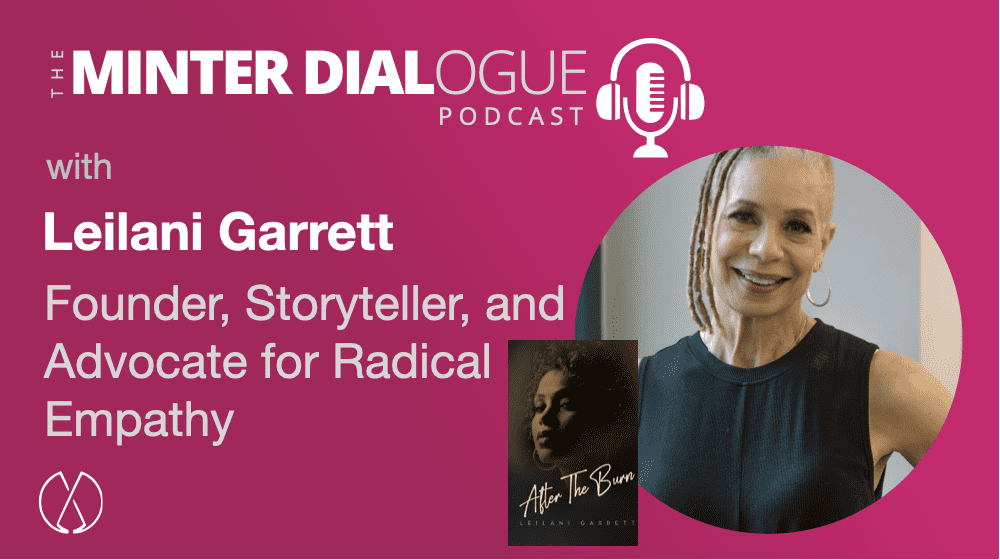
Minter Dialogue with Leilani Garrett
Leilani Garrett joined me for a profoundly resonant conversation about identity, courage, and the power of authenticity—both in the boardroom and beyond it. Leilani, a 30-year veteran of corporate America in technology sales, is now the founder of “Be More Human,” where she helps teams and leaders harness the transformative power of storytelling to inspire radical empathy and genuine connection.
Leilani’s journey threads together the pursuit of creativity and success, and the challenge of reconciling the two. As we discussed her novel, “After the Burn,” I was struck by her candour about the toll that striving to succeed in male-dominated spaces can take on women, and how vital it is to claim one’s own narrative—especially when the world tries to write a different one for us.
We delved into the meanings of “being” versus “doing” human, and the difference between performative empathy and what Leilani calls “radical empathy”—moving beyond just understanding to making a tangible, positive impact on those around us. We explored the power of story: not just in telling, but more importantly, in listening deeply to the stories of others to foster true understanding.
Leilani’s reflections on corporate life, change, and her own creative “side hustle” will resonate with anyone who’s ever felt the tension between who they are, who they’re told to be, and who they want to become.
Key Points:
- The Cost of Conformity: Leilani highlights the emotional and personal toll of masking one’s true self to fit into established—often masculine—corporate norms. True freedom, she demonstrates, only emerges when we allow ourselves to show up authentically, even (and especially) if that means challenging the status quo.
- Radical Empathy in Action: Leilani draws a distinction between empathy as passive understanding and “radical empathy”—the purposeful act of contributing to others’ growth and well-being. In practice, this means supporting colleagues, looking out for one another, and creating environments where people feel seen and valued.
- Knowing Thyself Is an Ongoing Process: The journey to self-knowledge is never complete. Through her own story and her novel’s protagonist (Elle), Leilani illuminates the struggle—and necessity—of identifying your core values and living them, both in life and in work, even as those values evolve over time.
Further resources for the Minter Dialogue podcast:

Meanwhile, you can find my other interviews on the Minter Dialogue Show in this podcast tab, on my Youtube Channel, on Megaphone or via Apple Podcasts. If you like the show, please go over to rate this podcast via RateThisPodcast! And for the francophones reading this, if you want to get more podcasts, you can also find my radio show en français over at: MinterDial.fr, on MegaphoneFR or in iTunes. And if you’ve ever come across padel, please check out my Joy of Padel podcast, too!
Music credit: The jingle at the beginning of the show is courtesy of my friend, Pierre Journel, author of the Guitar Channel. And, the new sign-off music is “A Convinced Man,” a song I co-wrote and recorded with Stephanie Singer back in the late 1980s (please excuse the quality of the sound!).
Full transcript via Castmagic.io
Transcription courtesy of Castmagic.io, an AI full-service for podcasters
Minter Dial: Leilani Garrett. This has been a conversation I’ve been looking forward to. We’ve had multiple trials. This is it. We’re all. We’re live and looking forward to it. Leilani, in your own words, who are you?
Leilani Garrett: Who am I? Well, it’s an ever-evolving answer to that question. But I, as you say, mentor Leilani Garrett and I spent 30 years in corporate America selling technology and serving customers and growing teams. And now I am founder and principal storyteller of an organization I called Be More Human. And really our goal is to share the transformative power of story, to drive radical empathy. Not just to drive revenue and innovation, all those things, but to inspire humans to really, you know, care about each other just a little bit more. Right.
Minter Dial: Well, human. Human being. Human being, human. I was wondering how you would describe, define what actually it means to be human or be more human, to go worse.
Leilani Garrett: That is the first time I’ve got that question. I’ve received that question. So, I love it. In my view, human being is really the word. And if you look at, I’m kind of a word girl, words are interesting because they do point to things that we don’t necessarily think about. So, human being with, in my view, a capital B. We are a collective of individuals who I believe are made of the same stuff. Atoms, cells, spirit, whatever you want to call it. And I think that we are here to uplift and understand each other better. Maybe we don’t remember it when we come here, but I think that is our goal. How do we live on this planet in a way that sustains all of us, recognizing that abundance is a real thing and there’s no shortage only in the mind of men and women. And so, we create those shortages. Being a human being. A human being means really looking at each other as ourselves and working to understand and care about each other and assist each other in navigating this. This life that we live here?
Minter Dial: All right, so then what is. Or what. Where is the place for a human doing?
Leilani Garrett: Rephrase the question. Maybe.
Minter Dial: Well, as opposed to human being. Oh, human doing. Where. What place to where? You know, where in the hierarchy should doing come to be?
Leilani Garrett: I think doing comes after being. Because if we are being the thing, being the thing that we say we want to be, the doing comes. We actually create the doing. Now, one could argue doing comes first. As an example. If we look at our values, our individual values, I’m a person who really believes in truth, believes in honesty, believes in authenticity, and so I could be untruthful. And do things that are inauthentic, then I’m not really living up to my humanness. And so, I think that the doing part. Okay, so I’m going to contradict myself and say they really go hand in hand. I don’t think I can be the thing without doing the thing. And I’m not sure I can do the thing unless I at least aspire to be the thing.
Minter Dial: So, when we talk about our collective and being more human, it feels for me, we live in a world where we have different ideas of what is the human condition. We have different ideas of what it’s all about. And so, maybe within your work, how do you go about rendering uniform that concept of being more human? I mean, obviously you have stories, but what stories should we be telling that would work in an environment where we have people up at arms, at each other’s throats all the time?
Leilani Garrett: So, maybe we shouldn’t necessarily emphasize the telling of our story in that environment. I think more effective and impactful would be to listen to the stories of. Of others. And in an environment where there’s a lot of, or at least some conflict, some dissension, which is pretty much everywhere, the ability to be curious about the other human beings and what their condition is, what their perspective is without making them wrong. Maybe just trying to understand. There’s a story that I think Covey told in one of his books that I read years ago. He was on a. He was on. There’s a guy who got on a bus with, like, five kids. And the guy was very quiet, and his kids were bouncing all over the place. They were throwing things, they were climbing on people. It was a mess. And somebody turned to him and said, dude, could you get a hold of your kids? They’re, like, wreaking havoc on this bus. And he looked up and he said, I’m so sorry. We just left the hospital and their mother just died. And so, the perspective of the person seeing these kids, like, losing their stuff and the real thing that had happened, no one care. No one asked what happened to him or why. You know, it was just more, get your kids together. So, being curious about why a person is the way they are or believe the thing that they believe is, I think where we should all start without judging, if possible.
Minter Dial: I. I’ve always appreciated the notion of storytelling. I thought of myself when I was a CEO, of being the chief storyteller. And as such, the general yawn of a story is that it tends to involve you. You get emotional attachment to the story. You might Associate yourself with the person who’s being told to. But what I’m hearing there is more the openness, the need for openness to hear the story. And. And it’s on the listener’s ability to. To open, you know, stay curious and. And lean into what the storyteller is telling. I. I tend to think of the storyteller having to be the motor of the. Of the. Of the message. But actually, what I’m hearing there makes me feel like it’s the listener’s ability that actually is the motor of the message.
Leilani Garrett: I think that’s true. I think that’s. I think that’s an interesting angle, and I think there’s real merit there, because I can tell you a story all day long. If you are unwilling to receive it or at least analyze it or consider it, then it. It. It did not serve any real purpose other than me running my mouth, which is, you know, could be meaningful, might not be.
Minter Dial: Well, I’m reminded of one of the most meaningful books that I read, which is the dystopian novel by the Russian author Yevgeni Zamyatin. And the book was called we and why. It was published in 1923, first in English and then was banned in Russian, and then finally came out in the 50s in Russian. But this is preceding, of course, [Huxley’s] Brave New World and George Orwell (1984). And what was interesting about his book and his perspective is this notion of who determines who we are. And so, the idea, of course, is we are here, the human race. In the case of the Soviet Union, it was, you know, we, the Russians, or the Soviets, within Russia. But even within the Soviets, of course, there were some less favorable versions of the Soviets that didn’t fit with we, who we are. And the. And then the question becomes, as the book describes, who determines who we are?
Leilani Garrett: Wow. Yeah. First of all, love the title. I mean, as I. As I write this next novel, I’m grappling for a title, and I. I can’t steal that one, but I do love that one. It’s interesting. I’m reading a book now called When Elephants Fell from the Sky. I think by Cebo Campbell. It’s kind of dystopian. One day, all the white people in America wake up and walk into the nearest body of water and die. So, what’s left is this whole black America. There are some Asians there. I’m just getting into it. But there’s this discussion of us and them, and it keeps coming up in the story. And the daughter of the man who’s kind of the protagonist, he uses us, and she’s like, I’m not us. Well, she’s half white and he’s black. And her mother walked into the water, and so there’s a huge us in them. And she’s trying to figure out, am I part of us or am I them? And it’s really fascinating, and I think that we are belabored with the us and them over time, more and more, when there really isn’t us and them, and there’s just us, frankly, there’s only us.
Minter Dial: I. I’ve had many friends with mixed backgrounds, and, you know, that can be sort of Ashkenaz Muslim, and that can be Russian, Ukrainian. It can also be black and white. I mean, there’s so many versions of. Of mixed. As the world has become more integrated in this way. And then the. The question is identity. And I. I’ve long felt that we. In the chase for the human race, the big one, the global peace story, it. It feels like we. We end up losing our ability to have tribalism and. And unite, for example, around the support of the Chicago Blackhawks, or I think they’re called that the hockey team, or, you know, whatever your team might be. And I feel like being able to rally around a team, around a community, around a tribe is. Is. Is terribly important for us. And I wonder how that sits with you.
Leilani Garrett: That’s a really great point. I think that the idea that if I am proud to be a black woman and I support black women, means that I don’t support everyone else. The fact of the matter is I can support all and care about all, and it’s okay for me to have a particular affinity for from whence I came. It doesn’t discount my caring and understanding or seeking to understand from your community, but let me have mine without it being a thing. I mean, you know, when you think about this might bring a little light to this point, which is like the whole Black Lives Matter movement, and folks were like, well, black lives matter and all lives matter. Blue lives matter. Every life matters. Yes, every life does matter. This is fact. But if I’m on a block and this house is on fire, and you say, well, all houses matter, and you don’t give me water because all houses matter. My house is on fire. How about some water on this side of the street so we can have it all, but because we dissect ourselves out in such a way that it eliminates others, that’s where we run into the problem. Yes, be about all people and love and care about and have a special affinity for your people. That’s fair.
Minter Dial: Anyway, I suppose this tension, I think, is. Is part of our human condition these days. So, speaking of tensions, I should say you, Leilani, you spent 18 years at IBM and LinkedIn. And then you, or at least at some point within your career, you wrote a novel, you sat on it. But the book is. I saw it as I, I read it. Was it. It’s about black woman navigating corporate sales and love. At what exact moment did you feel compelled to write Elle Rollins story?
Leilani Garrett: You know, when I was a little girl and I don’t know how old I was, maybe I was 7 or 8. And I remember sitting on my bed with one of those green pads and a yellow pencil and I endeavored to write a story in that moment. And I don’t remember if I wrote the story, but I did write down the title. And the title was the Green Stone. I’ll never forget the title. I don’t know where the story went. So, I always fancied myself deep down as a writer, got an opportunity to work at IBM. And I think you made the point before we spoke. There’s a big conflict from being a creative and working in corporate America, although there’s always discussion about be creative, be innovative. And so, I, I wanted to write this book for a very long time or a book. And I was leaving IBM and I thought, maybe I’ll take this year off and write this book. So, that’s when I actually sat down and did it. It was a fabulous experience. I would start writing at 11pm and 3am I was still writing. It was really amazing. And then I’d sleep till noon and go do yoga and take. That was like such a wonderful writing life. And so, when I had the agent who didn’t get a deal, then I had another agent who almost got a deal. And then Random House, sort of the editor who wanted to pitch it to her team left and we couldn’t find her. I thought, okay, I lived my dream. I did it. I wrote the novel. It was a year and a half, had this great experience. It’s done. I put it under the bed. But it was always something that I needed to do. And I still feel that drive now. Now I’m writing what I think is a more important book. No shade to my first novel. I think it’s fun and fast and sexy and there’s ambition and love and guidance on how to like, realize who you are. But this next one is like, like an Oprah book. So, something a little Deeper, something more resonant, something that I think, I hope will have an impact.
Minter Dial: One of the things I like to dig in on is the masks and personalities we adopt as we go and get. Get older. We go to work and. And, you know, I’m a big executive. Look at this title, the “pay”. And. And yet you have. We often have something underneath us, you know, like it might be a guitar or. Or some sort of side hustle, side hobby that you look at and you try to get to on a Friday evening or exhaustedly, and you’re like, I wish I could do more of that. To what extent was writing this novel a something was always like a side hustle. So, you were looking up, I want to be there, but you can’t because you’re in a workplace. And the. The gap between the. You working successfully and that desire to write, how. How did you manage that gap? Was it something you lived with comfortably or was it always a little bit of a niggle?
Leilani Garrett: It was always a niggle. It was. It always was.
Minter Dial: I.
Leilani Garrett: My first experience in, like, real corporate America was IBM. And so, when I was there selling, I looked for ways to write, and I wanted to get into, like, the writing part of either writing, like, documents or writing, you know, back when they had brochures, that kind of thing. And there was always a pushback. Well, you’re. You sell. You’re not. Yeah, but I have a journalism degree. I know how to write, and I. I only got to write for free. Oh, you’re going to have a customer center event. Maybe I can write the document that invites people in. So, I only got to write for free. And it wasn’t taken so seriously. And then it just felt like, well, how are you going to make money? And so, you work for corporate America. The check gets bigger and bigger and bigger every year. But there was always something just pulling at me, like biting at me that said, you have to do this other thing. And so, that was an opportunity for me to do it. But I never got over that conflict of wanting to do this, needing really to do this thing and making a life for myself and my son. And I think that we were put here to create. I am the creator. The creator is me. And so, either I get to do it or I don’t. And it’s going to. I mean, it was suffocating not to be able to do it, frankly. You probably had some of the same experiences.
Minter Dial: I certainly did. And I. And I’ve often talked about this idea of the side hustle. And I feel like we’re not equipped to know how to integrate the side hustle into our lives. And therefore, it becomes this burden, almost this entropic element of our lives. In after the Burn, your novel, your first novel, anyway, Elle resigns. And as she resigns, she says free. She says it twice before breaking down in tears in front of her mama’s photo. What does that scene tell us about the price women like her pay for success?
Leilani Garrett: Yeah, that scene makes me want to weep a little bit. You know, I’ve had women leaders right over the course of my career, and so I’ve seen them work like men, look like men, act like men,
Minter Dial: and
Leilani Garrett: inauthentic to them probably most of the time. But that’s how I think many of us felt we should behave. I remember wearing the starched shirts and the Mark Shale suits with the silk ties, and I literally had marks on my neck from the starch and the shirts. And I hated. I mean, I was fashionable, it looked good. It was the thing at the time. But I would much rather wear T shirts and a jean and some jeans that was. And I would always try to buck the system. I would color my hair a strange color and then I would get in trouble for that, or I would wear something that wasn’t quite corporate enough. And I think that women, as women, and I can speak for myself and elves, we’ve had a struggle in corporate America revealing the truth of who we are and fitting into the boxes that were created by men that men maybe fit better in. And we fashion ourselves to stuff into this place that does not that we just don’t fit. It’s very hard to fit. I think now there’s more opportunity for women to be who they are in corporate spaces. And my best experience in a corporate space was LinkedIn. And I don’t know if it. Because it was Silicon Valley or what, but we were definitely not put in boxes that I had experienced, for example, at Microsoft. Loved Microsoft, no shade, IBM and so on. It was a freer environment for a woman to be a woman, if you will.
Minter Dial: Where’s. Now Microsoft owns LinkedIn.
Leilani Garrett: I’m sorry? Yes.
Minter Dial: Now Microsoft owns LinkedIn.
Leilani Garrett: Yes. Well, and I was there when Microsoft bought LinkedIn and it was a moment where there was a lot of fear, uncertainty and doubt because two very different organizations.
Minter Dial: So, from your perspective, not that it was your role per se, but in terms of acquisitions, when you have one culture, one company buying another, what did you take away from that purchase? Because Obviously, you know, LinkedIn had a very strong entrepreneurial background. I was Doing something very different from what Microsoft was doing.
Leilani Garrett: Yeah, I, I felt like our culture that had been cultivated before I got there would change and would shift. It took some time. I was there six, six and a half years or so. It took some time, but it did start to look a lot more like Microsoft, which I had been at just before LinkedIn, but not quite. I think the culture at Microsoft also shifted when Satya came. Very different than Steve Ballmer. So, that was helpful. Satya, actually, his first memo was about empathy and he talked about our industry does not respect tradition, our industry respects innovation. And you can’t really innovate unless there’s empathy in the room because innovation is nothing more than a wild idea. I’m not going to pitch you a wild idea if I don’t think you care about me or think I’m smart or at least we’ll consider what my idea is. So, LinkedIn today, I think is different than it was certainly in 2015, 16, 17, 20 when I was there. Not perhaps more akin to Microsoft, but Microsoft also changed, which I believe was a really good thing for that organization and the people who work there and the shareholders.
Minter Dial: So, I was just listening to a man who’s written a new book about culture and change and it seems to be a forever question, how does one accommodate culture and change? And what I hear from what you said is that it took a while. And then you also seem to. I inferred that the fact is that the CEO sets the pace. Yes. Is that a fair rendition? And in the six and a half years, what allowed for the changes to happen? Was it both willing to do, you know, toing and froing or specific individuals? How do you assess the success of the ability to integrate?
Leilani Garrett: Yeah, I think that a couple things happened. I know Microsoft paid, I forget how many billions, 2 billion or something for LinkedIn. So, clearly they get to set the tone. Also because LinkedIn had such an entrepreneurial attitude and the culture was very Silicon Valley, even though Microsoft is there. I mean, it’s old school Silicon Valley. Right. I think there was a willingness to allow LinkedIn to be LinkedIn because that was the reason they bought it. However, there are some procedures and policies, et cetera, in place that ultimately we want implemented. And so, they did it like in little bitty bite sized chunks. There was the fear that we had was that it would change overnight. Of course that did not happen, but over the course of five years or so it did change. The good news is because Microsoft changed, as I mentioned, and LinkedIn changed they sort of came together in a place where I think folks at LinkedIn are not beleaguered anymore by the fact that they’re owned by Microsoft, at least not to a significant degree.
Minter Dial: So, a little bit of. A little by little, we’re using processes and sort of habits and behaviors that little by little, help you to, let’s say, merge. So, speaking of LinkedIn, on your profile, you say that stories can unlock new ways of thinking, inspire empathy, and foster growth after the Burn. Seems to be very autobiographical in spirit. Anyway, how much for you is in Elle Rollins and how honest was it or uncomfortable to be her? Ooh.
Leilani Garrett: So, this is the question I’ve. I have heard before. The truth of the matter is part of the reason I think the book was under my bed for so long. Because, I mean, I’m her. I’m. It was not hard to write her because I know her so well, and I have a son who now is 36, and some of it I was, like, not so sure I wanted him to know about. And it’s funny, because when he started reading it, he did call me and he said, mom. He said, I didn’t know that you, like, felt some of these things or thought some of these ways. And I hadn’t realized that the look at Elle was so intimate. It’s very close in to. To her. So, there’s a lot of me, I’d say, I mean, we’re talking 80, 90% of her values were mine. Her feelings were mine. The way she behaved, the way she talked, the way she moved. An example she was very clear about. I’m not going to do that whole haughty, see how smart I am. Speak in corporate America, because it was expected. And I did that a lot. I would say y’ all in meetings and people. Yes. And I’m not. I just happen to be. My mother was Southern, and, you know, it’s kind of how we ended up talking. And I would do things to. To sort of poke the. The boundaries. And one client told me one day I said something about me being typical, and I said, well, I am typical. He said, no, you’re not typically said, but I’ve come to appreciate it. So, that was, you know, you can be different and be appreciated. Which that taught me a little something about the world and myself. But, yeah, I’m her. She’s me. So, it was easy to write her. And as I write this new novel, I don’t know these people, and it’s harder to create someone that you don’t know well. So, yeah. And it was. There was some fear in revealing myself so. So, intimately. But there’s also a great deal of freedom in that.
Minter Dial: And how much did the process of writing the book help you to crystallize who you are?
Leilani Garrett: It really did. I believe that at the end of the book, when I started to. Folks started reading it, like my friends and what have you. And they would ask me questions, and I told my son this. Ask me any question you want. I’ll tell you exactly did that or did that not happen, and how did I feel about that, and what was the outcome? And he was like, I’m good. He didn’t ask me any questions. But it did crystallize for me some of my choices and why I had made them and the outcome of those choices and what I learned from some of those choices. And I did realize, like, Elle, a lot of the choices I made were to accommodate the wishes of others. Who I was supposed to be, who you wanted me to be, who you thought I should look like and how I should behave. Those were the things that I took to heart and did. But there was always a pushback in, like, I’m not her. And like, Elle, at the end, I finally decided, yeah, I’m. I’m going to do me, so take it or let it alone. I learned a lot writing that book about myself.
Minter Dial: I, I mean, in the end of the day, one of the challenges we have in our society, I think, is a very distant knowledge of self, generally speaking.
Leilani Garrett: Yeah.
Minter Dial: And in that distance, that gap is a whole lot of performative and bravado and distance. And in that distance, actually, an inevitable solitude because it’s. I’m not me. I’m. I’m. I. I don’t even know who I am. Whatever I’m projecting is detached from me as reality. And that detachment then becomes unhinged because it’s, it’s not rooted in, in some kind of proper or closer to truth.
Leilani Garrett: Yeah, I, I, I misquote Frank Sinatra. And I say that he sang that song I Gotta Be Me. But I think it was Sammy Davis Jr. Who sang that song. I just figured that out the other day. It’s like, that wasn’t Frank. That was one of his boys. But. Or, and to your point, when we do the performative thing, because I think we all do. I very much buck up against it these days, period. And I think I have more freedom to do that. It’s. It’s injury. It’s injury to yourself because. And, and you don’t know it if you don’t The. The first thing we have to do, even as we seek to understand others, is to. To understand ourselves. Who. Who are you? Who. Who do you want to be? And maybe the answer is in what are your values? What do you really believe in? The two or three things that you hard and fast believe in, that you would stand for. In the dark or in the light. There was this movie, Joan. I can’t think of her last name. She was going to be vice president. Oh, gosh, I wish I could think of the name of the movie. And they were asking her to tell a story about something she did in college with a group of guys, sort of an unfortunate situation. They didn’t rape her. It was more a consensual. And she was like, no, I’m not answering that question. And she ended up being vice president, I believe. But the point was, if that was a guy, they wouldn’t even have asked the question. So, she stood in the light and in the dark on her principle, on her value, which is, you don’t get to ask me that. You wouldn’t ask him that. You don’t get to ask me that. And I think that when we discover, like, the things that matter to us most, we could say, yes, family is the thing that matters most. That means, what would you do for family? Anything, Everything. Two or three things that matter to you. If you can say, these are what I believe, and you live from that place, you have a better sense of who you are. Now, having said that, who you are will shift and change. I mean, people in relationships are like, oh, my God, you changed. Well, I hope so. I mean, I met you 10 years ago. What am I, the same person? So, but those things. Something dramatic has to happen for one of those things to shift and change. And it has to be profound enough to say to you, I was wrong about that. And I think that that’s going to be hard to do. So, what are your values? 2 or 3. Don’t make it a long list. If you can live by those, then that’s who the real of you are. And you can add things. Oh, I’m creative. Oh, I’m funny. You can add the ancillary things, but the core of you has to be 2 or 3 or 4. The most real things about what you believe.
Minter Dial: Totally agree with you. And the idea of. Of moving from a word like family to. What actually do you mean by family? Because as Tolstoy said, you know, every happy family looks the same, but no unhappy family is the same.
Leilani Garrett: Wow.
Minter Dial: So, I, in. In looking at the idea of, of the self, your ability to lean into that, it is usually challenged at work. And, and so how do you. Because I mean, at the end of the day, having values you stand up for, that are your backbone. Yet we need to listen, be curious, adapt to environments. Because if we just, you know, use the pirates, hey ho. And, and that’s not the culture that we’re going into or part of how the community goes. How do you marry those two things? At what point do you need to bend and how do you know when you will break?
Leilani Garrett: I think, I mean, being a successful human is having the ability to adapt, to be somewhat flexible. I mean, there’s a story about the oak, you know, that breaks or you want to be the reed that like bends with the storm and so bend with a storm. I’d say, you know, in terms of phrasing it differently, and I don’t like using the word but because it sort of negates everything.
Minter Dial: I’m with you.
Leilani Garrett: And, and though if something happens at work that you, that really, really pushes against your values. Example someone lies on someone and you know they’re lying on someone else and this, the person they lied on is the one who gets, you know, put in the, in the trick bag. And, and I’m going to stand at my desk and not say you lied. I’m probably going to say you lied. And I’m probably going to live with the consequences of that, whatever it is, because maybe it’s, I mean, I had, I had a leader lie on me one day at IBM, just flat out lie in front of the branch manager. And he and I were sitting there and he, and, and he told this lie and I thought, and I was two or three years in, so I was, you know, young. And I looked at him and I looked at the branch manager and I looked back at him and I said, are you going to, are you going to say that differently? Because I didn’t know what to do. And he said no. And I said, well, I’m, I can’t sit here and just, I can’t. And I, I said to the guy, I said that’s not true. And so, the branch manager said, well, tell me what really happened. And then we sort of got our story straight because he came from where he was more to, but just to watch someone malign another human being and you know, it’s not true. In that environment when most folks would be like that, not my business, I’m protecting us over here. Then you didn’t really believe in that whole do it in the dark and the light thing, it wasn’t an important thing to you? I’ll do it when folks are watching, but when they’re not, I’m not going to do that.
Minter Dial: Yeah, well, speaking of culture, of course, the fact is that trust is the glue, right? Within a culture. And if you can’t trust what that person said to somebody else because they were lying, then that person’s kind of rubbed off, rubbed out of your trust network. I mean, I recall a time when my boss had flown over to me and he wanted me to come over, come change countries. And so, I had breakfast with him. And while we’re having breakfast — he was always very verbal in the negotiations — I was writing down on a napkin what he said. And then when I got to Paris, he completely, flatly refused to admit what he’d said. And I said, well, why do you think that I would have written that down on the napkin? How do. How do you. I mean, I. I didn’t bring this napkin and. And cheat and. And write it afterwards anyway. That. That set me on a path not to appreciate that person. Speaking of the journey for the book, you had. You had this moment where you put the novel, the manuscript down, and then a friend comes out and says, hey, you got to get this out. And you. What did that moment of surrender and then recovery say about the stories we tell ourselves when we do. We do things where things don’t go according to plan?
Leilani Garrett: She said to me, I think it was January 2025. It was 25, 24, 24. We’re talking about this season of our life. What do we want to do? La la. She said, you know, you wrote that book. You haven’t done anything with that book. And just, like, totally called me out, and I kind of went, oh, really? And the. I realized. I said. I said to myself, at least pull it out and read it. That’s the least you can do. So, I did that. And I thought, this is. This is good. But I realized that I had lied to myself when I said, I live my dream. I did it. I wrote the book. I took a year and a half off. I did yoga. I did. I did the whole writing, writing life. It was a lie. It was. It was like, I did my dream. It’s gone. And so, I realized that, no, that’s. It’s. It’s. So, the surrender was. I read it. It’s worthy. And I knew it was worthy because I had two agents and I had a. An editor involved who was interested. So, I knew it was worthy. But I read it again. I said, this is really worthy. How are you going to publish this? Are you going to publish this? This? And I thought about it for a couple days, and then I thought, okay, I’m going to figure this out. So, I found an indie publisher and we got it done. So, when I did that, to your point about surrender, I did feel exposed. I very much felt there’s a difference between visibility and exposure. I was definitely exposed. And so, it made me a little bit nervous, for sure. Would it be received well? I mean, the reviews are good. Thank you for reading it. I appreciate that very much. And then the. The. What was the. The second part of that question?
Minter Dial: You said, well, the. The stories we tell ourselves. Because, I mean, when you are creative, you know, you’re putting yourself out, that you’re exposing yourself.
Leilani Garrett: Yeah.
Minter Dial: And I think there are perhaps many people who are listening who have a creative flair, doing something else, but they. They worry about the reaction. The. Because, I mean, the end of the day, it does require people liking it or buying it. And that’s. You are being put up.
Leilani Garrett: Yes.
Minter Dial: For a contest of sorts. It’s not like a popularity contest, but it is. Is it worth buying this book?
Leilani Garrett: Yeah, I. I think for me, I’m. As I write this next one, it. I’m working to not be someone who thinks I can’t do it. I know that I have the skill. I know I have the talent. The question is, will I execute on that skill and talent? It’s really just about the doing. Right. Yeah. You want people to love your work. And I feel. I feel validated. I feel fortunate that I’ve gotten that with this. With this particular novel. I. I hope to have it next time. But either way, I’m going to write what I’m going to write, and I’m going to write it the way I want to write it. And there’s a whole chapter in that book that the agent told me to ditch. She’s like, you don’t need this. It’s the whole one where the previous IBM executive and what happened to her, and I just love the whole. The room, you know, made for her. And. And she’s like, you don’t need that. Let’s. Let’s get rid of that chapter. And I was like, no, we. We. We’re not doing that.
Minter Dial: Yeah, I. I found. I mean, I haven’t done. I haven’t published a novel. But the idea of an editor editing the novel seems a lot harder because it is part of a true creative genius, and it comes from you within you as opposed to non fiction, which is what I’ve done, where editors seem to know the marketplace better and all that kind of stuff. So, I can imagine that little confrontation. So, moving into your be more human work that you’re doing today. First of all, what does that look like in terms of, you know, type of clients who should be calling you?
Leilani Garrett: So, corporate clients. And it can be the event producer, it can be, it can be a sales manager, it can be a sales vice president, it could be a marketing vice president and someone who has a team that wants their team to be as cohesive as possible, as innovative as possible, as trusting of each other as possible, and to really like, help them meet their objectives as they go along this journey of what they have to produce. The bottom line is when teams are really cohesive, they are more innovative. Revenue is up by 7%. There’s all these hard facts and figures that show, show when a team appreciates and cares about each other, they win more and they win a lot more a lot of the time. And so, there are micro exercises that teams can do amongst themselves to like actually create these bonds in the team. So, anyone who runs a team, from a CEO all the way down to a first line manager and what I deliver are keynotes that talk about the transformative power of story and really this intersection between storytelling, empathy and leadership, as well as workshops which are more aligned with like, personal narrative to help people know themselves better. Know thyself, know thy neighbor. So, so that happens. And I’m, I’m, I’m talking, I’m having a conversation with a potential partner who’s really an AI genius. And we’re talking about how does humanness enter into this whole fray of all this information about how AI gets implemented? Does it work? Part of the reason that it’s not working in a lot of organizations, as I’m reading, is because of the human element of either being afraid of it, not knowing how to implement it, not realizing that it’s helpful, or how it could be unhelpful. So, that’s something I think I’d like to formulate and offer as well. But, so conferences, team meetings, off sites, retreats, those kinds of things to really teach how to be more human and understand that this is not a soft skill, this is strategy. When you understand the people around you better and seek to know them better and really be a part of assisting them, everybody wins more.
Minter Dial: So, I, I mean, I’ve been, I, I love analogies with sports and obviously having been a leader in business, the idea of a cohesive team, you know, getting together, standing up for each other. I played rugby, you know, so if someone did something that was untoward with one of my teammates, went over and made sure that the other guy on the opposition got near full or whatever it was needed at that time, so you stand up and that, that cohesion is strong. And I wonder to what extent you might compartmentalize or look at the idea of cohesion within the team and attachment to a bigger purpose. Because I, I see teams who just want to win. Yeah, is the big thing, but winning by itself is really just a, an illusory type of objective. By winning, what do we do? You know, well, we earn more money. Okay. That’s another extrinsic element. And, and the idea of actually going to do, going through battle and, and, and, and throwing your body at whatever was needed at the time and suffering the challenge, the consequence of that, that journey for me is more meaningful than the win itself. So, when you’re looking at a corporate environment, thinking about cohesion and allowing for everyone to trust one another, to what extent is purpose the bigger purpose a part of a necessary part or a part of the work that you do with your teams?
Leilani Garrett: Yeah, that’s a great question. I want to say, fortunately or unfortunately, the emphasis in a corporation is going to be on winning, revenue and growing revenue and all of that. So, that has to be a component of it. Otherwise it’s a nice to have. The bottom line is. And, and I’ll give you an example. If you’re, if you’re on a team and you know that your neighbor is sort of that quiet contributor who has a superpower that’s never really lauded or brought to bear. Maybe you have a conversation with him one day and he has to make a presentation and he’s nervous about it. And, and I. What I like to call radical empathy is not just saying, oh, I’m sorry, you know, I know this is going to be hard for you, et cetera, and sort of trying to feel the thing with them. Radical empathy means how can I contribute to this human being and move them forward in their quest? Maybe it’s like, tell me what I can do in the meeting to set you up to succeed. Tell me what I can do to help minimize your angst or whatever it is, but make a contribution. And I think when this is, I think when we do that in our lives with other humans and even animals. I just helped get a really difficult to place cat adopted, which made my day, frankly, because that cat was on the street and he would have died. The ability to contribute and know that you gave something that created light or reduced pain or helped advance someone or something forward, that’s, that’s real purpose. That’s what life, in my view, is all about. I, I think stopping and asking people on the street how they got to be where they are. How did you get to this place? How can I help you besides maybe giving you money, some contribution to your fellow human being? Because guess what? We are one. That’s the biggest purpose in my view. And so, if you can do that in a corporation and make money and people go to work and feel like they’re part of something, that’s more than, oh, I made my quota last month. Important to do. But is it the end all be all to your point, mentor, it’s not, Not a bigger purpose, a contribution to the people and the, and, and whatever else on this earth matters to you, I think is really, for me, that’s, that’s the thing.
Minter Dial: Oh, when I, I read about radical as a word, I, I think of radical honesty. You know, that radical is, is a, you know, hey, rad. It’s really radical, the word, it seems to have many meanings and radical empathy, was that something that you termed or you borrowed from someone else? Because for me, I’ve always thought of empathy being the ability to feel and understand someone else’s thoughts, emotions, and experiences. And it stops there, as in there’s no necessary action out of empathy. So, radical, as I understand it, the way you, you describe it is almost like being purposeful. Contributory.
Leilani Garrett: Yes.
Minter Dial: As opposed to being radical. I don’t know why. For me, I always think radical seems extreme and as opposed to being more intentional, perhaps.
Leilani Garrett: I think that’s a really fair point. So, to answer your question, did I borrow it or come up with was it had this amazing marketing woman, a savant for real. She came up with it and I thought it felt right because it is a word that’s a little bit jarring. You know, it’s kind of like, oh, radical. Radical means. What does that mean? That means out of the ordinary. That means harder to do or that means different than. So, that’s. So, I adopted it because she wrote it in the treatise that we were working on. I was like, I like this. And you’re right, it basically means contributory. It means having an idea that you can do something as opposed to pure empathy, which is. I feel for you. I understand you. I seek to walk in your shoes, but my shoes are just fine, thank you very much. So, yes, she made it up. I adopted it. I think it. Because of the. Not harshness of it, but because of the sort of jolt that it. It gives. That’s why I liked it.
Minter Dial: I get it. I don’t know the etymology of the word radical, but I’m going to look that up, though. It’s something about a root, probably.
Leilani Garrett: Etymology is a whole nother discussion we could have.
Minter Dial: Indeed. And I love words. And as you said the very beginning, Leilani, words are structuring. Words are important. And getting the right words is. Is something I think we can do a lot better of. Better in. In general, in society, it feels like we lost our ability to read. We. We don’t write with effort. Grammatical correctness. And. And these are. This is effort. And it feels like you. Your effort to write and. And bring your story out is most worthwhile. So, Leilani, been lovely chatting with you. I’ve enjoyed the experience immensely. How can someone get your book, follow what you’re writing, hire you for being more human and maybe find out about your new book?
Leilani Garrett: Yes. So, my goal, I’m on Instagram @lahhnee L A H H N E E and I will be talking about the writing that I’m doing going forward. My idea is sort of share the process with the audience. So, you can find that there. I’m on LinkedIn. Leilani Garrett. Obviously, you can click on LinkedIn and you can go to my website, which is Leilani Garrett.com and book a discovery call if you are interested in hiring me for a keynote or to find, facilitate, or on a panel or those kinds of things. And I would. And you can buy my book, the current book, at, of course, Amazon, although I do support the small independent bookstores. My favorite one is the book joint on the south side of Chicago. So, you can order it there. Barnes and Noble, Target books, a million. You literally can get my book anywhere.
Minter Dial: All right, well, I’ll put as many of those in the show. Notes, the links and calls to actions. Le Ani, thanks for coming on. Great to chat and good luck with your new book and. And keep being the wild duck.
Leilani Garrett: Thank you so much. Minter a distinct pleasure chatting with you. Absolutely. My pleasure. Thank you so much.

Minter Dial
It’s easy to inquire about booking Minter Dial here.