Have Bat, Will Travel
Padel may be expanding rapidly around the world, but the elite game remains overwhelmingly Spanish and Argentine. The question is no longer whether padel will become international; it is how quickly other nations can build the depth, talent pathways and competitive experience needed to challenge the established powers.
The dominance of Spain and Argentina
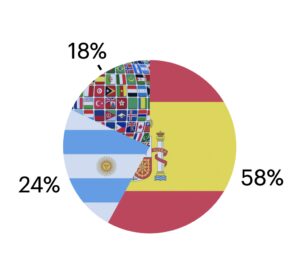
The current rankings tell a striking story. At time of publication, here are the standings:
Among the Men’s Top 100 (according to the FIP)
- 58 players are Spanish
- 24 players are Argentine (four of whom are in the Top 10)
- Together, they account for 82% of the men’s top 100
- Among the 18% ‘other’, there are representatives from 8 countries: Italy (7), two a piece for Portugal, Paraguay, Brazil and UAE; and one each: France, Chile, and Belgium.
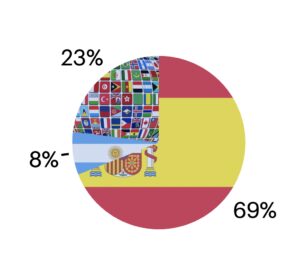 And for the Women’s Top 100 (FIP)
- 69 players are Spanish
- 8 players are Argentine (just one in the Top 10)
- Together, they represent 77% of the women’s top 100
- Among the 23% ‘other’, there are representatives from 11 countries: Italy (9), France (3), two each for GB and Portugal; and one each for Russia, Mexico, Germany, USA, Netherlands and Sweden.
For all the sport’s global momentum, the professional game remains rooted in the two powerhouse countries that created its modern competitive culture. Spain has the infrastructure, coaching system and sheer volume of players. Argentina has a deep sporting tradition, a distinctive competitive edge and an enduring ability to produce outstanding talent.
So, what will it take for other nations to break through? By the numbers, surely Italy is closing in.
Building the foundations at home
The first requirement is infrastructure. A country needs enough courts, accessible at sensible prices, to make the sport available to a broad base of players — particularly young people.
In countries where the weather is less forgiving, indoor facilities are essential. It is hard to develop a year-round sporting culture if court time is scarce, expensive or dependent on sunshine. Quantity matters, but so does the quality of the environment: well-run clubs, regular competition, youth programmes and a clear pathway from recreational play to high-performance training.
The second requirement is coaching. Countries need coaches who understand the game in depth: its tactics, positioning, technical demands, physical preparation and, importantly, the way players develop over time. Padel is not simply tennis played within glass walls. Developing international-level players requires coaches who can identify talent early and guide it through the particular complexities of the sport. This is another reason that indoor facilities are important, particularly when the weather isn’t good year round, so that coaches can count on a stable income. If you want good coaches (espeically Spanish), you had better ensure that they can earn reliably.
Third, there must be tournaments at every level, and throughout the country. Young players need regular matches, not occasional showcase events. A healthy domestic circuit allows players to gain confidence, learn how to compete under pressure and meet opponents with different styles.
From domestic promise to international progress
Once a country has produced promising players, the next challenge is finding ways to help them make the jump.
That usually means access to funding, elite facilities and high-level training partners. For many players from emerging padel nations, spending substantial time in Spain remains a necessary part of the journey. They need to train with experienced players, learn from specialist coaches and compete consistently in international tournaments.
One of the clearest signs of progress is when a player from an emerging country begins to pair with — and train alongside — a more highly ranked player or a partner with extensive experience on the professional circuit. Brazil, Portugal, Italy and France are increasingly producing such examples.
Yet building a national team is not simply a matter of producing individual stars. A country needs balance across positions and enough depth to form effective partnerships.
Take Brazil’s men. Lucas Bergamini and Lucas Campagnolo have both reached the Top 20, but both are right-side players (and both funnily enough are called Lucas). It is difficult to imagine Brazil mounting a sustained challenge at the World Championships without left-side players of comparable quality. The same principle applies to Italy’s women: having two left-handed players (Carolina Orsi* and Giulia Dal Pozzo*) in the Top 30 is encouraging, but the country must also develop compatible players for the other side of the court (granted there’s a better supply).
The next phase of internationalisation will be about creating not just isolated talents, but complete ecosystems — and complete teams.
Why big-stage experience matters
For the smaller padel nations, every opportunity to play in a major tournament can be transformative. A single unexpected run can bring ranking points, confidence, visibility and, perhaps most importantly, belief.
At the Paris Major 2026 at Roland-Garros, several lower-ranked players from less-established padel countries recorded notable wins.
Frenchman Thomas Leygue*, ranked No. 146 in the world, partnered Spain’s Jesús Moya, ranked No. 156. They came through qualifying, defeating the legendary Miguel Lamperti in the first qualifying round before winning a hard-fought three-set match in the second quali.
Their momentum continued in the main draw. In the Round of 64, Leygue and Moya beat the talented pairing of David Gala, ranked No. 35, and Enzo Jensen, ranked No. 47. They then produced an even bigger upset, overcoming the 13th seeds Juanlu Esbrí, No. 24, and Carols “Sanyo” Gutiérrez, No. 23, in three sets.
Their run ended in the Round of 16, where they lost in two closely contested sets to the No. 4 seeds, Jon Sanz and Franco Stupaczuk. Nevertheless, the experience should prove invaluable for Leygue: valuable FIP ranking points, greater confidence and a higher profile that may open the door to stronger partnerships and further opportunities.
A US star on the rise
On the women’s side, American Brittany Dubins*, ranked No. 78 worldwide, partnered Mexican Camila Ramme, ranked No. 75. Having come through qualifying, they won their Round of 64 match on the prestigious Suzanne-Lenglen court. For Dubins, it marked the first time an American had won a match in a Major tournament.
Dubins said, after the Paris experience: “It was really special. A dream come true that I want to dedicate to my family. I feel like people used to celebrate when the draw came out out and they saw that their opponent’s flags weren’t Spanish or Argentina. The goal is for that not to be the case and for other countries to continue raising the level. USA padel is moving in the right direction!”
Dubins/Ramme then faced Germany’s No. 1, Victoria “Vici” Kurz, ranked No. 76, who was playing with Spain’s Anna Ortiz, ranked No. 88. Kurz and Ortiz had entered the draw as lucky losers after an injury withdrawal from a seeded pair, and they went on to beat Dubins and Ramme in the Round of 32 in straight sets. For Kurz, this represented the first time a German player had reached the Round of 16 at that level.
These moments may look modest beside the achievements of the sport’s biggest names, but they are precisely how new padel nations gain momentum.
Beyond the usual flags
By the quarter-final stage in Paris, the familiar pattern had largely reasserted itself. The flags still flying were Spain, Argentina, Brazil and Portugal (where the latter two countries feature one or two exceptional individuals).
That underlines the scale of the challenge. Padel’s international growth is real, but competitive parity at the top remains some way off. For now, Brazil, Portugal, Italy and France appear to be the most likely countries to make further advances. On the men’s side, the UAE could also become more competitive, stimulated somewhat artificially by Spanish-born players. In the women’s game, after the Italians, the Netherlands and Sweden may be especially well placed to make progress.
Wild cards can also play an important role. When Premier Padel events take place in countries with less mature padel ecosystems — such as the UK, South Africa or Belgium — organisers should use wild-card places to give domestic players meaningful exposure to the highest level. That is not merely a gesture towards local interest; it is an investment in the sport’s long-term global development.
Looking towards 2032
The road to possible Olympic inclusion in 2032 should, one hopes, be marked by a broader and more competitive international field.
For that to happen, padel must develop beyond its traditional strongholds. It needs more courts, more good coaches, more structured domestic competition, more funding for elite pathways and more opportunities for players from developing nations to test themselves against the world’s best.
The World Championships in Doha this November 2026 should offer exactly that kind of opportunity. Unlike the Premier Padel circuit, where entry is heavily shaped by FIP ranking points, the team format gives smaller countries a chance to compete on the same stage as the game’s leading nations.
That exposure matters. It is how players learn what the top level truly demands — and how the so-called minnows gradually become contenders.
*Everyone with an asterisk has been a guest on my podcast, the Joy of Padel. Find them all four seasons and the more than 70 episodes here.