FYI: If you want to hear the Spanish with English Subtitles, please go to the Youtube channel or click on the Youtube embed above!
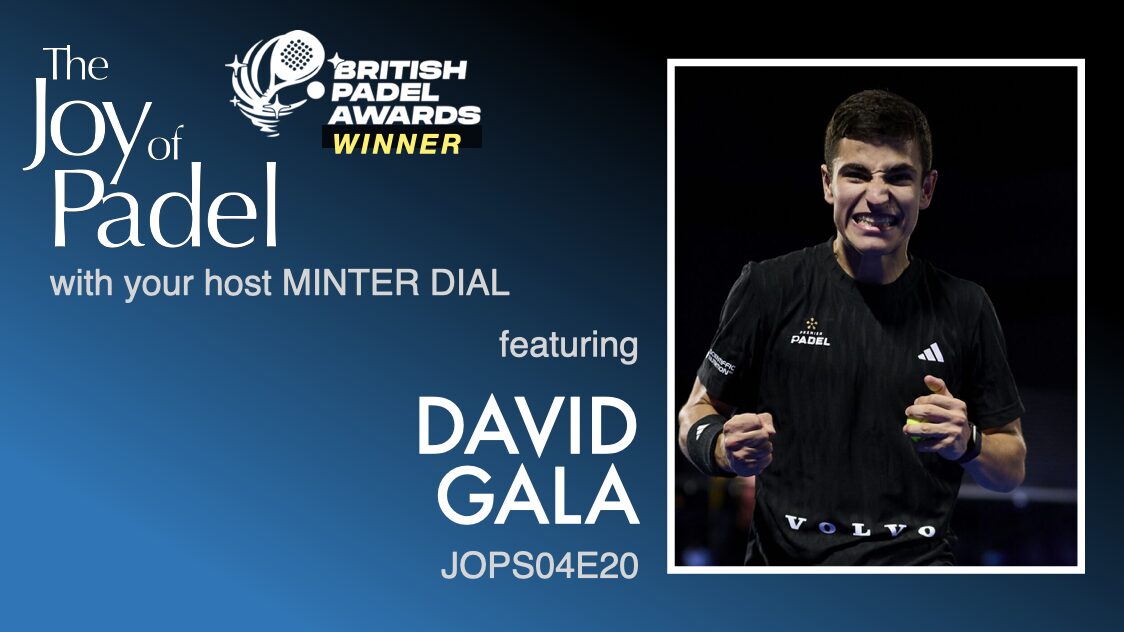
The Joy of Padel podcast with David Gala (JOPS04E20)
On the latest episode of the JOY OF PADEL podcast, I had the true pleasure of welcoming David Gala, a young talent who is quickly making his way in the demanding world of professional padel. For those who enjoy diving into the journeys of people who live and breathe this sport, David’s story is as inspiring as it is revealing.
A bit of background on David Gala
David Gala is, above all, a young man from Madrid who, at 20 years old, already holds the 34th spot in the professional padel ranking. Since he was a child, he balanced his love for football and padel, until both his passion and family environment ended up steering him toward the glass court. As he told me, the support of his parents has been fundamental: he always saw them coming after work to take him to training, and that effort forged his competitive character and his desire to always give his best in every session.
Main topics we explored
Our conversation focused on the value of experience within a team, the importance of a strong support group off the court, and the psychological nuances of professional competition. David emphasized how enriching it was to share both locker rooms and matches with older partners—he learned key lessons from each that helped him grow as both a player and a person. We also talked about the famous left-handed/right-handed dynamic among elite pairs, that strategic “plus” that’s so hard to replicate.
We couldn’t skip reflecting on the resilience required to navigate losing streaks, and on how to separate sporting results from personal worth. David was honest about the pressure, self-criticism, and patience involved: adopting the mindset of “Rome wasn’t built in a day” helps him find progress in small steps, without losing his ambition or falling into complacency.
Three takeaways from my conversation with David Gala
- Padel is as mental as it is physical. Working on explosiveness and patience simultaneously is key for peak performance—and David sees this as a never-ending development.
- Your environment matters. Family, coaches, and teammates have been pillars shaping David’s journey, reminding us that a professional path is never walked alone.
- Enjoyment is essential. Beyond rankings or contracts, what truly hooks David is the pleasure of competing, sharing laughs in absurd points, and the never-ending quest for self-improvement.
Are you inspired by David’s story? Don’t miss the full JOY OF PADEL episode to discover more stories of perseverance, community, and love for this sport that brings us all together. See you on the court!
To find out more about David Gala:
- Follow David Gala on Instagram: @galadavid__
To listen to the show:
To listen to The Joy of Padel podcast, you can use the embedded player above, or go find it on Spotify, Apple Podcasts or any number of other podcasting services listed here.
Send in your questions or reactions:
Please send me your questions — as an audio file if you’d like — to nminterdial@gmail.com. Otherwise, below, you’ll find the show notes and, of course, you are invited to comment. If you liked the podcast, please take a moment to review and/or rate it! ¡VAMOS!
Further resources for The Joy of Padel:

The Joy of Padel podcast, hosted by Minter Dial, a padel tennis player since 1974, is an exhilarating show that delves into the captivating stories of notable padel personalities worldwide.
Meanwhile, you can find Minter's other podcast, The Minter Dialogue Show (in English and French), in this podcast tab, on Spotify or via Apple Podcasts.
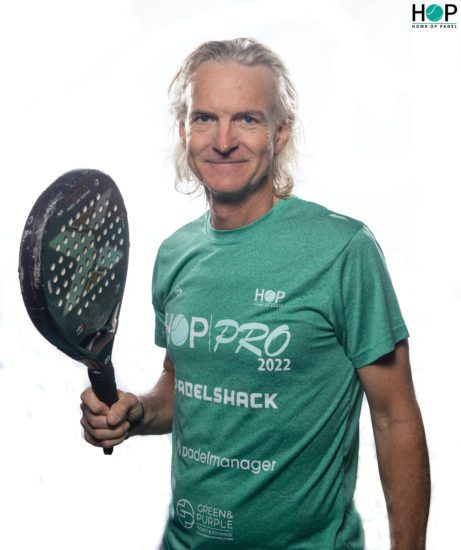
About the host: Minter Dial
Minter Dial is an international professional speaker, author & consultant on Leadership, Branding and Transformation. His involvement in sports has been a lifetime passion. Besides playing 18 years of rugby, captaining athletics teams, coaching tennis and playing squash for his university, he’s been a lifelong player of padel tennis, starting at the age of 10, from the time of its very first public courts at the Marbella Club in 1974.
Then, after a successful international career at L’Oréal, Minter Dial returned to his entrepreneurial roots and has spent the last twelve years helping senior management teams and Boards to adapt to the new exigencies of the digitally enhanced marketplace. He has worked with world-class organisations to help activate their brand strategies, and figure out how best to integrate new technologies, digital tools, devices and platforms. Above all, Minter works to catalyse a change in mindset and dial up transformation. Minter received his BA in Trilingual Literature from Yale University (1987) and gained his MBA at INSEAD, Fontainebleau (1993). He’s author of four award-winning books, including Heartificial Empathy 2nd edition (2023), You Lead (Kogan Page 2021), co-author of Futureproof (Pearson 2017); and author of The Last Ring Home (Myndset Press 2016), a book and documentary film, both of which have won awards and critical acclaim.
It’s easy to inquire about booking Minter Dial here.
Full transcript of interview via CastMagic
This transcription, translated into English, comes courtesy of Castmagic.io an AI service for podcasters, with the translation from Google.
Minter Dial: David Gala, finally, I have you on my podcast. After quite a long time, we have Juanjo, our mutual friend. It’s a pleasure. So, David, as always, I always ask at the beginning, who is David Gala?
David Gala: Well, I’m delighted to talk here with you. We’ve been trying to arrange this for a long time. I’m, well, David Gala, a 20-year-old guy, or a father since I was, well, 5 or 6, and that’s what I do professionally. Now, I think I’m ranked 34, and that’s it. I’m from Madrid and we’re in the fight to keep moving up spots in the ranking.
Minter Dial: Congratulations so far. But at first, you used to combine football with padel, right? And you said that choosing padel was the best thing you did, the best decision you made.
David Gala: Yeah, so I played football from when I was 5 years old, 4, 5, 3, and there was a point when I started doing both at the same time. Maybe I played padel on Friday, Saturday morning it was football, and then running to play padel, until there was a moment when I chose padel. It’s true that my family, my parents played padel, my brother was already starting to play tournaments, so it wasn’t that hard to make the switch, and besides, I was good at it. So…
Minter Dial: But what did you find on the padel court that you didn’t find on a football field?
David Gala: Well, you know, I couldn’t really tell you. I’ve always liked playing sports, and since my brother too, the oldest, played as well, so maybe I kind of looked up to him, and as he was starting to play tournaments, I thought, okay, why don’t I start playing tournaments too? And so that’s when I started doing both, football and padel, and I saw that with padel, I was pretty good at it, and since my brother was already into it, well, I went with padel.
Minter Dial: If there’s one scene from your early years that would explain who you are today as a player, which scene would you choose and who would be with you?
David Gala: Let’s see, one specific scene could be going to train every day and seeing the effort my parents made to be there, taking me to train, getting out of work quickly to be able to take me, waiting for me at practice. I’ve always tried to keep that in mind and even more now that I’m more aware of it as a way to show gratitude to them, you know, giving my best effort every day. And in the end, that’s what makes me the type of player I am, I like to train, I like to give my best, make an effort. So yeah, I think one scene like that would be seeing all the effort my parents made so I could fulfill my dreams, the ones in padel.
Minter Dial: It’s true that even though you’re alone on court or with your partner, you always need a team. How important is that for you?
David Gala: Yeah, yeah, it’s very important, it’s very important. In the end, partners come and go—and especially with how padel is now, partners come and go, I mean, that’s just how it is—but the reality is, at the end of the day, you choose your team, sometimes you don’t choose your partner. Mm-hmm. There’s no other option or… But you choose your team, you’re with them every day, you work on what you need to improve both on and off the court. When I was a kid, my coaches were there, I mean, they taught me on the court as well as helping shape me as a person, giving me values. So yeah, it’s very important to have a good team behind you to guide you along the way.
Minter Dial: When you said you can’t choose your partner, does it mean, like, you play on the left, you need someone who plays on the right, you’re ranked 34, you need someone about the same level—so there’s not many people you can choose from?
David Gala: No, so, I mean, you can choose, but the problem is, imagine there’s that domino effect where the top players split up, and then that domino effect. So sometimes you might get left hanging or something and you end up having to play with someone you might not want to at that moment, but that’s what there is. That’s what I mean.
Minter Dial: In an interview in ’23, three years ago, you said that during trips you felt really small among older players, but on the court you considered yourself their equal. Do you remember the match when you started to feel you really belonged to the professional circuit?
David Gala: Well, that’s basically because I was relatively young compared to all of them, who’d been competing for many years. I was with all of them who’d been competing for many years. I felt new in that world. It was totally different from what I’d been playing in juniors. And
Minter Dial: of course,
David Gala: I felt young, I felt inexperienced, and what happens is once I stepped on the court, I tried to level the playing field, because at the end of the day I’m out there to compete, doesn’t matter if the other guy is 10 years or 20 years older than me. Off court, yeah, sometimes I did feel like, damn, I’m just starting out, I’m just starting out. But after a few months or tournaments, you get used to the tournament life, to hanging out with them, and even though I’m still young, at least now I feel like I’m part of the scene, that I’m not the new guy anymore, so to speak. For them, a new one.
Minter Dial: Yeah, of course, younger ones. But it seems like your partner’s experience is important. So is experience—like, could someone older be a good partner for a younger player?
David Gala: Yeah, yeah, yeah. I think so. I mean, I’ve always had older partners, that’s pretty common. But yeah, because there’s a moment in the match, or not even the match, just day to day, they teach you things, show you routines, they let you see their perspective. What’s good about having had several older partners is that each one gave me something with which I’ve been able to improve, see things differently, and in the end, you become a more experienced player with different solutions in a problem. So yeah, for sure, playing with someone who’s been in the circuit for a while is really valuable. Nowadays, for example, I play with Enzo, we’re the same age, and maybe playing with someone your age gives you that push, you know, of being young and hungry and wanting to win. But obviously, I’ve also had to go through a lot of partners who had to teach me little by little.
Minter Dial: It seems like the best pair is a right-hander and a lefty, like Tapia and Coello, there’s Jon Sanz who plays well with Chupa, and you with Enzo. But how much of an advantage is it really to have a lefty and a right-hander on the left?
David Gala: I think it’s the best combination, because it’s also the one you see least often. There are few lefties. If you notice, a righty and a lefty have always dominated. Juan Martín and Vela, Vela Lima,
Minter Dial: or
David Gala: Galán and Lebrón, no, but, or, Eliott
Minter Dial: Tapia. Uh-huh.
David Gala: And I think it gives you a plus, because at the end of the day, if you manage to complement each other, it gives you a little extra that maybe a righty can’t give you, and since there are so few lefties, it’s different—different spins, a different way to cover the court.
Minter Dial: Of course. I
David Gala: think it gives you a little bit of an advantage.
Minter Dial: And you’ve had the chance to play against the top players, like Coello, Tapia, Galán. How do you prepare differently for these matches? Who do you enjoy playing against most, and why?
David Gala: Well, you know, those matches are really tough, really tough. And, you know, you prepare for them to try to push yourself a bit more, try to look for more, because if you don’t,
Minter Dial: More risk?
David Gala: For example. Yeah, yeah. And in the end, that can go kind of well if it works out, even though it’s still really tough, or it can go really badly, because, of course, if you take so many risks and it doesn’t work… I’ll tell you, the last time we played against Chingo and Ale, they gave us a tremendous beating, a tremendous one, and we left the match wanting to try again, like, come on, let’s give it a shot, let’s try, and it just all came together—between us not really performing and them being very, very good, they just gave us a tremendous beating. Those matches are really tough, you need a little bit to go your way… Nowadays, you can see they are one, two or three leagues above. You notice it.
Minter Dial: But when you play against the best, is there a pair that you most enjoy facing?
David Gala: Well, enjoy is not the word, because against the top pair you’re going to lose. I don’t want to lose any match, not even at Parcheesi—I’m super competitive, you know… So, enjoy, not really. I mean, obviously you enjoy it in the sense of, like, ‘they play so well’ and as a padel fan, even when they’re on the other side, you’re like, ‘Wow, this is another level.’ But enjoy as in, you know, losing—ugh, no way.
Minter Dial: And following that question, but who is it worst to play against, like, in terms of having no options, the toughest to face?
David Gala: Well, the other day, normally I’d say Coello and Tapia, because it’s really tough to get out from the back against them, because both of them hit so hard and Coello covers a lot of ground, the other seems smaller but covers a lot too, and it’s really tough. But the other day with Chingo and Ale, they gave us a real beating, a real beating. And you see, with Chingo and Ale, they’re just as tough, but you have the lob option with Chingo, I mean, he doesn’t crush you—hey, you lob to him and he doesn’t explode on you. That’s what I mean. I think it’s a little tougher against Tapia and Coello because they just crush you.
Minter Dial: In ’23, I think, you won gold at the European Games playing with Daniel Santigozo, right? Beyond the medal, what moment from that experience would you like to relive?
David Gala: Well, honestly, yeah, because it was a week that was totally different from what we’re used to. In the end, in a tournament, it’s just padel, the same people, almost the same draws, the same places, and this was a different vibe, with different pairs, other sports, you hang out with other people, and it was really cool, honestly. We did it again not long ago in Tarato and it was practically the same. But yeah, it was a really great experience, really great. It’s different.
Minter Dial: Uh-huh. And you’ve used the phrase, ‘Rome wasn’t built in a day.’ How do you say it? To explain how you approach your career. How do you tell the difference between being patient with your growth and getting too comfortable?
David Gala: You know, there’s something I talked about a long time ago with Fayo, who was the coach in Madrid, for juniors, and it’s that I’ve never been the type to make big jumps, like moving up the ranking quickly or progressing very fast. I’ve always taken it step by step, little by little, doing what needs to be done. I think I work well, I do everything possible, everything I can, I keep improving little by little, but of course, given my age, sometimes I get in a hurry, I’m like, damn, I want to rise faster, I want this or that, but I always have that patience, so to speak, of knowing I’m going little by little, that I’m happy with myself because I’m improving, I feel that I’m improving, moving up place by place. I’ve never been one to move up really fast. So, when I feel stuck, that’s when the urge hits, but I’m a calm, patient guy, so it’s not like I get anxious. Sometimes in the year I get the urge, but not very often.
Minter Dial: It seems to me that almost the hardest thing in padel is having, like, that patience, and on the other hand, that explosiveness, the ability to hit really hard, and at other times play softly and delicately. And at one point, it can be patience and explosiveness.
David Gala: Yeah, I mean, nowadays padel is really explosive, really physical. If you look at it, the ones who rise up fastest are the ones who hit hard, who are explosive, who are physically strong, big, agile. And well, I’m improving when it comes to being explosive, because I know I can still improve a lot, and also improving my patience. Everything can be improved, everything can be improved, or it can be improved and I have to…
Minter Dial: improve. There are interviews
David Gala: very thorough.
Minter Dial: Sorry. But in another interview three years ago, you pointed out the physical side as the most important aspect to develop in your game. Looking at it from today, in 2026, what change in your preparation has transformed your game the most?
David Gala: Well look, even so, since then, since that time, I keep working on the physical side. I think I’ve improved a lot, but I can still improve more. I need to have more muscle mass, be a bit stronger to have that explosiveness that maybe someone like Galán has, who in the end is burly, he’s strong, hits really explosively, so trying to reach maybe—well, I don’t know—to that point, because everyone’s got their own physique, but trying to do my best and also balance it with patience. Because in the end being explosive and not having patience is not really useful, or having a lot of patience and not being explosive, I mean, you have to have a bit of both. Little by little I keep improving that aspect; there’s still a lot to give.
Minter Dial: And unfortunately you have to chain together, chain together quite a few defeats. How do you keep the result of a match from becoming a judgment about your worth as a person?
David Gala: Look, there are always streaks in the year, and for example right now I think I’m in a good streak in terms of level, I think I’m playing really well, I feel good, so losing hurts, because it always hurts, and now it hurts and it’s a little, not frustrating, but because I feel good, I feel really good, but also feeling good makes me forget it fast, I get less frustrated, I mean, it lasts me the hour after the match, half an hour, whatever, and then I think about how to improve for the next one. Maybe in a bad streak where you feel, well, things aren’t working out, you don’t have that feeling, maybe that loss hits harder, because you say, ugh, another loss, and on top of that I’m not feeling good, now I have to go to the next one and all that. But right now, for example, since I’ve got good feelings, the loss hurts but you forget it quickly to focus on the next one. You study, you learn what you did wrong and you practice so it doesn’t always happen to me.
Minter Dial: I don’t know, but when you watch the video of your match afterwards, is that something you always do? Or how do you learn more when you watch your game? Because when I—I’ve, I’ve done it, I always see the
David Gala: old stuff,
Minter Dial: that I move too slow, that I miss too much. But how do you learn from what you see?
David Gala: Well, look, always, once I come out of the match, I more or less know what I did well or badly. So when I watch the match, I focus on that I had in mind and also a bit on different aspects, because once you’re calm you see the mistakes better, you can also see if you did well, if you did badly, or not as badly, because sometimes we see it worse than it really is, and watching it calmly a day later or a few hours later, it’s easier to see. Plus, if you have the help of your coach or a technician who can help you see those mistakes, well, it’s much easier.
Minter Dial: And do you do it with Enzo, for example, with your partner or alone or with your coach?
David Gala: I usually do it alone or sometimes with my coach. Or just my coach watches it by himself and then we agree on some things. I understand he, I mean, sorry, I understand he does it by himself, that’s what he does. Then, yes, it’s true that, well, each one reaches a
Minter Dial: conclusion and
David Gala: then you talk about it.
Minter Dial: Uh-huh. Because there’s always the other one.
David Gala: Right, no, the best is to have communication, to be able to say everything with your partner. Sometimes it can be bad, but I usually think it’s positive, because if you trust each other and there’s no problem saying things, you’re both going to improve.
Minter Dial: But the thing is, padel is so simple sometimes, and yet we make mistakes, even on very easy balls—I mean, as the amateur that I am. But if your partner misses an important ball, how do you decide whether you need to say something, give a look, or just keep silent?
David Gala: Well, you have to know him a bit too. I mean, you have to know your partner. There are partners that need a bit more space, some that need support, need you to go up to them, give them a hand, talk to them, it’s about getting to know them a little too, so once you’ve got that, you know sometimes you need to go or you know you shouldn’t go. With Enzo, for example, I think we have a good relationship, we trust each other, so almost always either I give him some space and then go over, or I go, or the other way around, or he comes. On the other hand, with other partners, sometimes I just had to go straight to the bench to dry off, and meanwhile he had his space, his time—I mean, you need to know a bit about yourself too. Or maybe it annoys you more when your partner misses than when you do, and you have to know your partner to know the exact moment when to support him.
Minter Dial: Ah, so, for those listening and who play at an amateur level like me, what simple decision would help us win more points, even if we don’t actually improve any of our shots?
David Gala: What decision did you say? Well, I’m not sure if there’s so much frustration in amateur padel regarding missing a shot and then feeling really down, an important ball. But, well, what I’m telling you, it’s also more complicated to have a regular partner, usually these matches form sometimes just to have fun, sometimes for a friendly game. But ideally it’s getting to know your partner a bit, knowing yourself, and see, I’m the kind of person who if you focus on yourself and play 100%, it’s going to help your partner. Instead of focusing so much on what your partner does and getting frustrated about it. Maybe it’s more about focusing on yourself and trying to help your partner as much as possible. If your partner’s having a bad day, then do that. If you’re having a bad day yourself, then it’ll be his turn to support you and he’ll try to give his best too. I like
Minter Dial: how you answer my question. Well, to wrap up, the whole idea of padel is to enjoy this game. What’s the funniest, most absurd point you remember playing? One where you ended up laughing even if you lost it.
David Gala: Look, that for sure, without a doubt, must have been with Lucas Campagnolo, because he was really crazy, really crazy, absurdly crazy, and there were a lot of points that made me laugh a lot. He made me laugh a lot because he would start shouting silly stuff, making gestures, making funny faces, I would just crack up, I’d crack up. There was one point, for example, in Málaga last year, I think it was against Coqui Janguas, we won a long point, we won the point, he went nuts, pressed up against the glass, licked it from top to bottom and of course, I was behind just cracking up, I mean, laughing so hard.
Minter Dial: The spirit of padel. And to finish with the spirit of—of this whole padel thing, when rankings, contracts, and all the pressure disappear, what still makes you want to pick up the paddle and get on
David Gala: the court? Well, for me it’s because I really like competing, I really like playing sports too. So, if I can combine the two, for me it’s perfect. Whether it’s padel, golf, football, ping-pong, or chess. Anything that’s about doing sports, exercising, and also adding competition, I’m all in.
Minter Dial: And the challenge.
David Gala: That’s it, that’s it. Improving oneself, improving as a person, and trying to be satisfied because you gave it your all.
Minter Dial: And breaking a bit of a sweat.
David Gala: Yeah.
Minter Dial: David, thank you so, so much for being on my podcast. Let’s see, I hope to see you very soon. Good luck in your next tournament, and see you there. Thank you very much.
David Gala: Same to you, man.