
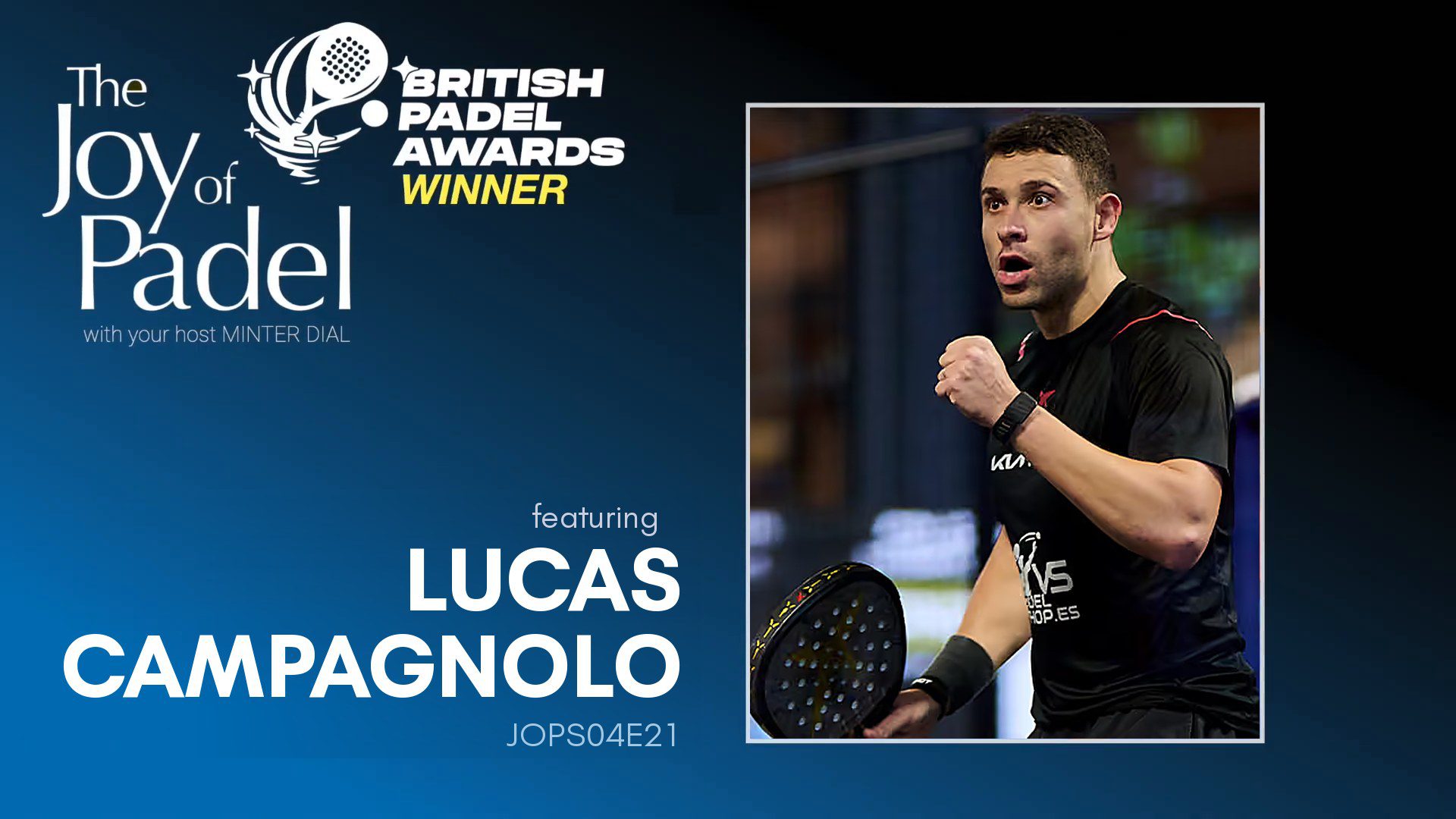
The Joy of Padel podcast with Lucas Campagnolo (JOPS04E21)
On this episode of the JOY OF PADEL podcast, I sat down courtside at the London P1 with Lucas Campagnolo, known to everyone on the tour as “Campa”. Lucas is one of Brazil’s leading professional padel players, and his story is a lovely reminder that a career can start with nothing more than having fun at the club with your parents.
A quick note on the sound: our original recording was poor (entirely my fault), so we re-voiced the conversation in English with the help of AI. The words are exactly what Lucas and I said.
A bit of background on Lucas Campagnolo
Lucas started playing padel at five, tagging along with his parents at the club in Brazil. He never imagined he would make a living from the sport. He came to Spain for three months of education, and ten years later he is still there, competing on the professional circuit. For his first four years he played on the left, before a coach persuaded him that his aggressive game, good lobs and solid blocks would be a bigger asset on the right.
Main topics we explored
We talked about the state of padel in Brazil: strong players as far back as the early 2000s, including a world junior title in Curitiba in 2003, but a sport that was a hobby rather than a career, so talented players went off to university instead. Now that the professional side is growing, Lucas hopes Brazil can one day challenge Spain and Argentina. We also touched on the curious fact that Brazil’s two men’s pros are both called Lucas and both play on the right, and on his time partnering Lucas Bergamini.
Then we got into the craft: how to find the right partner and the right chemistry, why impatience kills points, his favourite shot (the lob), and the mistake amateurs keep making with it. We finished with the pinchado, the etiquette of hitting your opponent with a smash (“I say sorry, but inside, I’m not so upset”), and where he still finds the joy in the game.
Three takeaways from my conversation with Lucas Campagnolo
- Confidence is the glue of a partnership. When a team loses confidence, players rush the point instead of building it. Trust your partner, and yourself.
- Play the lob off the easy ball. Amateurs tend to lob when they are in trouble; Lucas says the lob works best when the ball comes easily off the back wall. A difficult ball is one to defend.
- Learn both sides of the court. Lucas switched from left to right because the left demanded more mobility, but he insists that knowing how to play both sides makes you a better player.
And the joy? For Lucas it is simple: seeing his family still watching him, and happy. Don’t miss the full JOY OF PADEL episode for more stories of passion and perseverance from the people who make this sport so special. See you on the court!
To find out more about Lucas Campagnolo:
- Follow Lucas Campagnolo on Instagram: @lucascampagnolo
- Follow Lucas Campagnolo on X: @lcampagnolo
- His player profile on Premier Padel
To listen to the show:
To listen to The Joy of Padel podcast, you can use the embedded player above, or go find it on Spotify, Apple Podcasts or any number of other podcasting services listed here.
Send in your questions or reactions:
Please send me your questions — as an audio file if you’d like — to nminterdial@gmail.com. Otherwise, below, you’ll find the show notes and, of course, you are invited to comment. If you liked the podcast, please take a moment to review and/or rate it! ¡VAMOS!
Further resources for The Joy of Padel:

The Joy of Padel podcast, hosted by Minter Dial, a padel tennis player since 1974, is an exhilarating show that delves into the captivating stories of notable padel personalities worldwide.
Meanwhile, you can find Minter's other podcast, The Minter Dialogue Show (in English and French), in this podcast tab, on Spotify or via Apple Podcasts.

About the host: Minter Dial
Minter Dial is an international professional speaker, author & consultant on Leadership, Branding and Transformation. His involvement in sports has been a lifetime passion. Besides playing 18 years of rugby, captaining athletics teams, coaching tennis and playing squash for his university, he’s been a lifelong player of padel tennis, starting at the age of 10, from the time of its very first public courts at the Marbella Club in 1974.
Then, after a successful international career at L’Oréal, Minter Dial returned to his entrepreneurial roots and has spent the last twelve years helping senior management teams and Boards to adapt to the new exigencies of the digitally enhanced marketplace. He has worked with world-class organisations to help activate their brand strategies, and figure out how best to integrate new technologies, digital tools, devices and platforms. Above all, Minter works to catalyse a change in mindset and dial up transformation. Minter received his BA in Trilingual Literature from Yale University (1987) and gained his MBA at INSEAD, Fontainebleau (1993). He’s author of four award-winning books, including Heartificial Empathy 2nd edition (2023), You Lead (Kogan Page 2021), co-author of Futureproof (Pearson 2017); and author of The Last Ring Home (Myndset Press 2016), a book and documentary film, both of which have won awards and critical acclaim.
It’s easy to inquire about booking Minter Dial here.
Full transcript of the interview
This transcript comes from the English re-voiced version of our conversation, which was recorded courtside at the London P1. The words are what Lucas and I said; the transcription is AI-assisted with light cleanup.
Minter Dial: Hola, chicos y chicas. Many thanks for joining me on the Joy of Padel podcast, spreading and sharing the supreme delight of this wonderful and fast-growing game. I’m your host, Minter Dial.
So for this 21st episode of season number four, I have the pleasure of sitting down with Lucas Campagnolo, a talented Brazilian padel pro who’s currently ranked number 15 in the world. A quick word before we start, however: the sound on our original recording, made courtside at the London P1, was poor, and that’s entirely my fault. So that you can listen with ease, we’ve re-voiced the conversation with the help of AI. The words are exactly what Lucas and I said.
So in this chat, Lucas opens up about his journey from playing padel with his parents at the age of five to carving out a professional career across continents. We dig into the growth of padel in Brazil, how to find the right partner on court, and the all-important question of which side to play. Lucas also shares invaluable insights for amateurs on making the most of their lob, plus what really keeps the joy of padel alive for him. Now, let’s go.
Minter Dial: So, Lucas Campagnolo, great to have you on the Joy of Padel podcast. How did you get into padel? What was the moment Lucas Campagnolo said, “I need to become professional”?
Lucas Campagnolo: Well, I began by having fun with the game. I went to the club, saw that my parents played padel, and because I saw a lot of people playing, I began playing with them. I started at five years old. In fact, I never thought that I would live from padel as my career. I was just surfing when I did the first jump. I came to Spain to do three months of education, and I’m still here, ten years later.
Minter Dial: I love it.
Lucas Campagnolo: Yeah.
Minter Dial: So, coming from Brazil, of course, it’s very different to Spain. I’ve been many, many times to play in Spain. But what is the state of padel in Brazil?
Lucas Campagnolo: The state of padel in Brazil? Padel is growing. Padel in Brazil in the year 2000, for example, we had good players.
Minter Dial: Pablo Lima.
Lucas Campagnolo: Pablo Lima, for example, yes! Brazil won the World Junior Championship in 2003, in Curitiba. We had good players, but what happened? Before, in Brazil, it was a hobby. You couldn’t live from padel, you couldn’t earn much money with this sport. So, although the guys played well, they went to university and stopped playing at the top level. Now padel is growing, the professional side in Brazil too. So maybe in the future we can play against the top, against Spain and Argentina. Hopefully it happens.
Minter Dial: So, one of the funny observations I have is that we have two Brazilian men pros. You are both called Lucas, and you both play on the right. Is that what it takes?
Lucas Campagnolo: Well, first, before, I actually played with Lucas Bergamini. Then I played the left side, only because I’m bigger than he is. Because he plays the left side better than me! Yes. He played on the left all his life when he was young, but when he grew older, he moved to the right. And I also passed from the left side to the right. So today, both of us play the right side.
Minter Dial: What does it take to know what side you should play? You said that in the first four years you played on the left, but then you switched to the right. How do you know what side you should be on?
Lucas Campagnolo: I can tell you that it’s really important to play both sides of the court.
Minter Dial: To know how to play both sides?
Lucas Campagnolo: Yes. But I made the change because I thought that to play the left side, I needed more mobility, and I didn’t have it before. So my coach told me, “Lucas, maybe play on the right side. You can do less, but you can be better. That’s good, because you’re an aggressive player. You make good lobs. You block. You could be a big asset, because we don’t have enough aggressive players on the right. So we need you to change sides.”
Minter Dial: And now, one of the things I’ve always thought about is: how do you find the right person to play with? The right player for you? Of course, you might have a player like Tapia you’re hoping to play with, but it takes more to know how to have the right partner. How do you find the right chemistry? How do you find the right mixture with your partner? How do you find the right feeling, making it work?
Lucas Campagnolo: The most important thing for me is confidence. It’s important, because if you feel that the confidence is there with your teammate, it’s good, and you play better. In the tense moments, when we are having a problem, sometimes the player doesn’t give time to the team. He wants to play with you, but he rushes too fast. They can’t build the point. They don’t have confidence. Of course, playing too fast is bad for us.
Minter Dial: They become impatient.
Lucas Campagnolo: Yes. I don’t think it’s best to be impatient! When they lose confidence, they want to rush the point, and this isn’t good. You need to have confidence in each other. And in yourself.
Minter Dial: So, Campa, what’s your favourite shot?
Lucas Campagnolo: I think the lob is one of the most important shots. People don’t think about it enough. They look for hitting hard, for good volleys, and they love winning points. But that’s not the game.
Minter Dial: So, for amateurs like me (I myself have been playing for over 50 years), I’ve fallen in love with the lob too. But for amateurs, what’s the one thing you think they constantly get wrong about the lob?
Lucas Campagnolo: That they make the lob on the difficult ball.
Minter Dial: So they go for the lob when it’s a hard ball, like a defensive shot in tennis, as opposed to the lob as an offensive shot?
Lucas Campagnolo: Yes, because you should make the lob when the ball is easy, when the ball is coming easily off the back wall. That’s when you have to do the lob. But the lob off a difficult ball is not good enough, and the opponents can smash it, too hard. If the ball is difficult, you know, then you have to defend it.
Minter Dial: Right, so there’s sometimes a tendency to do a huge lob, a “pinchado”, as they say in Spanish. You just pop the ball up tens of feet. I sometimes felt that was sort of bad sportsmanship. I was wondering how you feel about that, because there are certain players that did it a lot more than others.
Lucas Campagnolo: Not all the time we can do this. Sometimes the ceiling doesn’t allow it. Here in London, for example, we can. Here we can. Here you see many pinchados.
Minter Dial: And is there any culture within the professionals to say that’s okay? Like, for example, hitting the ball at the opponent, is that actually just accepted? With a smash, I mean, you smack it at the opponent and it hits them. You say “sorry”, but amongst you, as professionals, do you sometimes get a little bit upset?
Lucas Campagnolo: I say sorry, but inside, I’m not so upset.
Minter Dial: “I’m sorry, not sorry,” we say!
Lucas Campagnolo: Yes.
Minter Dial: It’s sort of like the net cord.
Lucas Campagnolo: Yes.
Minter Dial: So, in padel, what’s your mantra? Why are you still playing? Where’s the joy of padel for you? Where’s the fun?
Lucas Campagnolo: Why am I still playing padel? The fun for me is to see my family still watching me, and happy, because I’m inside, you know. I see them, and inside, I’m happy. The family! They are probably the most important thing for me.
Minter Dial: Perfect. Vamos, Campa!
Minter Dial: So I hope you’ve enjoyed this Joy of Padel episode. Please don’t forget to subscribe to be the first in queue for the next episode. And if you like what you hear, please do share it around with other padel aficionados. This is a sport that deserves to be played by absolutely everyone. And if you’ve got a story that you’d like to share, please send me an email or, better yet, a voice note at nminterdial@gmail.com. With that, thanks for listening and see you on the next episode of the Joy of Padel podcast. Vamos!