Minter Dialogue with Julianne Miles MBE
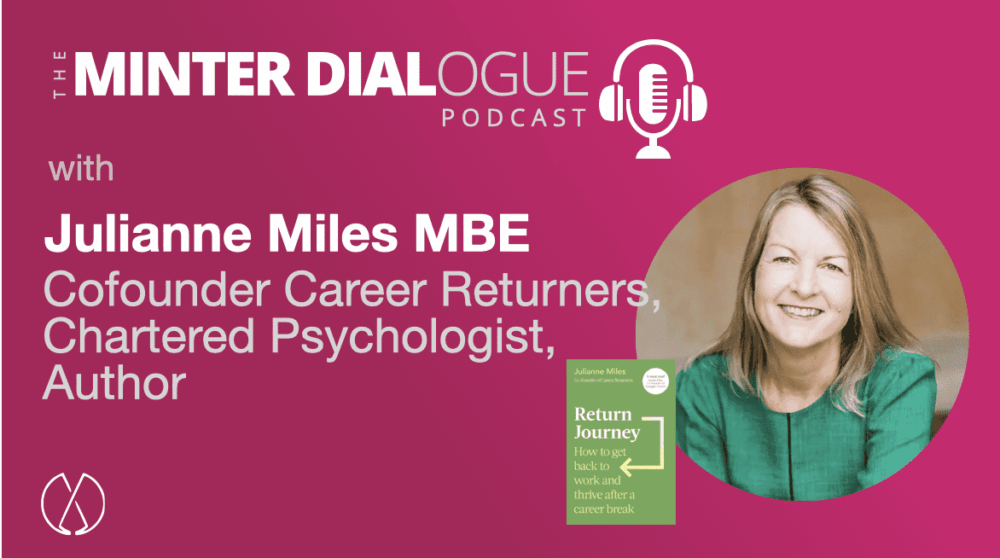
I had the pleasure of speaking with Julianne Miles, my former classmate from INSEAD and co-founder of Career Returners. We delved into the challenges faced by professionals returning to work after extended career breaks. Julianne shared insights from her new book, “Return Journey,” which offers a psychology-led approach to re-entering the workforce.
We explored the importance of rebuilding professional confidence, crafting a compelling career narrative, and the value of side hustles in testing new career paths. Julianne emphasized the need for returners to upskill and adapt to technological changes, while also highlighting the unique perspectives and resilience they bring to the workplace.
For employers, we discussed the benefits of tapping into this experienced talent pool and the importance of providing support during the transition. Julianne stressed the need for intentional hiring practices and the creation of returner programs to overcome recruitment biases.
Overall, our conversation shed light on making career breaks a valued part of a lifetime career journey, benefiting both individuals and organizations in the evolving landscape of work.
Other mentions/sites:
- Ricardo Semler’s TED talk here
- SavvyAunties run by Melanie Notkin (on Instagram)
Further resources for the Minter Dialogue podcast:

Meanwhile, you can find my other interviews on the Minter Dialogue Show in this podcast tab, on my Youtube Channel, on Megaphone or via Apple Podcasts. If you like the show, please go over to rate this podcast via RateThisPodcast! And for the francophones reading this, if you want to get more podcasts, you can also find my radio show en français over at: MinterDial.fr, on MegaphoneFR or in iTunes. And if you’ve ever come across padel, please check out my Joy of Padel podcast, too!
Music credit: The jingle at the beginning of the show is courtesy of my friend, Pierre Journel, author of the Guitar Channel. And, the new sign-off music is “A Convinced Man,” a song I co-wrote and recorded with Stephanie Singer back in the late 1980s (please excuse the quality of the sound!).
Full transcript via Flowsend.ai
Transcription courtesy of Flowsend.ai, an AI full-service for podcasters
Minter Dial: Julianne Miles, how lovely to have you on my show. We have known each other since way back a at our business school INSEAD. But let’s say for those who don’t know you, despite your MBE behind your name, who are you? Julianne?
Julianne Miles: Well, other than being your classmate from a very, very long time ago, Minter, thanks for inviting me. Your podcast who Am I? I have a number of titles. I am co-founder of an organisation called Career Returners that we’ll be talking a little bit more about. I am a mother of two children, I am a chartered psychologist and as of this month I’m also an author.
Minter Dial: Brilliant for you. What was it like, the process of writing? I mean I know I’ve listened to some of the other podcasts you’ve done. You sort of sat on it by doing a lot of other things, making the returning happen and the process of writing, what was that like for you?
Julianne Miles: Well, this was a book that I’ve been mentally writing for about 15 years since I first started putting together return to work coaching workshops and I had taken a different track and founded an organisation to actually make some social impact. But this book was always at the back of my mind. So, I think the, the first feeling when I started writing was a sense of relief that I was finally doing this thing I’ve been talking about for so long actually practise what I was preaching in terms of you’re never too old and it’s never too late to realise an ambition. I, I won’t say it was easy and you well know this Minter can, you know, see, see all your books there in your background. It’s, you know, it’s not easy and I think there is a lot of self-discipline required. What, what worked incredibly well for me was having the deadline from the publisher which meant that it had to be done. There was less, less self-indulgence there. I had to, had to get on and do it and I think a huge sense of satisfaction when each chapter was ticked off. Yeah. So, and at the end particularly I think that that sense of achievement of I’ve, I’ve written my 60,000 words.
Minter Dial: I, I’m interested to know for having read your book, how you thought about storytelling because you have many others stories, things that you picked off from your experience and, and for having the same kind of issues choosing the stories, did you think, all right, in this chapter, these are the stories that I want to talk about or did they sort of flow more naturally? Huh? Oh, I should talk about that one at this point. How did you pick and choose your stories that you told?
Julianne Miles: The first point here is that the stories were composites. I was very careful not to be identifying anybody because I think even if. Even if people are happy to be featured as a returner this year, they might not be, you know, years. Years down the line. So, the stories are composites. And I think that gave me a little bit of flexibility in terms of what to include in each chapter. But I. I heard Return of Voices with each chapter. I think that’s when I started to write it. The words started to come into my mind of what I’d heard some returners saying. And I said, this. This fits so well here. So, I think that’s what the voices came, and then the stories built on top of that.
Minter Dial: And then the other thing is the notion of clarifying, expliciting what is sometimes, and I have to imagine often a messy experience, messy context. Well, my situation involves. I had cancer, I have one kid, two kids, divorce, this and that. And each time there’s a context that can make the return differently, an obstacle. And sort of, how did you make it simple so that we can relate to it without it being fake? Because you’re obviously compositing things.
Julianne Miles: I think that what makes it real is the dilemmas that people are facing that I talk about are very real dilemmas. And what I hope is that anybody reading the book, they won’t necessarily relate to each case study, but there’ll be ones in there that they do relate to, and there’ll be elements of each story that they may relate to. And one of the things that I do talk about in the book is, is this aspect of having relatable role models. And I think that’s incredibly important for anybody returning to work after a long career break. Because often what I hear is somebody saying, I don’t really know anybody in this position. I don’t know anybody who has returned to work after 10, 15 years. And is it really possible? And I think what I’m trying to get in there is this feeling that other people have done it. They’ve gone through this roller coaster of getting back, and they’re there and they’re happy and they’re satisfied back at work. And I’m hoping that gives anybody reading it the sense of it is possible. I can do it.
Minter Dial: I see much of your work, Julianne, has been aimed at women returning to work. I read this as a dude, and. And it struck me that it was obviously entirely applicable and even applicable to someone who’s just been fired from A job because of the issue of confidence. That’s where it really struck a tone for me.
Julianne Miles: Yeah, I think that the elements, what, what I, I talk a lot about, and this is, as a charter psychologist, what, what I do recognise is how often what gets in our way, particularly initially, is what’s going on in our heads. It’s what we’re telling ourselves. It’s the aspect of negative thinking and when you’ve been made redundant, that’s huge. The negative voices, the inner critic, you feel you failed, you feel you’ve somehow not been good enough and you start to question whether you can get back, whether it’s possible to go back to what you did before, whether it’s possible to do something different. And, and that has a huge parallel with anybody who’s taken a career break and this aspect of identity, your identity being knocked, your sense of that inner sense of self. I think absolutely relatable there. The question of gender, absolutely irrelevant here. The reason that a lot of the focus, a lot of the stories is women is because the core target of people for the book is women who’ve taken a break for childcare and, or elder care. And in terms of people who take a break for caring, release related reasons, it is about 90% of those are women. But there are stories in the book and it’s absolutely relatable if you’ve taken a break for relocation for health reasons, which is becoming increasingly common, and also for aspects like unretiring, which I think we’re talking a lot about now, people feeling that they are ready to retire at, you know, a classic retirement age and then fine, they either want or financially need to get back to work. So, I think there will be a lot within this book for, for people who fall within those categories as well. Indeed.
Minter Dial: And I want to sort of focus the next portion of our chat on this notion of identity and recreating confidence. And then I want to get after that the notion of the other side of the table, people hiring and the corporate culture and such. But with regard to the, the creation of self, if I just take someone who has just taken a one year break or you know, had a sabbatical or got fired and needs to lick their chops and come back, much less have had two kids taking care of them and nappies and all these other things that then create a distance from the workplace, you know, much, even maybe bigger gap, how does one go about creating that confidence and, and establishing. Well, I’m going to take, get rid of the idea that I’m going to Come back as a CEO.
Julianne Miles: Yeah.
Minter Dial: To come into another type of role. Yeah.
Julianne Miles: And confidence is, is an interesting one because I think it’s important to really pin down what aspect of confidence this is because I find that people, when they’re coming back after a career break, it’s not overall confidence. You might meet them and think this is an incredibly confident person. But actually it’s when you start to talk to them about what they feel is possible now, what they want to do next, that’s where those sort of self doubts start to kick in. So, I think once you hone in on the fact that it is this professional confidence, it is this aspect of working identity that you’re trying to regain. And I think that it’s a stronger factor when you have taken a longer break or you’ve had a particularly sort of traumatic immersive experience, which could be often health related breaks or maybe something to do with bereavement where you felt, yeah, you’ve completely disconnected from the working world. And then, you know, this does happen when people have the caring related career breaks and you hear this, you may, I’ve heard, you know, friends of yours, family saying, oh, I’m just a mom now. Yeah. Or I’m just, you know, I’m just looking after my kids. We tend to apologise for it and be a bit defensive and we, we lose that aspect of identity. You may even, I remember when I had my children, you start calling yourself somebody’s mum. You know, you even lose your name after a while when you’re, when you’re immersed in that aspect. So, starting to get it back. I think the first thing is working on your narrative and I think how we tell our story and this concept of storytelling is so fundamental in relating it to yourself. So, it’s starting to reintegrate that aspect of what I did before my career break, what I’m doing now and then what I want to do in the future. So, your career break goes in the middle and this is what I call it, do cover this aspect of how to tell your story about which, yeah, the career break sandwich, patented. And that is this aspect of. You put your career break in the middle so it feels part of your story. You don’t apologise for it. You’re not defensive, but you’re also not ignoring it. You’re recognising that this is an important part of your career journey, your life journey and start to focus on what it’s brought to you. So, I think the aspect is revisiting all Your life up to your career break. You know, there’s a nice little exercise which is talking about your achievements, thinking about your achievements way back to, you know, might be when you left school, even, you know, what happened each year, what did you achieve? What do you feel proud of? And that starts to both reconnect you with your professional identity, but also make you feel good inside. You’re like, oh, yeah, I did do that stuff. And then you think about what you’ve actually achieved during a career break. And often that’s been a. A real growth period where you’ve built these skills. You’ve actually done incredible things when you start to think about it and then to think about what you want to do now. So, I think that’s a great starting point. But I think there is a point where you have to stop thinking and move to action and move to talking to people and move to getting out there, because that’s where really the confidence starts to build. You can’t really think yourself into confidence. Confidence.
Minter Dial: In listening to you, Julianne, it makes me wonder about this idea of confidence itself. It feels. And since I’m not a psychologist or any practise in this, I really never talked about it, but to what extent you can have. You can compartmentalise confidence and lack of confidence or say, well, I’m confident in this activity, I’m not confident in that. And when does confidence in something else turned bravado in another field?
Julianne Miles: Yeah. And I think you what? One. One of the ways that we can build confidence is thinking about how we talk about ourselves. Exactly as you’re saying. So, I think using this little tool which is saying, not yet. So, I’m not yet feeling confident that I can do what I did before, and that’s the sense that it will happen. But actually that’s very different than I’m not confident in this, where you can start to make it an entrenched part of who you are. I think there are parallels, like when we’re talking to our children and we’ve got to be careful about labelling our children as shy, because once you start to label a child as shy, they can become shy. Whereas if you can talk to them about your children, about building your confidence, then, you know, in the same way as adults, we’re rebuilding there. So, I think the. The words, the way we talk to ourselves and we label the confidences is really important. The aspect of bravado, you know, you’ve got to fake it till you make it, is obviously a sort of classic, classic saying for a Reason, I think the. There is always a period where we have to take a deep breath and get out there and do a bit of pretending to be confident. And the more you do that and the more you get out there and you speak to people and the more you are making yourself look confident, actually, that helps you to feel more confident. So, these, these two very, very closely intertwined, what we’re saying, how we’re behaving and in the end how that makes us feel.
Minter Dial: Yeah. What I liked about the not yet, although I sort of started thinking you were going to talk as a bad idea, is somehow a identifying where I need to go. I’m not yet there. What do I need to make that happen? And, and in my world, I, I tend to talk about that as the south in a compass, which is what’s stopping me from getting there. Yeah, I, I can’t do that because I’ve been 15 years off the work. I can’t do that because I don’t have three letters after my MBA in not an mb. But what is it that I need to do to feel yet ready? And to what extent is knowledge of self the sort of. The pivotal piece?
Julianne Miles: I think there is an important phase to go through and it’s actually, it’s the, the first part of what I talk about in my book, which is, is that looking inwards and a career break is a brilliant opportunity. It is that moment you’ve stepped off the career ladder. You can think, what do I want to do with the rest of my life? And reflect on that. And that’s both sort of exciting and terrifying at the same time, you know, a world of opportunity which can actually keep us stuck. That’s what this whole aspect of having too many choices we’ve got to be careful about. But I think it is a moment to actually get more clarity, to understand yourself better. And I like to use the analogy of a research experiment. I think if you look at your. Maybe this is the MBA in me coming out. You know, if you look at your life so far as a bit of an experiment, you’ve done all these amazing things in your life and you’ve done things that weren’t that great and you’ve had aspects of your life where you’ve really thrived. You thought, I love this, I’m fantastic at it. It really works for me. And times where you felt, you know, this, this, I, I’m not good at this, or I don’t like working in this sort of environment, or this doesn’t work for my, you know, Generally what I want out of life in terms of my balance. So, that’s what you want to learn from. And I, I think the chunking it down into looking at sort of aspects of yourself and that’s your, your strengths, your interests, what’ terms of your values and then looking at what helps you to flourish in the world. And that’s the sort of environment, the types of people you like working with and doing some work on that up front can help you to get a lot clearer on the type of work that you want to do now and the type of environment you want to be in. And then you can start to do the exploration phase which can get you down to and exactly what form that might take.
Minter Dial: Yeah, I very much use the same terminology around compass that you used and very, I think accurately you describe as how that’s necessary before you start doing where, how, what when the sort of the activation piece. If you jump into the activation without doing that pre work, you can end up going where the wind blows which can also be turbulent and you end up in a place where you don’t succeed or you’re not happy and therefore won’t succeed.
Julianne Miles: Yeah, yeah. And I think it is. I’m, I’m glad you like the, the idea of a compass because for me that’s what it is. It’s not like having the totally defined too rigid end destination because then if you don’t get there, you don’t have a plan B. But it, but it’s being clear what, what direction you want to sail in. But, but at the same time being open minded to something really exciting might come in. And I think that that’s the psychology of luck, you know, that’s that being open minded to. There may be another great possibility out there that I haven’t thought of and you can start to go, well, does this fit with my compass or as you say, am I just sort of blowing in the wind to something that is not going to work for me?
Minter Dial: Well, you also have to get off, I mean that as you call it, the realistic optimism. Get off a little bit the high horse of, you know, when I was earning, you know, seven figures and I was, you know, I had two assistants and you know, and the car, this, I can do nothing less. That’s on the one hand and the other is the, the issue of well, I used to be earning big figures. Am I ready to go back and earn £27,000 per annum? I don’t know what the minimum wage is anymore, but you know, what, what, how, how you Broker that to this.
Julianne Miles: Yeah, yeah. And it, it, it’s recognising you have to make trade offs. You know, you, you can’t, you can’t have everything. You’re not going to go back and have the most sort of perfect fulfilling job at the highest salary and particularly if you’re also looking for some elements of flexibility which a lot of returners are. So, you need to think what the, the North Star that I talk about back to the compass is this idea of what, what work am I going to be excited about, what am I going to find fulfilling and rewarding and then work out, think how can I do that with the salary I want or need? And we can’t ignore that as well. I mean I do think that if it is really important for you to have the status, to have the salary, acknowledge that, you know, and think, well, how can I work it within that. But don’t start with I want this salary or I want this flexibility because then you might end up in a job that makes you feel really unhappy.
Minter Dial: Well, and why did you stop it in the first place? Possibly question. But I consider this a very pragmatic approach because you do need to, you know, maybe you have a mortgage to pay, maybe you’ve set it a task that sort of has to be part of your north, hopefully that you have an education you wish to pay for for your kids and therefore that’s what you need to take into account. So, you mentioned it just the once in is specifically the notion of a side hustle. And I’ve long thought about how people who are unfulfilled at work will, will do one of two things. All three things, possibly. One is burnout.
Julianne Miles: Yeah.
Minter Dial: Two is try to catch up for lost time after they’ve left the, the, the situation they weren’t comfortable in. Or three have a side hustle on the side. Oh, if only I can make money from my side hustle. And I was wondering for you, to what extent is a side hustle a vector or a well of good information to help you on a return?
Julianne Miles: I think a side hustle gives you an opportunity to test and learn classically in Herminia Ibarra’s words. I mean I think it is this aspect of your exploring because often we can think we might really enjoy something, we can think we might love it and sometimes that is turning a hobby, an interest into work. But you might find when actually you start trying to do it as a job and earn money as if actually the joy goes and for some people that’s what happens but you only know that if you try it out. The same thing with setting up your own business, with being an entrepreneur. Some people absolutely love it. I found when I started working for myself many years ago now that, that, you know, I love that. I love the blank sheet of paper and having that total autonomy. Other people hate it, but you don’t know, you don’t know what’s going to work for you. And I think this aspect of, I very much encourage people in these, these long careers we’re having now, which is sort of 50, you know, maybe up to 60 years to give yourself that flexibility that you could change career or pivot career at any stage of your life. But rather than thinking it’s like I have to go end one career and start another, you can gradually move towards it. And I generally see the most success that people have in terms of a second or a third career is when, when they try it out. And my, my own personal example, I’ve, I’ve had a number of careers through, through my life. So, I started off in, in corporate strategy and marketing and then that was before, before doing the, the INSEAD MBA with you mentor and then, then say sort of worked in marketing, then have my four year career break which was very much the genesis of Career Returners and the Return Journey book and then ended up retraining as a charter psychologist and then ended up setting up my own organisation. Now each of those sounds like it was A to B to C but actually there was a real transition process at each stage and say for example, before I went off to go back, go back to school and study psychology, I did, I did an Intro to Psychology book. I talked to a lot of Intro to Psychology course. I talked to a lot of people in that world. I actually attended a conference and spoke to people and thought do I like this? And that. The more I experimented, the more confident I felt that this was the right path for me.
Minter Dial: The more you do it, the more you get to understand it and whether you like it or don’t.
Julianne Miles: Yeah, exactly, exactly. And you think is this, is this my world? And I think that’s the aspect of it’s less tick the boxes and pros and cons and it’s more put yourself in there and think how does it feel?
Minter Dial: One of the tools that I, I’ve apparently are a wonderful classmate in common now she told me that in the west we absolutely get it wrong is the icky guy formula. Yeah, the icky guy where you talk about your passion, what you’re good at. And is there a market for it? Can you make some money out of it? And it turns out that they make the money out of it isn’t part of the Japanese version at all. In fact, it’s quite differently interpreted in Japan. Understood. And the idea of formulating your passion. So, in my world, the. This idea of a purpose has to be deeply related to who you are as an individual. And the deeper the connection with who you are and your deeper personal narrative, the deeper that the strength. The more the strength of that mission is and driving you. And so I was wondering how you crafted your purpose as. As I can’t remember what exactly the word to use, but essentially it’s about bringing, you know, helping people get back to work.
Julianne Miles: Yeah. So, my mission, I define. I have refined this over the years.
Minter Dial: But as one does, by the way.
Julianne Miles: As one does exactly develop that narrative. It’s making career breaks a valued part of a lifetime career, and that is through removing what we call the career break penalty. And that’s all the systemic challenges and personal challenges that professionals face when they’ve taken a long career break and they want to get back to work. But I think the reason that I love the aspect of making career breaks a valued path for a lifetime career is it’s less about just removing the barriers to people getting back in, and it’s more about, as a society that we’re recognising that a career break is a real time of personal and professional growth, which means that you have more to bring to an employer rather than less. So, yeah.
Minter Dial: All right. So, interesting, this idea that you are giving value to the career break. It makes me think about a Brazilian guy. I don’t remember his name, begins with an S. So, actually, we have it kind of all backwards where we retire when we’re old and don’t have the stamina, the strength to do what we’d like to have done all our lives. For example, climb Kilimanjaro or, you know, do the ultramarathon or whatever it was that seemed to inspire us. But we’re always busy doing other stuff. And so he also thinks about it as you. We should do this earlier in our lives. We should create an environment in. Where we allow people to explore their biggest fantasy, biggest purpose, if you will, when they’re capable, when they’re the most capable, and. And. And revalue the fact that we have people with greater experience, richer experiences, when they come back into the work environment.
Julianne Miles: Yeah, yeah. I would, I would also query the, the, the whole premise that we get too old to be able to do, to follow our purpose. Because I, I think that this is back to the. You’re, you’re never too old to do something that you feel is purposeful and meaningful. And it’s not a moment when you’re coming back in, when you’re in mid-career or later career to think, I wish I’d done that. It’s the moment, well, what can I do now? So I think that was what I would, I would always say, say to do that. But I think there is this moment, this aspect of whenever you’re going back to work or wherever you have this reflection point that is a moment to think, how can I bring more purpose and meaning into my life? And I would, I would advise anybody not to get too hung up on finding your passion because I think that can be a bit of a trap that we’re waiting some, something for the, you know, the, the glorious moment when our passion arrives. Because what, what we found through psychology research is it’s typically when people follow an interest, just, you’ve got that spark of interest, there’s something interested in learning about, talking about. You follow that and as you become more expert, as you learn more, as you get more into it, that’s where the passion comes. And I think again, for my personal example, it’s exactly that, you know, I was working, I had my own career psychology practise and I, I started helping just friends alongside who were getting back to work after a career break and I became really interested in, well, why, why are they finding it so hard to get back to work? These are really talented, experienced people. Why can’t they get back and starting to explore, starting to see what was out there and what was happening structurally and realising that there were huge recruitment biases for getting people, for people getting back into work. And that was combined with this lack of reduction in confidence and the two were creating this maelstrom that made it so, so challenging to get back. And as I found out more and I was looking for solutions and then I was finding this solution of at the time, returner programmes that were happening in the US and thinking about bringing them to the UK and then thinking, oh, somebody should do something about that for quite a period of time before I realised, okay, this is me. So, the whole process of finding my purpose and my meaning and the societal challenge that I wanted to take on, it took a number of years. It didn’t just fall out of the sky.
Minter Dial: I mean, well, I 100% agree with that. So, I just peeked at my Internet to find the name of that Brazilian. He’s called Ricardo Semler. He did an amazing TED talk, really worthwhile listening to. And what you say rhymes with me in the fact that asking someone who has their purpose, who’s never done anything, in other words a kid or maybe someone in their 20s who mistakenly think they’ve done lots, you know, I mean they have in their mind because they’ve lived 100% of their lives as it is, but it’s really not a aggregate of many different things they’ve typically lent on what their parents advise them or society discusses. And, and so finding that purpose without really having tried being a lawyer, try being a tennis pro, try being working at a zoo or whatever else falls into your lap at that time that then helps you to craft what is something interesting. And I worked in the hairdressing industry and for 16 years. And did I do an MBA to become a hairdresser? Absolutely not. But in the end of the day I developed a passion, just as you say, for helping in this world. So, let’s focus the last Julianne on this. The environment into which a returner comes, which is the workplace and these biases and everything. So, if someone is listening to this and they are working in a big corporation and they need a spot filled and oh God forbid, this ancient dude with million things on his head, so much experience, probably going to ask for a lot. That’s a me kind of thing. What kind of, how do you architect a landing that becomes successful for that type of a profile that they want to bring back in or they, they, they’re confronted with bringing it back in, they may not want it, but that’s this is person who’s showed up is he or she’s gotten through the selection process. But how do you accommodate that kind of a person to make it successful?
Julianne Miles: I think the, the first thing as a manager you need to do is to recognise the stereotypes that you’re talking about and the assumptions that you’re making about this person and what they want. And I think one of the, the things that, but again I sort of bringing it back to the returners. There’s a feeling that if somebody’s taken a long career break then they can’t hit the ground running, they’re not really up to it. If, maybe if they’re older, you might be questioning can they get up to speed quickly? Can they take on the technology that you Know the advances that we’ve seen and some things you’re saying there, you know, maybe they’re going to want greater salary. Well, they’re going to be older. How’s that going to work if I’m managing them and they’re older than me? So you need to recognise these things that are going through your head as a manager and start to address, is this the right person for the job? You know, and put aside your stereotypes and really focus on the person themselves and what they can bring and this whole sort of mix of skills and experience. I think if you do decide to bring them into your team, then providing a bit of support through the transition is something that can be very, very helpful. There may be training for you as a line manager within your organisation in bringing on somebody who’s had a career break. We do recommend, if you bring somebody in who’s had a significant career break, typically, you know, 18 months or more, then to look at giving them some coaching, a little bit of mentoring and looking at their training needs. And we find if you do that, if you provide a support structure, then people can really quickly flourish when they’re back at work, if they’re thrown in the deep end. And this is, I think, both from the perspective of the line manager, who might be bringing somebody very different into the team, but also for the returning professional. It may work and it may well work, but it just takes a bit longer and it’s a bit harder and there is not. You’re not really setting everybody up for success in the same way.
Minter Dial: Well, the issue, if I’m a. The employer and you’re coming to tell me, oh, I got to accommodate this dude, I’ve got to give him. So, it’s training. I could get a younger person who would cost me less, doesn’t come as much baggage. And I don’t need to give them this training. They don’t need a rewiring, they’re just here to be wired into my, My, my culture.
Julianne Miles: Yeah, And I think it’s, it’s, it’s not an either or. I mean, I think bringing in young people is fantastic and they, they bring a huge amount. And we need people who have the maturity, who have the perspective, who bring that experience from their life, from their work to date, so they bring something complementary. And, you know, there’s so much research out there showing that if you have different minds, different perspectives, that benefits your productivity, that benefits your innovation. You’re bringing in people who are, you know, they’re adaptable, they’re motivated, that they have a fresh perspective, they’re bringing fresh eyes. And why would you not want that in your team? So I think that’s the bit. It’s not polarising young people or mid career people or older people, it’s saying if we have a mix, that’s where we’re going to both typically, you know, it could be mirroring our clients, mirroring society, but also just creating better products and services.
Minter Dial: Yeah. And surely a degree of resilience and bringing in all the experience. The daunting piece, if I were to decide that I was going to hire you or your team to help me get back into work, is to think about two things, which in the 50s, 15, 16 years that have been since I was in a corporate function is A, to think about the ridiculous change in technology and two, to consider how workplaces have so changed as well. So, this means generally having to work with maybe be underneath someone who’s much younger than you, who is typically brought up in a different era, maybe only digital and in an environment where they flip around emojis, emoticons, they don’t care about spelling and are completely digital literate with the latest ChatGPT 7.0 or whatever else is going to be coming around the corner. So, how does one deal with that, both from an employer and the prospective employee perspective?
Julianne Miles: Yeah, well, let’s start with the prospective employee. I think one of the first stages is do upskill yourself. I think there is a generalised fear that you can have about technology and the world’s changed so fast, I’ll never get back up to speed. There are so many courses out there that you can upskill yourself on. So, start there and it’s not so terrifying. Once you start to find out, once you start to understand the terminology, to actually get out there and train yourself, that starts to make you feel more confident that, you know, it’s, it’s not, it’s not so terrifying.
Minter Dial: In, in elegant English, I say just do.
Julianne Miles: I love that mentor. Yeah, exactly, exactly. Get out there, stop being afraid of it and do it and upskill yourself. I think the second thing is that you don’t need to learn everything, and I think we hear this so often from people in organisations who are bringing in returners, is that they don’t need to upskill and they don’t need to fill the gap of what happened in the last 10 years, they just need to get them up to speed with what’s happening now. And because of the pace of change, that happens anyway, when you’re moving into a New organisation. Typically you have a lot of tech to learn that is specific to that organisation. And things change so fast, even within an organisation. I mean, at the moment, everybody’s getting up to speed with AI and it’s like that. That’s not unique to a returner. So, I think that’s. The bit is we need to get past, you know, this 10, 15 years of experience. You’ve got to fill in. You don’t. You just need to upskill them with what is current now. So, there is a, you know, a process of understanding what the gaps are and just having a structured plan to do that and to upskill people. And I think it typically, again, it’s back to this. If the plan’s there and if it’s done early on, so there isn’t, you know, this gap that will keep tripping people up when they’ve come into the organisation because they’ve never really had the training, then typically they will be flourishing very quickly within the realm.
Minter Dial: Yes. It’s not yet idea right before you go in. And then with regard to the employer perspective, the environment where it’s such a different type of culture than typically, than what it was in terms of what’s required, the legal landscape, what words are and aren’t acceptable. You know, the way you expressed suicide, for example, we now have to talk about death by suicide. No longer can use another verb to accompany it. So, there’s. There’s a lot of differences and also in the language, which makes the environment sometimes harder for people who come from a different stock.
Julianne Miles: Yeah, yeah. And one of the things that people bring in when they fatty karaoke is normally they. They can learn quickly because they. They’ve been in an environment, they’ve been doing very different things, They’ve had to adapt, they’ve had to be flexible. Flexible. If you are, you know, if you’re a parent, if you’re a carer, if you’re negotiating the health system, you have had to learn things pretty quickly that is not within your comfort zone. So, often you are, as you say, bringing this resilience and this learning mindset and recognising things are different. But you’re not going to be thrown by it, you’re just going to take it as it comes.
Minter Dial: I think this is this one of me. For me, the key words these days is resilience and to be able to get up, dust yourself off and get on with it. Julianne, we could have gone on for a lot longer. Mark, my words were lovely chatting with you about this. It’s a really great topic. Thrilled to have had this conversation. So, how can people what are the best calls to action? Anyone listening to you both as an employer or a potential returner, someone who’s working beside a returner, what resources can you throw people to?
Julianne Miles: Okay, so I’ll start with as a returner number one is clearly Return journey How to get back to work and thrive. My new book is out there which takes gives you a step-by-step psychology led route map. From very first thinking about getting back to work to finding work that works to flourish in your first six months back. So, that’s the first step. Second step is to join. We have career returners professional community through my organisation and that is a global community where we will provide you with advice, support and connection which is a really important one. If you’re feeling isolated, there is a tribe out there that you can join and support and encourage each other along the journey back to work and then go out there and look for opportunities. I think there are opportunities out there now that are returner programmes. There are hiring initiatives which are directed specifically at returners and there are also employers who are more open minded and valuing people with a different type of experience. So, you can find some of those opportunities through career returners careerreturners.com but you can also look for your own opportunities and look to create those. And I think it’s being open minded, being creative. If you’re an employer. I think step number one is looking at your recruitment processes because what we found some research we’ve done recently with the Recruitment and Employment Confederation there’s also similar research being done in the US and in Germany is that recent experience within the last 12 months is one of the top two screening factors. So, you may well be immediately just screening out at the first stage talented experienced professionals that you’re not even seeing them, they’re not getting through. So, understand, have a look at your recruitment processes and check that they are not filtering out people who don’t have recent experience what we call career returners and then look understand more about this talent pool and consider whether you want to create a returner programme. You can find out more again if you have a look at our website there, the employers section about what we mean by a returnship which is like a high level professional internship for returners or bringing returners just in through a supported targeting intentional hiring route. But I think the key message as for employers is to be intentional about targeting returners, bringing them in on your hiring and also providing them with support. And you’ll get a really talented and relatively hidden talent pool. But you do need to do it deliberately, because it won’t just happen because both the returners themselves may well not apply for your roles. And if they do, they may well not be getting through. So, you need to be targeted and focused and then you will get this wealth of skills and experience.
Minter Dial: I love those very pragmatic words, and it really speaks to what I think is an appropriate future of work, which we didn’t get into. I also wanted to just make you have a hat tip to my lovely friend Melanie Notkin, who has created the Savvy Aunties community, which are aunties who don’t who never became mums. And it just speaks to finding your niche community of returners.
Julianne Miles: Love.
Minter Dial: That was wonderful, Julianne. Many, many thanks.
Julianne Miles: Such a pleasure, Minter. Thank you.

Minter Dial
It’s easy to inquire about booking Minter Dial here.