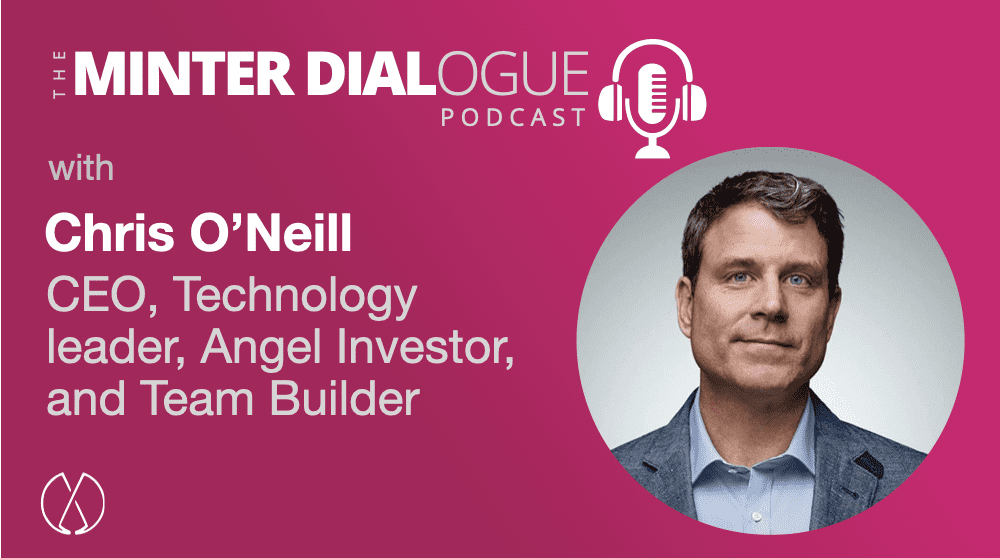
Minter Dialogue with Chris O’Neill
Chris O’Neill is a proud Canadian, seasoned business leader, and tech veteran who joined me for a lively exploration of personal roots, retail lessons, team building, brand purpose, and the seismic impact of AI. With a career spanning retail, Google, Evernote, Glean, and now GrowthLoop, Chris brings a grounded, human perspective to what truly drives success, resilience, and meaningful change in the fast-evolving world of business.
During our conversation, we traced how early experiences—his parents’ tireless work in Canadian retail—imprinted a lifelong appreciation for customer service, hard work, and connecting with people from all walks of life. Chris is passionate about modelling those values for his kids today, recognizing how privilege and rapid change challenge authentic transmission of life lessons.
We dove deep into team dynamics, drawing from his enthusiasm for hockey (and mine with rugby) as metaphors for collaboration, cohesion, and resilience. For Chris, success has always hinged not on solo stats, but on the strength and integrity of the team. Whether at Google or Evernote, he emphasized that the culture you build—the clarity of mission, values, and objectives—matters as much as individual skills.
Chris’ take on brands and purpose is refreshingly direct. From Evernote’s category-defining product to Gap’s resurgence rooted in nostalgia and social responsibility (“bridging the gap”), he believes brands must stand for something clear, connect emotionally, and attract communities built on shared meaning. Purpose isn’t just a buzzword—it’s vital for attracting talent and sustaining growth, even if Wall Street sometimes sees only the numbers.
And of course, we couldn’t avoid the topic of artificial intelligence. Chris is “net bullish” on AI, yet realistic about the makeshift hype and the necessity of genuine human change. The toughest challenge isn’t just technology, but transforming workflows and overcoming fear to unlock new, truly beneficial possibilities.
Key Points:
- Retail Roots Matter: Early lessons in customer service, hard work, and humility forged Chris’s outlook, reminding us that authentic leadership starts with how you treat and connect with others, no matter their status.
- Clarity and Culture are Critical for Teams: Winning in business means intentionally crafting your mission, values, and priorities—and living them every day. Team health and cohesion can trump raw skill for lasting impact.
- Pursue Purpose and Embrace Change: Brand and purpose are essential long games. Whether through AI innovation or social responsibility, clarity about why you exist and how you adapt will set you apart—especially in a messy, fast-evolving landscape.
Chris’s wisdom is rooted in experience, humility, and a belief in compounding the small things that make a big impact over time. I’m left inspired to focus more on team, purpose, and never underestimate the potential of genuine human connection—even as AI transforms the world around us.
Further resources for the Minter Dialogue podcast:

Meanwhile, you can find my other interviews on the Minter Dialogue Show in this podcast tab, on my Youtube Channel, on Megaphone or via Apple Podcasts. If you like the show, please go over to rate this podcast via RateThisPodcast! And for the francophones reading this, if you want to get more podcasts, you can also find my radio show en français over at: MinterDial.fr, on MegaphoneFR or in iTunes. And if you’ve ever come across padel, please check out my Joy of Padel podcast, too!
Music credit: The jingle at the beginning of the show is courtesy of my friend, Pierre Journel, author of the Guitar Channel. And, the new sign-off music is “A Convinced Man,” a song I co-wrote and recorded with Stephanie Singer back in the late 1980s (please excuse the quality of the sound!).
Full transcript via Castmagic.io
Transcription courtesy of Castmagic.io, an AI full-service for podcasters
Minter Dial: Chris O’Neill, I am just thrilled to have you on the show. We, we’re just talking a little bit ahead of time about some of the things you’ve done. You’ve got an amazing background. But let’s say, as I like to start off on my show. Who are you?
Chris O’Neill: Well, Minter, it’s a pleasure to be here with you and your audience here today. I am a proud Canadian. I’m still figuring out. I’m still figuring out that to be clear, it’s part of life’s journey is to figure oneself out and evolve and grow and learn, to unlearn and begin again with new challenges. But first off, I’d say I’m a proud Canadian. I’m a husband to a lovely wife and two children now adult, one adult and one is wrapping up her senior year at school. And I’m a business leader who wants to make change and impact for good in the world. So, I’d say that’s what I would. I would describe myself at least at this phase of this season of my life.
Minter Dial: Well, in, in sharing fun things. I lived in Montreal for nearly four years running the l’ Oreal business. And I, so I got to know all of Canada. So, I even know sort of lute, goofy, Newfies, PEI, Saskatoon, all these kind of good things. Where are you from in Canada?
Chris O’Neill: So, I was born in Toronto in Ontario, and I grew up in a very small town or small towns in, in Canada. My, my, my parents were retailers. My grandparents, who on my mother’s side were farmers in Manitoba Portage La Prairie area. And then my other grandparents were. My grandfather was a turnaround expert at the largest grocery chain in the country. So, they moved around frequently but then settled in British Columbia. So, I have seen all parts. And your city you visit? Montreal is my favorite. If it were so dark cold, I think I’d live there. I absolutely love Montreal.
Minter Dial: Well, I think if, if it weren’t so darn cold, there’d be too many people there.
Chris O’Neill: Perhaps, perhaps one way to control the population, I suppose, but it’s a wonderful place.
Minter Dial: So, your background, you, you mentioned you’re, you’re the retailer. The experience with your parents and actually being on the, the show floor or you see the, the shop floor with your, with your parents. What kind of lessons did that? What do you think today, Chris o’ Neill is still imprinted with, from those experiences back in those days. What images are coming to your mind?
Chris O’Neill: Yeah, I try to model this with my own children. I think that everyone at some point in their life should Work in retail and, or be a server in a restaurant. It teaches you a bunch of things which I think.
Chris O’Neill: Pay off for the rest of your life. The notion of customer service and problem solving. When someone comes into store with the broken bits of stuff and have questions about hardware, you have to work with them to understand what they’re asking and help them solve problems. You deal with all sorts of humanity, right? Grumpy people, friendly people, everything in between, right? So, the ability to connect with humans and then help them solve their problems and, or service them in an appropriate way is a super, super important skill. I’d round it out to say hard work. My parents worked their butts off, right? They not only had the job during the day, they had their night job. I liken it to our dining room table. We had this creaky old wooden table and we would try to get together. We had four, there were four children, six of us total. We try to get together most nights for dinner. That’s sometimes hard with all the sports and all this good stuff, even back then. But we’d have dinner, we’d clear the table and then I’d say like the second shift for my parents started, you know, they would sit at that table and that was their, that was their home office. For their second shift of the day, they worked their tails off. So, I learned the value of hard work and it wasn’t giving me an option, right? We had to work from a very young age. And then I’d say the, the other thing is like when you work in retail, you’re working with real people, real people with real, real like life challenges. So, so it didn’t matter that I was the boss’s son. They used to rip me a little bit for that. But they’re like, hey, we got a job to do, son. Like, you know, like, you know, we need to clean up an aisle, number, whatever, and, or you know, we need to, need to get some, some stuff done or the customer needs help. So, you learn how to connect with people largely, most, most of whom are being paid minimum wage, right? So, I think that’s amazing, right? I was always taught through my parents and just my upbringing that you treat everyone the same regardless of their lot or their station in life. So, I think the combination of customer service, the ability to hard to work your butt off, right? And then the ability to identify and connect with humans of all different skills, experiences, backgrounds in a non judgmental way just to figure out how to, how to be a part of a team to accomplish something, you know, together So I don’t know. I highly recommend people working in retail and it’s all about the details and human connections of the sort I just mentioned.
Minter Dial: Well, I love that. It makes me think on the one hand how at l’, Oreal, when I started, they made me be a salesperson, which at the end of the day is the closest ability for in our world. We were selling shampoos and hair colors to salons. And so, rather than be the marketing dude sits in the office in the ivory tower, we had to go out there and actually sell what the marketing folk were doing. So, you get that little bit of reality. And I have, I have two follow up questions, Chris. The first is you pick this up from your parents and you talked about, you know, getting the ribbing, the, the hard, you know, do the hard labor. How do you think the transmission happens today as opposed to you? And I basically, I’m going to say in the same kind of ballpark of age.
Minter Dial: How do you do the transmission today? Because it’s a very different world.
Chris O’Neill: Yeah, it certainly is. It’s something I wonder about as a parent, especially parents of children growing up with affluence and in a pretty affluent area. It’s probably my biggest challenge as a, as a human and as a certain, as a parent. And I, I think it’s trying to expose children in particular to two different experiences. Right. They maintain connection with their cousins back in Canada. Right. We try to travel. Travel is one part of it. Both of, both of my children have had part time jobs. Right. Not only in the summertime, but my, my daughter works at the local pizzeria.
Minter Dial: In touch with customers.
Chris O’Neill: Yeah, yeah. And she wrote about it as part of her college applications. Right. So, it’s having formative experiences and then you know, obviously, you know, offering everything we can to them to whether that’s through education. I mentioned travel experiences and just really trying to role model ourselves as parents. But it’s, it’s, boy, it’s hard. And especially in a world where, you know, kids that are living what I call checklisted lives, it’s like everything’s sort of done for them. And so, I try to fight that urge. Right. Obviously we, we’re happy to do things with and for our children, but I think the ability to get out and experience the world in some proximate way that I was describing before is all I think one can do as a parent. I’d say the other side too is I was having a conversation with my son last night about what he wants to do in his first full summer internship, and he was fresh off of meeting from this very. I’ve never met this person, but he was very sort of a scrappy entrepreneur who doesn’t believe in going on the, you know, the investment banking or consulting path. He said, no, what you need to do is just email a bunch of people and offer to do things or favors for them. Right. To solve some problems. You know, there’s never been. There’s never been more opportunities to just reach out directly to humans. And then whether it’s things like Vibe coding or just the ability to build a small business on like a Shopify or something, you can just be an entrepreneur. So, this was something we did this summer with my son. He’s a. He’s a fledgling photographer. I’m like, great, well, what do you want to do? Like, so he has a site and we sat down, we Vibe coded the site. So, against the backdrop of lots of complexities and lots of checklists and lots of, like, things that are disrupting normal experiences. Normal experiences. Like, for people like you and I, there’s all sorts of opportunities for people who have agency and really want to, you know, be curious and follow some of their passions. Like, I think that’s the road that I’m trying to. To help shape with and alongside my children and others too. People come to me for advice and career stuff. It’s like, don’t just kind of pick my brain. Like, come. Come with ideas. Come with some agency around how you might help advance problems or solve problems in the world, or figure out how to be useful to people and build a relationship well ahead of any need. Right. These are the sorts of things that I wonder about. And it’s messy and it’s imperfect, but I think it’s the reality of what we’re all living through. And we. I’m sure we’ll get into the topic of artificial intelligence and what it means and those stuff. I’m. I’m net bullish and optimistic on it. Although, you know, it’s. It’s definitely. There’s definitely some puts and takes on either side of the ledger.
Minter Dial: I love the way you put it. Net bullish. Yeah, the, the idea of, of doing the hard work.
Minter Dial: Me do. My daughter did some bartending. That kind of a thing where you’re really in front and you’re having to be a service.
Minter Dial: I think those are robust ways. And the other thing it makes me think of is the hue. You said lots of opportunities, but in terms of disruptive opportunities, because there’s so much messaging going out there with AI and such, there is a huge opportunity for the people who are putting in some time, like handwritten notes or writing. Hey, listen, I’ve. I’ve looked at your situation, Chris, and I think I have a true solution for you. Because you were brought up in Canada, you did retail, and like a personalized approach.
Minter Dial: AI can only go so far to do that. And finding that, putting in the hours, the effort, maybe that’s where the. What do you think is that. Is that like, maybe.
Chris O’Neill: Yeah. What. I. I’ll tease that apart a little bit, but I actually think one of the great opportunities for artificial intelligence when applied correctly and ethically and properly, is personalization. Right. Like, so much of our lives is like, you know, just like, is dealing with the same sea of sameness, same experiences, right? You. You’d understand this given your. Your background and your work as an author. It’s like there’s such an opportunity to break through and truly connect with people in a way that is more personal. Not just like, brand. Brand cfc. So. So, we can park that. But to your point, like, I’m obsessed with the concept of compounding, right? It goes back to a. A week. It’s literally a week. I grew up in this part of. Got a lot of snow, so there’d be times when we’d be stuck, like, literally in our house for days.
Minter Dial: A foot and another foot.
Chris O’Neill: No, no, like, quite literally, like snow forts. Like, tall as the house. And I’ll never forget this time, this. Gail Jackson was her name, you know, amazing friend of my parents. And she gave me this book called the Wealthy Barber. And I was very. It sparked a lifelong interest in. Have you heard of the book?
Minter Dial: No, but I mean, barber. You know, I worked in the hairdressing industry for 16 years, so space.
Chris O’Neill: I know. Well, it’s a parable. It was written about, you know, a person in a wealthy barber who did a bunch of things, simple things in life to accumulate wealth over time. But it was small, consistent investments, right? Nothing fancy or flashy, but it really not only sparked an interest in investing, but it actually didn’t know it at the time. This concept of compounding, it’s the notion of doing small things consistently over time that lead to exponential gains over time. You talk to Warren Buffett, right? Think about how he’s compounded. So, it’s an investing concept. When you think about it, it applies to so many things in life. It applies to nature, it applies to technology, also applies to personal habits. What you’re describing, I believe that playing the long game, whether it’s a handwritten note or whether it’s basically doing something for someone with no expectation of return.
Chris O’Neill: There’s a whole bunch of things that I’m starting to see the benefits of this over time. And they’re not linear, they’re exponential, but they look small at the beginning. I believe that part of what Silicon Valley gets right is this. For all the negative back backlash about the Valley and all the positive accolades, one of the things I’m really clear about is there’s a willingness and a pay it forward mindset that pervades most, if not all, the Valley. Right. That I have benefited from. And I feel it’s my obligation to continue to contribute to. If people have ideas, if I have something that I can be additive to that I make it a point to try and adapt, adopt some folks, not in a weird way, but just to kind of take them under my wings, offer them perspectives. Right. Sometimes that includes writing a check as an angel investor or offering just perspectives that I have had so many fortunate opportunities and I want to pay it forward in a way that people did for me. So, I think that the concept of breaking through with handwritten notes and those sorts of things, I love it because that’s again, that’s sort of zigging when other people are zagging. It’s not 1500 emails that are all like form written with a form letter in your resume. You’re trying to find a job. It’s. No, no, no, I noticed, I noticed you spent some time in Montreal. L’. Oreal. Wow, that was an interesting time in that brand. Right? They had, you know, like something that shows you actually went the extra mile to get to know, truly cut through the bs to get to know the person either at a human level and, or try to connect with some of the things that they would, they would be, that would resonate with them if you could advance or remove some of the friction or solve a problem. Something, something that’s, that’s, I think how people are going to, going to break through in this world, who knows? But I think there’s a something, there’s something to what you’re describing.
Minter Dial: Love it. It’s so refreshing, Chris, to hear positive things about Silicon Valley because basically it seems like that the, the major narrative is, is all negative. That’s lovely. So, you, you’ve worked in, you know, you’ve had so many amazing things you’ve done, Chris, and I’m wondering, you know, if I take the example of what you did with Glean where, which I, I don’t know the organization, but clearly you did something huge. And you worked at Google Canada, you worked at Google, you founded the first office in San Francisco of Google in the city. How much of your roots did you have you taken with you? Do you feel like you’ve managed to stay rooted in your family experiences?
Minter Dial: When we talk about scalability and all these things and hand writing on the other side, it seems like a very two. There are two squares. How do you square those holes? Pegs?
Chris O’Neill: Yeah. Well, I think so. I think I have. I think that I’ve been very fortunate to have been raised the way I did in the country that I grew up in. Now I stay close with, with my family, so that keeps me, keeps me.
Minter Dial: Sort of, sort of grounded.
Chris O’Neill: I think having teenage kids also keeps me ground too. But I. No, look, I, I’m really, really lucky, right? I think that it’s important to not lose sight of the role that luck has in life. And like, you know, that is something that gets lost because we’re human, right? Like it, it literally is when you have success, it’s like, oh, clearly it was because of my one’s greatness. And that’s just, I just don’t believe that. I don’t believe that it’s not because of, you know, something special I did. I’ve been very fortunate both in terms of my upbringing, the country where I grew up in, and then the many opportunities that I’ve been affording. So, you know, I’d say another thing that was a good life lesson too was sport. I was not a great student to start. I wasn’t very interested in school. I mean, today I’d probably be diagnosed with lots of different, different things. But, but I suffice it to say I wasn’t that interested in school. Growing up in a small town, a blue collar town in, in Canada, it wasn’t really necessarily cool to be the smart kid. Right. In fact, you’re sort of, you know, called the nerd or sort of picked on in, in interesting ways. I changed that over time. But like the, the point I want to make is I learned how to play lots of different sports, mostly team sports. And I believe that that is applicable in life. Right. You have to understand like, the goal of a team is to win. And your goal and your position in achieving your accomplishments or contributions to that victory or loss really will shape shift depending on the situation, depending on your skill and so forth. And why am I starting that? Well, yeah, you mentioned some of the successes and again, every one of those is because I was lucky enough to be part of a great team. Sometimes I helped create the team, but most of the time I was lucky that I landed with a great team. And like everything to me, you know, there’s a, there’s an expression from the valley, it’s Vano Koso is an interesting character who says the team you build is the company you build. And I believe that fundamentally, right. Everything begins and ends with the people you, you are there. And like that is has been true throughout my life. And there’s a force multiplier for me that is probably stronger than average in terms of the people that I’m surrounded with. I’ve been surrounded with some amazing people. So, with glean that was like fairly interesting. It was all about an amazing team. Mostly, mostly Google search engineers, some of the people with Google brain who literally had cracked a problem I had been breaking my teeth on for many, many years. Evernote I called it OmniSearch. It’s the ability to basically a Google and ChatGPT had a baby to find information in your professional work life. And it was so obvious that they had broken through it even before they really had any meaningful revenue at all. And that’s when I was advising the company. It didn’t even have a name that we talked about publicly. It was literally in stealth when I jumped in with that because of the quality of the team, the resonance of the problem and the breakthrough that I could see that literally the T part of ChatGPT stands for Transformer. And basically application of that technology to this problem allowed it to break through after many years and many attempts. So, again people, the problem, application of technology. And then I was lucky to contribute to, you know, we were naming the company, we were positioning the company and we were basically bringing on the first, first customers, the first paying customers. I’d say there’s a bunch of design partners. So, that was amazing experience and I couldn’t have my wildest dreams imagined how successful the company would go on to become. And it’s amazing, it’s a testament, you know, I, I played a tiny little role, let’s be clear. But they’re going, they’re going off and doing great things. And you know, Google of course a generational company, I had many, many different roles there. But the common through line was look like that was probably the best business model ever designed during a very transformative time from you know, analog media to digital media, from on premise software to cloud software, right? And now there’s the AI wave, there’s the mobile transition, like there’s all sorts of these gigantic transformations that were like gusts of wind in the sails. And then when you had such talent density there, you’d really had to try hard to screw it up. So, I was really lucky for an extended period of time there. So, I don’t know. The commonalities are, look, is a problem resonant to me, Is it a mission that matters? But above all else, is it the team that you’re able to shape or be a part of that really leads to outside experiences and results? So, that’s how I’d comment on weaving those things through. And I can see some through lines back to my heritage and my upbringing in a way that I try not to lose sight of. But, you know, I’m human and probably, probably imperfect in that.
Minter Dial: We are all imperfect, Chris. At least I know I am. The, the team thing is really interesting to me. I’ve had a number of rugby players and a number of famous hockey players, two sports that I sort of think of in the same way as team sports. Hardcore give of your body. I mean, you can imagine how many times I’ve seen the Canadiens Habs. And I’m unfortunately a Flyers fan. But, you know, I love.
Chris O’Neill: We’ll forgive you, we’ll forgive you.
Minter Dial: But I, I. Those two sports, not all sports are equal in this manner in terms of the values that they encourage and the standing up for your team. I’m, I’m always grateful for my rugby friends and I, and I, I just appreciate the way the hockey players stand up for each other. I feel in such a different way than some of the other sports where. What’s your opinion about that?
Chris O’Neill: Well, I’m really biased. I’m Canadian, after all, and I did play very serious hockey throughout most of my life. I’ve not played it in the last several years since I moved back from the Valley from Canada. But, but yeah, you’re absolutely right. I didn’t really play much rugby, but I have admiration for it. But hockey is exactly what you’re describing, right? And one of the things people don’t understand fighting in hockey, right, like they’re like, oh my God, what about barracks sports, right? Well, first of all, hockey, when you’re fighting on the ice, it’s a little different. Like it’s, it’s not quite the same as doing on ground, so it’s not a slip around. It doesn’t land with quite the same force. But all that to say there is a reason people fight, right? It’s actually a series of unwritten rules in hockey. And it’s, it is about standing up for your team. If someone does something, say they run into your goalie or they hi. High stick or they do something, they do something that violates one of the unwritten rules. That’s what causes fights, right? Or you’re looking to gain momentum in a game where you’re sort of losing, you’re trying to shift the momentum. Fighting has a role to play, but really it starts with standing up for your team. And being one really starts with hockey. Everyone, everyone has to work as a unit, right? You can’t just single a single person have the dominance that you can in other sports. It requires a team, you know, and then the playoff run for hockey. And you need everything to work. You need to be, you know, have stamina. You need to be strong and big and forceful. You need to have an incredible goalie, right? You need to, of course, get some good luck, but you really need avoid injuries. But like, really, really what it’s about is, like, clarity of mission and commitment to a goal that’s much bigger than any one individual. And then everyone doing their part or blocking a shot, standing up for their teammate, yes, scoring a goal. But it’s about a million little things that happen for a successful hockey team. You know, I’ll tell you a quick story because I was a decent hockey player at a young age, and I.
Minter Dial: Was like, I love to hear that, Chris. It’s cool.
Chris O’Neill: No, no, but I was like two other brothers. They’d beat the crap out of me and like, fire shots at me. Like, I would just play up from an early age and is obsessed with the sport in an early age. I used to score a lot of goals. And like, I remember one time driving home from a game and I was talking to my dad. I was like, yeah, dad, like a pretty quiet guy, but he’s like, how, how did the good game go today for you? And I was like, oh, it’s amazing. I scored three goals, right? My dad says, yeah, okay, but you guys lost. Like, what are you talking about? Like, don’t talk to me about your individual stats. Like, you guys lost. So, that is, that is like, it was an interesting lesson that you learned. Like, you either win or lose as a team. Individual stats don’t really matter. They really don’t. So, this, this is the mindset. I think it serves well in life, right? In business. Know, any organization, I think, has some of those characteristics that, you know, I, I, I, I’ve had good luck hiring, hiring people who ironically, especially, especially women college athletes. I’LL hire women college athletes, like disproportionately disproportionate amount of the time. And we can unpack it if you’re interested. But like, I, I just think there’s so many lessons in, in, in sport.
Minter Dial: Oh, and amen to that. I, you know, 18 years of rugby, I played probably 20 games of ice hockey. They occasionally invited me on the, on the, on the rink. In the rink. But.
Minter Dial: The challenge is moving from a sports field where we have a mission to win and bring that into a work environment.
Minter Dial: And sometimes, for example, you might find a really good, competent person, but not my style.
Minter Dial: Or. Well, maybe I just overlook that because, you know, complementarity sometimes comes in diversity and it doesn’t jive with me. But you know, we don’t go out and drink beers afterwards. But that got the guy or the girl is really the right competency.
Chris O’Neill: Yeah.
Minter Dial: What kind of arbitration do you look at when you’re trying to create that chemistry? The vision of the goal, the win.
Chris O’Neill: Yeah. Yeah. I had this conversation this morning with one of my engineering leaders and just talking about the cultural evolution that we’re on and how do you think about evaluate. And we’re going through typical performance end of the year cycle. It’s like there’s competencies and you can literally in engineering, in certain functions, you can look, you can see like this is many pull requests this week and this quality of code and like there’s a whole bunch of dimensions you can look at to evaluate competency. And then the culture one is more of a qualitative thing to say, hey, what’s the agency? What’s the accountability? What’s the kind of cultural thing that this individual or this team represents? And that’s a little harder to do, but I think it’s very important. So, the extremes are easy. So, people who are.
Chris O’Neill: Either the proverbial. I’m not a fan. And do not allow that to happen within my realm of control. Like I just, that, that’s, that’s toxic to a company. Right. Someone who, even if they’re super high achieving, they’re the, they’re the toxic person in sport. It’s the person who sort of becomes like that really negative.
Minter Dial: Look at me.
Chris O’Neill: Yeah. Or just a person in the locker room that really distracts the team and it becomes all about them. Or they’re just, just an ass. Right. And that’s easy to do. It’s easy to deal with. It’s sometimes. But there’s more nuance in there. Like how much of a contribution to the culture and what values you value in a company. So, I think, I guess I’m a big fan of being articulate about those, writing them down and not just putting them on a wall, but actually living them. Whether that’s celebrating things on a weekly basis, big and small, whether it’s reinforcing in terms of your hiring processes to basically connect your values to specific questions you ask and interrogate for when you hire and fire people. Like, how do you actually apply these sorts of things? This is the nature of, nature of what I was describing earlier with the engineering leaders. Like, how do we think about this? What does that mean for us? We have these values and how do we translate them down? I think the great companies do that. They’re really clear about what they stand for and more generally, they’re clear about what they’re doing and how they do it. When I do this, I mean, on a single piece of paper. Now, I actually learned this from Jeff Weiner. Now, Jeff Weiner was an investor in one of the companies I ran once and really respect him as a leader. And I remember I asked him, like, Jeff, like, I’m new in this role. I love your perspective. I’d love your perspective in general and just open to your advice and leadership. And one of the things I’ll never forget is like, you have to have everyone you know on the, on the journey to being a healthy team. You have to have cohesivity. So, you have to invest in each other at a human level. You have to ignore what each other’s complementary stuff. And you can form a vocabulary around that. But beyond that, you say clarity. And he’s a big fan. He said, look, what’s your vision? What’s your mission? What’s your strategy? What are your objectives? What are your values and what are your very near term priorities that need to be done? Like right now, I might have some of those details wrong. But he said, listen, if you don’t have that on one page and everyone on that team can literally read back verbatim what’s on that page, then you’ve got work to do. So, I’m just a huge, huge fan in being really clear and intentional about what it is you’re trying to do, but then how you go about it, right? Organizational health is underlooked or overlooked and not as underappreciated, right? So, a lot of people can be clear on the what, less clear on the how, which means cohesivity. I’m a big fan of Lencioni’s work on this, right? Whether it’s the five dysfunctions of the team. He has a book called the Advantage. It really talks about cohesivity and clarity and then communication and how you then reinforce clarity throughout all your processes. So, I’ve seen lots of different approaches and all of them have their puts and takes, but that one is, has been the one that seems to have stuck with me in terms of a model for leaning into the organizational health.
Minter Dial: I’m guessing that that was when you were head of Evernote, that you were talking, when Jeff was part of Jeff Leonard, correct?
Chris O’Neill: Yes, yes, yes, correct. I had to think of when, when we actually did work with Lencioni’s group. And they’re amazing, but. Yeah, yeah, that’s right. Jeff was an investor in Evernote.
Minter Dial: That’s what I was suspecting. And this idea of, of clarity is, is gorgeous. And for me, the way I interpret that is the need to be clear with yourself first.
Minter Dial: Because how do you have clarity if you’re jumbled within? So, to what extent do you attribute your success? And this idea has to be linked with self awareness, self-knowledge.
Chris O’Neill: Yeah, yeah.
Chris O’Neill: Yeah. Those are pretty deep, deep thoughts. You know, I, I, One of my, one of my brothers, the two, two older brothers in the younger system, one of my brothers is that the reason they don’t fully understand at a very early age was one of these people who read and listened to tapes like Self Improvement, kind of like Tony Robbins and Stephen Covey. And literally he would, he would just either listen to tapes or read all the things I remember reading. The 7 Habits of Highly Effective People by Stephen Covey. And in there, there’s the seven Habits. And don’t ask me to recite them all, but one of them I really remember is exactly what you’re describing. He talks about the concept of interdependence before you can have interdependence. So, the notion is exactly what you’re describing, right? You have to be clear in who you are and you have to be able to rely upon yourself, right? And invest in yourself, right? The concept of putting your own oxygen mask on before you can help each other concept he used is called sharpening the saw, right? You can be using a saw and if it gets really dull, right, then you’re going to be very inefficient and ineffective in life. So, periodically investing in your health, investing in your food you eat, minimizing alcohol intake, these sorts of things, for me, that’s what that means. But this concept of being self-aware and interdependent before you can be interdependent and influence people I think is very powerful. It is interesting, the wellness movement, which I try my best. I am very imperfect on this many, many reasons, but like at least to have a heightened awareness, you know, the Hubermans and all these things have controversy for sure. But raising the general awareness of what it takes to be, you know, treat our bodies and our minds in a certain way is I think a critical ingredient of a leader. And I, like throughout my career, I’ve burnt out more times than I care to admit. So, I have an appreciation for what it takes for me personally to be my best. I know what it is. I call it my recipe. And do I adhere to it all the time? Heck no, I don’t, despite my best efforts. But it is rooted in this concept of interdependency and self awareness. I know what I’m good at this stage. I know what I’m crappy at. I try to surround myself with people. You touched on this earlier. I think the job of a leader is much like putting on a dinner party or building a team that’s a complementary or an orchestra. All the pieces have to come together in unison. But it does start with a leader being clear about who they are, what they stand for and how they can build self-awareness as a starting point.
Minter Dial: It feels like a good segue. When you were at Evernote, obviously you did a big turnaround. It’s what I read about it. I mean, I don’t know to what extent it was turbulent within, but building resilience is a such a topic of society. Yeah, but also in business. And I’m wondering, what are, what are the keys to helping building resilience? I mean, does it start with you?
Minter Dial: Where do you start when you’re trying to build a resilient team in a shitty environment?
Chris O’Neill: Yeah, certainly the Evernote journey was really turbulent. Would be a nice way to say it’s a company that created a category, could do no wrong until it could do no right, attracted the capital and advice from the who’s who in the world, graced the covers of magazines and then really kind of lost its way in many ways. And so, part of it was to rediscover its purpose by reconnecting it back to what it made it great in the first place. Easy, easier said than done. So, it certainly was a turbulent thing. I’m really proud of the work. Right. Like to me, I look at situations certainly at that time where it’s like, look, can I learn certain skills? Can I help move the world further on A problem that matters to me and I think is, you know, matters in the world.
Chris O’Neill: And give it my best and like, even if it doesn’t work out with the greatest outcome or impact, I would be a better leader because check, check and check. That was absolutely true. And never know we left it better than when we found it because it really had lost, lost its way. We got it back on its feet, cash flow positive and live to live to fight another day. But to your point about resilience, like, I had an old boss who said, you know.
Chris O’Neill: Adversity doesn’t, doesn’t build character, it reveals it, right? And I think that’s pretty profound when you think about it. I therefore look for people, remember back to kind of clarity in terms of the how connecting it all the way down to your hiring processes. I’m very curious about people and frankly skeptical of people who have not been through resilience. I ask them to talk about the tougher moments in life or certainly in business. Okay, maybe too personal, but it reveals a lot about one’s character. It reveals a lot about one’s resilience. I don’t care who you are, you go through in life, right? Whether it’s loss, loss of a loved one, you know, you fail in a class, you fail in business. Like, and if you have it, then you lived in a bubble. And like, that’s a whole separate issue. But I think it’s about how do you open up the door to say, hey, what ha? Like, talk to me about setbacks. What did you learn? And what you’re looking for is someone who is truly using setbacks as fuel for their growth, right? We’re looking for people who accept responsibility as opposed to point fingers, right? It’s about, hey, what did you learn from that? And it took me a long time with Evernote because it wasn’t the outcome anyone was looking for. Eventually it got sold and we had opportunities to do that along the way, but it was like no one was really happy because it was like the venture capital model where if it wasn’t billions of dollars, then it’s deemed a failure, which is. We could have a separate topic conversation about that. But I come back to how what I took away from those experiences, right? And I learned more in those three and year and change than I did in 10 years at Google, right? Because of the adversity. And you have to make decisions under with imperfect information. You’re dealing, you’re trying to motivate a team when it’s not like gusts of wind in the sail, it’s like quite the opposite. You’re like getting attacked on all sides and you have to have clarity. Rain is pouring down 100 and actually come back to you. At the time when I did burnout, right, I was like hardly taking time. It was really just 24/7 of like high load bearing decisions after decisions and often with very, very, you know, one of the things I think certainly failed in that regard was, was how do you coalesce a board with different people who have different perspectives, right, who had come into the journey at different times? Like, how do you coalesce like that group to a shared vision? I was not able to do that. Right. When you, and when you have four or five different powerful people who have six or seven different perspectives, it makes it very difficult, right? So, clarity of where you’re going is really a necessity. So, you know, lots of lessons on that journey. But like, to your point about resilience, you have to go through those experiences, right? Eric Schmidt used to famously say couple things, right? Revenue solves all, all known problems in business. Revenue growth. That is the other thing he says in one’s career. You should work on a rocket ship, you should do a turnaround and you should work globally, right? You should, should work across different geographies. I’ve been fortunate in my career to have had all three in spades. And you learn different things from each of them. So, no, I think like. And resilience is one of them, right? Because you have to know you’re going to get setbacks when you’re, you know, all three of those have different, different portfolio of opportunities and different portfolio of challenges. So, by having experience and having setbacks, that’s how you, you build resilience.
Chris O’Neill: Love.
Minter Dial: It speaks volumes. Chris, you’ve worked at some great companies. I personally am still a premium member of Evernote.
Chris O’Neill: Oh, thank you.
Minter Dial: Kind of know Google.
Minter Dial: This is, it’s a. Not as simple a question as, as it might sound like, but what for you is the importance or how important is a brand? And what is a brand today?
Chris O’Neill: Yeah, yeah. One of the three lines is, is, you know, so actually categories and brands, right? I actually part of what we, you know, Google, of course, it’s a verb. It’s bigger than a category. It’s literally a verb. You know, glean is on its way to, to building a category. Evernote built a category, right? Part of the work I’m doing, growth loop right now wasn’t just like, we’re going to, you know, stay in this Alphabet soup of like marketing Technology. No, it’s like, it’s actually a category. We actually talk about compounding, compound marketing engine. Like I’m a very big believer in like you can just pretend to be like live in your little, your little box and say, oh, I’m a little bit better because of the speeds and feeds. No, I’m a much bigger fan of saying no, we’re different. We’re different for these reasons and these are the benefits that we offer that are unique relative to anybody else. So, it’s difference. But I ultimately, I believe brands do that, right? They stand for something. They’re clear, they’re clear as to who they’re for, they’re clear as to who they’re not for, right. If you can’t answer that question, I don’t think you’re spiky enough or sharp enough in terms of that. But brands are everything is part of what attracted me to Gap, right? For iconic brands, right. Part of the reason Gap is having a nice resurgence is come back to some things we talked about great leadership, clarity in terms of what the brands are for and then a little bit of everyone’s pulling for those brands, right? People want Gap to succeed. It h happens to tie back in to like maybe a reptilian part of our brain, but a notion that says, hey, there’s nostalgia in that brand. It has resonance and latent value that is being unlocked again, but with good product, good leadership and great storytelling. So, to me, brands represent an emotional connection that’s above and beyond just the underlying product, right. You’re getting a premium in a financial sense, but more in a more holistic sense. It’s something that attracts a community of people, of like minded people and repels people that are not part of that and not actively, but. But certainly has the benefit of doing that to be clear as to what you’re representing. So, Richard, the amazing leader Gap talks about bridging the gaps in society, right? That means very specific things, right? Going back to the heritage of the brand, going back to things we do in society, even the things we do in the supply chain, right? By investing in women in places like Vietnam to basically invest in their education and well being, it’s bridging gaps and that really means something on a lot of levels. So, very big believer in brands. You can see it in my background and where I’ve been attracted at different stages of my career.
Minter Dial: It’s gorgeous. So, the word we haven’t used yet really is purpose and it’s something I’ve been long talking about. But if you start going to Wall street, you start talking about purpose, you get glazed eyes for the most part, even on some of the boards that I’ve, I’ve worked on. You know, here, we’re here to make money, dude, you know, you know, put down your little high horse story about brand and, and purpose. How are we going to make better innovation, foster sales, get that revenue growth that you were talking about and make money. Where is purpose in all that? And is, is there, I mean, is it, is it for everybody or is it just has to be for a few or bridging the gaps so they got a really coherent story?
Chris O’Neill: Yeah, no, obviously in business you need to build results, you need to have revenue growth and like the ability to invest, I guess. So, I take that as a given. But I, I absolutely think this purpose, you know, I remember in part of my board training there was, you get access to all these experts and there was this sort of wonky, wonky academic who was, was really on this thing that we needed to add yet another forum to the disclosures for publicly traded companies that talked about writing down their purpose and having like 17 dimensions of like what purpose meant. And I was like, oh my goodness, like, I agree with the sentiment, but the actual implementation is counterintuitive. And I was, I had a very constructive debate with him. And I’ll get back to your point on purpose in a second. But it was like when I’ve been in the boardrooms or in leadership situations, it’s not the checklist of people that tend to rise to the occasion. Right. When Tim Hortons was being acquired by Burger King and George Paul Lehman and Warren Buffett. Right. It was actually my mentor on the board who rose above and beyond amazing humans. Frank, Frank Yakubuchi is his name. He’s a retired Supreme Court justice, most amazing human. I just learned so much from him. And he’s a lawyer and a judge. His assessment of the situation, his ability to galvanize a group of people in a time of high stakes decision making was amazing. Just amazing. Right. So, I guess back to the, to the purpose thing. I don’t think it’s something you can sort of write down in checklists. I think it’s counterproductive to do that. My point is maybe simpler if you’re going to attract the next generation of people, both as customers and as employees, partners, et cetera, into your community. If you, you can’t astroturf this, right, you have to stand for something. And people have a very well tuned BS detector as to whether you’re living your purpose or not. So, I’m absolutely. A belief like goes hand in hand with a brand. A brand has to have a purpose. It has to stand for something and a point of view about the world that’s going to be better than it is today. Right. And that can be aspirational over time. But if you don’t have a purpose, I think you’re really leaving a lot. You’re not going to attract the best talent, you’re not going to build the best robust community. And it doesn’t necessarily quantify one for one. It’s hard to do that. But ultimately I think the smart investors get this. Look at Warren Buffett, right? Look, look at, he’s invested in brands that compound many, many, many years, even decades. Right. I, I don’t think he has a formula that says, you know, it’s this X premium and it results in this. No, it’s not how it works. But I, I think you, you see over time the brands and the purpose led companies just, just do better.
Minter Dial: Well, I mean anything that’s formulaic is tick boxing.
Chris O’Neill: Correct.
Minter Dial: You know, you’ve talked about the messiness of it all and so it’s obviously not one thing. But you also mentioned the long game. And at some level, purpose is the long game. You have to make the shareholder monthly meetings or quarterly numbers. Of course. Chris, I have so many other questions, but I want to last question because you have so much experience and this is around the AI world, which we only just briefly mentioned at the very beginning. But you know, all of us, there’s nobody who’s not aware of AI, there’s nobody who’s not trying stuff out. I mean, I go into octogenarian groups and they’re all trying to be T, much less the younger ones. But it’s, it’s, it still strikes me that like issues of digital transformation programs of diversity programs of environmental safety, ecology, whatever, all these programs that we put in, so most of them fail. And in AI, everybody’s on the case, oh, we’ve got to do it. But not everybody is doing it well. Like, you know, teenage sex. Right. Wants to do it but doesn’t know how to do it. Well, what is, what is it that people are missing out when they’re trying to implement AI in today’s business world?
Chris O’Neill: Yeah, yeah.
Chris O’Neill: I think it’s, it’s a, it’s a human change thing. This, this is quite objectively the most transformative shift in technology that I’ve been through in my, in my life. And I’ve Been through many. This is just, it’s. The magnitude of change is bigger and, and importantly the slope of progress and change is, is steeper. Okay, great. So, why is it not having the, the desire? Well, there’s the hype cycle, right. It’s over promised in the short term. You know, it’s the notion of everything it under delivers in the short term and over delivers in the long term. Right. We get that backwards in the early days of transformation. But at the root of it, it’s human change. And there’s a whole bunch of reasons why people are fearful they’re going to lose their job. They’re fearful of just change of this magnitude, period. But ultimately it comes down to changing the work. We’re basically applying new tools to old work, old workflows. So, that’s the thing that’s taking time. It always does. That’s what leads to the notion where you basically over promise in the short term and under promise in the long term until you actually start to change workflows to take advantage of this. I’ll give you a very specific example from our business actually having this conversation in terms of how do we think about our business model pricing like we do certain things with our technology. It is fundamentally different by basically bringing intelligence to the data instead of data to intelligence. And I won’t bore you with all the details other than to say we are experimenting with agents that can do things that humans just can’t do, but that requires different inputs and different workflows that don’t exist today. So, we’re having this taking us a lot longer and we have to find those courageous leaders who are willing to take a risk because this is imperfect. It’s not tried and true. Even if it’s a suboptimal or local maxima, it’s not a global maximum basic. But we’re going to, we’re going to try to get there. And it’s stepwise, it’s ups and downs, but that’s what’s really going on. The longest poll of all is actually human change and getting people comfortable that this is going to be net beneficial. And back to my comment earlier, I am bullish on that. But people are going to lose. Certain functions are going to go away. So, therefore people will be disrupted. Some people will lose their jobs. I think every job will be reinvented in some meaningful way. And I do believe there’ll be many, many new opportunities and roles that we can’t yet articulate. Right. And I don’t think it’s prompt engineering by the way it’s just basically whole new ways of how we apply technology to change the way we work and change the way we interact with.
Chris O’Neill: Our world. Right. And you’re seeing actually just in Black Friday, we’re just recording this week after Black Friday, it was a 9x increase in terms of agentic commerce, meaning 900pl percent improvement from last year to this year in terms of people using some form like there’s ChatGPT or whatever perplexity or whatever tool of choice to do their shopping. Right. And then the conversion rates were like 30 to 40% higher than other channels. So, you’re at the beginning of like a new modality and we just don’t know what to do. Even in the early days with Gap, we’re sort of asking those questions because it’s a very small base. But boy, oh boy, when I talk about the slope of that curve, it really doesn’t take long for that to compound to something that becomes profoundly different. And humans have a hard time dealing with exponential change and compounding like that. It takes us a while. We sort of think more linear than linearly just due to our wiring and how we’re like how we’ve evolved over the generation. So, I know that those are, those are some of my thoughts on the topic of AI as I think it’s fascinating. It’s, it’s what keeps me super energized these days and even knowing that I, I know very little about how it will ultimately unfold and you know anyone else who pretends to know otherwise, I think is I’m a little skeptical.
Minter Dial: I was chatting with one of your colleagues right before about quantic quantum energy and things. You know, if someone says that they know everything about quantum computing, I’m like really? As it is, you know, the number of startups that I see saying, you know, I’m something, something AI. So, tell me about your AI. How much AI, how much data do you have in there really? Is it AI or is it going to be AI? And, and I, the, I’ve written about empathy, I had this acronym, the Tate, like the TATE Gallery … T A T E which is trust, authenticity, transparency and empathy. And, and, and they, they all relate to, to a very human elements, but the, the one that really is probably the, the sore thumb and then that is this notion of transparency. How transparency should you be? The other ones seem obvious, but transparency is the one that’s sort of more tricky. And the transparency of AI, well, I don’t even know what I’m going to do tonight, much less Why a perplexity might give me the right answer or not. Yeah, it seems to be maybe the, the messiest of the words out there. What do you think?
Chris O’Neill: Yeah, I think there’s something to that. Yeah. You know, the, the thing I wonder about on this is is there a lowest common denominator that doesn’t serve society well? Meaning if we’re all sort of tuning to these models that inherently reinforce biases. You know, I, I, I wonder out loud about that as it relates to, okay, what does it mean to transparency being part of it? So, how do we have transparency into what is going on inside these models? I think it’s a very tricky topic, both technologically but also from a societal perspective and ethics perspective. I mean, these are really, really big, big questions that I think are unanswered and it is against a balancing act of not trying to over overly regulate something that is growing so quickly in a way that’s uncertain. So, I’m generally skeptical that’s too fast moving to basically try and corral it entirely. Nor would we want to. But your point about transparency, and I think that I can interpret that on a lot of dimensions. I agree it’s all pointing in roughly the same direction and we need to tackle it. But it is also very tricky for many of the reasons and I’m sure many, many more that I haven’t thought about yet.
Minter Dial: Well, hopefully this has stimulated a few of our listeners ears. Chris, I must let you go. I’ve already overstayed my welcome. I like to try to be on time as we talked about beforehand. Been a great pleasure talking to you, listening to you. What, what can you, what kind of calls to action would you like for listeners who are still with us, who are saying what, what. How do I go find out more about Chris o’? Neill?
Minter Dial: What would you like people to do?
Chris O’Neill: Well, good luck to them. But I do try to maintain a good presence on LinkedIn. Other social. I don’t really keep up with much, but I like to put some ideas out there and I’d love to engage with people in the LinkedIn community world. I think that’s a nice platform and that’s where I’d point people. But thank you for hosting me today. I hope you enjoyed this. I enjoyed this conversation very much and hope your listeners do as well.
Minter Dial: Lovely. Many, many thanks, Chris.
Chris O’Neill: Thank you.

Minter Dial
It’s easy to inquire about booking Minter Dial here.