Minter Dialogue with David Meerman Scott
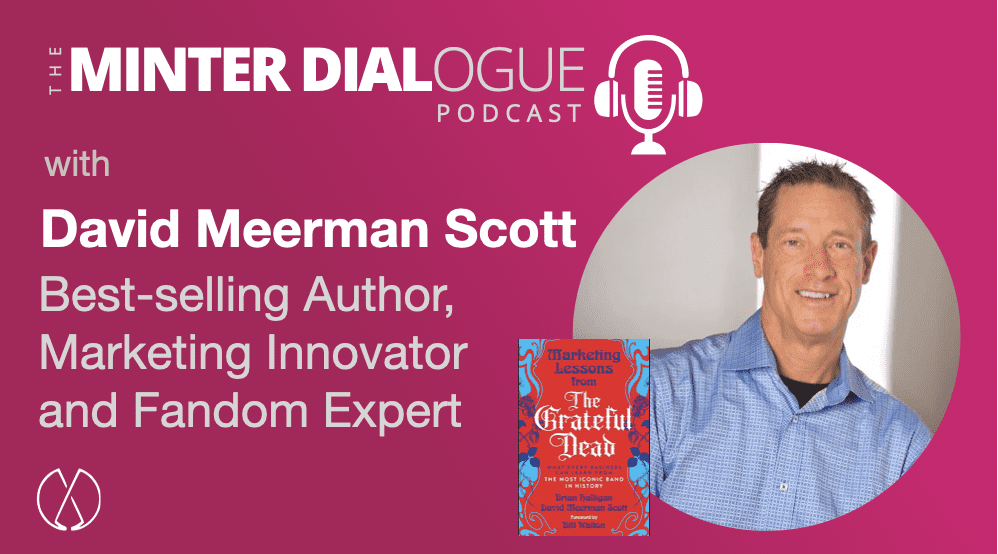
David Meerman Scott is an internationally renowned marketing strategist, bestselling author, and advocate of creating genuine human connections in a digital-first world. He’s been on the show three times now, and it’s always a treat to talk with someone whose career has spanned bond trading on Wall Street, tech marketing across three continents, and a portfolio of 13 books—four of which are international bestsellers. David’s most recent project is the new edition of Marketing Lessons from the Grateful Dead, a book co-authored with HubSpot co-founder Brian Halligan, which has just come out fifteen years after its original release.
Our conversation delved into why the lessons from the Grateful Dead are more relevant than ever—in an era dominated by algorithms and AI, how can brands and leaders cultivate real, lasting human connection? David explains how the Grateful Dead’s business philosophy—sharing generously, letting go of control, and fostering true fandom—helped shape not just their own legacy but influenced business giants like HubSpot. We also explored the group’s legacy approach, specifically how they’ve managed seamless transmission from charismatic founders to new leadership, drawing fascinating parallels to business and brand succession.
David’s personal journey has been infused with risk, adventure, and the value of experiences and relationships over material things. He shares how immersive hobbies like swing dancing provide a fresh perspective on human connection and happiness, especially in times of digital chaos and societal polarization. Our exchange also covered the limits of AI in facilitating genuine human interactions, the shifting value of “free” in today’s noisy marketplace, and how legacy is shaped by letting go and allowing fans, not just founders, to own the story.
Key Takeaways:
- Human Connection Over Algorithms: As digital marketing and AI automate more interactions, the lessons of the Grateful Dead—building offline, authentic communities—are more essential for brands and leaders seeking lasting impact.
- Let Go for Lasting Legacy: The Dead’s openness—allowing fans to tape, remix, and spread their music—created a multi-generational legacy. In business, letting go of strict control enables true fandom and sustainable relevance.
- Fulfillment Stems from Experiences and Relationships: As David shares from both personal and research perspectives, it’s not possessions or perpetual productivity that matter most, but the adventures we take and the people we connect with along the way.
Whether you’re shaping a brand, sustaining a legacy, or just seeking more meaning in your work, David’s story is a powerful reminder: embrace risk, cherish experiential connection, and don’t be afraid to let go so others can make your creation their own.
To connect with David Meerman Scott:
- Check out David’s eponymous site here
- Find/buy David’s latest edition of “The Marketing Lessons of the Grateful Dead,” here
- Find/follow David Meerman Scott on LinkedIn
- Find/follow DM Scott on X (formerly Twitter)
Further resources for the Minter Dialogue podcast:

Meanwhile, you can find my other interviews on the Minter Dialogue Show in this podcast tab, on my Youtube Channel, on Megaphone or via Apple Podcasts. If you like the show, please go over to rate this podcast via RateThisPodcast! And for the francophones reading this, if you want to get more podcasts, you can also find my radio show en français over at: MinterDial.fr, on MegaphoneFR or in iTunes. And if you’ve ever come across padel, please check out my Joy of Padel podcast, too!
Music credit: The jingle at the beginning of the show is courtesy of my friend, Pierre Journel, author of the Guitar Channel. And, the new sign-off music is “A Convinced Man,” a song I co-wrote and recorded with Stephanie Singer back in the late 1980s (please excuse the quality of the sound!).
Full transcript via Castmagic.io
Transcription courtesy of Castmagic.io, an AI full-service for podcasters
Minter Dial: Are David Meerman. Scott. Can you imagine? This is actually the third time we’ve had it. And the first time was just.
David Meerman Scott: Thank you. Three. Thank you three times. One, two, three.
Minter Dial: Hey. Ten years ago. Really?
David Meerman Scott: Was it that long ago?
Minter Dial: Yeah. Crazy. And I. I remember saying, oh, my God, you wrote the book that I should have written. Yeah, yeah. And. And you did it. Exactly. And you are a gorgeous man, and I’ve always enjoyed hanging out, checking out what you’re writing about. You just did a new edition of the Marketing Lessons from the Grateful Dead. Yeah. Well, let’s say for those who don’t know who the heck you are, give us a little spin.
David Meerman Scott: Sure. I thought I wanted to be a bond trader when I graduated from college and went down to Wall Street, got a job and hated every second of it. But I was totally intrigued by the data the bond traders were using. Oh, my God, that was cool. Things like Dow Jones and Reuters. So, I worked in that industry, the real time financial information industry, for about 15 years. Based in New York, based in Tokyo, based in Hong Kong. Moved back to my own country, US after being in Asia for 10 years and worked for several different publicly traded technology companies as a marketing and sales guy. And finally got fired too many times and realized I’m not good for working at big companies. So, struck out on my own in 2002 and have been going strong ever since. I’ve written 13 books, four are international best sellers. My books are in 30 languages. I’ve sold nearly a million copies. And then that, that drives some advisory work I do for companies. For example, I’ve been on the advisory board of HubSpot since the very beginning, 18 years now. Great company. And also I deliver speaking engagements all over the world. And we got to know each other partly because of that book, Marketing Lessons from the Grateful Dead. Both being fans of that book. And as we’re recording it, just last week the new edition came out. It’s been 15 years since we put that book out, and a ton has happened in Grateful Dead land and. And a ton has happened in marketing land. So, my co-author, Brian Halligan, who’s the co-founder and former CEO of HubSpot, and I rewrote that book and are super happy that it’s out there.
Minter Dial: Well, yeah, and a great reintroduction. Do you feel, to what extent do you feel that the Marketing Lessons Grateful Dead are even more relevant today than they were when you originally wrote it?
David Meerman Scott: I think that’s true. And I’ve been trying to figure out why, and I think I’ll answer that in just a second. But I’m going to back up just a little bit and say that Brian and I, my co-author, Brian and I, both wrote new introductions to the new edition of Marketing Lessons from the Grateful Dead. And what Brian focused on was how the ideas of the Grateful Dead, how they did their marketing, how they did their business, and Jerry Garcia as a founder. Brian calls Jerry Garcia Ronald, one of the great Silicon Valley founders, because as you and I know, the Grateful Dead came out of Palo Alto, California, heart of Silicon Valley. Jerry was the de facto leader, although he would never say that, but he was seen as the leader. So, Brian calls him a great Silicon Valley CEO. But anyway, Brian wrote that he used Grateful Dead style marketing to build HubSpot from nothing to over US$3 billion per year in annual revenue, which I think is super cool, because when the first edition came out of Marketing Lessons from the Grateful Dead, HubSpot was a tiny company with not a whole lot of revenue. Now they’re enormous, publicly traded on the New York Stock Exchange, over 8,000 employees, over 250,000 customers, doing super great. So, I love the fact that Brian wrote about how he used the. The ideas that we found in the book to build this great company, HubSpot. Here’s why I think it’s even more interesting, because digital marketing, digital sales, the whole social media thing, and now artificial intelligence has meant that so many of us are now driven by the algorithms, driven by the AI. And for that reason, going back to the fundamentals of the Grateful Dead, true human connection, pre-digital, building something of lasting value, are all things that I think we can learn from. And I’m doubling down on this idea. I too am working on a new book and it’s too early to talk about right now, but. But it’s a secret. It’s a secret. But the broad ideas of the things that I’ve been thinking about a lot, which are very much covered in Marketing Lessons from the Grateful Dead, are the idea that true human connection, offline connection, is super valuable in today’s world, especially when there’s just digital chaos going on and, and jumping into the social networks is not as much fun as it used to be.
Minter Dial: Well, this resonates on so many levels, as you can imagine, huh? Yeah. So, Grateful Dead, it’s an interesting title for a group when you. I don’t know about you, but, you know, occasion in Europe a lot more often I might say, oh, I know. I’ve been a fan of this group they call the Grateful Dead. Oh, that must be some sort of horrible, you know, dark, deep punk and all that. And I explained to them, actually. Well, they, they were a group that suggested through the fable that once you know, you die, you’re far more grateful. Bless you. And in the, in the world of Silicon Valley where so many people are interested in being immortal, it feels like the. Not only is the in real life experience relevant, but let’s actually lean into our mortality and enjoy the experience that is now.
David Meerman Scott: I love that. I absolutely agree with it. It’s how I live my life right now. And I think what’s fascinating about that concept is how to apply that to business. How can you be kinder and gentler so that people want to come back and do business with you again? I love the idea of fandom, as you well know, and Grateful Dead fandom is one of my most important fandoms. Like for Fanocracy, I’m also. Thank you very much. I’m also a fan of surfing, which is why I’ve got a surfboard over here and a fan of the Apollo lunar program, why I’ve got a model of the Saturn V rocket over there. But this idea of fandom, and when you’re a fan of something, it doesn’t matter if there’s another company providing it faster, better, cheaper. You stick with what you are a fan of. And so, yeah, I think this, this human approach to life, to business, to living is really, really important right now. Especially in my country. The political world is ridiculously polarized and it doesn’t seem like anybody’s trying to help their fellow man. They’re just trying to get out for themselves. And the Grateful Dead were about that. They were about kinder, gentler, doing the right thing. And that’s why their marketing is what it is. That’s why they’ve developed to be in many ways more popular now than they’ve ever been. Selling out the Sphere 25 times a year, twice in a row. I mean, amazing things for a band that started in 1965.
Minter Dial: We’re going to get back to the sphere in a moment. But when, when we, when we look at the Grateful Dead, this idea of legacy is, is really interesting. And, and I was listening to a book called “Selfless” by Brian Lowery, and he’s from Stanford, and he talks about how meaning is shaped by beyond the present. Because if we just live in the now, it’s superficial. And I wanted to counterpoint that idea. So, you build legacy, which is supposed to be beyond today, maybe beyond my death, maybe you know, people remember me after I die too, in the Silicon Valley. A desire to live forever. And we have in our world. We were so involved with me. And I interviewed a chap called Dr. Chris Kerr, who’s a Canadian doctor who deals with end of life hospice. And he interviewed a hundred, fifteen hundred people in the moments or the lucid moments before they died.
David Meerman Scott: Right.
Minter Dial: And they said that there are two things that were important to them in this moment. And these were young to old people. They said two things are important, my relationships and my experiences.
David Meerman Scott: Right.
Minter Dial: How does that resonate with you, David?
David Meerman Scott: Oh, in a big, in a big way. I suspected that experiences was going to be in there. And relationships, two important ones. Material possessions, not so much. Did I end up with a private jet and a private island? Nope, people didn’t say that. Right. And I didn’t take it to the grave. Right, right. And I’ve been really, really focused on those things myself recently. Something that I’ve taken up since we last spoke is a version of swing dancing called the Lindy Hop. The Lindy Hop was the original swing dance out of Harlem in the 1930s. And it’s still going strong today, in many ways more popular even than it’s been in nearly century. And I go to social dances almost every week where there’s a live swing band and so, and it’s an improv band, just like the Grateful Dead. So, it’ll be, you know, it could be a big band, it can be 20 pieces or it could be on the smaller side, six or eight piece band with horns, with a singer, and they’re jamming on this jazz music that was popular in the 30s and 1930s and 1940s. And I’ve gotten pretty reasonably good at this dance. I go take an hour and a half of private lessons a week and usually four hours of group lessons a week and go to a social dance. I practice at home a couple hours. And it is a human connection, it’s an experience. I’m meeting new people all the time. It’s people I’ve danced with, people from the ages of high teens to high 80s. And it’s just a remarkable thing to have that experience, that human connection and to be able to get reasonably good at this crazy dance. But then that allows me to have these experiences at these social dances. In fact, in just two weeks’ time, I’m going to Asheville, North Carolina for a six day Lindy Hop festival. Can you imagine? And so, yes, I think we humans are hardwired for those things. We’re hardwired for human connection, for family connection, for having experiences. And I don’t know how hardwired we are for material possessions. So, I love that idea that you just shared. And hopefully it’s a very, very, very long time till I’m on my deathbed, but I hope I can. I can say those same things for me.
Minter Dial: Yeah. I’ve come to the position, David, where it’s not quite as important to me how long I live. What’s more interesting is how well I live, how much. And the idea of risk that you were talking about, the beginning, reintroducing our ability to accept risk and know that maybe if I do that, it may not end so well. There’s an expression I often talk about which is, an adventure without risk is not an adventure. And a life without adventure ain’t no life that I want to live.
David Meerman Scott: …that makes for a way, way, way better life, doesn’t it, Minter?
Minter Dial: All right, so you and I, a little fandom of the Grateful Dead. And like you, I. I went last year to the Dial three nights in a row and had an enormous experience.
David Meerman Scott: Yes.
Minter Dial: You know, because you don’t go see the concert, you see the experience, right?
David Meerman Scott: Yes, yes, absolutely.
Minter Dial: So, we got John Mayer on board, and there’s all sorts of fun stories about John Mayer. I have a friend of mine. Well, actually I met when I was doing my film. I was asking, I briefed three editors and I said film editors. And, you know, send me some material. I had to choose. And one guy sends me. Well, I did a film about a guitarist called John Mayer. It turned out to be the most successful documentary film ever about John Mayer. And this was literally about six months before he signed up before with the great. With the Dead.
David Meerman Scott: Oh, interesting.
Minter Dial: And so, I. I was like, oh, my gosh, the. The stars were aligned and. Yeah, anyway, lots of things I’ve seen John Minter separately, independently as well. But the. The point. That’s interesting. And you talk about this, which is moving from one CEO to the next. So, you might have a charismatic leader, founder who builds a business, Brian Halligan, whoever it is. And then all of a sudden, well, they. They might come to the end of the road and they may say, well, I’m ready to let go. And typically, most brands in my experience, I worked at l’, Oreal, they bring in some smart guy, usually guy, and they’re very good at doing this and that, but they don’t have the entrepreneurial flair. They don’t know about the original risk. They want to be a Japanese, certainly shepherds of the new business, but they don’t carry it on. Transmission, legacy. And. And so, how. What sort of takeaways do you have from the way the Dead brought in John Minter to create what is now a hugely popular, as you said, still sold-out experiences? I mean, even all their cover bands, whether, you know, whatever they are, they. They still get sold out in 2025.
David Meerman Scott: Yeah.
Minter Dial: What do. If you’re. If a brand or business leader today is thinking about transmission, what are the legacy lessons learned from the Grateful Dead?
David Meerman Scott: So, wow, that. That is a big question. We could spend two hours on this single question. But what I think are some of the interesting points of this or. I remember when my daughter and I were writing this book, “Fanocracy”, that came out a couple years ago, and one of the things that Reiko, my daughter, insisted on being a chapter is this idea of letting go. And that’s what we named the chapter, let go of your creations. The idea that once you put a product or service out there in the world, it no longer belongs to you, it belongs to the fans. And therefore, when a fan owns the experience, the product, the service, the idea, because they’re now part of that organism, the organism in this case of the Grateful Dead, that you can’t bend the fans to your way, you need to be with them in the way that they’ve developed their fandom. And I think Bobby Weir and the rest of the people who decided to work with John Minter did a fabulous job at finding somebody who can fit in, can absolutely put their own stamp on things, but can recognize the legacy of what had been a band that had been around for 50 years, now 60 years. John’s been with them for 10 years now. John’s been with them longer than Pigpen has been with them, was with them, which is interesting. But to then work within what already exists, recognizing that the fans are in charge, being a part of that legacy, but not trying to take it too far in a different direction. And I think that that worked out really, really well. The other aspect, which is fascinating to me is how Bobby Weir has, over the last 30 years, roughly since Jerry Garcia’s death, how Bobby has worked on the legacy of the Grateful Dead tirelessly and a number of things. He’s always continued to play Grateful Dead music with a different roster of musicians. Most recently have we been talking about with Dead and Company, John Minter and so on. But also he’s got his other band, Bob Weir and the Wolf Brothers and their fabulous band. The other thing Bobby has done is he very often sits in with Grateful Dead cover bands or other musicians who often play Grateful Dead music, cementing legacy in that way. And then I was absolutely fascinated by his collaboration with symphony orchestras to perform Grateful Dead music with a full-on symphony. I had the pleasure of seeing Bob Weir and Wolf Brothers play with the National Symphony Orchestra in the Kennedy Center in Washington D.C. a couple of years ago. And that was fascinating. And so, Bobby’s playing with people who are 50, in many, in some cases 50 years younger than he is, people in their 20s who are playing Grateful Dead music, playing with classical musicians, to play Grateful Dead music, playing with other genres, whether it’s bluegrass or jazz, to play Grateful Dead music. So, I think that Bobby is looking for how can this music live on beyond my lifetime, perhaps even centuries into the future. Like the music of Beethoven has been played for centuries. And I love that Bobby is doing that. I love that he’s shepherding this music and these ideas in new and interesting ways that do set up the opportunity for this music to live on well beyond our lifetimes and into the future of my grandchildren’s lifetimes.
Minter Dial: Well, many things come to mind. I was listening to a brass band from Detroit playing in a gorgeous adaptation. And of course I know Stanley Jordan.
David Meerman Scott: And how, yes, I saw, I saw him do Stanley plays the Dead about a month ago at a jazz bar here in, in Cambridge, Massachusetts. Fabulous, fabulous version of jazz version of Grateful Dead music. It’s fabulous.
Minter Dial: Yeah, I’ve had Stanley on the show and.
David Meerman Scott: Oh, really? Oh, that’s neat.
Minter Dial: Yeah, yeah, yeah. Totally. Known Stanley for 30 years, but the idea of letting go somehow is fundamental to the ability for it to be owned by others.
David Meerman Scott: Yes, yes, yes, absolutely. You need to let people run with it. A friend of mine is a very well-known flamenco guitarist. His name is Juanito Pascal, and he’s looking to do covers of well-known music from artists we would all know the names of and can’t really repeat them right now, but he’s tried to get permission to play music from these well-known artists and record them on an album of covers, flamenco style covers of famous songs. And he’s having the damnedest time getting permission from these artists. Typically it’s the artists estates or the record labels. Or the record labels because they want to exert this control, whereas the Grateful Dead’s like, yeah, sure, go ahead and do a cover, it’s fine.
Minter Dial: You want to tape a flamenco version.
David Meerman Scott: Of a Grateful Dead song, please go for it. I love it.
Minter Dial: I mean, God, what, what a different sort of mindset that we see so often.
David Meerman Scott: Yeah, that’s right, that’s right.
Minter Dial: So, free. So, you know, the idea of free, you know, you need to earn a living, make money. It’s important. And this idea of freemium is, is sort of a new trendy thing. The Dead always had the tapers.
David Meerman Scott: Yeah.
Minter Dial: But now we’ve gone from, it seems, from free to infinite. Especially with the signing that we’ve just seen with, I think it’s war, where they’re allowing AI to write scripts. AIs. You know what, we’ve gone from free to infinite. So, do you think the value of free has changed in this? How are we supposed to differentiate between generosity in this world of noise?
David Meerman Scott: Couple thoughts. First of all, for many organizations, especially business to business companies, for some reason free has never been free. Because many companies insist on putting a gate in front of their so-called free content. So, the basic model is, hey, we wrote this fabulous research report, it’s totally free. You have to give us your personal information, your email address, your phone number, whatever to get this free information. Well, that’s not free. That’s trading for something of value. What’s the value? Your email address, your phone number. So, free has morphed into, in many ways, not free. And also the content provided often really isn’t all that valuable. So, what I’m teaching now, which I’m in love with this concept, is what proprietary data do you or your company have that you might not have even thought of as having value that you can offer for free to people. And the Grateful Dead, huge pioneers in that, yeah, please bring professional level recording gear to the concerts. We’ll give you a power strip to hook into. We’ll give you a place to hang out right behind the mixing board where it’s the best sound and stick your microphone stands into the air. That was an amazing thing. It was something they could offer for free and something that had tremendous value. Another great example of this is I’m in love with this insurance company called Hagerty. They do classic car, classic insurance. And they realized at Hagerty that valuing a classic car, a 1965 Ferrari for example, or in my case a 1973 Land Rover Series 388 hardtop, valuing those classic cars is super difficult. But Hagerty realized because they insure classic cars, they’re the largest insurer of classic cars in the world. They insure 2.5 million cars. They had the actual data in their database of how much people were insuring their classic cars for. And so, they, they said, why not offer this for free to anybody who wants to check it out. How much is my 1973 Land Rover Series 388 hardtop worth? Well, I can go to Hagerty and can find out exactly how much it’s worth. So, they provided Hagerty provided all this free data to everybody who wanted it. And all of a sudden they’ve become the source for true values of what classic cars are worth. Or another example, I was working with a company called Interlinks and they have a SAS based software system which provides secure data rooms for companies that are doing M and A transactions used by investment bankers and lawyers and people within the company. And of course, their data on an individual company basis is highly, highly, highly secure and highly confidential. I mean, they’re working on investment banking deals, can’t get much more confidential than that, which is why people use their products and services. So, they realize maybe we can aggregate that data and quantify it and figure out how many M and A deals are likely to be closing this quarter versus last quarter, versus this quarter last year and so on. And I suggested this idea to them and they ran with it. They’ve been publishing this data now for a number of years. Incredibly valuable free data that was just sitting in their databases waiting to be unlocked. So, yeah, on one hand, as you rightly said when you asked the question, there’s a ton of free stuff out there right now, but if you dig a little deeper within your organization or you dig a little deeper into what you’re creating, maybe there’s something in there, some nugget in there that you hadn’t even thought of to make available to people because it will deliver tremendous value. Value and build fans of your business.
Minter Dial: I was just reminded as you were speaking, David, about the fact that you and I also shared the fact that we worked on Wall Street right after graduating. I worked at DOJ for four years.
David Meerman Scott: Okay. I was at. At Dean Witter Reynolds. And it was a terrible job, but I’m really glad I did it. I learned a lot.
Minter Dial: We learned about money and things like that. And your idea. That reminds me also about Marcus Sheridan, who, Who’s the guy who said, you know, well, you know, so many people are asking the question, how much is my swimming pool going to cost me?
David Meerman Scott: Yeah.
Minter Dial: And. And every customer would, would call in and said, well, it depends.
David Meerman Scott: Yeah.
Minter Dial: And he said, well, fuck that. Let’s just say what it is. Give that information, which was free and it turned into a million viewers, which turned into a million-dollar business. And you know, he made a business out of the business.
David Meerman Scott: Yep. And he wrote a book called they ask, you answer, which is talking about those ideas.
Minter Dial: Exactly. So, all right, so AI and fandom. You talked about the importance of experience and real-life moments. Hugging, dancing with your dance mechanisms. Do you think that AI can facilitate any of this human connections? Or is it merely going to be relegated to a more transactional reproduction of the past? How can you. How can. Have you ever seen any AI actually help us in this version of like the deaddy kind of sweaty, dancing, swirling experiences?
David Meerman Scott: No. Short, short answer. I think. I mean, I. I’m a. I am a supporter of AI. I’m on the board. Board of an AI company. I’m an advisor to several AI companies. I’m an investor in several AI companies. I use AI every single day. I’m writing a new book, partly with AI, but using my own data. It’s a secret. It is. But essentially what I’ve done is I’ve taken more than a million words of my words, which included more than 20 years of blog posts, several books, transcripts of speeches, transcripts like this, of podcast episodes that I participated in, and a bunch of other data, put it in a private database, private GPT, and I can essentially query my own brain. So, I mean, yeah, I am not a Luddite, I’m using artificial intelligence on a regular basis. But I think there is a massive difference between what AI is delivering to us and a genuine human connection. Going to a sports stadium to cheer your favorite team, like I just talked about going dancing, like you’ve talked about playing padel. Going to a live music show. These are things that people are even more drawn to in a world of AI because the more stuff out there that’s artificially created, even if it looks realistic, the more I believe we’re driven to a true human connection. I have a bunch of friends now who are in Gen Z, which is up to age about 28 or millennial generation from 28 to about 40. And they’re like way into stuff like board games and going to each other’s house for dinner and doing things that are the exact opposite of digital artificial stuff. Which fascinates me, the idea of wanting that genuine human connection.
Minter Dial: So, last question for you, David. You and I are both there. Is it sexagenarians or sex, anyway, 60-year-olds.
David Meerman Scott: Yeah. I don’t know. There’s Octo and there’s. Yeah, I don’t know, Septo, something like that. Yeah. We’re in our 60s, proudly, I would say in our 60s, as are the.
Minter Dial: Grateful Dead, should we say. And you’ve seen so many trends. You and I have had business experiences and, and one of the things that you and I, presumably you have also seen is that there’s a, a lot of distress and hardship, depression and burnout. How has been following the ethos, the Grateful Dead? Has it helped you in dealing with energy, positive spirit moving away from burnout despite this high speed, AI infused ridiculous chaos?
David Meerman Scott: But I’ve almost never regretted going to a live music show. I’ve almost never regretted going to a dance recently since I’ve been doing my dancing, I’ve almost never regretted, like, taking the time to go out to dinner with a friend or go to dinner with someone from my family, my wife, or whoever it might be. And because of that human connection, and I think the Grateful Dead teaches that. I think the idea of building a tribe of like-minded people, of getting up and dancing, of having connections with people who are like you and enjoy the same things as you. If I have a ticket to a Dead show, usually you buy it four, six months ahead of time. I’m excited for four or six months until the show comes up. Oh, yeah, yeah. It’s in my calendar with a big circle around it. Got to go to Las Vegas and see the Dead at the Sphere or whatever it might be. And that’s super exciting. And so, I think a lot of that does come from the whole live music scene. And the idea that I can go to a show and look around and I probably will recognize some people. I might even know them by name. Maybe I’ll run into you in the lobby. Or we’ll be down front in the pit next to each other. Hey, how’s it going? Good to see you. And that’s.
Minter Dial: When was the last time I saw you.
David Meerman Scott: That’s a fabulous thing. Yeah, it’s a really, really, really great thing.
Minter Dial: Yeah. My last show at the Sphere, I was the third night in a row and I’d seen my friends. I’d had three different experiences. And this night I was by. And I’m standing there, you know, you know, digging around, and a woman beside me says, oh, you look like. Yeah, yeah. Says, and she said, open wide. And so, I opened my mouth. And therein started another journey. And, you know, just accepting because you have trust in that, the experience, and you’re letting go. And, you know, what if. You know and.
David Meerman Scott: Right, right. What if I get on an airplane and go to Las Vegas? I don’t know. It will be interesting. It will be spiritual, it will be fun, it will be cosmic, and it’ll be what I make it. If I want to sit in my hotel room and stew about my problems, that’s what I make it. If I’m super excited and I go to the bar and see an interesting person, I see if I can find some interesting people to meet and hang out with, that’s going to be my experience.
Minter Dial: Cosmic. Charlie, how do you do?
David Meerman Scott: Beautiful.
Minter Dial: Hey, listen, David, how can someone. What would you like people to run to or check out?
David Meerman Scott: You know, run, run, run, run, run. The new edition of Marketing Lessons from the Grateful Dead just out. Love it. My full name, David Meerman Scott. I use my middle name because I’m the only David Meerman Scott on the planet. Yet there are tens of tens of thousands of David Scott. So, Google my name, you will find me and only me.
Minter Dial: Excellent, David. Absolute pleasure having you on. I over here in London, we share the love. Beautiful story. Yeah.
David Meerman Scott: So, good to see you.
Minter Dial: You betcha. Bye.