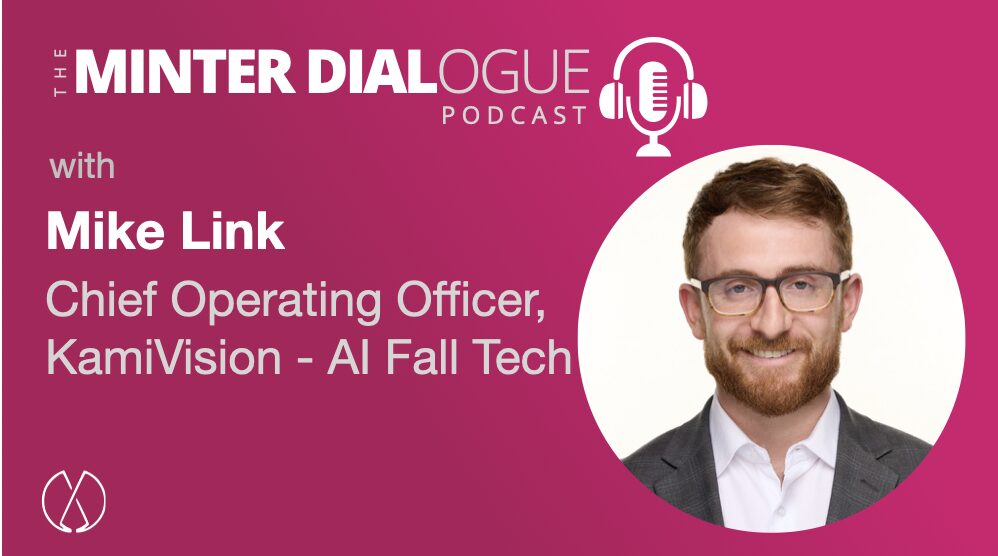
Minter Dialogue with Mike Link
Rooted in a desire to meaningfully contribute to society, Mike’s story is both unconventional and compelling. On returning to the US, his interest in neuroscience and elder care led him into the AI technology space, where personal narrative met professional opportunity. Today, at KamiCare, Mike runs operations for an innovative AI-fuelled fall detection company. The mission is clear: use technology to preserve dignity and independence for the elderly, grounded in privacy, human-centric thinking, and practicality drawn from real experiences with his own grandparents.
The discussion with Mike ranged from the specifics of developing niche AI for falls, to the broader and more philosophical challenges of ageing, caring, and maintaining both safety and dignity for those we love.
3 Key Points:
- The “Questing” Mindset and Purposeful Living: The conversation focused on Mike’s drive to follow intense curiosity wherever it leads, ultimately channelling this energy towards work that feels meaningful—particularly when it intersects with personal history, such as family illness and the inspiration to give back through health tech.
- Ethics and Privacy in AI Fall Detection: A key theme that emerged was the balance between technological innovation and privacy protection. The discussion explored how KamiCare anonymises and filters sensitive data, ensuring that only what’s absolutely necessary is shared, preserving the dignity of vulnerable users whilst still enabling effective intervention.
- Human-Centric Challenges vs. Technological Solutions: Several points were raised, including the difficulty of integrating even the best technology into people’s lives. Mike emphasised that human issues—family dynamics, stress, definitions of ‘dignity’—often prove more complex than technical ones. True impact comes when tech serves as an enabler for better, more compassionate care.
To connect with Mike Link:
- Check out KamiCare at KamiVision.com
- Find/follow Mike Link on LinkedIn
- Find/follow Mike Link on Instagram
Further resources for the Minter Dialogue podcast:

Meanwhile, you can find my other interviews on the Minter Dialogue Show in this podcast tab, on my Youtube Channel, on Megaphone or via Apple Podcasts. If you like the show, please go over to rate this podcast via RateThisPodcast! And for the francophones reading this, if you want to get more podcasts, you can also find my radio show en français over at: MinterDial.fr, on MegaphoneFR or in iTunes. And if you’ve ever come across padel, please check out my Joy of Padel podcast, too!
Music credit: The jingle at the beginning of the show is courtesy of my friend, Pierre Journel, author of the Guitar Channel. And, the new sign-off music is “A Convinced Man,” a song I co-wrote and recorded with Stephanie Singer back in the late 1980s (please excuse the quality of the sound!).
Full transcript via Castmagic.io
Transcription courtesy of Castmagic.io, an AI full-service for podcasters
Minter Dial: Mike Link, as I now understand, is your last name. Comes with baggage, as we were talking just before recording, hitting the record button, the magic record button. But Mike, in your own words, how would you like to describe who is Mike Link?
Mike Link: Wow, that’s a great question. I don’t know, I think who I am I’m just a very curious person. I think I kind of navigate through life and I will intentionally go towards things that I find are interesting. And I sometimes like obsessively get into those things. And then I think in getting into those things, sometimes I get thrown in, you know, one direction or another. And then I continue to like obsessively go down these paths. I call it, you know, people nowadays, they call it side questing or questing, you know, you’re going along these different routes. But I think I’ve always had this like curiosity to me. And I think I’ve always had no rules. Like I looked at the world as in there’s no rules, there’s no, there’s no, you can, you can’t do this. Of course, with an ethical mind in the back of my mind, but anything is really possible. I always felt like anything you wanted to make happen, you could make happen. And my phrase is that dumber people have done more with less than what I have. So, I’m sure that I could figure out how to make it happen. But yeah.
Minter Dial: Isn’t it funny? So, questing, that seems like a much larger, more noble idea than rabbit holes.
Mike Link: Hmm.
Minter Dial: Which I think most of us end up running down. And I’m wondering, Mike, to what extent, not that this was really germane to our full conversation, but how do you know which quest to run after? Because at the end of the day, being a bright dude with maximum options and opportunities, you could end up tearing your hair out. Questing after one thing after another. I mean, I could mention, you know, what’s inside of Anthropic? Oh, that’d be fun. I’d love to know how that works. Or how do you get to Mars? Oh, that seems interesting. What happens in the depths of the Pacific Ocean? Oh, that seems interesting. So, anything could be interesting. How do you architect or navigate the multiple options that are ahead of you?
Mike Link: For me, it was giving something to society that was of value, that I also had a deep personal relationship with. And this current, you know, I call this this Kami quest, or this thing that I’m working on is related to this. But I think the original thing was that my brother was super sick when he was young. And this kind of inspired me to take a keen interest in medicine and health. And, you know, that was kind of the main thing was that I really was interested in like, how do I give back to those who might have suffered like my brother or my family had? I think that’s inspired a lot of things or inspired my curiosity driven towards certain things. Originally, I wanted to become a doctor, a neurologist or a neuroscientist, something like this. And I shadowed a lot of doctors and ended up not doing medicine because I felt like I really wasn’t going to give back in the way that I wanted to. And met these 2 Indian women who cooked Ayurvedic food for me, if you know what Ayurveda is. And I ended up—
Minter Dial: Explain it for those who don’t, please.
Mike Link: Ayurveda, if you’re familiar with Chinese traditional medicine, a lot of Chinese medicine comes from Ayurveda. It’s like the earliest documented form of medicine in all of history. And it’s a very personalised preventative approach to medicine. Ayurveda actually translates to living in a way to promote longevity and health from Sanskrit. But it’s a combination of what types of foods you eat, what types of exercise you have, combination of herbs or different remedies, also how you think and how you control the mind. There’s so many different things that it looks at at different seasons of the year and different seasons of life, all with the goal of promoting longevity. But long storey short was that, you know, in my Western medicine studies, I felt that there was a lot of like symptom treating and not cause treating. And when these women explained to me and cooked the food and all these things in 2017 were kind of similar to, you know, the food combining that people in the West were, were thinking about now and meditation and mindfulness. And a lot of this stuff Ayurveda already understood. Also the, the different types of metabolic embryonic development types, mesomorph, endomorph, ectomorph, like exactly mapped to the different body types that Ayurveda already identified, which I found was very interesting.
Minter Dial: Mm-hmm.
Mike Link: And I never wanted to work for anybody. Like I was at a point when I was younger where I was like, you know, I’d already made money, you know, having little side businesses or doing sales or, you know, so it wasn’t like I wanted to wait 12 years to make money to be a doctor or, you know, work for some business that I didn’t care about. I mean, money didn’t even really mean anything to me at the time. Like, it felt fake. So, I was like, man, you know, I, I might as well go explore this Ayurveda thing. And I found this guy in India. Dr. Giddish, who basically told me that I can come and, you know, he’d mentor me. And it went from like a 2-month little quest exploration thing to a year, you know, a year-long study. And I self-funded it and I ran out of money because this is fresh, you know, out of university. And it was pretty incredible. I lived for like a year on like $4,000 USD.
Minter Dial: Wow.
Mike Link: And came back to the States. All I knew was sales. And that’s how I got into, you know, the AI tech space. And, you know, affiliated was my interest in neurodegeneration because some of the technology that I was helping go to market with was aimed towards people in memory cares. And I recently had had grandparents who had fallen and who had Alzheimer’s. So, you know, this kind of from the leaving India thing, coming back to the States and, you know, being offered, you know, some positions, I was like, oh, well, this kind of seems, you know, deeply related to like things that I’m experiencing in my life that I could give back to and I could also like support myself. So, that was kind of the, you know, back to the who I am thing. But yeah, as you could see, it was a very long quest and I haven’t given up on that quest. But yeah, that’s—
Minter Dial: Well, in total, say, frankness, long is a relative storey and, you know, lives of 30 years or 60 years and so on. What is long? But it sounds very much though, Mike, that through your, the experience of the Ayurvedic, through your brother’s experience, your family and your brother and you, your experience of having to deal with illness in such a close fashion and your background in neuroscience, it feels like you’ve come to some sort of a very purposeful living. Would you feel comfortable saying that that’s what you’re up to?
Mike Link: I think so, because, you know, I had the opportunity to make like a lot of money and You know, I did at one point, and it just didn’t feel the same, you know. And there’s way more that you get, I think, from doing something that you feel connected to. Or, you know, what I realised at one point, and this was like in part being in India and like not being around anybody really that spoke like a lot of English or like I connected with, But having nothing and making nothing, I had the same amount of joy that I do now in having material things and being able to travel wherever I wanted, you know. And the real joy that I got and I really emphasised in my mind at that time was that doing things for other people or like being of service and being valuable to the world, there’s no there’s nothing that can replace that kind of fulfilment. And I think that’s what really emphasised my thoughts on how I should live my life.
Minter Dial: Also, having grandparents that you saw makes it very real, this notion of falling over. Talk us through now, because really the rub here is this new or the adventure that you’re on at KamiCare or Kami Vision. Tell us about you, what you do there and what is KamiCare?
Mike Link: So, I kind of run operations and I started with go-to-market for them because I had helped another company doing AI fall detection, do go-to-market work, you know, How do they get customers? What message fits? You know, do people want to pay this much for this thing and how does it work? And that’s how I started at KamiCare. And then over the years, you know, we had big teams or, you know, executives or, you know, offshore teams. And the CEO, you know, now he wasn’t the CEO at the time, he was just, you know, the chairman investor. But now he’s the CEO and he would come to me every 6 months and he asked me how the business is doing and I’d say, man, we’re cooked. Like, you know, it’s not going well. And a lot of the time I think the other folks on the team would kind of fluff a storey and I think he respected that I’d be honest with him and, you know, I’d bring deals and I’d fix problems and do these things and over time he just gave me everything basically. And it was like last July I took over for the last COO and You know, now I help them with, you know, everything and anything you need. Like, I just got back from Europe. I was there for a few months helping them set up like European compliance and getting into Europe and helping with the US compliance efforts and, you know, whatever the business is, Kami Vision or Kami Care. But Kami Care, it’s an AI vision technology for fall detection. And the idea is that a lot of times when somebody falls, it’s not a severe event, meaning they’re not breaking a hip or they’re not getting a concussion or having to go to the hospital the first time they fall. And the research shows that by the 6th or the 7th fall typically is, is by the time that, that something happens. So, the thing is that if you can capture the fall, maybe the first or the second or the third fall, you could start to understand that the person is a risk. And you could see how they fell so that you could prevent the injury. Because the idea is that you prevent the injury. And most of the time, in the early falls, nobody will say anything, right? The person— and I’ve watched this, you know, back to my connection personally with my grandparents— is that I was in Fort Lauderdale with my grandfather. And, you know, first of all, he picks me up from the airport. And I was like, listen, man, like, get in the back seat. Like, I can’t drive with you anymore. This is crazy. I think I’m going to— you know, die. And then we get home and he like trips over the couch and almost falls. And I was like, you got to be careful, man. You almost fell. He’s like, oh, I didn’t almost fall, you know, like in complete denial that he almost completely like, you know, he probably would have had to go to the hospital too because he probably would have hit his head or something happened. But yeah, it’s like the denial and the ability for the AI to pick this up, to be able to get a clip of that event so you could validate it. and not invade the privacy of the individual. That was kind of the concept, especially because KamiVision has millions of cameras around the world. That was the start of the business in 2014 was security. And a lot of customers would say, oh, well, I have a security camera at home, you know, mom or dad fell. Why can’t we get notified that mom or dad fell at home? You know, these cameras are here, you do AI, dog detection, people detection, package detection, why can’t you do fall detection as well? So, this kind of led us to explore this thing. And in the enterprise space, so nursing homes, facilities, communities, residential living, the cost of the technology was very, very high. And, you know, because I had come from that space, I understood that the reason the cost is so high is because the only way that people have built this technology is with venture capital. And because they’ve taken so much money and they have all these teams and kind of like an old school way of doing business, the cost of providing the service is so high that they have to charge this much. And the situation with Kami, which I found very interesting, was that there was no VC, there was no outside money. It all came from the home security business, and the home security business is almost like the funder of the projects. So, it was allowing us at the time to either both come in at a low, low cost and be very quick to build new features or build new things that customers found was useful, which you really can’t do at a typical, you know, VC-backed startup. So, I don’t know, I said a lot there. I don’t know if you have any questions, but that’s kind of the—
Minter Dial: Oh, believe me, I do. Mike, so let’s just start with figuring out what exactly you guys do. You have security cameras that are essentially there to provide, you know, rob— detect robbers and violence or intrusions and such like that. And all of a sudden, these very same cameras without any further enhancements to them, you’ve provided them a mechanism to also see if an individual who’s probably a patient or a resident at a facility is falling and having nothing to do with a security infraction of any sort. It specifically is able to identify an individual who falls, and presumably that could also be a staff person who falls as well. So, it’s anonymized. It’s latched onto, layered onto existing infrastructure of cameras. So, you don’t have to pay for the cameras. Is that a fair description?
Mike Link: Yes. The only difference I would say is the camera itself that does fall detection is a separate camera because we built an edge chip for the camera. Because if we built a cloud model, we’d basically have to be sending all the footage to the cloud all the time. Which we’ve thought about in the future to basically put fall detection on existing cameras. But at the moment, the fall detection camera is a separate and its own camera. And the predominant use of these are in nursing homes and senior living facilities. But we will be releasing a consumer version later this year or early in 2027.
Minter Dial: All right. So, AI, such the big, big old topic. You’re in the heart of AI land, basically in the heart of the news every day these days as to whether it’s good, bad, indifferent, and so on. But I feel like it’ll be useful for you because it’s such a specific niche use of AI to consider and help us understand how much of a database, a learning database, did you need to have? What went into making AI fall or fall AI, whatever the name of this category is, viable to be able to detect falls patterns? Falls as opposed to stumbles, radical falls from less important falls. I’m wondering, can you help us understand for the layperson what goes into crafting AI for a niche like this?
Mike Link: Yeah, that’s a really good question. So, I think part of this was having a huge database already of AI training data from a huge consumer base. Like if you think, you know, 23 million cameras sold around the world. It’s a tonne of AI camera data, AI training data from specific, you know, consented parties. So—
Minter Dial: And so, just to be clear, this is KamiVision’s 23 million cameras?
Mike Link: Correct. Yeah.
Minter Dial: So, proprietary dataset.
Mike Link: Exactly. Yeah.
Minter Dial: But not destined for the AI fall. It was originally security. So, you have to probably figure out the privacy components of that, anonymizing this. This is a fall of an old man who’s 70 to 75 years old and the labelling that goes into that. How much, how, how, you know, describe if you could also the amount of work that goes into creating a good learning dataset?
Mike Link: Yeah, I mean, it definitely took, and this was even before that I came on, but when I talked to the engineers, it was probably from 2020 on, and it probably by 2022, mid-2022, the model was actually detecting it with an acceptable level of accuracy, the fall. But it’s taking all of this data of people either just moving about or doing their thing and identifying when people are upright. And then we could identify when somebody is in the upright position and then goes to either a kneeling or a laying down position. And it’s a combination of identifying the points on the body as well as a change in plane. And then we could say with a level of confidence that yes, this person is on the ground because it’s not just when somebody falls or, you know, tumbles very hard that we want to detect. But if someone were to sit down in either a facility or at home, we also want to know this, right? Because this is typically a behaviour that’s triggering that they don’t have the strength or the independence to stand upright, which makes them a fall risk.
Minter Dial: In the— so you have this ability to now detect a random fall. You know, this is an individual who is standing upright. And to what extent did you need to sort of say, well, this is a 70 to 75-year-old male, uh, who has a walking stick? And, and how much did you sort of get into the nuance of labelling each of these? Because that’s ultimately what I was understanding is that you’re trying to figure out pattern recognition of specific individuals. So, this 75-year-old man with a walking stick who fell over a 3rd time, you can now say, well, this is a guy who’s got the 4th coming quickly. And, but you don’t want to know exactly his name. How do you— anyway, so talk us through the complication, the ethical issues between trying to get efficient, effective recognition and yet confidentiality issues that are so pregnant in this world?
Mike Link: Yeah, that’s a good question. So, that’s part of the reason why we use the edge chip on the device is because we don’t have to send anything up to the cloud to actually do the initial detection. The edge chip can do this detection and then we can actually blur and anonymize it for an AI filter to go through and say, okay, it looks like there is or isn’t somebody on the ground. And then the 3rd level of filtration that we have is a human team that gets another blurred anonymized clip and says yes or no, is or isn’t a fall. There’s no name, there’s no address, there’s no room information. There’s literally nothing but, you know, a rectangle that has, you know, somebody blurred and is either like on the ground or standing up, right? And they see the clip. enough of the clip to say, okay, looks like they are on the ground or are not on the ground, or, you know, it looks like they just got up. Let’s flag this one so somebody goes and cheques on this resident. But that’s, that’s how we maintain the privacy piece.
Minter Dial: So, this is with regard to creating the tagging of the data, right?
Mike Link: You mean in actually building the—
Minter Dial: The learning dataset?
Mike Link: Ah, I see, I see, I see. No, so the— I don’t know exactly how they labelled or trained the data, but what I was told was they basically used the encrypted data from some of the existing feed database and then also had tonnes of falls. From our offshore Philippines team to train and basically go between the database that we have of people kind of, you know, just doing their thing. And this is not just from, you know, Kami Home customers or Kami Vision customers, but this is from like customers all over the world because basically, you know, some of the cameras are used in like East Asia, And there’s a huge dataset from over there. So, we know what somebody looks like when they’re standing up. And then a Philippines team was used to provide tonnes and tonnes of falls so we could see what it looks like when people fall down. And then as we got customers, part of the agreement is that whatever data gets used for training AI, and then every time there’d be a fall or a missed fall, then we can go and say, okay, well, how do we miss or how do we capture this one? And then that would get added to the The database.
Minter Dial: So, that is, would that be the reinforcement, what’s it called, the reinforcement learning from human feedback?
Mike Link: Exactly, over time. And even today, like, let’s say, you know, one of the, one of the niche cases that we found were being missed where if somebody was walking with a walker, for some reason the algorithm wouldn’t detect if they fell behind the walker. So, we basically had to train the algorithm to say like, You know, what’s the reason why it’s missing the walker? And then if somebody is behind an object but is partially, you know, obstructed, that it should still be detected in this way. There’s this one also, like sometimes if somebody was behind partially a couch, it wouldn’t detect. So, yeah, I would say like every month or every couple of weeks there’s like a new You know, edge case where the team has to adjust the model or like train the model to get the specific type of fall.
Minter Dial: All right. So, I, there’s an area where I’m struggling, which is figuring out the element of learning where you have anonymized, you figured out that there’s a person behind a walker who’s fallen, but it’s anonymized. So, but you’re teaching the AI that this is an individual who has a certain age, certain issue, has fallen. But now we need to get to the specific individual, you know, because the person who falls 3 times, that’s what we’re trying to identify. So, how do you manage this quandary, if you will, between the learning anonymized version, the blurring anonymized footage to the identification of the individual who we’re trying to ultimately protect?
Mike Link: So, we don’t do any type of identification of somebody, like, wouldn’t say, oh, like Joe has fallen this amount of times. It always stays, you know, it’s just someone, you know, it’s not someone’s name or how old they are. It’s just a human, basically.
Minter Dial: Yet, I mean, I’m going to guess, Mike, that the camera in the camera 623 in 1500 Blakehurst Avenue, whatever, uh, that probably is likely to be an individual in that room who typically comes out of that room on a regular basis.
Mike Link: Right.
Minter Dial: And if this is to work, it must recognise Joe Bloggs who lives in that space because he’s now at risk of falling a 4th time. You know, just like you’re going to the consumer world, so you’re going to put in a camera or cameras in a home. I’m no longer interested in anonymizing that. If I were to buy that for my father, who, if he were living at my home, I’d, I’m not worried about the anonymization component. I’m worried perhaps that it doesn’t fall into the hands of some evil you know, nasty person who wants to, you know, kidnap us or whatever.
Mike Link: But yeah, yeah, yeah.
Minter Dial: There’s that sort of specific element that we as carers, whether we’re medical or family, want to know what’s going about. So, help us sort of move through the, you know, privacy protection, being ethical to— Help me, Mike. Yeah, yeah, yeah.
Mike Link: No, that makes sense. I think specifically I’m talking about the nursing home setting and how we’ve trained, because even at, you know, 540 Wacker Street, whatever the thing is, there’s a million rooms, you know what I mean? So, you really can’t pin it down to, you know, Joe or Susie or whomever, right? At home, it’s a different case where we actually allow the user to have both a live view and 2-way audio. And it is specific to that individual. And I don’t think that we can do the same level of training in the consumer setting unless it’s part of the consent on the, you know, on the acceptance of the service, right? And we did a beta test probably with 5, maybe like 550 homes, but we weren’t training the data from the consumer. We were more so seeing how the consumers responded and how they used it. And that’s kind of why we pulled back a little bit, because we found that so many people needed a lot of handholding to actually install the system. So, now what we’re doing is we’re talking to a number of partners. We’re still looking for partners basically to go and like full-service white glove support for a home that, you know, maybe it’s like a, you know, an ADT or a SimpliSafe or somebody that already has these customers, maybe an ISP. that can go and say, oh, well, you know, we can outfit your home with, you know, Kami Care and we’re going to support you and install it. But yeah, at home, you know, we haven’t done any kind of training or AI training. It’s only been in the community setting.
Minter Dial: It’s funny how ultimately a lot of these AI elements, the tech inevitably comes head-to-head with the human component. In this case, the ability for the carers to maybe know how to use the cameras, use the information that’s there, the fears that go into how we accept a new thing happening in our place, worries that the press helped us to ingrain in, oh my God, this is fearful. AI, it’s running away. It’s going to take over the world. And yet there’s obviously, I mean, this is why I wanted to have you on, Mike, a true benefit to this technology. But it seems what I’m hearing is that it’s difficult to get that integrated into whatever the space is as much as we might want it. There are challenges that are human challenges. Is that what I’m hearing?
Mike Link: Yeah. And it’s not It’s not like there’s one human challenge. There’s a handful of different ones. Like, one of the human challenges that, like, you have a human who, even if they’re technically savvy, they are not only taking care of probably their children, but also their parents. And there’s this element to, like, like, life and stress. And, like, also they probably have, like, a brother or a sister. that they don’t maybe agree on how the parents are taken care of, that kind of becomes a blocker, you know, in the process of actually using technology. Not to mention if they’re not technically savvy.
Minter Dial: Right.
Mike Link: On top of like the millions of other notifications and like, you know, how simple a lot of technology is, people just don’t have the bandwidth. But, you know, I think you make a really good point about, you know, the privacy and all these— like a lot of people do want this technology in place. I think one of the drawbacks is that most of the technology, and I’d say specifically in elder care, you know, pinpoints like one or 2 problems of the greater problem. The goal, I think, for everybody is that they don’t want to go to a facility. They just want to stay at home. You know, nobody wants to go and pay you know, especially in like the UK, like $10,000 a month, you know, to be in one of these facilities. And same in the US. But a lot of the technologies that allow you to age in place, they only do like 1 or 2 of the things that you’d move into a facility for, you know.
Minter Dial: Yeah. So, to what extent then does falling fall into the biggest hurdle for someone wishing to stay at home? I mean, I have no idea of the hierarchy of things, but if, you know, 80-year-old grandpa want, or grandma wants to stay at home rather than go to a facility, your technology is helping how much of the problem? Because, you know, Granny wants to go out and drive her car again. Uh-oh. Maybe not. Granny, or grandpa wants to go mow the lawn. Not a good idea.
Mike Link: Yeah.
Minter Dial: These are part of the issues that one comes across, as you presumably had with your grandparents, me with my parents. And to what extent is the fall factor the recipe that Can help allay fears?
Mike Link: It’s a pretty big one. I would say the number one reason a lot of folks will move into a residential care setting is because of multiple falls. And this is like, like the, what the research shows. I would say the other reason the fall is pretty big is because you can fall at home and be stuck on the ground for hours and hours and hours and hours, and you just don’t know. You know, I think I was on a podcast a couple of days ago and was being told that somebody basically fell out of the recliner and the recliner fell on top of her and she sat there for 2 days because nobody, you know, and then the neighbours finally noticed and all these things. But, you know, it is just one piece, I think, because even if you detect and find that somebody fell, this is probably like the end of the road for them at home.
Minter Dial: Right? Mm-hmm.
Mike Link: Like having the camera there is like an insurance policy basically. It’s okay, now you can detect it. Now you can see that somebody fell, but now what, right? Are they going to fall again? Maybe they broke their hip or maybe they have to go to the hospital, right? I mean, at least you were there to get there in time. But a lot of people say, okay, well how do I keep them at home longer? And there’s really not one solution. I think that’s, the direction that we want to go in. And I think I’ve realised that, you know, fall is the thing that gets people’s attention. And I think it’s the easiest thing to kind of quickly go to market and say, okay, well, we have this elder care solution, but there’s so many other things. And I think the vision for us is to build an integrated system that understands the individual that can either be at home or in a facility and can be almost like a doctor and a therapist and a psychiatrist is in the room every couple of days doing a remote checkup because we know the comorbidities, we know the list of medications, we probably know the vitals from either remote sensing devices that are already very, very accurate, either radar devices that, you know, there’s FDA-approved radar devices that are doing like respiratory rate and heart rate and all these things. And then there’s wearables. And if we have all these data points, We have the peer-reviewed journals and we can make all the inferences to give recommendations, say, well, it looks like of course Susie’s going to fall in a couple of weeks. She hasn’t moved, or the last 3 months she’s been declining in movement. She hasn’t left the room as much. Or look, we could see she’s sitting in front of the TV most of the day. Yeah, maybe she should go for a walk, or maybe you should send somebody over there. And the difficulty is that you can’t exactly attribute these things to prevention, right? Like, for example, if I say Susie has become less active in the last 3 months, and our solution is let’s go have somebody to go to the house and walk with Susie once a day. If Susie never has a fall, it’s very hard for me to say this caused Susie to not have a fall, right? But I think over a long period of time, we could say, well, it looks like the people using this kind of integrated system, we actually have better outcomes. Okay, now it’s a— now it’s a thing. But it’s very hard to kind of get to the point where you can have all these data points, and then make the inferences and then show in the long term the outcomes. But you know, this is kind of like the vision is to have all this data from the vitals, from the medication list, from the comorbidities that they might have been diagnosed with, and then be able to make inferences and give recommendations. But that’s the easy part. The hard part is the implementation, actually getting the family to have somebody go. Maybe you go hang out with mom or dad and take them for a walk, or maybe, you know, and then it kind of gets back to the societal thing. And, you know, your interest in philosophy is that really the problem is that we’ve become less of kind of like a whole family, right? Like a lot of people do their own thing. Mom and dad are alone. You know, people don’t go visit mom and dad. And if you go to like Asian countries, it’s like it’s a shame to send mom or dad to a home, you know? And it’s interesting now that Japan is becoming very big on elder care because the elder population is growing. But, you know, a lot of these things would be solved by having like a more, you know, like a connected family where you could kind of go take care of mom and dad and visit them and walk them and do these things. But yeah, I think the implementation is the hardest part. Technology will be there, right? Like technology can say you should do these things. But, you know, even my grandfather has diabetes and he’ll argue with me. He’ll tell me, you know, it’s not, The diabetes is not from me, I promise you this. He tells me that there’s tumours inside that are causing the diabetes and that, you know, it’s very okay to have a Coca-Cola and, you know, candy because it helps his blood sugar go up, you know. So, yeah, it’s—
Minter Dial: It’s fascinating. So, what I’m hearing, of course, Mike, is that way beyond just detecting the fall, The real interest is in all of the surround sound, the holistic vision of Suzy. And then you have the human component to it. And it just, it’s always, it’s so paradoxical how often AI-centered companies need to say, well, we want to be human-centric. Because at the end of the day, as much as we want AI to sort of solve all our problems, make us last forever, live forever, which by the way, I disagree with.
Mike Link: Yeah.
Minter Dial: But the idea of human centricity. So, you who are in this space and someone came to you and said, ah, well, we’re human-centered AI. What question would you ask them? about that claim that would make you believe that they are truly human-centric?
Mike Link: Basically, somebody saying that, you know, we are a human-centered AI company.
Minter Dial: Yeah.
Mike Link: I mean, that’s a good question. I think, I guess when I mean human-centered is that, you know, the AI can do things, but you really need humans to kind of be in support of a lot. I think, you know, there’s some examples where I use AI products and it’s like good, but, you know, they have teams offshore somewhere and, you know, they don’t exactly work as they should.
Minter Dial: And then the chatbot says your call is important to us.
Mike Link: Yeah, exactly. So, it’s like this kind of thing. And I think the other thing is like because I don’t think you really need to. Every company needs to be human-centered, you know, but I think, you know, for us, we need to be because it’s such a, like, a deeply personal and an emotional thing. I think for a lot of people, like, it’s a, you know, when your mom and dad or grandma and grandpa get older, it’s like having an adult child. And you certainly don’t want to be on the phone with a robot or, you know, something happened and your mom didn’t get detected on the floor. And then, you know, you’re talking to a robot and you can’t get to anybody, you know. And I think the majority of the employees have some kind of personal connection to either falls or Alzheimer’s or, you know, care. You know, we have like an administrator, for example, she used to run facilities, you know, and that’s kind of the majority of the people who work at KamiCare and help kind of like push forward the mission.
Minter Dial: So, well, I have met many, you know, experiences of people falling and I wonder to what extent having an Apple Watch That, because I, my Apple Watch has told me I’m falling. Yeah, I’m playing in a, I’m playing in a padel tournament and I fell over chasing a ball. I scratched my arm. Whoa. Wow.
Mike Link: Is me.
Minter Dial: All these wearables, do you open, are you open to integration of all of these wearables as well? Is, is, I mean, because that, that then behoves the, or it needs you to worry about their security and their confidentiality and hacking and cloud potential and then proprietary or not information confidentiality, which is another element. Are you, how open are you to try to sort of aggregate somehow and allow for all these other inputs that you were talking about?
Mike Link: I think I’m very open to it. I think it’s a risk-reward discussion. It’s the same risk-reward discussion in having a, you know, a camera-based sensor in a room. Because we could say, no, we don’t want to do this and we want to build our own devices and, you know, do that. But then the risk is that we wait 4 or 5 years. You know, ideally we could find manufacturing and distribution and all this, for the hardware and then get it tested and then, you know, hope that in 4 years, maybe 5 or maybe less, I don’t know, that it works. Or we cannot reinvent the wheel. And we know that people already use Apple Watches and already use Oura Rings and Whoop and all these things. And we could just take their inputs, right? And, you know, pay smart people to help us with data security and compliance because That’s what you got to do. And that, to me, that seems like the easier route. And of course there’s risks in like, you know, data privacy and health data especially, and HIPAA and all this. But to me, the reward of potentially keeping mom or dad at home, or, you know, even as simple as it is, you know, in talking about like vitals data, and being able to send a baseline change notification to a family member saying, your mom’s sleep has declined gradually in the last 3 months, and cognitively, this is a huge risk for her. And this also puts her at risk for falls, and you might not have known it, you know, or her resting heart rate has really jumped in the last 3 days. You should probably cheque on her, you know. Or she hasn’t moved, or this is her daily decline in activity over the last 3 weeks. You should probably give her a call. That, to me, is invaluable because you would have otherwise never known it and then just maybe found mom on the ground. So, I think it’s, again, it’s just like a risk-reward discussion. And I think it’s just a matter of time before somebody does it. I just hope that we can do it the first— be the first one.
Minter Dial: I’m going to finish with an opportunity for you to say how can people figure out who need your services in a moment. But just to finish on one more, maybe philosophical question, which is around dignity. In Switzerland, there’s a programme called Dignitas, and this idea of dignity and ageing well seems like a very societally relevant question. And you promise you have a dignity-preserving technology, which clearly sounds appealing, but dignity’s hard to quantify. So, what decisions in the design of your product, your service, prove that dignity is being genuinely embedded into it rather than simply being added in for some marketing mumbo jumbo?
Mike Link: Yeah, that’s a really good question. I think, I think it’s something that we’ll probably struggle with more so in the consumer space. Because some adults, they don’t want to be captured, right? In the facility—
Minter Dial: My dignity is total freedom.
Mike Link: Yeah. Yeah, yeah, yeah.
Minter Dial: Good luck with that one.
Mike Link: I would say in the community facility, like the residential setting, what we’ve done is we’ve tried to only provide the absolute— only what is necessary in a clip to the staff. So, we’re not sending loads and loads of footage. It’s an 8-second clip of the fall that they can go back a little bit or go forward a little bit. So, they’re really only seeing ever the fall. There’s no live view. There’s no, you know, audio recording. And in facilities, you know, the question is, well, the staff will be helping with dressing and changing and all these other things. So, you know, in the fall, and the off chance they happen to be in a compromised position, the only people that are seeing this are the people who are already dressing and changing and doing all the things with these individuals, and only the staff can see. In the home setting, it’s a little bit more difficult because maybe mom doesn’t want to be captured when she falls, right? Or maybe she doesn’t want the live view. So, we’ve looked at other ways of potentially doing it and maybe detecting only a stick figure or doing a stick figure overlay where we’re actually not seeing the individual, where it’s literally just a stick figure that’s being transposed from the image of the body, which is kind of an interesting concept. But the only drawback to this would be the root cause and seeing what happened, because if there’s a stick figure that falls, you can’t see if they hit their head. No nuance.
Minter Dial: There’s no nuance.
Mike Link: Exactly. Yeah. So, I think it might be something that we leave to the consumer to decide or for the consumer to kind of like lead how the product will be. But it’s, yeah, that’s definitely something that we’ve thought about. But yeah, providing like only what is necessary for care to be provided or for, you know, an investigation to be done to keep somebody safe is the key.
Minter Dial: Yeah, I mean, and that also brings up all the same, a clear definition of what we actually want. And the challenge is, for most of us, this is a one-time rodeo. And, you know, what do you want for your, your father? Well, I think I want safety. That sounds good. What do you mean by that? And what do you mean by dignity? Was that the same definition that he had or not? And so, on. And oh, my sister disagrees with me. And all of a sudden we’re back into the merry dance of humanity. Well, well, well, this has been a wonderfully interesting tour of a space that I know nothing about, Mike. I appreciate you helping to vulgarise, make it more accessible to people who don’t know the ins and outs. And I do think it is tremendously useful work, even if it’s ultimately also to make money. Which is not a shame. It’s a good thing. I’m good on that, Mike. So, for someone who’s listening and is maybe in the business of nursing homes or is thinking, oh my gosh, my mom wants to live alone and I’m worried. And how many countries are you in? Who can contact you and inquire more, find out about your potential offers, what links would you, Mike, would you like to have them go to?
Mike Link: So, we’re probably in 120+ countries with the home security. With the fall detection, we’re in the US and the UK, also in Japan, and we’re looking to expand into Europe. That’s the reason I just came back from Europe. And you could do, you know, a quick Google search of Kami Care.
Minter Dial: With a K.
Mike Link: K-A-M-I-C-A-R-E. You can go to kamivision.com and then find KamiCare there. So, and we’re doing like a whole revamp of the website. So, you know, soon you’ll be able to see more information on, you know, the consumer and everything that’ll be available for the consumer market.
Minter Dial: So, the never-ending journey of fixing digital stuff, right? Mike, many thanks. And if someone wanted to contact you, Is there a specific way to contact you?
Mike Link: Yeah, you can connect with me on LinkedIn. You know, Mike Link is my name. You could look up KamiVision. I have an Instagram account that I don’t really use. I think it’s, I mean, I’ll see it, but I haven’t really posted anything on here. I think it’s called, let me see, MikeLink.HQ. But yeah, you know, you could send me a message there, you know.
Minter Dial: I’ll put all that in the show notes. Mike, good luck with everything. I wish you all the best. Thank you for leading us on this journey, and good luck with Kami Care, Kami Vision, and maybe see you in London sometime soon.
Mike Link: That’s right. Yeah, it’d be a pleasure, man. It was really good to meet you.

Minter Dial
It’s easy to inquire about booking Minter Dial here.