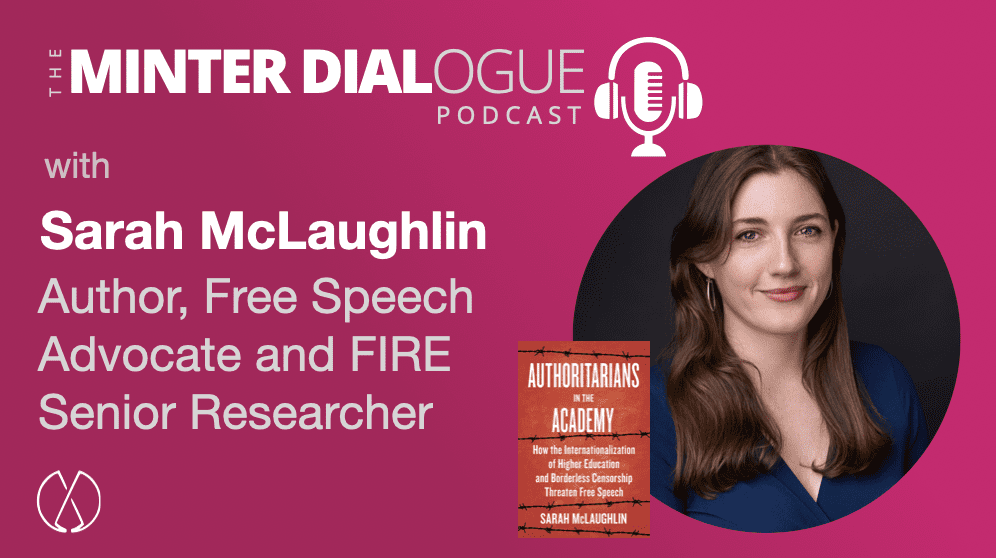
Minter Dialogue with Sarah McLaughlin
Sarah McLaughlin is a free speech advocate, author, and thinker who joined me for this episode to dig deep into the state of expression on campus and far beyond. Based in Philadelphia and working at FIRE—the Foundation for Individual Rights and Expression—Sarah dedicates her work to defending speech across the political spectrum, championing First Amendment rights not just in law, but in the culture of higher education.
Our conversation pivots around her latest book, Authoritarians in the Academy, which shines a light on the subtle and not-so-subtle ways censorship is shaping universities globally. The book zeroes in on the growing influence of foreign governments—China in particular—over what can and cannot be discussed in US classrooms, as well as the quieter crisis: self-silencing by students and professors alike due to pressure from internal and external sources.
We examine why higher education is such fertile ground for these battles. As Sarah points out, universities are the birthplace of ideas and future leaders—making them a key target for those seeking to control the narrative for generations to come. Our discussion takes us from the complexities of internal versus external censorship (and how those lines blur in a borderless digital age), to the challenges leaders face standing up for the principles of expression in the face of financial and political pressure.
Key Points:
- External Influence in the Classroom: Chinese, Russian, and other authoritarian governments increasingly attempt to limit discussion on “sensitive issues”—from Tiananmen Square to Hong Kong—especially among international students, who often return home as future leaders.
- The Power and Peril of Self-Censorship: In both the US and abroad, the threat isn’t always draconian laws—it’s the chilling effect on academics and students who see the risk and choose to stay quiet, especially when personal safety and careers are on the line.
- Why Free Speech Is (Still) for Everyone: Protecting expression means defending opinions you may dislike as fiercely as those you cherish. As Sarah notes, free speech isn’t a finite resource—the more we safeguard it for others, the safer we are ourselves. Objectivity and principled leadership are vital, even when the cost is standing against financial incentives or tribal pressure.
Three Takeaways:
- University leaders must show moral backbone—defending campus speech against both overt censorship and more discreet pressures, regardless of where they originate.
- Diversity of thought isn’t just a buzzword. Creating environments where differing perspectives are honestly heard builds resilience—personally, professionally, and democratically.
- Free speech is more than law; it’s a cultural commitment. The healthiest societies protect the right to speak, even when it’s unpopular (or uncomfortable), because truth thrives in open, messy debate.
To connect with Sarah McLaughlin:
- Check out the FIRE site here
- Find/buy Sarah McLaughlin’s book, “Authoritarians in the Academy,” here on Amazon
- Find/follow Sarah McLaughlin on LinkedIn
- Find/follow Sarah McLaughlin on X (formerly Twitter)
Further resources for the Minter Dialogue podcast:

Meanwhile, you can find my other interviews on the Minter Dialogue Show in this podcast tab, on my Youtube Channel, on Megaphone or via Apple Podcasts. If you like the show, please go over to rate this podcast via RateThisPodcast! And for the francophones reading this, if you want to get more podcasts, you can also find my radio show en français over at: MinterDial.fr, on MegaphoneFR or in iTunes. And if you’ve ever come across padel, please check out my Joy of Padel podcast, too!
Music credit: The jingle at the beginning of the show is courtesy of my friend, Pierre Journel, author of the Guitar Channel. And, the new sign-off music is “A Convinced Man,” a song I co-wrote and recorded with Stephanie Singer back in the late 1980s (please excuse the quality of the sound!).
Full transcript via Castmagic.io
Transcription courtesy of Castmagic.io, an AI full-service for podcasters
Minter Dial: Sarah McLaughlin, I’m just tickled pink to have you on my podcast. We had a little chance to chat beforehand. A native of Philadelphia, the town from which my mom hails. I’ve been many, many times. We, we support a team in common. And more importantly, you’ve just published a new book, which is really interesting, and you work at FIRE. So, in your own words, let’s start with who are you?
Sarah McLaughlin: Absolutely. So, first of all, thanks so much for having me on the show. So, I’m Sarah McLaughlin. So, I work at Fire. As you mentioned, Fire is the foundation for individual rights and expression. So, what we do is we’re a nonpartisan free speech group in the United States. We advocate for the First Amendment, free expression doesn’t matter what you believe, what you say, as long as it’s protected, we’ll defend it. And we think that’s really important. We think that’s a key principle for free speech advocacy, that you need to be out there willing to defend speech even if it’s unpopular, because popular speech usually doesn’t need that much defending. And so, my book, Authoritarians in the Academy came out this past summer, and it’s about the relationship between higher education and global authoritarianism. And this is an issue I’ve been working on at FIRE for a number of years now, and I’ve become increasingly concerned about the way that countries like China, not only China, but often China, use their financial and political power to influence what happens in higher education. And I think globally, but especially in the United States, there has been a lot of attention in recent years on the way that campus free speech, the way it’s been limited, the way it affects society. But to me, this has kind of been a silent censorship crisis that’s been happening on campus that not enough people have been paying attention to. So, this is something I wanted to bring attention to in this book, and I’ve been pleased that I’ve been able to shed some light on the stories of people who have been censored and silenced and threatened just because they criticize the Chinese government in higher education.
Minter Dial: A little bit of irony in the fact that it’s the silent silencing.
Sarah McLaughlin: Sure. Yeah. Well, I think the issue is sometimes, if it’s not hot button political issues that are being censored, sometimes people don’t pay as much attention. It’s not about race or abortion or gender, kind of the things that Americans fight about the most. They might not be aware that it’s happening, but that doesn’t mean it’s any less important or any less real, just because it’s not necessarily the political controversies that we’re used to in the United States, but there might be political controversies in other countries that are being brought here that are actually being silenced. And I think that’s really important.
Minter Dial: Yeah, that’s interesting point. I mean, there are many interesting points, but to some degree, I would argue that for China and a state like Russia, a lot of the hot button topics that are top of mind for Americans are actually the reverse for them. Yet those aren’t the topics that they are typically infiltrating and censoring on.
Sarah McLaughlin: Yeah, so it’s, I think, you know, right now in China, for example, there’s a lot of censorship about the economy, about people’s fears that the economy is failing them. But what we’ve been seeing on American campuses is what some people like to call China’s sensitive issues. So, you can probably guess what those are. It’s Tibet, it’s Taiwan, it’s Hong Kong, and freedom activists there. It’s the Tiananmen massacre. It’s historical controversy from perhaps even days ago or decades ago that the Chinese government is kind of still waging a battle over for public perception. They still don’t want people talking about what happened in 1989 at Tiananmen Square. It’s really incredible the extent to which there’s this much government power being exerted to ensure that even today, people from China, and perhaps even outside China can’t learn about what happened at Tiananmen.
Minter Dial: Well, this notion of censorship, I mean, the reason why your book raised my eyebrows when I first saw it, is that you’re looking at censorship from the outside. I don’t live in the us, I live in the UK, but we talk about this a fair amount in France, where I’m also a citizen. And in the UK, the notion of censorship from within the topics is that really the difference is that while we talk about censorship happening on campuses and political correctness is done, it’s part of censoring what we’re not, you know, your sensitivity. What do you. I think what. How you called it, the sensitivity issues. These are the topics that are sort of, let’s say, largely being censored internally or domestically, whereas the topics that the foreign governments are looking at are, as you say, more like less off a hot button topics. And yet they should be together at some level.
Sarah McLaughlin: Yeah, it’s an interesting question. And it’s hard to draw a clear delineation between external and internal censorship because sometimes they overlap. Sometimes, you know, they overlap in confusing, contradictory ways. But I think it’s just difficult to draw a line between the two in the way the world is today. And this is something that I, you know, what motivated me to write the book was I think the world has become so interconnected. You know, all of us, or many of us, travel overseas regularly. Some people have dual citizenship. Some people are educated in a different country. They’ll spend a decade of their lives getting their undergraduate graduate degrees in another country. We don’t really have these clear borders in the way that we used to have maybe 100 years ago. Whereas if you are a citizen of this country, you were in that country. We don’t really have that anymore. And not even just the movement of people, but the movement of ideas. With the Internet, we’re all kind of vastly interconnected. You know, I comment on political issues happening in the rest of the world, and the rest of the world comments on political issues that are happening in the US and it’s. Because what happens in the US Affects the rest of the world, too, as I think has been on full display in a number of years recently. So, I wouldn’t, you know, it’s hard to say whether it’s internal or external, but, you know, to the question of why the Chinese government might want to control what’s said about something that happened 30 years ago outside of its country. Well, I think there’s a reason why higher education specifically is such a target for that, and it’s because higher ed is where we create the knowledge that the entire world relies on. So, if we have, you know, a government like China or Russia or Turkey limiting or controlling what’s written and taught about historical events that are still relevant to those countries today, that’s actually a powerful tool to be able to impact or perhaps even control the narrative about history, about current events. And so, I think some people might say, you know, why would a. Why would a country care about trying to limit what happens at Harvard University when they’re holding a lecture about human rights from 30 years ago? Well, the reason why is because what you learn about what happened 30 years ago depends on what happens in that classroom. Sometimes we have current and future educators, students, writers. So, there’s actually a lot of power to be had in, whether internally or externally, trying to control what’s taught or said in the classroom.
Minter Dial: It does seem like a behemoth task to try to control every classroom of every university. And my first thought, really, is that the real target that they’re looking for are the foreign Chinese students, the foreign Russian students, as opposed to, let’s say, Jane Doe from Minneapolis who’s attending Harvard. She’s not the real issue here. Maybe she’ll write a book one day, like you. But what they’re trying to do is silence the narrative that comes back into their country because that’s really the. Where the porousness is an issue for them.
Sarah McLaughlin: Absolutely. So, in my experience, my research, those international students have been the number one target, because not only will they bring ideas back to their country, but a lot of times students who travel abroad for perhaps an elite education, they return home to be the leaders of their. Their country. Someday. They are going to be powerful businesspeople, politicians. So, it’s very important to try to have control over the future leaders of your country, who international students very often tend to be. So, that’s absolutely part of it. And I think the other aspect of it is you don’t need to silence everyone. Sometimes if you silence a few enough, get the message that you have effectively silenced a significant portion of the debate of the conversation. So, you know, as long as you kind of have those, you know, the signal or the canary in the cold mine, as long as that, that one gets silenced, it sends a message to the others that, do you want this to be you? Do you want to suffer the same fate? Do you want to have your. Your family threatened because of what you did on campus? You want to have your career, your future career eliminated? And a lot of people will understandably look at that and say, I saw what happened to her. I don’t want that to be me. I’m just going to stick to the safe stuff and go about my day. And I think it’s hard to judge or criticize people who make that choice, especially from a position of relative safety or comfort where many of us, you know, don’t have to fear, perhaps that if we say something our government doesn’t like, our families will pay the price. So, I think, you know, it serves two purposes. You, you get the important future stakeholders that international students tend to be, but you also send a message to everyone else that there’s a price to pay.
Minter Dial: When you, presumably living in the U.S. Sarah, have people who say, oh, my God, freedom of speech is broken. We don’t have it in the US to what extent do you go in the back and say, well, you think it’s bad here? Try Turkey, try Russia.
Sarah McLaughlin: Yeah, so I have definitely some thoughts on that. It’s something I’ve been working on for a few years at FIRE actually, is I’VE been writing a newsletter every month about international free speech issues to give people a better sense of what it looks like in the rest of the world. For, from perhaps in certain countries, even in the UK where for a tweet you might be arrested and you might get a few months prison sentence over it. But then there are places like Pakistan where if you’re accused of blasphemy, you actually might be executed either by the state or by a mob. And so, I think sometimes people underestimate the extent to which significant portions of the world have no real access to what we would conceive of as free speech. And so, here in the U.S. you know, FIRE, we are so passionate about the First Amendment because we don’t want the United States to experience the kind of censorship that other countries have. I do think it’s important to note that, you know, there have been a lot of concerns in recent years, especially the past year in the United States, you know, from the Trump administration especially, there have been a lot of concerning First Amendment violations that are really starting to affect Americans right to free expression. But we believe that’s what the First Amendment’s for. We utilize the First Amendment to fight back against those. And it’s very important not to say the government censoring, it’s all over. We believe that the First Amendment lets us say the government censoring, and the First Amendment says they can’t do that. So, here’s how we’re going to fight back. That’s something we’re doing at FIRE. We are pushing back on things like that.
Minter Dial: Well, I need to get back to FIRE, but I think it would be useful for us to level set one second about what is freedom of speech. Because in the end of the day, I’m also inquisitive as to its cultural definition, to what extent that freedom is a cultural word, maybe even.
Sarah McLaughlin: Yeah, absolutely. So, I think there’s absolutely sort of the legal conceptions of freedom of expression and then the cultural conceptions of freedom expression. And so, when we talk about the legal question, it’s can the government fine you, punish you, put you through a lengthy trial because of what you say, how you express yourself, what art you make? And so, that’s what we’re talking about with the legal protections. And it even gets a little bit more extensive. Can the government investigate you for tax fraud and find other ways to try to punish you for speech that maybe aren’t, you know, under like a hate speech law or a libel law, but try to find other ways to punish you? You know, a broadly construed legal free expression concept is that there are limits on government power to punish you, whether it’s through arrest or whether it’s through, you know, nonsense investigations. But then when we look at the cultural question, it’s very important. It’s a lot messier. And I think that’s where a lot of the confusion comes from. But more broadly, the cultural discussion and question about free speech is how do we create a society where people know that they will not be imprisoned or fined for saying something, but also feel like they will not face perhaps overly severe social sanctions for what they say and what they think. And that gets complicated, it gets messy. But, you know, one thing that we’ve been, you know, pushing is this idea that you should be able to have an opinion and have a job. And so, you know, we want people to not feel like, you know, if they’re working at a clothing store, they can’t share their opinions about current events on social media because someone’s going to say, I don’t like what they say, let’s find out where they work and get them fired. And I don’t. That’s all legal. For the record, you know, it’s legal to say, I don’t like this person, let’s get them fired. But it’s not perhaps healthy for a free society. This idea that there are going to be sanctions socially that are so severe for what you think and what you believe, that you’re not able to live your life as the other members of society are. And this is. Sorry, you can continue, but I was going to say this is something kind of across the board politically. You know, this isn’t just for right wing or left-wing views. And I think that’s something that we saw a lot in the US in the past few months over people who said negative things about Charlie Kirk after he was assassinated. I think a lot of people thought it was sort of, you know, a right-wing conversation or discussion about social sanctions for free speech. But there are a lot of people who I think were fired or punished in ugly ways socially because of what they said about Charlie Kirk. And so, I think it’s not just a partisan issue. I think this is something that everyone wants to be able to be included on this idea that you should be able to have conversations without worrying that it’s going to be the end of your professional life or that you won’t have friends anymore.
Minter Dial: Some level, you talk about non-partisanship, but it feels like it’s deeply politicized as to who even owns the space of freedom of speech. And in a world where one wants to crimp the ability for the other side to speak about whatever their topic is or isn’t, to what extent do you think that this is a measure of the ability for democracy to continue? I mean, if we’re Greek in origin, this is the basis of democracy. And it feels like the politicization of freedom of speech is really the undercurrent that’s hurting the ability for a democratic state to continue.
Sarah McLaughlin: Yeah, I fully agree. That’s one thing that I really try to make clear to people sometimes. There’s this conception of free speech as a politically coded idea, and I firmly disagree. Free speech is for everyone. It is everyone’s. It’s not one single person, one single political views idea. And kind of an idea I’ve been, you know, explaining it to people as lately is I’ve noticed that some people are approaching free speech as if it’s a pie. And if somebody gets a slice of it, there’s less of it for everyone else. But that’s not how free speech works. It’s not a limited resource where once some people have it, no one else does. And the more we protect it for everyone, the more everyone will actually have it. And that’s kind of the funny thing about free speech is the best thing you can do to protect your own free speech is to protect the free speech rights of people you don’t like. And that’s, I think, difficult and sometimes counter to human nature. But it’s really the truth. If you want your own free speech, you have to want it for everyone else, because you can’t protect it just for yourself.
Minter Dial: Under that seems a thesis that you have to be objective in order to be able, in your case, in your job, to sit in your shoes, Sarah, you have to be able to remove yourself from someone who says something that might be offensive to you personally. You might be at a cocktail, one genic too many, and the guy says something which you don’t like. I think you might refer to these as red lines. At least you use the term red lines very much in universities, which is really the part of what we’re supposed to be talking about. But I feel like it’s such a societal thing and the idea of being offended. And I bring it up because something that really interests me is this notion of truth. It’s not without a small amount of irony that Yale and Harvard both share the same motto, or at least one word of the same motto. Veritas truth and So I have my truth. Well, in society, we’ve now said, well, you have your truth, I have my truth. My feelings count more than facts, or at least my feelings are as valuable as facts. So, it seems that truth is in a wash of feelings. And, and, and people don’t be, aren’t able to be objective. I, I would specifically think that people are normally subjective. And therefore, how do you, in your role, maintain that objective line?
Sarah McLaughlin: It’s a good question. And, you know, I personally, I do my best. You can remove yourself to a certain extent. Of course. I’m always going to look at the speech that comes across my desk from my own point of view. That’s just natural. But I think if you come at it from the position of, as a, you know, as a preliminary matter, it doesn’t matter what I think or feel about this, then you’re really looking at it the way you’re supposed to be when it comes to defending speech. But the other part of it is that, you know, I’m surrounded by a lot of smart, wonderful people who also don’t agree with me on everything and who I disagree with and who disagree with me. And so, you know, if you, it’s a good way where if you fail personally, sometimes you’re surrounded by people who will keep you honest and who will say, you know, actually, I disagree with you. Here’s my take on this. And so, that’s kind of the important part in protecting free expression, of being able to have other points of view in it, because sometimes you’ll be missing something because of where you’re coming from, because of your own beliefs, your own background. And so, when you communicate and work with people who don’t agree with you on some very important political and religious things, you actually benefit from that because it makes you not only better at seeing how other people perceive that speech, but it also makes you better at responding that speech yourself because you understand what it means, where it’s coming from, how other people perceive it. And so, I think that’s the healthy way to keep yourself honest, is to try to be principled yourself, but also to surround yourself with other people who are doing the same thing.
Minter Dial: What you’re describing, in my opinion, is, is, and I’m an old man, but is the benefits of diversity of thought. And diversity of thought has been, I would say, probably diluted in a notion, another notion, which is just diversity for the sake of diversity. And you can have 12 women and have diverse opinions. It doesn’t mean that they have to have a man in their group and, and vice versa. As far as diversity of conversation and points of view, especially if one’s a lawyer and one’s a creative or whatever, you’re going to have diversity of opinions and our ability to confront, have psychological safety in that is perhaps also entangled in this issue of free speech.
Sarah McLaughlin: Yeah, absolutely. And I think sometimes people scoff at the idea that they need to be exposed to, to diversity of opinion. You know, I’m right. Why do I need to hear other people’s ideas?
Minter Dial: Of course you’re right, dear Sarah, I’m.
Sarah McLaughlin: Saying in the hypothetical, but you know, the, really there is a benefit from it if you want to just look at it from that own standpoint. If, if you don’t want to be convinced, if you don’t want to have to change your mind, if you don’t want to, you know, make yourself open to the idea that these people who disagree with you may be right or at least partially right, even if you just encounter them at all, you will get better at defending your own viewpoints because you’ll be forced to defend them to people who don’t already agree with them. So, there’s really an upside to it. Even if you don’t want to change your mind, even if you ultimately still think these people are ridiculous, they’re wrong, you may get better at defending your own points of view and who knows, maybe you’ll even change their mind.
Minter Dial: So, let’s say a fundamental element of what you’re defending is the ability to have an opinion.
Sarah McLaughlin: Sure.
Minter Dial: The way I look at it somehow sometimes is that if an opinion is merely feelings based, removed from facts and context, to what extent does that in your mind devalue the opinion that’s coming? Or is that on exactly the same basis as someone who has an erudite, well researched opinion based on facts and supposed truth? Is there, is there, is there something, is there something in that tent that provides tension?
Sarah McLaughlin: You know, I, I, when we’re looking at the, the legal question of it, you know, the broader context, it’s not going to make a difference to me defending the right to engage in it, whether I think it’s very well researched and argued or whether I think it’s spur of the moment, pure burst of emotion, that’s not going to make much of a difference to me on, you know, the defending inside and the right to engage in it, you know, on the other hand, you know, whether I think there’s worth or value for, to one more than the other, obviously I think that’s a well-researched thought through opinion is usually going to be more productive and it’s going to be more persuasive to me. But I don’t want to downplay, you know, emotions or expression that is perhaps more emotionally based. I think there is value to that too. I think, you know, some of the fantastic art has come from people who are expressing pure emotion and nothing more. And so, I, I don’t want to say that it has no value. Sometimes it may be less persuasive, but I think it still plays a really important role in society too.
Minter Dial: Right. So, my mind now swings back to Greg Lukianoff’s experience of viewing. I think he actually viewed it in person was the, the experience in Silliman College, which is my college at Yale University, which is where I live for two and a half years. And so, it was very raw to me, the whole experience. It feels for me, and this is just my interpretation, that it was an engagement of feelings versus a researched mind as far as the college dean was concerned. And, and that of course, blew up. And there’s the emotions, the, the, the virality that goes with it because sort of clickbait is, isn’t exactly playing to research facts. It’s sort of playing to whatever freezes the mind or gets fear and flight in mode. So, I, I wonder to what extent, how do you view that particular experience or that particular part of the battle on campuses in. Because, I mean, that seems very germane to your book.
Sarah McLaughlin: Yeah, I, I think that, you know, you can see by the way that that was publicly perceived, which of those two points of view or perspectives were more persuasive to viewers. I, I think that it’s pretty clear from the way that people react, responded to that video was that they did not find the more emotional arguments as persuasive as, you know, a carefully researched and thoughtful response. So, you know, I think it’s, it’s clear what was better perceived by viewers.
Minter Dial: Public. The public, the public vote.
Sarah McLaughlin: Yes. And you know, the public vote is, you know, ultimately that makes the argument for, or it makes clear who makes a better argument, but it doesn’t really have much weighing on the idea of whether something’s protected or whether it should be permitted or not.
Minter Dial: So, I mean, that was really more about the sort of a domestic type of issue in free speech as opposed to what you was really talking about in your book, which is the notion of censorship from, by foreign governments. And what I’ve been so much more interested in is the new version of FIRE, which is freedom of expression, not just freedom within education, but that’s really what your book’s about. And if you were to, I don’t know, if you do have engagements with university presidents, what sort of advice, if you had one in front of you, or if you’ve had one in front of you, do you give them in terms of tolerating any incursions on free speech, whether it’s domestically or foreign, which is, as you say, a little bit more discreet? Maybe follow the money?
Sarah McLaughlin: Yeah, it’s. It’s a great question. And it’s, you know, it’s really complicated because I think there are a lot of incentives, you know, on the. The question of foreign censorship, there’s a lot of incentives on universities not to pay attention to it. Yeah, it’s, you know, if you have. If you’re getting a lot of funding that’s from the Chinese government or related partners, and you find out that the Chinese government is perhaps threatening harm against some of your students for what they say, you have a lot of incentive to ignore that and just keep taking the money. Because if you point it out, if you criticize it, then perhaps that funding source dries up. So, on that front, I would. It’s actually the advice that I would give the universities on the foreign and domestic fronts is kind of the same. Have a spine. Stand up for your values. Whether it’s a foreign government that is trying to use financial incentives to control you, or whether it’s things happening within the US Whether it’s from online mobs, whether it’s from students who want censorship, whether it’s from the federal government, if they’re demanding censorship of some sort that violates your values, you have to stand up against it, and you have to say, no, we’re drawing a line in the sand. Here’s our values, here’s our rights. And so, you know, I’m making a lot of, you know, arguments about what’s morally right for these universities, but there’s also legal questions here, too. If these are public universities, you know, as we talked about, Yale isn’t okay, sure, that’s a problem. If you are a public university, you are actually bound by the First Amendment, so you can’t be censoring students or academics in ways that violate their rights. So, it’s not even just necessarily a question of what is morally right for university leadership, but also what’s legally required of them. And so, they actually may face penalties if they’re engaging this kind of censorship.
Minter Dial: I appreciate that. And I’m. What I think is always tricky is actually having a backbone when you’re supposed to be objective on everything. And it’s the kind of issue that a lot of business leaders have as well, is you might have a personal opinion, but do you put that subservient to the business idea? Do you hide that from your moral background because you want to please everybody? Or are you prepared to stand up for something that won’t please everybody, including your benefactor?
Sarah McLaughlin: Yeah, no, that’s. That’s absolutely right. And it’s sort of fascinating the way that the, you know, business questions here overlap with the values questions, because I think, as you point out, you know, the way business leaders are. Have to approach these issues, I think, is more and more the way that university leaders have started to approach it. What makes sense from the bottom line, is this going to be acceptable to our donors? Is this going to hurt our ability to raise more money, to bring in more students who are ultimately bringing in money? And that’s. That’s a problem. You know, that could talk a lot about, you know, my concerns in the business fields with free expression, but, you know, in higher ed, we expect universities.

Minter Dial
It’s easy to inquire about booking Minter Dial here.