
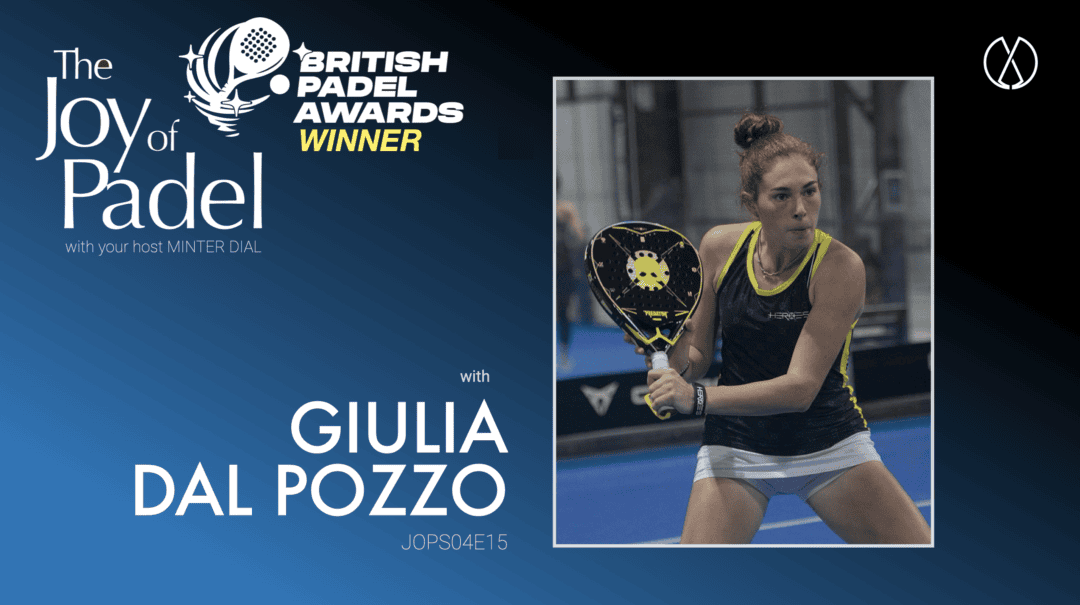
The Joy of Padel podcast with Giulia Dal Pozzo (JOPS04E15)
On the latest episode of the JOY OF PADEL podcast, I had the great pleasure of chatting with Giulia Dal Pozzo—a left-handed Italian padel star who reached a career-high ranking of 31. Giulia’s infectious energy, honesty, and love for the sport truly shine through, and I came away from our discussion with a newfound admiration for her journey and approach to the game.
Background on Giulia Dal Pozzo
Giulia’s athletic roots began in tennis, where she competed at a high level as a junior. Three years ago, she took the leap into padel—a decision that was not without its fears and uncertainties. Switching from an individual sport to one that’s built on partnership, communication, and shared strategy was transformative for her. What stood out for Giulia was the joy of not being alone on the court and being part of a team—an aspect that reignited her passion for racquet sports and drew her fully into the world of padel.
Main Topics Covered
The conversation focused on Giulia’s transition from tennis to padel and the specific skills that tennis players need to adapt when entering the sport. One concept discussed was the challenge of learning to use the wall—a defining feature of padel that’s initially “very strange” for tennis converts. Giulia emphasized the importance of embracing new habits, such as letting the ball pass and utilizing the slow lob, which are less intuitive for those with a tennis background.
A key theme that emerged was the critical role of communication and chemistry in doubles play. We explored how finding the right partner goes far beyond just matching skills—it requires alignment of attitude, on-court mindset, and even lifestyle. The discussion explored the evolving landscape for women’s padel, noting Italy’s rise to prominence and the increased physical and strategic demands of the Premier Padel circuit.
Several points were raised, including how to build confidence and resilience during high-pressure moments, the need to train with both women and men, and tips for effective on-court communication—calling plays, supporting each other after mistakes, and always focusing on the next point.
Three takeaways from my conversation with Giulia
- Switching sports can be daunting, but embracing the team spirit of padel turns fear into joy. For tennis players, learning new strategies and embracing the wall are key to thriving in padel.
- Communication is everything. From pre-point strategy to in-game calls and post-point support, great padel partners are built on trust, clarity, and the ability to move on quickly after mistakes.
- Women’s padel is evolving rapidly, with increased speed and athleticism. Italy is emerging as a top nation, and players like Giulia are proof of the growth, resilience, and potential of the women’s game.
If you’re a tennis player curious about padel, or simply a fan of inspiring sports journeys, Giulia’s story is one to follow. Tune in to the latest JOY OF PADEL episode to hear her insights on partnership, progress, and what it means to chase your joy on and off the court.
To find out more about Giulia Dal Pozzo:
- Find or follow her on Instagram: @giulydalpozzo
To listen to the show:
To listen to The Joy of Padel podcast, you can use the embedded player above, or go find it on Spotify, Apple Podcasts or any number of other podcasting services listed here.
Please send me your questions — as an audio file if you’d like — to nminterdial@gmail.com.
Further resources for The Joy of Padel:

The Joy of Padel podcast, hosted by Minter Dial, a padel tennis player since 1974, is an exhilarating show that delves into the captivating stories of notable padel personalities worldwide.
Meanwhile, you can find Minter's other Evergreen podcasts, entitled The Minter Dialogue Show (in English and French) in this podcast tab, on Spotify, Megaphone or via Apple Podcasts.

About the host: Minter Dial
Minter Dial is an international professional speaker, author & consultant on Leadership, Branding and Transformation. His involvement in sports has been a lifetime passion. Besides playing 18 years of rugby, captaining athletics teams, coaching tennis and playing squash for his university, he’s been a lifelong player of padel tennis, starting at the age of 10, from the time of its very first public courts at the Marbella Club in 1974.
Then, after a successful international career at L’Oréal, Minter Dial returned to his entrepreneurial roots and has spent the last twelve years helping senior management teams and Boards to adapt to the new exigencies of the digitally enhanced marketplace. He has worked with world-class organisations to help activate their brand strategies, and figure out how best to integrate new technologies, digital tools, devices and platforms. Above all, Minter works to catalyse a change in mindset and dial up transformation. Minter received his BA in Trilingual Literature from Yale University (1987) and gained his MBA at INSEAD, Fontainebleau (1993). He’s author of four award-winning books, including Heartificial Empathy 2nd edition (2023), You Lead (Kogan Page 2021), co-author of Futureproof (Pearson 2017); and author of The Last Ring Home (Myndset Press 2016), a book and documentary film, both of which have won awards and critical acclaim.
It’s easy to inquire about booking Minter Dial here.
Full transcript of interview via CastMagic
This transcription comes courtesy of Castmagic.io an AI service for podcasters.
Minter Dial: So, Giulia, great to have you on the Joy of Padel. Congratulations on, on getting to number 31, it’s your highest ranking. In your own words, who is Giulia Dal Pozzo?
Giulia Dal Pozzo: Giulia Dal Pozzo is a lefty-handed who plays padel. I enjoy my life and I’m, I’m strong.
Minter Dial: What got you into padel? What was your journey into padel?
Giulia Dal Pozzo: I started playing tennis all my life. I changed it 3 years ago, then I started to play padel, and now it’s my life.
Minter Dial: So, what I want to know about is that moment that you said, ah, let me just go try that other sport over there.
Giulia Dal Pozzo: I was looking for the padel, and I was like scared, afraid to to try another sport, right? Because I, I was playing tennis good at high level in junior, so it was like difficult to me the idea about another, a different sport, you know.
Minter Dial: Sure. I talked to a lot of players who have transitioned from tennis, and a lot of amateurs typically will meet padel because it’s at the tennis club and there’s another sport over there. But for you, how did you make the transition? What are the things that really players who are tennis players need to think about most to get to padel?
Giulia Dal Pozzo: Yeah, I really like the fact that we are in a couple, so I’m not alone in the court. And this is why I didn’t feel good in tennis, I think, because I, I was alone. And now it’s easier for me to, to play and enjoy padel. So, I started a little bit changing. I started playing 1 or 2 times a week, and then now every day.
Minter Dial: And now what about the moving from the typical habits of a tennis player, wanting to rush, get in? How did you sort of learn the slow lob, Chiquita, what was that process that’s in your mind that helps people to get there?
Giulia Dal Pozzo: Playing tennis, I think, helps you in padel. What about volleys, smash? Yeah. And all the shots like this without the wall, right?
Minter Dial: It drives.
Giulia Dal Pozzo: The difficult thing is to, to learn how to use the, the wall.
Minter Dial: Yeah. So, how do you do that? What was it that Unwired you to let the ball by.
Giulia Dal Pozzo: It was very strange the first time. I didn’t understand. It was difficult for me, but every day I improve.
Minter Dial: So, in Italy now, it’s obviously a big sport. There are something like 9,000 courts, a lot of players. And congratulations to you and Carolina for being top 30 in the world, both left-handers. So, that doesn’t mean you can play together. What about the potential for Italy? Do you think— how far are we from having a competitive Italian women’s team to go up against the Spaniards and the Argentinians?
Giulia Dal Pozzo: Yeah, I think Italy is in the top 3 countries in the world, and I think can improve a lot. And number one is of course Spain with a lot of players and then Argentina, but I think Italy has a good potential to grow.
Minter Dial: So, for someone who’s got to your level, how important is it for you to speak Spanish? How important is it for you to train in Spain as opposed to at home?
Giulia Dal Pozzo: For the moment I’m training in Italy. most of my time, and I go sometimes in Spain because there is my partner and an academy.
Minter Dial: Nuria [Rodriguez]?
Giulia Dal Pozzo: Yeah, Nuria. I go to train with her, but I can do both things. I think it’s important to go in Spain sometimes. What about the, the level of the girls? There are many players to train But in Italy also it’s possible to train good. I feel good with my coach, so a mix, I think it’s good.
Minter Dial: Do you sometimes find it useful to train with men?
Giulia Dal Pozzo: Yeah, I always train with men because there are no girls.
Minter Dial: Well, there are lots of good Italian men players too.
Giulia Dal Pozzo: Yeah, yeah, yeah, there are.
Minter Dial: How about finding a partner? How do you go about finding the right partner for you?
Giulia Dal Pozzo: It’s very difficult to find the right partner. I think it’s difficult to find a person similar to you.
Minter Dial: What does it mean to be similar to you?
Giulia Dal Pozzo: Similar to me? What about the style of life? What do you think in your mind, the attitude in the court. So, it’s difficult.
Minter Dial: How do you deal with pressure with your teammate? When you’re with Nuria, there’s a star point, a set point, a match point. What sort of— how do you deal with that as a team when the stress is highest?
Giulia Dal Pozzo: Yeah, with Nuria, I think I find the right partner. We play good together, we feel good together in the court. So, when there is a difficult time, we can stay together with all the team. Outside we have the coach also, and so we are a team that—
Minter Dial: Off the court and on the court.
Giulia Dal Pozzo: We go together inside the court and outside. Right.
Minter Dial: So, one of the things that a lot of amateurs struggle with is knowing which side they should play on. You don’t need to worry about that. You’re left-handed. But when you have a— you try to find a good new partner, how do you organize the communication between the two of you? In other words, thinking about how you’re communicating in the points, between the points, how much do you go through that? And when you have a new partner, what’s the first thing that you think that amateurs should be thinking about when they see their partner?
Giulia Dal Pozzo: I don’t know, you have to start knowing each other outside the court, and then in the court, like, trying to speak every point. You have 20 seconds to have a stop to speak with the partner and then try to understand. You also, when you’re playing, you know, you have to know before what your partner will Yeah. So, that’s the difficult thing, what do a good couple.
Minter Dial: Yeah, when it’s a new couple, you don’t know their strokes.
Giulia Dal Pozzo: Yeah.
Minter Dial: So, for one of the things that I personally, I play a lot, is when I have a new partner and I want to get the communication right. Obviously most amateurs still don’t know that they should be calling what the opposition is doing. Most amateurs sort of maybe say yours, mine, but they forget to say, back, up, cheating.
Giulia Dal Pozzo: I mean, it’s very important to speak in the court during the point. Yes, I think it helps this also, the effect to train together. If you have the opportunity, train together. It’s, it’s very good to, to know.
Minter Dial: So, as an example for the people who are listening, what is it that you want if I were playing with you Let’s say I’m on the left, I’m playing with you. What would you tell me in terms of the calls? Let’s say it’s an important match and we need to get this. What, what instructions would you like to give me so that I call for you correctly? And of course, I’m thinking about specifically when they’re coming ones up, ones back, when they’re cheating, you know.
Giulia Dal Pozzo: Yes.
Minter Dial: How do you— what— imagine you had to tell me, right, Minter, uh, this is what I want you to call.
Giulia Dal Pozzo: Yeah, you have all the time you have to speak to your partner what about the opponents are doing, and you also have to have confidence with your partner to tell him what is doing good and wrong also, what are the problems. You have to be open.
Minter Dial: Right, because when you screw up, which happens, What? When you make a mistake.
Giulia Dal Pozzo: When I make a mistake?
Minter Dial: Right.
Giulia Dal Pozzo: Nothing.
Minter Dial: Move on, move on.
Giulia Dal Pozzo: The next point.
Minter Dial: Yeah, but isn’t it funny that sometimes you can still feel within you, ah, damn, missed. You feel the urge to say, I’m sorry, I screwed up, or you get angry that your partner made a mistake.
Giulia Dal Pozzo: No, I think the best thing is that when, when your partner makes a mistake you have to be like, to keep calm and think about the next point.
Minter Dial: Next point.
Giulia Dal Pozzo: Yeah, yeah.
Minter Dial: Last question for you, Julia. I appreciate you coming on. Um, the, the P1 or the Premier Padel this year, uh, how would you describe the evolution in the 3 years that you have been playing padel? Obviously your game’s coming up, but what do you see in the women’s padel that’s been changing over the last 3 years that you played?
Giulia Dal Pozzo: I started playing Premier Padel this year, so I don’t know well the difference, but from before, from before, it’s more physical. I think it’s becoming faster, the padel in women, also with the smash. It’s not so slow, and there are a lot of things that you can do in the court. So, I think you have to take it as a job and train every day. It’s like very, very important.
Minter Dial: So, what do you work— what’s your favourite shot and what are you working on?
Giulia Dal Pozzo: My favourite shot is the smash, por tres. And I’m working a lot the backhand network.
Minter Dial: The backhand. To improve the backhand return, volley, the backhand volley. Yes, because that’s going to be down the side for you. It’s down on— down the, down the side over here, right? Right. Well, anyway, Giulia, vamos!
Giulia Dal Pozzo: Thank you so much.
Minter Dial: Thank you.
Giulia Dal Pozzo: Thank you.
Minter Dial: Thank you for being on the Joy of Padel.
Giulia Dal Pozzo: Thank you.