
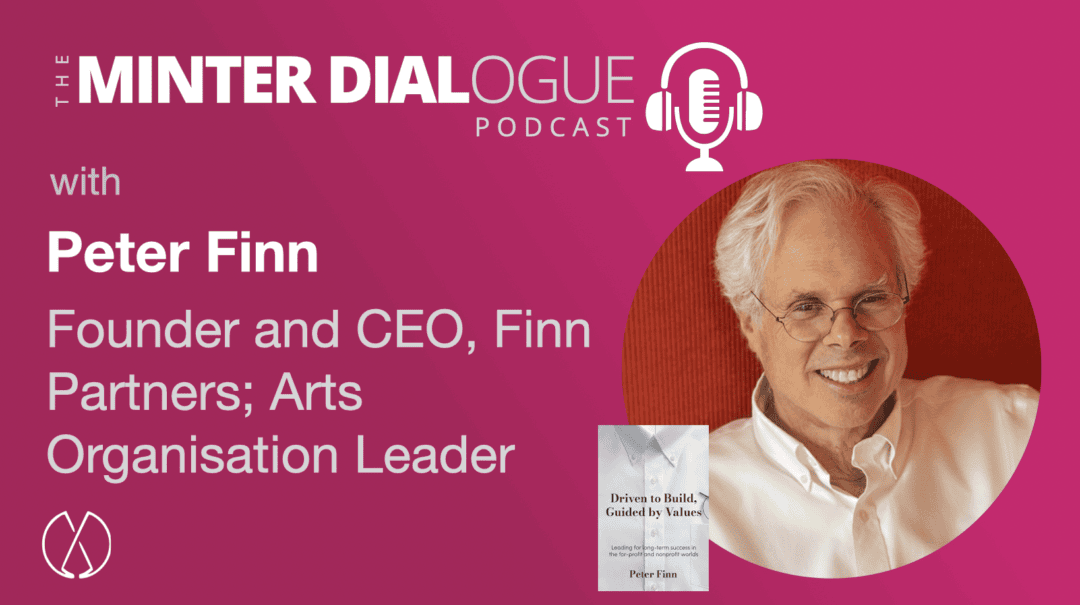
Minter Dialogue with Peter Finn
Peter Finn is the founder and CEO of Finn Partners, one of the world’s largest independent global PR agencies, and the author of Driven to Build: Guided by Values. I was delighted to welcome him onto the show for a deep dive into both his professional journey and the values underpinning his leadership philosophy. Peter brings decades of experience in communications and a unique approach to growth, focusing relentlessly on building with kindness and integrity—whether shaping a business, orchestrating acquisitions, or revitalising a rural community.
What stood out for me in our discussion is Peter’s rare conviction that success doesn’t have to come at the expense of decency. Having separated from his family’s agency to forge his own vision, he’s built Finn Partners into a 1,300-strong firm across 36 offices. But equally impressive is his commitment to communal impact through the Catskill Mountain Foundation, an arts and cultural powerhouse he created with his wife to breathe new life into the once-declining Catskills region of upstate New York.
This episode explores Peter’s steadfast belief in collaboration, the art of managing creatives, navigating difficult client relationships, and integrating acquisitions with purpose at the centre. For anyone wondering whether you can thrive in business and still “play nice,” Peter’s journey is both instructive and inspiring.
3 Key Points:
- Values-Driven Leadership: The conversation focused on how building and maintaining a successful company rests on clear, lived values. Peter’s principle of “work hard, play nice” is more than a slogan—it underpins decision-making, from client selection to staff relations and even merger negotiations, proving that kindness can coexist with commercial achievement.
- Human-Centric Growth: The discussion explored how true leadership involves recognising one’s strengths—and weaknesses—and building diverse teams where collaboration multiplies success. Peter’s choice to focus on management and long-term strategy, rather than day-to-day client hustling, allowed him to cultivate an environment where creative and business talents both thrive.
- Community and Cultural Impact: A key theme that emerged was the transformative power of the arts. Peter shared how investing in the Catskill Mountain Foundation revitalised not just local culture but the very fabric of its communities, showing that business leaders can—and should—use their resources to uplift society well beyond the bottom line.
Further resources for the Minter Dialogue podcast:

Meanwhile, you can find my other interviews on the Minter Dialogue Show in this podcast tab, on my Youtube Channel, on Megaphone or via Apple Podcasts. If you like the show, please go over to rate this podcast via RateThisPodcast! And for the francophones reading this, if you want to get more podcasts, you can also find my radio show en français over at: MinterDial.fr, on MegaphoneFR or in iTunes. And if you’ve ever come across padel, please check out my Joy of Padel podcast, too!
Music credit: The jingle at the beginning of the show is courtesy of my friend, Pierre Journel, author of the Guitar Channel. And, the new sign-off music is “A Convinced Man,” a song I co-wrote and recorded with Stephanie Singer back in the late 1980s (please excuse the quality of the sound!).
Full transcript via Castmagic.io
Transcription courtesy of Castmagic.io, an AI full-service for podcasters
Minter Dial: Well, hello, Peter Finn. Great to meet you and great to have you on the show. You are the founder and CEO of global communications Finn Partners, and you’ve got a new book called Driven to Build: Guided by Values, which we are going to deeply dive into. But as I like to say, Peter, in your own words, who are you?
Peter Finn: Good question. So, as you said, I’m the founder and CEO of Finn Partners. Finn Partners is 15 years old. I had been a 25% owner and co-CEO of another agency that my father had started many years ago. And I negotiated a separation, started Finn Partners. And so, we didn’t start with nothing, but we started with 150 people and we’re now 1,300 people. So, with 36 offices around the world. So, so Finn Partners has become one of the largest independent global agents, PR firms. So, my identity is very much tied up in with Finn Partners and what Finn Partners is all about. Finn Partners was founded based upon a number of values. I have, I’ve been in this business for my entire career. So, that’s a long time. And I’ve always been disturbed by people I’ve met over the years who view business as a contact sport. Somebody gets in your way, you knock them over. I’ve never believed that’s the right way to behave in business or in life. And I think that if you treat people badly, you will pay a price down the road. So, I always, I’ve always believed to treat people well and so one of the core values for Finn Partners is work hard and play nice. We have to work hard. You know, we work in a very competitive industry. We have clients we have to take care of and do amazing work for them. But we can do so by treating everybody with respect. And somebody actually recently asked me, what do I want to be remembered for when I’m no longer around? And I said, I’d like to be remembered as being genuine and kind. And that’s who I am. I mean, I have been driven to build. I’ve built Finn Partners into a very significant organisation. My wife and I started a not-for-profit arts organisation in 1998. So, it’s almost 30 years now. And that has become also a significant organisation in the Catskill region, one of the largest multi-arts organisations in upstate New York. Far more than I ever imagined it would be. It had a transformative effect on the community where it operates. So, I am, as I said, I’m driven to build, but values are very much at the heart of who I am.
Minter Dial: Super. Well, obviously lots of things I want to dig into, including about the arts, but just going back to the decision to break away from the family business, I have to imagine that was a rather turbulent concept somehow, breaking away. And I wonder just to what extent, what was the thing that stimulated that need? And was it worth it to sort of do the family breakup? I mean, I think of this, not to dive into your gut, the baggage that you have with that, but how should people have with healthiness, break relationships that aren’t what we should be doing to what we feel we need to be doing?
Peter Finn: Well, it was a difficult process, but there’s no question that it was in the end beneficial to everybody involved. The prior agency is run by one of my sisters. They’re very successful. They’ve grown a lot. Finn Partners It’s very successful, grown very substantially, and I’m free to shape the agency and run it in a way that makes sense for me. And there were different philosophies in life and business when we were all together, and it was hard to make decisions, and that problem was resolved. So, it was a difficult process to go through, but in the end, it really proved to be the best for everybody involved.
Minter Dial: And how do you ensure that it works out well for you, at least?
Peter Finn: Well, I didn’t really know how it would work out. And there were people who didn’t join me in launching Finn Partners, but who were watching what I was doing that predicted that Finn Partners would fail within 6 months. And, you know, one of the key issues is, do you get ahead in business by being nice? I believe you do. There are people who believe you don’t, that if you try to run a business by being nice, you’re going to get stepped on. And I think that’s why people felt that Finn Partners would be out of business in 6 months because I was trying to do business and at the same time be nice to everyone. So, you can’t know for sure what’s going to happen. And I certainly didn’t. I worked as hard as I possibly could thinking and worrying every minute of every day, you know, trying to think of what do I need to do to make sure this is successful? And I kept my eye on the long-term goal, which was to build something significant. But it honestly became much— Finn Partners is much more successful than I ever imagined it would be.
Minter Dial: Yeah, this really was the heart of my question, which is usually we say nice guys finish last. And the issue with being nice, for having been a CEO myself, is that it typically takes time and attention, AKA energy.
Peter Finn: Yeah.
Minter Dial: And it turns out we have a finite amount of both energy and time, or at least for sure time. So, the general motif of success is cutthroat, shark-eyed, radical decision-making. Oh, I don’t care about popularity. So, how do you square that?
Peter Finn: Oh, well, listen, you know, when you’re running a business, you have to make difficult decisions. So, being nice doesn’t mean that I avoid making difficult decisions. And I sometimes have to have difficult conversations with people, but I try to have those conversations in the most respectful way possible. So, I understand your point that being nice takes time and maybe extra time. But I think you can, you can do the same things even if it means having difficult conversations with people and just do it in a way that’s respectful to whoever you’re talking to. So, um, I don’t— there’s no question there are a lot of pressures in business, um, but I, I think that those pressures can be Dealt with in a way while you’re still being respectful to other people?
Minter Dial: Well, as you know, Peter, I’ve written about empathy, and one of the core qualities of someone who’s empathic is their ability to listen, which means you have to sort of be able to be present at that moment to allocate the time to listen to the person in front of you. And they may have, oh, I got a long storey to tell you. And you’re like, oh, I got a client right after this. And that tension is always a difficult thing to do.
Peter Finn: Yeah, well, I think that one of the keys to my success is that I actually don’t work on clients and I don’t pitch new business. And I think that is rare for the CEO of a young agency. Usually the CEO of an agency is the lead client service person and the lead person pitching business. But that’s never what I’ve done. I’ve actually been more on the management side of the business. And so, what that meant is that I was free to focus on what do I need to do for the long-term growth of the agency, whether it’s hiring people or making certain investments without the constant pressure of, oh my God, I’ve got a deliverable today for this client. Or I’ve got a pitch tomorrow morning I’ve got to prepare for. So, I have— I’ve assembled a team of fantastic senior talent, people who can do those things. Honestly, I can’t. They do it better than I can. But there are certain things that I can do that they don’t do.
Minter Dial: Yeah.
Peter Finn: So, together, I see that’s another thing that’s been key to the success of both Finn Partners and my arts organisation, Catskill Mountain Foundation, and that is It’s important for me to recognise what I’m good at and what I’m not good at, and there’s plenty I’m not good at. So, I— the way I deal with that is I, um, I invite people who have those strengths to complement my weaknesses, you know, so my strengths and their strengths together create success. And that’s— so collaboration has been, uh, absolutely essential for both the success of Finn Partners and the success of Cats of the Mountain Foundation, my arts organisation.
Minter Dial: And just to go back on this notion of allocating time, there’s this feeling like I’m wasting time sometimes listening to someone moan on about their problem or, you know, going on repeat on some kind of issue that they have. Oh, I don’t like, you know, Jim, he’s terrible. I don’t like that. Yeah, you told me that yesterday and the day before and the day before that. Yet the ability to show that you know, to listen and to care, ultimately is supposed to bring you rewards down the line in the form of loyalty and so on. But it is a leap of faith to believe that it will be successful at the end. When you say work hard, play nice, how important was the word play?
Peter Finn: You know, I’ve thought about that many times. And when we were all young, our parents would tell us, now play nice, don’t get into fights. So, play nice is not something necessarily that would be said in business. But I use that because what I was saying is this is a lesson we all learned early in our life. Let’s, you know, first of all, accept it, believe it, and bring it forward into our work. So, that’s why I use play nice is it’s, this is not new. This is a lesson we all learned long ago.
Minter Dial: Well, and in the same vein, Peter, I was thinking about your 1,300 employees. I would imagine, but I don’t know because I know a lot more about marketing agencies per se and creative agencies per se versus PR-based agencies. But you have a fairly large number of creatives in your organisation. Is that a fair statement?
Peter Finn: Yes, that’s correct.
Minter Dial: And for having been at L’Oréal, which working in the hairdressing industry, we had a lot of creatives. And creatives are wonderfully useful, necessary, playful type of people, yet not always the best managerial people. And one of the challenges is now that you’ve been doing this for so long with success, how do you best manage creatives?
Peter Finn: I think the answer to that is that to some extent what I said about myself, recognise what I’m good at and recognise what I’m not good at, is the same thing whether it’s creatives or other members of our staff. There are many different strengths that are needed in the business. There’s creativity, there’s financial management, there’s the ability to actually manage and get things done for clients. And then there’s also business development, which is very important. So, what we have tried to do is to attract people to work together who fill all those different needs. So, you know, we don’t expect somebody who is creative to do exactly the same thing as somebody else who’s really more of a business manager.
Minter Dial: That’s for sure. And then you value the creativity of your creatives. Yeah. So, I’ve spoken to many creative agency CEOs over time, and as you can imagine, with my time at L’Oréal, I knew many, many of them. And it was always interesting, this dynamic of brand. So, what is the brand of a big marketing agency? And I used to liken it to the brand of a large distributor. Because let’s say Carrefour or Walmart has a brand as a place where you buy stuff, but it’s typically dependent on the Levi’s and the L’Oréal brands that they’re selling to be their brand, or at least portion of participating in the brand. So, in the same way, when you’re an agency, you have the brand that you are, you have the culture that you’ve developed, Peter, and then you have these clients and you write in the book, I did see this where you write about, well, how do you select clients? We don’t take people who kill people. We don’t take gun manufacturers and so on. And that seems very obvious. Yet, is it difficult to match the values and the culture that you have within to the values and the culture that they have at a client that comes in? And you write in your book, you say, for those clients, and you can correct me if I’m wrong, you say, for those clients who say, I don’t care about your values or your purpose or your vision, I just need great work at a good price. You say, that’s okay. So, tell me how you match that tension between the values that you espouse, your vision, and those of your clients.
Peter Finn: So, there are clients that match perfectly with our vision, and there are clients that are completely opposite to our vision. So, clients that make tobacco, or clients that are looking to hire an agency to help them fight environmental protection groups, we won’t work for those clients. So, those are at one end of the extreme, and then there are others that perfectly match our vision and values, and there are others that are in the middle. And we can work for those others in the middle unless, um, even if they are focused on doing good in the world, or they, you know, their products or services are not harmful, sometimes, um, we discover that the clients are abusive. And it’s harmful to our staff to work for them. And we sometimes, we have to resign those. So, um, there is a wide range and we can work for those in the middle. Some care a great deal about our values. And as you said, others just want great work done for them. And that’s okay.
Minter Dial: I’ve been thinking about this piece about abusive behaviour, and it’s sort of a sad statement of our times that you come to a counter at a rental car business or you Airport where they cheque you in, and there’s a panel says, please treat our staff with respect, or NHS at the hospital, the medical service in the UK, their phone message says, we won’t tolerate abuse. It seems like it’s a pretty crazy world where, A, we need to tell people don’t be abusive. At the same time, Peter, I’m also feeling like we tend to have sensitive skin when it comes to some of the harsher talks. Like, I don’t like your work. Don’t take this personally, Peter, but I didn’t like your work. So, where do you sit on that thought?
Peter Finn: Well, it is a commentary on our times that we have to tell people to treat our employees nice. We don’t actually tell that to clients. We assume that they know that. But, you know, whether it’s at a car rental place or at, you know, a health facility, it’s amazing that people have to be told to treat everybody with respect. So, I would say the vast majority of the time we do not run into any problems, and our clients know we’re working hard, and they know we have a great deal of expertise, and they treat us with respect. There’s sometimes— there’s somebody on the client side who just has a volatile personality, and, uh, they sometimes— they even get pleasure out of tormenting other people. And we sometimes will have a conversation and say, well, look, this is, this is problematic for us. And if it’s not possible to, to change the behaviour, which it often is not, then we resign the account.
Minter Dial: You fire your client?
Peter Finn: Well, we never do it that way. There was one client that we had worked with for a number of years. Client was in California. It was a significant client of ours. And I had a relationship with our direct contact and it came up for time to re-pitch the account. And I told the client I wanted to come out and see him. You know, I’m in New York, it’s in California. So, it was a not an insignificant trip for me to make. He assumed I was coming there to try and convince him to increase our fees substantially. And instead, what I said to him, look, I’ve loved working with you. You have a great— you’ve been a great organ— you know, you have a great organisation that you’re representing, but I think it’s time for you to hire another agency. You know, we’ve worked hard, we’ve done great work for you, but we think you should hire another agency. He was stunned, and he He said, okay. I turned around, went to the airport, and flew back home. Because I felt I owed it to him to not just tell him over the phone, I went out and made a day and a half round trip to see him, to personally tell him that we were not going to continue to work for him.
Minter Dial: Well, this This lands me on the idea of communications. I mean, Peter, going out, flying out and being up, having that harder conversation face-to-face. I’m sure you thought about it long and hard as you were on the plane flying over, and then you’re ringing the bell, going into his door or knocking on it, and that moment. It feels like in our communications, we have so made it transactional. So, made it automated that surely that’s also something you must have to deal with. And how do you manage the time heaviness of in-person relationships and conversation versus just send out the PR release?
Peter Finn: So, it, you know, those are important conversations and I make the time because I need to, because it’s important. I had a difficult conversation with somebody last week, and I could have had a call, done it over Zoom or by phone, or I could have had somebody else have the conversation. I said, no, this is somebody I have a relationship with. I’ve got to go see the person. And I’m, and I’m, you know, somebody said to me, just be nice. I said, no, I’ve got to be honest about what I’m feeling. what the issues are. I think that’s actually more respectful to be honest about what the issues are. So, I— and it worked out fine. The person I was having the conversation with understood, and we came to an agreement that was satisfactory for me and for the other person because of the way we had this conversation.
Minter Dial: And not meaning to push back, I do I generally have a thing against the word nice, just like I have a thing against the word being happy. For example, I think being honest is being nice. It may not appear to be sympathetic, but as long as it’s delivered in an empathetic manner, then it’s a lot more powerful and useful to everybody.
Peter Finn: Yes. Yes. So, when we say work hard, be nice, by nice we mean be respectful to everybody.
Minter Dial: I understand. I mean, I just, I think it’s just one of the issues of words, sometimes semantics. I just sort of, I get irritated. Oh, be nice. Yeah. When you’re in a business mode, you know, because as you know, I ran a business and you can’t necessarily be nice with everybody. And as soon as you’re not, then someone calls you, oh, you know, Minto wasn’t nice with me. You know, he talks up a good game, but he isn’t necessarily.
Peter Finn: Yeah.
Minter Dial: Peter, I want to dig into an area which is of relevance for everybody. And you’ve had specific work by integrating acquisitions. You know, you’ve acquired in part as part of your growth, other agencies. And for having participated in acquisitions, these are usually flying failures. And I’m sure you’ve had some failures on the way, I’m sure. But you’ve obviously succeeded a lot. And it’s the same question for me, or same ballpark as hiring an employee. You know this, you’ve got puppy love. Oh, I’d love to be together. Let’s, you know, I want to hire you. I want to buy you, whatever. And they are happy because you’re getting to pay them. The employee’s happy because they’re getting a job. And yet there’s very difficult conversations when it comes to match of culture. So, what is your room for negotiation and margin, if you will, for difference when it comes to, these are my values, let me see yours?
Peter Finn: So, we have done a lot of acquisitions. I think we just completed our 38th acquisition in July. over 15 years and the acquisitions have been all over the world. And every time I have the first conversation with a firm that we might be interested in acquiring, the first meeting is usually an hour. We do not talk about numbers at all. It’s, I give a presentation about Finn Partners and it’s all about our values and our culture. And the kinds of clients we won’t work with. And I need to hear how the leader of the other agency responds to all these things. And there have been times when the head of the other agency has said, oh, this is all wonderful, it all makes sense. But then it turns out they have a client that we don’t want to work for because it would be a violation. With what we believe is, is our ethics. And there’s one particular situation where the agency said, oh, no, no, these guys are the good guys. And I said, well, you know, I’ve done some research and they’ve hired lobbyists to try and fight environmental regulations in Washington. And we don’t want to work for an organisation that does that. They said, these guys really are the good guys. Well, we ended up deciding not to pursue that acquisition, which would have, you know, would have been financially a good deal for us. So, we start with discussion about values. It can— we, once we, we do, I write a long proposal. Usually it could be as long as 10 pages long. I talk about values in there as well as all the financial aspects of the deal. And we don’t offer the most money upfront of any potential buyer. We offer substantial upside. The earnout is over 5 years. And people who are looking for, you know, get rich and quick exit, they don’t belong at Finn Partners. I’m looking for people who want to join us and stay with us and help us build a company and feel comfortable with our values. All of that is laid out in our proposal. And then once we sign a term sheet, then we begin a series of hour-long weekly transition planning calls where we talk about every aspect of integration. So, by the time we’re actually ready to close on the acquisition, we’ve gotten to know each other quite well. Usually from the first conversation until we actually close, it’s a year. Now others will take a long— will move much faster. And sometimes people say, well, you know, I want to close in 3 months or 4. I say, well, then we’re the wrong buyer for you. And if they say, well, I’m looking to retire, I’m not looking to join an agency and stay and help you build. Okay, well, then we’re the wrong buyer for you. So, I— yes, I actually, a couple of days ago, I was looking at a list of all the potential acquisitions that I’ve looked at and declined to pursue. And it is a long list. We’ve closed 38. there must be 200 that I’ve looked at and said, you know, this is not right for us. So, and we’ve had a few acquisitions where there’s been some rough going, but usually ours go extremely well and we have a much better track record of success with acquisitions than many other acquirers.
Minter Dial: Well, by merely stating how you’ve refused a lot. I think that speaks volumes. Yet, is it difficult to translate what you mean by family or integrity or work hard? Because some people think working hard is, oh my gosh, I have to get up before 9, and then others, work hard is 80 hours, 100 hours a week. So, to what extent have you spilled out exactly what you mean by those values, and where is the wiggle room? Because, you know, 80, 90 hours, there’s always a wiggle room.
Peter Finn: Yeah. So, we don’t tell people how many hours they have to work. I look for agencies that have a track record of success. The leadership team is known and respected in the industry. They have a great client list and win awards for the work, you know, with all those qualities. I don’t need— I’m not a micromanager. I don’t need to tell them, I want you working 60 hours a week or 70 hours a week or 30 hours, whatever. I just want them to continue doing what they’ve been doing, but work collaboratively with all the other leaders within Finn Partners that they’re going to get to meet, some before they join us, and they’ll meet more after they join us.
Minter Dial: Guy, of course, I wasn’t really imagining you were asking how many hours you work. Um, I want to get into the measurement piece in a second, but one of the challenges I can imagine happening, and I’ll take it in another route, which is when you have multiple brands in a country and, and, um, but, or multiple, and then a singular client who owns the client. So, take for example, um, like a luxury goods company like LVMH. They might have a client who buys some Christian Dior, some Moët Hennessy, and some Louis Vuitton. Who owns that client? And I’m sure that there are times where you might have a client that has multiple needs from within your organisation. How do you manage that issue?
Peter Finn: Well, first let me say that one of the things that we decided early on is that we are not and do not want to be a holding company. So, when we acquire agencies, they do not remain separate companies. They fully integrate into Finn Partners. They may be in a different country. We have to keep a company there, but they transition. There’s goodwill in their brand that they have built over time, and we don’t want to lose that. But we do want them to transition over time to the Finn Partners brand because we don’t want to be in a room with a client and they say, well, I don’t understand, there are 3 different names here. Are you at one agency or not? So, and we’ve had that experience. So, there is always a transition period, which is usually about 2 years. So, first the company becomes known, their name, comma, Finn Partners Company, and then Usually at the end of 2 years, they transition just to be Finn Partners. So, so you, okay, so you were asking about who owns a client or a relationship. So, usually there is a senior person that has a relationship or initiates a relationship with a potential client and then leaves the pitch and then leads the account. And even if the client ends up working with other divisions within Finn Partners, other offices around the world, or our other services that we provide, that senior person really owns the relationship because they initiated it and they have the strongest tie to the clients. So, we do have to have one person in charge of that overall relationship. And it’s usually, not always, but usually it’s a person who initiated the opportunity and leads the account from the start.
Minter Dial: So, Peter, something I obviously truly appreciated about your approach, which is this combination of culture, profit, and purpose. And obviously, so not backing away from the idea of being profitable. I, you know, so many companies see, or, you know, idealists say, well, I just want to have purpose, you know, but if you are not profitable, you will serve no purpose. Yet sometimes there’s issues in sort of measurement qualities as a businessperson, the business acumen. So, how do we measure? You say true success in business is measured not only by growth, but by the difference we make in people’s lives. Question I want to put to you, and I think it would be great if we could get some headway on this, is how on earth do you actually measure making a difference in people’s lives? How do you practically audit or evaluate this kind of human-centric impact?
Peter Finn: So, it’s not something that we measure. We don’t look at an individual office and say, well, did they make the world a better place this year? It’s something that I share with all of our staff as a value for us and something that I hope everybody will agree with. There’s certain things that everybody has to agree with, which is work hard and play nice, treat everybody with respect. Making the world a better place is something that’s important to me personally. It’s important to other members of our leadership team, and it’s something that I encourage all of our employees to think about and to integrate into their life and their work. But we don’t measure it and say, well, you didn’t make the world a better place this year, so you’re going to be, you know, your bonus is going to be smaller. Our main measurements are financial performance, quality of the client list, and the quality of the work, in part measured by, are you submitting for awards and are you winning awards? Because then there’s a third part. Well, first, also the feedback we get from clients. That’s very important. You know, if clients send emails, which are then I assure you they are passed on to me. But wow, this is fantastic. You guys are far exceeding your expectations. I love that. And then I know that group is doing a great job. And if they’re also meeting our financial metrics on top of that and they have a great client list, that’s a home run.
Minter Dial: In my book, You Lead, I talk a lot about the ownership structure and what sort of liberties that allows or does not. So, for example, a publicly traded company or a company with a private equity large holding, these are companies that typically are beholden to short-term results. I don’t know what your structure is, Peter, but I’m imagining it’s more or less private. To what extent has that given you liberties to be the type of person and company that you set up?
Peter Finn: Yeah. So, Finn Partners is privately owned. I own it with a small group of members of our leadership team. We do have a long-term plan to make some changes that will be beneficial to all of our employees, but I can’t go into details because it’s premature. But, you know, I just want to say that that’s something that I’m aware of. I want Finn Partners to be beneficial for all of our employees. I have been approached by holding companies. I have been approached by private equity. I’ve probably been approached every 2 or 3 weeks by private equity over the past 4 years. And it would destroy the company because, as you say, it’s all quarter to quarter. Well, the private equity company, they’re just looking to how are they going to flip you in 3 to 5 years and double their investment. And that’s crazy. That’s not going to be good for the health of the business. And the holding company, publicly traded holding companies, they’re all worried about the stock price and that’s driven by quarterly results. So, I’ve been very fortunate that I can think long term and I don’t have to worry about monthly fluctuations or quarterly fluctuations. I was at a dinner about a year ago of CEOs of large agencies, and at the end of the dinner, one of the CEOs of a— running a company, an agency owned by a publicly traded holding company, said to me, Peter, well, what do you think about what’s going on in the industry these days with all the holding companies. And I said, all I can tell you is I count my blessings every day that I’m not owned, that Finn Partners is not owned by a holding company or by private equity. I said, I think I’m very lucky. His answer was everybody else sitting at this table thinks you’re very lucky too.
Minter Dial: Yeah. And clearly the issue at some level is how does one get acquired and keep what you’ve done through the acquisitions. Anyway, put that one off the record. But the notion of failure is something that you’ve talked about. You talk about productive failure, and it’s another one of those terms that people sort of like to talk about, at least, you know, oh, failure’s great. You learn from failure. Yet it’s a little bit harder to expose your failure, especially, I mean, I remember when I was in a big corporation, I didn’t get up on stage and say, oh, this, you know, to my, you know, the head office, oh, I failed yesterday. It’s not the sort of thing you tended to project, but you talk about failing productively. So, I’d love it if you could share with us maybe a time when you had some sort of strategic initiative or acquisition or whatever where you failed and you managed that setback without damaging company morale, Or how did you turn it into a productive failure?
Peter Finn: Well, I think that the most— I’m not sure failure is the right word, but, you know, you asked earlier about whether it was difficult or traumatic to separate from the family business, and that was a very difficult process, and it would be easy to look back and say, well, I’m angry at this person for what happened, or that person for what happened, that we couldn’t all stay together. But I actually look back, and it was, it was very painful. But I— what I say is, I am grateful to everybody who was involved in that, even the people who were not my friends during that time, because that conflict led, made it possible for me to have Finn Partners and build the success and with the vision that I have. So, I think when you go through difficult times, if you just do your best to get through it, stay focused on the long term. For me personally, those difficult times have proven to be key to my future success that followed.
Minter Dial: Right. So, in the same vein, then, Peter, following on that, I understand that you went to some small Ivy League university up in Providence, Rhode Island, otherwise known as Brown. And apparently you had long hair like I did. You meditate and vegetarian. You had a very strong idealism that you were there. How would that Peter Finn back when you were at college think of you as a global CEO today?
Peter Finn: You know, I’ve never thought about that. You know, I didn’t plan to go into business. I wasn’t sure what I was going to do, but To the extent I had a plan, I was going to teach literature at the college level. So, what would that Peter Finn think of Peter Finn today? Probably be surprised.
Minter Dial: In what way?
Peter Finn: Well, surprised at my success, surprised at my ambition. Um, you know, one thing that is not a surprise, and I recount this in the book, I, I had a conversation with an elder in my family when I was 18. My parents were worried about me. I was meditating, I was losing weight, I had thought about going off to India, which I didn’t end up doing.
Minter Dial: Let’s not mention the ganga.
Peter Finn: So, no, that was in the past. That was gone. Um, but my parents asked me to speak to an elder in the family, my father’s uncle, and I went to see him. And what I said to him is, you know, before I know it, I’m going to be at the end of my life looking back, and I don’t want my life to be spent on meaningless nothings. I don’t want to fritter my life away, so I’m trying to find a way to connect to something that’s really important. And he looked at me in amazement and said— he was probably 80 at the time— he said, Peter, you’re absolutely right, but I have no idea how you know this when you’re only 18 years old. I’ve remembered that conversation ever since, and that’s the part of me as a teenager or a college student that does connect to what I am today. And that is that I have tried to spend my life in ways that when I look back, I say, you know what, I’m happy with how I spent my life. I have made a difference in people’s lives. So, the arts organisation certainly has made a significant difference in the community where we started it. And Finn Partners, we work with fantastic clients. We do great work for them. And I think I’ve made a difference in the lives of many of the people who work for us. So, while I think my 20-year-old self would be surprised that I’ve ended up going into business and started this arts organisation and been so successful, I think my 20-year-old self would say, oh, okay, that’s how I did it. That’s how I stayed true to trying to make a difference in the world and feel that I spent my life well.
Minter Dial: I have to imagine then that 2011 was a pivotal piece of that vision.
Peter Finn: Yes. Well, 2011 was when Finn Partners started. And yes, there’s no question that I’m on a much better path because of 2011 and the launch of Finn Partners and its growth, to be able to look back on my life and say, I did not waste my life. Now, the arts organisation would have done that anyway, but now I have 2 pieces. I have both the arts organisation and the growth and success of Finn Partners that I can look back on and say, okay, that was A life well spent. And I still have more years ahead of me. I have a lot more work to do.
Minter Dial: I am not suggesting anything to the contrary, Peter. I do want to talk about Catskill Mountain Foundation. Catskills, which is a mountainous region up in New York State, upstate New York. I think it crosses into Pennsylvania. I can’t remember. But tell us about the foundation that this foundation is and what was its birth and what is it doing today?
Peter Finn: Well, today the Catskill Mountain Foundation is a performing arts presenting organisation, presents about 80 performances a year. There are 2 performance venues, one a larger one for dance and larger orchestra performances and larger theatrical productions, and a smaller one for chamber music and smaller theatrical performances. performances. And it also runs the studio art school, which is on a 180-acre campus. The 2 performance spaces are in 2 villages, adjacent villages. And see, there’s also a film programme. We have 3 movie screens, and we show about 50 films a year. We show Hollywood films, but also foreign independent films, or some of our foreign independent films we show free to the community. And we have the filmmakers come and talk about their films. Let’s see what else. We have an organic farm. Actually, it’s called Natural Agriculture. It’s a farm that we created with a partnership with a Japanese organisation called Shumei, which has their own form of organic farming, which they call natural agriculture. We have many youth arts education programmes. We have a summer programme, a studio arts programme for kids. We have a theatre called Art Explorers, and we have a Theatre Explorers programme for kids. We’re thinking of starting a music school.
Minter Dial: Wow.
Peter Finn: We have a gift shop next to one of our performing arts centres. Oh, and we, we bring a lot of artists to the community because we can’t have the performances we present without artists coming from elsewhere. We have a partnership with Catskill Mountain Shakespeare. We— they need about 20 bedrooms for 6 weeks every summer. We have dance partnerships with works in process at the Guggenheim and with the Joyce Theatre in New York City, 2-week dance residencies where dance companies come and we give them housing and rehearsal space and develop new pieces and then do a performance for us at the end of their residency. So, we have about 50 bedrooms for artist housing, each with a— each bedroom with a private bath because we want to give the artists a nice space to be when they’re with us. And it’s amazing, we don’t have enough housing. We’re now building more. So, that’s what the Catskill Mountain Foundation has become. It’s almost 30 years when it was started. I can tell you what the vision was at the start. It was very small. It’s become much more than I ever expected.
Minter Dial: And you started this with your wife, is that correct?
Peter Finn: Yes.
Minter Dial: So, where were you when you said, oh, let’s do something around art? You were sitting at a cafe, you were having a dinner, romantic dinner. And, and what was that vision, and where are we today with that?
Peter Finn: Um, the, the village of Hunter and the village of Tannersville, 2 small villages in the town of Hunter, uh, which is where the Catskill Mountain Foundation has part of its operation— part of its operation is in the town of Windham— um, in the mid-’90s before, a couple years before, like, before my wife and I started the Catskill Mountain Foundation, um, both the village of Hunter and the village of Tannersville, um, were in a very sad state. A third of the buildings had for sale signs on them with no buyers. There were buildings literally collapsing on Main Street. And I took over a family home my great-grandparents bought our property in Hunter in 1907. So, I have deep roots here. But it was really only in the ’70s and ’80s and ’90s that the villages of Hunter and Tannersville started to go into a downward spiral. So, I was committed to the area. It’s a beautiful mountain area, but the villages were terrible. And there’s a movie theatre in the village of Hunter, And my wife and I and our kids, who were young at the time, would go to the movies every weekend. My wife and I love movies, but it was a dingy movie theatre and there were never many people there.
Minter Dial: Bad popcorn.
Peter Finn: Popcorn was okay, but there was a for sale sign on the front of the movie theatre like there was on so many buildings there. And so, I, one day I said to my wife, I have an idea. Why don’t we buy the movie theatre? And she says to me, well, why would we do that? We both had full-time jobs in New York City. I said, I don’t know. We go to the movies every weekend here. We love movies. If we buy the movie theatre, we, you know, we get to pick the movies. And our, our son was technical director. of his high school theatre company. I said, maybe we can invite his theatre, his school theatre company to come up and do a performance on this tiny stage, which I later learned was not practical. So, we made the stage bigger. And I said, oh, maybe in the lobby we could have some artwork on the wall for sale and have a little bookstore. Well, totally impractical. Lobby was tiny. So, my wife finally said, All right. So, we made an offer to buy the movie theatre and it was turned down. Then about a year later, I was having a conversation with somebody I’d recently met, and I told them I was interested in buying movie theatre and picking the films and having some performances there. And he said, well, why don’t you do it as a not-for-profit organisation? I said, well, why would I do that? You know, I’d have to give money to the not-for-profit to buy the theatre. and I can never get the money back. He said, Peter, you’re never going to get the money back anyway. He said, if you do it as a not-for-profit, other people will help you. So, I thought about it. I said, okay, maybe he’s right. So, we started the Catskill Mountain Foundation to buy the movie theatre. Our original idea, that was it. We were going to buy the movie theatre, show some performances there, have a little shop in the lobby. And I said to my wife, I said, you know, when we retire, you and I can sell the tickets. So, we’ll have a job after retirement. So, that—
Minter Dial: Throw people to their seats.
Peter Finn: Yes, exactly. Now, so I thought we would be running an organisation with 2 employees. Today, there are 30 year-round employees, and my wife and I do not work there. We are significant donors to the organisation.
Minter Dial: Yes.
Peter Finn: No, I don’t think that will ever happen.
Minter Dial: I’m just kidding.
Peter Finn: Yeah. The vision expanded over time because other people would say to us, oh, just like my friend Barry Kerr said to me, well, why don’t you set up a not-for-profit out of the movie theatre? Other people contacted us and said, would you be interested in this? Or would you be interested in that? And one thing led to another. And, you know, we now have some 15, 16, 17 buildings and A lot of programming and—
Minter Dial: And a vibrant village or vibrant town.
Peter Finn: Yeah.
Minter Dial: Right.
Peter Finn: So, very few buildings for sale now. And when they— most of the buildings have been purchased and renovated and some by us and some by others.
Minter Dial: All right. So, last area of intrigue for me, Peter, and I think it’s, you know, maybe it’s a blueprint for other villages and towns to get better. However, I’ve been writing about, I’ve had numerous people on my podcast talking about the value of art, the value of beauty as being something of a healthy need for our society. We talked earlier about the abuse language. I talked earlier about your trip of flying out, meeting someone face-to-face. what’s the value of a painting that’s not perfect like a photograph? What’s the value of a theatre where people stumble on the words as opposed to cinema where it’s perfect? How do you evaluate what role beauty and art has in our society and how much more do we need that can be done in a way that’s sustainable? Because obviously, That sustainability factor must, must exist.
Peter Finn: So, let me say 2 things about that. One, I have been in many situations, performances and others at Catskill Mountain Foundation, where I was just so moved by the experience, either the performance itself or what people were saying. There’s a short video that was recently created on the Catskill Mountain Foundation covering all the things I talked about. It’s only, I think it’s 90 seconds, but every time I watch it, it’s people talking about what the Catskill Mountain Foundation means to them. It moves me because they say, you know, we really are making a difference in people’s lives. We’re creating an opportunity for them to have a richer life and find ways of expressing themselves that they might not otherwise have. I mean, we— I didn’t mention we have a ballet school as part of the Catskill Mountain Foundation. And we have a Nutcracker, and we just had a Cinderella performance. And some of the dancers who started in our ballet school have gone on to become company members at professional ballet companies around the world. We’ve really impacted their lives. So, that’s one piece of it, is it gives people— the arts give people a way to express themselves and to connect.
Minter Dial: Beautiful.
Peter Finn: People come together because of the arts. But another important part of the arts for a village like the village of Hunter or Tannersville or Maplecrest in Windham, which is where our studio art school is, these were communities that were in— Maplecrest was a boarded-up hamlet. There were a dozen buildings there that were all boarded up, and none of them are boarded up anymore. And we— it’s our studio art school. Um, and we’re going to continue to invest there and expand it. So, I remember when the mayor of the village of Hunter, before I started the Catskill Mountain Foundation, met me, and he knew I was in the public relations business. And he said, the village board is thinking of hiring a PR firm because our village is in trouble. We need to hire a PR firm to fix that. And I said to myself, well, what, what’s the, what’s the storey? What’s the press release? Village for sale? Village in Decline? No, you don’t want to do that. So, there is no— you can’t— a village in dire straits can’t hire a PR firm to fix the problem. That, that’s not how it works. But if you want to turn around the, the, the, the path, the trajectory for a village, you have to have a positive storey to tell. So, starting an arts organisation That’s your first storey. Then we have a performance to announce. Then we have another performance. Then we have a partnership with Works in Process at the Guggenheim. Then we have a building we bought that we’re renovating. Here’s the rendering of what we’re going to do. This has given us countless storeys over almost 30 years to tell about our community and our communities that we’re in. And so, that’s another aspect of the arts for for a community is it creates an identity and a storey to tell about the community. And over the years, there are people from the greater Catskill region— takes 2 hours to drive from one end of the Catskills to the other— the people from other areas of the Catskill Mountains have come to me and said, I want to do what you’re doing, or I want you to do— that’s what they say to me— I want you to do in my community what you’re doing in Hunter. And if I’m in my answers, I’ve got my hands full. I’ve got, I’ve got a lot of work. I can’t take on another job. And the problem is, it’s, it’s easier to talk about doing this than it is to do it. I’ve been at this for almost 30 years, and I work day in and day out. In addition to running Finn Partners, I worry every day about the Catskill Mountain Foundation. What is it? What is this programme going to be next year? What is its cash position? Where’s the money going to come from? What are the ideas that, you know, for the next 5 years? And it takes commitment and endurance, and you have to stick to it. I also take risks, but I don’t go over the edge. I know when to stop, not to take too much risk. So, I think the art have 2 ways of impacting community. One is it can enrich the lives of the residents of the community and people who visit and attract new people to move to the community, all of which has happened. But it also can give those who are trying to change the fortune of a community a storey to tell about the community and give them a way to actually change the fortunes of the community.
Minter Dial: That makes total sense, Peter. I think to your credit, clearly this needs not just commitment, but conviction because you also are attached to it in the roots. And I think that helps as well to stay the course, to go for it. And as you say, sometimes take risks, but also to use money and It sounds— I often talk about the issue of the side hustle. So, I work here, but I have fun in my side hustle. Would the 18-year-old Peter Finn say that’s your real side hustle?
Peter Finn: So, I think I have You know, I used to think that for years, I thought the Catskill Mountain Foundation and my business life in New York City were totally separate, no connection between the two. And then probably 10 years ago, one of the senior people who had joined Finn Partners, not at the launch, but not long after the launch, who’s made a huge difference in the organisation. He’s, he’s built our health practise. His name is Gil Bash. And, uh, Gil said to me, Peter, of course the Catskill Mountain Foundation and Finn Partners are very closely connected. He said, you started the Casco Mountain Foundation because you wanted to make the world a better place. Isn’t that one of the core values of Finn Partners? Isn’t work hard and play nice really all about trying to make the world better because you’re treating everybody with respect. He said the two are so connected. And I’ve realised since then— and one of the original buildings that I renovated for the Catskill Mountain Foundation also is a retreat centre for different partners. And the housing, the artist housing that the Catskill Mountain Foundation uses, when the foundation— some of that I own personally. And when the foundation isn’t using it for artist housing, Finn partner staff can come upstate and spend a weekend with their family there at no cost to them. So, I find ways to connect the 2 organisations, and I think, I think they are very connected. So, I wouldn’t say that the Catskill Mountain Foundation is a side hustle. I’d say that I’ve taken on myself 2 big jobs, and I managed to connect them and to keep them And I think that’s the message that you’ve crafted your storey.
Minter Dial: Peter, by the way, do you never call it the CMF? I was thinking surely because Catskill Mountain Foundation is a mouthful.
Peter Finn: Yeah, everybody calls it the CMF who knows it. But I’m not calling it CMF on this podcast.
Minter Dial: Anyway, that was, that was, I just, neither here nor there. Beautiful. Peter, how can people look at the CMF, the Catskill Mountain Foundation, maybe participate, cheque it out. And of course, cheque out your book and your company. What are some of the links you’d like to send people to? Call to action.
Peter Finn: So, for Catskill Mountain Foundation, the website address is catskillmntn.org, abbreviated for mountain. And all of everything the foundation does is on the website there, and people can find out about the studio arts courses. People— many of the people who come for the studio arts courses come from around the US and even from overseas, or they can find out about performances there. For the book, it’s available on Amazon or from any bookstore. It’s Driven to Build: Guided by Values by Peter Finn. And for my business, it’s finnpartners.com, www.finnpartners.com.
Minter Dial: Spectacular. Many thanks for coming on and sharing your storey, Peter, and inspiring people to live, not, I want to say live their dream, but go after what’s important in life.
Peter Finn: Thank you so much.

Minter Dial
It’s easy to inquire about booking Minter Dial here.





That’s a really interesting point about aligning culture with partners – it makes so much sense for long-term stability.