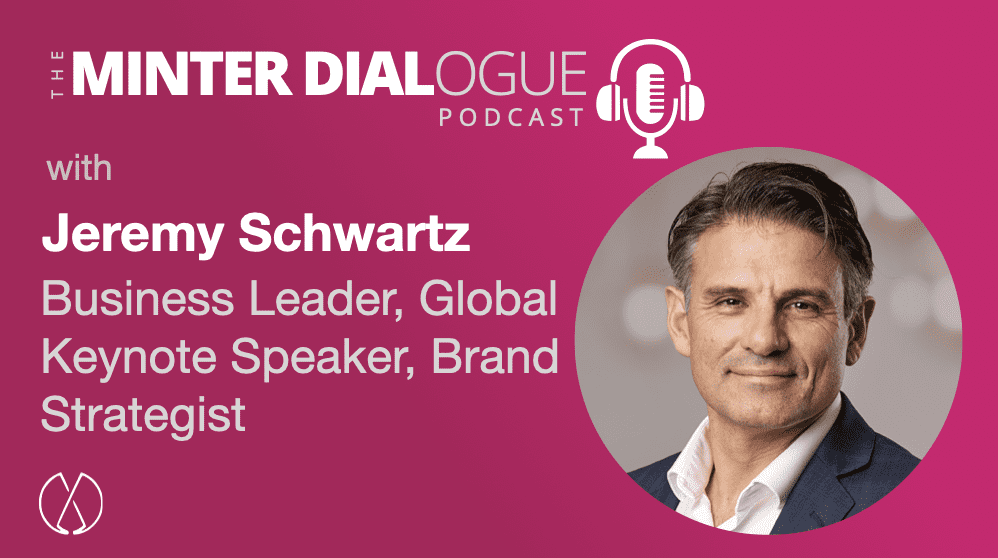
Minter Dialogue with Jeremy Schwartz
In our episode, we traversed the worlds of personal expression in leadership, dissected what makes slogans and company purposes truly move markets, and confronted the complex reality of corporate fear. Jeremy shared stories from his days co-creating the iconic “Because I’m Worth It” campaign, as well as his experiences reshaping legacy brands ripe for reinvention. We also explored the finer points of taking risks in large organizations, and how play, laughter, and presence infuse teams with innovative energy.
Key Points:
From decoding the pitfalls of corporate conformity to highlighting the art of making purposeful change stick, Jeremy’s perspective is as relevant to founders as it is to Fortune 500 leaders. If you want to unlock transformation—whether that’s for a brand, a business, or yourself—true connection, bold clarity, and a willingness to play are the ultimate differentiators.
Further resources for the Minter Dialogue podcast:

Meanwhile, you can find my other interviews on the Minter Dialogue Show in this podcast tab, on my Youtube Channel, on Megaphone or via Apple Podcasts. If you like the show, please go over to rate this podcast via RateThisPodcast! And for the francophones reading this, if you want to get more podcasts, you can also find my radio show en français over at: MinterDial.fr, on MegaphoneFR or in iTunes. And if you’ve ever come across padel, please check out my Joy of Padel podcast, too!
Music credit: The jingle at the beginning of the show is courtesy of my friend, Pierre Journel, author of the Guitar Channel. And, the new sign-off music is “A Convinced Man,” a song I co-wrote and recorded with Stephanie Singer back in the late 1980s (please excuse the quality of the sound!).
Full transcript via Castmagic.io
Transcription courtesy of Castmagic.io, an AI full-service for podcasters
Minter Dial: Jeremy Schwartz, brilliant to have you on my podcast. You and I have connected thanks to our mutual friend and associate, Philip Waterhouse. We also have a bunch of shared things in common, but as I like to start, Jeremy, I want to go with a little question is, who is Jeremy Schwartz?
Jeremy Schwartz: Oh, who? Well, you see, That is a good question because it depends how one defaults to define yourself. So, I will say that I’m now a mountaineer, long-distance cyclist, adventurer with 3 great sons who are adult sons and a delightful wife. That’s how I shall define it for the moment. And we can then see if we push the definition more to a work background area. I’ll let you do that.
Minter Dial: Well, Jeremy, what’s interesting about the way you describe yourself, those are all very personal elements, And one of the things that you and I share in background, of course, is an experience at L’Oréal. I for 16 years and you for combined 16, 20 years, somewhere in there. Personal elements at work. What was the place that you give for personal elements at work?
Jeremy Schwartz: Okay. Can you define that slightly differently, the question?
Minter Dial: Right. Well, what, where does personal‚ do personal elements, personal health, personal strife, personal issues have a place at work?
Jeremy Schwartz: Oh, I see, have a place at work. Oh, that’s interesting. Wow, that’s a very interesting! where do they have a place, personal issues, personal strife at work? Well, I think at one level, it is to not have a place for that at work, to separate it from work. However, I’ve actually always been very sensitive and disposed to support people who have a personal issue that is discovered and I’m aware of at work, and to accommodate it, to show care and attention to it. And I could just make that a full stop, and I’d like it to be just a full stop on that point. And, you know, I’ve got lots of examples of‚ I think of a particular woman whose boyfriend was badly injured in a motorbike accident in Italy while they were on holiday, and I paid for her to go back to Italy to be with him in hospital. I’ve got other examples of people dying or being ill and giving them, you know, generously time off to solve that so that when they did come back, they were more effective. But my little sad element that I am bringing forward in the same breath is There is this line that no good deed goes unpunished. And I think what I’m disappointed by the human condition is I have been more‚ I have more examples of the fact that people respond in kind by not it being in kind, but being disappointing in how they might reciprocate some action. And therefore, though one never does anything with any expectancy of response or thanks or so on, one doesn’t expect people to go the other way. And I have got too many examples of that, so I become a bit cynical in some aspects of supporting people and whether that kindness is reciprocated when required. So, there you go. Well, you‚ those two thoughts into one sentence, which is a bit disappointing, but it is my reality.
Minter Dial: Well, life is complex and there’s lots of nuance needed. It’s sort of, you can’t have blanket statements like, well, everyone shouldn’t be personal or everyone should be personal. And, uh, I talk a lot about empathy at work and I come from an experience where I did not divulge at work my illness for fear of being chastised or eliminated for being weak. So, there’s, I think it’s a topic that’s worthy of conversation.
Jeremy Schwartz: Well, let me explore something because actually you’re bouncing into something that I do. So, what I do now is two things. I’m a global keynote business expert speaker. So, I’ve just come back from Helsinki and the week before last come back from Japan. Actually, I spend most of my time outside the UK speaking to groups of executives. But also, I have a 1-day transformational offer that I give, that I have for executive leadership teams. And it’s got 2 components. One is to get at this very senior level conversations between executives that don’t get that aren’t said, conversations that need to be said but aren’t said, because at a very senior level, you are very‚ people are defensive, they are territorial, they have hidden objectives, i.e., self-preservation. And yet conversations do need to be said. And this methodology requires people to share a story that explains the behavior that they exhibit in work which they know may antagonize or require explaining. And every time I’ve done it‚ I’ve just done it in Saudi last year, I did it in Singapore last year, I did it in the UK last year‚ a group of 10 senior long-toothed executives will end up crying, as I have too, because people reveal the stories that explain their behavior. And actually, everybody on the whole is carrying a story. And the question is, should that be revealed? It’s a really interesting question, because does in revealing it you lead to a judgment which can uh, be, negative, or, or lead to an assumption of behaviors and so on? And I think I can see two outputs. One is the engagement between individuals once a story has been revealed actually amplifies dramatically. The human condition‚ the person becomes more human in the eyes of their colleagues. Um, and that is what I’m trying to achieve. Though I know there’s a couple of examples where I myself have judged the people as a result of their story, and therefore in them revealing it, they may well have inhibited their opportunities or progression. So, this is a delicate line to follow, but, um, the benefit of doing it has been greater, I think, than the loss for the majority. And it has been very interesting.
Minter Dial: Well, I think this notion of fear, uh, the fear of saying what we want to say, the fear of retribution for revealing something that’s personal‚ that’s not how we do things around here. It’s, I think it really is part of the toxicity and the loss of engagement that happens in a lot of businesses. Obviously not all, ’cause that’s a sweeping statement.
Jeremy Schwartz: Well, it’s funny, it’s even funnier that you’ve literally used the line, how we do things around here, because that is not, I don’t think, a particularly well-used line. And it’s a line I use a lot. And in just the way you’ve done it, which is between quotes with a sort of that this is an important line. And, uh, I believe that the word, the concept of fear is not discussed enough in both work life and even private life. But since we’re talking about work, and that fear is a huge driver of behavior. And in fact, one speech I did which I thought was shocking is, um, I did a speech for Disney Europe on creativity, but the context was that the employees were so frightened of their managers, of the business, of the institution, that people weren’t creative because they were so fearful. And there was an organization, Disney, that we attribute great creativity with, and yet they’ve obviously institutionalized a behavioral environment or culture, if you want to use that, where fear predominates. So, yeah, it’s a huge item. And the fear isn’t necessarily about retribution and personally, it can you be, know, I’m going to make a decision now. If it works, that’s great, but if it doesn’t work, what may be the consequence. So, it’s not necessarily personal, it is the consequence of doing an action which may not succeed, and you know how people react, and therefore it’s better not to do anything because I’m fearful of the unknown. So, yeah, fear is a crucial element that’s not discussed at all.
Minter Dial: And I would argue that in the end of the day, I mean, my‚ this is my position statement‚ we are all run by emotions. And if we do not have a space or a place for emotions at work, good Lord, just everything being rational. You, you being a marketing man and a branding man would understand that brand and marketing isn’t just about rational decisions and KPIs.
Jeremy Schwartz: Yeah. Yes. I mean, emotionality is crucial to brands if we want to. That’s the fundamental differentiator is it creates some sort of emotional reaction. But we are‚ we probably have always been, and are now as much as ever, in an environment where the pressure to get results and the intensity of meetings and the intensity of interactions with people mean that there isn’t much easy space for emotion, probably. It’s fair to say. I mean, it’s quite, yeah, that’s, you know, it is a, it can be a weakness to express it and therefore it is about hard behaviors and hard tactics and hard men and hard women and hard decisions. Yeah.
Minter Dial: Well, speaking about hard, Jeremy, in my little research on you, you, I like to sort of explain you in one sort of, you know, elevator pitch, metallurgy to marketing with a taste for theater. And was wondering to what extent either you think that your success, your original story comes from the fact that you had this strong, heavy scientific background, engineering-trained mind, or is it the combination of creativity plus engineering that makes you so successful? And maybe what does that spell for how other companies should be viewing candidates?
Jeremy Schwartz: Yeah, very‚ it’s very‚ it’s a very interesting observation because for many years‚ and I haven’t said this for many years‚ but for many years I saw myself as combining a mathematical engineering logic with a creative streak, and that those two things together were actually paradoxical and were in opposites, but were interesting to combine them, uh, because it brings both a scientific sort of curiosity and delving into, uh, the‚ what I call the truth of the matter, what is actually the driver of something from a scientific analytical mind. But I’ve also got a creative streak, and, um, and the word theater is also an interesting choice because theater is also important to me, which is more around actually entertaining, which is more around elevating people’s joy in themselves. So, the motivation, if I strip it all back, is to improve people’s moments. I don’t want to use lives because lives is big, but it could be. But let’s say moments. That is what gives me satisfaction and why I was in brands and big companies is our brands in theory can improve people’s moments in their lives. And big brands affect many, many people. So, a way to change the lives of many people is to work on big brands. It could be politics, but I chose big brands. And yes, those two words sort of express how I’ve approached those things, a blend of analysis and creativity to uplift people.
Minter Dial: So, I suppose there’s no, there should be no surprise that the way I positioned that was very much with a French saying which is chez L’Oréal: une part poète et une part paysan, be a poet and a peasant, which is what we used to say at L’Oréal, which was very much that sort of similar type of comedy. Well, it was more hardworking necessarily than being rational, but de facto because of ESSEC and HEC and all that, very much rational thought.
Jeremy Schwartz: Yes. I mean, I also had a different, slightly different word. I know that was very L’Oréal. It was the Princess Diana effect, which was to be both as aspirational as Princess Diana was, but also a woman of the people. Why I feel that she had this global, uh, impact. And particularly when you hear some people in Britain talk about her, you know, the appeal was here was somebody who was clearly a princess but of the people, because she could be very close. And, uh, again, I have that same driver, which is at one point to Listen very, very carefully, both first of all to customers, to people, to what is it they’re trying to achieve in life, or in a work environment, to the youngest person or the person with the most menial job or the person who’s never talked to behind a computer screen, because they could reveal something of importance. But at the same time, trying to always create a sense of ambition and inspiration and ambition, which is really important to me. That would mean that people could imagine going somewhere bigger than where they were. And so, I’m interested in those two thoughts.
Minter Dial: So, you use the word theater and entertainment, which equals in my mind the word play. Obviously a play is something one performs in theater. The idea of to play is something that we usually associate with children, And yet, does it have a place, if I may go back to that idea, in work? Does play have a place?
Jeremy Schwartz: Oh, it absolutely and utterly does. And of course, or no, not of course, we know, or we see that creativity comes from play and that play allows one, I’m having to think this loud because I haven’t thought about it for a while, specifically, but the idea of play does appeal to me. Um, it appeals to me in the sense that, uh, you know, even now, if I, I enjoy the company of young people a lot, like you just mentioned also, I think you said yourself, and I like it because there is a sense of joy, a sense of play, a sense of, uh, um of release, you could say, or of exploration through game. And of course, you know, football and rugby and all these sports and padel is about play, and it is about being able to take yourself away from just rational thought to in the moment and an emotional experience and relying on other skills just than your brain, but how you can bring your whole physicality together and the joy of, of winning in a moment, which is playful, And yes, creativity and therefore breakthrough thinking requires that playful thought because I have a strong conviction that new innovation comes through the subconscious processing large amounts of data, and the data is random in its nature. It’s not random in its actuality, but it comes from different sources, and innovation comes from the subconscious making connections and then bringing it to the conscious mind.. And therefore, there’s a play that needs to be occurring to make connections between thoughts that aren’t all rational, and that leads to innovation. So, yes, I think play is crucial actually in a work environment. In fact, I’ve always brought and tried to bring a laugh into a meeting. So, as an executive team meeting, unfortunately, I am neither funny nor comedic. According to my family. Um, and therefore my‚ Oh, Dad! Yes, oh, Dad. And, uh, or Dad, you’ve gone too far, maybe even another one. But just to bring that lighter moment, that sense of laughter, which just takes away the tension and gives permission that, you know, we’re here to be human, we’re here to have conversations, we’re not here to, uh, be tight-arsed because we better worry about what we’re going to say and who’s saying it, and we’ll keep everything quiet to ourselves because actually it’s dangerous to say something. So, and in fact, a little story is that relatively early on in my career when I was in Sainsbury’s, the CEO knocked on the meeting room door that I was holding a meeting and told me and all my team to not laugh so much. Now, clearly, we must have been laughing such that we were heard through the wall. And so, if he was having a serious meeting, I do forgive him for, for wanting to have some more silence. But I thought the moment was just So ironic that we were being told not to laugh so much as an instruction from the CEO, where I think, you know, laughter is actually really required in work to remove the tension, to create bonding, because laughter is a moment of shared understanding and bonding. And so, yes, a long answer to a simple question. There you go.
Minter Dial: Giggles are contagious. One of the things I, I mean, I love playing sports a lot, and of course there are lots of parallels between sports and work, but the interesting component for me in play, whether you’re acting or in a game where you’re playing padel in particular, is the need to be present. Because if you’re not present, you’re going to skip your lines. You’re worried about what’s happening after the performance or other elements come into your inability to lean into the character you’re playing. When it’s a theater, I did a lot of acting in my life as well. And when you’re playing padel, if you’re worried about who’s going to pick you up afterwards, am I going to make the train or whatever else? How on earth do you play? Are you present in that moment? And I think play in general is a great way to be present. At least it breaks us away from the shackles of fear, performance, and other, the risks that we are interested in. So, I want to go back, Jeremy, or at least focus in on two topics in the time that we have left because they are of particular interest to me. One of them is work on Because I’m Worth It. I’ve rarely had the chance to talk to OGs, the original gangsters who worked on Because I’m Worth It. So, tell me about how that came around or what your role was perhaps in it, and to what extent you think it’s still a vibrant, relevant, powerful, timeless claim.
Jeremy Schwartz: Well, it started The background, the strategic background is that L’Oréal in the UK was not performing to where it would like to perform for two reasons. First of all, it didn’t have a haircare brand, and the haircare brand was a way to sell a large volume of very affordable products and therefore become much bigger as a business because of volume and affordability. We were selling a lot of skincare and makeup, which is more niche and more expensive. And consumers in Britain were feeding back that they perceived that the brand was expensive for what it was. And at the time, L’Oréal was using adverts that were showing the famous 7 supermodels swishing their hair, getting off helicopters, becoming very businesslike, which was all fine, but was starting to become parodied by comedians as the sort of L’Oréal hair. But more importantly, consumers were saying we were too expensive. And so, one thing that became clear is, yeah, we’re expensive because we invest huge amounts in R&D, and, you know, we’re worth it because the product performs much, much better. And we wanted to, needed to somehow make that point. And we were also working at the same time on trying to relaunch again Elvive, which was a brand which we’d launched several times in a mousse format and formats, but it failed to succeed. And my team and I, actually it was a lady called Emma Wormsley, who is the CEO. Glaxo. We’re looking at, or wanted to challenge Mr. Owen Jones and the establishment on the adverts that we would use to launch this brand, believing that we needed to tailor something to the UK market if we were to succeed, that if we just use the French standard ads at that moment, we would be ridiculed probably. And so, we were trying to justify and give a good reason. So, anyway, we were looking at all the ads, and there was an advert by Cybill Shepherd in a America, in which she tapped on an ATM with her L’Oréal nail varnish and was explaining how it was crackproof and therefore she could tap on the ATM. And she said, because I’m worth it. And it just was like, wow, there, there’s a line that sort of sums up what we’re trying to deal with, which we cost a little bit more, but we’re worth it. Now, at the time, there was also a vice president of the company, Monsieur Rabain, a very particular French character, Patrick Rabain, who saw also this line and could see that this was a way to address this gap that we had in perception, and therefore advocated really strongly that we should bring this line back and link it to the launch, the relaunch of Elvive. We were able to convince Mr. Owen Jones that we should use Jennifer Aniston to be the front lady, which she was not at all supportive of. He did not respect her or think that she was an appropriate supermodel because she was an actress, but she had the most stunning hair at the time. Of course, she was in Friends. Her hair was her reputation, and she‚ we felt she had the ability to deliver a story and that line in a way that an actress would more than a supermodel. And she could also say some other things because in fact we asked her to say that she’d just fallen in love with a shampoo. And also a line, we wanted her to signal that we all really did know that the technology bits in the adverts were part of the L’Oréal signature, but, you know, were not necessarily always foliable. So, she said, and here comes the science bit, which for England, we understand that that was done with a twinkle in her eye, which said, well, you must have this. Anyway, so that was the launch of both Jennifer Aniston, Elvive shampoo, and Because I’m Worth It. And she delivered it beautifully. And that was then rolled out worldwide by L’Oréal as a result of seeing the success because the shampoo became market, well, number 2 in the market within 3 months and was a big success and is now the market leader from memory.
Minter Dial: Is it not Elvive now? I thought they, did they change? Yeah. But what’s very smart about that particular story is that it went from, because we, the company, our products are worth buying, to I’m worth it to pay the extra amount for the shampoo. And I think that’s the genius behind it. But how does it live with you today, Jeremy? How do you, when you look at that slogan?
Jeremy Schwartz: Yeah, I mean, I personally think it is a timeless slogan. I do think I see, I mean, look, I’m not studying L’Oréal adverts at all. And because I don’t watch that TV, I’m watching YouTube and so on, and sometimes I see, but I do sometimes go and have a look. And the only thing I feel is, um, or too often it’s thrown away as an advertising line by the woman spokesperson as opposed to a sincere statement delivered by a woman to other women. And therefore, I find from time to time it’s, it’s lost its meaning. And this is actually quite important because I’ve had this in several jobs where‚ and we could actually even say with this line that the line was used in America and then stopped. And the reason is, in big companies and in all sorts of things, people lose the history and lose the original intent. And with that loss of intent, uh, it becomes like just some mechanical thing. It’s not a mechanical thing. It’s one of the most profound lines of a company to speak to women to say, you know what, yeah, well, I’ve said it because I’m worth it. And it’s, you know, and that can’t be just delivered as a monotonic line. It’s got to be done with theater and entertainment because you’re trying to make a point. And I, I see‚ anyway, I’m repeating my point‚ somebody doesn’t quite understand the importance of that line when the actresses say my it, in view.
Minter Dial: Well, and that’s definitely part of any storytelling that goes around purpose. Jeremy, I wanted to talk to you about a topic that has been dear to me, which is the notion of purpose in companies and the specific challenge of having purpose in a conglomerate. Because at the end of the day, you have the option to have a company-wide purpose. We’re here to solve a problem for a group of people, let’s call it, you know, women in the world. And then you have brands underneath them. And it, it, it seems archaic to believe that each brand should have the same purpose. Probably every brand should have a different purpose and, and that’s specific and coherent, congruent with that brand and its history and so on and so forth. Especially when you have many of them. How do you look at purpose in that context when you’re thinking about the corporate identity and then how it breaks down into brands?
Jeremy Schwartz: Well, first of all, I would actually humbly call myself a guru on purpose thinking, purpose architecture, purpose development, purpose execution, purpose leadership. So, I’m just going to make that statement to you. I’ve invested a lot, I’ve developed a lot of thinking around this, I have a lot of frameworks for this. And I can answer you very clearly that, first of all, you can have some companies in which the brand of the company is the corporation to. So, let’s say Coca-Cola, for example, with that brand.
Minter Dial: Apple.
Jeremy Schwartz: And Apple, yes. And we can go‚ the many we can go on, I’m sure, you know. Um, well, not I’m sure, I know there are many, many. But you’re bringing up a different problem, which is when you have a company that has multiple brands. And I’m clear that you, uh, absolutely can have a corporate purpose, uh, which is the role of the corporation and should lead how it approaches, let’s say, slavery or pricing or product or innovation, blah, blah, blah, and should be an engine to growth for all of those things. And that some of the brands can warrant to have a purpose too. Now, I have worked with and seen companies who have sought to take the idea of purpose and to apply it systematically to every brand. And depending on how you define purpose, which we could or not in a moment, run foul, that they have forced that idea onto some brands where really there is no purpose in that brand, or the application of that thinking just does not warrant it. And then they’ve got themselves into a bit of a mix or pickle, rather than saying, okay, we’ve got 3 brands here for which that idea is justified, can work, and has value to the consumer, and we can differentiate the brand through it, and it is useful. And these other ones have a simple proposition, which is potentially less added value, less differentiating, but can work with what’s called a proposition, which is more of a moment in time, while a purpose is the impact it has on a consumer over time that can change. So, that’s the way I would skin that cat. Yeah.
Minter Dial: And so, the, the particular problems‚ we talk about the Coca-Colas of the world, of course, they had other brands underneath them.
Jeremy Schwartz: Yes, they did. And therefore, you could what I just apply said.
Minter Dial: Right. Well, the challenge that I was thinking of in particular is if you take the example of Procter Gamble versus L’Oréal, where Procter doesn’t sell a single brand under the name of Procter Gamble, did but doesn’t. L’Oréal, on the other hand, has at least 3 commercial brands that carry the name L’Oréal. And therefore, the murkier the water, because if you have a corporate identity It, it’s more of an umbrella. It’s a distant concept. But when you have brands that are commercial that have their purpose, how does that not link into the corporate company and therefore somewhat impact, stain, or mold the purposes of other companies? And so, rather than say that every, the corporate mission purpose should exist in each brand, How do you have one where a purpose might be antagonistic from one brand to the corporate brand or from one brand to another?
Jeremy Schwartz: Well, you could, I think the word, let’s take the word antagonistic ’cause I think that is important. And for example, well, I won’t use this example, I’m going to just tell you it and then we’re going to move on to a different example. But you know, L’Oréal acquired The Body Shop, and The Body Shop, we can argue, was part of its justification and engagement was that it was a counterforce to L’Oréal. It was that, I think we could, could argue and define, was why it was successful, because it was the antithesis of L’Oréal. And then when L’Oréal bought it, it then had to reconcile or justify or maintain something that L’Oréalized. And, you know, we got that with McDonald’s and Pret. You know, there are a lot‚ there we got quite a lot of examples of where these big corporations buy a brand whose very essence seems to be to exist as a counterforce. And then how does that stack up with both the consumer, if they have checked that out, or within the company, when and only you have a decision in which there is a conflict because 90% of the decisions of that brand could be aligned to the corporation. Let’s say the corporation said, we’re ethical, you know, we’re here to, you know, solve consumer problems, we do it, you know, responding to the sustainability, blah, blah, blah. You could say, well, that’s all of those check up nicely. So, we’re not in any conflict. But there may be a place, perhaps Ben Jerry’s with Unilever, where Ben Jerry’s said, we’re not going to, you know, well, the local team said, we’re not going to, I think, supply to Israel. Which may be very in conflict with the corporate that we’re here to be in every country, for example. And then you have got a challenge which I can’t give the full answer to now, but definitely that challenge can exist. And then you have to say, do we keep that brand? Can we credibly keep it? Or are the daily conflicts means it gets watered down and therefore it’s not truthful to itself and the consumer will detect that and we will therefore not grow because that is so fundamental.. So, I think that has to be looked at case by case, but definitely can exist.
Minter Dial: All right. So, for the last portion, I’d love to focus in. I mean, you’ve done so many things, Jeremy. It was a little bit difficult for me to cherry-pick the topics that I wanted to discuss with you, but obviously the fact that I‚ so thank you. But looking at The Body Shop, obviously a huge experience investment for L’Oréal buying The Body Shop. And you then, after coming back to L’Oréal, which I also wanted to ask you about, but running The Body Shop during that period, making it saleable and coming up with the tagline, enrich, not exploit. Just let’s start with sort of a more general picture. How do you look back at your time at running The Body Shop?
Jeremy Schwartz: Well, there were two elements. I think at a personal level, it was extremely rewarding because it was a global brand. In 66 countries. And it was a franchise business. So, I had the privilege of working globally, privilege of working with franchisees, who are very interesting collaborators, with a great team, and obviously on a brand who had a lot of legacy, but was not seeing that translate into growth in the way that one would like it to. I think it was disappointing to not do some of the things I wanted to in order to get that momentum back. And, and that was frustrating because other brands like Sainsbury’s and Pandora, the work that myself and the team have done have led to transformations of sales that have been almost instantaneous. Well, within 8 weeks, and have led to 5 or 10 years of like-for-like growth. So, the ability to do something to a business and a brand and see an instantaneous transformation, I’ve luckily had 2 or 3 examples, but The Body Shop wasn’t one. It was in some countries, in the UK that happened, but not overall. So, that’s disappointing, you know, and it continues to struggle. It struggled with its next owner and it struggles again. For many reasons I can see. But yeah, that’s frustrating and disappointing because it’d be great to have had that as another success.
Minter Dial: Well, I wanna just zip in on one piece you just talked about with your work at Pandora, the fascinating story that you wind about that where you very quickly got them focused on what does the customer want? What are they thinking? What are they saying? And having impact within such a short period of time. There is a saying that goes, you know, you have 100 days to make your mark. And if you don’t make it in 100 days, are you not then probably destined for a less successful experience? To what extent that resonates with you?
Jeremy Schwartz: Yeah, I’m, I’m very torn by that because at one level I actually like to spend the first 3 months listening, um, because in fact it is all too easy to come in all guns blazing thinking you, you you know, know the answers to everything from your previous experience or from observing and then finding that the truth of the matter‚ that’s a really important word‚ is much more embedded deeply in something that takes time to uncover. Um, on the other hand, uh, funnily enough, whenever I write down all the things that I think I should do and are necessary to do before I’ve joined a job, and then look back perhaps 5 or 6 months or even a year later, I’m always astounded that those‚ some of those things were so true and so accurate, and that I’ve somehow perhaps even forgotten them or been distracted onto lots of other things. So, I think it’s important to make some bold moves in the first 100 days, so that people get a sense of your leadership, they get a sense that you are bold, they are, and they get a sense of where and how you’re going to lead. But for your whole career or your whole impact to be weighted on that, I think, is completely naive. And, you know, we can see that with politicians because they’re probably sometimes more easy to see. But we have seen some people who‚ and the most interesting one for me is the previous CEO of Unilever, who I think was in his job for 1.5 years and was fired for not acting fast enough. And so, we are also in a particular time where time, I believe, and I talk about this a lot, You know, is a source of competitive advantage. Speed is a source of competitive advantage. And if you are too slow, a board or others or the competition, you know, will penalize you and so on. So, speed is a component of action, but your whole action does not depend on your 100 days, in my view.
Minter Dial: Well, hopefully you don’t get a board that gets bored, so to speak.
Jeremy Schwartz: Well, that can happen, yes, I think.
Minter Dial: Yeah. And to just go back, you said the truth of the matter, and you said that’s an important word. The funny thing is the way I heard that is what matters is the word that matters, as in the truth of what matters is probably the most interesting component of that statement rather than necessarily the truth.
Jeremy Schwartz: Well, yes, I mean, they are linked in the sense that the truth means that this, the thing that you are seeing is the true, the absolute driver of the results. And in, you know, businesses are incredibly complicated, consumers are very complicated, products are very complicated. Again, coming back to one can‚ one has to say, is something correlated or is it causated? And too much of what one sees or judges can be a correlation, not a causation. Finding the causation takes time, and that’s the truth of the matter that I was talking about.
Minter Dial: In The Body Shop story, something I’ve written about without ever having discussed it with Philip Clough, I did chat with him about it presumably, or is it Michel Tanguy or one of those two? But in any event, The Body Shop for me was bound to be difficult for a new owner because it lacked the presence of the founder. The issue of the founder was that she’d run out of steam and the, the, the, that, that was, that there was a need for new impetus and all that. But it seems to me always very difficult for any brand in transmission after founder to keep the chutzpah, the risk-taking, the need for difference and the, the rememory of why it exists in the first place. How did you, take on that mission, that mantle?
Jeremy Schwartz: Yeah, I think I can partly agree with you. I think we’ve got a lot of examples of brands. Well, you know, near enough every brand we deal with has its‚ many of them have their roots, you know, 100 years ago. So, whether it’s Mercedes or Coke or BMW or Apple, you know, we can go bum bum bum bum bum bum bum, and all of those had a founder. And all of those don’t have that founder anymore, and they continue to grow. So, I don’t think I can support that proposition. And that’s why having a purpose for me is so important, because that should be the driver of that original thought. Or‚ and yes, well, that’s the full stop. And that brand hopefully is connected to that, and everybody understands what was that, what is that truth that is the thing that people are connected with. I mean, for me, you know, one of my diagnosis of the problem with The Body Shop was that as brilliant as Anita was, and she was brilliant, she fell in love with her own news and her own, um, passion for campaigning. And in the end, you know, this was a retail beauty business, and it was not good at retail, and it was not, uh, very good at beauty. And the brand itself was a weak brand idea, as in its name. And therefore, all of those things meant it fell beside, fell back versus competition such as Lush and others, where the products were better, the retailing was better, the brand name was better, and just campaigning as an idea became a weak idea and very fragmented. So, yeah, that’s my, was my diagnosis. And therefore, why did I therefore focus back on product with all L’Oréal skills and asked L’Oréal to Supply all their fantastic product, and we had a fantastic product developer. Because in the end, beauty is about amazing product, and people respond to something that works. Why did we then try and, you know, improve the retail, all the retail expertise? Because then people come into shops and they want to find the product that they love and not be lost, and they want to see the pricing, and they want to have amazing service. But we didn’t crack, unfortunately, the brand bit, which was to make the brand something that people in this modern brand world of another 10,000 brands on your apps, be something that people had an image about what it stood for. Because The Body was not the products that actually people bought a lot of, it was skincare. And by having The Body in the name, it limited the opportunity to be a brand of products for all of you, in my view. So, the brand name in itself was the problem.
Minter Dial: Interesting.
Jeremy Schwartz: Well, because not many people have either discussed it, engaged with it, or processed it. But changing‚ I’m‚ one little sub-subject is when does a brand name actually lack the gravitas or the, the elements to make that brand ginormous? And there are times, and you know, we can see it with Snickers as one little teeny example of changing a brand name and that being a good decision?
Minter Dial: Well, indeed. And if you look at so many law firms or consultancies or advertising agencies, to take a few, they’re the basically the names or the initials of the 3, 4, 2, 1 founders and stuff like that. And that doesn’t have much gravitas. I mean, as great and amazing as some of the entrepreneurs are, it smacks of another problem. I want to get last topic, Jeremy. We started off talking about fear, the fear of doing things and the fear of being rebuked or punished for saying things, doing things that are wrong. And it talks about this notion of risk. And in The Body Shop, you put this bold bet on the notion of enrich, not exploit. And I can imagine that that was quite a contentious topic. I don’t know, but a contentious topic to try to push through. A, is that true? B, how important is it for people to take bold bets and risks? And C, how would you mastermind such an idea? If someone’s listening, says, I really want to do something bold, what should I be doing?
Jeremy Schwartz: Well, I think it’s very important because We see those companies that are growing phenomenally right at the though moment, they are ones that do take bold risk. I mean, they don’t have to be risk, they can be just bold moves that are very relevant. That’s the way I try and position it. I think the word risk is a real problem in business because it is associated with many actions of which there is no risk, or the risk is incredibly manageable or worth it. And the risk should be that of the 10 decisions we take, 8 will be very successful and 2 will not be, but the value of the 8 is greater than the 2, and therefore this is business. It is about having a net upside versus downside where you try 10 things and 2 don’t work and 8 do. And therefore, boldness is required. The way to get it through, in my experience, is to bring the consumer into the story because When you bring actions internally, there’ll always be 5 people who think that’s a good idea or happy to support it, and there’ll be somebody who’ll be antagonistically, annoyingly against it because of their opinion. And then you’re in a battle of opinions, and it’s whoever may be more senior or more loud will win that. While if you bring the consumer’s voice into it, then it’s a pretty arrogant person who says the consumer’s wrong. Now, of course, there are some people, And Steve Jobs, you know, believed that you didn’t, shouldn’t ask the consumer because how do they know? I mean, that was all very nice. I sort of agree with him, but no, I don’t agree with him. Actually, I don’t agree with him. I think he probably had a very good intuitive understanding of what the consumer actually wants and was uber consumer-focused and therefore felt he didn’t have to ask them but knew what they wanted. But otherwise, one needs to bring the consumer’s voice in such that that’s the data that gives the confidence to the managers that this is a good decision because the consumer says that they will engage with it. And it’s not just your opinion versus theirs.
Minter Dial: A powerful and well-spoken finish. It does make me think about the 80/20 rule, which‚ so 80% would be good ideas and 20% don’t. It’s funny because in the entrepreneurial world, it’s more like 1 or 2 that work and 8 or 9 that don’t. And therein lies the gap, I would say, between the true startup and the corporate world. And the French expression, which is related, in fact, we worked for L’Oréal and so on, is the difference between venture capital, which is how Yanks and English talk about investing in startups and so on, whereas French call it capital risk, whereas, and they much prefer to invest much less as a result. Lots of messages in there. Jeremy, how can someone track you down or at least hire you, get you in for speak at their conference with your inspirational stories and all these different experiences that you’ve had?
Jeremy Schwartz: Well, I have a website, so it’s jeremy-schwarz.com. That’s my speaking website. And then my business one is maxius, because it’s about maximizing a business,.co.uk. And on both of those, they have my email to my PA, so you can contact to me directly that way. And of course, there’s our friend LinkedIn, um, but I’m happy to be contacted directly and will always answer promptly, inspired by Mr. Martin Sorrell, who if you email him 24/7 will answer you within 30 minutes. And, uh, I find that’s a good, um, belief system to have, or value system to have.
Minter Dial: The famous SMS.
Jeremy Schwartz: Yeah.
Minter Dial: And, and, uh, he certainly responded every time to me. So, he lived and walked, he preached what he did, and he did what he preached. Love that. Thank you very much, Jeremy, for coming on.
Jeremy Schwartz: Yeah, it’s a pleasure. It’s been enjoyable. Thank you.

Minter Dial
It’s easy to inquire about booking Minter Dial here.