
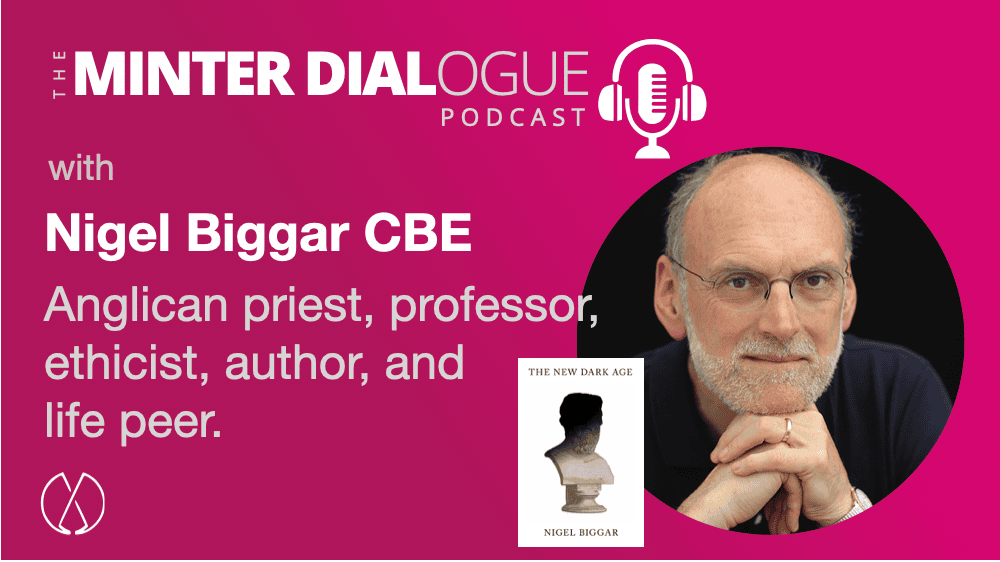
Minter Dialogue with Nigel Biggar
Nigel Biggar CBE is a renowned Anglican priest, ethicist, and, as of January 2025, a Conservative peer in Britain’s House of Lords. Hailing from Scotland, he boasts an illustrious academic career that culminated in the professorship of Christian Ethics at Oxford University. What fascinates me most about Nigel is not just his distinguished background but his commitment to grappling with the thorniest moral and historical issues facing Britain and the West. From colonial history to the modern culture wars, Nigel has never shied from uncomfortable debates, instead inviting us to see our past—and present—with nuance, courage, and honesty.
Our conversation unpacked the complex interplay between patriotism, progress, history, and the responsibility that liberal societies bear to face their flaws without losing sight of hard-won virtues. We explored why the story of Britain—and indeed the West—is too often reduced to its sins, and what’s at risk if we abandon both pride and realism about who we are.
Key Points:
- The Importance of a Balanced National Narrative: Nigel champions the acknowledgement of both Britain’s historical sins and its remarkable contributions. He warns against a culture that “trashes” our history, arguing for a narrative that admires past achievements whilst never glossing over moral failures.
- Progress, Ethics, and the Myth of Irreversibility: We discussed the evolution of ethical standards and the danger of moral complacency. Progress isn’t a one-way street; blind spots remain, and virtues like humility, courage, and self-restraint must be consciously cultivated to preserve a liberal, open society.
- The Real Threats to Liberal Society: Nigel is acutely aware of illiberal forces from both extremes—whether progressive zealotry seeking to silence dissent or reactionary movements in religion and politics. For him, the survival of freedom hinges on courageous, honest engagement and a renewed commitment to open debate.
In a world plagued by culture wars and historical amnesia, speaking with Nigel reminded me how crucial it is to both cherish and scrutinise our story. His emphasis on balance, moral rigour, and the courage to speak out feels more necessary than ever.
Three takeaways from this episode:
- We must engage honestly with our history, resisting both hagiography (over flattery) and self-flagellation in favour of the whole, complicated picture.
- Liberal societies are only sustained by citizens willing to practise, and sometimes fight for, virtues like courage and humility.
- Progress isn’t guaranteed; defending freedom and open debate requires each generation to reject both denial and despair with equal vigour.
To connect with Nigel Biggar:
- Check out Nigel Biggar’s profile at the University of Oxford here
- Find/buy Nigel Biggar’s books on his Amazon author page here (and individually below):
“Colonialism: A Moral Reckoning,” here
“Reparations: Slavery and The Tyranny of Guilt?” here
“The New Dark Age: How the Culture Wars Came for the West,” here - Find/follow Nigel Biggar on LinkedIn
- Find/follow Nigel Biggar on X (formerly Twitter)
Other mentions/sites:
- “The Abolition of the Brazilian Slave Trade,” by Leslie Bethell here
- “The Tyranny of Guilt,” by Pascal Bruckner here
- “Our Island’s Story: A Better Story About Britain,” by Nigel Biggar and Robert Toombs (forthcoming – October 2026) here
- Poem: “The Second Coming,” by W.B. Yeats here
- Minter Dialogue Episode featuring Rob Schenck here
Further resources for the Minter Dialogue podcast:

Meanwhile, you can find my other interviews on the Minter Dialogue Show in this podcast tab, on my Youtube Channel, on Megaphone or via Apple Podcasts. If you like the show, please go over to rate this podcast via RateThisPodcast! And for the francophones reading this, if you want to get more podcasts, you can also find my radio show en français over at: MinterDial.fr, on MegaphoneFR or in iTunes. And if you’ve ever come across padel, please check out my Joy of Padel podcast, too!
Music credit: The jingle at the beginning of the show is courtesy of my friend, Pierre Journel, author of the Guitar Channel. And, the new sign-off music is “A Convinced Man,” a song I co-wrote and recorded with Stephanie Singer back in the late 1980s (please excuse the quality of the sound!).
Full transcript via Castmagic.io
Transcription courtesy of Castmagic.io, an AI full-service for podcasters
Minter Dial: Nigel Biggar, how lovely to have you on my show. I, I’m just delighted to have this conversation. It’s not often I have an Anglican priest, much less a lord of, from the House of the Lords. And you, you are somebody who I in my opinion deserves to have more of a platform for, for all the courageous messages and things you’re trying to do so but you, in your own words, for those who don’t know who Nigel Biggar is, how would you like to describe who you are?
Nigel Biggar: First of all, Minter, thanks so much for having me on your platform. Glad to have a chance to chat again. So, who am I? I’m a 71-year-old Anglo, Scottish Briton, born in Scotland, educated Scotland, England, Canada and the U.S. my wife’s American. I’ve had an academic career that culminated in my being a professor of Christian Ethics at the University of Oxford until October 19, 2022. Since then, I’ve been writing books and for the press and as you said, Since January 2025 I’ve been a Conservative peer in the House of Lords. So, I now have a legislative and party-political role which I’m delighted to have
Minter Dial: the curious and including myself, first of all, what was it like receiving the call that said you’re going to, you’re being made appear.
Nigel Biggar: Well, I, I won’t pretend I, I hadn’t been fishing for it because Minter, all my life really, I have been a British patriot. And even my academic career was launched with the aspiration to develop my mind in such a way that I might be able to say something useful to British public affairs. And so, for 10 years before I academic spurs, I’d been writing for the British press on, on areas where I had some expertise as an ethicist. And when I finished my academic career I, I didn’t really think I was ready to go and play golf for the rest of my life. I felt I, I had, I still had a vocation to pursue and was looking for ways to pursue it. So, I had let it be known that I would be interested in a political role but however that had been pursued for five years or so with, with no success under successive Conservative Prime Ministers. And so, really I’d virtually given up on the prospect. But then I stepped off a plane from New York in early December 24and had a message from someone in the office of Kimmy Badenoch, the leader of the Conservative Opposition, to ask me to ring him. I rang him and he told me that the leader of the Opposition had nominated me for a period so that’s so it came, it wasn’t a shock, but it did come as a surprise. It’s a very pleasant surprise.
Minter Dial: That’s lovely. I’ve heard. I read an article that said it was one of the best decisions that she’s made in her, in her current stance. You mentioned being a patriot and I think it’s one. It’s sort of one of those words. It’s almost not sayable anymore. It feels. Do you.
Nigel Biggar: That’s, that’s why I say it.
Minter Dial: Indeed. So, one of the questions I’ve been fussing around about in myself is this notion of nationhood. How important do you feel having a, a definition of one’s nation is? And where are we in Britain if we just keep ourselves focused on our home base? In, in this definition.
Nigel Biggar: Yeah.
Minter Dial: So.
Nigel Biggar: So, let me be clear. I mean, Minter, you ensure it rightly. All my life I’ve felt that to, to declare myself a British patriot in my middle class, university educated circles and in particular in university circles would be to invite at best a sucking of teeth and at worst private murmurings about bigger becoming a fascist. So, certainly lately I’ve decided to come out. But I’ve come out because I think we in Britain in the last 10, 15 years have come to a very unhealthy place where notwithstanding all the failures of our history, notwithstanding all the problems we face internally and externally now, we British, our ancestors have built something here that includes very precious things that we ought to take care of. And in recent years we have been casually trashing and that’s really unhealthy. So, so let me say also, Minter, I married an American. I could have made my life in North America. I chose to come back to Britain with my wife and happily she followed me. Partly because I find Europe deeply attractive. I find its historical and cultural richness, its diversity deeply attractive. I, I can speak touristic French, I can get by in German, I speak a little Italian. So, let’s be clear. When I say I’m a British patriot, I do not mean that I don’t value and appreciate other countries. But whatever we tell ourselves, certainly even before the resurgence of a great power rivalry between America and China, in particular in the period after the end of the Cold War when we were tempted, I think, to think the day of the nation state was over and we should all just be global citizens and everything with hunky dory. Even then, the nation state remained the fundamental element in the international order. I mean, the United Nations only has so many troops that nations choose to give it and the European Union, although it aspires to create transnational structures, the basic units are nations and lo and behold, some nations can decide to leave. So, the nation state, I think we’ve been kidding ourselves about the nation state. The nation state remains fundamental. And it’s partly fundamental because nation states, partly because of their limited size, partly because of structures built up over the centuries, they do command the, the allegiance of their peoples more I think than even the transnational institutions like the UN or the European Union command. And so, and I think Britain has, as I say, Britain is the achievement of centuries. We have certain traditions, certain strengths and we need to take those seriously whether we’re in the EU or outside it.
Minter Dial: When I combine, or at least had to, Douglas Murray and the way he rehabilitates the good things that have happened in the west, which sometimes get trashed under, under sort of various flags if you will. What would it take for us in Britain for, for people to re, give shine, shine, shine up our pride in our nation?
Nigel Biggar: Basically, Minter, what it would take is that we expose ourselves to the whole truth. It’s not difficult. Lately we’ve taken to rubbing our noses and all the bad stuff and in complying with people who want us simply to ignore the good stuff. So, right now in Britain we, we expose ourselves to the terrible involvement of some Britons in transatlantic slavery for about a century and a half and the horrors of it. We flagellate ourselves over our systemic racism. We flagellate ourselves over our colonial atrocities. Now there’s truth to all of that. No surprise. The British Empire, like the French Empire, was a phenomenon over centuries, in different parts of the world, different times. You’ll not find any long-standing state, whether national or imperial, that doesn’t include some pretty bad stuff. That doesn’t mean that those states didn’t also achieve some really valuable things that we ought to treasure and remember and, and conserve and promote. So, for example, yes, the Brits were involved in slave trading and slavery in the Americas for about a century and a half, 160 years. But let’s remember that slavery was a universal phenomenon. Let’s remember that Africans have been involved in enslaving other Africans and selling them to Romans and the Arabs long before Europeans came along. It’s been estimated that over a period of about 5,000 years, about 41 million, probably more than 41 million Africans were enslaved by the Africans. The British portion of that is under 8%. So, let’s get things in perspective. And then the Brits were among the first peoples, not the first, but among the first peoples to abolish both slavery and slave trading in the early 1800s. And then, because of our predominant imperial power after the Battle of Waterloo, we led the world in suppressing slave trading and slavery from Brazil to New Zealand for another century and a half. And is that the second half of that story? The. The noble, heroic moral endeavour that is ignored or dismissed in the current climate. And so, we need to. We need to tell the whole story and get a far more balanced view of. Of our past. And by all means, let’s lament the sins, but for heaven’s sake, let’s admire the heroes and their achievements and resolved to model ourselves on them.
Minter Dial: I’m listening with irony in some respects, because one of the things I tend to say in the same vein as I say that we refuse reality at a societal level. We no longer wish to talk about our pains. We don’t wish to talk about death. We want to avoid risk. And so, all these bad things. So, it’s half the truth. We present on Instagram how good we are. Look at me.
Nigel Biggar: Yeah, it’s interesting. That is ironic, isn’t it? A kind of divorce between the. The personal story and the national story? Yes, I. I do. I’ve in. In my writings, as you know, I’ve tried to diagnose, as it were, the social or the national psychological problem,
Minter Dial: the imaginary guilt.
Nigel Biggar: You talk about imaginary guilt. Why is this attractive? I mean, yeah, if. If you identify yourself with a group, a family, let’s say, or a community or a nation, and if someone comes along and tells you that your people did bad things, well, if you’re honest, you know, you will examine the evidence, and if the evidence says your people did bad things, you will admit it, but you’ll do so reluctantly because surely it should pain you to recognize that your people did bad things. But the odd thing about so many of those British people, Canadian people, Australian people, who paint this relentlessly black story about our past, is that they want it. They really want it. And when people come along and say, wait a moment, you say this, but what about that? The response is not sceptical curiosity. The response is aggression. You. You must not be allowed to say this. And that’s what happened to me when I got dragged into the culture wars in 2017. And that’s very odd, because people have an investment in the negative story. One interesting speculation about the social psychology of this was articulated by the. The French Jesuit educated philosopher, Pascal Bruckner. I think he wrote a book called the tyranny of guilt. And what it, what he speculates is that Europe, having lost its global dominance, and what applies to Europe could apply to the Anglosphere as well. Having lost our global dominance, we now seek to maintain the moral high ground by saying, of all peoples on earth, we can acknowledge our sins, and we were the sinner in chief. So, ironically, we maintain the moral high ground by exaggerating our own sins. But the important point about that is that, as he says, other peoples, you know, the Africans and the Asians and the North American natives, they all play walk on parts in our own kind of cultural psychodrama. And the great irony is here that though we proclaim ourselves to be sinners in chief of having oppressed the natives, we don’t care about natives at all. Not the real natives, certainly not. Now. This is all about us. And I find that quite persuasive.
Minter Dial: It does feel like there are any number of incoherences in this pitch, this desire to, to rehabilitate or, you know, to, to patch up, repair the slavery. You, you, you do definitely choose some of the more polemic topics between your book on colonialism and reparations. And I, yeah, I congratulate you for that. That’s why I wanted to have you on. So, before we get into the topics of the, the two books, I want to look at reparations, and your last one on the dark age is coming. So, ethics, you’re a specialist in ethics. And so, for me, just at my state in my life, I think of ethics as understanding the good and the bad. So, two questions. Is there a relationship between ethics and progress? And two, have ethics evolved in a perceivable way for us to understand? Where are we with ethics in Britain if we just focus on our country? Yeah.
Nigel Biggar: So, first of all, I’ll answer the second question first. I do believe that, that there are, first of all, ethics and morality. You can make a distinction, but for our purposes, they’re the same thing. You’re quite right. They have to do with good and bad, right and wrong. So, I do believe that there are moral principles, ethical principles that are universal, and you can find across cultures and across time. Not every culture recognizes all the universal values equally, and they may prioritize them differently and they interpret them differently, but common principles. Do our ethics evolve? Well, I think principles remain the same, but our understanding of the principle certainly evolves. And sometimes we discover principles we hadn’t noticed before. And that’s why when we come to judge the behavior of our 18th century, ancestors. And we are appalled at the fact that some of our ancestors were involved in slavery. We need to remember that what’s obvious to us wasn’t always obvious to people in the past, partly because their circumstances were so different from ours. And the reason we take certain things for granted, such as slavery, is wicked. The reason we take that for granted is because we in the west have benefited from what our ancestors had to learn. Right. So, yes, the abolitionists at the end of the 18th century in Britain and some other parts of Europe and in the northeast of the American colonies, yes, they’ve come to realize that slavery as such is a bad thing. But, you know, a lot of people thought, well, slavery is effective life. It always has been. What we can do is to try and make it more humane. But it’s a fact of life. So, much so that when I went to visit my wife’s family in Raleigh, North Carolina, a few Christmases ago, I went to visit the Museum of the History of the State of North Carolina, where I discovered that on the eve of the American Civil War in 1860, there were in the state of North Carolina, 30,000 freed African American slaves, some of whom kept African American slaves of their own right. So, accepted was this institution. So, you know, before we get on our high horse and point fingers at people in the past, we need to remember that what we now regard as common sense, we only do so because our parents or grandparents or great grandparents learned it. So, yes, our views do evolve. Some things become clearer or the implications become clearer. And so, that should caution us when we judge the past, because we can be very sure the generations to come will look back on us and say, how on earth did they think that?
Minter Dial: So, I have these concurrent thoughts. One, is that a way of assessing progress looks like it has a parallel track with the movement of what we consider good. And the more things that now we consider bad, somehow there’s a sort of a sliding scale, sort of like the left and right wing of a political spectrum has been swinging further. So, we really want to be really, really, really, really good. And oh, all that’s even a small thing, you know, a little nick on, on a car that’s bad. I, I metaphor. And we’re, we’re, we’re just constantly feel like we have to constantly keep on going this way as if progress is forever good.
Nigel Biggar: Interest. That’s interesting. Yes. Going back to your first question, of course, we, we can’t have a concept of progress without some notion of what’s good, because progress is from what’s Worse to what’s better. Yeah, but yes, that’s, that’s interesting. I mean there’s no doubt that, that there has been progress in our moral evolution. There are some things that we don’t accept now that were not, were widely accepted before. Although, you know, even in the past you can find people who were doubtful about slavery, but just, it just didn’t seem as if you could change the world. So, there has been progress and the progress is valuable. But no, certainly, and I speak as a conservative here and as a Christian, we should never suppose that progress is irreversible. We have, we have progressed and the achievements of progress are valuable. But no, we could all roll back. So, let’s, let’s not take progress for granted. What’s more, and I certainly speak as a Christian and conservative here, Notwithstanding progress, notwithstanding that in some respects we are more morally enlightened than people in the past, we have plenty of moral blind spots right now. Plenty of them. And I mean, I mean just to take an example, progressive people, progressive people who are all in favour of transgender self-identification, who think that we’re systemically racist and who bang the drum of anti-racism and think that we need to trash our colonial past and cleanse ourselves, etc, in a certain sense they’re all for progress, but the way in which they respond to people who doubt them or criticize them is, is, is aggressive, illiberal, dishonest, authoritarian. So, I think, I think all of us need to get used to the idea that we are a bundle of virtues and vices and good tendencies and bad. And our task in life is to, is to try and major on the virtue and diminish the vice. But we’re never going to be perfect. So, yes, let’s make progress, but let’s not imagine that perfection is within our grasp because we’re creatures, we’re not gods.
Minter Dial: I tend to prefer the word better than good.
Nigel Biggar: Yes, that’s good. Yep.
Minter Dial: There’s a saying that’s bandied around and attributed to a chap called Hop. I’m not sure if he was the originator, but he says hard times create strong men, strong men create good times, good times create weak men and weak men create hard times. You have, sure you’ve come across that. To what extent do you, does that resonate with you?
Nigel Biggar: Yes, well, just taking the last bit. The kind of irrational, exaggerated self-trashing that some of us are engaged in in the west right now is a sign of decadence. I mean only, only a very wealthy, successful, oddly self-confident or at least self-complacent culture could, it could afford this kind of stuff. And it does strike me that, you know, if you’re, if you’re anywhere near the front line in Ukraine right now, the kind of stuff that we obsess over in Britain and Europe and America, they just can’t afford to obsess over. So, yes, in a sense, because we’ve been successful, we become weak and complacent and now we are funding our own hard times because we are threatened by aggressively illiberal, powerful states, particularly in China, not so powerful, but still very aggressive Russia. And at the same time we’re undermining our own self confidence through this indulgent self-trashing. So, we can’t, we just can’t afford that. And yes, hard times, I mean, I do, Minto, I’m not despondent about Britain or about the west because the hard times that woke or progressive zealotry has brought upon us in the last five, six, seven years in Britain and elsewhere in the Anglosphere, perhaps for a bit longer elsewhere in the Anglosphere that has provoked a reaction and I’m part of the re reaction. And whereas eight years ago I felt alone, I’m not alone anymore. And I see all sorts of organizations beginning to grow up from the, from the grassroots are beginning to push back against some of this nonsense. And I, I feel the, the voice of resistance is becoming ever more coherent and loud. And I’m confident that most people in this country doubt the zealots, but for various reasons they feel intimidated. So, so the more that some of us, for whatever reason feel reckless enough to stand up and say no, the more other people realize they’re not crazy and begin to do the same.
Minter Dial: It’s my observation in the manic reaction, the aggressive reactions, you’re saying, it feels for me that that is existential. And the reason why it’s sort of manic and aggressive is that it’s untethered to reality. And so, they no longer have any bounds to, to keep on. And the further away they get from reality, the, the more strident their cries must be to make it exist because they’re so far detached from the reality.
Nigel Biggar: I agree with that, but I put it slightly differently.
Minter Dial: Peace.
Nigel Biggar: I, I, I do. Well, I just developed a bit, I’d say the detachment from reality of the view that they’re espousing to which they’re attached is being exposed. Right. And so, that is why, I mean, way back on December 17th when I, I was dragged into the culture wars because I had this project on ethics and empire that some academics objected to. And an academic in Cambridge started an organized campaign to shut my project down. And she, she tweeted her followers on December 13th at about 8:35 on in the morning in 2017. OMG, oh my God. Referring to the project. This is serious. We need to block capital. Shut this down. And you know, at the time that sounds aggressive, that sounded aggressive to me. On reflection, it’s an expression of panic. We need to shut this down. Why? Because if this gets traction, it’s going to expose that your views are nonsense, a wicked nonsense. And the, the social role, the professional role, the academic role you built around these nonsensical, dishonest, mendacious views, that’s all going to be exposed and you with it. So, you, you, you, you, damn right you better shut this down otherwise you’re going to be in trouble. So, no, I think that’s right. It’s not just a, it’s a detachment, it’s the exposure of the detachment from reality of these views which then exposes the people who’ve invested themselves in these unreal views that that is the reason for the aggression. And that actually gives me hope because my view is these emperors have no clothes on. And their response, their hysterical response I think is a, is a half-conscious expression of the fact they know they’ve got no clothes on
Minter Dial: in the, in this notion of how society is coming around. I was chatting with my friend and an evangelical minister in Washington a few, not so long ago, Rob Schenck to name him, who’s been on my show as well. He’d been the evangelical minister to many of the former US Presidents and Supreme Court justices. And we were talking about how in this movements that we’ve been seeing there’s been, there are two religions that are going gangbusters, essentially the evangelical movement, so much more orthodox approach, and the Islam where which are both, we can characterize them as, at the very least as conservative in terms of reactionary values. And, and that’s what a lot of people are now headed towards and open to, as opposed to the wishy-washy woken environment that we’re in.
Nigel Biggar: Yeah, yeah, yes. Because I’ve been combating the progressive left in Britain over particular colonial history. I have sometimes been taken aback when people say ah, ah, ah. No, but you need to worry about the people on the right. To which my responses, and I say this in, in my book the New Dark Age. No, I, I perfectly understand that there are threats to liberal culture and I needed to explain what I mean by that from the right as well as the left, certainly in the past, but right now, in recent times in Britain, the major threat has been from the left, the progressive left. But, but, but no, even in Britain there is a threat, though not as dominant, but still an important threat from certain kinds of Islam. And I, I’m careful here, Minter, because I, I know enough about religion and about Islam to know that there are different kinds and not all of them are as politically hostile to liberal culture as some, but some certainly are. And you know, we, in the west, we have a, we’ve had a problem for some time, not least in Britain, about how to, how to encourage British Muslims, some British Muslims, to, to integrate into our liberal society. By liberal here, I don’t, I don’t mean, I mean there, there are good, bad forms of liberalism. I, I, I, I don’t mean a kind of libertarianism. I don’t necessarily mean progressive views on sexual behaviour. I just mean a liberal society where we are free, you and I, to, to tell each other what we think, the truth, tell each other why we think each other’s wrong, to test each other’s views. And you know, if we, if we exercise the virtues of self-restraint and careful listening and, and obey the rules of logic and evidence, who knows, we might actually together get closer to the truth. And that’s the kind of society we want, it’s kind of society we have developed, and we want all people to be free to engage in that. But at the same time all people need to restrain themselves from trying to destroy that by insisting that their view is the only one that can receive public expression. And if there are conservative Christians in particular North America, or if there are radical Muslims in our countries, or if there are progressive zealots who want to say no, only our views are going to get expressed, then the rest of us need to fight back. And since the rest of us are liberal in the specific sense I referred to there, but because I don’t live in America, I have lots of American friends, I’m aware of some things going on over there. I don’t feel the need to combat certain kinds of illiberal evangelical Christianity. I mean there are some hints of it here, but not very pronounced
Minter Dial: side note, which is that I wonder to what extent the reparations book slavery and the tyranny of imaginary guilt would also be quite duplicable to the United States situation. Meanwhile, the colonialism story is both sides, they have been, let’s say they were a colony, they did their thing and Then they sort of now, quote, unquote, colonizing where.
Nigel Biggar: What
Minter Dial: I want to go back to the question I originally posed about patriotism and nationhood. It feels for me, Nigel, that one of the biggest things that we could do would be to graphically and together describe what we mean by liberal and freedom. Liberty and freedom. This word everybody has. I mean, Khomeini in 79 said he believes in freedom. Everybody. Yeah, everybody tends to think of it as a very positive attribute and tends to, you know, aspire, you know, wind their story around freedom. And fine to have different versions. However, just to say that we believe in freedom isn’t satisfactory. It’s sort of like saying we believe in family. You know, like Tolstoy said, there’s a bunch of unhappy families out there, and that’s maybe not the family that I want to have.
Nigel Biggar: Yeah, yeah. So, speaking as a. As a Christian, I don’t. I don’t believe that human beings have radical freedom. There is a view, as far as I understand it, by the 70th century philosopher Thomas Hobbes, that we are born with a kind of absolute freedom as individuals. And, you know, we can do whatever we damn well please to avoid pain and to avoid death and do to others whatever we please to achieve those things. It’s only when we enter into social agreements or contracts and create society with laws that, in a sense, issues of justice and morality arise. And so, you have this notion that when we’re born before society exists, we have this radical, untrammable freedom. And I don’t believe that. I think that we are born and grow up in an environment where we have moral obligations, and within the moral obligations, we have freedom. And sometimes we have freedom to interpret what the moral obligations mean. So, we need to be specific about what we mean by freedom. But then in terms of the Anglo-American tradition, the democratic tradition, freedom means, again, freedom is never absolute, but it means that with respect to the state or governing authorities, the law grants us rights that says we. We have certain freedoms and the state. The state, at least in our society, the state cannot detain us or arrest us for no good reason, and it can’t keep us in prison forever without. Without charging us with something. So, we are guaranteed freedom for certain kinds of interference and with regard to speech, provided we don’t incite other people to racial hatred and some other things. Well, until recent times, we were free to say what we believe to be true in public and to argue our case. So, freedom is not unlimited, but our societies in the west have established Legal freedoms through the granting of rights that keep the state at bay, keep other authorities at bay, and allow individuals room for manoeuvre to plow their own furrow. And not only are those freedoms circumscribed, but yes, in times of emergency, in times of national emergency, in times of war, those freedoms are constrained. Certainly happened in this country during the Second World War. But once the emergency is lifted, the rule of law, the rule of relaxes and freedoms are recovered. So, these particular, if you like, political freedoms or legal freedoms in the west, and particularly in the Anglo-American west, we have developed those to a degree that you won’t find easily replicated in other societies. I mean, I do think that legal rights, you can find forms of legal rights in many societies, but not to the developed extent that the Anglo-American world has done.
Minter Dial: Well, I. Having both of those passports can relate to these notions of freedom. And it feels like both the United States, France, England, I mean so many countries would do well to define their version of it as part of a nation building or rebuilding process. Because for example, the free to be whoever you want to be. Well, that is more the Yankee approach.
Nigel Biggar: Yes.
Minter Dial: And to dress up in, in horrible clothing and still be good about that. You’re not going to be doing that in France otherwise.
Nigel Biggar: Right.
Minter Dial: And you get an eye for.
Nigel Biggar: The thing I want to add, I’d like to add to that is that to think of the American example, early American thinking about legal rights also talked about virtue. And so, you know, a legal right to freedom of speech is one thing. And, and within the legal right I might well be able to insult you and provoke you and demean you lawfully right without it descending into libel, without saying it liable. But I believe there’s a moral obligation not to do that. So, so in addition to legal freedoms, there are moral obligations. And among the moral obligations might be an obligation to exercise self-restraint, which is a quality of character or a virtue. And you will find early American discussions of rights talking about virtue at the same time. So, no, although the law might allow you to say whatever you damn well please, within certain limits. And although the law might allow you to behave in all sorts of ways, there may well be good moral reasons why you shouldn’t do it. And I think that’s something we need to recover. In the west, law is not enough. We need, we, we need a, a virtuous, self-disciplined citizenry and, and the state, the state can help with that, but the rest of us, families, schools, communities, we have to generate and enforce these informal norms. Otherwise the Law and the police and the courts, they can’t cope with, with the whole responsibility for maintaining order and peace among us.
Minter Dial: Hence my question earlier, Nigel, about the state of ethics in our country. Because that’s what this is, right? It’s this notion of our moral constraints and our moral fibre. And so, a question for you with regards specific to the reparations book. The book promises to remove the sloganeering from the reparations debate and set it in a proper historical context. Anecdote number one, of course, is that no one studies history anymore, as I’m sure you’ve seen the precipitous decline of people actually knowing what actually happened in the past in its context, which I think is one of the other travesties of our society. But if you were to look at the current repeated slogans or narratives around slavery and empire, which ones would or one would you consider as the most misleading in today’s world? And why?
Nigel Biggar: Yes.
Minter Dial: So
Nigel Biggar: one of the main claims made by this in the wake of George Floyd’s killing in Minneapolis in 2020 and the upsurge of Black Lives Matter crossing the Atlantic coming here, one of the central claims made and one of the most common phrases generated was colonialism, slavery. That’s to say the claim was made that our colonial history, our clone in the ever worldwide can be summed up in one word, slavery. And behind it the racism that justified the enslavement of black Africans, which racism, through our continuing admiration for some colonial achievements, communicates to us now our systemic racism. That’s why we have to pull down statues and decolonize and repudiate our colonial past so that we can free ourselves of our systemic racism. And that, that I think is at the heart of the decolonizing project. And there are two sets of things wrong with that. First of all, the assumption that we in Britain or Australia or Canada or even the US that we are systemically racist. I, I can, I can provide a number of different kinds of evidence to support my claim that we’re not systemically racist. I’ll just take the latest one. The World Values Survey 2023 asked people in 17 countries worldwide two questions. Would you object to having as a neighbour an immigrant? Would you object to having as a neighbour someone of a different ethnicity? Britain, followed by Canada, Australia, New Zealand and. And the US scored amongst the lowest of those 17 nations. About Britain was about the same as Norway, in sharp contrast to China, Japan, Iran and Russia. The Britain and former parts of the British Empire, the U.S. Canada, Australia, these countries among the least racist on earth. And there’s, there’s other evidence I could bring to support that. And it’s, it’s quite clear to my American wife coming here 30 plus years ago that there was much more mixture of the races than you’d find in, in America. When we lived in Leeds for four years, I do remember a common sight of white women and Asian men walking hand in hand down streets, which you would not see in many parts of America, and you certainly wouldn’t see in China. So, first of all, the claim that we are systemically racist I think is not true. And then the claim that colonialism was all about slavery isn’t true. Why? Well, because the second half of the British Empire was spent following abolition, suppressing slavery worldwide from Brazil to New Zealand. And there’s no, as it were, unbroken continuity between the racism that justified enslaving Africans in the 1700s and the present. When the famous African American abolitionist Frederick Douglass came to England in 1845, he observed that he found in England a perfect absence, quote unquote, of the racist hatred he was accustomed to in America. And when the US brought troops here in 1943 in preparation for D-Day in 1944 and tried to impose segregation in English villages, the locals erupted in protest. Now, this is not to say that racial prejudice has been absent from these shores in Britain certainly hasn’t. Certainly it is present now. But it is to say that we are not systemically racist. And there’s also a strong tradition in Britain going back at least to the campaign for abolition of slave trading and slavery, of anti-racism.
Minter Dial: It’s probably a dangerous statement, but I feel like racism is natural. I don’t mean it to be systemic, but I think it, it’s part of, well, my family. So, I’m, I’m familyist about my family. Over your family.
Nigel Biggar: Yeah.
Minter Dial: This idea of putting hierarchy around who we want to have is relevant everywhere in the world. So, there’s inherent racism everywhere that we might be. Less or more is better.
Nigel Biggar: I will, I will, I will. Second your, your dangerous statement. I will, I will compound it by saying I, I think that group prejudice is a universal phenomenon, be it racial, sexual, political, religious, what have you. It’s, it’s, it’s a bad habit, but you will find it everywhere. And you will certainly find racial prejudice in non-European, non-white parts of the world. So, of course we need to rein in our prejudices and recognize that sometimes they disparage other peoples. But no, they are universal. And a certain preference for his own people is Sometimes natural and right. And also to say that the culture and other people is in a certain respect inferior scientifically, technologically, politically, morally needn’t be racist. It may be accurate and, and the truth is we, we all do it. You can be quite sure that progressive people regard non progressive people as, as, as idiots. Well, as, as morally perverse. Right. And personally being a non-progressive, I think that’s unfair.
Minter Dial: Funny that. So, one more comment and then I want to get to your, your last book quickly. But the other comment I have is, is that the same people who are vying for reparations for the damages caused by slavery several generations ago do not, do not fight for the 2 million currently enslaved people or you know, somehow enslaved individuals have, have no, no passport identity and, and are stuck working or providing the energy that’s needed. And then there’s this other point which you point out in the book, of course, about. Well, what about the. My ancestor who was, whose head was lopped off by a Norman conqueror and well, oh, I don’t, I don’t. I get the same treatment for the genetic epigenetic damage caused to me and all my ancestors. But anyway, that was more the comment. But that’s an invitation for people who are interested to check out reparations. But just quickly now, just to slip into the last book which was published this year, the New Dark Age, why Liberals Must Win the Culture Wars. First of all, what inspired this book? It’s a little bit different from the, the topic of reparations and culture. It’s more the war itself, as you will, I guess.
Nigel Biggar: Yeah, yeah. So, what inspired it really was, you know, so I had these views on colonialism, and I was dragged into the culture wars by people that tried to shut me down. And so, since 2017, what’s that? That’s eight, nine years I’ve been in the culture wars. I’ve been observing what’s, what’s been happening, particularly in universities, puzzling over why it is that, that the people who lead our institutions buy into this nonsense. Why it is that they allow people like me who express lawful doubts about the stuff, why they allow us to be penalized by other people. Why, why, why so many of our friends and colleagues keep their mouth shut when dissidents are to dry and what to do about it. So, the New Dark Age is not yet upon us, but if we’re not careful, it will come upon us. And the subtitle of the book was why Liberals Must Win the Culture Wars. And again, liberals, I mean in this classical million sense of those of us who believe in responsible free speech and a free market of ideas so we can all get closer to the truth without fear of being penalized for saying the wrong thing.
Minter Dial: And
Nigel Biggar: the culmination of the book are two chapters. The penultimate chapter is on the propagation of intellectual vice. And what I do there is to take examples of intellectual bad habits that I’ve discovered partly in my critics, partly in. Among historians I’ve come across who seem incapable of reporting what people like me say accurately or truthfully. Repeatedly misrepresent us instead of, instead of addressing what we say. They try and slur and smear our persons. People setting up straw men, things I. I would never have said, which they do in order to, to knock it down. And I’m sitting here thinking, well, I’ve never said that. So, a series of vices perpetrated or expressed by people who have professor in front of their name and PhD after the name and have been showered with, with prizes and, and awards. And this has corrupted universities. And universities now produce the people, the elites who govern us. So, we should, we shouldn’t be surprised if we are, if we find ourselves reading newspapers with columns written by journalists who, who can’t report accurately or who, who distort what someone says. And then the last chapter, more positively is okay, given that universities in particular, but also schools and families, we all need to get into the business of promoting virtues if we want to create the kind of people who are capable of sustaining a liberal society. And if we, if we don’t do that, we risk civil war. And one of the quotations at the front of the book is from a poem by The Irish poet W.B. Yeats. And the line runs something like: The worst are full of passionate intensity, while the best lack all conviction and a way that captures our situation here. And that was written on the eve of Ireland’s War of Independence, which was actually a civil war. It was written on the eve of bloodshed. And so, in a nutshell, we who care about a peaceful liberal society where we get to express our differing views and negotiate some kind of compromise and way of living together. If we care about that, we need to recover our liberal conviction and face down the zealots who are full of passionate, aggressive intensity.
Minter Dial: In, in my own writings and, and the historical work that I done, I went and looked at what, how. What was the Environment in the 1850s in the United States and, and how predictable was the Civil War at some level? And how is it, how is it to come about? And it Feels like since we don’t study history anymore, people blithely, like you say, think it’s irreversible, our progress. And we’ve got, we can’t possibly go back to that. So, of scoundrels, you know, horrible work of, of the virtues that you talk about. How high on the list? I mean, there must be some sort of hierarchy somehow in your mind, but how high on the list is courage?
Nigel Biggar: It is high. I mean, I think I mentioned about eight different virtues. Courage is high partly because if we’re going to have a liberal society, that means we need people who are able to tolerate hearing things that disturb them and threaten their interests, ideas that threaten ideas they may have built their lives around. And to be able to tolerate that, to tolerate what you find offensive and threatening requires courage. Right? So, it’s not, it’s good to be able to listen, but behind that, in certain circumstances, it takes courage to listen. Okay, so part of what I’m saying is that the well-worn, cliched liberal virtues of respect and tolerance, that’s all fine, but you can’t have those and that you’ve got a deeper set of, set of virtues. I also go one stage further right at the end, and I bring in a kind of liberal, excuse me, a religious or spiritual dimension. Say that the kinds of things we regard as virtues also depends on how we regard ourselves as human beings. And because I’m a Christian, I did regard myself as a creature and a sinner, limited in knowledge and somewhat, I know, is distorted by sinful interests. And that for me, therefore the virtues of humility and self-restraint and facility, that’s to say a willingness to learn, that makes perfect sense. But not every philosophical system regards humility as a virtue. Aristotle did, Nietzsche assuming Aristotle didn’t and Nietzsche didn’t either. And I say that, you know, one of the great advantages of believing in God is that you’re less inclined to mistake yourself for one. So, I do say that belief in God helps to put us in our place. And that may be helpful if we want to maintain a liberal culture. Other people may see the, as it were, the attractions of the virtues necessary for liberal society simply because of the ugliness of the alternative. So, if you can’t, if you can’t buy the religion on the metaphysics, then at least observe the ugliness of the alternative and see the, the virtue of the virtues.
Minter Dial: Which is what Nietzsche, I suppose, did. He, he said, I don’t think he professes religion so much as he says a world without God will be dangerous.
Nigel Biggar: Yeah, yeah, yeah, I think that’s right.
Minter Dial: Little bigger. It’s been lovely to have you on this. I. I appreciate your. Your wisdom. I recognize your nuanced debate. I. I see an ethical backbone all mixed together and feel like that’s a fundamentally useful model for others to replicate. How can someone get all of your books? Which one would you want them to read first and. Or get in touch, follow you. Follow your work in general.
Nigel Biggar: So, Samantha, thanks. I mentioned. We’ve talked about the one on colonialism that came out three years ago. You mentioned the reparations one, and we talked about the UDAC age. Probably the one I recommend is the next one. So, Robert Toombs, the Cambridge historian, and I have just about finished writing a book that will bear the title Our Island’s Story. And the subtitle is A Better Story About Britain. And it’ll only be about 60,000 words. There may be couple hundred pages, but trust me, the font will be large and the space between the lines will be big. And basically it’s telling in short compass the story of Britain. And then the final major chapter is these are the precious things that history has bequeathed us in Britain that we need to take care of. And what applies to Britain applies also to America, Canada, Australia, New Zealand too. So, that’s the one to look out for. But if you’re interested in the culture wars and the threat that poses to the west, then the new Dark Age is the one to go to.
Minter Dial: Fabulous. Many, many thanks to you. Soon, I hope.
Nigel Biggar: Thanks, Minj. I really appreciate this chance to talk.

Minter Dial
It’s easy to inquire about booking Minter Dial here.