Minter Dialogue with Dr Florence Hazrat
3 Key Points:
- The Personal is Punctuational: One concept discussed was the hyphen’s existential role in identity, especially for those of us with multicultural backgrounds. The conversation focused on how simple marks like the hyphen encapsulate complex and evolving senses of self, connection, and belonging.
- Punctuation as Navigation and Symbolism: A key theme that emerged was the broader definition of punctuation—beyond the full stop and comma—to include margins, spaces, formatting, and even silence itself as elements guiding how we process meaning, emotion, and intention in language.
- Cultural and Emotional Underpinnings: The discussion explored the contrasting strictness of German punctuation with the expressive freedom found in English, and raised how punctuation choices express personality, culture, and even carry metaphors for life and death—from the finality of the full stop to the creative, open-ended energy of a comma or semicolon.
To connect with Florence Hazrat:
- Check out Florence Hazrat’s Substack newsletter, Mind the Gap, here
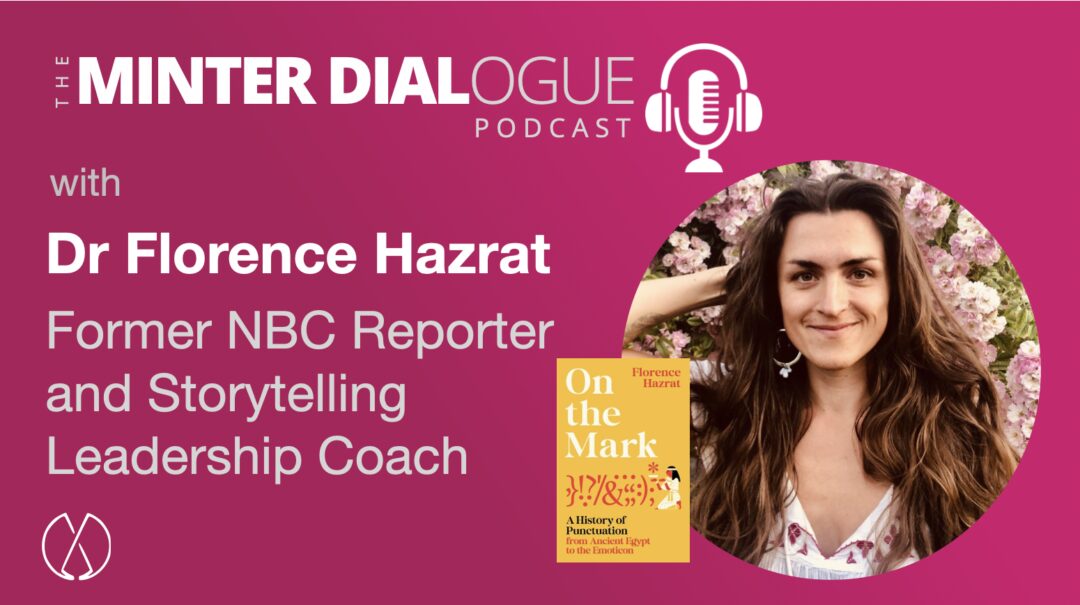
- Find/buy Florence Hazrat’s book, “On the Mark: A History of Punctuation from Ancient Egypt to the Emoticon,” here
- Find/follow Florence Hazrat on LinkedIn
- Find/follow Florence Hazrat on Instagram
- Find/follow Florence Hazrat on TikTok
Other mentions/sites:
- “The Dash” (Poem) by Linda Ellis here
- “This Is Your Brain on Music,” by Daniel Levitin here on Amazon
- “An Admirable Point,” by Florence Hazrat here on Amazon
- “Pamela,” by Samuel Richardson here on Amazon
- “Ulysses,” by James Joyce here on Amazon
- “Werther” (“The Sorrows of Young Werther”), by Johann Wolfgang von Goethe here
- Project Semicolon (Suicide prevention initiative) here
- Yayoi Kusama (artist) here
- Punch magazine here
- Gretchen McCulloch (internet linguist) here
Further resources for the Minter Dialogue podcast:

Meanwhile, you can find my other interviews on the Minter Dialogue Show in this podcast tab, on my Youtube Channel, on Megaphone or via Apple Podcasts. If you like the show, please go over to rate this podcast via RateThisPodcast! And for the francophones reading this, if you want to get more podcasts, you can also find my radio show en français over at: MinterDial.fr, on MegaphoneFR or in iTunes. And if you’ve ever come across padel, please check out my Joy of Padel podcast, too!
Music credit: The jingle at the beginning of the show is courtesy of my friend, Pierre Journel, author of the Guitar Channel. And, the new sign-off music is “A Convinced Man,” a song I co-wrote and recorded with Stephanie Singer back in the late 1980s (please excuse the quality of the sound!).
Full transcript via Castmagic.io
Transcription courtesy of Castmagic.io, an AI full-service for podcasters
Minter Dial: Dr. Florence Hazrat, what a true pleasure to have you on the show. I got wind of you through the magic of social media, specifically X, and people talking about you and your book. And I suppose in the end of the day, there are niches and you have found a very special niche close to my heart. But as I like to say when I start my podcasts, Who are you, Dr. Florence Hazrat?
Florence Hazrat: Thank you for having me, and thank you for giving me an opportunity to talk about this niche subject of punctuation. I am a thinker and a writer, uh, expert on Renaissance literature and also on punctuation, which is a great title that I share with a couple of really amazing other punctuation researchers and writers. I am a dog lover, a dog mum as well, and an urban gardener. Maybe that’s how I would introduce myself.
Minter Dial: So, would that be urban hyphen gardener?
Florence Hazrat: Yeah, good one. Yeah, I’d like that. I’d like to bring these 2 together like that. Yes.
Minter Dial: Yeah, you know, in the realm of funny things, I speak a few languages like you, and I think about the hyphen in the German language. I have no idea, is there a hyphen And in German, it just seems like not.
Florence Hazrat: Yeah. German is so, um, kind of voracious in terms of compounding nouns, right? And even adjectives sometimes. And we just create these very, very long, uh, words. So, and apparently we’re perfectly capable of just grasping them with like one look. I also teach German and sometimes I need to put hyphens for my students to just tell them where one word starts and ends, but the hyphen in German is called Gedankenstrich. So, like thought stroke, perhaps one could say. And, um, or rather that’s the, uh, yeah, that’s the, that’s a dash actually. We call it connecting stroke, I guess. So, we have this like Germanic word to, you know, happens much less than in English, I would say.
Minter Dial: I have to imagine, though, it must happen a lot when you write in a book to mark the end of a line and the beginning of the new line because you can’t— you have to break the word. And therein lies already the very first obvious use and commonality of a hyphen. Is that correct?
Florence Hazrat: Yes. So, German breaks words syllabically, whereas English, I think I have seen, doesn’t really do that. I, I don’t know whether it has to do with casting off of the page, that it’s a design question, or that it’s something that is not kind of common or required in the language or something, but sometimes it throws me off a little bit when I feel like, oh, that, that’s a strange cutting of the word.
Minter Dial: it’s done syllabically in— if that’s a word— in English as well. It depends on the format. Like you say, there are different texts and things like that.
Florence Hazrat: Yeah.
Minter Dial: All right, so one of the things that really struck me and I enjoyed very much when I began reading your book, your new book, was the reason why you, Florence, became existentially interested in punctuation. Can you explain?
Florence Hazrat: Yes, thank you. My mother is German, my dad is Iranian, and that’s an interesting and also sometimes difficult mixture to kind of negotiate because it’s— these are very sort of different cultures and heavy histories, potentially both of them. And I never quite knew how to introduce myself. Do I say I’m half this, half that? But I’m not. I feel like fully this and fully that. Like both because I’m very connected to both cultures, both languages, and both families. And then I used to say my mom is German, my dad is Iranian, but then I’m also more than my parents, right? And so, in the past couple of years, I discovered the hyphen for me to be like German hyphen Iranian, Iranian hyphen German. Sometimes it seems to make a difference to me what I say first, sometimes it doesn’t. And that was kind of the key for me to understand this mixture. And I think for a lot of people today who are mixed, because we live in this more and more globalised world, that is some way forward to understand themselves, that they, you know, we can be both at the same time. We can be this new mixture that, you know, comes from these different roots, but that doesn’t need those roots to define themselves in that way.
Minter Dial: Well, I mean, at the end of the day, Florence, we are all born of a mother and a father. And so, mother-hyphen-father. So, you don’t need to be Iranian-German to need to have a hyphen, because maybe my father came from Sheffield and my mother came from Newcastle, for example. So, I’m Sheffield-Newcastle-Jordi. And so, So we all have at least 2 provenances and their family histories and where they come from.
Florence Hazrat: Yes, I also love the hyphen because it creates a balance between these 2 elements, right? So, of course, sometimes we have an adjective at the beginning and then a noun, if we look at it from a kind of linguistic perspective, or anti-inflammatory, that’s a prefix and then an adjective or something. But if it’s 2 nouns or 2 origins or double-barreled name, for example, the hyphen does create equality between them. And I love this too, to say both of these cultures, both of my parents contributed to who I am in equal measure. So, yeah, love the hyphen. Right.
Minter Dial: So, I went to university in America and I studied deconstructionism back in the ’80s. I also studied women’s studies. And in my recollection about deconstructionism, at least when I got into it, because it was fairly avant-garde, as we say in Dianic astrology, is that deconstructionism is about studying the space between words.
Florence Hazrat: Mm-hmm.
Minter Dial: And I found that just super fascinating. And of course, one of the things that’s complicated for me is to understand what actually is punctuation in the world of grammar. Is silence punctuation, grammar, a word, a non-word? So, I just want to throw that one at you and have you riff on that.
Florence Hazrat: Yeah, absolutely. And in my work, I try to enlarge the concept of punctuation for us, right? And yes, we have this narrower repertoire that everybody probably will come up with, you know, when you ask people to enlist all of the punctuation that you know, they’ll be like question mark, colon, comma, dash, you know, something like that. Maybe somebody will also be like, okay, apostrophe, you know, probably, although that doesn’t necessarily tell us anything about the sentence as such, but, you know, we need it grammatically and so on. Maybe somebody will even say an asterisk. That again, the question is, is that part of telling us anything about grammar or tone? Not really, but then it makes our eye move, for example. And so, my definition of punctuation is any sign that’s not a letter that tells us something about the text in terms of moving our eyes, for example. So, asterisks or footnotes would also be in the peripheries of punctuation as well, would also belong to that. Or, for example, design features. So, if you have bold text or a capitalised word or italics, for example, because they pick out a word, they tell us something about this word, or they manipulate the text, they do something to our eyes, to our mind, to our understanding. And with that definition, spaces between words or margins or, for example, paragraph lines or indenting or not indenting, that all tells us something about units of thought. So, for example, the paragraph I would consider as one of the first punctuation, or one of the first phenomena of punctuation. It’s not a sign as such, but it’s constituting one idea. So, one unit. What is one idea? Because it might be one sentence, but it might also be several sentences parcelled together, right? And so, with that definition, then punctuation is really implicated in understanding the text. We have the grammatical signs of punctuation, we have the tonal signs like an exclamation mark, for example, but then we also have these outliers that also manipulate the text or help us interpret the text or help us make sense of the text.
Minter Dial: Absolutely fascinating. So, in the realm of preparations for this, I was looking at— I asked Gemini, I said, what is actually the definition of grammar and where does punctuation lie? And can you believe it? The entire, I mean, fairly long, 30-line response didn’t have once the word punctuation in it. as part of grammar. And I mean, so go fix that, by the way, Florence. But where I come into that thought is the explicitation that happens when you go into Word, a Word document, and you say show punctuation or show marks. So, the paragraph mark, the P backwards, and the spaces, the dot, all become all of a sudden visible to our eye and yet are hidden in the background. How much is How much do you play with that thought?
Florence Hazrat: Oh yeah, absolutely. For me, punctuation is this workhorse, or the marks are these workhorses that help us navigate, and they’re supposed to be transparent to a certain degree. We’re not supposed to stumble because the major requirement of a text is that is, you know, nice to look at and we can read it quickly and we can get the information quickly. But then, of course, punctuation and text and language and literature is always going to do whatever it wants to do, right? So, we do actually then stumble over a period or a full stop and we ask ourselves, okay, what does this do here? So, I really like this twin function of, on the one hand, being ultimately transparent and just there to like usher us along and float us along, but then they have their own life. And sometimes we do stumble, and when we do stumble, we discover this hinterland of potential meaning.
Minter Dial: So, punctuation, there are so many things running through my mind, but punctuation exists in so many different ways. And yet one of the things that I loved, Florence, about in reading your book and learning about punctuation, and I feel like a hat off to my mother, as I told you, a stickler for grammar, spelling, punctuation, too many commas or not, was the origin of punctuation. And it was amazing to hear, for example, that a sentence was a— was it a— I can’t remember— as a dot or something. So, a comma was a phrase. And so, they used the word comma, as I understand it, or you can correct me— to indicate that this is a phrase, and that the point was at the higher end to say that was a sentence. And so, actually, these were concepts before they became indications and specific marks.
Florence Hazrat: Yes. So, I think there are 2 ways to approach what you have raised, and one is to discuss the grammar, which is a little bit difficult for us nowadays unless we really know ancient Greek and potentially also Latin to have access to this, um, kind of way of thinking of language that is both grammatical— so is there a noun, is there a verb, you know, is the sentence finished— but also rhythmical. And of course, we cannot really map ancient Greek rhythm onto English, modern English rhythms. So, sometimes it gets a bit difficult talking about these things because we don’t have this profound knowledge and profound kind of ability to hear these different rhythms anymore. But for the ancient Greeks and the ancient Romans, one period was one full sentence, and that is one thought in that sentence that is complete and that is grammatically— Did you say something?
Minter Dial: Yeah, I was just going to— I hopefully— it seemed to cut there. Hopefully it didn’t cut. But there, there is even, as you describe in the book, that the point was created, the period was created by 2 words. that explicitly this concept. So, it was actually very formulaic. I mean, they really defined what is a period, punt, house, or something. I can’t remember the words.
Florence Hazrat: Yeah, peri-hodos. So, something that you can go around in one circle. So, the period— one period, one sentence for the ancient Greeks and Romans would be a sentence that is grammatically complete. We have all the nouns, all the verbs, everything that we need. There’s nothing hanging. But also, rhythmically complete. Again, that’s something we don’t tend not to have so much access to anymore, but it sounded complete to them. It sounded beautiful and melodious. And then we have the next smaller section, which would be a colon, and that’s not just the sign, that’s a whole set of a sentence, a clause or phrase that is, um, grammatically complete, but it’s not rhythmically complete. again, maybe a bit difficult to access, but we just have to accept that at face value. So, they thought, okay, this is, this is fine. Maybe like a semicolon or, you know, a sentence that has a semicolon, you think, okay, I could leave this like this now, but it doesn’t feel quite right. It feels like it should continue. And then the last sort of smaller, smallest part is called a comma, and that is grammatically incomplete and rhythmically incomplete. So, for example, if I told you, because I’m ill, then you’re like, okay, what? Because you’re ill, right? You know, there’s something missing here. And in, um, ancient Alexandria at the library, we have these librarians who were constantly engaging with non-native Greek speakers who found that difficult to have, you know, to be able to read these very difficult sentences because that wasn’t their native language. And so, these librarians thought, okay, we need to invent some markers for these people to tell them this is a sentence, this is a comma, this is a colon. And then they would add dots at different levels of the line to let them know, pause here, it’s finished here. So, like signposts to navigate the sentences.
Minter Dial: So, in a lot of what you just spoke about, if I were to say we were talking about music, it feels like it’s completely the same. Because in music you have rests, you, you have punctuations, crescendo, there’s the rhythm, the sounds, and, and the punctuation of music. To what extent have you found crossovers? Have you— I mean, you mentioned music a lot of times in your book, but you don’t specifically look at it. Since I’m somewhat musically inclined, I’ve always enjoyed. For example, just to share something, one of the— and this was from a book about the— your brain on music.
Florence Hazrat: Mm-hmm.
Minter Dial: The silence in music is often a high stimulator for— to— because you’re anticipating what’s going to come next. And that comes back to my notion of, of the space between words, the power of the silence between words. The power of silence in music is You’re, you know, what’s about to arrive. Anyway, I was wondering about the punctuation in music and how many crossovers might there be?
Florence Hazrat: Yes, absolutely. So, we have this grammatical aspect of punctuation that tells us, okay, and finish sentence finished here. But we also have intonation, for example. And so, punctuation helps us to pronounce the words properly, and even just in our heads as well, right? When we have a lot of people have the silent voice in their heads whilst they’re reading. And I also want to encourage everyone to keep that silent voice because it actually helps this process. And a lot of people, especially in the Renaissance, have tried to think about punctuation in terms of music. So, they would, for example, say a period is a full rest, right? 4 beats, for example. And then a colon would be half of that, and so and so many minims, and so and so many crotchets and stuff. So, so people have thought about punctuation in that way. They even said, okay, you need to count to 2 or 4 or something every time you read something out loud. So, that’s definitely something that has been kind of cross-fertilizing each other constantly. And then— So like religious practise where monks would sing The Gregorian chant. Scripture. Yeah, for example. And then they would make a note in their text when the voice should go up, and that used to be a dot and then, um, a kind of hook that was lying to the side, which at some point then became erect. And that’s where our question mark comes from, because when we ask a question, most languages, we lift our voice.
Minter Dial: Don’t you think?
Florence Hazrat: Yeah, exactly.
Minter Dial: That’s gorgeous. I absolutely adore that. And it does— you write, you wrote at one point, and I’m going to find the quote. It says, culture without dots is unthinkable. And why that landed with me so, so much. I have, I’ve created for 20-odd years a North Star direction that has been sort of my guiding light navigational principle, and that is to elevate the debate and connect the dots for a more meaningful existence. And you wrote, culture without dots is unthinkable. Can you elaborate a little bit about why that’s the case?
Florence Hazrat: I think the dot is such an underrated part of our life. It seems so simple and even evident, self-evident almost, to, for example, put an end at a sentence, right? To somehow mark that. And it’s— the dot is also so, um, resting in itself. It doesn’t really go like, look this way or look the other way, like a question mark, for example. It doesn’t really have any other thing on top or, uh, under it or something. It’s really just very simple, like the Earth, you know, it’s just, it’s just a round thing.
Minter Dial: It’s very simple Earth.
Florence Hazrat: Very simple, but very simplified Earth. And so, and yet it exerts so much power around it, right? And in the beginning, you know, we have the atom, for example, although of course we know also now, okay, something is going on in the atom as well, but everything kind of starts from a dot and then expands outward. So, it’s almost like the entirety of existence is kind of pressed into this dot that’s like potential waiting to expand. And dots can be squeezed into words, for example. So, we can make sense of something centuries after a monk has copied out a manuscript, for example. And then there’s so many artists who create with dots, like Yayoi Kusama, for example.
Minter Dial: Seurat.
Florence Hazrat: Or Seurat, exactly. And we have pixelated art now as well, for example, right? That’s just like the dot blown up. So, I think the simplest, supposedly simplest shape is so eternally reproductive, generative, that I honour the work of the dot deeply.
Minter Dial: So, there are a couple of things. One, in your book, you identify if you put a microscope up to a certain dot written in a certain script, it’s actually completely nothing to do with the perfect spherical dot that we might imagine. It’s a brush that’s come in, and it’s almost like the Sun in an eclipse, which when we think of the Sun or the Moon as this sort of nice round thing, but there’s all sorts of stuff happening around it. And that felt like a wonderful metaphor for our world. Blue Dot, though, the Armstrong might have identified whoever was the astronaut who said it. And the second thing is, why is the dot the dot? In other words, or should I put it another way, how is the comma the comma, a minor element, and why is the dot more definitive than the comma?
Florence Hazrat: I mean, the comma is a rest that wants to continue, I guess. And so, I think commas are doing an amazing job as well. And, you know, they are much less— they’re unassuming, right? It is true that the exclamation mark is a bit of an attention seeker, perhaps. I wrote a book about the exclamation mark, so I feel very partial towards it. And I know that people have, you know, are saying, don’t use so many exclamation marks, and, you know, you’re shouting at people. So, I don’t even want to go down that lane. But A comma is kind of carrying the sentence along, and it gives us a way to rest and to take a breather. And also, which I think I talk about in a later chapter as well, that eye-tracking studies have found that we do linger over a comma when we’re reading prose, but then we can process the words that come after or the couple of letters that come after faster and more safely, more securely, and remember them better. So, our ancestors kind of found these ways of navigating and these almost perfect ways of reading all by themselves. They didn’t need fMRI scanners and all of this stuff, right? So, um, I think a comma is softer as well than a full stop because the full stop is just also very much there and, and, you know, very definitive. And the comma gives a way of continuing thought, continuing conversation, which is also why I like semicolons very much, because they have this implication of meandering, continuing, spiralling, just very creative, softer, gentler ways of thinking and feeling. Yeah.
Minter Dial: Wow. All right, so I had another couple of questions, but I sort of feel like I need to run back to this one, and hopefully it’s not too provocative. But, uh, that we— when I studied at university, we studied, we tried to come up with an idea of what is a feminine text and what is a masculine text. What is a feminine narrative and what is a masculine narrative? This is back before the days of MeToo. And, um, and there were certain books Proust comes to mind, where the full stop was less present in certain texts, as in long run-ons, albeit written by men or man. Do you have any—
Florence Hazrat: Mm-hmm.
Minter Dial: —critique lecture, any reading on that? I’m sure you do.
Florence Hazrat: Mm-hmm. Yes, I’ve been thinking about this too, um, and I haven’t come to a conclusion yet in terms of both punctuation or female grammar or something like that. But what comes to mind is maybe comparing Hemingway and James Joyce. So, Hemingway has these like hammering periods or full stops, right? And, um, so much is being pressed into the sentence and the emotion needs to be kind of drawn out from this very compressed way of writing. Or Albert Camus, for example, I think they called it écriture blanche. That is supposed to be very sober.
Minter Dial: The white writing.
Florence Hazrat: Exactly. Very kind of journalistic in the 1920s and ’30s, very sober, but actually there’s so much going on, and the punctuation is like, um, a corset or a construct construction that helps the sobriety along. And then in comparison to that, there’s Molly Bloom’s dialogue, Molly Bloom’s monologue at the end of Ulysses where she, you know, she just, her thoughts just spiral.
Minter Dial: James Joyce.
Florence Hazrat: There’s James Joyce, exactly.
Minter Dial: Yeah, because these days Ulysses is more Homer and Nolan, Christopher Nolan.
Florence Hazrat: That’s true, exactly. And she keeps producing more and more thought, and she has this yes, yes, yes that’s like patterning the— her monologue, her internal monologue as well. And, um, so maybe there is something to more sort of gendered ways of thinking, potentially punctuating. Although I guess, as you have said yourself, we can inhabit those and we— when we want to reproduce them, right? So, like a woman can certainly start to write like Ernest Hemingway if she wants to maybe produce a kind of tone that he created in his storeys and books.
Minter Dial: All right, so Hemingway was part of my thesis, and there are a few people that might think of him as a misogynist.
Florence Hazrat: Of course.
Minter Dial: All right, so groovy stuff, Florence. I want to talk about multilingualism and We talked about the hyphen before. And a couple of thoughts. Punctuation is at once a universal language in my mind because you don’t need to read an a or a fa or whatever. And yet, I’m sure it’s got to have nuance with regard to how it’s written in Persian, Arabic, and of course over time Japanese. But then the other thing I wanted to talk to you about, the hyphen, and I suspect you’re aware of this, but is the Linda Ellis poem called The Dash.
Florence Hazrat: Mm-hmm.
Minter Dial: And her poem written in 1996 was that the dash exists between 2 numbers, the year of our birth and the year of our death. And life is about the dash. And I was wondering to what extent that would resonate with you, Iranian, German, and your life within those 2.
Florence Hazrat: Oh, I definitely have to look up that poem. I don’t know it yet. Thank you. Yes, so as far as I understand, so the dash is— the hyphen connects and the dash separates potentially abruptly, right? But it does also maybe help us understand the mindset of the person who is thinking, either the writer or the narrator, right? So, I really love these 18th century novels where when people start to use— well, when the character on the page, because of course we have these biographical novels like Clarissa or Pamela or something, they start to use dashes, then it means, okay, something’s happening to their mind, right? So, in that sense, one could say, okay, life is lifing, life is happening here, and the dash becomes like a a red flag almost that says something’s interesting, something noteworthy or distressing is going on here as well. And maybe again, that’s why the full stop can be a bit scary because it is so final. And something that didn’t make it into the book is a beautiful art project by, I think, Sophia Pompéry, a French artist who found the ends of original novels. So, for example, Goethe’s Werther from, I don’t know, 1789 or something like that. She found the original text.
Minter Dial: French Revolution.
Florence Hazrat: Yeah, exactly. And she took the picture of the last full stop and she blew these up of different kinds of novels. And, um, that, that full stop is scary, of course, because once we stop talking and telling storeys that’s the end, right, of so much. Which is why then One Thousand and One Nights, Arabian Nights, has this continual, like, keeping going on with telling our storeys, and one more day, and one more day. So, the, the full stop can be connected to death. That’s definitely true as well. Whereas something like these other connecting punctuation marks, or brackets, for example, maybe help us think about continuing and, and different alternatives to life, maybe. You know, for example, the— during the pandemic, I had the feeling that we were all in this parentheses waiting to be able to go back to our main sentence. And, um, there’s an American project called, I think, Project Semicolon, which is about suicide prevention. So, a lot of people that have, um, semicolons tattooed often refer to this experience, for example, having a loved one, um, who either has committed or, or, um, has had suicidal ideation, or themselves. And the idea is to think of life not as a full stop but as a semicolon. So, sometimes you feel like you want to end it, but then you continue. So, punctuation is very powerful in terms of symbolism and metaphors and helping us to conceive of where we are in that moment.
Minter Dial: And this circles back to the very beginning of, and the reason why you wrote the book and just to what extent punctuation is existential.
Florence Hazrat: Mm-hmm. Yes.
Minter Dial: It’s remarkable that you’ve spent your career looking at this. And, and the— I actually came upon that dash, hyphen between your birth and your year of death from a priest when I was walking through a cemetery in London. And the guy said, you know, well, you know what, the most interesting, the most interesting thing on this tombstone is that hyphen, the dash. And that’s what life’s about. Is the moment you’re born, you’re going to die, but what are you going to do with it in between?
Florence Hazrat: Again, so much compressed into this, this thing that doesn’t have a sound, right? We call it dash, we call it hyphen, but in and of itself, like you mentioned, ah is ah. Okay, that makes a sound, right? Or dog is a word, makes sound. Have any meaning, any content. And I think maybe that’s why they’re so endlessly generative as well.
Minter Dial: Well, it just froze again just now. So, hopefully everyone’s hearing what you’re saying. It’s all total gold and people need to get your book. I’m going to just get— find out. I remember what the title is. It is On the Mark, the new book. A History of Punctuation from Ancient Egypt to the Emoticon. And I was shocked, Florence, when you said the age of the emoticon is at— is over, it’s dead. I, I’m still using the bloody emoticon and I’m terrible at the emoji. Do I feel— do I feel old or what?
Florence Hazrat: Well, um, I think people can use the emoji and the emoticon in different ways. So, I have a friend who actually uses emoticons when she wants to not even give people an emoji. So, for her, it’s a punishment. You just, you just get an emoticon, you know, very bare, pared-down version of like a smiley face. And people who do the nose bridge, for example, rather than just the eyes and the half bracket, apparently they’re a little bit older. Now I do this too. I’m a millennial. So, you know, you can kind of understand when these people joined the internet age or didn’t, or whether they’re native digital natives or just sort of semi-natives. And in some ways, I think the emoticon might actually survive because we can also make it with a pen and paper, much in contrast to the emoji, which really needs this digital— needs devices in order to be able to make it, right? Nobody’s going to scratch out a tree or a dog with a leash or something when they just want to dash off a message. Whereas actually punctuation and also emoticons, I think, are easier to make. We can make them by hand offline. So, anything that is like that is more likely to survive actually.
Minter Dial: Well, and to your point, I mean, first of all, I get a little bit upset, irritated, sorry, when I I put it in a WhatsApp, I do, you know, an old-fashioned colon bracket and it turns it into an emoji like I’m some teenager. And yet in your book, you actually identify 2 things which struck me. First was the antiquity of the emoticon where there was some language, I can’t remember, it was a foreign language, a Greek or something like that, where they would actually write very sophisticated emoticons in the 19th century. And then the second one, which was interesting, was how much more sophisticated the emoticons are in Japanese, where they, you, when you do in your book, you show an emoticon that looks very much like a Japanese monster. So, um, so does that validate the idea that the emoticon has greater staying power?
Florence Hazrat: Yes, so people have experimented with typographical arts, maybe we can call it that, for a while. So, apart even from these emojis, we have artists who just type punctuation and who create whole images just through punctuation, for example. And I think you are referring to the Polish newspaper?
Minter Dial: Exactly.
Florence Hazrat: Where they— yes, exactly, they were using kind of emojis, but then not in a horizontal way, but like a vertical way for creating, you know, happiness or sadness or something. So, there was this notion and this concept and this playfulness, I think, around— Punch is doing it as well, the Punch magazine, I believe, at the end of the 19th century. The Japanese ones, I think, are called kaomoji. So, again, they’re vertical, but they’re vertical and horizons at the same time, and they’re very complicated and sophisticated. And I think part of the emoticon’s power is that it is so reduced and so simple, whereas I love emojis. I’m not saying anything against emojis, but they can become quite complicated in terms of decoding which one is this actually. We have so much, so many ways of expressing now, but then which ones are we choosing? How much time are we going to give this text message? Are we really just finding the one, for example, that is snorting out, you know, like, why are you doing like this? You know, just like the one that’s angry. Or can we just use the one that we always use and that is at the beginning of our text message, right? When we open the emojis, we have the ones that we’re always using and then we have the full range. So, I think the power of both punctuation and emoticons is That they’re so reduced. They can only, only really mean happiness, sadness, crying. And then you as the reader are supposed to make sense and interpret, and you can do it so quickly, whereas the emojis have become quite complicated. And hence also they’ve become something other than punctuation. They do have these punctuation functions, I believe, but then they have become little storeys in and of themselves. Or we pick out one word. Let’s say I ask you, would you like to have coffee tomorrow? And then I might pick out, I can put a coffee emoji, a croissant emoji, a sun emoji, a park emoji. So, many ways of interpreting and drawing something out from that sentence. So, in terms of that, emojis are not like punctuation. They’re like meta communication that can become quite complicated. All right.
Minter Dial: So, Florence, you’re absolutely making me feel like a 62-year-old. I mean, the number of times I look at an emotion like, have I done this? Yeah, it says positive or negative. Um, absolutely fun. So, uh, in, in, I suppose the, the main last topic, if I can’t remember what I wanted to say just now, because, you know, conversations are the way they are and thoughts come into your mind and sometimes they disappear. You and I are both multilingual, and I am sure that many people listening who have at least nuances of other languages and the concept of punctuation, how universal can punctuation be? When you say the full stop or the period is sort of quite definitive, is that true for the Aboriginal in Australia, the Japanese? How much of this punctuation is just basically because you and I are Indo-European, or do Hungarians, Finnish, Basque have different punctuation?
Florence Hazrat: Yes, yes, thank you. In some ways, if we have this broader definition of punctuation, it is universal. If we define it as Any mark that is not a letter that somehow tells us more about the text or any manipulation of the text itself, for example, bold or blowing something up and making it bigger or italic or even fonts, different fonts have a lot to say, right? Like if we wouldn’t like to get a letter from our lawyer in something playful like Comic Sans, right? I like to read my comics in Comic Sans. Maybe I wouldn’t really find that very reassuring.
Minter Dial: So, just one second. I mean, even in font, how universal is font? I mean, let’s say we just stick within Roman letters. And so, let’s, let’s include all the European languages that are in Roman letters. Is the bold strong in HTML? Is it— does it always have the same signification? Because Google, of course, has to figure that out. And maybe we should be speaking to someone at Google who has to figure out what is the meaning behind this punctuation in one language and the other. Is— are there reciprocal feelings?
Florence Hazrat: Yeah. Yes. No, absolutely. I think there is. Um, it depends much on education as well, and then on associations too. And I’m not sure, but it could— there could also be something more biological maybe about serifs, you know, something that is serifed maybe looks more stable, and then that has an implication to how we think about the text in and of itself and what we expect. But a lot of course is really expectation and how we are used to the page looking. So, uh, linguists Gretchen McCulloch, who talks a lot about the internet and about internet language, has looked at toddlers’ ways of playing with their parents’ phone and using emojis. And she says that even though, you know, when you get a text message from your toddler, from your grandchild or whatever, then it’s just going to be like random emojis, right? But she says, well, they are practising they are somehow practising how does something like this look like, because maybe they do use 3 pairs of 3, for example, right? So, it’s not as random as it maybe looks from the outset. Or when we look at how children start to slowly, slowly write, you know, they get used to the spaces between words and the spaces between lines and having things in like this rectangular and stuff. So, it is really something that we kind of imbibe by learning and looking and being um, exposed to text. But then again, we, all of us, have developed this over 2,000 or thousands of years, right? So, I want to still believe somehow that our ancestors— like, we have this, what we have today, for example, like this, this shape, right? Is that always the same, right? It’s, it’s the kind of size that fits into our hands, right? And the phone is like smaller, that’s true, but it’s still somehow a rectangle, right? And so, there is maybe something biological that we can, could explore further. But in terms of different cultures and different languages, for example, Arabic has a different grammar from English, and so it it might be— it’s possible that it doesn’t need just as much punctuation to give information about the language. Or for example, I speak Persian, or I know Persian, and there’s a— and you know French as well, there are question words at the beginning like est-ce que, or in Persian that would be آیا. That’s— then I know that question is coming. So, technically then the question is, do we still need a question mark at the end to tell us that that is a question? So, punctuation makes— it’s, it’s not something that we need, need perhaps, but it just makes reading much faster, much more safe. We don’t need to have a lot of education. So, even if you didn’t know this question word at the beginning, you see the question mark and then, you know, okay, that’s the question. So, it makes writing text more accessible for people who don’t have a huge knowledge about language potentially, or huge familiarity with the language. So, in that way, punctuation is super democratic. And now also because something like Persian or Arabic or Japanese has— they have taken over the European kind of punctuating ways, it’s difficult now to say, would they need that? Would they not need that? Like, just to give like a little bit of an insight, Persian and Arabic, for example, used— before they took over European punctuation— used little flowers or, um, heart shapes or tear shapes between units of thought. So, again, the paragraph, right? So, they, they didn’t have a lot of nuance in the middle of the sentence or in the— while they were writing, maybe again because the grammar is different, so maybe it doesn’t need that, but also because people had more knowledge. People who were able to read had a lot of knowledge of language and kind of didn’t need that then, these like crutches to like be able to read along. But then they had a mark at the end, a beautiful decorated mark at the end, to make sure that this is the paragraph here now. So, it is the question about punctuation in other languages There is always, I think, an impulse to separate language to make it more clear and faster. But then we get into the nitty-gritty and the ins and outs of the language, which is very much also connected to colonial history and, and the language’s specific grammar.
Minter Dial: Or the control of media. You are German-Iranian. descent, and yet you chose to go to the United Kingdom for your higher education, I noticed. To what extent do you think that contributed to your interest in punctuation? And I’m thinking that if I could just add one more little piece, the British comma, the British English comma.
Florence Hazrat: I am German, so I have the kind of German background, but punctuation in German is very, very much not creative. And because it’s mostly grammatical, so you really get downgraded really harshly. Yes, yes, yes. If you don’t put your commas exactly where they need to be between clauses and subordinate clauses and so on. So, Germans tend to have a lot of grammatical education, which is great on the one hand. On the other hand, I find it a little bit stifling perhaps in terms of expression. And again, because punctuation is something where you can show your personality in, in some ways, I felt very drawn to the British context because in the UK, of course, or in English, you do have to set some commas, right? But then there’s a lot of leeway, and I was very, um, thankful that both of my publishers in the UK and in the US allowed me to keep my own punctuation in the book. So, it’s 100% Mike.
Minter Dial: You didn’t have to battle with your editor?
Florence Hazrat: Not in terms of that. We battled, but not in terms of that.
Minter Dial: And then with your German, because you’ve written also your Exclamation Punkt in German, was it less of a battle with your German editor?
Florence Hazrat: So, I wrote both books in English and then it was translated.
Minter Dial: I see. You didn’t have to worry.
Florence Hazrat: And I don’t even do— no, yeah, I don’t even do that translation. Yes. It’s just somebody else does that, and, um, which is normal apparently. I was, I was checking it and I was adding some stuff as well, but, um, I love the English way because you can punctuate in what’s called elocutionary punctuation. So, how you breathe and how you speak and where, how you pause. And I conceive of my books as conversations with the readers that I can’t see. future conversations like we have now, right? And so, I want the tone to be conversational, as if we were sitting on a train ride for 5 hours and then we struck up a conversation, or we sit in the pub and, and then suddenly we have this conversation about something whimsical and slightly eccentric, but actually really key and really present in all our lives. So, I punctuate where I— how I would also speak, and I kind maybe over-punctuate a little bit in some ways because I, I do have a lot of commas and that kind of thing because I want my readers to pause when I would pause in their heads. And I found that the UK is, um, there’s sort of a premium placed on maybe, uh, wit and kind of also finding something quirky and then exploring that, whereas It is true that I think Germany as a culture and also as a writing culture is a little bit more sort of steady. Exactly, exactly. So, I found more freedom in English and also in the UK. I’ve been there for 8, 9 years before I returned. Yeah.
Minter Dial: Well, the British grammar— I mean, we haven’t even gotten into American British differences in grammar and punctuation and hyphen and exclamation mark, exclamation mark, exclamation mark. Um, last question, personal and probably unexpected. Do you have a— I noticed you have a tattoo on your forearm. Do you have a tattoo of a punctuation mark?
Florence Hazrat: No, I haven’t. I really, really wanted to go very crazy and put all of the punctuation on my knuckles. And my niece thankfully talked me out of it, and she said, this is, this is too much, this is too much, you know, motorcycle gang.
Minter Dial: Yeah, especially on your knuckles. If you had one punctuation mark that you would tattoo?
Florence Hazrat: Hmm, that is a lovely question. I think probably the, um, the parentheses, because Yes, yes, yes, yes.
Minter Dial: Unexpected.
Florence Hazrat: And I hope at some point I’ll also write a whole book about parentheses, I have to say. Um, I started this whole punctuation thing, this kind of obsession with punctuation, when I did my, um, second postdoc on parentheses in Renaissance romance. So, having worked so much on, on Renaissance literature, I saw that the pages were just populated brackets or parentheses. And I asked myself, okay, where does this come from actually? And I started to dig and then it became all of this big thing and I went off into the exclamation mark area or the whole history of punctuation, but the parentheses just kept coming back. And my thinking, for example, is that— so the parentheses— like a lover of language who wanted to visualise this. Oh, I think the connection is tricky.
Minter Dial: It’s okay.
Florence Hazrat: Okay, so he wanted to visualise this rhetorical way of writing where you have insertions. So, insertions, being able to like insert something into a text, is something that even the Romans already did. They called it interpositio. So, like you interpose something in your bigger storey. Okay, he wanted to visualise that to make it faster to grasp the whole structure of the sentence. And then in the Renaissance, so in the 16th century, 17th century, they had all of these storeys where you have a knight, he goes on a quest, he meets someone else, he goes off, he comes back, he meets a dwarf, he goes back, he meets a lady that needs rescuing. So, there are storeys that constantly are interrupted and they have these, these parentheses, these side quests going on, and then the knight returns to his main quest. And the question is, are these really side quests or are they actually really key to what’s going on in the bigger picture too? And so, I found this, um, maybe being interested in side quests constantly, so I’m constantly going off on little tangents and exploring. And I think on the one hand that’s really tricky because we need to come back, we need to rein in, we need— and this is something that they wrote about in the Renaissance in these language manuals— if you go off on a tangent with a parenthesis, make sure you have a way to come back. So, they were very aware of that. And at the same time, I think these parentheses really give life, and these little side quests give life, and I want to allow myself to go on these side quests in order to then be, you know, inspired to keep riding the horse on this bigger main quest.
Minter Dial: There you are going off and being existential again.
Florence Hazrat: Exactly.
Minter Dial: When I did many plays and I’ve written a film and the use of parentheses in theatre for stage directions or, or sort of muse parentheticals, um, to sort of try to provide a little bit of an injection of pepper into the main course is, uh, a delightful thought. Whoa. So, Florence, Dr. Florence, um, wonderful as expected. this conversation. Hopefully the lags in the recordings didn’t show up. Maybe the double Zoom links will help. But in any event, where can people get in touch with you, track you down, read, buy your books, your writings? Because I know you have a newsletter, you write your books, you’ve written umpteen articles about this for anyone who wants to just dive a little bit further. go down the lane, as you say, I usually say the rabbit hole, um, what can they do? Where would you like them to go?
Florence Hazrat: Yes, so for writing, the best way is probably, um, Substack. I have a newsletter there called Mind the Gap. There’s some other people who have a newsletter that’s called that, so if you find— type Mind the Gap Hazrat or Florence or something, then you’ll probably find it.
Minter Dial: H-A-Z-R-A-T.
Florence Hazrat: Exactly. And I write maybe twice a month or so, like a bit of a longer essay on punctuation, and most of the time I try to make it relevant to what’s going on right now. For example, the latest one was on the Odyssey and how important punctuation was to stabilise this poem and make it accessible and so on. And I also am on social media, Instagram and TikTok, because we need to do that nowadays. But it’s fun, you know, I try to post shorter videos on punctuation history, but also like other whimsical interesting things, books I’m reading, and also what it’s like to be an author. Because I think people find that people don’t know a lot about it. Why would they, right? And I think the peep behind the curtain and kind of taking people with me in terms of starting a new project, but also publicity or interviews, for example, that might be quite interesting. So, Instagram, TikTok, and then for longer, more like think pieces, more writing, Wunderbar.
Minter Dial: Danke sehr. Schön. We will hopefully get a chance to share in real life, but for now, an ellipse.
Florence Hazrat: Exactly. Dot, dot, dot. To be continued. Thank you for having me. It was lovely to chat.
Minter Dial: My pleasure.