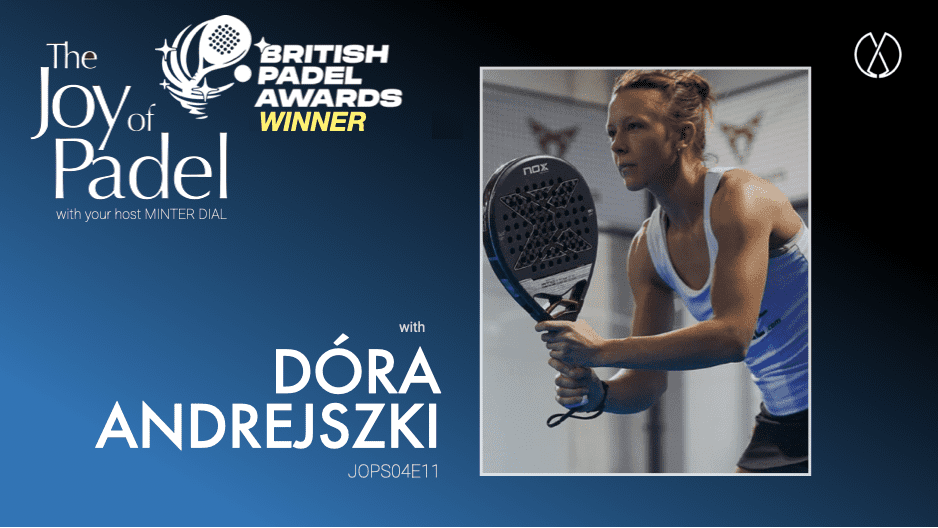
The Joy of Padel podcast with Dóra Andrejszki (JOPS04E11)
On the latest episode of the JOY OF PADEL podcast, I had the immense pleasure of speaking with Dóra Andrejszki—the top-ranked Hungarian padel player whose story is an inspiring testament to the relentless pursuit of growth and joy through sport. Dóra’s journey from competitive tennis in the US to professional padel in Spain captured so many of the themes I love most: reinvention, resilience, and community.
Background on Dóra
Dóra’s athletic journey began on the tennis courts of Hungary and the US, where she competed at the college level. After finishing her tennis career—and initially finding padel “nothing like I expected”—she eventually rediscovered her zest for competition and fun in the playful, social circles of Hungary’s new padel community. Over time, her curiosity and drive drew her to Spain, the epicenter of pro padel, where she now trains full-time with the goal of climbing ever higher in the rankings. So far, she has reached FIP world number 111, and is currently ranked #136.
Main Topics Covered
In our conversation, Dóra opened up about her initial skepticism of padel and how the turning point came in a friendly doubles match with three other women. The social aspect—the laughter, the camaraderie—hooked her and brought her back for more.
We dove deep into the nuances of transitioning from tennis to padel: how tennis skills and habits can both help and hinder, and why consistent training in a padel academy is transformative for rapid improvement. Dóra drew out the differences between playing doubles in tennis and padel, especially around communication, choosing partners, and adapting to new strategies. She was refreshingly candid about the psychological battles in competition—embracing stress in moments of pressure, learning from setbacks, and finding joy even when things aren’t clicking.
We also covered the subtle art of team dynamics. Dóra reflected on why humility and adaptability are so vital in padel—there’s no hiding in the cage, and true success demands empathy and teamwork, on and off the court.
Three Takeaways from My Conversation with Dóra
- Keep Growing—At Any Age. Dóra’s transition from college tennis to pro padel in her late twenties is a reminder that it’s never too late to challenge yourself anew. In her words, “until the last day of my life, I can improve.”
- Community Makes the Difference. The heart of padel isn’t just strategy or skill—it’s the people, laughter, and support. Dóra’s fondest memories revolve around shared matches with friends and the empowerment of seeing international players break into the top ranks.
- Humility Fuels Success. Whether learning to master the back wall or collaborating with new partners, Dóra’s story champions the mindsets of flexibility, humility, and open communication. It’s the collective effort—never shining alone—that leads to lasting results and real fulfillment.
If you’re chasing that unique blend of challenge and joy, padel might be your next calling. Tune in to JOY OF PADEL for the full conversation with Dóra Andrejszki and be inspired to pick up a racket—and a new community—wherever you are on your sporting journey.
To find out more about Dóra Andrejszki:
- Find or follow on Instagram: @dora_andrejszki
- Find or follow on Facebook: Dóra Andrejszki on Facebook
To listen to the show:
To listen to The Joy of Padel podcast, you can use the embedded player above, or go find it on Spotify, Apple Podcasts or any number of other podcasting services listed here.
Send in your questions or reactions:
Please send me your questions — as an audio file if you’d like — to nminterdial@gmail.com.
Further resources for The Joy of Padel:

The Joy of Padel podcast, hosted by Minter Dial, a padel tennis player since 1974, is an exhilarating show that delves into the captivating stories of notable padel personalities worldwide.
Meanwhile, you can find Minter's other Evergreen podcasts, entitled The Minter Dialogue Show (in English and French) in this podcast tab, on Spotify, Megaphone or via Apple Podcasts.
About the host: Minter Dial
Minter Dial is an international professional speaker, author & consultant on Leadership, Branding and Transformation. His involvement in sports has been a lifetime passion. Besides playing 18 years of rugby, captaining athletics teams, coaching tennis and playing squash for his university, he’s been a lifelong player of padel tennis, starting at the age of 10, from the time of its very first public courts at the Marbella Club in 1974.
Then, after a successful international career at L’Oréal, Minter Dial returned to his entrepreneurial roots and has spent the last twelve years helping senior management teams and Boards to adapt to the new exigencies of the digitally enhanced marketplace. He has worked with world-class organisations to help activate their brand strategies, and figure out how best to integrate new technologies, digital tools, devices and platforms. Above all, Minter works to catalyse a change in mindset and dial up transformation. Minter received his BA in Trilingual Literature from Yale University (1987) and gained his MBA at INSEAD, Fontainebleau (1993). He’s author of four award-winning books, including Heartificial Empathy 2nd edition (2023), You Lead (Kogan Page 2021), co-author of Futureproof (Pearson 2017); and author of The Last Ring Home (Myndset Press 2016), a book and documentary film, both of which have won awards and critical acclaim.
It’s easy to inquire about booking Minter Dial here.
Full transcript of interview via CastMagic
This transcription comes courtesy of Castmagic.io an AI service for podcasters.
Minter Dial: Dóra Andrejszki in lots of usual syllables like that, you know, consonants in a word. Sounds very Polish to me. But as I like to always ask my guests, starting off with who is.
Dóra Andrejszki: Well, first of all, thank you for having me on your podcast. Thank you for the invitation. You’re not wrong. My last name sounds very Polish, although I don’t know anybody Polish in my family. Yeah, I’m a Hungarian Padel player and I’m super happy to answer any questions you may have for me.
Minter Dial: Splendid. Well, so like, I, I, I mean, at the end of the day, Padel, although it’s been around since 1969, so it’s not actually that new, but for many it is. And, and the, the, the, the discovery of Padel. So, let’s talk about how you got into Padel coming from tennis. And, and when did, how did you discover Padel?
Dóra Andrejszki: I went to college in the US I played college tennis and I moved back to Hungary in 2020. And yeah, I would say the first time ever I played Padel was at the end of that year. But I must say, the first time I tried it, I really didn’t like it. I just finished my tennis career and I was looking for something fun and I looked up some videos, what I must do and how it’s supposed to be, and I went with three other players from tennis, and it was nothing like I expected. Like, this is not what they did in the videos. And I didn’t play after that for like six, seven, seven months. And then in 2021, one girl asked me to join in because they didn’t have enough players. And that was fun. I played with girls and it was four girls, some fun doubles. I always preferred doubles in tennis anyways. And I basically just started to pay for the social aspect of it and to make new friends. It was a small community back then in Hungary. And yeah, I played once or twice a week the first year or so, some mixed tournaments. And yeah, really just went for the fun.
Minter Dial: Right. So, what I’m understanding is that you in the States, you were talking offline about where you were and playing college tennis, and then you, you go, you go back to Hungary and that’s where you discover.
Dóra Andrejszki: Exactly. Yeah. I never heard of Padel before. I was playing tennis with one of my friends who was still going to university, and we played at a tennis club, which ended up having the very first Padel courts in Hungary. And in the meantime there was a tournament happening, and that’s when I discovered it.
Minter Dial: So, it was an outdoor court or indoor court?
Dóra Andrejszki: It was outdoor.
Minter Dial: Right. So, that’s not always the easiest thing either. Right. I don’t know to what extent do you, now that you’ve been playing for a good amount of time, do you believe in the statement that Padel is actually an indoor sport or should be an indoor sport?
Dóra Andrejszki: I think it’s. It depends. Maybe yes, maybe no. I think it can be very interesting how each team can adapt to the conditions. I really enjoyed this in tennis, but it was very different in tennis. I. I enjoyed playing in tough conditions when it was sunny, when it was hot, when it was windy especially. It’s a little bit different in Padel and the bad conditions always seem, seem to help the lower level team and then big upsets can happen. Yeah. When it’s normal conditions indoor, then you can definitely see the level difference, if there’s any between the two teams. I personally enjoy both and I see the beauty in both, even if I’m not on the team that adapts better. I find this part very, very interesting.
Minter Dial: Yeah. So, let’s talk about that because in the end of the day, that’s a mindset idea. You’re playing. Let’s go back to your tennis days. You’re playing in a swirling winds, big sun, and you’re both having to deal with that, those conditions. What was it that was going on in your mind that said that? That’s what I like.
Dóra Andrejszki: I used to hear from a lot of players, oh, my God, it’s sunny, it’s so hot, it’s so cold, it’s so windy. It’s whatever. And yeah, just one day I was talking about it with my coach and he was like, well, why, why wouldn’t we say the opposite? I love the sun. I love when it’s hot. I love when I have to play such a long match. And it slowly became something, I guess, that I sort of believed. And when it was super windy, I thought, okay, great, today I can slice more. Today I can play more drop shots. Maybe I can do more spin. I played with a lot of spin. I broke a lot of strings. And yeah, it’s, it’s a complete different game from Padel. I think when there’s tough conditions in Padel, it’s more difficult to find a good touch on your racket.
Minter Dial: Right. So, did you have, did you use gut or did you have some synthetic. Synthetic cut to get the nice grip on the equal?
Dóra Andrejszki: I tried a lot of different kind of strings a lot. And at the end of the day, I’m not even sure what it’s called in English, but I had to use a specific tool to Put some like, plastic in between my strings.
Minter Dial: All right, all right, all right.
Dóra Andrejszki: To give it a little bit more every training. Yeah.
Minter Dial: And all right. So, I wanted to ask the same, I mean, in the same zone, I, I. When you get to your level where you’re playing pro, Padel even high level tenants playing the decisive points, you know, like a game point or set point, what I tend to do is I say, well, all right, that’s actually why I’m playing in that very moment. I lean into the stress of that moment. Oh, gosh, this is the privilege, this is the pleasure of being here right now. I’m 61, I’m old, I’m here, I’m still doing this. This is great. As opposed to succumbing to either in the case of bad weather, the wind, the sun and blah, blah, blah, or in this case, the stress of the moment. Do you think there is a parallel for you in that?
Dóra Andrejszki: Yes, I love the competition and yeah, of course, theoretically I know what I’m supposed to do in these moments, but day to day I learn something new and there’s a lot more to learn. But I think this is one of the reasons why I love Padel so much, because I really believe that until the last day of my life, I can improve. And tennis has become so physical for me personally that I think I reached my peak where there was no more improvement to come. I think I reached my best level and in Padel, I, I find myself doing something new, something better almost every day.
Minter Dial: Well, I’m, I’m living proof that you can. Well, I mean, I hope I’m still improving somehow. I’m still learning anyway. Improving, learning. At least I’m learning for sure. But so, you, you got to, you, you, you discovered Padel a little bit more fun. Oh, the second time playing with some of the girls and having a social experience. Right now you’re starting to get interested in it. What about the movement to Spain and actually to where? When? How did that happen?
Dóra Andrejszki: So, the first time I trained in Spain was about four years ago, and I was very eager to know whether this is something I should continue or. I had this, like, thought in my head for many days after my first pro tournament. What if I put the time and effort and if I actually train like a pro, how far could I potentially get? I was 29 years old at the time, and I think there’s a lot of questions going through in most women’s head at this age, and maybe not all of them think about changing a sport and going pro. So, I came to Spain to figure out if this is something I can go for. And I wanted to see if some professional coaches would tell me what could be a potential direction. And they told me most likely I wouldn’t be world number one, but I improved fast. And if this is something that I cherish and this is something that I really want to do, do it. And it took me three and a half years to actually be able to. To train here full time. So, since January, I’m, I’m full time in Spain and I’m learning a lot, I’m training a lot. This is the most professional environment I’ve ever, ever been to. And it’s interesting psychologically. Like last year I already played Padel full time, but I didn’t have a base where I trained. Like every now and then I did a few days of training in Spain, then I was in Hungary, then I actually moved to Germany. I have a German boyfriend, but then I couldn’t do my trainings in Germany as much as I wanted to. And yeah, it’s a little bit crazy to think about it and since January I’m here. But yeah, what I was going to say that last year was more about, oh, I’m competing a lot, this is fun, I’m playing a lot of matches, I have some new partners to play with. I can kind of figure out what kind of partner I really want to play with or I like to play with. And this year I’m a little bit stuck. And I’m not afraid to say it out loud. It is what it is and I’m working on it. Like in my trainings, I’m playing 10, 15 times better than last year, for example, but it became now so important to me. And yeah, and it’s not coming out in the competition yet.
Minter Dial: Isn’t that funny? Right? So, I want to get into that in a moment. What’s going on in the mind, in the heart. But the transition from tennis to Padel, you are. You’re currently 100, you’re getting close to the top hundred. As I remember. So, many people are trying to get into Padel from tennis, which is your experience. What sort of, what are learnings? If you had to wind back the clock and say, all right, if I wouldn’t want to think, increase and speed up the learning, or maybe because you did it so well so fast, what was it? What is it that people need to get or you think, as they move from tennis to Padel?
Dóra Andrejszki: I think it’s very important at the moment to spend as much time as possible consistently in A Padel academy, not only because of the coaches, not only because of the environment, but because there are a lot of players. You can watch the players, you can train with them, you can see different kind of styles, different kind of techniques. And you have to adapt. When you’re a tennis player or when you’re coming from any other racket sport, you have to change your technique. So, yeah, the advantage of the players who pick up a Padel racket for the first time before picking up a tennis racket is that they’re learning the correct technique from day one. And when you get older and you have to change your habits, you know, even if it’s not a tool in your hand, it’s not easy. So, the tennis players, and there are a lot of tennis players playing Padel these days, even like some of the top pros, they played college tennis, a lot of them. And it’s, it’s very interesting. Like, I don’t regret any of the things that happened to me the last three, four years because they brought me to this moment right now. But I think if at the beginning I would have been, if I would have been able to stay a little bit longer in Spain, do more trainings, not just for one week, and then leave for a few months and then come back for another week. Of course, there’s a lot of obstacles that come your way. First, money. Second, oh, I have to take some days off. Okay. How can I do it with work? A lot of us had full time jobs when we started playing pedal. So, I think it’s important that you listen, you know your limitations and you
Minter Dial: know,
Dóra Andrejszki: you know the things that you can change. And if there’s something that you cannot change or there’s something that is actually a good thing from the sport that you started with, then keep it and take it to your own advantage. I had an excellent double handed backhand in, in tennis. Amazing. It was three times better than my forehand. This was my power shot. This was the shot I could always rely on. And then I started watching a lot of pedal and I see, okay, some players use a double handed, but a lot of them play one handed. And so, I told my coach, I want to play one handed. And until this year, because at the beginning of the year I changed back to a double handed. I played single handed and I never realized that my timing is way off when I play one handed. And now I play two handed and I feel a lot more comfortable. And these are like little things that maybe you want to look good, you want to look pretty, you want to look much like. Well, and the things that you’re comfortable with, you don’t have to lose them. You might have to change a few things, but you don’t have to get rid of them.
Minter Dial: So, I think of Gabriella Sabatini, the beautiful one hand backhand, of course, amongst the women, and then Roger. But the fact is, even in doubles tennis, the volley is typically not a double handed shot. You can slice with two hands. I don’t know if you slice with two hands because that happens. Harold Solomon. There are some people used to, you know, cut with two hands, but generally speaking it’s a one hand shot and the lob is a one hand. I mean, I can’t. You can. I suppose you do two handed lobs as well. Everything is two handed. Or how, what do you, how do you decide when you go one handed? Two handed if you’re playing so many backhand. Two animal.
Dóra Andrejszki: Good question. I mean, I play my lobs with one hand and I play my backhand volley with one hand. Normally when the ball, when I hit the ball on the bounce, I play with two hands. At the beginning it was difficult. Yeah, basically like on the bounce. And at the beginning was difficult to change the speed. So, I always played it fast. I used to have a lot of top spinning tennis and now I’m slowly learning. Okay, I can play it down the line, I can play it down middle, cross court a little faster, a little slower. Most of the time it depends on where I stand on the court. If I stand a little bit too close to the line, it’s almost impossible to play slow. But if I’m just one step behind, I can already dictate much easier. And when I play off the glass, I play with one hand. So, yeah, I guess only when it’s on the bounce, I play with two hands.
Minter Dial: So, I want to get to your choice of partners. That was something you talked about earlier. But you’re right handed, play on the left. And I have this sort of sneaky suspicion. I’ve spoken to a few people about this, but there’s obviously no uniform opinion. But I feel like if you have such a strong backhand, it feels like that’s a better thing to have on the right side than on the left side. How do you, I mean, go tell me why you. Your stronger backhand is better for you on the left side than on the right side.
Dóra Andrejszki: I don’t know if it’s better on the left or on the right. I do play on the right side when I train. I have not competed Once on the right side, unless it was for mixed doubles, right?
Minter Dial: Oh, right. Because the guy, the guy sends you that.
Dóra Andrejszki: Yeah, yeah. And with that I’m not going to compete. It’s okay, they can take over. I don’t know. I recently thought about like potentially trying to move to the right just to be flexible when I’m looking for a partner. I, I don’t know. There are a lot of good left side players who have strong backhands. And to be fair, this is a question I’m not really sure if I can answer. If it’s better on the right side to have a good backhand or, or not.
Minter Dial: I mean, at the end of the day, you know, to protect against the rule, you have to go in there for the half volleys, protect, I mean, and they’re going to go into that corner and so you’re always in the backhand against the sidewall knowing how to handle all that. So, of course having a good backhand on the left side is vital, of course. And especially if you’re playing with a left handed player on the right, that’s where you got to sit. Anyway. I’m always intrigued by the decisions that we make to play left or right side and all that.
Dóra Andrejszki: Sorry. The reason why I started to play on the left is because my partner in Hungary, she’s much shorter than me. And when we first started to play, we asked our coach like, hey, what do you think? Like at that time she was much better than me and she has really good hands. She’s super talented, super fun to play with her. Shout out to Palma. But yeah, and, and we asked our, our coach like, what do you think? We had no clue who should play left or right. And then he recommended like, okay, you’re, you’re taller, maybe you can smash better from this side. Let’s see how it works. And we just stayed like that and then I kind of got stuck on the left, which I don’t mind because I, I love playing on the left. But I have to say that since I’m, I’m training with the Knox Academy here, when I go on the right, it’s completely different and I’m much more calm. I, I feel like there’s less, less things to focus on in general regarding directions and, and it keeps me more calm in the game. But this could be also maybe because of the change that I’m doing something different and it, I have to focus more to, to play a good level. But I, I enjoy both.
Minter Dial: Well, I, I do too. I mean, I, I, I, I Coach and I, I basically say to someone, don’t get stuck on, I mean, unless you’re left handed, don’t get stuck on your side. Because in any event, even if you’re playing on the left, there are times when you need to switch. And, and secondly, and I would say even more importantly by, by understanding what your right sided player, if you’re playing left, has to go through and the limitations, like you said, say what, what needs to happen on the right. You can understand their life much better when you’re calling what the opponents are doing you, you, you, you’re much more in their skin as opposed to. That’s their job.
Dóra Andrejszki: Yes. Yeah, I know what I can expect from my partner. Exactly.
Minter Dial: All right, so Dora, how about choosing partners first of all, in general, like you’re an amateur or anything. What, what is it that you, how do you approach that? And then we’re going to talk specifically as a pro how it might be different when you’re looking as a pro. So, what do you look for in a partner in general?
Dóra Andrejszki: For me, it’s important that they, they have a good attitude in terms of understanding the female mind. I know that I’m not perfect. I know that I have some days when I try my best and it’s just impossible to, to do any good. We can still pull through. But yeah, I told you earlier when we were not recording yet that I’m a, I’m a girl’s girl. I, I support girls. I really enjoy watching somebody’s journey when it’s more or less similar to mine and they, they can push through. I think it’s really nice to see that there are a lot of players coming from different countries and not only from Spain, from Argentina, who are succeeding, who are breaking the top hundred. I think it’s very empowering and it’s nice to see for the next generation that you don’t have to be born in Spain to be able to play a high level. So, yeah, it’s, it’s nice. There’s a lot of players now from other countries and everybody’s trying their best. So, it’s also not easy. But yeah, I would say it’s very normal that you’re trying to play with somebody who has a higher ranking than you because then maybe you can be seated in the tournament, but everybody thinks like that. So, it’s not always easy to find somebody higher ranked and a lot of times the ranking may not matter when you’re playing with somebody who plays so well. This weekend I will compete with one of the Girls who I train with. I think she only played two or three international tournaments in her whole life. Hardly has any points. But I know we will play well because she plays amazing. To me, she is a fantastic player, but she’s at the beginning of her journey. So, yeah, I would say when I see somebody like really trying her best and is being a good teammate and is more or less good to cooperate with, then I like to give it a try. We all have different personalities and yeah, actually it took me some time to learn that we both have to be flexible in some ways. Sometimes I was maybe a little bit too flexible with some of my partners. Not because they pushed it on me or anything like that, but because I thought that I can easily deal with it. And then it was maybe not good for my performance, but, you know, yeah, every tournament I learned something new about me and about my partner, and it’s a learning process.
Minter Dial: All right, so do you think there’s any difference? Sometimes I’ve, with a few of my friends on the podcast, I’ve talked about the difference between your life partner, your romantic partner, and your Padel partner. You can answer that one also. But the difference between choosing a tennis part doubles partner and a Padel doubles partner. Are there any significant differences in terms of mentality and getting along? Do you think it’s more or less important or the same?
Dóra Andrejszki: When I played tennis outside of college, doubles was always a plus, fun because we all went to play singles and you could sign up for the doubles on site. So, it’s like if you didn’t have a partner and then last minute you decided you wanted to play, ah, this girl doesn’t have a partner. Okay, maybe we try. So, it was like it wasn’t always the most professional setting in tennis. I’m not saying for everyone, this was for me. And then when I played college, I had a regular partner and the girl who I played with, we, at the beginning, we had very different, very, very different mindsets. She was somebody with a lot of talent. But at the moment when we started to play together, nobody really pushed her to her limits. And I’m more like a player, okay, I have some, some talent, but I, I push really hard, I work really hard, and I go to my limit as much as I can. And the more we played together, the more we kind of merged. And then it became a very, very good partnership, but we always played together. And what I find difficult in, in Padel right now is that since the very beginning, at the very beginning, I had one partner for five, six, seven tournaments that we did a small project with, but it haven’t, it hasn’t happened since. And yeah, it’s in some way it’s my fault. But I think when you’re, you’re comfortable with a person outside of the court, then you will be able to do a project together. And, and sometimes it takes time, sometimes you start in a bad way and then you need to wait and suffer a few tournaments to then become very successful. But yeah, I see that the teams who stick together longer, they are definitely the more successful ones.
Minter Dial: One of the things that a college, of course, is that typically the coach has a choice. So, you play with, you know, to what extent you can. You know, now you’re independent, you’re, you’re an individual working in the pro circuit. You’re surrounded by lots of players. You’re probably eyeing looking at people and, and, and it must be, that must be difficult. I want to get to that in a moment, but I just wanted to point out a couple of things that you’ve said dua that were very, I would say, I say very characteristic of padel players a little bit more than tennis players. And this was your sense of humility. You’ve noted a couple of times it could be your fault that you’re not perfect. And it’s almost. That’s very endearing. And I wonder if that resonates with you as something that you might find more frequently on a Padel court than on a tennis court.
Dóra Andrejszki: Yes, because the main competition is in doubles. We don’t have singles. And as much as the ranking is individual and we are individual players and, and we’re working for our own goals, at the end of the day, we can only win together. So, there’s a. I think it’s an individual sport with a very strong team aspect to it.
Minter Dial: Sanjo Gutierrez, he said that. So, yeah, it’s an individual sport played by two.
Dóra Andrejszki: Yeah.
Minter Dial: So, now when you’re, let’s say, focused on the Padel doubles partner, how important is it for you to get off, get along off the court? And to what extent that is important. And do you think it’s more or less important as women versus men?
Dóra Andrejszki: Oh, good question. For me, it’s important to get along well outside of the court. It could come from my age. I don’t know. I’m 33 years old. Maybe when I was younger and I played tennis, it was more like, I don’t know, like if there was a bad match. Okay, whatever. I don’t know. We don’t have to talk about it. Your nails look pretty Your hair looks pretty. Whatever. Yeah, I, I think it’s, it’s important to find good off court time because we all travel every week. Well, most weeks we are all in the same shoes and there are a lot of girls who like to bring cards and games and then we socialize and maybe the next day we play against each other. And to be honest, I really like that when I, I played in college, I, I had this vision that oftentimes women, how can I say this? We are very catty with each other.
Minter Dial: Can be.
Dóra Andrejszki: And, and when, and when we play a match, we are very tough. And when we finish the match, we’re still very tough. Whereas guys, they come off the court and you can say that they’re best friends. And, and I really wanted to see that in college tennis and I think it was nice to see that when we graduated I remain in touch with some of the girls I competed against and every now and then we check in with each other. Hey, how are you? How is it going? And we, we killed each other on court and our schools were competing against each other and, and we died for every ball. But at the end of the day we, we kept a nice relationship and, and I think it’s, it’s something that is happening in Padel. I see that the players in general are more open to do things with each other. Whereas when I travel to tennis tournaments, everybody was like, only my match, don’t bother me, don’t talk to me. I’m super focused. Only this. And I’m sure there are players like that in per as well and it’s great. But I think it’s important to remember and to remind each other that we are all there to enjoy our time.
Minter Dial: Well, I think with age we certainly begin to understand that one of the things observations between tennis and padel is that of course we’re playing in a 10 by 20 and that cage feeling the MMA almost and, and the. When you’re up front, you’ve got the social aspect. You can hear each other, you can talk to each other. It’s very simple. As opposed to tennis region, what’s the score? You know, it’s everyone who hears everything. You give the ball back immediately. It’s sort of, there’s a. And you’re, you’re, you’re physically close, yet when you have the, you know, a big smash coming up and you smack it at one of the players, it’s, it happens much more that you hit or go at, you know, whether it’s by mistake or on purpose. So, there’s A. It seems like it’s a little bit more gladiatorial in the cage than in tennis.
Dóra Andrejszki: It could be, yeah. But I would say for the most part, the players are aware that it’s. It happens. And most of the time we give each other a high five. Okay, maybe there will be a red mark there, and the next day it will be purple, and the day after it will be yellow. But, yeah, I think it’s more. A lot more accepted than, than in tennis. In tennis, when you pack someone with the ball, it’s. You’re the, the last player that anybody wants to talk to then, and you feel like you’re the bad guy. Well, depends on the player. Yeah, but I think in. In Padel, it often happens also by accident.
Minter Dial: Right. It’s a smaller box. And your zone?
Dóra Andrejszki: You have got two people and you’re playing inside the lines. Like, if you imagine a tennis court, you always play outside of the court, and here it’s. If, if. Even if it was the same size, you’re playing inside the lines and you’re a lot closer. This is also why we have the cord on the racket, because if you let it go, the players are so close to each other, it’s very dangerous.
Minter Dial: All right, so I have two last zones of questions before I let you go and back to training, I’m sure. All right. Is with regard to dealing with the back wall, you’re a tennis player coming in, trying to figure this out. How did you master. What was it that allowed you to say? Got it.
Dóra Andrejszki: Training, playing experience. It’s not, it’s. It’s not something that is so difficult when you’re a tennis player. At the beginning, it’s very strange, and you think this is the, the. This is something that you will never learn. You will if you play a lot, and if you, you practice and then you put it in matches, you will learn it. And it’s going to feel exactly like when you learn how to hit a forehand in tennis one day it’s going to feel better than others. Then it’s going to feel better again, and you will be like, I don’t know again what I’m, I’m supposed to do. And the more you play, the, the better positioning you will. You will be in and you will understand more like what you’re supposed to do or if they slice the ball, what’s the ball doing if the ball touches two glasses, what it’s doing. It really just comes with experience, and the more you play, the better you can master it.
Minter Dial: Yeah. One of the things that drives me bonkers with some of my partners and I see them or, you know, people playing and in the warm up, they don’t let the ball go to the glass. And I wouldn’t. But I mean, God, just that’s. You’re warming up, for God’s sake. It’s not even in the match. Because of course in the match you have that sort of Pavlovian. Oh, I like it when it’s, you know, a ground shot, which I’m sure you had to struggle, sort of resisting against too. Yeah, that shot that comes up. Oh, it’s easy. I can just take it here half fully up. Should be letting it go, pop up the lob.
Dóra Andrejszki: I can, I can relate to this. And also there’s one thing that really, really annoys me is that, like, I spent a lot of hours and weeks and months and years of mastering the black, the back wall. And then there are some players actually on the, the men’s national team in Hungary. We have a couple of these players who picked up the racket for the first time after tennis. They went in the corner, you know, bounced the ball a few times, did a few slices, tried to see like what the ball’s doing. And then they, they played a Padel match and they let the ball go to the glass the first time. And I’m like, why? This is so unfair. It’s so unfair.
Minter Dial: Look, the real learners, I mean, that, that, that’s a lovely, that’s a lovely thing. So, hopefully for people who are listening, this will give them some inspiration. All right, so last question is, is with regard to or major question, is your partner playing with your partner? Communication is obviously such a vital part, more important than tennis, as far as I’m concerned. Doubles. What. How do you establish you’ve got a new partner? Give us some tips as to how you guys as pros figure out the communication story. You know, is it. Do you say, is it all about being flexible to what they want? Do you have a style that you like to impose? How much, how much communication should be going on? What are the advice structurally? How do you put together a good communication plan?
Dóra Andrejszki: This is something I’m also working on. I’m a very chatty, social high five, let’s go kind of player. It’s very important if you have the chance to train with your partner, whether it’s once or twice or three times before your first tournament and of course afterwards, as much as possible. It can be, it can be crucial because the first time you play a match together There will be things that you hear for the first time, like how they say, for example, the positioning of the other players. And, and if you don’t know what words they’re using, it will be a new information that will distract you when you play. And yeah, if you can get in a few practices together and then you talk about, oh, okay, you, you’re not saying two back, you’re saying both back, or you’re not saying right side back, you’re saying left side up. So, then it’s a different kind of mentality. You’re saying, who is the defensive player where it’s safe to play, or you’re saying which one is dangerous? And then you need to adapt because the information you give to your partner will then decide what they’re going to do with the ball. And if they prefer that you say which one is the safe player, then you must focus on that. Because if I say the player and she thinks there’s a safe one, but it’s actually the dangerous one, the one that’s closer to the net, then I put the both of us in a bad position and we might lose the point. And it’s very important to know these kind of things or to know it’s not just the communication verbally, but numberable. Like to know the best shots of your, of your partner, how to build up the point so that you can help your partner to hit her best shot. And I don’t know, if it’s the vibora slow to the middle, then you know that the next ball that she’s going to take and she will play the vibra slow to the middle. You kind of know what ball you can expect back and be ready and get in a different positioning. So, it’s, it’s all about for the both of you to figure out what’s best for the other one and how you can make it the best for the team. Because if my partner hits a winner, it’s amazing, it’s great, we win the point. Of course, if I make a mistake or it’s bad for the both of us, if I hit a winner, it’s good for the both of us. If the opponent misses, it’s good for the both of us. So, we’re. It’s important to know that we’re scoring together and nobody’s there to shine alone. And, and yeah, sometimes, for example, if my opponents are in. In a good series and they are winning a few points back to back, I like to say to my partner, okay, I need now the 20 seconds. I need them to tell me to hurry up, because I want to take a deep breath, I want them to wait, and I want to, like, reset. And some of my partners may not understand why if we didn’t play together before, but, yeah, train together a few times. Even if it’s just the day before the tournament and you get to play a practice match, at least you’re listening to what she says, how she says it, and. And you can talk about your preferences and make the next match better.
Minter Dial: All right. So, just because I hopefully get a chance to play with you one day, Jorda, what do you like. Do you like to hit? To know where the soft player is, who’s up, who’s back? What are some of the things you tell me, if I were playing with you, what would you want me to be able to call for you? And which language, by the way? English, or do you prefer in Spanish?
Dóra Andrejszki: I speak much better English than Spanish. I. I do speak Spanish by now a little bit. I understand most of it on court. I’m very comfortable to speak Spanish. This weekend I will play with.
Minter Dial: For the calls. For the calls.
Dóra Andrejszki: Yeah. Yeah. So, this weekend I. I must speak in Spanish, and I’m very excited about it. It’s the first time that it’s a full, Full, full Spanish weekend for me, but I’m training with my partner, so we know.
Minter Dial: What is it that you want? If I. If we’re coming together, what would you like? I.
Dóra Andrejszki: It kind of doesn’t matter. If you tell me who’s back, if you tell me who’s up, it’s. It’s kind of the same for me.
Minter Dial: You just. You would. You will adjust
Dóra Andrejszki: in this thing? I can adjust, yes. There are some things that I probably wouldn’t be able to, but in this, for me, it’s okay.
Minter Dial: Yeah, maybe.
Dóra Andrejszki: Maybe I prefer to know who is. Is more dangerous to hit, too. So, if somebody’s coming up to the net, if somebody’s coming really close to the net, maybe I prefer to know that. But if you tell me who’s back, then it’s also like, good information. Yeah, I don’t really have a preference in this. What do you prefer?
Minter Dial: I. I like to know who’s back on my diagonal in particular. That’s my, you know, if, like I said, I’m going to be 60 of my shots diagonal, and maybe 20 so down the middle, and then the rest, you know, are little chiquitas or down the line. Except if I play on the right, I’m playing right with you. So, this is what I think we’ll get to that. So, this is the joy of Padel. Last question is do you have a moment in your life that has — on the Padel court or off the Padel court — has brought you tremendous joy?
Dóra Andrejszki: Yes, of course. I mean, I had some nice moments in my professional career also. I have one tournament win with a. A Swiss player, and that was. When was that? That was the end of 2024, and we won 7-6 in the third.
Minter Dial: Wow.
Dóra Andrejszki: And our opponent had three match points.
Minter Dial: Yeah, it was sleepless, sleepless nights for that match.
Dóra Andrejszki: Yeah, it was a crazy match. And yeah, the. The moment we won that match, it’s. It’s something I will always cherish. And I still. If I look at the videos of us winning the match point, I get so emotional and I get those feelings back, and it’s a very, very nice memory. But in general, I have to say that some of the matches that I play with my Hungarian friends, we have a fun group of four that we sometimes mix and match, and two girls that are a few years older than us. Palma is one year younger than me, and the other two girls, they’re a little bit older, and they’re. They were excellent tennis players. One of them is still very active in beach tennis, so she’s a crazy racket girl. And, yeah, the four of us have. Have very nice matches and some fun time together on court.
Minter Dial: Well, that is lovely. I. I’m thrilled to have heard this. Or maybe you know Dennis Timar, I suspect.
Dóra Andrejszki: Yes, of course.
Minter Dial: Yes, I do know him. Excellent. All right, well, may we have a chance to play together and have some fun together? It’s been lovely to have you on the show, Dora. How can someone at least follow you on your career path where. What’s your Instagram handle or anywhere else you’d like for people to go and check you out on?
Dóra Andrejszki: I would say I’m most active on my Instagram, Also fairly active on my Facebook. And basically, the way my name is, they can. They can find me.
Minter Dial: Yeah. If they can spell. If they can spell you correctly.
Dóra Andrejszki: Yeah. There’s nothing. Nothing crazy, I would say, for. For Dora, if you have a good algorithm for Padel. If you just type in my first name, you would most likely find me.
Minter Dial: Yeah. Beautiful, Dora. Thank you so much. Vamos, Padel.
Dóra Andrejszki: Thank you. Thank you very much for having me. It was really fun.