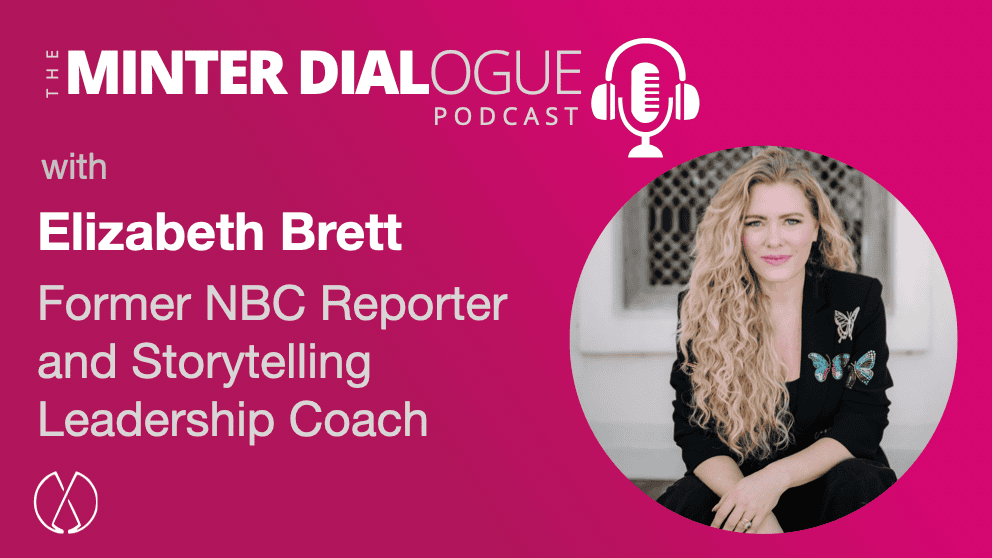
Minter Dialogue with Elizabeth Brett
Elizabeth Brett is a former NBC news reporter whose journey took her from the fast-paced world of television to guiding women in authentic communication. After a decade on screen, Elizabeth stepped away from news, spent formative years as a mother, and ultimately returned to her passion for storytelling and empowering women’s voices. Her approach, which she calls “Story Alchemy,” is rooted in helping others harness their inner narratives and show up with true integrity—on stage, on camera, and in life.
Our conversation centred on what it truly means to be authentic in an era that’s obsessed with performance, the difference between inner and outer stories, and the courage required to shed external expectations. Elizabeth’s lived experience, including a life-altering near-death moment in the ocean with her daughter, showed just how impactful self-awareness and presence can be when it’s time to communicate with heart.
We explored how stories are not fixed assets to be polished and repeated, but living, evolving expressions of who we are now. The way women and men relate differently to emotional storytelling, and the challenge of maintaining one’s sense of self amidst society’s demands, also featured prominently in our exchange.
3 Key Points:
- Story Alchemy—From Inner Belief to Outward Expression: Elizabeth distinguishes between the stories we hold about ourselves and the way we tell those stories publicly. Real authenticity arises when both layers are aligned, and we make intentional choices about what, when, and how much to share.
- Presence over Performance: Rather than rehearsing a story into oblivion, real impact comes from being present with the material and your audience in the moment. Elizabeth’s tools help leaders and speakers reconnect to their personal ‘why’ before stepping into any room or turning on a camera.
- Sovereignty and Boundaries in Storytelling: Not every story is ready—or meant—to be shared. Practising discernment about which stories serve you and your listeners, and which need more time to settle, safeguards both energy and authenticity.
Other mentions/sites:
- The Daily podcast by The New York Times here
- “The Odyssey” (referenced as a Nolan film)—likely “O Brother, Where Art Thou?” by Joel and Ethan Coen or another adaptation; general background on The Odyssey here
- James McCrae (poet, referenced for poetry about life) here
- The Grateful Dead (band reference) here
Further resources for the Minter Dialogue podcast:

Meanwhile, you can find my other interviews on the Minter Dialogue Show in this podcast tab, on my Youtube Channel, on Megaphone or via Apple Podcasts. If you like the show, please go over to rate this podcast via RateThisPodcast! And for the francophones reading this, if you want to get more podcasts, you can also find my radio show en français over at: MinterDial.fr, on MegaphoneFR or in iTunes. And if you’ve ever come across padel, please check out my Joy of Padel podcast, too!
Music credit: The jingle at the beginning of the show is courtesy of my friend, Pierre Journel, author of the Guitar Channel. And, the new sign-off music is “A Convinced Man,” a song I co-wrote and recorded with Stephanie Singer back in the late 1980s (please excuse the quality of the sound!).
Full transcript via Castmagic.io
Transcription courtesy of Castmagic.io, an AI full-service for podcasters
Minter Dial: Elizabeth Brett, it is wonderful to have you on the show. I didn’t know much about your life beforehand, but I got this great chance to dive down rabbit holes, explore you, and understand your past. And I think you are at the cutting edge of a very important part of what the world needs, which is understanding media and authenticity. But in your own words, Elizabeth. How would you like to describe who is Elizabeth Brett?
Elizabeth Brett: I love that you always start with this question. It might be the hardest one to answer. Who are you? So, I am a former TV news reporter. I worked for NBC for a decade straight out of college, um, and then I, I left news and went down a windy road of, um, working with, essentially working with women on speaking on stage and speaking on camera. I became a mom, stayed at home with my kids for a few years and came back around to storytelling and the power of authenticity and, you know, real intentional communication.
Minter Dial: Lovely. So, of course there’s storytelling to kids and then there’s storytelling to a public.
Elizabeth Brett: Yes.
Minter Dial: How, how, since you work with women so much, how do you think storytelling is different for a woman than a man?
Elizabeth Brett: Well, sort of one of the things that I do see is that women very easily access the emotional layer of reality, right? And so, we are able to bring that in really effectively to our storytelling. We understand the emotional layer happening. And of course, you know, men can do this as well. But I do really feel like what makes a story great is not just the ability to tell someone what happened, but to really put soul into it, to have it move and inspire the person on the other side. They need to have some emotional buy-in. And how do they get that? They feel the emotion that you’re sharing with. And then they in turn are able to see themselves in it. They relate to it. They get invested in it. And the story then becomes something that enables them to see something in a new way or uncover a part of themselves they didn’t realize was there. And then if you’re able to do that, then you’ve really created an experience with that person. You’ve created a way for, for them to know you and to remember you. It’s one of the fastest and most effective ways for us to gain influence. And I mean that in a very positive way and also to become memorable.
Minter Dial: All right. So, in this, the emotional intelligence, there’s the ability to muster to create the personality that, that tells the story with emotion. And my observation for having studied this a lot is that the way girls speak to one another is very different than the way boys speak to one another.
Elizabeth Brett: Hmm.
Minter Dial: And, and when a woman is in a crowd with men, It’s, it’s very different than a woman is a crowd with women. And then there’s one man in a crowd with women and one man in a crowd of men. And it’s amazing how we’re different in this. My point is that there’s one is the ability to relate into the others. The other is to understand who I am deep down and how I must correlate or make an attachment between the story I’m telling and who I am. And I feel like that is the, the quintessential challenge of authenticity.
Elizabeth Brett: Yeah. So, I— the, the framework that I work within is, I call it Story Alchemy. And one of the things that I want to bring into the conversation is there’s really 2 layers that we’re talking about. There are the inner stories that you believe about yourself. Hmm. That’s knowing who you are, knowing what you stand for. What does it mean to you to be a purposeful CEO? What does it mean to you to be the leader or the expert in your industry? And how do you show up as that? Those are the stories that you have that are inward. There’s also the outward expression. And where real authenticity happens is when those 2 meet. So, who you are on the inside is the same as what you’re showing on the outside. And, you know, I have something I call the sovereignty filter, which is really around knowing whether or not to share a story. But really the essence of it is the question. There are 4 questions. One of them is, Is this in integrity with who I am now? And that question really gets to the heart of what I would say is the heart of authenticity.
Minter Dial: Couldn’t agree with you more. And Elizabeth, for the real challenge I feel is in our society is actually coming to grips with really understanding who I am.
Elizabeth Brett: Mm-hmm.
Minter Dial: I’ve really talked a lot about this topic, and authenticity is such the buzzword, but it feels like, A, it’s actually impossible to have 100% understanding of who I am, and therefore to come with that idea of authenticity with a level of humility to say that actually I’m imperfectly knowing who I am, not to mention I am imperfect. And while know thyself is such the Socratic desire, Yeah. The issue is we tend to put performance ahead of that work. And at one point, usually my observation is that we end up with some kind of radical experience that says— that just shakes it all up, kills the masks, and brings you to, oh my God, near-death experience, I don’t care about the rest. And until that happens, we end up on this sort of moving carpet that just pulls us along, and we say, well, I just have to, and I justify and I perform.
Elizabeth Brett: Oh, there was so much in what you just said that is, and yes, yes, yes to all of it. So, yes, of course, what I would say, I spent 5 years really going deep into the sacred feminine and an alchemical lineage that understands, that really is based on this idea that everything is cyclical, so we are always changing and evolving. So, there are always parts of us that are dying and parts of us that are being born, right? So, of course, yes, we are not saying, you know, I know every ounce of who I am. The first step of alchemy is actually awareness. So, becoming aware of something, because you can’t actually change it or choose to keep it or change it unless you are aware of it. So, that really is the first step. And this idea of knowing yourself, it is a deep dive. It is a question of learning to discern what is yours and what is not. It is a question of being willing to go inward and ask. And that’s what I feel far too few people are doing. They see the outward and they see, especially, you know, when we’re talking about storytelling, there are so many people who have these hangovers because they have been told they’ve got to be more vulnerable and share all the— in this specific way, or someone taught them the, the perfect structure, or this is going to be their origin story and it’s the only story they should ever tell. And, you know, for me, you lose so much of the power of that evolution if you are stuck with 1 or 2 or 3 or 4 powerful stories that you’re telling over and over again. And that piece of being emotionally connected to your words cannot happen if you are stuck in the performance of it. If you’re stuck in, this is what I say next, and then this is what I say after that.
Minter Dial: Hmm.
Elizabeth Brett: You have to be present. So, so much of the work is coming back to the present, to who do I know myself to be now, to the best of my ability. Knowing that I don’t know everything and that I’m going to change between today and tomorrow and then between tomorrow and the next day. But is it in integrity with who I am in this moment? And that’s all we can do.
Minter Dial: Gorgeous. So, when I was running a company, Redken, I remember running around the world and, and I would systematically think of myself as the chief storyteller.
Elizabeth Brett: Love that.
Minter Dial: And I would like to, and at the time I would talk about Paula Kent, who was our founder, and I felt like my role was to tell that story. But since I told the story so often, where I maybe got a mistake was I would just tell the story differently because I didn’t want to bore myself.
Elizabeth Brett: Mm-hmm.
Minter Dial: Maybe what I could have done better was to always be more in touch with my relationship with that story.
Elizabeth Brett: Mm.
Minter Dial: And work from within me before I tell the story, as opposed to how can I just tell the story differently? Because I don’t want to bore myself because I’m saying the same thing. And I felt like my performative element was By saying it differently, I would be more interesting and more engaged because I’m not being rote. But I think that I missed the point of stepping into me and being the creator from within. That’s something that I failed to do. And so, when you’re talking to leaders and people you work with, how do you navigate? How do you bring them to be more in touch with themselves? And allow for the story to evolve from within.
Elizabeth Brett: Most leaders are actually very hungry for this because they’re probably at a point where they have been sharing the same few stories and they are feeling pretty stale. They’re pretty bored with them. And actually, your instincts were beautiful to change it. I do feel that whatever keeps you more alive and in the moment with the story is helpful.
Minter Dial: Mm-hmm.
Elizabeth Brett: And, you know, there are many practices to do that, ways to come back to the moment. You know, you talked about that moment that we all have that, you know, takes us down to our knees and strips away all the masks and everything. I have that moment, you know, a few years ago I was in the ocean with my daughter, had a near-death experience, and everything was stripped away.
Minter Dial: Mm-hmm.
Elizabeth Brett: And I have told that story many times. And the way that I approach it is, of course, I take myself back to the moment, to the fear of losing her, of not being able to get her to safety. And then the absolute bliss that I felt knowing that she was safe, even in the uncertainty of whether or not I was going to make it.
Minter Dial: Mm-hmm.
Elizabeth Brett: And to me, it’s about tapping back into the, that, that essence, that truth, to bring you back into the presence of what happened. And then also understanding, I would take it the next step beyond that, which is to also really be in touch with who your audience is. So, knowing what for them is going to be the transformation. from that story. It, you know, for me, I can take, I can use that moment to illustrate any number of things to any number of audiences, right? I mean, it was truly a life-altering moment, crawling out of the water, turning around, looking back, recognizing instantly I was no longer the woman I was when I went into the water, right?
Minter Dial: Hmm.
Elizabeth Brett: And then what happens from there in the story, I can take my audience anywhere I want them to go. And so, the other piece of that is to really look at your audience and say, what, what do they need? What is going to be, you know, what is my intention for this story? Where do I want to take them? What is the internal journey I want for them? And it may be the subtlest of shifts between one audience and the next, but that also keeps you online. It keeps you awake and really in the moment. It also makes that story so much more powerful because you are literally telling it for them.
Minter Dial: So, that brings up this notion of performance at some level, because there’s the story you tell that’s authentic to you within you. And, and one of the questions that I drummed up before our interview was, what’s the difference between developing trust with one person? You and I are speaking at this moment, or you and your daughter. You might be having an intimate conversation and you want trust to be harbored versus, you know, 1,000 people or millions of people as you did on television. Obviously, when you’re doing news reporting, it’s a little bit different, but How do you, because I mean, at the end of the day, a lot of people listening are, are, have individual issues of trust with their partners and family and stuff like that, but also running businesses and trying to have trust with 1,000, 2,000, 20,000, a million people listening.
Elizabeth Brett: Mm-hmm.
Minter Dial: How do you architect the building of trust in storytelling differently when you’re doing it or is there a difference between doing it with an individual and doing it with mass people?
Elizabeth Brett: I love this because one of the things that I always say to people when we’re talking about speaking to live audiences as opposed to a camera, right? And in the camera, I would say speak to one person on the other side of the lens. Imagine it’s one person on the other side of the lens. Same thing in a room. If you focus on connecting with one person, right, and you focus on really speaking to them, then that will emanate throughout the room.
Minter Dial: Hmm.
Elizabeth Brett: And I feel one of the biggest things that I see that changes for people is how they— to try to navigate a one-on-one relationship and to try to be authentic with one other person is something that we can all imagine. We can all say, okay, in my relationship with my best friend, or, you know, with my partner or with my business partner, right? I can imagine. I know exactly what that feels like when I’m really being authentic, when I’m really, you know, fully expressed, when I am giving all of myself in a conversation. When we try to say, okay, now imagine that to 500 people or 1,000, our brain doesn’t necessarily know how to do that. It’s like we get, we get jumbled and thrown off. But if we come back to what we know and what we felt, and this is really, you know, a big part of this is trusting, trusting what you’re feeling. And, and when you know how it feels to communicate with one person, the key is you’re standing in front of 500 people, you want to feel the same in your body. Now I talk a lot about performance culture. You know, coming from news, I was told not only how to do my hair and how to— what colors to wear and how to speak and how to sound like an authority, even though I was 22 and doe-eyed, no idea what I was doing, you know. And so, I got ton of coaching for the first 10 years of my career of exactly how I needed to shape myself to perform best.
Minter Dial: Mm-hmm.
Elizabeth Brett: And, you know, we all get those. We all get ways that we need to perform, and we all learn how to shape-shift somewhat to become who we need to be to find that level of success that we’re after. And we all get to a point where we know We’re stuck in the performance. We’re stuck in having to now play the role that we’ve created for ourselves, even though it doesn’t feel like who we are. And, I talked to so many clients who, you know, have been doing it, and now they’re like, I just, you know, I want to— sometimes I just want to walk away from the whole thing. And, it’s because that role no longer is In alignment with who you are. And so, stripping away the performance is actually very liberating. It can be really terrifying if you’ve only known that for the last 15, 20 years, but it also is wildly liberating. So, most of the time, it’s as simple as going inward and again, looking at those inner stories. What are the stories I’m telling about myself, about who I have to be and how I have to show up? And are they still true? Do I still choose them? And what is the new choice I can make? And this is where I do feel like you can share authentically if you’re, if you’re really willing to look at that and, and, and to be honest about how you’re showing up. If you can step into that and say, this is who I want to be, this is who I’m choosing to be, and just be aware of your choices, then how you’re sharing and how you’re shaping what you’re sharing— it’s not about like authenticity, doesn’t— it’s not about, you know, having a perfectly scripted, um, uh, story that you’re, that you’re repeating over and over until you memorize it. It’s about literally speaking from the depth of who you are. and sharing that with one other person, right? Or it could, it could end up being millions. But if you can do that, then again, we’re back to— we’re circling back to this idea of who am I?
Minter Dial: Mm-hmm.
Elizabeth Brett: But keeping that at the center. And this is why so much of my work actually is around that inner story and, and those pieces and reshaping that and reimagining that and opening up You know, offering liberation for the parts that feel really trapped and really stale and really stuck. And saying, well, what’s the— what would be the juiciest way that I could now do this, right? Maybe it is the same story, maybe it’s a different angle, or maybe it’s a whole new story.
Minter Dial: And this is the—
Elizabeth Brett: this is— I could talk for hours about this, but one of the things I do want to share is that I really believe we all have a gold mine of stories.
Minter Dial: Love it.
Elizabeth Brett: This idea that we just have 1 or 2 or 3, it is absolutely ludicrous. We have hundreds of stories that are always emerging. And so, if we can get away from this idea that we have to stick with certain stories, even though those may have worked beautifully, and we can move toward the idea of micro stories, these smaller stories, these little bite-sized pieces, that we can be always updating and always sharing based on where we are now and who we are now and who we’re speaking to, then that gives us a lot of freedom.
Minter Dial: So, one of the, the word you talked about, sovereignty, um, and then there’s a— so I, I, I feel that notion of sovereignty of who you are is, um, it’s a really interesting concept. I also wanted to break back to the story of the story alchemist that you are, you talk about. Um, my wedding band, um, has magnesium salt and mercury on it, which is the, the 3 ingredients of alchemy, the alchemist. And so, that’s just funny. Um, but How do you protect yourself? Because the issue at some level, if you take— let’s take a role that neither you or I have exercised, which is being a doctor and, uh, or a nurse, where you have to have empathy for the individual, the patient.
Elizabeth Brett: Mm-hmm.
Minter Dial: And, and sometimes, you know, you invest yourself into that story. of the person, the patient’s situation, illness, and it can be somewhat corrosive to you. And if you give of yourself all the time, hmm, how do you protect yourself? How do you ensure that you remain, that you remain energetic? Because, you know, what I hear in you, Elizabeth, is this ability to tell stories, and be yourself and give of yourself, which is a beautiful thing. And I don’t believe, by the way, that everybody has great stories. I think that— I think that there are, A, some people who have better stories and some people who know how to tell stories better.
Elizabeth Brett: Mm-hmm.
Minter Dial: That’s my take. But how do you protect yourself? And what is— what is this notion of sovereignty?
Elizabeth Brett: Mm-hmm. So, how do you protect yourself? So, there is an element here of— for me, I would say the exploration of this came in the form of motherhood. The over-giver. I had totally confused sacrifice for love.
Minter Dial: Hmm.
Elizabeth Brett: And giving of myself and being, you know, ignoring my own needs, right, for the sake of my family, my children, and ended up completely lost in the process. Completely lost. And for me, Sovereignty came in, in the form of a mythical sword.
Minter Dial: Hmm.
Elizabeth Brett: To cut away everything I had learned about— from others, about what it meant to be a good mom, what it meant to give enough. Um, you know, what I was supposed to be doing, uh, even, you know, how to, how to navigate work and life. And this is something that no matter where we are, no matter if we’re parents or not, we are now more than ever inundated with experts and, you know, people who have it figured out and people who, you know, want to tell us exactly the formula to get from A to B. And, um, if you haven’t, you know, you, you may have hired 4 business coaches but this 5th one definitely has the way that’s going to get you to that next level, right? Whatever it is. And so, we have so many people that are inputting, they’re, they’re offering input that’s all outside of us. Sovereignty is actually being, being able to first discern what is your inner voice and what is it saying, and then to actually Listen to that first. And this is a lifelong lesson. This is a— what I like to imagine as a spiral, right? You’re going to, you’re going to have one round and then you’re going to come back around to it and be like, I thought I learned this lesson, right? I, I thought I really learned to listen to myself and not other first. But you’re going to have to keep coming back around to it because our culture teaches us to look outward. At doctors, at experts, at other, you know, to, to learn from them as opposed to really learning our own intuition, understanding what, what integrity feels like inside of us, right? Being able to ask those questions about what— who am I and what do I need and how do I choose to show up? How do I choose to, to be A CEO, right? Whatever role we are choosing to take on. The not giving too much comes from understanding your own needs, which is sovereignty. You know, to be able to have boundaries, to be able to recognize, for example, the sovereignty filter that I, that I mentioned is all about whether or not a story is ready to be shared, because not every story is, and not every story should be shared.
Minter Dial: Hmm.
Elizabeth Brett: And that’s something that, that I feel that not enough people say. You know, it’s always find the juiciest story and share it. Well, is it ready to be shared? Is it yours to tell, right? Is it in integrity to share that and to allow yourself that space and time to actually create that relationship within First. Not for me to say, well, you should definitely tell that story next, and then after that, let’s tell that story. But for you to feel, you know, how does this story feel when I share it? That also takes you out of performance and into authenticity because you’ve chosen. You’ve said this story is ready, or there are pieces of the story I’m going to protect and not share, but there’s a whole lot that I am going to share because it feels actually in integrity for me. And I’m sharing it in a way that feels so good for this audience, right? That in and of itself is wildly empowering in the sense of you’re giving, but only what you’ve agreed to. And I feel like where people over-give is where they’re unaware of the choices that they have, or they’re not aware of their ability to create a boundary.
Minter Dial: So, I’m curious, Elizabeth, what was the— what was the thing that transformed you from performance to authenticity? If I can make that as a sweeping statement, was there a moment that allowed you to say, all right, I’m going to lean into me and I need to be more me. Lost as a mom where you were giving more than being. You were getting all the metrics of performance and audiences on the NBC, whereas I wasn’t happy at home. What? I don’t know what happened. What was the thing that sort of said, well, fucking A?
Elizabeth Brett: Yeah. It was that moment in the water with my daughter. It was, you know, several summers ago. And it was a, you know, we were at a place that, at a beach that I’d been to since I was a little kid. The water there, it’s on Eastern Long Island, so it’s unpredictable. The shelf, the sand beneath the water changes every day. So, you’re not quite sure how far out you can reach the bottom, but the waves are not tame. Generally speaking.
Minter Dial: And, um, welcome to nature, I should say.
Elizabeth Brett: And so, that day we’d gone in, and there we always have the rule of our kids go in with an adult, um, just because we know the unpredictable nature of it. And, um, my daughter was 6 and, you know, weighed about 55 pounds. And we were out in, in the water swimming away. My cousin was with my son. They went in, we stayed out, and I started to notice her getting tired. And as I did, I looked, I looked up and I saw, you know, I saw, I saw a set starting. So, I saw a big wave coming. So, I thought, okay, you know, I can kind of calculate, all right, I can go under and up with her. And I did that. As I did that, I, you know, kind of let her know we got to, we got to stay out until we can catch a break and get in. And she went under with me, and as she came back up, she was pulling on my shoulder, like she was not really helping to swim anymore. And so, that’s when I really started to calculate how long can I sustain this. We were not in a place where I could touch bottom. And of course, the next wave came. We went down and came back up. And then something primal started to click in where I recognized, you know, I was in survival mode here, and I was, I was going to fight, and I was going to need to fight. You know, went down and again, we’re back up. Of course, hoping that this was a 3-wave set and we’d be, we’d be good. And then of course, the next wave was right And so, after one or two more waves, I remember just screaming this kind of primal scream to my cousin, who I didn’t even know if he was still there or down the beach with my son, but he happened to be close enough to hear me. And I screamed something like, I can’t, I can’t keep her up, I can’t hold her. I don’t remember what the actual words were, but it was enough of an alarm that he came running over. Oh my gosh. He came, you know, came in. He was—he’s a whole foot and then some taller than me, and a former lifeguard. So, like the—the what a wonderful magical thing that it was him. But he came in, and I remember the handoff and the moment that I gave her to him. And I knew—I knew in that moment that I’d done my job as a mom, that she. She would be safe. And then this was the moment that totally and utterly surprised me because even though she was safe, I wasn’t yet in far enough to reach. And I didn’t know if I was going to make it back or not, but inside my body and every cell of my being, I knew it was okay. I knew it was okay because I had done my job. I’d gotten her back to safety and I surrendered fully, maybe for the first time in my life, like fully surrendered to the water and said something like, take me home. And I didn’t know if that meant to shore or if this was it, but I knew I had nothing left. All of the fighting that I’d been doing to get her to my cousin to safety was done. And so, I simply surrendered. And I couldn’t tell you if it was 10 minutes or 30 seconds, but the next thing I remember was crawling, hands in the wet sand, crawling out of the water and turning and looking back. And that was that moment that I mentioned where I knew instantly.
Minter Dial: Mm-hmm.
Elizabeth Brett: Having gone through that, having felt not only the peace in that moment but the absolute bliss of total surrender, something awoke in me that I recognized I didn’t have to be anyone or do anything that wasn’t true from that moment forward. That every single thing I chose, it was like I only had this one life. How was I going to live it? Like, wake up, right? It was really a huge wake-up call for me to be like, this is it. Everything I create, everything I choose, everything I say yes to, everything I say no to now gets to be with this deep understanding of how precious How sacred, how fleeting this life is. And so, from that moment forward, it wasn’t even a choice. It was just everything I had done, everything that I had decided because I thought it would make me more successful or better at what I did, it didn’t matter anymore. And that all I actually wanted was to be in alignment with this Soul level purpose. that I had about offering a way for people to understand the power of their own voice, the power of the stories they tell, not only outwardly, but the power of the voice within them and the power of those inner stories to shape their reality. So, that’s what I’ve done ever since.
Minter Dial: So, uh, first of all, I, I, um, I, I share— I want to share a story because stories beget stories, right?
Elizabeth Brett: Yes.
Minter Dial: As they do. That’s why it’s fun. Um, I remember when I was around 16 or so, I, um, I got a boomerang for Christmas and we were in Marbella in south of Spain and I threw it. I was, I was in the beach and I threw it towards the land. No, threw it to the— into the sea and it didn’t come back. So, I said, oh shit, I have to go swim and get the boomerang. And I ended up swimming out and then the tide and, and I lost my footing and I, I got swept out and, uh, and I screamed. And I do remember what I screamed at that point was I said, socorro, socorro, which is Spanish for help. And he, my sister was with me and she was desperate. She’s younger and, and Elizabeth, my, my lovely Lisa. And, um, A Spanish woman in a dress apparently took off her shoes and dove in and saved me. Pulled me out, and then she just ran off. I never got a chance to say thank you.
Elizabeth Brett: Wow. What an angel.
Minter Dial: Indeed. So, the point that I was thinking about was You know, we, we, you have had that experience and then it, it made you change and it allowed for you to say, I’ve done my job. What is your relationship with death at this point? Hmm. Hmm. Hmm.
Elizabeth Brett: Well, I’d like to say, I’d like to say that that I’m not afraid of it, that, you know, I, I have one of the archetypes. So, in the lineage that I’ve studied in sacred feminine, um, we— there are 13 archetypes that we work with, and one of them is the Queen of Death.
Minter Dial: Hmm.
Elizabeth Brett: And in one of the, um, temple spaces, when we were dancing with the Queen of Death, I remember there was a moment where, you know, we were asked, what else is here? What will you not release to me? What will you not, you know, give me? Because at some point, right, everything we have will be, will change and will be gone and we will release it. And I remember I was, you know, it was kind of a meditative state, but I remember wailing and saying, don’t take my children, take me.
Minter Dial: Hmm.
Elizabeth Brett: So, I would say, you know, my relationship with death is that I do have fear of, of the experiences that I will miss. Um, if I were to die, I have a much bigger fear of my children being taken right before me. And I know, I know now that I have children, I would be willing to sacrifice myself for them, which I had never felt before having children. And so, it, it’s an interesting dance. I don’t know that I have like a neat answer for you on my relationship with death. But I would say it’s, it’s always, um, an inquiry for me about my attachment to control, my attachment to what I know, my attachment to keeping things the way they are, right? Um, and my willingness to surrender to the unknown, you know, which is what I really think death asks of us, to surrender to the unknown.
Minter Dial: The Nolan film of The Odyssey is extraordinary in this regard, in that it poses the true philosophical question of what is life and who are we? I haven’t seen it yet, but of course I’ve read about, I mean, The Odyssey and Odysseus and Ulysses. Um, I feel like our, our, our, one of our major problems in life, in our society, is our inacceptance of reality, our inacceptance of who we truly are, and, and, and ultimately, uh, an inacceptance of our mortality.
Elizabeth Brett: Hmm.
Minter Dial: And, uh, I’ve been impressed with certain of the— there’s the Daily from the New York Times. They often explore the key, true, deep topics of our society, I feel. And they— I talked to you beforehand about how I think media is not playing the role that they have. They have a knack of tackling some of the big ideal questions. The idea of, well, because I can, should I? Just because I can, am I allowed to believe in immortality? And we have become somewhat detached from reality. This is sort of my general thing. But so, to try to bring it back to a little bit more prosaic elements, Elizabeth, you know, when one of the things you talk about, you say, I don’t teach performance, I teach presence.
Elizabeth Brett: Mm-hmm.
Minter Dial: And I so believe in being present. It’s a delightful thing. Yet when you’re running a business, you need to make the numbers. You have a history, you need to be in touch with your past. So, you can’t just be present. You know, you exist in a context, you have DNA. You have things that have— that your country, your, your people, your community have brought you to. So, you don’t exist in isolation. No. And then I don’t think that’s what presence is. All right, good. And what I want to do is see how you would answer this, but then you can deal with presence more in a sec. But how do you distinguish between presence From charisma, confidence, or polish?
Elizabeth Brett: Hmm. Well, presence is just being here now. It’s actually seeing what’s in front of you. So, in the simplest form, that’s what we’re talking about. Not being stuck in the past, not being stuck in all the tasks you have to do later today. And so, really an effective leader is— does need to be present. It’s not that you’re unaware of the past or you’re ignoring the past. You’re actually very aware of what is real and what is on the table and what is at stake. But you’re actually in the moment. You’re not in a meeting thinking about the next meeting you have to go to. That’s the distinction. So, it’s, it’s, it’s really being here now. So, that’s all it— that’s all presence is in the way that I have learned to understand it. Um, I would say one thing that I want to, I want to just add is, you know, you talk so beautifully about, about death, uh, um, and our unwillingness to really see it. And I do think one of the gifts— and I, I’d love your perspective on this— after having a near-death experience is to have faced the fact that we are mortal. And there’s a beautiful poem, I wish I knew the author, I don’t, but it talks about how we will lose everything. We will lose our friends, we will lose our lovers, we will lose, you know, our beautiful You know, tight skin and everything else, but in recognizing that we will lose it all, life actually becomes the altar. The moment we’re in now becomes more sacred if we know that at some point we will not have everything we have now in the way that we have it now. And yes, life can get juicier and juicier and juicier, but it is, it is to not ignore that everything is going to change. That is the only inevitability.
Minter Dial: In— we’re going to finish off because time is of the essence, but, um, I was thinking of you as you were crawling in the sand, and, and so This is such not what happens is, oh, where’s my makeup?
Elizabeth Brett: Right, right. How do I look in this moment? Or do people think I’m professional right now?
Minter Dial: Right, exactly. And I wanted to address, raise, but I don’t remember the name, but there’s a guy called James McCrae who’s written a gorgeous poem about life, and I’ll put it in the show notes because it’s I read it to my father, who’s still alive but no longer fully cognizant. But I felt truly delighted that I was able to read to him this poem. So, it felt like it’s, it’s, we’re just, this is a short little shift that we have on this earth. And, and if I have been a, a student and a fan of the Grateful Dead, All my life, really, since I was 16. It’s because when you know you die, you are grateful, ever more present, which is just the big reminder of life. So, Elizabeth, um, good golly gosh, this is one of those Joe Rogan moments where I should bring out a big spleef and we should go on for another 4 hours. However, We can’t do that. Um, who would you like to have reach out to you and how would you like them to reach out to you?
Elizabeth Brett: Um, well, I would say anyone who really is ready to explore their inner stories, who is, you know, who has their interest piqued on storytelling or maybe is in a place where they feel, oh, that there might be more to how they want to show up. Or just anyone who wants to say hi or resonated with some— something or wants to share a story. I love hearing from, hearing from your audience, and I would be honored to. You can find me on Instagram. I’ll send my Instagram handle so it’ll be in the show notes. I’m at elizabethbrett.com. You can email me, it’s elizabeth@elizabethbrett.com. So, very easy to remember. Yeah, but I love conversations. One of my favorite things, and the reason I got into news was because I love getting to know people. So, please reach out.
Minter Dial: Beautiful, Elizabeth. Multi-thanks and hope to see you in London someday soon.
Elizabeth Brett: Absolutely. Thank you so much.

Minter Dial
It’s easy to inquire about booking Minter Dial here.