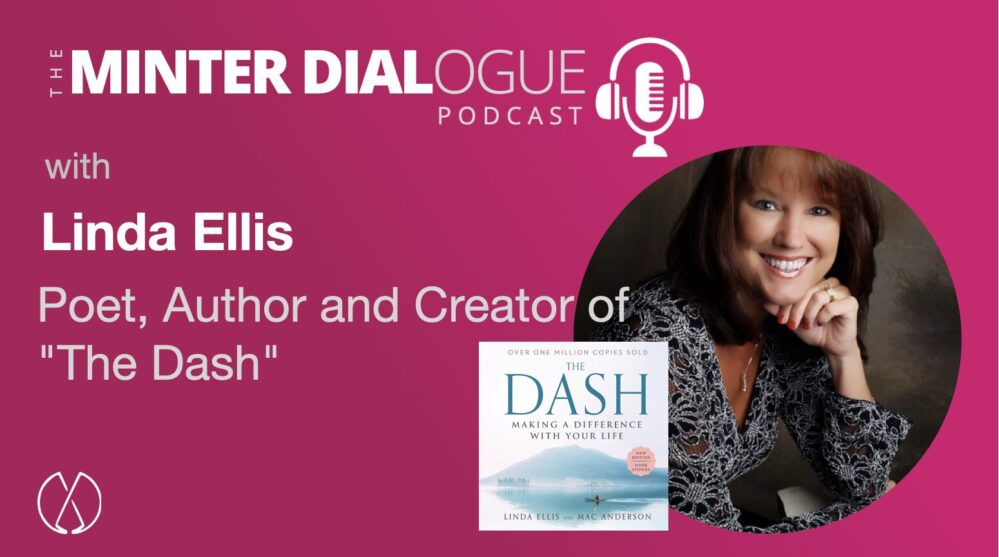
Minter Dialogue with Linda Ellis
In our exchange, we explored what it means to truly live and embrace the finite nature of our existence. Linda opened up about her own early discomfort facing death—avoiding funerals as a young woman—making her ascent as author of the country’s number one funeral poem all the more remarkable. Through both humour and heartbreak, she’s come to champion not only “the dash” that separates our birth and death dates, but also the imperative to fill that dash with connection, authenticity, and joy.
The conversation delved into the responsibility Linda feels towards readers who reach out after reading her work, her experience navigating public expectations, and her conscious effort to infuse life into what could otherwise be deemed a poem about death.
3 Key Points:
- The Power of Simplicity: Linda credits the accessibility of “The Dash”—its straightforward language and relatable metaphor—for its extraordinary reach, connecting deeply with people from all walks of life, from doctors to prisoners.
- Legacy Beyond Possessions: For Linda, legacy isn’t about material wealth but the memories, kindness, and character we infuse into others’ lives—through laughter, music, or a heartfelt note.
- Living Authentically: The heart of Linda’s message urges us to live each day as if it might be our last, ensuring our actions align with our true selves, not just public personas or external pressures.
Further resources for the Minter Dialogue podcast:

Meanwhile, you can find my other interviews on the Minter Dialogue Show in this podcast tab, on my Youtube Channel, on Megaphone or via Apple Podcasts. If you like the show, please go over to rate this podcast via RateThisPodcast! And for the francophones reading this, if you want to get more podcasts, you can also find my radio show en français over at: MinterDial.fr, on MegaphoneFR or in iTunes. And if you’ve ever come across padel, please check out my Joy of Padel podcast, too!
Music credit: The jingle at the beginning of the show is courtesy of my friend, Pierre Journel, author of the Guitar Channel. And, the new sign-off music is “A Convinced Man,” a song I co-wrote and recorded with Stephanie Singer back in the late 1980s (please excuse the quality of the sound!).
Full transcript via Castmagic.io
Transcription courtesy of Castmagic.io, an AI full-service for podcasters
Minter Dial: Linda Ellis. I mean, I— we’ve just been having a little chat before. I’ve never met you before, but it feels like a lot of my life has been written by you somehow. In your own words, as I like to ask my guests, Linda, who are you?
Linda Ellis: I’m a poet at heart. In fact, one of my poems is “I Am a Poet. I feel words. I often say if I was wounded, I would, I would bleed words. And I, I’m just— I love to write. I love to get to know people. And the Dash poem, which you’ll explain, has given me the opportunity to do that on another level. I instantly connect, just like you and I just did. It’s an instant connection for me. So, I get to know people on a different level. I really do.
Minter Dial: So, you mentioned wound, which, I mean, sounds rather grotesque. I mean, harsh to wound and bleed words. It feels like the dash has to bring meaningfulness to everything. And faced with typically the second number that follows the dash, the fact that we do die will render things more important.
Linda Ellis: Right.
Minter Dial: How do you manage if that’s so much of what you do and the reality that is there, How does one not make everything all the time meaningful?
Linda Ellis: You know, for a long time, I had a problem being the Dash author because all I talked about was death. But the fact is, I didn’t do death when I grew up. My grandparents, all 4 of them passed away, and I didn’t go to one of their funerals. I just, I thought if I could ignore death, it would go away. And then what do I do? I write the number one funeral poem in the country. So, I think it was a way me, my own journey, a way to get me to accept death. And, um, the dash is actually— the death is what gives the dash, the metaphor, its power. Um, if it wasn’t for death, life— you wouldn’t appreciate life as much. And that’s the, that’s the theme that I go on. Um, but I did have a problem for a long time because everyone it— the Dash became synonymous with death, funerals and death. And I spoke for the National Funeral Directors Association, and it started just to go in that direction. So, I actually wrote a different version called Live Your Dash, which I published with Barnes Noble, to add life to the poem rather than have it just associated with death. But I went through some sort of mental almost depression because every single day I was answering people and I felt a responsibility to answer people. They would write me and say, this poem means so much to me. It was read at my mother’s passing. And I can’t just pass those emails up. It’s very— even if I just wrote 3 lines, they felt connected to me and I couldn’t pass any of them up. And I would sit at my computer all day answering. people. And death, you know, some of my friends where I work, they thought the queen of death is here, you know.
Minter Dial: Yeah.
Linda Ellis: It was just, I just became so, death became so much a part of my Dash. So, I tried to change the trajectory of all of that. I really did. But then I started to learn to accept it and realize that that’s the reason the Dash is touching so many hearts and lives. Um, a lot of it is because of death.
Minter Dial: So, I’d love to get more into the living in a moment. So, where it totally resonates for me is from the age of 16, I was in England and, I looked up to an older boy at my boarding school and, uh, and he introduced me to the guitar. to marijuana and to a rock and roll band, an American rock and roll band called the Grateful Dead. And I’d never heard of them in England. No one knows who they are. And their principle, the idea was once you know you die, you’re forever grateful. I’m like, oh my gosh. Anyway, so I ended up writing my thesis around death and everything. And it strikes me that While you wrote your— and I want to get back into how it became such a massive success in a pre-social media world, but it strikes me that the resonance of your story is that in our society today, we have a tendency, like you said at the very beginning, to run away from death. And I’m wondering to what extent this is helping people to come to grips with it, to move back into the living the dash than worried about the death. And do you feel like it— how existential, to use an obvious word, it’s become important in our world to be more in touch with? As opposed to run away from death.
Linda Ellis: You know, the revelation or the epiphany people have is usually in a crisis about the dash and how short the dash is. It’s usually— maybe recently I held my brother’s hand as he passed. And although I’ve had a lot of stories like this, to experience that really puts it all into perspective. So, sometimes it takes a crisis, and probably 80% of the people that I hear about have heard it at a funeral or in reference to someone’s death. And it is— I’ve never, to be perfectly honest, written 36 lines of anything in my life that affects people the way that this poem does. And I, for a long time, I had a hard time understanding it. I wrote it quickly. I sat down and wrote it. Talk about an epiphany. I sat down and just wrote the poem. And usually I’m very picky about changing words, but I literally spilled it out. And then I shared it. I think I’m wandering from your question, but—
Minter Dial: No, no, no, but I want this answer. So, please feel free. Continue on. I mean, I would love to know, I mean, what made you get Write— what was happening? Piece of paper, spilling? What was happening in your mind? How did you get to that and just let it riff?
Linda Ellis: Okay. So, I was working for a very large corporation at the time, but as a hobby, I was on a syndicated radio show sharing my poetry. You know, my grandmother was from Ireland. She wrote poems. My mother wrote poems. And I wrote poems—
Minter Dial: That’s the Blarney Stone.
Linda Ellis: Yes. And I wrote poems as a child. I have friends that have typed out poems that I wrote them as a child. So, I’d always written poetry, and I was on a syndicated radio show as a hobby. And, I was working for a very large corporation, and I started to see how some of the priorities there were a little bit misaligned. And, it just started to strike me. I was not in an environment that I was comfortable with. But something came to me. It was a— I never knew The Dash would be what it is. So, when people say, what exactly were you thinking at the time? I was thinking I’d write a nice poem. I didn’t have this huge idea of what it would be and where it would go.
Minter Dial: Mm-hmm.
Linda Ellis: And I’m certainly grateful and overwhelmed that it has. So, I sat down to write it and I think that in my mind, there was a letter that had been routed around our office, you know, how things would come in and you route it around to all the people. And it was an original written letter from a woman who knew that she was dying. And she wrote in there, if I’d only known then what I know now, but I did, and so do you. We’re all going to die. So, stop worrying and start living and loving. And it just— wow, that put it all into— in just a few lines, that put it into perspective for me. So, and I wrote The Dash and I sent it into this radio station and he read it and that was it. Um, it just started the ball rolling. And again, never knew I, I was— never knew what would—
Minter Dial: How old were you at this moment when it was read on the radio?
Linda Ellis: Um, 1996. Do I have to say how old I was? Many years ago.
Minter Dial: How about younger? Younger. Did you listen to that journalist?
Linda Ellis: I did. And I have it on a cassette tape. I have it on a cassette tape marked Dash 1996. But my boss at the time called me into his office afterwards and he said, you need to get a copyright on this. And I said, what’s a copyright? I had no idea. And fortunately, I did that right away.
Minter Dial: Well, good for the boss, by the way.
Linda Ellis: Yeah, exactly. And he wasn’t one of my favorite people, but now I look back and he helped me a lot. But I did get a copyright, and I’m glad I did because down the line, people— I got messages, I wrote that on toilet paper in prison, and I— so many different stories. I’m like, no, you didn’t.
Minter Dial: Well, and like I was sharing with you beforehand, I came across the concept in a walk in the old Brompton Cemetery, and a priest basically didn’t say the poem, but he gave me the concept. He didn’t call it a dash, he called it the hyphen.
Linda Ellis: Mm-hmm.
Minter Dial: Because I think that may be an Americanism versus the way we speak over here. But So yeah, it’s, I suppose, like the woman who wrote that letter. We all know it, but you know how we come up with it. And, and the issue is, and I think that this is sort of the pregnant problem, is that so many people, it only comes to when you get to a crisis.
Linda Ellis: Mm-hmm.
Minter Dial: Do we start getting focused on the dash? And, and yet, if you speak to someone who’s not in a crisis, oh, you should get, you should live, love, and enjoy life and the dash and this and that. Oh yeah, well, I’ll do that tomorrow because I’m on my journey right now. I’m going speeding on my magic carpet and I’ve got my job and my this and that and that, and life is just running right by me. But oh, you’re going to die in 5 years’ time. You lose your mom, other crises like you say, or, and for me it was the 9/11, is the wake-up. to the proximity, to the reality and what actually is important. How does one imbibe the dash without a crisis?
Linda Ellis: I guess just realizing, like I say, everything that we do, that dash represents every relationship, every failure, every adventure, everybody that we’ve loved, and the mark that we leave behind. It’s like when you go and you’re inspired at a funeral or someone passing away, and you get that, oh my gosh, life is so short, I need to start living. Well, you might do it for the day after and the day after that, and maybe a week, and then it just starts to fade. So, what I’ve tried to focus on is just living every day because all the stories that I mentioned earlier, some of them were just shocking that young, very young— my best friend lost her son at 24 years old in a horrible accident. And I, in fact, I wrote a poem specifically about that. We don’t know— what middle age is. You know, middle age in his case was 12. So, people can’t say, oh, I’m middle-aged, I want to start living my life. Middle age can have already passed you by several years ago. So, it’s all a matter of realizing that today is really all we have. We don’t know if— and also, whoever you love and the people that you’re talking to, this could be the last time you see them. And, the older you get, the more often that happens. So, you have to make sure that every relationship and everybody that you love knows you love them. I’m— I always send notes to my friends saying, I’m just so glad you’re a part of my dash, and I want you to know that. It’s just so important to let people know. I, you know, I write people that I not— don’t necessarily love, but that I respected, or years ago who made a difference in my life. I’ll write them a letter saying, you know, you really helped me, and I want you to know that, you know. Because I’ve had people pass where I didn’t have that opportunity to tell them, you know. So, I just think we need to think of every day. I wrote in one of my poems— I always refer to my poem— every day, consider every day a lifetime in itself. Um, that will be— could possibly very well be over that evening, you know. So. Now I can talk about death more freely than I used to. I, I—
Minter Dial: Right. Well, I think as we get older, it becomes a little bit more—
Linda Ellis: Absolutely.
Minter Dial: Easy. Oh, I forgot to say before, sorry, fear loss. I should have mentioned that before.
Linda Ellis: Thank you.
Minter Dial: But to go back to how to sort of be frivolous when you have the weight of death, in every conversation. How does one sort of make the frivolous fulfilling? How does one— how can the rest of life be materially useful when, if it’s not meaningful and deep and huge and legacy building? Well, How do you sort of square that round peg?
Linda Ellis: Well, everything we do is legacy building, whether it’s serious or frivolous. That’s what we’re leaving behind. And I’m just— everything to me has always been fun. Like, if you ask any of my friends, I’m a silly— and so I had to find a fine line between death and living life. You know what, when I spoke at one of the large funeral director conventions, I ended up having a few cocktails with the embalmers that night.
Minter Dial: Wow.
Linda Ellis: And I’ll tell you what, they absolutely put some ideas into my head about living life because they see what they see and they do what they do. And I learned life lessons I never dreamed that I would. So, yeah, I’m partying with the embalmers. That was— that should be a poem, right?
Minter Dial: I second that thought. I love this idea.
Linda Ellis: One whole group of people. Sorry.
Minter Dial: Silliness and death. You know, it sort of sounds paradoxical, but so relevant to be able to be silly and know that we die.
Linda Ellis: Absolutely. My mother, who— I’ve had a lot of people, and my A-lister people in my family die back to back to back just in the last couple years. So, all of this is very fresh and relevant for me. I also got a brand new view of my own words. And my mother was the silliest person alive. She laughed at everything. And she left that with me. Thank Goodness. Um, but because when I even think of her passing, um, I, I think of her laughing, you know, and she left that with me, a frivolous part of her legacy. Um, she was just the silliest person ever, and I, I love that. I love that about the dash too, because the fact that we are going to die makes you question why. We take things so seriously. None of this is going to matter. You know, none of it’s going to matter.
Minter Dial: So, true. Of course, I’ve had, I’ve had on my podcast a couple of individuals who are dying with the sentence prescribed, and that inevitably sounds like a rather heavy conversation. Uh, and I’ve, I’ve also had a, the wonderful Dr. Chris Kerr, who is a hospice doctor. And, um, he did a remarkable TED Talk. And, and since he recorded something like 1,000 interviews of people in their lucid moments before death, uh, I was like, that, that seems like a really important conversation for me to have.
Linda Ellis: Mm-hmm.
Minter Dial: You know, like some, I sometimes said, someone said to me the other day, oh, Meeting you means I’m one step away from— in this particular case, it was Hitler— which, you know, one step away from. And with this man, I felt like I was one step away from death in all its beauty. And he remarked on connecting the dots as to what these 1,000 people in different ages, from teenagers to octogenarians and so on, felt was important in life. And yet, do we need to be able to strum a guitar, laugh like— I’m assuming your mom was the Irish part of your family.
Linda Ellis: Yes, absolutely. That’s— yep.
Minter Dial: And, you know, drink a beer and, you know, and allow yourself to get drunk every once in a while. And, you know, and yet within all that, be good and— but know that we are imperfect. And I think that’s sort of the— I feel like that’s the trickiest part of death, is that it ought to be the door opening to our imperfections without being religious about our sinning.
Linda Ellis: And, you know, you talk about— you spoke with people who knew they were dying. That’s the whole crux of this. My father used to say we should all be born with expiration dates stamped on our forehead like a carton of milk, and that way we could plan. Well, you spoke to people who could plan and tell everyone that they love, but some of us don’t know our expiration date, and that’s why we need to almost pretend that this could be our last day. So, we express— you know, a lot of people are so hesitant to express the way they feel. And then they don’t get an opportunity later. Either they don’t get the opportunity to say it, or the person that is on the receiving end is gone. So, it’s— I don’t fear death anymore. I used to.
Minter Dial: Mm-hmm.
Linda Ellis: I don’t fear death anymore. I, you know, recently— well, I don’t want to get personal, but I’ve got, you know, medical things happening to you when you get older. And I started to really go deeper in my own mind about the concept of not being here anymore. And my expiration date. Um, and I realized the fear that I have— I mean, not, not of the actual instance, but of, um, not being here anymore. Letting everyone know that I love them has taken that hesitant hesitancy away from me. I don’t fear death anymore.
Minter Dial: I don’t— I was—
Linda Ellis: I’m not looking forward to it, but I don’t fear it.
Minter Dial: I think that’s fair.
Linda Ellis: Mm-hmm.
Minter Dial: I was listening to Sam Chernow’s biography of Hamilton and how he recounts the passing of Hamilton and how even mortally wounded, he was still talking about, you know, you need to do this, don’t forget that, I’m good, and the presence of it. And I felt like that was a A good example for us to settle in with that moment of, I will not exist any longer. So, Linda, I certainly don’t mean to be this only to talk about The Dash because— but the sort of the link in is, to what extent has this poem, do you feel, defined you? And do you feel that’s fair? Or not?
Linda Ellis: Um, I believe it’s fair now. Um, I walk the talk of the Dash. Um, and if I come to an instance where I feel like I’m not, I’m not respecting others, or, um, you know, smiling more— that’s my big thing in the Dash— I’ll reread it. I don’t have to read it, actually. I recite it myself, um, to remind myself. When I first wrote it, I thought it was a special poem. I sent it to the radio station. I had no idea what would happen, but I didn’t walk the talk of it. And then it started making money. And then I had a real problem because the dash is all about— it’s not about the cars, the house, the cash. And cash was coming in for a while there when it— and I thought, I really have to make sure I separate you know, the words of my poem and walk the talk of the Dash and not being more taken by the profit that it can make and is making. And that took me a couple of years, you know, but I really did it. I really did it. And if, you know, I got— I took a— I spoke in the Bahamas recently and I took a flight there. And by the time I got off the— well, most people know the Dash. It’s incredible. If I mention it, they’ll say, I know that poem. You wrote that poem? But I had people on the plane meeting me afterwards for, you know, a signed book or whatever. I am the Dash lady. I walk and talk the Dash. I want to spread the word. I feel like it’s my responsibility. Like I had mentioned to you, there is a reason. There is absolutely a reason this poem has reached millions. And there’s no way to ever know, really understand how many people that it’s reached, because what I hear from maybe a fraction of them. Um, so something, you know, I was working for a large corporation at the time and there was no social media. It was put on a gentleman, Mac Anderson. He used to— he was an entrepreneur, had a lot of companies, and he Wrote me when he heard it, and he said, let’s do something together. You know, we ended up making the Dash gift book, which has now sold over a million copies. And but at the time, um, he said, let’s do something with this. And that’s how everything came about. But he had put— it was a Flash movie way, way back when they called it Flash movie. That was the—
Minter Dial: Oh, I remember Flash.
Linda Ellis: Yeah.
Minter Dial: So, I had a Flash— I built a Flash website, I remember.
Linda Ellis: Yeah. And so, he put a bunch of pictures with it and some music, and in no time at all it had a share button. Remember, share. This is before any social media, and it was shared over 50 million times or visited and shared over in absolutely no time. And that’s what prompted the book and everything. As I say, there’s no— no matter what you believe in, if you believe in God or any kind of a higher power or the universe, the collective power of the universe, whatever anyone believes in, there was something pushing this work out there. There’s no way I could have done it. There’s no way I, I had the wherewithal to, to spread this out by one radio station reading. Um, so I truly believe there was a higher power wanting— because it’s all about treating people with respect and realizing This is it. This is the show, and there is no dress rehearsal. Um, so we have to make the most of the, the dash that we have, our life.
Minter Dial: I love how you have to— you felt like you, you have to live up to the dash. I mean, I’ve done a few books on empathy, and, and so frequently I might— I’m not called Dr. Empathy or anything like that, but there is a— there are times when I get called on, you know, well, that’s not very empathic of you, Mr. empathy or Dr. Empathy. And so, that’s a burden that once you start, you know, becoming the master of the topic. In, uh, where did I want to take this? I was thinking about empathy. Well, no, no, that’s my thing. But, uh, no, no, no. So, the, the, the— you mentioned the movie and, um, or at least The Flash.
Linda Ellis: Mm-hmm.
Minter Dial: Has it ever crossed your mind that this should be some sort of movie? That it could— I mean, I don’t know, I haven’t investigated enough, but I can sort of imagine a Robin Williams type person reading the Dash and making that sort of the central piece of maybe a short film. But has that crossed your mind? Maybe?
Linda Ellis: Yeah, it’s crossed my mind. And I know there’s a lot of documentaries that have been done But never a movie. Yeah, that would be interesting. There are documentaries where sailing groups name their groups the Dash and their boats the Dash. In the first book, there’s a group of older women, I think it was in Australia, senior citizens, and they had a Dash group. And they would— one person would be in charge each month. I think they went monthly on an excursion that they wouldn’t normally have done. And they— it was all about living your dash. And one person would be in charge and they would write the group and all they knew was what to wear. They didn’t know where they were going. They didn’t know what they were doing. And they had these wonderful excursions all about, you know, living their dash. That was a neat story. I have a lot of those. I went sailing myself.
Minter Dial: That’s beautiful.
Linda Ellis: gentleman named his sailboat the Dash, an older gentleman, and my daughter and I met him in Jacksonville, Florida, and we went sailing on his Dash sailboat. It’s just, it’s been an incredible ride.
Minter Dial: That must be so, so lovely. And yet the funny thing is the word dash etymologically also means to hurry. And it’s that sort of somehow paradoxical.
Linda Ellis: It is.
Minter Dial: The idea of dashing through life. Answer, Dasher. So, one of the other things that I regularly talk about is the importance of words and communication. And you’ve described your work, or this work in particular, as an uncomplicated poetry in a complicated world. What’s the discipline behind making something emotionally profound without it becoming too simplistic?
Linda Ellis: I think, um, the simplicity is the reason the Dash is what it is, because I get messages from doctors, I get from PhD, um, I get messages from prisoners and drug— former drug addicts that have changed their life. So, I think the simplicity is the reason the dash is what it is. So, I followed that pattern in that lesson. And when I write and I use words and I think to myself, I’ll write something and then I’ll say, you know what, that’s just a little too deep. You know, I don’t want people to have to grab a dictionary to find out because that’s going to ruin the whole rhythm of the poem and/or story. And So I keep them simple on purpose. The things that I write that are not simple, I don’t share as much. The stories I can share and get a little bit deeper. But with the poetry, I want them to be— I want them to reach everyone and be understood and grasped by everyone. And sometimes that takes— the flow of, of the words. The syllables play a huge part in— because I write rhythmic poetry, and, um, the syllables play a huge part for me. And big words have a lot of syllables.
Minter Dial: That’s true. I, I’ve, um, as I was telling you, I, I’ve had, um, a German lady [Florence Hazrat – Sep 20 episode 671] who has written a book on punctuation. And of course, the Germans have these long words that have lots of syllables and make their language very precise, which could be another way of saying simple because precise equals clear. But the beauty of the English language, of course, is that there are many words that have multiple zones and roots and offshoots. So, Linda, most of my podcasting of the 20, almost 20 years I’ve been doing it, I talk about leadership and this is a great opportunity for me to talk about meaningfulness in business. You talked about the big corporation you worked with. The boss wasn’t so nice but gave you good advice. If a leadership or, you know, some CEO is in front of you and he or she took the question, hey, how are you spending your dash? How would you encourage them to do things differently? What would— what should they be thinking about in the way that they run their business?
Linda Ellis: I think work-life balance is huge, you know, as far as the dash is concerned, to be more for their employees be empathetic to what people are going through. Where I worked, I, I was told by that same gentleman that told me to get a copyright that I care too much about my family. I will never forget, I was passed over for a promotion because I cared too much about my family. I had 2 little kids in school, and I— and those words really stuck with me as far as leadership and how those words would never have been spoken. But he told me the truth of why I didn’t get promoted. So, I think just realizing, again, it all comes back to whether in business or not, we’re all here. We’re, you know, for a short time and we’re all in this together. And when we have a job and we work, those people are a part of our dash. You know, I say, even though you don’t like where you are, it’s, it’s, you still have to, to be there sometimes. So, make the best of it, make the most of it.
Minter Dial: So, your story, Linda, reminds me of, of my boss. And I, I came to him, I just moved to Paris, I was on the executive committee. And so, kind of a senior role. I was the youngest person on the executive committee worldwide. And I said to him, well, I have a challenge at home with my wife being handicapped. And basically he replied, that’s personal. I don’t want to hear anything personal. You want to have one way of cutting me off?
Linda Ellis: Mm-hmm.
Minter Dial: From engagement?
Linda Ellis: Right.
Minter Dial: You mean that which is personal has no place at work?
Linda Ellis: And there’s really no way to separate the two completely. There’s no way.
Minter Dial: I mean, it’s how I sleep. It’s how I wake up. It’s how I leave before I go to work. It’s what I’m thinking about when I’m at work. I mean, holy Toledo. So, um, The tricky topic, you know, how do you bring into work personal? You talk about work-life balance. I feel my position, Linda, has become that you can’t separate the two. Balance is a very ephemeral idea. You can have a moment of balance perhaps, but it’s, you know, the weight’s going to come down the other side and it’s going to unbalance and And the idea of seeking balance like some sort of Zen Buddhist in, in all your day, I don’t— so I don’t know how you move at some level because life is fluid and life is filled with all sorts of things.
Linda Ellis: Yep. It’s a seesaw. And, and but the balance isn’t found in one day. The balance is, is, you know, incorporates the whole time that you’re working there, you know. It’s not— I, as I’ve gotten older, I get a whole different perspective on everything.
Minter Dial: Yeah.
Linda Ellis: My job used to be number one, and I worried so much, you know. I missed, I missed— my daughter was wearing Girl Scouts. I missed meetings, and they, um, because I felt it was so important. And the things that I did were never even noticed half the time, you know, the extra work I put in. So, it brings me— it reminds me of a story. I worked with a gentleman at that company that I was at, and he was there for his entire career, from the time he started at a very young age to the time he was getting ready to retire. And he worked so many hours, and he was just such a tremendous employee for them. And all he could think about was retiring, and he bought a Winnebago, and his wife and I— and he had a map on his office, his wife and himself— he had a map on his office with pins of everywhere they were going to go. And he lived to retire and go on this trip, literally lived, put every penny into that. The week that he retired, he passed away. So, all that time that he put into work, all those extra hours, He wasn’t living the days that he had. He was looking forward to the future that he never got a chance to experience. And that story, it’s also in one of my books. I write about it. That story stuck with me as well. We need to just realize that every single day is a lifetime in itself and live it to the fullest.
Minter Dial: Good story. Yeah. And so, I was thinking you would have a regard on this idea, which is, you know, I talk a lot about bringing the personal into the professional and taking responsibility for that and allowing for it. Of course, it’s not to have you whinging every moment of every day about everything that’s personal, but it’s to accept that it is part of our life and therefore of our work, which is part of life. And so, but things like death, In today’s world, it feels like push it at arm’s length. Don’t want to see anybody dying. Like you said to begin with, with your grandparents, we don’t have them living with us. We push them off into hospice. We don’t want to talk about it. We take drugs to avoid it. It’s out there. And yet in business, it happens.
Linda Ellis: Yeah.
Minter Dial: And employees will have members of their family or whatever friends who pass while they’re at work. Do you have any ideas as to what does mature humanity when it comes to dealing with these types of topics at work? How does a form of maturity—
Linda Ellis: Yeah.
Minter Dial: In leadership.
Linda Ellis: Death at work, you mean?
Minter Dial: Yeah. Yeah.
Linda Ellis: Another way, on my last job that I had, I was responsible for— and I don’t know, everything death comes back to me somehow. I was responsible for responding to employee deaths, whether it be the employee or a family member, you know, getting the flowers sent and making sure that the company was representing their sympathy. And There were deaths that happened on the job, and it always brought me back to that gentleman’s story, just having to put as much as we can into making money in our career. I mean, if it wasn’t for money, we wouldn’t be there. So, it’s all— I wouldn’t be at a job. Um, and those people that died there were there because of money, trying to live their dash and provide for their families. Um, the funny thing is, um, not funny, but when I, when I was in charge of sending the flowers and doing everything, um, I had my, my mother pass away, my uncle passed away, my brother passed away, my dog passed away, my cousin who I grew up with passed away, all in a short time. And not one person thought to send me flowers. And it struck me, you know, what you were talking about. It struck me that nobody even realized that I was in pain. So, when I left that job, I ordered myself the most beautiful arrangement. And put my boss’s name on it. Yep.
Minter Dial: It’s the tricky piece, Linda, at some level, until you have walked the talk enough, is it’s very difficult to talk to someone who’s dying or someone who’s passed. So, many people are tongue-tied. What do you say? And, and how do you manage it? And I think that this also reflects our inability to accept our own death, maybe is behind that. What, how does that resonate for you?
Linda Ellis: Um, I get a lot of questions. People, you know, I’m, I’m not a counselor, and I’m not trained in grief counseling. But people assume that I am. So, I— it’s, it’s a, it’s a tremendous responsibility, actually. Where I, where I last had a speaking engagement, the gentleman came up to me and asked for advice because his, his best friend, she, she just lost her husband suddenly and had 2 children at home. And I said, I’m not qualified. I’ll give the best I can, but I am not qualified to, to really give your friend advice because I wrote You know, people assume that I am qualified to help them. And all those emails that I told you that I answer, I started to get deeper and deeper into helping people. And I’m like, this is, this is not going in a good direction. You are not a trained professional. You’re not a grief counselor. You’re doing the best you can with what you’ve learned through writing The Dash and through people communicating with you. But don’t get ahead of yourself. You know, you can only help them a certain amount. And if they need professional help, you need to tell them that, you know. But people assume that I’m much more capable of giving advice. You know, I talk about living the dash, and I can give wonderful advice from what I’ve learned and what I’ve written about, about how to treat people and how to live every day and how short life is. And I do have a certain amount of things about grief, especially recently experiencing so much of it. And I can help to a point, but, you know, I’m, I’m not the grief counselor that people think that I am. I try. I do my best, and I always respond to people because I think it’s important, and I love making that connection. And if it makes someone feel better to hear from the person that wrote the poem that they’re living their life for. People have gotten the poem tattooed on them, the entire poem. It’s on my website. People— and now people are starting to send in a picture of the tattoo, which absolutely blows my mind. Of all the things that people have told me, which, um, people have turned their lives around, they’ve, they’ve got the poem framed on their wall and they read it every day and Then I started— people are tattooing it to their bodies. That just— it’s to me the, the— I’m— wow, my words have hit somebody so hard that they want to see it every day on their skin. Um, and, and one person got the whole poem on their back.
Minter Dial: Ouch.
Linda Ellis: And I have a picture of it, and I look at that and I say I made a difference in this person’s life by my words, a real, you know, difference. And it just— when I, when I see those pictures, for some reason that resonates with me more so than, than anything. That’s a permanent, permanent— people get a little line on their wrist, which I wanted to do. I, I went to the tattoo place, uh, but I’d had a couple glasses of wine and they wouldn’t give it to me. Because you can’t drink and get a tattoo. And probably that’s why I had the guts to do it. But I would do it. But now I’m older and wrinkled, and I’m not sure it would— I can’t get the words. They’d all run together, but I can get that little line.
Minter Dial: So, lovely story, Linda. Of course, I would like to just raise—
Linda Ellis: I apologize.
Minter Dial: No, no, don’t apologize. But I would like to suggest that even though it’s a tattoo, it’s not permanent.
Linda Ellis: They can.
Minter Dial: Anyway, this idea, I, in my new book, I write about tattoos and the idea of permanence and importance that we attribute to tattoos and so on. Because at the end of the day, we’re just a little microscopic flick fleck in some large universe. And as important as we think we are, I was going to ask you, or what I’d like to ask you, what about the importance of legacy? How important is legacy for you? Has it become— to what extent do you think it might be overrated? Can it become an obsession?
Linda Ellis: I don’t think it’s overrated. We talked about walking through a cemetery. Well, every one of those people that knew those people, I can’t look at a dash without thinking, how did they get there? What was their life like? And what did they leave others? And Legacy to me, especially as I’m getting older, is everything to me. What I’m going to leave behind. And it’s not— I have a specific— we leave bits and pieces with ourselves. Legacy is not what the things that you leave people, the money that you leave people. It’s the things that weave themselves into daily life. I can’t make you know, a certain dinner without thinking it’s my mom’s favorite or this is what she loved. And I can’t hear a song on the radio, especially Irish songs, um, I sit and, um, have a couple and listen to all of her favorite Irish songs. She left that within me. And I make my children listen to Irish music. It’s your legacy, I say. Um, and my friends, they’ll tell you, I hand out song lyrics to them on St. Patrick’s Day, and they’re forced to sing with me, even the non-Irish. But it’s the things that we leave with people, the daily parts of our lives that we weave into someone else’s life. It’s not the money that you’re leaving people. It’s the jokes that you tell people and, of course, the memories that you make with people. But it’s the little bits of your life that weave themselves into their life that we leave. So, I think about that all the time. And when I’m talking to my daughters, or I said this, this might be something that they remember.
Minter Dial: I know that apparently some US president has also read your poem. Is that true?
Linda Ellis: Yes, it was read actually Senator Bob Dole. use the Dash to read at veterans conventions and get-togethers. And I’m very proud of that. And he wrote a letter that’s in one of my books. And so, at his passing, his chief of staff read it, and it was— President Biden was there and all of his— former President Biden— and all of distinguished guests. And it was on all CNN and everything. And she read The Dash because it was one of his favorite poems that he read all the time. And The Dash has reached famous people, politicians, coaches. Lou Holtz, I recently read it for, or videotaped it for his service. And college coaches use it. I’m learning more and more. It’s become, you know, a part of their teaching.
Minter Dial: I don’t mean this to be a surprise question, Linda, but have you come across a poet called James McCrae?
Linda Ellis: I have not.
Minter Dial: Well, if you haven’t, you might have, but you just might not know it’s his name. He wrote a poem rather recently called Instructions Before Visiting Earth. It starts, in the event you wake up and find your soul separated from Source and manifest in material form, don’t panic. Your condition is only temporary. You have been selected for the opportunity of human incarnation. It’s a delightful poem. I think you will enjoy—
Linda Ellis: Yep.
Minter Dial: Diving into that. All right, I want to finish with one last question, Linda, because time is limited. We can’t go on forever, although I’ve really enjoyed this conversation, Linda, immensely. If listeners are— who have got to this point in the episode and they hit pause, it’s another button, and make one small concrete change in how they spend their next days of their Dash, What would you hope it is?
Linda Ellis: Well, I don’t think there’s one definition of a good dash. And I write, I think the question is whether at the end of it, you can say, this life was authentically mine. We live in the shadow of others, especially on social media. We look and we see everybody living their perfect lives. Um, I think to be authentic in your life, um, and look inside and see if how you’re living is by your own values and beliefs and not being led by others or influenced by others. Um, I’m not sure if that answers the question exactly, but I think to live authentically, to live yourself is living a good dash.
Minter Dial: The way I— that lands with me, Linda, is, and it’s my mantra, is get to know who you are.
Linda Ellis: Yes.
Minter Dial: Because you can’t live authentically if you haven’t done that work. And the issue I see is that we might fill our lives with dashes and things and dos and don’ts and all that. But from which place is that being assessed. And if it’s within a full or as complete a knowledge of self, then it’s more likely to be authentic, even if it’s not good, by the way.
Linda Ellis: I wrote a poem called Inside Out, and it says, does your inside match your outside? Does your outside match your in? Do the kind deeds you envision stay within your skin? And it’s all If, if your inside tomorrow became your outside, would people be shocked, you know, at the difference? Because it’s all— we, we think it’s about how we look and how we appear to others. But what if your inside was on the outside? Would you have to— what would you adorn it with? You know, more kindness, more compassion.
Minter Dial: I love that. Well, I’ve written about the inside-out model in business, how the inside, your culture, should be reflected in how you are outside. And so, if you’re hiding emails, you’re trying not to show your intention, but you, you know, you do a deal, but it’s sort of a bastard deal where the intentions inside are not reflecting what you’re presenting, communicating, marketing on the outside. then that’s bad on you. Wow, Linda, great last words. Did you want to finish with anything? But I want to ask, of course, for you to tell us how people could hire you. What, what would you like people to do at this moment, uh, to read your work, get your books, material? What would you like them to do?
Linda Ellis: All of the above. I’m on lindaellis.life. And mostly, uh, if you don’t want to buy my book, just send me an email because I try to respond to everything. And I love hearing if you’ve been touched by my words. I always say that’s my payment, not the, not the royalty checks that I have received in the past. My payment and the thing that gives me the most fulfillment and the most satisfaction is when I get an email from— I can literally go to tears right now from some of the stories that I receive. just how my words have literally changed the path of lives. And like I said, I’ve never read anything that hit me that hard. So, I can— I can’t sometimes understand it, but it just fills me with so much. It’s part of my legacy. The Dash.
Minter Dial: It feels all the more important in light of what you’ve been going through recently.
Linda Ellis: Absolutely, absolutely. But, um, I just— it’s hard for me to fathom how many people have been affected by my words, um, and I have to really dive deep to even think about, about that, um. But it thrills me, absolutely thrills me that I’ve touched lives with words. You know, there’d be no way, nothing else that I can do Where I could have, you know, I’m not an actor. I’m— I don’t— I could never get into people’s homes and lives with anything, any other avenue but words. You know, how did this happen? There’s no way for me to explain it, but I’m so grateful, so grateful for it.
Minter Dial: Well, I am very grateful for having, uh, you accepting my email, uh, unsolicited, just to come out. to join me for a heartfelt conversation. Linda, you’ve obviously touched a lot of lives. You’ve touched mine. And I hope you, your legacy will continue to touch. And once again, so, so thank you for joining me, Linda.
Linda Ellis: I’ve enjoyed this. I really have. Thank you.

Minter Dial
It’s easy to inquire about booking Minter Dial here.